




Abstract
Unequal divisions of paid work and care among new parents contribute to increasing inequalities. One explanation for this is joint utility maximization and the benefits of partners (temporarily) specializing in paid work and care. This paper examines the (dis)advantages of specializing compared to dividing tasks more equally by studying whether differences in specialization between same-sex and different-sex couples lead to differences in household earnings after entering parenthood. Using register data from Norway, Finland, Denmark, and Sweden and examining first-time parents, we show that female couples have a more equal within-couple income development during the transition to parenthood than different-sex couples do. However, we find no differences in household income (including or excluding social transfers) between the two types of couples. Although a more equal task division may be preferred from an individual perspective, our results show no evidence of a “best strategy” when it comes to maximizing household income.
Keywords
Introduction
The transition to parenthood has been shown to structure how families divide their paid and unpaid labor. After becoming parents, women spend more time on household and care work, and men spend more time on paid labor, which augments gender differences in career opportunities and income development (Aisenbrey et al., 2009; Angelov et al., 2016). The reason for this unequal division of paid work and care after parenthood has been proposed to be spurred by financial reasoning, and couples’ aim to maximize family utility. This is suggested in the theory on specialization (Becker, 1981, 1985), but also in research on the motives that increase (decrease) the uptake of women’s (men’s) parental leaves (Evertsson et al., 2018; Lammi-Taskula, 2007). However, very little research has studied the outcome of these assumptions or aims at a household level. In other words, it is still not clear whether specialization is financially more beneficial for families or if a more equal division of work and care would be more advantageous for the overall household earnings.
The question posed raises difficulties in empirical studies that focus on the financial outcomes of the divisions of work and care as only observed outcomes can be studied. Naturally, couples cannot be assigned to a given division of work and care beforehand. For different-sex couples, specialization might only occur among couples where one partner earns enough to provide for the partner specializing in unpaid work and care, resulting in problems of endogeneity (as the decision to specialize can be affected by household income). However, by including a rarely studied, but growing group of families; female same-sex couples with children, this study uniquely tackles this question as research has shown that female same-sex couples divide their paid work and care more equally than different-sex couples do, both before and after parenthood (e.g., Brewster, 2017; Ciano-Boyce & Shelley-Sireci, 2003; Downing & Goldberg, 2011; Evertsson & Boye, 2018; Goldberg et al., 2012; Jaspers & Verbakel, 2013; Jepsen & Jepsen, 2015; Kurdek, 2007; Patterson et al., 2004; Van der Vleuten et al., 2021). Comparing same-sex and different-sex couples with similar earnings before parenthood can be considered an advantage to comparing different-sex couples with similar earnings but who specialize differently as sexual orientation is exogenous, that is, not influenced by the decision to specialize or other factors that might predict household earnings. Hence, by comparing female same-sex couples to different-sex couples, we can study whether differences in specialization between same-sex and different-sex couples lead to differences in household earnings following the transition into parenthood.
Research on the economic consequences of an (un)equal division of paid work and care after parenthood has primarily focused on individual earnings trajectories. The few studies that include same-sex couples conclude that earnings trajectories of birth and non-birth mothers in female same-sex couples fall in between those of partners in different-sex couples after parenthood (Andresen & Nix, 2022; Machado & Jaspers, 2023; Moberg, 2016). Although a more equal division of paid work and care between partners may be preferable from a long-term individual perspective (considering future careers and financial stability), less is known about the short-term financial relevance from a household-level perspective.
We use longitudinal population register data from Denmark, Finland, Norway, and Sweden (1999–2020). These four countries are known for positive attitudes towards gender equality, family-friendly policies, and high female labor force participation (Grönlund et al., 2017), and consequently, they provide an interesting context for studying remaining gender inequalities in work and family life. Moreover, the Nordic countries have a long history of same-sex partnerships and/or marriages and are known for high-quality register data, allowing us to study a growing, but relatively small group of families, that is, female same-sex couples with children. Although there are differences among the countries, as described in more detail below (see the heading Parental leave and childcare in the Nordics), identifying similar patterns across these countries would strengthen the results and our conclusions. We identify 3,184 female same-sex parental couples and 1,188,748 different-sex parental couples and follow them from 3 years before to 5 years after they enter parenthood. In order to mitigate potential selection effects into being in a same-sex or different-sex parental couple, we select couples that are as comparable as possible on observable pre-parenthood characteristics (partners’ income, age, and year of first birth) by using an exact matching strategy. First, as a starting point and background to the discussion of unequal versus equal divisions of paid work and care, we compare the within-couple relative earnings development as they transition to parenthood. Second, we use an event study design to study how household labor market earnings trajectories develop for same-sex and different-sex couples after they had their first child. Whereas labor earnings are the most commonly used indicator of the outcome of couples’ division of paid work and care, incomes from social transfers may also play a role for (any) utility-maximizing couples, not least in the Nordics, known for generous parental leaves, both in terms of length and compensations (Grönlund et al., 2017). Therefore, we replicate the analyses of labor earnings with models including work-related social transfers (i.e., parental leave benefits, sick leave benefits, and homecare allowances) to ensure that this does not change the results and/or our main conclusions.
Background
Money Matters in Deciding on Paid Work and Care
In most countries, mothers in different-sex couples take the vast majority of leave and/or reduce their work hours to a much larger extent than fathers do after becoming parents (e.g., Grunow & Evertsson, 2016; Hayfield et al., 2016; Moberg & Van der Vleuten, 2023; Van Belle, 2016). In deciding on who stays home (longer) with the child, couples often mention that it is more lucrative for the higher-earning parent to remain in paid labor or to return more quickly to paid work after having children (Beglaubter, 2017). This is more or less in line with predictions from Becker’s specialization theory; if partners specialize in the tasks that they are the most productive in—either paid work or care—they will maximize their joint income and utility (Becker, 1981). However, whereas specialization theory emphasizes that different roles in the household are beneficial, Oppenheimer (1988, 1994, 1997) recognized the increasing importance of women’s economic contribution to family economics and argued that the pooling of resources by partners is important for the economic well-being of the family. To some extent reflecting this, in the Nordic countries, specialization is often temporary and part-time, restricted to the first year or two after a child’s birth. Overall, women’s labor force participation is high and dual-earner couples dominate the picture (Gehringer & Klasen, 2017; Vitali & Arpino, 2016). However, even though complete specialization during longer periods is rare, part-time work among women is common and mothers often reduce work hours when their children are small (Grönlund et al., 2017). As men on average earn more than women (Andresen & Nix, 2022; Kleven, Landais, Posch, et al., 2019), prioritizing the man’s income and his continued specialization in paid work may be financially rational in many families during early childrearing years.
Research suggests that economic factors are of central importance for the division of paid work and care (Bergsvik et al., 2020; Dotti Sani, 2015; Evertsson et al., 2023). In a Swedish study, 80% of the interviewees stated that the family’s economy was the main factor behind the decision of how to share parental leave (Nyman & Pettersson, 2002). In a Finnish study, more than half of the fathers who did not take parental leave (54%), and mothers who took the whole period themselves (61%) said they had expected the family’s economy to suffer if the father had taken parental leave (Lammi-Taskula, 2007). Similarly, Norwegian fathers mention demands of their jobs and income reduction as the most common reasons for not taking leave beyond the father quota (Brandth and Kvande, 2001). However, contrary to the claim that specialization might maximize household income, and in line with Oppenheimer (1997), an international, comparative study of household earnings comparing male breadwinner households, female breadwinner households, and dual-earner households finds that dual-earner households have the highest earnings among the three groups (Kowalewska and Vitali, 2021). However, in a descriptive US study focusing on married couples, Smith (2015) found that household income was highest for couples in which the husband was the primary earner, followed by dual-earner couples, and subsequently, female breadwinner households. In a UK study of 20 heterosexual couples who went through redundancy, couples’ priority was not specialization but maximizing the potential for dual earnings over time, and this tendency was most apparent in couples where inequalities in the domestic division of labor were less pronounced (Garcia & Tomlinson, 2021). Hence, research evidence on the benefits of specialization versus a more equal sharing of paid work and care is inconclusive.
In deciding on paid work and care after parenthood, and how to secure a household income good enough to provide for the family, households may take benefit levels and/or non-transferrable parental leave into account. Research suggests that fathers take more leave when they are well-compensated or when they do not want to “waste” any paid parental leave by not utilizing the use-it-or-lose-it period, also known as the father quota (Beglaubter, 2017; Farré, 2016). Given that parental leave benefits have ceilings and fathers are more likely than mothers to hit the ceiling, fathers might take less leave because the family experience a larger reduction in income when fathers use parental leave (Sundström & Duvander, 2002, see, however, Duvander et al., 2022 for indications that this has lost relevance over time).
Finally, it is worth noting that couples may find utility in having the mother specialize in unpaid work and care—even when she is the main provider—if couples for instance find it socially rewarding to act in line with gender norms (Akerlof & Kranton, 2000; West & Zimmerman, 1987). Theories on the social construction of gender place emphasis on gender norms and prescribed gender codes. Couples “do gender” or perform gender by doing stereotypically feminine tasks (childcare and household tasks) or masculine tasks (paid labor) and acting against gendered expectations may lead to criticism and discontent from others (Butler, 2004; West & Zimmerman, 1987), maybe more so for parents. This would likely contribute to the utility functions of different-sex and same-sex couples in different ways. Because it is difficult to empirically measure this non-financial form of utility directly, the focus of this study is on household income. Consequently, we see the earnings trajectories observed as the outcome of parents’ attempts to maximize joint utility, some of which may be non-financial.
An Equal Division of Paid Work and Care
As indicated earlier, female same-sex couples divide their paid and unpaid work more equally after having children than different-sex couples do (Brewster, 2017; Ciano-Boyce & Shelley-Sireci, 2003; Fulcher et al., 2008; Goldberg et al., 2012; Kurdek, 2007). Mothers in female same-sex couples take more equal amounts of leave (Evertsson & Boye, 2018) and have a more similar reduction in work hours after parenthood (Andresen & Nix, 2022; Jaspers & Verbakel, 2013). Partly as a consequence, their earnings’ trajectories develop similarly and fall in between that of partners in different-sex couples. Mothers in different-sex couples have the largest reduction in earnings, whereas the earnings of fathers is hardly affected by having children (Andresen & Nix, 2022; Machado & Jaspers, 2023; Moberg, 2016).
An equal division of paid work and care is often an advantage from an individual perspective, especially if a relationship ends. Specialization increases women’s financial dependency on their partners and consequently, the ending of a relationship can be detrimental to women’s household income or pensions when specialization during the relationship was high (Lancaster & Johnson, 2016; Leopold, 2018). However, because our aim is to shed light on what a more (dis)advantageous strategy is for maximizing household earnings, we focus on the period when there are two partners in the household.
Parental Leave and Childcare in the Nordics
We focus on four Nordic countries known for their family-friendly policies that make it easier for mothers and fathers to take considerable leave from work to care for a small child. Parental leave is typically for one year or longer, and reimbursements range from 70% to 100% of prior earnings (Nordic Council of Ministers, 2019). The maximum amount of leave that mothers can take with income compensation, with the assumption that fathers only take the amount of leave that is reserved for them, is approximately 48 weeks in Denmark, 44 in Finland, 49 in Norway, and 47 in Sweden (Grönlund et al., 2017). In Sweden and Norway, parental leave schemes are gender-neutral, meaning that a certain period is reserved for the father and an equally long period for the mother, while the rest of the leave can be shared between the parents. In Denmark and Finland, part of the leave can be shared equally (parental leave) but there are different periods reserved for mothers and fathers (maternity and paternity leave), meaning mothers in Finland and Denmark have access to more leave than fathers. Nevertheless, fathers have a maximum of approximately 34 weeks in Denmark and 35 weeks in Finland (Grönlund et al., 2017). All four countries offer additional leave, which can be taken by each parent, with lower levels of compensation (13 weeks in Sweden and 14 weeks in Denmark) or flat-rate compensation within a cash-for-care scheme (Finland and Norway). The latter is much more popular in Finland than in Norway (Grönlund et al., 2017).
In all four Nordic countries, subsidized child care is available from a young age. For children under the age of 2, the share of children enrolled in childcare is 58% in Norway, 55% in Denmark, 48% in Sweden, and finally 37% in Finland, compared to 36% which is the OECD average (numbers from 2020: OECD, 2023).
Next to their similarities, there are also differences between the countries. In Denmark, Norway, and Sweden, it is common for women to engage in (long) part-time work, whereas, in Finland, this practice is much less prevalent. In 2012, only around 15% of Finnish women worked part-time, while the percentage was around 30% (36% for Norway) in the other countries (Lanninger and Sundström, 2013). Moreover, cash-for-care schemes are much more popular in Finland and Norway, compared to Sweden and Denmark. Cash-for-care is paid to parents of children 9–35 months old who are not in public childcare and is used after the parental leave period. It is almost exclusively used by mothers and known to reduce women’s labor force participation and attachment to the labor market (Giuliani & Duvander, 2017; Kosonen, 2014; Morosow et al., 2021). In 2012, only 25% of all children in Norway were enrolled in cash-for-care arrangements (Grönlund et al., 2017). In contrast, Finland has a utilization rate of nearly 90% of families making use of this scheme at least for a certain period following parental leave in 2016 (Salmi et al., 2018). Of the four Nordic countries, Finland is also known to have the highest level of support for a male-breadwinner model among the Nordic countries (Rostgaard & Ejrnæs, 2021). In contrast, the Danish population exhibits the lowest level of support for traditional gender roles (Rostgaard & Ejrnæs, 2021). Although variations in family policies between the four Nordic countries exist, we do not expect the link between parenthood and household earnings to differ for same-sex and different-sex couples in these countries. If patterns are similar across countries, we see this as a validation of our results and overall conclusions.
Access to Parenthood for Same-Sex Couples
A vastly growing number of studies documenting family formation among female same-sex couples exists (e.g., Gates, 2015; Reczek, 2020). Due to excellent register data and a long history of legal recognition of same-sex unions, there is a growing body of research documenting family dynamics of same-sex couples in the Nordics as well, including partnership formation, separation and the transition to parenthood (Aarskaug Wiik et al., 2014; Andersson et al., 2006; Evertsson et al., 2020; Kolk & Andersson, 2020). Overall, the number of female couples with children has increased in the period between 1990 and 2018 in all four Nordic countries, ranging from very few 0-year-old children identified in same-sex relationships in earlier periods to little over 120 (Finland) to close to 350 (Sweden) in 2016–2018 (Evertsson et al., 2023).
Legal Changes, Policy Rights and Rules Linked to Partnership, Marriage, and Parenthood for Female Same-Sex Couples.
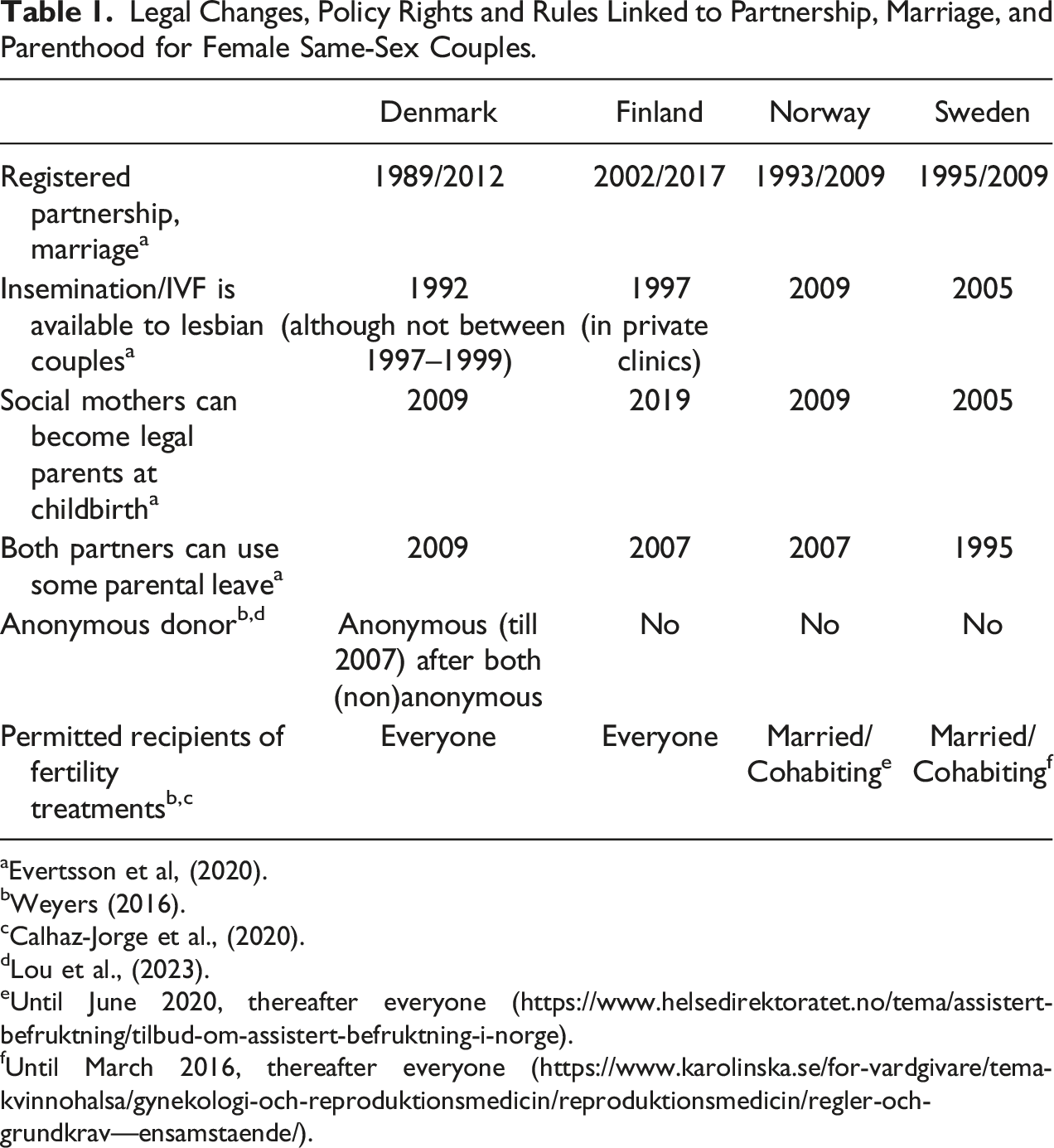
eUntil June 2020, thereafter everyone (https://www.helsedirektoratet.no/tema/assistert-befruktning/tilbud-om-assistert-befruktning-i-norge).
fUntil March 2016, thereafter everyone (https://www.karolinska.se/for-vardgivare/tema-kvinnohalsa/gynekologi-och-reproduktionsmedicin/reproduktionsmedicin/regler-och-grundkrav---ensamstaende/).
Data and Methods
For the empirical analysis, we use register data from Denmark (Statistics Denmark; DST), Finland (Statistics Finland), Norway (Statistics Norway; SSB), and Sweden (Statistics Sweden; SCB) from 1999 until 2016 in Sweden, 2017 in Norway and Denmark, and 2020 in Finland. The data include annual information on labor earnings, social transfers, income from self-employment, civil/union status, links between parents and their biological/adoptive children, level of education, and birth year and month, for the whole population.
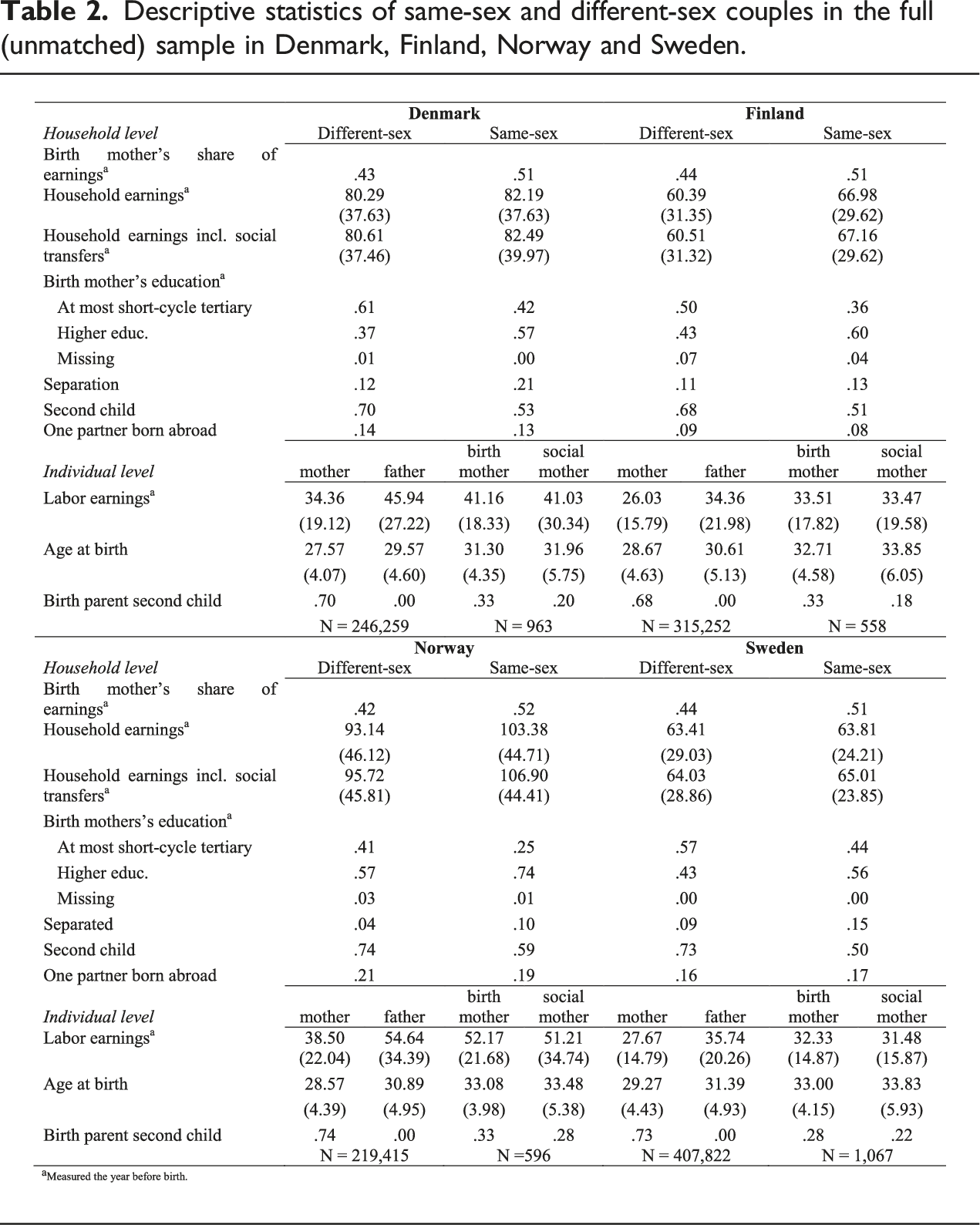
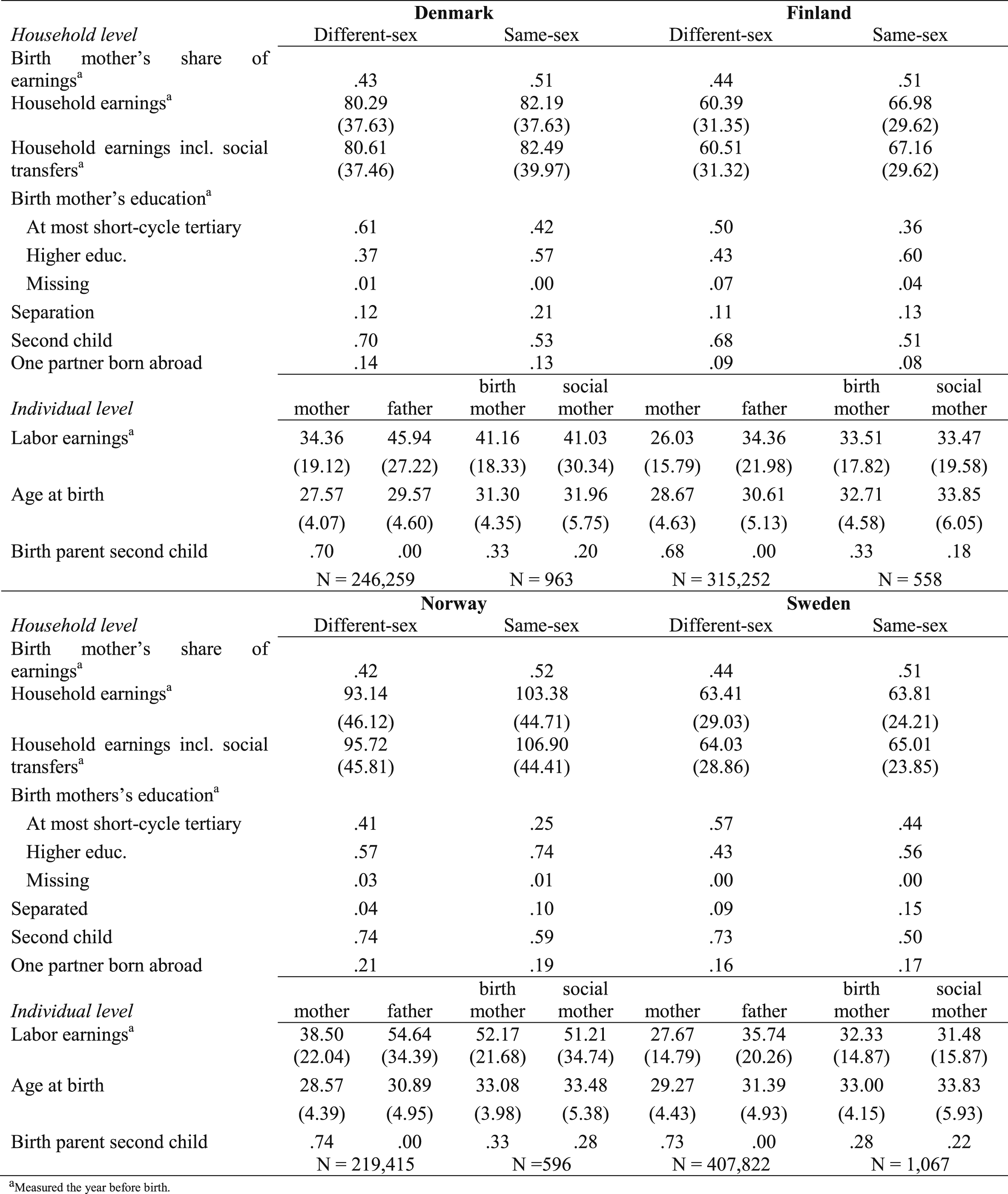
Descriptive statistics of same-sex and different-sex couples in the full (unmatched) sample in Denmark, Finland, Norway and Sweden.
Matching
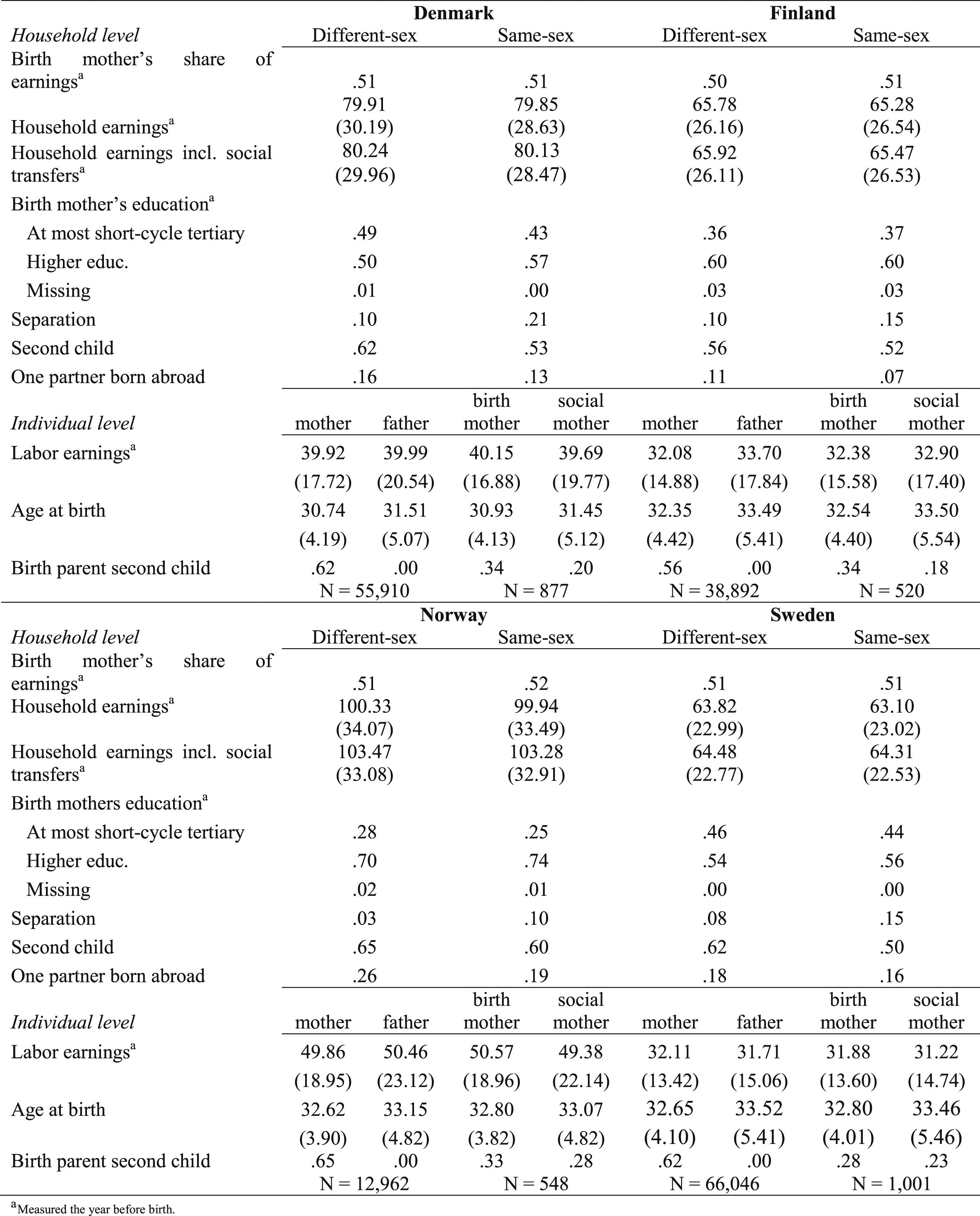
Becoming a parent entails different processes for same-sex and different-sex couples. While pregnancy can be a spontaneous event in different-sex couples, female same-sex couples need the assistance of a donor and/or a fertility clinic to become pregnant. In addition, mothers in same-sex couples are on average older, have higher income, and higher educational levels than mothers in different-sex couples (see Table 2). To find samples of same-sex and different-sex couples that are as similar, and thus as comparable, as possible, we use Coarsened Exact Matching (CEM; Blackwell et al., 2009) and match couples on the child’s birth year, partners’ ages, and both partners’ labor earnings before parenthood. We choose exact matching over other matching methods such as propensity score matching because research has shown that CEM models achieve better balance and have a lower root mean square error (Blackwell et al., 2009; Iacus et al., 2012). If the unobserved characteristics of the couples are correlated with the matching variables, same-sex and different-sex couples will also be balanced on these characteristics (Iacus et al., 2012).
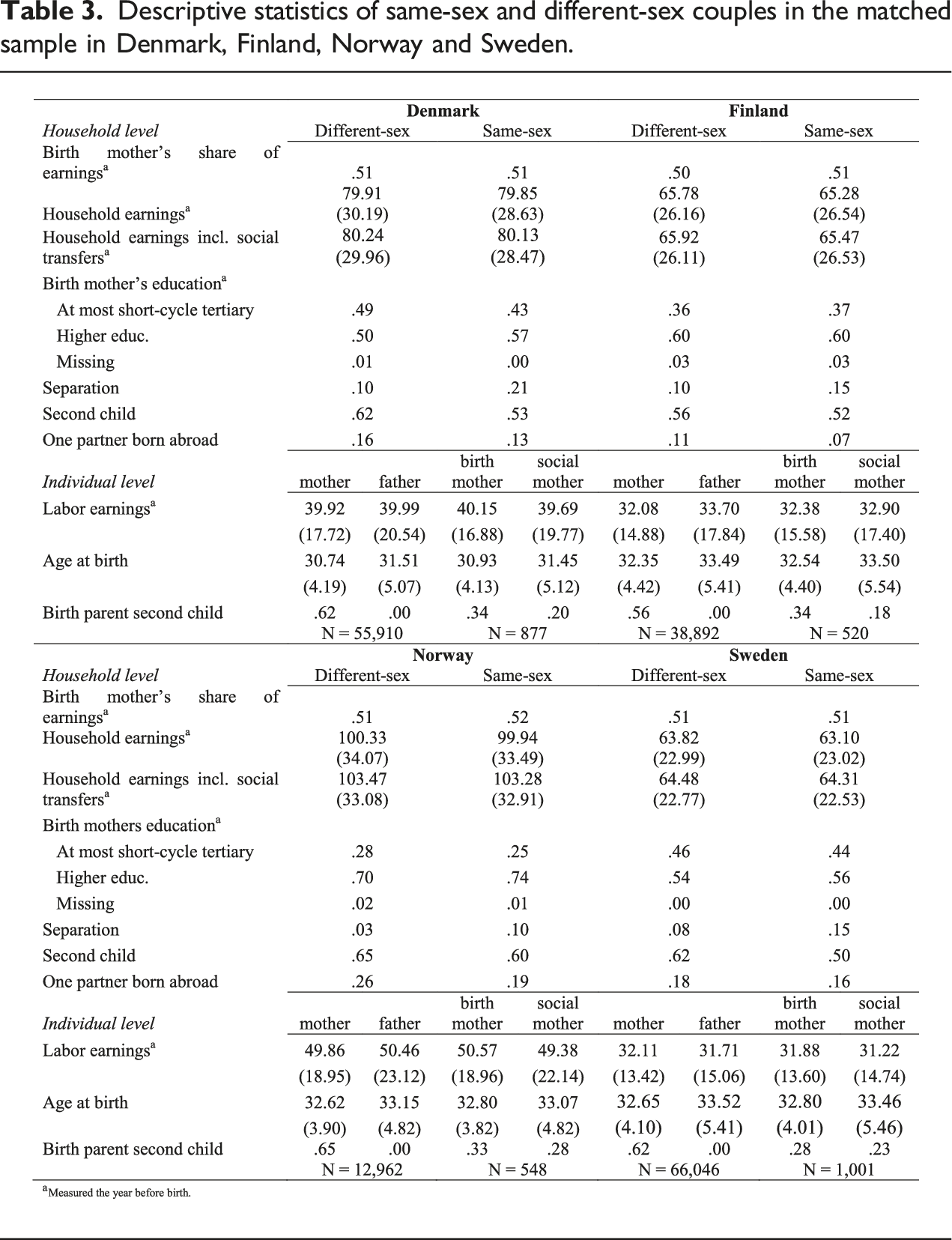
Descriptive statistics of same-sex and different-sex couples in the matched sample in Denmark, Finland, Norway and Sweden.
Variables in the Analyses
The main dependent variable is annual household earnings, which include all pre-tax wages and income from self-employment of both partners (top-coded at 1 million Euros). Household earnings including social transfers add work-related social transfers tied to parenthood such as maternal, paternal, and parental leave benefits, temporary parental leave (Sweden), and cash-for-care benefits (Norway and Finland). We also include sick leave benefits for both partners as sick leave often increases for mothers both during and in the years following pregnancies (Angelov et al., 2020). All earnings are included before taxes, inflation-adjusted (to 2014 levels), and converted to euros at the 2014 currency rate (from Swedish krona at 0,11 SEK/EUR, Norwegian krona at 0,12 NOK/EUR, and Danish krona at 0,13 DKK/EUR). Negative earnings are recoded as zero.
Couple type is defined as different-sex couples (reference category 0) and female same-sex couples (1). We control for the birth mother’s age and age difference within the couple to take into account differences between same-sex and different-sex couples in terms of their wage growth as well as differences in resources attributed to age. To control for differences in household earnings due to couples’ education levels, we control for the birth mother’s education level, consisting of three categories: Higher education (bachelor’s or equivalent level, master’s, or equivalent level, doctoral or equivalent level), at most short-cycle tertiary (the reference category), and missing. Event time is a set of dummies indicating the number of years, from three years before (−3) to 5 years after (5) the birth of the first child (reference year is the year before birth: −1). To control for time trends and business cycles during the observation period, we include the calendar year in dummy variables (reference category 2014). Lastly, to capture differences in earnings trajectories between people with an immigrant background, for example, due to different normative ideas on how to allocate work and care after parenthood, we control for whether one of the partners in a couple is born abroad (1) or in, respectively, Denmark, Finland, Norway, and Sweden (0).
Analytical Strategy
To estimate changes in household earnings between same-sex and different-sex couples after parenthood, we use an event study approach (Andresen & Nix, 2022; Kleven et al., 2019; Musick et al., 2020). Using this approach, we estimate the changes in annual household earnings in each year following the couple’s entry into parenthood (the “event”), relative to the year before they became parents. This means that the impact of parenthood is estimated as the change in household earnings compared to the level in the year before the child’s birth, for each age of the child in years (i.e., each “event time” period). Each event time dummy is interacted with couple type to capture how household earnings change differently when having children in a different-sex or same-sex couple. Hence, we arrive at the following specification
Following previous studies (e.g., Andresen & Nix, 2022; Kleven et al., 2019), we subsequently make the results more intuitive by computing the percentage change in household earnings (i.e., earnings penalty) for each time period after entering parenthood relative to the predicted outcome in the absence of children. We do this by rescaling the
The models are estimated separately for each country. We first show the impact of parenthood for all couples who had their first child together and fulfill the sample restrictions described earlier. Second, we use the matched samples and perform the estimations again on couples who have been deemed as the most comparable same-sex and different-sex couples. 3
Our estimation models do not include couple fixed effects. We instead take selectivity into couple type into account as much as possible via matching. One advantage of our models over fixed effects is that we take the typical upward trend in earnings over age and societal trends into account by controlling for the birth mother’s age and calendar year and scaling the household earnings effects of childbirth by these trends.
Results
Table 2 shows the descriptive statistics for the unmatched sample. Same-sex couples have a more equal share of earnings than different-sex couples the year before birth, and overall household earnings (excluding and including benefits) of same-sex couples are higher than for different-sex couples. Moreover, same-sex couples are older when they have their first child, have a smaller age difference, and are more highly educated than different-sex couples in all four countries. As earlier indicated, Table 3 shows that, after matching, differences in birth mothers’ share of earnings, total household income (including or excluding benefits), or age at birth more or less disappear.
Relative Earning Trajectories
To see whether differences in specialization between female same-sex and different-sex couples lead to differences in household earnings following the transition to parenthood, we replicate previous findings focusing on the financial consequences of parenthood for same-sex and different-sex couples. Figure 1 shows the birth mother’s share of labor market earnings in same-sex and different-sex couples from 3 years before until 5 years after the child is born, showing that different-sex couples indeed specialize more than same-sex couples after entering parenthood.
4
These specialization patterns are in line with previous studies that show that social mothers experience more of a penalty than fathers, and birth mothers in female couples experience slightly less of a penalty than birth mothers in different-sex couples, that is, female same-sex couples’ earnings penalty falls in between that of fathers and mothers in different-sex couples (Andresen & Nix, 2022; Machado & Jaspers, 2023; Moberg, 2016). Note that although a minor part of the within-couple earnings differences presented in Figure 1 can be due to changes in how mothers and/or fathers are rewarded, the majority of the within-couple earnings gap is due to differences in parental leave use and work-hour reductions. In other words, they are due to differences in behavior between women and men, and between birth mothers and non-birth mothers, behaviors that are likely to have been negotiated and agreed upon within the couple. Birth mother’s share of labor market earnings of same-sex and different-sex couples in the period from 3 years before to 5 years after the birth of the first child.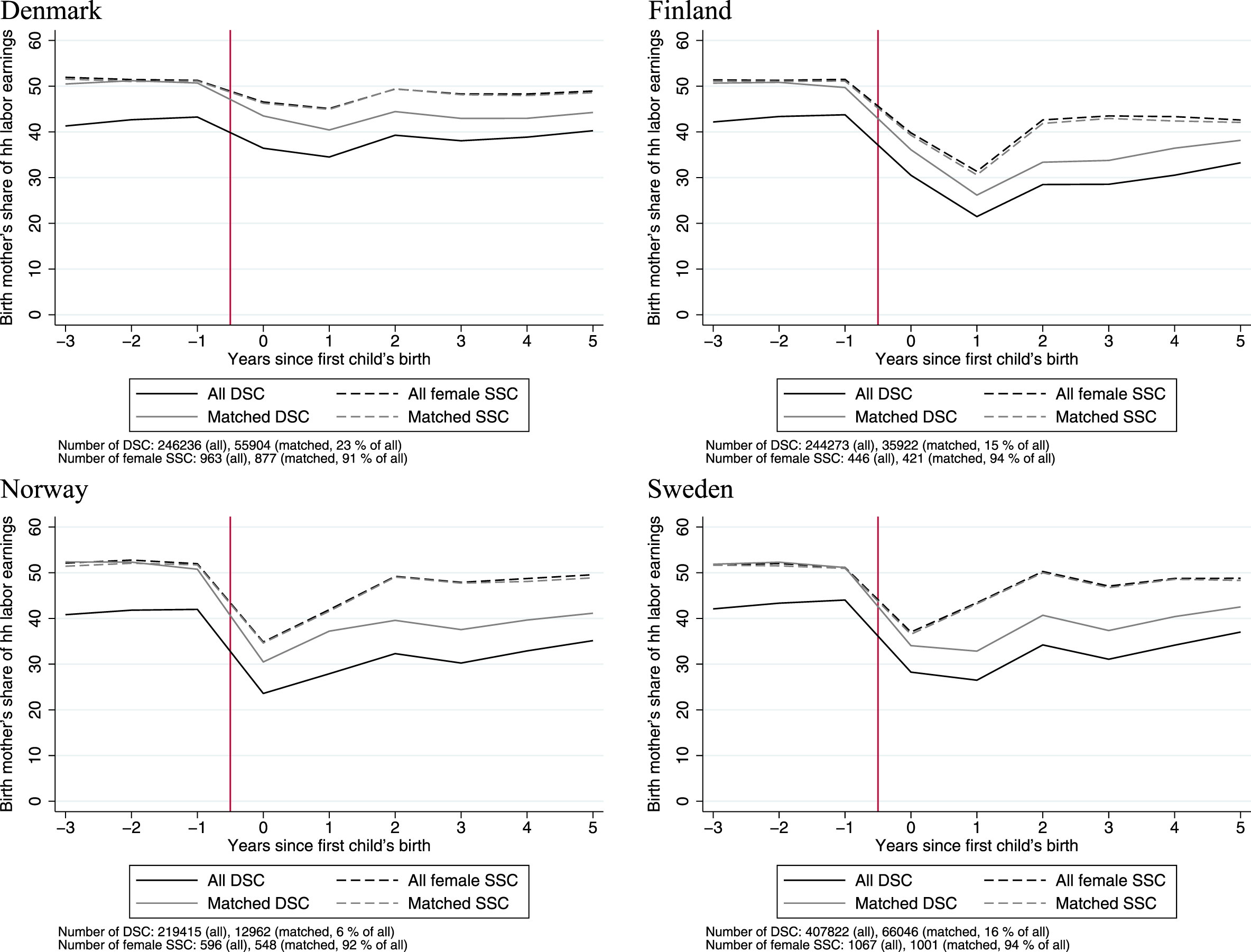
In all four countries, birth mothers’ share of earnings decreases after childbirth for different-sex couples (solid black line) as well as for same-sex couples (dotted dark gray line). However, in congruence with previous literature, the share of earnings is more skewed to the disadvantage of the birth mother in different-sex than in same-sex couples throughout the period. Same-sex couples have a more similar earnings contribution (≈.50) before birth as well as from two years after childbirth and onwards (compare dotted and solid black line) in all countries but Finland. For different-sex couples, the earnings gap is larger, and mothers contribute between 32% and 40% of the household earnings 5 years after the first child’s birth (see black line). Even when making couples as similar as possible by matching them, the within-couple earnings gap is larger for different-sex couples than for same-sex couples (compare the dotted light gray and solid light gray lines). Finland is the only country with a within-couple gap in earnings for same-sex couples (birth mothers on average earn around 44% of non-birth mothers in Finland 5 years after birth, compared to close to 50% in the other countries: compare dotted gray lines across countries). One explanation could be that the Finnish home-care allowance (cash-for-care) contributes to birth mothers investing more wholeheartedly in home production in Finland, not only in different-sex couples (e.g., Kosonen, 2014) but also to some extent in same-sex couples.
Overall, given the larger within-couple earnings gap in different-sex couples, the patterns reflect that mothers in different-sex couples take longer leaves and work fewer hours than the fathers after having children. When it comes to same-sex couples, this pattern is much more temporary and only discernable during the first two years after the birth of the first child. In sum, different-sex couples specialize more after entering parenthood than same-sex couples do.
With the presented differences in within-couple relative earnings in mind, we turn to a description of the total household earnings in the two groups of parents. Figure 2 shows total household earnings development for all couples in our (non-matched) sample. This allows us to descriptively evaluate whether differences in specialization between female same-sex and different-sex couples lead to differences in household earnings following the transition to parenthood. Figure 2 shows that same-sex couples have slightly higher household earnings than different-sex couples before childbirth in all countries but Sweden, where differences in household income between the two couple types are nihil. Moreover, there is a reduction in household earnings right after childbirth for both same-sex and different-sex couples in all countries, which is likely due to (mainly birth mothers’) use of parental leave (c.f. Evertsson & Boye, 2018). Nevertheless, the household earnings development after childbirth is very similar for both couple types. Only in Norway, same-sex couples have slightly higher household earnings throughout the period with the exception of the second year after childbirth. Household labor earnings trajectories of same-sex and different-sex couples in the period from 3 years before to 5 years after the birth of the first child. All couples.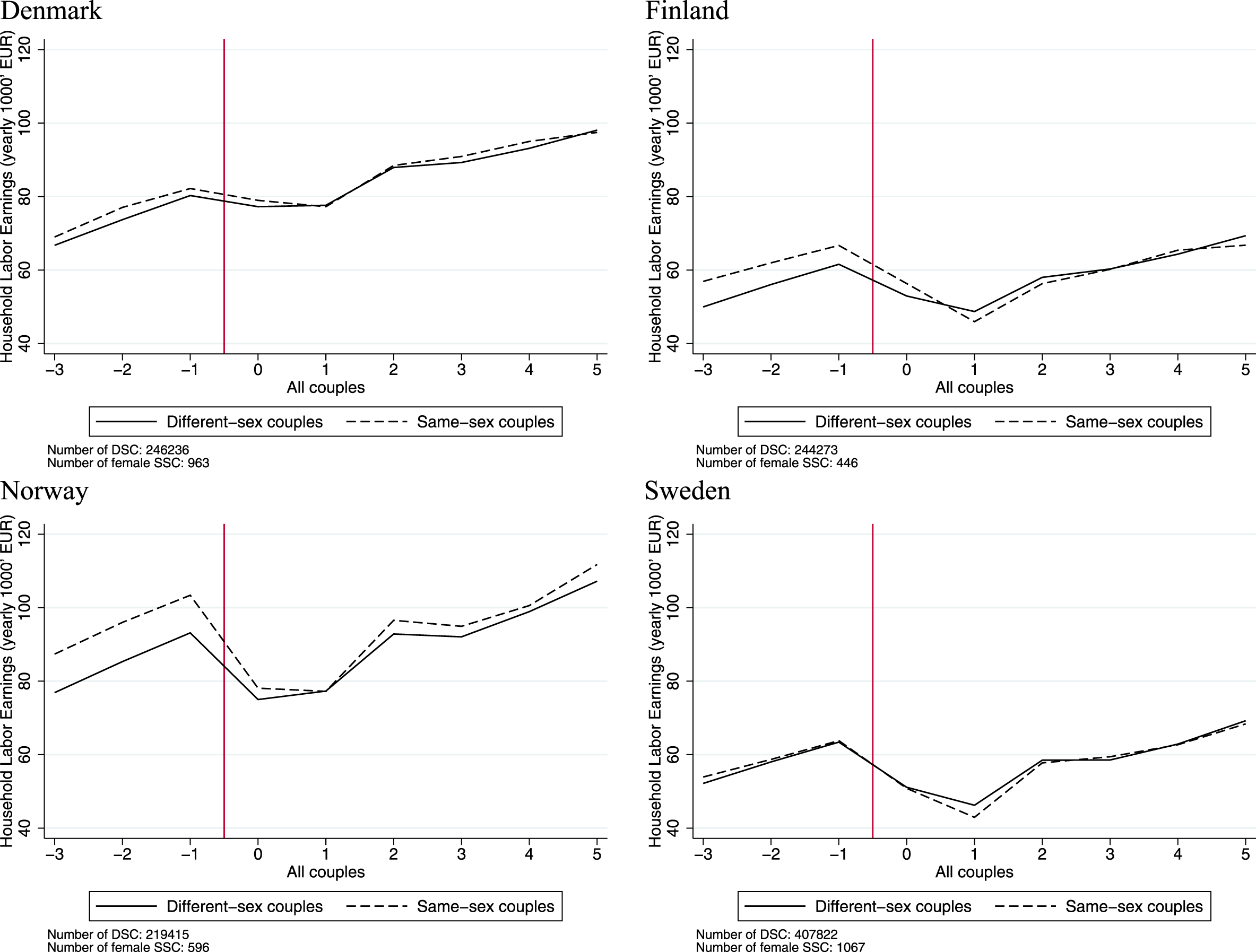
Figure 3 shows the development of total household earnings for the matched sample. Also, for couples who are as similar as possible on observable characteristics before birth, we see almost no differences in total household earnings after having children. Contrary to Figure 2 where same-sex couples had slightly higher household earnings before and after childbirth in Norway, Figure 3 shows that same-sex couples have slightly lower household earnings than similar different-sex couples, although the differences are small. Worth noting is that due to the matching, Figure 3 shows the household earnings for different-sex couples who are on average higher educated and higher earners compared to the complete population of different-sex couples (c.f. Figure 2). Thus far, our descriptive results indicate that differences in specialization between female same-sex couples (who divide work and care on average more equally) and different-sex couples (who divide work and care on average more unequally) lead to similar household earnings levels. Household labor earnings of same-sex and different-sex couples in the period from 3 years before to 5 years after the birth of the first child. Matched couples.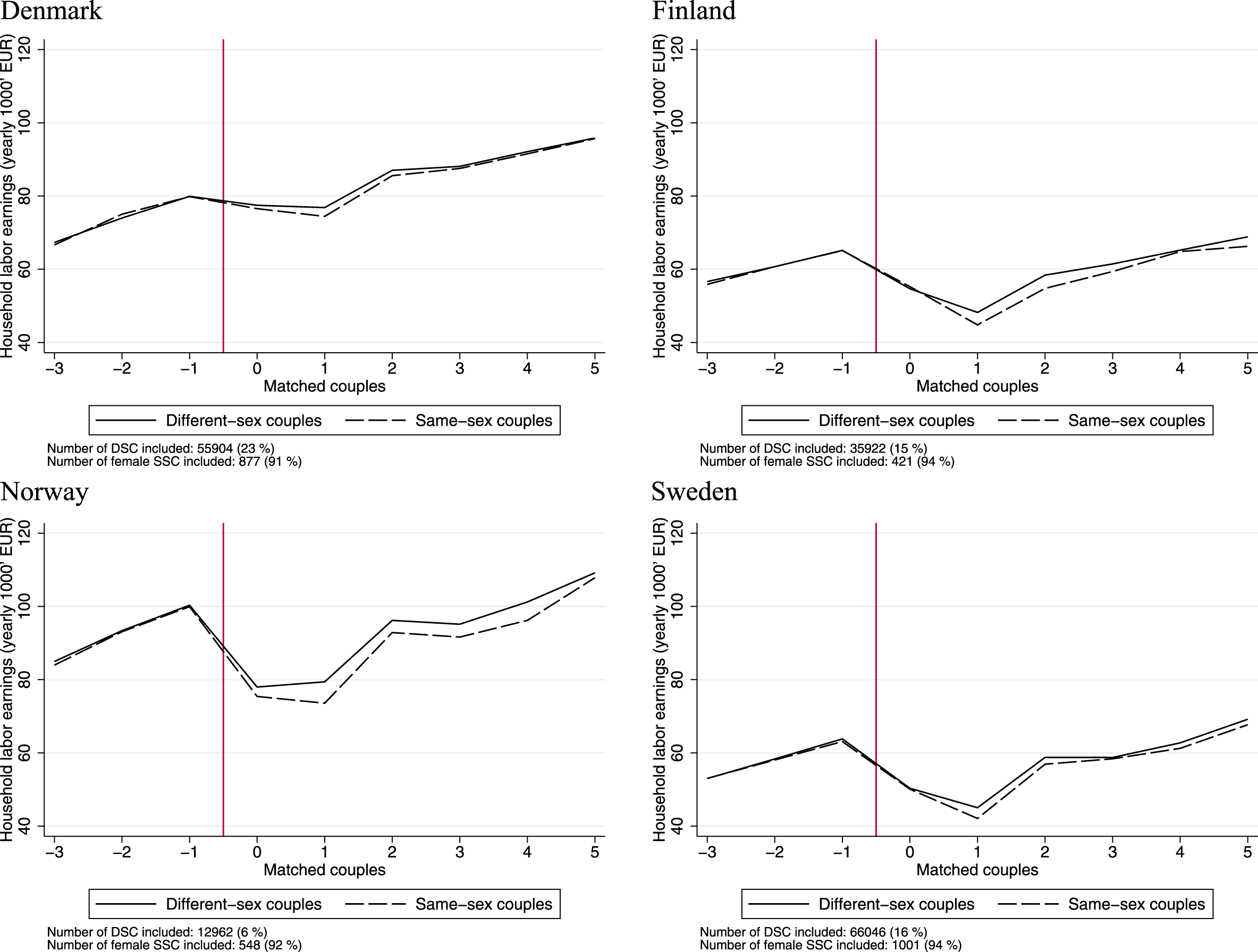
Figure 4 shows the results of the event study estimations on the matched sample. Even here, the percentage change in household earnings is highly similar between the couple types during the 5 years after entering parenthood (results are very similar in the long run for the unmatched sample, results available upon request). There are no significant differences in household income between female same-sex and different-sex couples with the exception of the year after birth for Norway, but also the differences are small. Hence, overall, differences in specialization between female same-sex and different-sex couples lead to no substantial differences in household earnings following the transition to parenthood, implying there is no great advantage of specializing or dividing your tasks more equally when it comes to maximizing household earnings after parenthood. Note that towards the end of the period, the confidence intervals increase in size for female same-sex couples due to the reduction in the number of couples that can be followed during the full 5-year period. As a consequence, potential differences between female same-sex and different-sex couples can be harder to detect. Household labor earnings trajectories of same-sex and different-sex couples in the period from 3 years before to 5 years after the birth of the first child estimation graphs, matched sample (with 95% confidence intervals). Note: The graph displays the average percentage point change in household earnings for each couple type in each year after the child is born compared to the predicted household earnings in the same calendar year and at the same age but in the absence of children.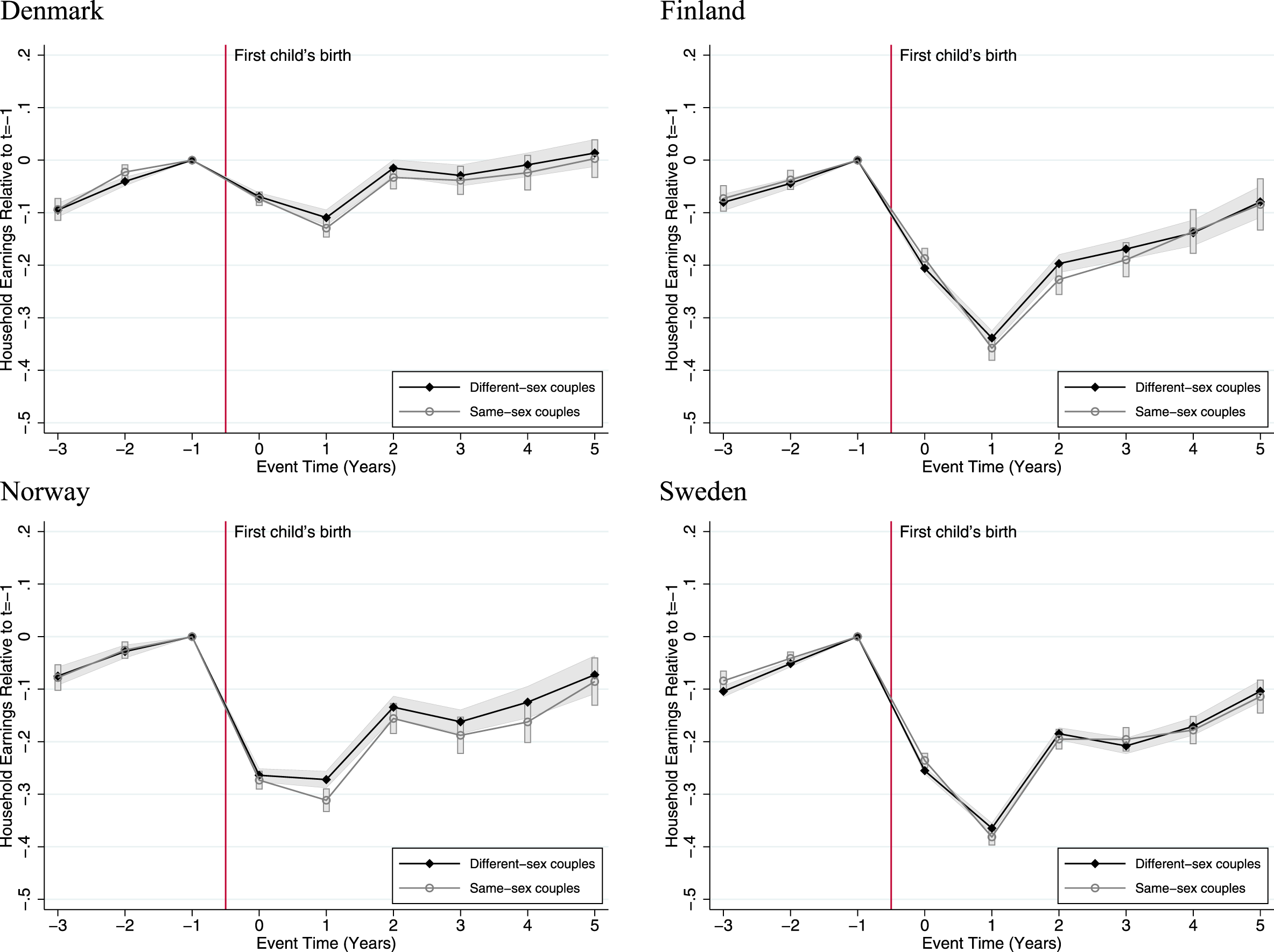
As a sensitivity check, event study results for the total household income including social transfers are presented for the matched sample in Figure 5. Comparing Figures 5 to 4, we see that the drop in household earnings is mitigated by social transfers in all countries. There are, however, no differences in changes in household income including social transfers between different-sex and same-sex couples. Overall, this suggests that family benefits function as a buffer for a reduction in household income after having children, for both couple types. Still, we find no evidence that differences in the degree of specialization between couple types matter for overall reductions in household earnings, even when including benefits. Household labor income including social transfers of same-sex and different-sex couples in the period from 3 years before to 5 years after the birth of the first child Estimation graphs, matched sample (with 95% confidence intervals). Note: The graph displays the average percentage point change in household earnings for each couple type in each year after the child is born compared to the predicted household earnings in the same calendar year and at the same age but in the absence of children.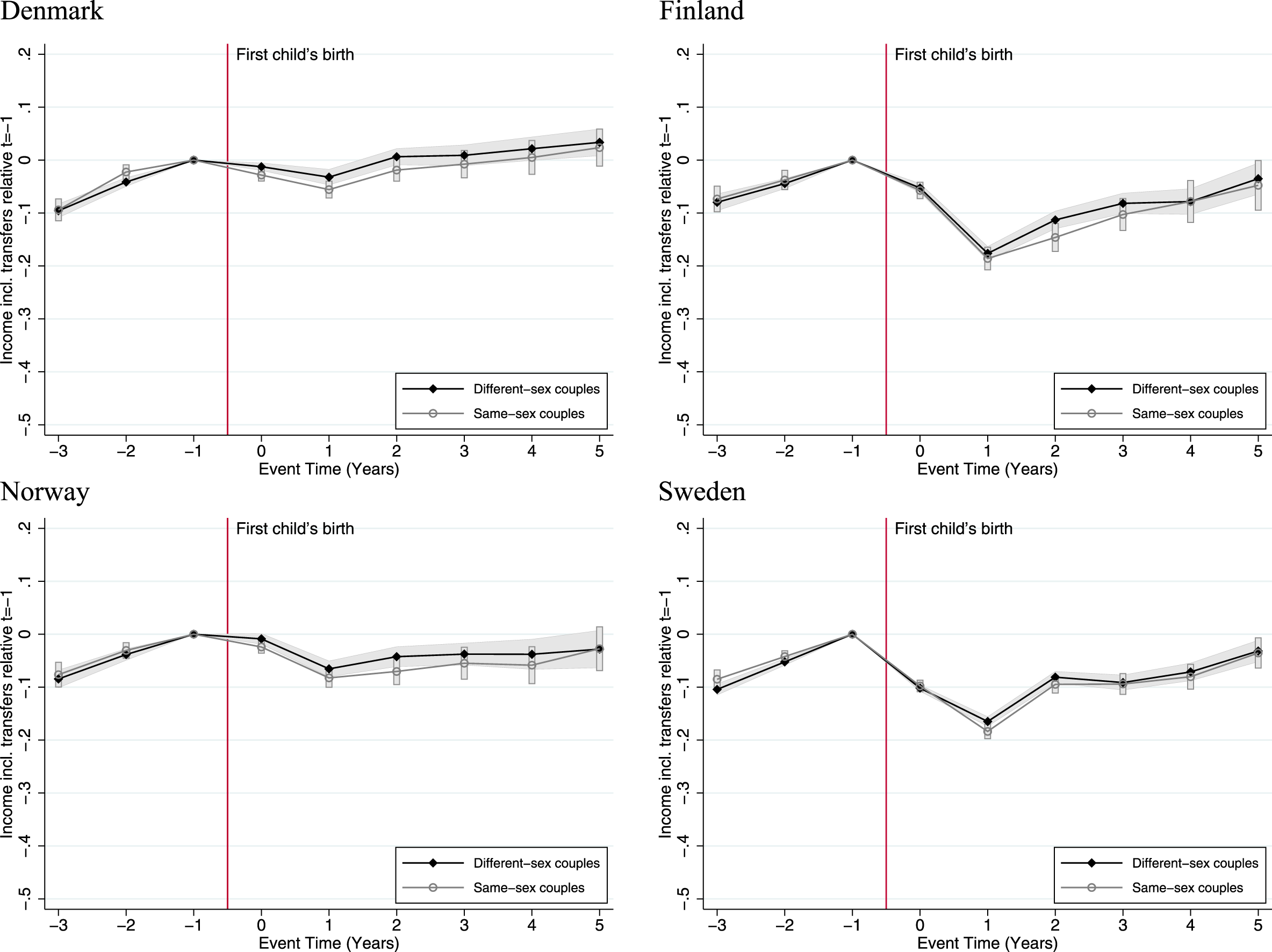
Conclusion and Discussion
In the Nordic countries, stimulating an equal division of work and care has been high on the political agenda (European Commission, 2020). Although a more equal division of work and care between partners may be ideal from a political and individual perspective, is it also more beneficial when we look at the household level? By comparing female same-sex couples, who divide their tasks more equally, to different-sex couples, who have a more unequal task division after their transition to parenthood, this paper sheds light on whether specialization or a more equal division of work and care is more advantageous for the overall household income after childbirth. Using longitudinal register data from Denmark, Finland, Norway, and Sweden, we analyze household earnings of 3,184 female same-sex couples and 1,188,748 different-sex couples as they transition into parenthood. We are the first to longitudinally examine household earning trajectories of the growing but rarely studied group of female same-sex couples with children.
First, we examined the economic consequences of a more equal division of work (like work hours: Jaspers & Verbakel, 2013) and care (i.e., parental leave: Evertsson & Boye, 2018) for same-sex couples compared to different-sex couples. Replicating previous single-country studies (Andresen & Nix, 2022; Machado & Jaspers, 2023; Moberg, 2016), our results showed that within-couple earnings gaps are larger for different-sex couples than for same-sex couples in all four countries. Second, our analyses showed that parenthood does not generate any meaningful differences in household earnings trajectories between same-sex and different-sex couples, showing no clear advantage of specializing or having a more equal division of labor for household earnings in any of the four countries. This is despite the differences in policies and regulations between countries, enhancing the validity of our overall conclusions. Lastly, because households may consider social transfers (e.g., parental leave benefits, sick leave benefits, and cash-for-care) in their calculations when deciding on the preferred way of dividing paid work and care, we also studied how parenthood affects household income including social transfers. For both same-sex and different-sex couples, social transfers partly compensate for the loss of earnings after parenthood, as expected. However, also when we include social transfers, there seem to be no substantial differences between female same-sex and different-sex couples. This implies that there are no clear benefits with specialization or having a more equal division of work for the household income, even when we take the generous social transfers of the Nordic countries into account.
Does this now mean that we should abandon the quest for more within-couple (gender) equality in work and family life and invest less in social policies that aim to stimulate an equal sharing of paid work and care? Probably not, as in the long run, a more equal division of work and care can be more advantageous at the individual level, especially if the relationship dissolves. Having a firm link to the labor market ensures a stable and reliable income, something that also reduces within-couple financial vulnerability in periods of unemployment and recession (cf. Garcia & Tomlinson, 2021). Our results, however, do imply that there are different ways for households to operate if the goal is to maximize household income. In other words, we find no support for Becker’s claim that household specialization is the most optimal way to achieve this. At the same time, households also do not particularly benefit from a more equal division of work and care in terms of income, even though individuals may, especially the lower income partner.
Although our study has advantages, it also includes limitations. We follow couples 5 years after parenthood and although our samples of same-sex couples with children are large compared to previous studies, the samples are not very large in statistical terms, especially in the later years after parenthood. We are therefore less likely to detect any significant differences between female same-sex and different-sex couples towards the end of the 5-year period after becoming parents. Previous research has shown that specialization patterns differ depending on income or education levels. For example, women with high income often take a shorter parental leave and, in these families, men use a longer leave (Hobson et al., 2006; Ma et al., 2020). The same-sex couples observed have on average higher earnings and/or have a higher level of education, and a more (un)equal task division could have different consequences for lower educated/lower income families. Still, it is worth noting that household income trajectories of same-sex couples did not differ much from the entire (non-matched) population of first-time parents in a different-sex relationship 5 years after birth (Figure 2), even though the latter group specializes more (Figure 1). Whereas within the matched sample there is a higher internal validity (i.e., different-sex and same-sex couples are more comparable), the unmatched sample has a higher external validity (i.e., representative of the entire population of first-time parents in both couple types). The fact that we do not find any large differences between female same-sex and different-sex couples in household income especially in the long run in none of the samples strengthens our conclusion that neither specializing nor a more equal division of labor after parenthood is financially more beneficial for families. Still, we encourage research to explore potential differences in household earnings for households with diverse socio-economic and educational backgrounds.
Worth noting is that our study assumes that couples decide on their division of work and care with the aim to optimize household income. There can, however, be many other reasons why couples divide their tasks the way they do. For example, couples may find utility in acting according to gender norms. Butler argues that individuals become comprehensible and able to lead a livable life when they subject themselves to discursive rules and requirements (e.g., Butler, 2004). Acting against (gendered) expectations may lead to criticism and discontent from others, not least when it comes to parents. The motherhood role is among the most cherished, yet also among the most guarded and normatively circumscribed roles a person can engage in. This makes the potential utility of complying with norms and expectations considerable, not least for different-sex couples. Hence, although our research only focuses on part of the story, it is still an important part as income is argued to be central when it comes to how couples decide on work/care divisions after becoming parents.
Footnotes
Acknowledgments
We would like to thank the participants at the European Consortium for Sociological Research conference (2022) as well as the participants in the workshop “quantitative and qualitative research on life-changing transitions in the LGBTQ + community,” for valuable comments and suggestions. We are also immensely grateful to the members of the GENPARENT group as well as the social policy research group at SOFI, Stockholm University, for providing us with their comments and suggestions, especially Eva Jaspers, Sebasian Sirén and Cassandra Engeman.
Declaration of Conflicting Interests
The author(s) declared no potential conflicts of interest with respect to the research, authorship, and/or publication of this article.
Funding
The author(s) disclosed receipt of the following financial support for the research, authorship, and/or publication of this article: This research has received funding from the European Research Council (ERC) under the European Union’s Horizon 2020 research and innovation program awarded to Marie Evertsson (grant agreement No. 771770) as well as Riksbankens Jubileumsfond awarded to Maaike van der Vleuten (Grant number P21-0166).
