




Abstract
While Zoom classes may work at the college level, they don’t work for all students. For PreK-12 students, educators quickly realized a dramatic and disruptive digital divide among families and students in economically-stressed urban and rural communities across the country. At the start of the 20-21 school year, with COVID-19 continuing, it is imperative to resolve the technology challenge to connect with all families and help all students keep learning.

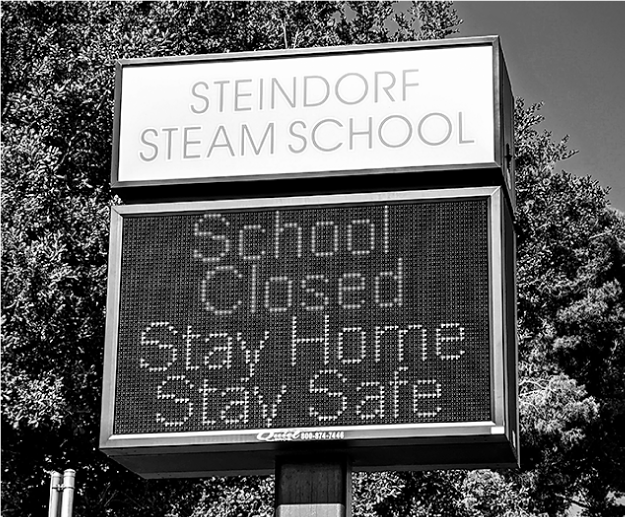
School doors were closed in March 2020, but “school” and learning were open. The geography of school expanded across neighborhoods into students’ homes and onto kitchen tables. The swift change in policy to children learning at home required new teaching strategies and new patterns of communication by educators, parents, and students. Initially, some interpreted the demand for remote learning only in terms of hightech options, such as online or Zoom classes. While an online learning environment may work at the college level, for PreK-12 students, educators quickly realized that there was a dramatic and disruptive digital divide among families and students in economically-stressed urban and rural communities across the country. Data revealed that millions of students did not have working computers or adequate Internet access at home, and could not participate in online learning. At the start of the 2020-2021 school year, with COVID-19 continuing, it is imperative to resolve the technology challenge to connect with all families and to help all students keep learning.
Research on Summer Learning
Research on students’ summer learning informs us about inequities that occur when students are learning from home. Early studies by Heyns and recent work by Alexander, Entwisle, Cooper, and others indicate that students make an average of one year of progress over one school year, regardless of their starting skill levels. However, during the summer, students from families with low incomes tend to lose an average of two months of reading or literacy skills. They require remedial work at the start of the new school year, which delays their progress in learning at each grade level. By contrast, students from economically-advantaged families tend to maintain or gain skills during the summer by reading books and conducting other literacy-linked activities. Further, as Kim reported, students who continue learning during the summer also gain confidence, and increase motivation to learn, regardless of family income or ability levels.
Focus on Equity with Different Technologies
The COVID-19 closures revealed that rule number one is for educators to know their families’ available technologies and their students’ strengths and needs to develop and disseminate feasible and useful lessons, projects, and activities for learning at home.
Read books—fiction, biographies, jokes, poems, sports, etc.
Create comics and graphic novels and stories.
Write fables, tales, poems, and raps.
Draw and sketch people, places, and things in an art portfolio.
Conduct oral histories and interviews with parents, family, and friends on topics of interest.
Take photos and add captions for thematic albums
Critique TV shows, movies, and other experiences
Compile a favorite foods recipe book
Needed Communications
The first stage of COVID-19 in spring 2020 revealed four basic steps that teachers must take to ensure student success in learning from home, with whichever technologies are available.
Travis Wise via Flickr
Policy Implications
COVID-19 closures showed that education policy leaders must fulfill two major requirements for all students to succeed in learning from home.
Recognize educators’ responsibilities. Teachers and district leaders must take the lead in producing and disseminating learning activities for their own students. Every family has many skills and talents to share with their children. However, it is not up to every parent in America to figure out how to develop activities to ensure that their children keep learning important school skills at each grade level. Surveys of parents in the U. S. and in Scotland during COVID-19 closures confirm that they are not “home-schooling” in the traditional sense of that term, nor do they say they are “teachers.” They report confidence about guiding their child’s physical health and emotional well-being, but not teaching math and reading skills. Parents report that they want clear and timely communications from and with teachers whether school doors are open or closed.
Reflection
Just about every district has an official policy stating, “Education is a shared responsibility of home, school, and community.” Last spring, when schools closed precipitously, this policy statement came to life. Everyone learned that teachers, parents, and students in nearly 100,000 schools across the country were, in fact, the most essential workers in the COVID-19 crisis.
In the National Network of Partnership Schools (NNPS) at Johns Hopkins University, Epstein and her colleagues guide over 500 schools, districts, organizations, and state offices to strengthen programs of family and community engagement as a component of school organization. See how they are implementing routine and creative activities during the COVID-19 crisis to fulfill their responsibilities in the e-book of Promising Partnership Practices 2020 on the NNPS website.
Now, in the 20-21 school year, some schools opened with face-to-face classes. Others continued distance learning for students with and without adequate technology. Still others arranged a hybrid schedule with combined modalities. This variation provides a valuable natural experiment for researchers to study the work of teachers, responses of families, and results for students in these school organizations.
These are tumultuous times. COVID-19 created unwanted opportunities to develop strategies and resources for student learning at home. These approaches will be useful in the future when schools are closed by major storms and summer vacations. Without question, the most important and wide-spread confirmation has come from attention to the shared responsibilities—the partnerships—of teachers and parents to ensure that all students keep learning.