




Abstract
Anthony James Williams on Wayward Lives, Beautiful Experiments: Intimate Histories of Social Upheaval by Saidiya Hartman.
Wayward Lives, Beautiful Experiments: Intimate Histories of Social Upheaval By Saidiya Hartman W. W. Norton & Company, 464 pp.
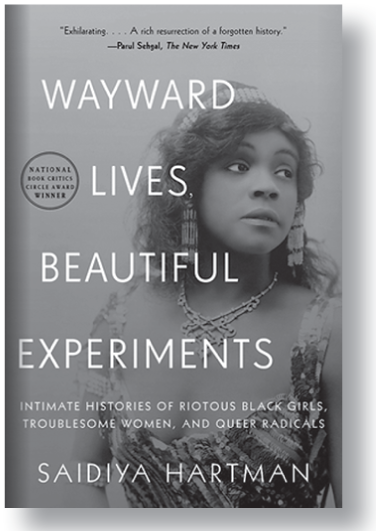
Sociologists—and social scientists more broadly—can learn a lot from Dr. Saidiya Hartman’s Wayward Lives, Beautiful Experiments: Intimate Histories of Social Upheaval. Sectioned into three books, Wayward Lives explores the interior life and resistance of everyday Black women and girls in U.S. northern cities post-Emancipation. Writing of subaltern populations, her work examines the creation of new forms of racialized enclosures (ghettos), Black mothers criminalized for merely trying to survive, and everyday Black people as minor figures ignored in portraits of Black America. Hartman uses close readings and speculative nonfiction to fill in the gaps and correct the violent wrongs created by archival materials like police reports and social reformer journals filled with harsh moral judgments.
Hartman’s takeaway is clear: everyday young Black women and girls at the turn of the 20th century were radical thinkers worthy of public recognition and scholarly attention. However, Hartman also forces sociologists to face how we conduct and present research. In fleshing out the stories of her cast of real-life characters, her work forces us to ask: how has sociology pathologized, spoken for, and spoken over poor Black people? How have our founding American sociologists furthered this idea of the Negro problem and the girl problem? And ultimately, might there be a fundamental mismatch between the study of Black social life and the disciplinary formation of sociology as we know it today?
Sociologists frequently question our impact outside of the academy, often ignoring how the government and other institutions have used our social science to further shape the lives of marginalized populations. Hartman’s chapter on W.E.B. Du Bois’ The Philadelphia Negro, a massive work commissioned by the University of Pennsylvania and completed in just one year, exemplifies the impact sociological work can have. Du Bois wrote The Philadelphia Negro during an era when free Black people were seen as a group of inferior humans expected to die off without the ‘help’ of their former masters. Contradicting common notions of Black extinction, The Philadelphia Negro indicted white supremacy and used mixed methodologies to prove that Black people were here to stay.
Unfortunately, Du Bois also wrote that Black folks were largely to blame for their own failings, prompting Hartman to refer to Du Bois as a cold statistician. Hartman writes that his “statistics and ratios were not bloodless and abstract, but antagonists in the tragic tale of black womanhood” (p. 96). In other words, these carefully collected numbers have historically been weaponized to make a negative difference in the lives of Black women then and now.
Yet, I see Wayward Lives’ critique of Du Bois’ varying oversights as a call to action for sociologists. Her work pushes us to consider how sociology might move from measuring intersectionality in quantitative terms, and instead toward more liberatory purposes through a variety of methodologies. How can a discipline be anecdotally perceived and often presenting as more inclusive of race, class, gender, and sexuality begin to reckon with a foundation that did not even see Black people as full human beings?
Much like acknowledging that European Americans massacred and displaced Indigenous peoples while colonizing the North American lands we inhabit does not decolonize the academy, acknowledging our discipline’s exclusionary roots alone does not let academics off the hook. Adding a few more scholars of color to our syllabi, recruiting and hiring more historically excluded populations, or citing Black women alone is also not enough. Abstaining from statistics or incorporating more minor figures will not fix structural problems within the discipline. Truthfully, I do not see the aforementioned problems within sociology ever disappearing: the discipline depends on them. What I can imagine, however, are additional courses of action to reduce the harm done by sociology and by the world at large.
We must broaden the “so what” we so often ask of our research questions. Given paywalls, minimal readers, scarce citations, little public interaction, academic jargon, and the sheer amount of capital invested into recreating academia, why do we do what we do? What are the unintended consequences? Who are our audiences? Are we actually reaching them? How do we measure our impact? How different would the world be if we did not conduct the research we decide amongst ourselves is most pressing? Finally, what if we allocated our time and resources in ways we rarely imagine? The beautiful experiments to which Hartman names in her title refer to how Black folks worked toward freedom under the weight of interlocking systems of oppression. However, what might beautiful experiments look like for sociologists and social science research?
Renaissance women like sociologist, poet, and Marvel comic book author Dr. Eve L. Ewing come to mind. Not in regard to prolific creative output, but instead the beautiful experiment of playing with medium. Similarly, Dr. Tressie McMillan Cottom, another Black woman sociologist and writer, experiments as well. From appearances on popular nighttime television shows to a collection of essays entitled Thick to a phenomenal Twitter presence, Dr. McMillan Cottom experiments. Neither of these scholars rejects the academy. They fulfill their academic duties while also engaging with non-academic publics on- and off-line. The so-what of their scholarship on education and their popular publications is clearly about documenting structural inequalities, attacking societal inequities, and establishing personal autonomy.
Sociologist Dr. Karida L. Brown took the traditional path of turning her dissertation into a book, but along the way, she also co-created a community archive. The Eastern Kentucky African American Migration Project Collection is a collection of oral histories and memorabilia from Black Kentucky coal miners, their children, and their great-grandchildren, exponentially increasing the accessibility and impact of her scholarship well beyond the academy. Historian Dr. Kelly Lytle Hernandez took her research on incarceration and policing further than a manuscript, expanding knowledge with a team of community members, undergraduate students, and graduate students on the Million Dollar Hoods project. Using descriptive statistics, the project exposes how rampant houselessness and the million-dollar price tags price tags of racist over-policing in poor and non-white neighborhoods deeply impact incarceration rates.
WaywardLives does not just chronicle existing experiments, but it also serves as a manual to chart new ways to experiment with existing paradigms that deem the subaltern as wayward. In considering how sociology might ethically study Black folks—as well as more racialized and marginalized groups of people—Hartman proves instructive again. We can ask ourselves, our colleagues, and our students a series of questions that serve as more than provocations. For example, how often are white researchers questioned for their desire to study communities to which they do not belong? How widely accepted is ‘me-search’ among Black, Indigenous, Asian, and Latinx researchers? Do we interrogate the way graduate school changes our class status when we decide whom we study? How seriously do we take the question of ‘broader impact’? How do we hold each other accountable for actually implementing reflexive practices? With regard to graduate student training, how often are oral history, archival methods, and historical methods taught as legitimate methodologies? The questions I pose are not just questions for racialized and marginalized people, but for everyone.
If sociology and individual sociologists are responsible for popularizing the welfare queen and the Moynihan-endorsed dysfunctional Black family among the public sociological imagination, how might we take responsibility and work against such tropes?
Wayward Lives continues the Black feminist project of asking us to question who we deem deviant, for whom we conduct our scholarship, and what unintended consequences our work may have. If sociology and individual sociologists are responsible for popularizing the welfare queen and the Moynihan-endorsed dysfunctional Black family among the public sociological imagination, how might we take responsibility and work against such tropes? Reading outside of our respective disciplinary and sub-disciplinary silos, truly engaging with our various publics in various mediums and locations, and normalizing intro-spection as a prerequisite for any and all research projects is a start. Considering how we serve those from whom we extract data is another approach. Making our work publicly available serves as yet another strategy. Finally, we must tap into the chorus in the form of community members, family members, co-authors, colleagues, mentors, mentees, and those we so often ignore. The major themes cannot exist without honoring the minor figure, and the minor figure alone will never capture the entirety of a particular marginalized population. In Hartman’s invocation of harm reduction, we must always ask ourselves a question once posed by Karida L. Brown: what do we owe to one another?