




Abstract
Amid a crisis that has limited access to basic needs for everyone, relatively little attention has focused on the experiences of people with disabilities (PWD). In this piece, the authors compare the experiences of people with disabilities with those without during the coronavirus pandemic to highlight how this marginalized status is reflected in their concerns and fears.
Flickr CC, Sam Felder
The spread of COVID-19 across the globe hit everybody hard, bringing to the forefront concerns for the lives of older adults, those living in elder care facilities, and those with existing medical conditions, groups for which the pandemic poses a particularly high risk. While mask mandates and public service announcements from celebrities and politicians are peppered with pleas for these vulnerable populations, others argue freedom and economic recovery are worth risking their lives. What is now a very public debate has been played out behind the scenes long before this current crisis. People with disabilities are used to having their worth questioned, their value and cost to society weighed, their risk calculated, all with relatively little voice themselves. What is it like to live with this increased risk during a pandemic? In this piece, we compare the experiences of people with disabilities (PWD) with those without during the Coronavirus pandemic.
Findings revealed distinct vulnerabilities to COVID-19 for PWD and those around them. We learned that in some ways their experiences mirror those of the wider society, but in others, PWD’s marginalized status was reflected in their concerns and fears during a societal crisis.
Social Worth in a Pandemic
People with disabilities are accustomed to living life through the paradox of invisibility and hypervisibility. Erving Goffman long ago laid out the discomfort “normals” feel when they are confronted with stigmatized individuals in interaction, leading to awkwardness for both sides. To avoid this, people at times will go out of their way to ignore people with disabilities, what Spencer Cahill and Robin Eggelston refer to as “nonperson treatment.” On the other hand, Cahill and Eggelston point out that some people will assume the paternalistic right to “help” those with impairments in ways they did not ask for or need. Many people with disabilities make use of assistance from others to carry out their daily activities. From a disability rights standpoint, however, the assistance should be directed by the impaired individuals themselves.
Polite interaction is one thing, but when people with disabilities enter healthcare contexts, issues of risk and worth come to the fore. The stakes can be life and death. Angela Frederick has shown how pregnant women or mothers with disabilities are subjected to the “medical stare.” While their own needs for accessible care remain invisible, they are seen as a risk to their (future) children simply by having a disability, with no clear medical risk evident. Moreover, their pregnancy itself can be seen as wrong because they could pass their disability on to their children—implying (or stating) that such a child should not be born. As Frederick points out, all of this occurs while relatively little effort is made to make the mothers’ own medical care accessible. Both David Sudnow and Stefan Timmermans have demonstrated how such estimations of worth can translate into the likelihood of death in health care settings. As the recent statement by Laura Mauldin and others in the American Sociological Association’s Footnotes newsletter highlights, these issues show how disability is a major axis of inequality that is highly salient during this pandemic.
The social worth of the vulnerable such as people with disabilities was raised through debates and protests regarding state lockdown policies. In addition to protesters displaying homemade signs about needing haircuts, trusting in Jesus, and governmental overreach, one person in Tennessee held a sign demanding, “Sacrifice the Weak I Reopen TN.” A California city commissioner spelled out the sentiment in even more detail in a Facebook post: “A herd gathers it [sic] ranks, it allows the sick, the old, the injured to meet its [sic] natural course in nature. [..] Then we have our other sectors such as our homeless and other people who just defile themselves by either choice or mental issues. This would run rampant through them and yes i am sorry but this would fix what is a significant burden on our Society [sic] and resources that can be used.” The post garnered comparisons to Nazi eugenicists and led to the commissioner’s removal. Nevertheless, the Lieutenant Governor of Texas, Dan Patrick, argued that many grandparents, including himself, would be (or should be) willing to sacrifice their lives to reopen the economy, adding, “So my message is let’s get back to work, let’s get back to living. Let’s be smart about it and those of us who are 70-plus, we’ll take care of ourselves.” After his National Economic Council Chairman Larry Kudlow stated that reopening the economy would entail “some difficult tradeoffs,” President Trump acknowledged that the death toll is “bad,” but nonetheless insisted that the country should reopen.
These discussions about the priority of protecting the vulnerable play out in the context of scarcity resulting from the social and economic upheavals of the pandemic. Hoarding and supply-chain issues surrounding food, toiletries, medications, and other basic necessities favor those with the resources and mobility to hunt them down. Even worse, when healthcare resources are stretched thin, official policies are referenced to determine who has priority to life-saving care. Unfortunately, as media producer and activist Alice Wong, who herself lives with disabilities and regularly uses a ventilator, put it, “The ethical frameworks for rationing often put people like me at the bottom of the list.” The U.S. Department of Health and Human Services Office of Civil Rights issued a bulletin alerting medical providers that rationing medical care based on disability is discriminatory and illegal. However, prominent medical scholars such as Ezekiel Emanuel and others have justified such rationing, and guidelines that do so remain in place in some healthcare organizations and state policies.
One step in addressing our current crisis is to document the experience of those impacted by it, especially when such experience is discounted or silenced.
Such considerations have historically been made without input from people with disabilities themselves. Too often, the need for assistance has been equated with childlike dependence on the paternalistic whims of service providers and politicians. As Sharon Barnartt and Richard Scotch have pointed out, the hard work of disability activists has led to changes, but as the pandemic has underlined, there is still work to be done in ensuring PWD are given voice in the decisions that impact their lives. One step in addressing our current crisis is to document the experience of those impacted by it, especially when such experience is discounted or silenced. This is what we did.
Surveying Americans During Lockdown
In early April, we surveyed a national sample of US adults about their experiences with COVID-19. Hosting the survey on the Qualtrics platform, we contracted with the online survey company Cint to reach 1,374 American adults. We set quotas for age, gender, education, and region to match U.S. Census figures. Cint’s panel has a double opt-in format: people have to sign up for inclusion in the panel and then verify their interest in participation, an approach that has been shown to result in few or no significant differences compared to traditional modes of sampling. To be sure, our study would have missed people in the most severe of circumstances, e.g., fighting COVID-19 on respirators in hospital beds, but those are the types of people unlikely to be represented in other types of survey projects as well.
Respondents’ personal experiences with COVID-19
At the start of our data collection, over 300,000 Americans had tested positive for COVID-19, and over eight thousand had died. We asked respondents whether they had various long-lasting conditions, and overall, just under 16 percent of respondents had one or more, matching figures from the U.S. Census Bureau’s Current Population Survey (our questions about disabilities are similar to the ones they use). We asked about the following communicative disabilities: blindness or severe vision impairment even with glasses or contact lenses; deafness or a severe hearing impairment even with a hearing aid; and serious difficulty having their speech understood. Such people make up somewhat less than six percent of the total sample. We also asked about serious difficulty walking or climbing stairs, dressing or bathing, and typing on a traditional computer keyboard. These we grouped together as physical disabilities; such people account for a bit over eight percent of the entire sample. We asked if respondents had serious difficulty concentrating, remembering, or making decisions (hereafter, cognitive impairments), a group that makes up five percent of the total sample. Finally, we asked if people experienced serious difficulty going outside the house alone, which three percent of the sample indicated. We then looked at whether there are differences between each of these groups compared to the rest of the sample when it comes to personal experiences with COVID-19, elevated worries since the outbreak, and the pandemic’s effects on home circumstances. Here is what we found.
Reported pandemic effects on home circumstances
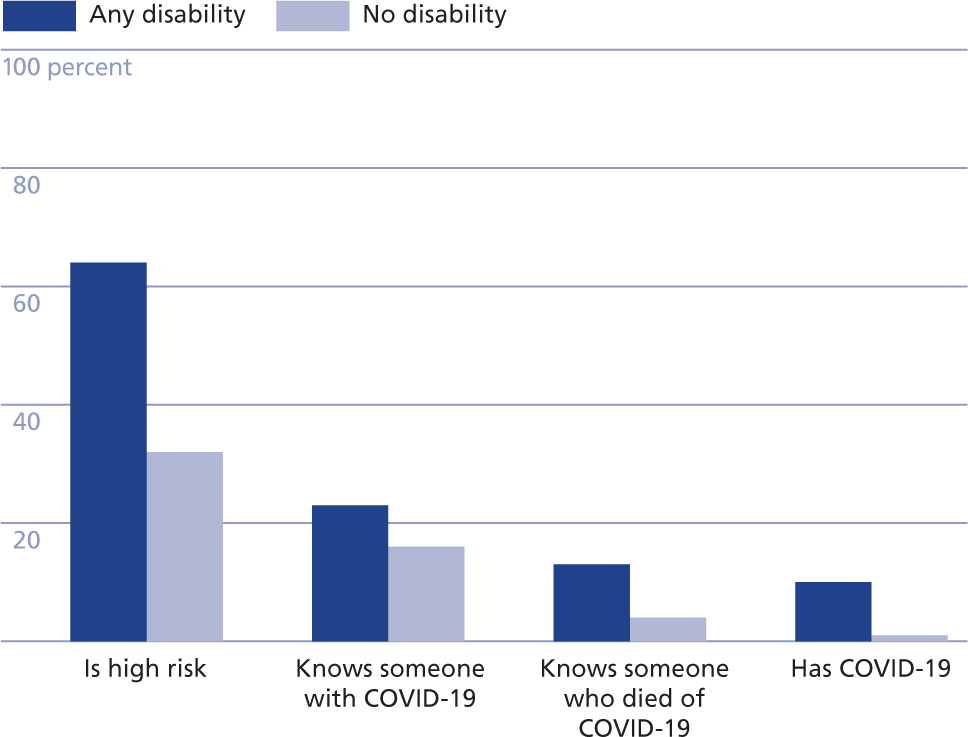
PWD reported COVID-19 as featuring much more prominently in their personal lives and social circles than people without disabilities (Respondents’ personal experiences with COVID-19). Among PWD, 64 percent reported health conditions that put them in the medically high-risk category for COVID-19 compared to under a third of those who have no disabilities. One in ten PWD in our sample reported having been diagnosed with COVID-19 compared to just one case among the 1160 participants without impairments. PWD were also much more likely to know others with the novel coronavirus: 23 percent of PWD said they knew someone. This compares to 14 percent of people without disabilities reporting they know someone with COVID-19. PWD were also much more likely to know people who have died from the disease: 13 percent with any disability reported this compared to four percent of others. It is clear from these statistics that PWD had very different personal experiences with the pandemic. Next, we turn to how these were reflected in their home situations.
Home Circumstances
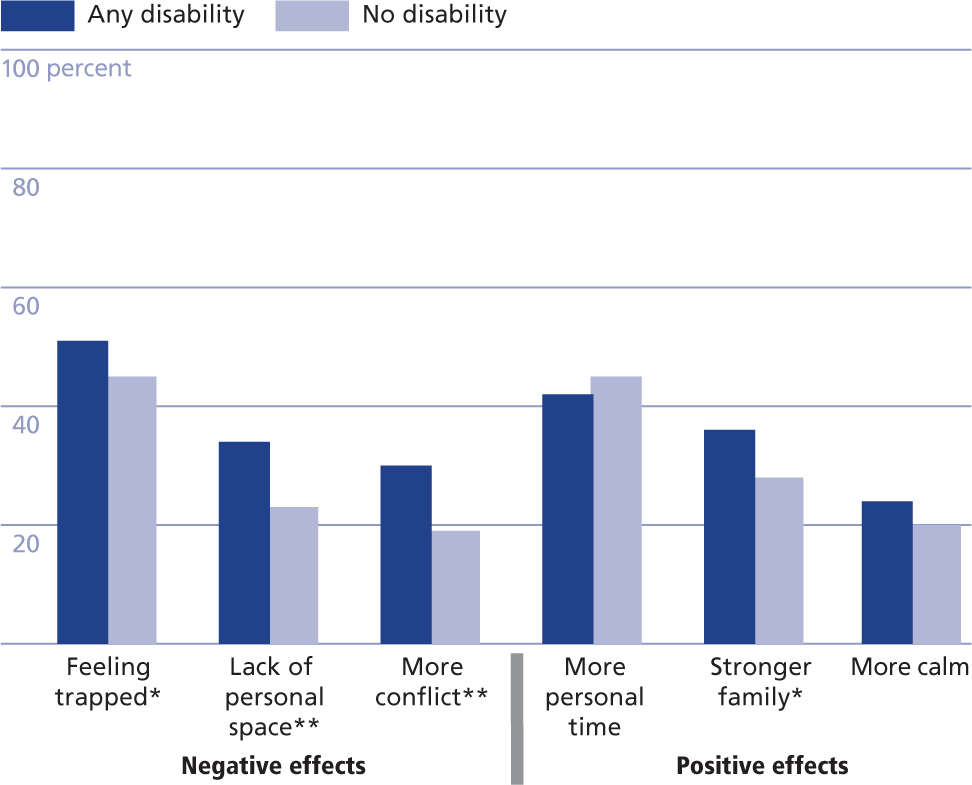
We asked respondents: “How does the current Coronavirus pandemic affect your circumstances at home?” inquiring about both positive aspects like having more calmness and relaxation as well as negative repercussions like feeling trapped. PWD expressed notable experiences on both ends of the spectrum (Reportedpandemic effects on home circumstances). Thirty-five percent reported their family relationships were stronger during the pandemic, and 24 percent reported more calmness and relaxation, compared to 27 percent and 20 percent of those without impairments, respectively. Especially notable here are people with communicative disabilities, of whom 29 percent reported experiencing more calmness and relaxation. On the other hand, nearly a third (30 percent) of PWD reported more conflicts at home and over half (51 percent) reported feeling trapped, with 19 percent and 45 percent of those without disabilities saying these characterized their home situation. Two thirds of those with cognitive impairments (66 percent) and 57 percent of those who had difficulty leaving home reported feeling trapped, perhaps not surprisingly as these are two groups particularly likely to feel the impact of limited physical contact with others outside the home. Those with impairments were also more likely to report a lack of personal space or alone time: over a third (34 percent) reported this, with only 23 percent of those without disabilities saying this characterized them. Overall, a larger portion of those with disabilities reported negative experiences in their homelife, with 63 percent reporting such experiences compared to 56 percent of people without impairments. There was no statistically significant difference between people with and without disabilities in reporting that they have more personal time, with 42 percent of PWD versus 45 percent of those without reporting this.
Reported worries since the coronavirus outbreak
Worries
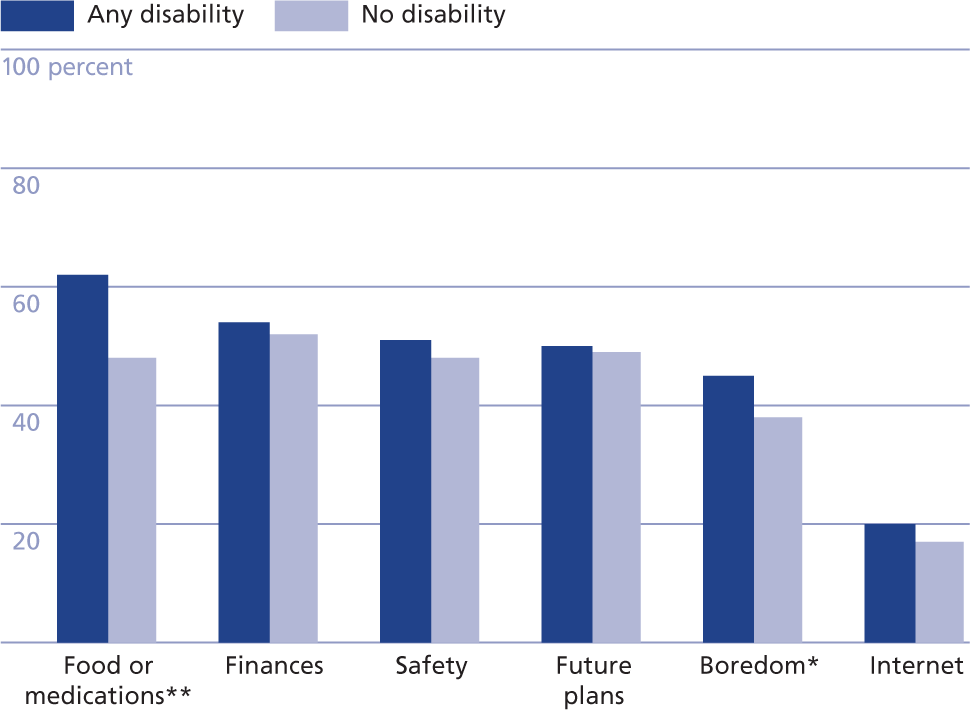
Another question asked respondents: “Since the Coronavirus outbreak, have any of the following been worrying you more than usual, even if only in a minor way?” Domains we inquired about included finances, safety, Internet access, as well as future plans (Reported worries since the coronavirus outbreak). In many areas, PWD as a whole did not notably depart in their worries from those without reported impairment: concerns about finances, safety, Internet, and future plans showed minimal differences between the two groups. Here we highlight some of the statistically significant differences we found.
In a time of hoarding, PWD were particularly concerned about obtaining food or medication: 62 percent mentioned this concern compared to 48 percent of those without disabilities. Boredom was another worry disproportionately expressed by those with impairment, with 45 percent reporting it compared to 38 percent of those without impairments. Respondents with cognitive impairments were especially likely to report worries, expressing higher levels on nearly every worry we asked about.
Unexpectedly, a smaller proportion of people with physical disabilities expressed worry about their future plans: 42 percent reported this worry, compared to 49 percent of those without disabilities. Overall, while PWD did not vary that much from those without in their worries, there is nonetheless a statistically significant (p<.01) difference in the number of worries they indicated, which is 3.0 for PWDs compared to 2.7 for others.
People with communicative disabilities stood out from those with other disabilities in their concerns. While respondents with these impairments expressed no difference from others in worries about getting food or medicine, they were particularly worried about their Internet access (something no other disability subgroup reported). Twenty-seven percent indicated this worry, compared to just 17 percent of those who did not report having a disability. This likely reflects that these types of impairment do not often require medication but do benefit from assistive technology—especially in a pandemic where information and communication technologies are increasingly important for communicating with others.
Listening and Acting
Overall, our findings document the experiences and concerns of people with disabilities during the pandemic. We show that COVID-19 has been deeply relevant to PWD and those with whom they are connected. In some domains, PWD experienced the pandemic differently from others. While seemingly everyone has been affected by this crisis, those with impairments had their home situations and their relationships impacted more. On the other hand, PWD shared many of the same worries as the rest of society. Areas where they stood out (e.g., food and medicine) relate to the need for assistance and threats to resource access that has been brought to the fore in the current crisis.
Although the United States has been at the forefront in many efforts to make society more accessible for PWD (e.g., legal protections through the Americans with Disabilities Act and the Individuals with Disabilities Education Act), codified rights do not necessarily ensure inclusion and support. Such policy gains are subject to backlash and cuts in funding that may be especially salient at the time of an unprecedented global pandemic. Support that is offered needs to attend to the stated needs and concerns of people with disabilities themselves. We live in a society where PWD are openly mocked by top leaders. Thus, fears that hard-fought victories could be fragile, especially during times of national crisis, are understandable. Given our tumultuous global context, extra vigilance should be taken to resist attempts to marginalize people with disabilities, in rhetoric, in services, and in policy