



Abstract
This article analyses COVID-19 stories of disabled young people describing their everyday experiences during spring 2020. Data consist of 14 entries submitted to the Corona Competition organized by the Supporting Foundation for Children and Youth with Disabilities. We ask how disabled young people narrate their lockdown experience. Our analysis focuses on the one hand on the hegemonic lockdown narratives and subject positions constructed with these and on narration of disability on the other. The findings highlight the variations in the narratives in relation to experiences of (mis)fitting. In many of the texts, lockdown is presented as not leading to changes in the narrator’s sense of self or experience of disability. A few stories make visible how the lockdown has even diminished dominance of disability experiences in narrator’s life. However, for some of the narrators, the lockdown has led to deepening sense of misfitting and amplified their experience of disability.
Introduction
In March 2020, as COVID-19 spread rapidly, Finnish government made a decision about implementation of the Emergency Powers Act which allowed officers to make exemplary restrictions concerning public as well as private lives. 1 Public services such as libraries, swimming pools and youth clubs were closed, and many of the services quickly moved on-line. All schools, from primary to upper secondary level, as well as universities, were required to organize their teaching as distance learning.
In general, the Finnish public were recommended to socially distance themselves by staying at home and not organize or attend social gatherings. At the same time, some groups were under specific scrutiny due to their vulnerability, with stronger recommendations or restrictions placed on them. These groups, including elderly and persons with specific health/physical conditions, were often lumped together in the public addresses from government as ‘persons belonging to risk groups’. One group considered as being automatically at risk was disabled people.
During the first weeks of the first lockdown period, as everyone was still trying to adjust to the immediate changes in their everyday lives, Ilari Kousa, a Finnish disability activist, posted the following text on Facebook:
Welcome to my life! Welcome to the fact that you cannot move outside without good reason. Welcome to the fact that many people are interested about where you are going. Now the rest of society gets its share of this shit that affects my life whether I like it or not. Maybe this is just little bit fair.
2
While the official risk group policy discourse was categorically separating disabled people from non-disabled ‘ordinary people’, Ilari’s post provides a totally different perspective to what was taking place. Rather than amplifying the distance between disabled and non-disabled people, Ilari suggests that the lockdown measures and experiences are actually narrowing down this distance. The fact that everyone has to mainly stay at home, carefully plan each task taking place outside of their homes and possibly even provide an explanation to why it is absolutely necessary to take up these tasks gives others a taste of Ilari’s everyday life where autonomy is not something that can be taken for granted but is constantly built and negotiated in relation to several institutional and societal practices and actors (see, e.g., Stefánsdottir et al., 2018). Hence, while everyone was trying to adjust to this ‘new normal’, for Ilari and many others, this actually was ‘the normal’ that suddenly did not seem that different anymore (see Goggin & Ellis, 2020).
Our article discusses the experiences of Finnish disabled young people during the lockdown, by asking how do disabled young people narrate their lockdown experience. At the same time, as this group of young people was considered as being ‘at risk’, both of immediate and long-term effects of the crisis, ‘voices’ of disabled youth have so far mostly been missing both from the public discussion and studies concerning these effects. In order to fill this gap, we analyse cultural texts produced by young persons identifying as ‘disabled young people’. Our data consist of 14 entries (essays, photos, videos, comic strips, poems and other art pieces) submitted to the Corona Competition organized by the Supporting Foundation for Children and Youth with Disabilities (Vamlas) in April 2020.
Whilst our aim has been to build an understanding about the immediate experiences of disabled young people, initial analysis of our data led us to readjust our analytical focus. Our (somewhat unconscious) entry point to analysis was to make sense of whether there was something specific to disabled young people in how the lockdown was experienced. However, when we started to analyse data, we felt that we were rather faced with a shared general cultural narrative concerning everyday lives and experiences under COVID-19 lockdown than experiences of a particular group of young people. In addition, already during the first readings of our data, we noted how difficult it was to get a grasp of disability in our data: while in some of the analysed texts this was in the forefront of the narration, constructing the plot of the narrative, mostly disability was something that remained in the background of the narration or was even totally missing from it.
In order to respond to these initial notions concerning our data, we have placed our analytical focus on normality and difference and approach disability from the point of view of this dynamic. As suggested by Ilari’s Facebook post above, the pandemic and measures taken by governments have rearranged or at least troubled previously taken-for-granted conceptions of ordinary life. In this new situation, lives with restricted mobility and limited choice can suddenly appear as common, relatable or even respectable, as suggested by the COVID-19 campaign slogan in England, ‘Stay home. Save lives’. What became of interest to us was whether this new situation and changing cultural narratives could open previously unattainable social positions to disabled people, or did it actually further marginalize persons in already marginalized positions.
This kind of perspective that approaches disability as contextual and situational resonates with relational (e.g., Tøssebro, 2004) and interactionist approaches to disability where disability is understood as ‘an outcome of the interaction between individual and contextual factors’ (Shakespeare, 2006, p. 58). In the current pandemic, characterized by unexpected rapid change of the context of everyday living, it feels relevant to presume that this change also affects those person–environment interactions that create experiences of disability. In this article, in order to analyse these interactive processes, our analysis draws in particular from Garland-Thompson’s (2011) conceptualization of misfitting.
We will next move to discuss key theoretical concepts and methodological approach, followed by description of our research data and practices concerning research ethics. The last three subchapters discuss findings of our analysis, with the last chapter drawing together some conclusive remarks.
Theoretical and Methodological Approach: Analysing Disability in Narratives
In order to build an analytical perspective that allows us to grasp the (changing) meanings of and roles that disability takes in the lockdown narratives of the young people, we have drawn theoretical and methodological ideas both from disability studies and narrative research.
In terms of disability studies, our reading has been influenced by theoretical approaches that consider disability as a relationship (Tøssebro, 2004) or interaction (Shakespeare, 2006) between individual and contextual factors. This challenges the traditional, medical understanding of disability that equates disability with impairments, approaching disability as lacks or flaws in the body. In addition, relational and interactionist approaches resist strong social model understanding of disability as being solely caused by environment. According to these approaches, the focus cannot only be on individual or context but on the interaction of the two, the ‘mis/match’ of person and environment (Goodley, 2014). This draws attention to the complex interplay of multitude of different factors in a specific context. According to Shakespeare (2006, p. 58, refer to Sim et al., 1998)
(i)t is always the combination of a certain set of physical or mental attributes, in a particular physical environment, within a specified social relationship, played out within a broader cultural and political context, which combines to create the experience of disability to any individual or group of individuals.
In order to theorize this interaction between person and environment from a materialist feminist perspective, Garland-Thompson (2011) has proposed the concept of misfit. According to Garland-Thompson, by emphasizing the particularity of varying lived embodiments and spatial and temporal body–environment encounters, the concept of misfit avoids reproducing a theoretical generic disabled body that fails to address differences between bodies. Additionally, misfit challenges the sole focus on bodies by emphasizing context over essence. It draws attention to the specific encounters where disability emerges as particular material bodies interact with their environment in particular social locations and moments. Fitting or misfitting takes place when body and world ‘come together either in harmony or disjunction’ (p. 592). ‘A fit occurs when a harmonious interaction occurs between a particularly shaped and functioning body and an environment that sustains that body. A misfit occurs when the environment does not sustain the shape and function of the body that enters it’ (p. 594).
At the same time as misfitting draws attention to the environment and what kind of bodies this is built for and, thus, sustains, Garland-Thompson’s conceptualization also extends to describe what follows from these moments of misfitting. It is not only the processes of disablement that the concept grasps—how and why this misfitting takes place—but also how these encounters contribute to the lived identity and experience of disability. According to Garland-Thompson, ‘to mis-fit renders one a misfit’ (p. 593, italics in the original). Misfit, thus, not only describes the act of not fitting but also the person who does not fit. In comparison, fit describes a positive, even valued position and way of being.
What makes concept of misfitting particularly useful for us is the strong temporal and spatial grounding in the examination of the process of disablement. Garland-Thompson (2011, p. 593) notes that ‘(w)hen the spatial and temporal context shifts, so does the fit, and with it meaning and consequences’. It is this kind of a shift in context—as people are forced to re-arrange and rethink their everyday lives due to lockdown—that raises the most interesting and at the same time complex questions in relation to our data: Does the lockdown change when and where disability emerges, and if so, how does this influence the young people’s experiences and the way that they makes sense of themselves?
We have analysed our data by using narrative analysis. Narrative analysis has provided us means to focus on the interplay between the circulating narratives of shared lockdown experience and narratives of ‘personal’ experiences (see Bamberg, 2012; Hänninen, 1999). Approaching the data this way made us sensitive to note how the young people were building culturally meaningful stories: even in those cases where the narrators were building counter narratives (Andrews, 2004; Tarvainen, 2019), pointing out how their experience differed from the ‘general’ experience, the hegemonic narratives of lockdown remained as important reference points.
The data do not comprise one shared narrative distinctive to disabled young people but rather multiple different ‘personal’ narratives that are differently positioned in relation to the hegemonic narratives of the lockdown experience. In order to focus specifically on these differences between narratives, we have used Bamberg’s (2004) ideas on analysis of narrative positioning. In this, the analysis focuses not only on the subject positions formed within the story that is told but also on how the narrator positions themselves in relation to the (imagined) audience and ‘how subjects position themselves in relation to discourses by which they are positioned’ (p. 367). This, according to Bamberg, allows us to build an understanding of how the narrators ‘establish a sense of self’ as part of narration (p. 367). This sense of self, subjectivity, becomes produced in a dialectic process where subjects make sense of themselves and others within the already existing, dominant discourses. In our analysis, this means that while focusing on positions formed in the young people’s narratives of living and experiencing lockdown, for example, ‘people managing the situation’, ‘victims’, ‘heroes’ and how the authors position themselves in relation these positions—we have also paid attention to tones, turns and emphases in the narration that can make visible ambivalence, discomfort or outright opposition in relation to these cultural narratives and assigned positions. These make visible how the authors position themselves in relation to these hegemonic narratives and how they use them: whether these are representative of their own experiences, whether the author experiences mis/match between the narratives and their experiences or whether the author challenges these hegemonic narratives.
It is important to note that while our research has started from interest to study disabled young people’s actual experiences of lockdown, what our data and our methodological approach grants us access to are representations of these experiences. As Atkinson and Delamont (2006, p. 167) point out, accounts do not simply mirror realities, but ‘the narratives (…) create the realities they purport to describe’. Thus, we are not claiming that we are able to or aim to grasp ‘authentic’ or ‘real’ experiences of the authors, but rather, our analytical focus is on narrated experiences and selves (see Bamberg, 2012). In order to clarify difference of these perspectives, for us, it has been important to draw a clear distinction between an author of the text and a narrator in the text: while the author is accounting their ‘authentic’ experiences, our interpretations concern narrated experiences and selves formed in the text—how the narrator constructed by the text accounts their experiences.
Data and Ethics
Our data consist of cultural texts submitted to the ‘Corona Competition’ of Vamlas Foundation. The competition was organized in April 2020 to gain information about how disabled young people were experiencing the lockdown. The competition was announced on the foundation website and advertised in social media (Facebook, Instagram). Earlier experiences in the foundation had proved that it was difficult to recruit individuals to surveys. Thus, the idea was to leave it up to the participants to define the form of the piece they were submitting to the competition and to encourage participants by offering a small reward for participation. This approach worked, since the competition got 14 entries, including comic strips, videos, essays, photo compilations and poems, to mention some. Participants represent a heterogeneous group geographically as well as from the point of view of their impairments (in cases where this was coming up in the texts), age and gender.
It should be noted that the competition call, with giving the authors opportunity choose any form of expression, has probably been particularly appealing to those who are already working with different kinds of art forms and techniques. In addition, our data are somewhat unconventional compared to mainstream of narrative research where often extensive biographical materials (in-depth interviews and written autobiographies) are used. While some of the texts in our data, in particular essays, are closer to these forms of accounting, with the authors writing in detail about different phases of lockdown and how they have experienced them, many of the pieces focus on describing a specific topic, moment or feeling. In addition, since we have limited our dataset to the pieces submitted to the competition, we were unable to ask the participants to further elaborate their stories. While, due to these characteristics, our data could be considered as fragmentary, we also find it to be quite rich with different pieces complementing each other, with some drawing a more general picture of life in lockdown and others focusing on a detailed description of a specific moment, feeling or topic.
Since these data involve collaboration with young persons, special attention has been paid to research ethics. Participation in the research has been voluntary and based on informed consent. The participants were given adequate information about the aims and methods of the competition. All participants were aware of further use of their work and gave permission for research use in connection to submission of their piece.
All the stories were published on the website and in social media of Vamlas as part of the competition. Participants’ first names and ages were published in connection to publication of the competition results, but individual names were not attached to single pieces. However, this did not ensure the participants’ privacy, since some of the young people could still be identified from videos or pictures or from the details of their stories (e.g., some used their first names in their stories as well).
In writing of this article, we have been balancing on the one hand the public nature of the data and protection of participants’ privacy with anonymity and respect for authorship/copyright on the other. When analysing and writing about the young people, we have done this in ways that aim to ensure their privacy: changing details of their narration if necessary and using pseudonyms to replace their first names. We have decided not to use images (as illustration) that could make the young people identifiable. However, in the case of the published full pieces (comic strip, poem, photo collage), we have negotiated with the authors of the pieces whether they want their full name to be included in the publication. Out of the authors of these three pieces, two chose to have their piece published with their full name while one wished to remain anonymous.
Positioning Oneself in Relation to the Hegemonic Corona Narratives
As discussed above, first reading of the data drew our attention to what we call the hegemonic cultural corona narrative. By this, we refer to the kinds of experiences that began gradually to be culturally recognizable as common or even normal ways of experiencing and responding to the COVID-19 crisis. In the analysed texts, this hegemonic narrative became visible through topics (what was discussed), storylines (what kinds of ‘plots’ were formed) and in forms of representation.
An obvious reference to common experiences in our data is ‘the Corona bingo’ submitted by one participant, depicting everyday things to do while social distancing (titled: ‘Are you like me? Amy’s social distancing Corona Bingo’). In the bingo, you can get hits by ‘feeling like starting hand crafts’, ‘meltdown when finally seeing people (your parents)’ or ‘having dry hands due to constantly washing them’. In the middle of the bingo, one can find ‘googling your symptoms’. However, at the same time, as Amy’s bingo is capturing (and even parodying) experiences recognizable to many, this is coupled in her piece with an essay portraying her social distancing experience as exceptional, as discussed below.
Another way that the hegemonic narrative(s) is present in individual texts are the topics and themes repeating in them. Many of the texts addressed cherishing and longing for your close social relationships (family members and friends); finding time to concentrate on or start totally new hobbies; time for self-reflection; being alone; getting bored, anxious and depressed; and already longing but also fearing for future. Many were also discussing means of coping with the situation: keeping in contact with family and friends (online or by phone), developing new routines and/or hanging on to the old ones. These topics and emphases resonate with several other studies and surveys focused on how young people experience and cope with the situation (e.g., Finnish National Youth Council, 2020; Lasten ja nuorten säätiö, 2020; Ranta et al., 2020; Save the Children, 2020).
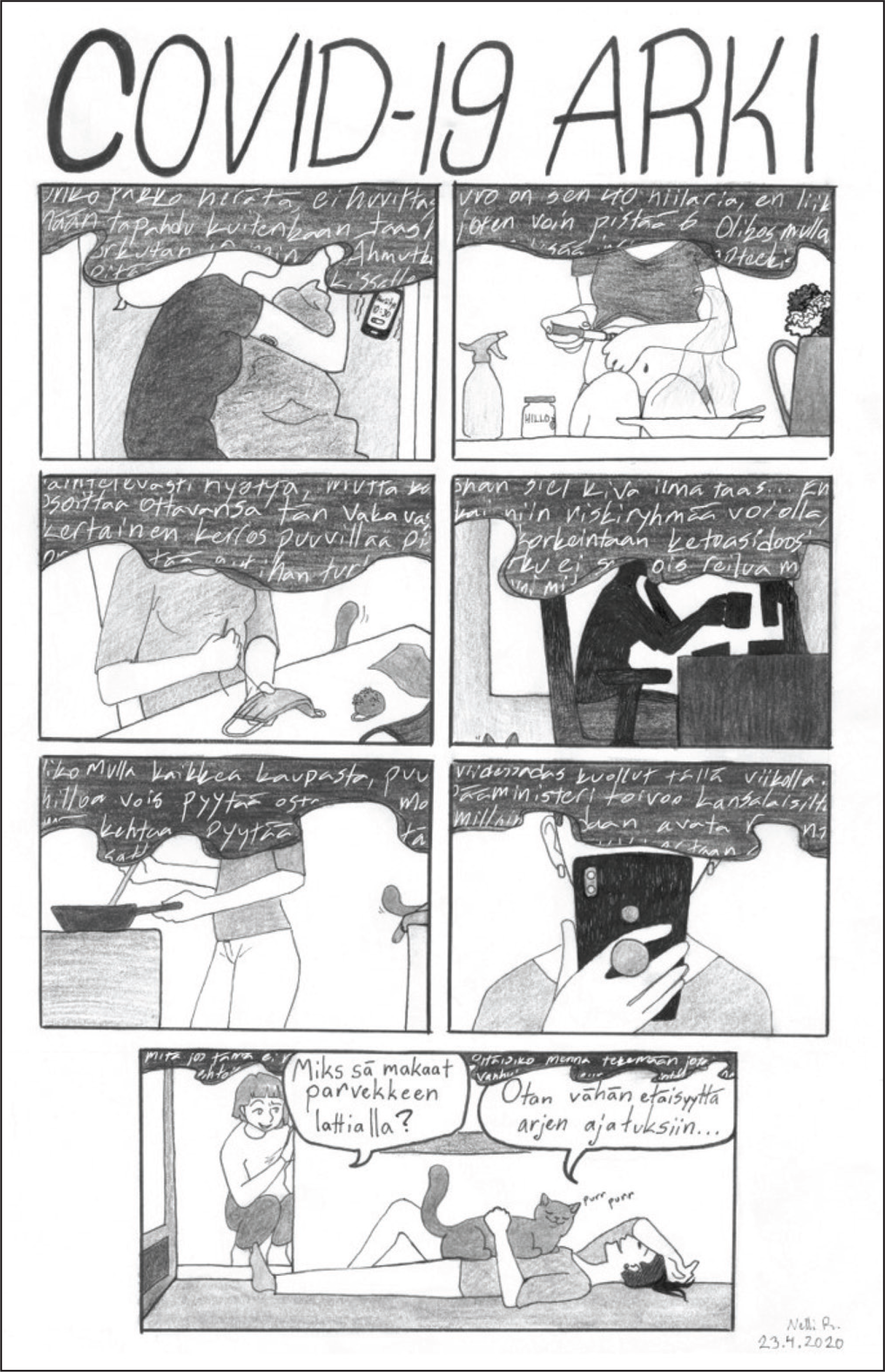
Some of the texts concentrate on one perspective or topic (e.g., on adjusting to distance learning and reflection about social relationships), some depict singular moments or feelings (like the comic strip and poem below), while others build their storyline around chronological time and change.
One repeating feature in narration is the plot of change: especially the essays describe a process starting from the suddenness of the lockdown, followed by disbelief and feelings of chaos and confusion as one is trying to make sense of the situation. After a while, one starts to settle down in the new situation with new routines and even possibly finding enjoyment in the situation. The story is often closed with some reflection concerning future and what one might take with oneself from this experience.
A comic strip submitted to the competition by Nelli Railanmaa (Figure 1) depicts a specific moment in this process—raised also in some of the other texts—where one is constantly following the news in order to make sense of the situation (see Tandoc & Lee, 2020). The last frame describes the exhaustion that follows from one’s inability to consume the information: ‘I’m just taking some distance to the everyday thoughts’ as the main character in the strip responses from their balcony floor.
At the same time, as many of the personal narratives can be interpreted as conforming to the hegemonic narrative, some can be read as critical commentaries constructing counter narratives. In these, the authors are taking distance to how people in general seemingly react to these circumstances. Sometimes this distance is narrated through parodying the actions of others, while themselves knowingly staying outside of the fuss. In other stories, this distance was created by making visible how oneself is not able to do as others do or take subject positions available in these narratives. In a text marked with #hävyttömänhaavoittuva [shamelesslyvulnerable], both these dimensions are present and alternate, as the author tells their story:
What is scaring me most is not corona. On the contrary, when everyone around suddenly seem to be preparing for the end of the world, it makes me in weird way feel even serene. (…) So now I’m observing amazed how people are hoarding toilet paper, in a sense of been there done that, that does not help at all. (…) I’ve been thinking, to be a teacher or a nurse, then one would have even some contribution to make that interests society. Instead, I’m just lazing around at home. I’m not even learning to cook god knows how many dishes or spring-cleaning my home. I would need help from someone to do this, whether it is corona time or not.
In the story, the narrator all in all looks at the social world from a distance, not being able to identify with the feelings (fear and anxiety) and actions (hoarding toilet paper) of others. Being outsider is presented in the beginning of the text even as a privileged position that the narrator can take, since they feel that they can cope with this situation. This ‘been there done that’ position, following from the narrator’s past challenging life experiences, is first and foremost an epistemically privileged position (Garland-Thompson, 2011), a specific standpoint that follows from profound experience of misfitting. As the end part of the text the makes visible, this outsider position is not something that necessarily would be the narrator’s choice. Not being able to have a similar lockdown experience as others and take heroic positions in narratives of this time—like being a teacher or a nurse (see Martikainen & Sakki, 2021)—is also something that is out of the reach of the narrator. They cannot even share the experience of investing in home life during lockdown, since ‘for this I needs someone to help me, whether it is corona time or not’.
These kinds of counter narratives come in different kinds of forms. In a poem titled Taltiointi [Filing] by Julianna Brandt, a counter narrative is formed through references to how one should act in these exceptional circumstances:
These days one I guess ought to file everything. Even that, when one accidentally gets a paper cut on a fingertip. Burns tongue with hot tea. Scratches an old scab open for seventh time, as if waiting for world’s eight miracle. Ought to take a picture of neighbour’s jeep, that looks like in its trunk carcasses of animals are carried. Ought to document children fishing from polluted water. Ought to document one’s weird sounds, filling days’ silences. Ought to document specs of sun on walls. Author: Julianna BrandtFiling
At the same time, as the poem with the repeating notion of how one ‘ought to’ can be interpreted to refer to the hegemonic response to the lockdown situation—how the most everyday notions and experiences are suddenly worth capturing and sharing—the same phrase ‘ought to’ distances the narrator from this response. While beautifully capturing all these detailed everyday notions, for us, the poem also opens up an interpretation where the narrator either refuses to take part in this cultural practice or has been petrified by the whole situation in a way that this response is out of reach to them.
Amy starts their story by stating that ‘I find it difficult to understand how people who feel bored during the corona time’. They write how as a person with executive functions disorder they feel that lockdown has produced an exceptional opportunity to live up to the criteria of normal existence:
I feel even relieved, that the rest of the world has nearly stopped for a moment. Now I don’t have to wrestle with feelings of guilt for missing something or in general not accomplishing enough.
In their text, Amy points out how being alone feels natural and that they have felt less anxious in their everyday life (see Goggin & Ellis, 2020). However, at the same time, these positive effects and easiness of the whole lockdown experience (compared to generalized others) has made Amy realize how exceptional their lifestyle and way of experiencing things are: ‘your own introvert being really hits you in the face when you realise, that the changes in your everyday life following from the current circumstances are really marginal’.
Fitting, Managing, Misfitting: Narrating Oneself and Disability
The above extracts from Amy’s story build an interesting tension in relation to normality. On the one hand, Amy’s narration is suggesting that boundaries of normality are on the move: since everyone is required to stay at home, Amy feels that there is considerably less friction between their way of living and social and societal expectations. This experience of fitting means that they do not have to constantly process feelings of ‘not accomplishing enough’. At the same time, Amy still writes that the situation really made them aware of their ‘introvert being’, since their experience of the lockdown does not fit the hegemonic narrative of experiencing a massive turmoil due to lockdown. Whilst the lockdown has possibly challenged what ordinary living looks like, and thus produced a fit in Amy’s life, their narration makes it visible how this sudden experience of fitting has not removed their conscious reflection in relation to existing norms and their suspicion that they probably still are a misfit.
Whilst maybe troubling normative understandings of ordinary living or ordinary citizenship, our analysis of Amy’s reflection suggests that hegemonic narratives—even if the content of these has changed—are anyhow normative. There still is a sense of what you should be going through, how you should behave and experience these new circumstances running through the participants’ narratives. At the same time, these new circumstances seem to provide space for new valued ways of being, some of which even challenge the ideal of autonomous, productive individuality (see Goodley, 2014); for example, Kathy states in their essay that ‘I eagerly followed those wise minds who think that now one is allowed to and even should—each according to their own abilities—let go of the superachieving-self and turn one’s attention to what is happening inside one’s head’. The superachieving-self articulated by Kathy seems to be exactly the kind of normative subject position that normally produces misfitting in Amy’s life.
Amy’s story also provides an example of one of the ways disability was narrated in the texts. As discussed above, disability took varied ‘roles’ in the texts. In some, disability was the entry point to the story or ran through the text, like in Amy’s narration. In others, disability was not raised at all or was mentioned in the sidelines.
In four essays, impairments enter the narration through notions of how due to health risks the authors had to self-guarantee. For three authors, this meant that they moved back to their childhood homes for now:
I’m still on that weekend trip to home-home [childhood home]. 44 days later. (…) And so I hurriedly built this life continuing for the time being until undefined date back into my parents’ house.
Even if the lockdown had caused a disturbance to the narrators’ lives, these four stories in general follow the hegemonic cultural narrative where the initial turmoil is followed by settling down to the new circumstances and continuing with everyday routines consisting of studying or by developing new daily routines in this new context. When looking at the marginal position of disability in their narration, what combines these stories is that the everyday lives narrated are characterized by experiences of fitting: living busy, ordinary lives, both before lockdown and also (as busy as possible) during it.
I’m usually really active and able [oma-aloitteinen] to do things outdoors, but now I just stay at home. Usually I go shopping quite often, go to hairdressers, cinema, gigs etc events, which now isn’t possible.
These kinds of representations of active, autonomous lives do not mean that these young people are downplaying or denying their impairments or disability experiences (see Watson, 2002); rather, these narratives make visible everyday living characterized by experience of fitting: lives where one is not constantly faced by barriers that cause experiences of disability (see Gustavsson & Nyberg, 2015). For some of these young people, like the narrator in the extract above, this kind of autonomous, active life is achieved by living in a neighbourhood that has accessible public transportation and other public services and having personal assistance (see Kittelsaa, 2014). While moving back to the childhood home has meant leaving this active life behind—and often also one’s personal assistance—the childhood home still provides a space where they fit (see Gustavsson & Nyberg, 2015; Priestley et al., 1999). As one of the four authors writes: ‘I get irritated by the constant company of four surrounding walls even if I feel that I usually enjoy being alone. At least while I’m staying here at the countryside [at my parent’s place] I can go for walks on the forest paths and tracks on my own, in spite of my blindness’.
In comparison to these narratives, in an essay titled ‘Neurological deviance + distance learning = Instability’, totally focusing on learning, disability is positioned to the forefront of the narration. The essay starts from a general notion of how the distance learning has made it difficult for those in need of special support to get support in their studies. The main part of the essay focuses on explaining what kind of experiences of receiving and not receiving suitable support the narrator has had along their educational path, finally arriving to the current struggles they are experiencing with distance learning at university’s online lectures:
One of the lecturers does actually give lectures online, which I am super grateful for. This helps me to keep up my daily routine, even if it is just for one day of the week. During other days I don’t even know where to start from when I should be in class but there isn’t one. And there is no lecturer online who I could talk to and explain that I have this kind of problem and I don’t understand. Cannot resolve this without feeling like banging my head on the desk, however hard I’ve tried to first solve this on my own.
The description of the online learning is dominated by a feeling of misfitting. Whilst the narrator knows that this experience is caused by lack of support in a situation where the normally existing support systems have been unable to take the sudden leap to online teaching, this misfitting is still experienced as a personal feeling of ‘instability’ highlighting their particular difficulties in learning. They, thus, narrate themselves totally in relation to these difficulties, as a person with a ‘neurological deviance’, a misfit unable to flexibly adjust to new learning practices. This is in marked contrast with another essay also discussing experiences of distance learning. In this piece, the author accounts that whilst the new situation ‘required quite a lot of learning and moving away from one’s comfort zone’, the challenges of distance learning have been quite specific: ‘How for example will I give a presentation in a small group and as a person with vision impairment make sure, that other’s see those things [on slides] that I want them to see’.
Whilst having different impairments and, thus, different kinds of challenges in online learning, we interpret that the key difference is not to do with impairments as such, with one body fit for online learning and the other not; rather, there is a difference between the practices of the two educational institutions. In the first author’s narration, the transition to online learning is presented as quite dramatic, with both lecturers and students as well as support systems struggling to adjust to this new learning space and build new practices. In comparison, the second author accounts that online learning spaces and tools were already at use in their institution, which eased the transition. Even if the transition to total online learning did raise some impairment-specific challenges, these did not challenge the narrator’s understanding of themselves as a fit student.
Another piece that represents a narration that has disability as an entry point for us is a photo collage depicting small everyday details, titled with an account: ‘Pandemic-time everyday living with attention deficit hyperactivity disorder. Mind in need of constant stimuli is restless in guarantee. Taking pictures of details helps’ (Figure 2).
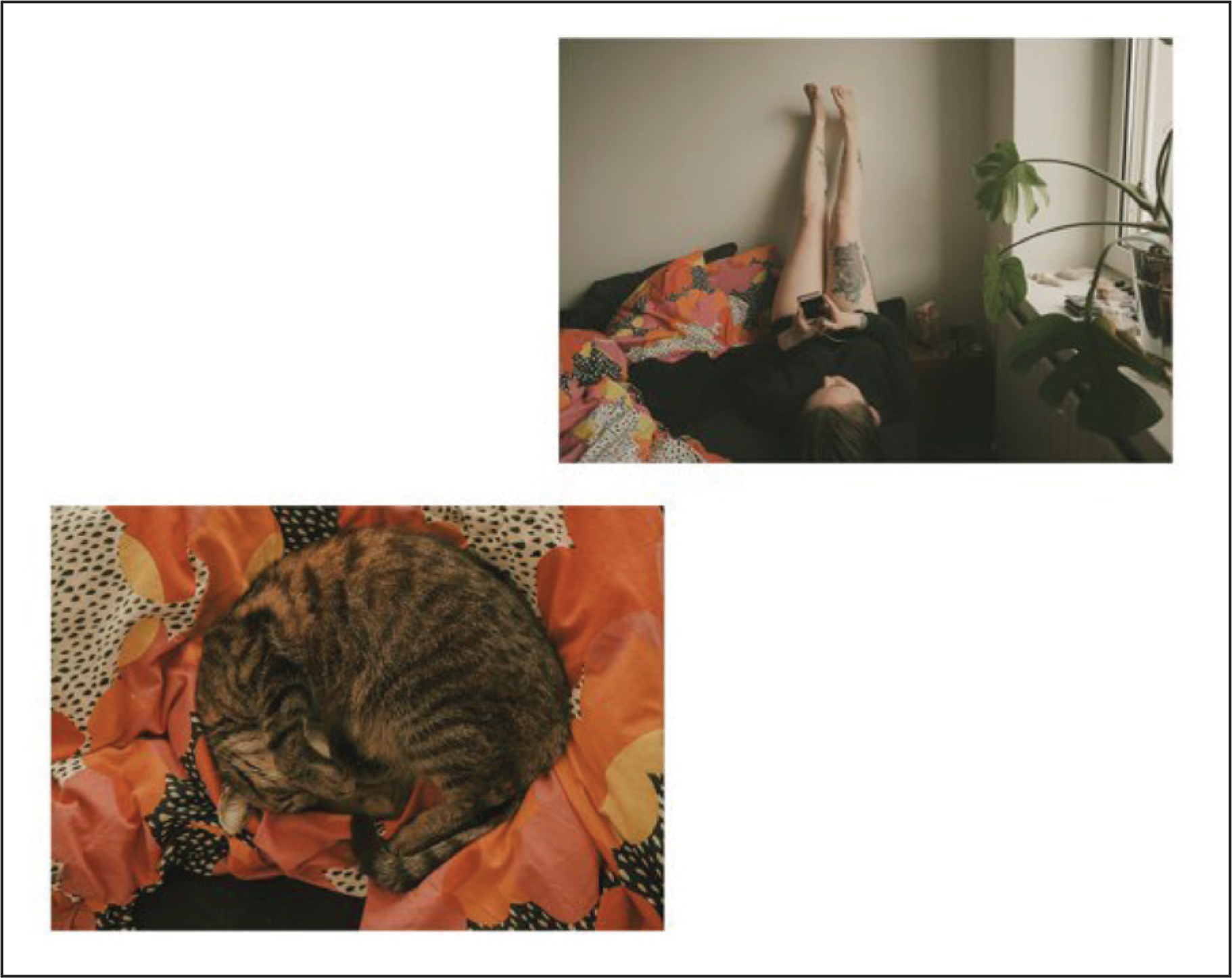
The text and the pictures build an interesting dynamic where the narrator’s special needs provide a specific interpretive perspective to these very serene and ordinary images. In this way attention deficit hyperactivity disorder (ADHD) is something that colours the whole piece, while at the same time for a viewer of the piece, the impact of it remains something hard to grasp. As with the distance learning essay, the title of the photo collage makes the experience of becoming extendedly conscious about one’s specific needs the focus of the narration. In this case, this experience of misfitting is caused by the clashing of the ‘mind in constant need of stimuli’ with the necessity of staying put at home.
It is noteworthy that while these young people might belong to the ‘risk group’ due to their long-term health conditions and, thus, having to self-guarantee, they do not in general narrate themselves as victims of these circumstances. Even in the stories where disability takes a more dominant role, the authors still represent themselves as managing the situation: even the narrator struggling with distance learning has found ‘a silver lining in the middle of this crisis’. Rather than positioning narrators as victims, many of the stories make visible how they are managing the situation, even if they might be temporarily struggling with negative feelings like anxiety or loneliness. The sense of agency present in many of the stories is supported by different kinds of resources that the narrators disclose. Many of the narrators talk about their gratitude over having close friends and other supportive social relationships. Some explicitly remark how they have the means to stay safe, for example, having a place where they can self-guarantee (e.g., by moving back to their childhood home for now), while in some of the stories, financial resources are discussed (being able to hold on to one’s job in a situation where many are losing their employment). For some of the narrators, continuing with their studies brings continuity in the form of routines and sense of self (being a student). This kind of resourcefulness—being one of the haves rather than have-nots—becomes summarized by Amy who writes that they are ‘one of the lucky ones, who have a safe home, money to buy food, internet connection and means to be creative’. Some of the narratives can even be considered as counter narratives challenging the victim narrative by discussing (unspecified) others whom the narrator considers as less fortunate than themselves in this situation.
However, this was not the case for all of texts. Out of all the 14 pieces, there is one that could be described as a victim or even tragedy narrative. In the essay marked with #shamelesslyvulnerable, the narrator describes profound feelings of loneliness and marginalization and fears related to how the lockdown experience might affect these.
What I fear most is not corona. I’m scared about the same thing as always: feeling of being outsider.
That I’m not essential part of anything. That no-one notices whether I’m there or not. (…)
The most terrifying thing is not corona. I’m most scared about being faced with myself, all alone.
Sometimes these difficult thoughts bring such strong emotions, that I’m about to loose myself in them altogether.
Still, I want to trust that after all this turmoil I feel more at home in myself.
While, in the beginning of the essay, the narrator accounts how they do not identify with people who are panicking due to the situation, since they have already ‘been there done that’, the end part of the essay focuses on difficulties they have been coping with. These negative feelings, however, are not connected to the uncertainty brought by the pandemic, but to how the lockdown affects their already marginalized social positioning. The narration builds an image of life already filled with social distance, even isolation and loneliness. What the narrator finds hard to cope with is the idea of becoming even more isolated and having to cope on their own with these fears.
Even if the narration has earlier touched impairments and how these limit the narrator’s possibilities to take certain social positions, when discussing current negative feelings, these are not directly connected to impairments in the narration; rather, the negative effects of the lockdown are connected to already existing experiences of loneliness and detachment from others and from society, ‘not being part of anything’ (see Watson, 2002). The tragic tone in the narration is built by the expressions of desperation connected to not coping alone and still having to cope with self who is not coping. The emphasized loneliness in the narration draws attention to how many of the resources that are present in the other texts are missing here. However, in the last sentence, the narrator distances themselves from the narrated situation. As if looking upon themselves in this current difficult situation, the narrator accounts how they still ‘trust that after this turmoil’, things will take a positive turn, with them even developing a more positive relationship with themselves.
Discussion
Our article has examined narratives of disabled young people about their lives during first months of lockdown. While taking different kinds of forms (essays, photo compilations, poems, etc.) and different kinds of perspectives (describing a specific moment or changes and turns in the process), the texts had a lot in common in terms of how experiences are narrated. However, the texts differed in how they positioned disability in the narration, with some giving disability the main role in the narration while others positioning this in the margins or totally excluding it from narration.
By using theoretization of misfitting (Garland-Thompson, 2011), we have argued that these differences result from varied experiences of fitting and misfitting. While the lockdown is described as changing or even challenging the narrators’ everyday living, in many of the texts, this is not presented as leading to changes in the narrators’ sense of self or experience of disability; rather, by conforming to hegemonic lockdown narratives, changes resulting from lockdown are presented as temporary and something the narrators manage with their resourcefulness.
Rather than conforming to hegemonic narratives, some of the texts form counter narratives where narrators critically reflect their lockdown experience and how it differs from how this ought to be experienced. A few stories also make visible how the situation has contributed positively to the narrator’s life and sense of self by diminishing dominance of disability experiences in their everyday living. However, in some of the texts, emphasis is on the negative effects of the lockdown. While even in these stories the narrators try to avoid resorting to victim or tragedy narratives by also making visible their agency in this situation (coping strategies and positive visions of future), the stories point out how lockdown can lead to even deepening sense of misfitting and amplify experience of disability.
The findings question disability as the primary factor explaining lockdown experiences of disabled youth (cf. Finnish Government, 2020) and even challenge perspectives approaching disabled youth as a group united by experience of disability. On the one hand, these kinds of approaches are in danger of failing to pay due attention to the heterogeneity of the group. On the other, approaches that unquestionably highlight disability might also fail to respect young people’s own definitions. For many disabled young people, disability is not the entry point in the way they narrate their lives and themselves (e.g., Ahponen, 2008; Gustavsson & Nyberg, 2015; Priestley et al., 1999).
However, this does not mean that disability does not matter; rather, it matters in complex ways. Even if this aspect might not have been highlighted by the authors themselves, many were faced already early on with effects that their non-disabled peers did not. Some of these followed from changes in services and support that they use due to their impairments; for example, one of the authors was in total lockdown in their housing unit that had banned all visits to and from the unit. Some followed more directly from their impairments, like the necessity to self-guarantee due to specific health conditions. Still, to suggest that being disabled and young is a particularly vulnerable position during the ongoing crisis as such would be simplifying; rather, the young people’s narratives draw a complicated picture where the interplay of multiplicity of different factors leads to different experiences of lockdown.
At the same time as valuing young people’s own representations, it is important to note that the pandemic and the policy measures following from it have had major impacts on disabled population. Whilst past decades have in many ways been triumphant from the point of view of disability rights, leading to more accessible societies and more equal lives, the ongoing pandemic has made visible the fragility of equality and even societal commitments to disability rights (e.g., Davis, 2021; Goggin & Ellis, 2020). Even now, as the pandemic is still ongoing, direct and indirect consequences to disabled people have been harsh. People with specific diagnoses have not only been repeatedly found to be more likely to die due to COVID-19 infection, with some groups even being denied intensive care, but disabled people have also been hit hard by the inability of the support and service systems to respond to the demands of the new situation (e.g., Shakespeare et al., 2021). In addition, some of the policy measures and practices that have aimed to keep disabled people safe have ended up violating their rights (Ervin & Hobson-Garcia, 2020).
Furthermore, while some of the young people’s narratives, as well as Ilari’s Facebook post discussed in the beginning of the article, are suggesting that the lockdown experience has somewhat challenged previously dominant conceptions of ordinary life and, thus, moved boundaries of normality, one should remain cautious with optimism raised by this. Whilst lockdown has normalized lives with restricted mobility in a sense that many of the changes that disabled people have been asking for (on-line cultural events, solutions for working from home, etc.) have been developed almost overnight (Goggin & Ellis, 2020), societies and individuals are still looking to return to the ‘old normal’. It is exactly this normal order of things that produces experiences misfitting to Amy, societies following the logic of neoliberal-ableism that pursues the kind of super-achieving individuality described by Kathy, or as Goodley (2014) phrases it, the hyper-normal. While diversity might be the new normality, disability still remains excluded from this normalized diversity in contemporary societies (Davis, 2013). Against this background, it is hard to imagine that the changes following from the COVID-19 pandemic would be able to profoundly challenge this order.
Footnotes
Acknowledgements
We want to thank all the young people taking part in the Corona Competition: it has been a privilege to work with such an interesting and rich collection of texts, pictures, videos etc. Additionally, we want to thank Pekka Koskinen for his insightful comments and suggestions on our text.
Declaration of Conflicting Interests
The authors declared no potential conflicts of interest with respect to the research, authorship and/or publication of this article.
Funding
The research has been funded by the Strategic Research Council at the Academy of Finland (decision no 336551) and Kone Foundation.