




Abstract
“COVID-19 is threatening the livelihood of the U.S. restaurant industry and its employees because of public-space avoidance, shelter-in-place orders, mandatory restaurant/bar shutdowns, and modified service (i.e., takeout and delivery only). All of these changes will have long-lasting, devastating economic impacts on the industry.”
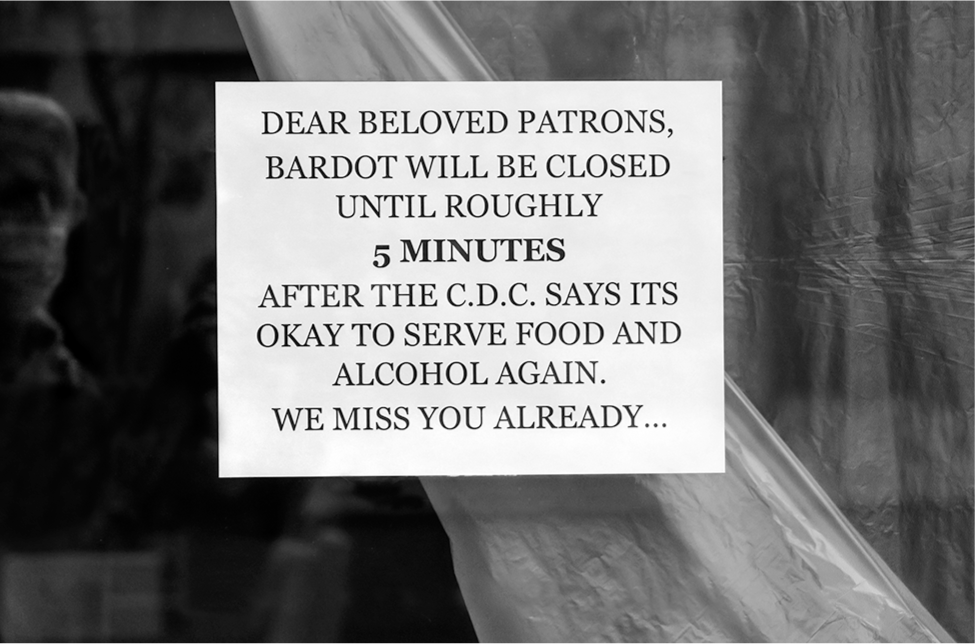
Early in the COVID-19 pandemic, restaurants closed up shop for what we thought was a temporary period before things could return back to normal. This sign on a restauraunt window shows the lighthearted and satiric tone initially used to announce temporary closings to customers.
Russ Allison Loar via Flickr
Often taken for granted, restaurants (i.e., eating-and-drinking places) have profound, influential, and far-reaching economic and sociocultural impacts on society. Their weight extends well beyond jobs and occupations, food-and-beverage service, recreation and leisure, or entertainment and hospitality. Restaurants affect nearly all people in the postmodern world and have significance relating to various macro- and micro-level phenomena: globalization, consumerism, media, politics (e.g., Fight-for-$15), equal-employment opportunities, corporate social responsibility (e.g., sustainability practices), activism (e.g., feeding homeless), community livelihood, neighborhood landscapes, art and culture, socialization, human and non-human animal relationships (e.g., cat cafes), networking, identities, behaviors, emotions, and more.
In The Restaurants Book: Ethnographies of Where We Eat, David Beriss and David Sutton wrote that restaurants embody “ideal total social phenomena” and “the most interesting aspects of social and cultural life in our contemporary world are featured in restaurants.” They contended that restaurants provide a lens with which to understand numerous economic and sociocultural characteristics of postmodern life. Restaurants constitute a massive part of the U.S. economy and people’s milieu. Derived out of the fifteenth century going forward, the meaning and purposes of restaurants have transformed from drinkable consommé remedies to medicinal sites of refuge, to sophisticated leisurely private-urban spaces, to political-public forums, and then to depoliticized places. As Rebecca Spang described in The Invention of the Restaurant: Paris and Modern Gastronomic Culture, restaurants are not merely locations for nourishment; they have evolved from exclusionary “bourgeois public spheres” to present-day arenas accessible to workers and patrons from almost any background. Restaurants are fields that afford interactive experiences, gatherings among family, friends, acquaintances and strangers, freedom from meal preparation, ethnic-heritage embracement, and beyond.
Restaurants Affect Nearly all People in the Postmodern World . . .
Underscoring one example of restaurant notability, Beriss and Sutton discussed how Hurricane Katrina devastated New Orleans restaurants for months post-disaster. As urban restoration commenced, they indicated that restaurants were crucial sites for the city’s economic and sociocultural recovery. Specifically, restaurants provide essential spaces for communities to reconnect throughout disasters. However—albeit destructive and widespread—Hurricane Katrina was a regional disaster without social-distancing mandates. Restaurants, as we knew them pre-2020, involve several hazardous conditions conducive to spreading contagious diseases (e.g., touching, putting objects in mouths, and close proximity). When restaurants are severely restricted as (or can no longer be) spaces of retreat, camaraderie and reconnection because they are vectors for viruses, what are the catastrophic and possibly permanent economic and sociocultural costs? The novel coronavirus (COVID-19) indeed unveiled precisely how much restaurants are embedded in everyday life.
Nationally, as COVID-19 spread, the restaurant industry, employees and consumers began experiencing a life altering reality in a matter of weeks. COVID-19 and the mitigating orders to slow the spread immediately threatened and will continue to threaten the livelihood of restaurants and their employees. Social-distancing practices, public-space avoidance, shelter-in-place measures, shutdowns, limited-service options, lowered-capacity dining, and patron reluctance to frequent restaurants, even as the country reopens, will have long-lasting, devastating economic and sociocultural impacts. Less obvious is how COVID-19 also affects innumerable other-industry employees and restaurant patrons. To highlight COVID-19’s consequences on and surrounding restaurants, I discuss the U.S. restaurant industry prior to and following the COVID-19 outbreak, government intervention, and workplace policies.
Having worked almost 14 years in restaurants, experienced layoffs and endured shutdowns, I am aware of how employee cutbacks and establishment closures have broad ramifications, noticeably for staff with mounting bills and little-to-no savings. As an academic, I interviewed 52 diverse restaurant workers from California and Colorado between 2009 and 2014. Most were economically vulnerable, part-time, and hourly-paid employees who typically disclosed low-annual incomes. When interviewed, almost all were long-term employees with 6 to 25 years’ experience. Participants did not discuss contingency plans for disasters. However, they exposed precarious circumstances regarding postmodern-workforce economic and sociocultural factors like nontraditional 24/7 job hours and shifts, uncertain wages and tips, minimal-to-no healthcare coverage, and workplace interactions, community and friendships.
We are in the hole with the 50 percent capacity. We have gone from taking in $15,000 to $20,000 a day to around $5,000 to $8,000 a day. It will take months, maybe even years, to see a profit again.
While six years passed since data collection, I have been in contact with some participants; they revealed feeling the impact of restaurant shutdowns, layoffs, modified schedules, and social-distancing practices. To illustrate, amid a June 2020 conversation, Lilu (now 37 years old, California manager) stated, “We are in the hole with the 50 percent capacity. We have gone from taking in $15,000 to $20,000 a day to around $5,000 to $8,000 a day. It will take months, maybe even years, to see a profit again.”
Early in the COVID-19 pandemic, restaurants closed up shop for what we thought was a temporary period before things could return back to normal. This sign on a restauraunt window shows the lighthearted and satiric tone initially used to announce temporary closings to customers.
Russ Allison Loar via Flickr
The U.S. Restaurant Industry Prior to the COVID-19 Outbreak
According to the National Restaurant Association (NRA), restaurant industry sales have grown from $43 billion in 1970 to over $860 billion in 2019 (4 percent of the GDP). Furthermore, the total economic impact of the industry is more than $2.5 trillion—every dollar spent there equates to at least 2 dollars paid to countless other-industry employees: maintenance, repair and construction workers, electricians, linen, sanitation and exterminator crews, farmers, food-and-beverage-related distributors, human-resource personnel, property owners and managers, advertising and insurance-plan agents, software developers and technicians, media and security-system providers, etcetera. Even during economic hardships (e.g., The Great Recession of 2008), the restaurant industry was resilient and played a salient role in annual revenue and job growth. By early 2020, it employed roughly 15.6 million people (10 percent of the workforce), expected to employ 1.6 million more by 2030, and projected 2020 would observe $899 billion in sales among its over 1 million establishments.
Before COVID-19, the U.S. restaurant industry was the nation’s second-largest private-sector employer, more than 60 percent of adults worked in it at some point, and nearly 50 percent of adults garnered their first job in it. Between 2010 and 2018, middle-class restaurant-industry jobs (those with $45,000 to $74,999 incomes) grew 84 percent—an expansion rate more than three times quicker than in the overall economy. Importantly, the industry is diverse; 47 percent of restaurant employees are minorities, and it employs more women managers and more minority managers than any other industry. Moreover, it provides job opportunities and second chances for marginalized groups of people, such as the homeless, those with disabilities or minimal education, transgender individuals, military veterans, documented immigrants and refugees who speak little-to-no English, undocumented immigrants, recovering addicts, and the formerly incarcerated—many of whom are considered unemployable elsewhere and are disproportionately affected by COVID-19. Consumer research also displays restaurant value; 90 percent of consumers enjoy restaurants, 75 percent believe time is used better eating with others at restaurants than cooking, 40 percent reveal restaurants are an essential part of life, 63 percent would rather buy restaurant experiences than store items, and nearly 50 percent feel they do not frequent restaurants enough.
Although these figures demonstrate the extensive economic and sociocultural importance of the restaurant industry, there exists underlying issues that make its jobs inequitable, all of which have been exposed amid COVID-19. Prevailing part-time schedules, low-wages, minimal benefits, limited stability, and fire-at-will policies in eating-and-drinking jobs evidence their insecurity, chiefly because contingent workers are first to lose employment during workplace shutdowns, modified-service, or reduced patronage. According to U.S. Bureau of Labor Statistics (BLS), part-time work is more common in the restaurant industry than in any other industry. Only 45 percent of restaurant workers are full-time, full-year employees. Most part-time restaurant staff earn tipped minimum wages, and restaurant workers’ average income is $25,580.
Notwithstanding the effects of COVID-19, restaurant workers potentially struggle. Comprising overwhelmingly part-time, hourly-paid positions, restaurants seldom guarantee fixed income or comprehensive healthcare. Even when restaurant jobs are full-time and salaried, hours and income halt during closures. Therefore, without consistent employment, most restaurant staff will not receive an income, and those living paycheck-to-paycheck will doubtfully be able to afford essentials. Contrary to popular belief, restaurant jobs are not simply temporary or for “pocket change,” they are long-term, permanent, and an avenue to livelihood. In the absence of alternative workplace experience, swiftly entering a job in another industry could be quite difficult for restaurant workers. Ultimately, structural disparities in restaurants make their employees vulnerable to global viral pandemic fallout.
The U.S. Restaurant Industry following the Covid-19 Outbreak
Since COVID-19’s onslaught, restaurants have laid off workers and temporarily or permanently closed. Among post-COVID-19 operating restaurants, economic gains and remaining staff pale in comparison to those during full-capacity service. Retained employees (i.e., principally full-time, salaried workers, such as managers) are overburdened with multiple roles (e.g., managing, preparing, and delivering orders), thereby placing their lives at risk of COVID-19. Meanwhile, myriad workers are incurring debt, filing unemployment claims, and hesitating to reenter employment because of virus-transmission fears. Consequently, the restaurant industry has endured more job and revenue losses than any other U.S. industry.
In March 2020, NRA anticipated losses of 5 to 7 million jobs and $225 billion in sales during the next three months. Thereafter, BLS reported that April 2020 ended with 5.5 million unemployed restaurant workers, with an increase to over 8 million in May 2020. As of September 2020, NRA announced losing $185 billion in sales and an expected loss of over $240 billion by 2020’s closing. Moreover, 10 percent of restaurants have shutdown either permanently or long-term, about 3 million restaurant workers remain unemployed, and 40 percent of operating restaurants expect not to survive without relief packages, plausibly resulting in further restaurant closures and employee cutbacks. Regardless of job gains in 2020’s summer months, continued COVID-19 case spikes have left the restaurant industry, its employees, and its patrons in a state of flux and uncertainty, especially given required social-distancing guidelines and possible COVID-19 surges (not to mention indefinite shutdowns of restaurants located in, for instance, colleges, casinos, stadiums, clubs, amusement parks, cruise ships, or theaters).
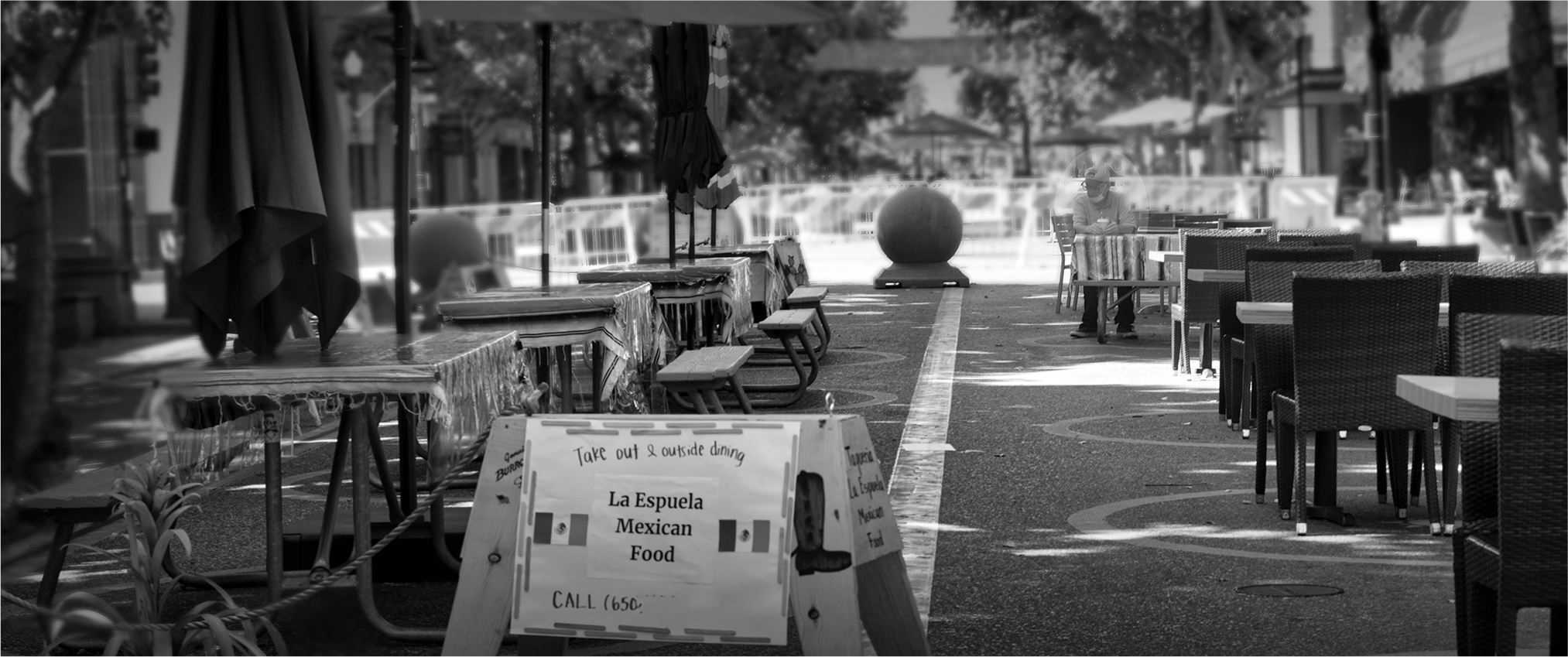
As businesses reopened during the COVID-19 pandemic, it wasn’t business as normal. Restaurants opened with outdoor dining only and limited capacity in order to facilitate social distancing and reduce the risk of virus transmission. This August 2020 photo depicts a restaurant on Castro Street in Mountain View, CA still only providing outdoor dining and takeout.
Vee via Flickr
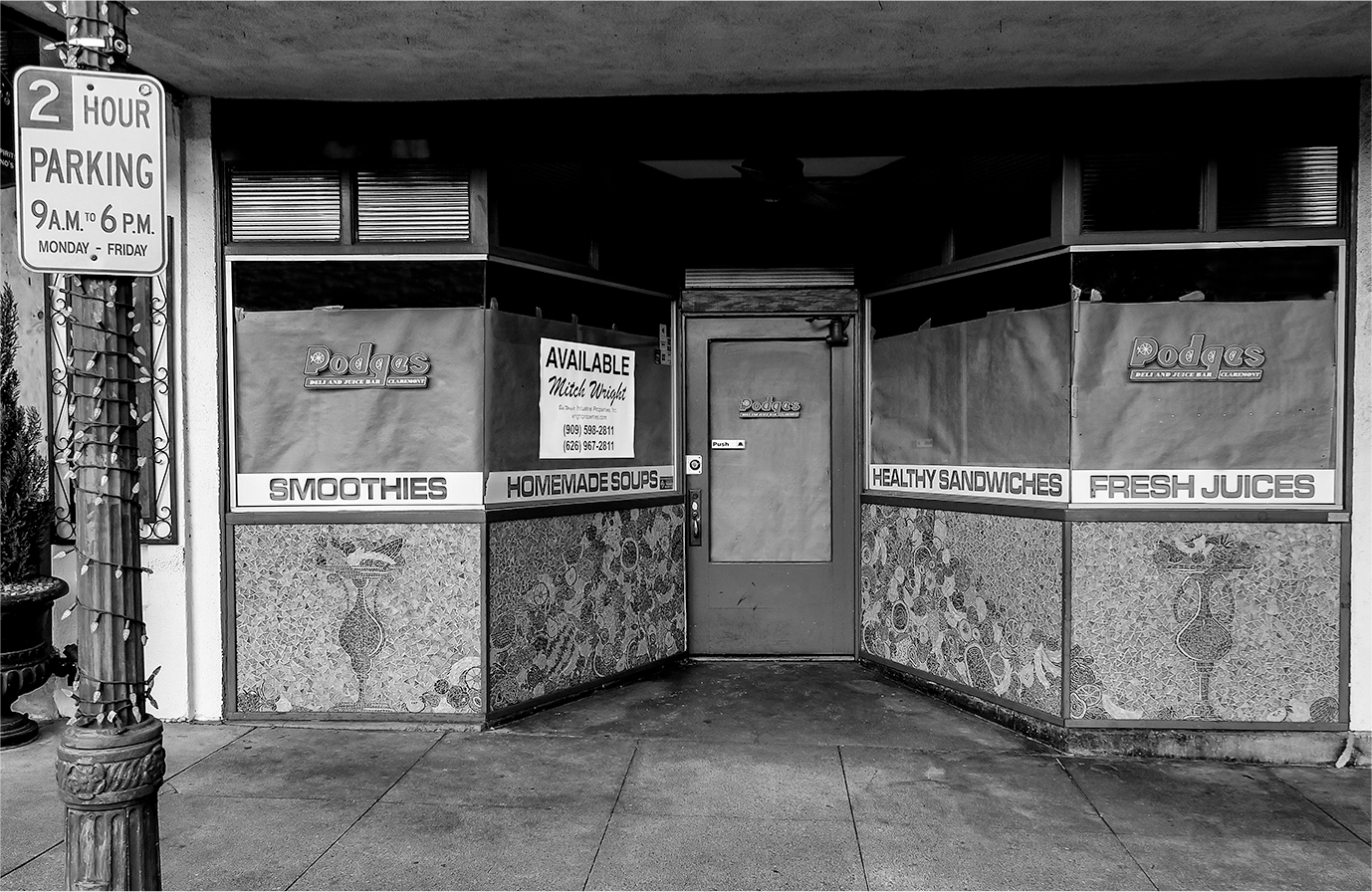
A California health food restaurant that went out of business during the coronavirus pandemic.
Russ Allison Loar via Flickr
Though U.S. restaurants have been affected by COVID-19 collectively, not all restaurants or employees have experienced COVID-19’s effects identically. Large corporate, chain restaurants are more capable of weathering the COVID-19 pandemic aftermath and actions to mitigate COVID-19 than small local, independent ones. Namely, independent restaurants are ill-equipped to be able to afford or attain social-distancing guidelines, rehire and retain employees, as well as survive and thrive pending long-term, infrequent and inconsistent patronage. Major dilemmas reside in the fact that most restaurants are independent, with 90 percent of them employing fewer than 50 employees and more than 70 percent existing as single-unit operations. According to Independent Restaurant Coalition (IRC), as the “backbone” and “lifeblood” of our economy and communities, up until COVID-19’s onset, independent restaurants directly employed 11 million people, indirectly employed 5 million food, supply and delivery workers, and annually contributed approximately $1 trillion to the U.S. economy. Strikingly, in August 2020, 75 percent of independent restaurants have already accumulated well over $50,000 in debt, and without direct aid, 85 percent of them could close permanently by year’s end, a circumstance riddled with considerable trickledown effects on incalculable other industries.
Restaurant shutdowns, employee layoffs, and social-distancing guidelines have ended, stymied, decelerated, or indefinitely postponed ethnic-heritage embracement through food-and-drink, locally-sourced produce support, spaces of retreat, camaraderie and reconnection throughout disasters, living-wage advocacy, and social justice offerings
Another pecuniary hurdle is delivery services’ (e.g., Door-Dash) inordinate fees, which introduce added costs to restaurants (and customers) on top of the 90 percent of revenue flowing to operating expenses. These are particularly detrimental to independent restaurants as IRC has noted that their “cash flow is completely dependent on current business,” and they “pay today’s bills with last week’s revenue.” Unplanned health-and-safety expenses (e.g., Personal Protective Equipment [PPE] and extra sanitizers) make it virtually impossible for independent restaurants to reopen, remain open, or flourish. After all, IRC has highlighted a minimum need of 60-percent-capacity dining for the possibility of them to open and stay open.
Besides COVID-19’s economic impacts on restaurants, there are sociocultural ones, too. Restaurant employees have had to transition from fast-paced, daily-work environments, where they experience continuous-human connection, to social isolation and quarantine, where they may experience no human contact or support. Numerous employees and patrons are unable or reluctant to return to restaurants whereby they have human interactions. Restaurant shutdowns, employee layoffs, and social-distancing guidelines have ended, stymied, decelerated, or indefinitely postponed ethnic-heritage embracement through food-and-drink, locally-sourced produce support, spaces of retreat, camaraderie and reconnection throughout disasters, living-wage advocacy, and social justice offerings (e.g., jobs for marginalized groups). Furthermore, corporate social responsibility and activism have substantially slowed or come to a standstill. However, some restaurants have shifted their charitable directions toward assisting and donating meals to nursing homes, hospitals, essential workers, communities, and protesters. Overall, COVID-19’s full impact on restaurants remains unknown and dependent on government intervention and workplace policies.
Government Intervention and Workplace Policies
As COVID-19 escalated, both NRA and IRC lobbied the U.S. government for intervention. On March 18, 2020, NRA solicited Congress to authorize a $145 billion Restaurant and Foodservice Industry Recovery Fund, $35 billion for Community Development Block Grants, $100 billion in Federally-Backed Business Interruption Insurance, and other relief (e.g., mortgage and tax deferrals and disaster-unemployment aid). In April 2020, IRC urged Congress to help independent restaurants with loan expansions and extensions through the Paycheck Protection Program, a $120 billion Independent Restaurant Revitalization Fund, tax rebates to incentivize continued employment regardless of slowed business, and Business Interrupted Insurance. Despite some intervention, as of early-November 2020, the restaurant industry awaits relief programs and packages submitted to Congress; meanwhile, workplace and national debt grow because of closures, modified-service options, limited-to-no outdoor-dining, fewer customers, unemployment claims, and business-reopening pauses because of COVID-19 case upticks.
Not only does the restaurant industry need assistance, its employees also need worker-centered support. Beyond temporary unemployment or stimulus-relief checks, restaurant staff require steady work, income, and fringe benefits. It would behoove the government to incentivize continued employment despite diminished patronage as well as assist outdoor-dining space permits and ordinance-compliance. These could ensure some wages and benefits for workers and safeguard other-industry jobs and sales as the economy gradually recovers. Restaurants should additionally seek long-term workplace solutions for socioeconomic crises, such as providing living wages and comprehensive fringe benefits to both part-time and full-time employees.
For restaurants to open and operate again, some costly COVID-19-specific health-and-safety policies are mandated (e.g., capacity limitations and masks). Government intervention would help restaurants follow and afford the required social-distancing guidelines. Restaurants should also establish well-being policies to limit COVID-19, such as employer-provided PPE, scheduled as well as timed hand and surface cleaning, sanitation stations, table layout reconfiguration, Plexiglas barriers, digital and touchless menu and payment options, single-use dinnerware upon request, best-practice handbooks, health-and-safety employee training and retraining, delivery-service disinfectant protocol, and so on. In sum, restaurants need to help reduce future COVID-19 flare-ups because many will not survive another large-scale, government-sanctioned economic shutdown.
Restaurants in a Post-Postmodern Covid-19 World
Restaurants constitute a microcosm of U.S. society, and COVID-19 has certainly underscored the gravity of the restaurant industry, along with its employees, other-industry workers, and patrons. Until restaurants can safely reopen and remain open with full-capacity operations, the complete scope of COVID-19’s consequences is pending—especially as outdoor-dining confronts inclement weather and climate disasters, COVID-19 cases and deaths rise, government aid is exhausted, moratoriums on loans, mortgages and evictions expire, people reenter workplaces and schools, people attend protests and political events, and social or holiday functions commence.
Largely, restaurant-industry recovery depends on how restaurateurs, workers, and community members handle health-and-safety practices. Undoubtedly, we will witness sizable, unprecedented and permanent economic, sociocultural, and architectural changes in and around restaurants. If the U.S. restaurant industry can marshal resources from government and cooperative efforts from interdependent industries to design and transform restaurant landscapes for a post-postmodern pandemic-rife world, it can overcome yet another national hardship. Subsequently, restaurants could then expand as essential sites of connection, reconnection, refuge, retreat, recovery, camaraderie and leisure, but with stronger infrastructure that will better withstand the next inevitable global crisis.