




Abstract
Stephanie Nawyn on Refuge Beyond Reach: How Rich Democracies Repel Asylum Seekers.
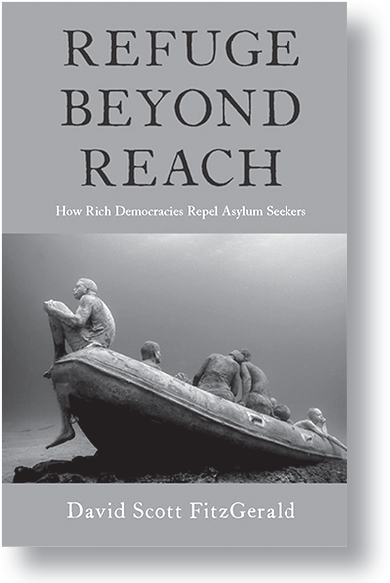
Refuge Beyond Reach: How Rich Democracies Repel Asylum Seekers by David Scott FitzGerald Oxford University Press 359 pages
Much has been said of the “global refugee crisis,” with numerous stories about the suffering of refugees and the difficulties of providing them protection. However, a closer look at those stories reveals that the “crisis” is actually about keeping refugees away from the places where they could receive protection. In reality, refugee suffering is caused not only from the circumstances that compelled them to leave their homes but also from being refused entry to countries where they could live safely. From the United States Border Patrol refusing to allow Central Americans to cross the Mexico/U.S. border in order to request asylum, to European countries keeping ships from docking that carry migrants rescued from the Mediterranean—the real crisis is the continued practice of safe countries keeping asylum seekers away from their borders.
This reality has made the burgeoning scholarship on the externalization of border enforcement one of the hottest (and arguably one of the more important policy-wise) topics in migration studies. Externalization is the act of extending border enforcement beyond actual state boundaries, sometimes into other state territories and sometimes into international waters. This happens in an effort to keep migrants outside of the externalizing state (and thus outside of any humanitarian or international treaty responsibilities that the state might have to migrants within its territory, particularly asylum seekers). FitzGerald’s Refuge Beyond Reach, a critical piece of scholarship, one that might consolidate concepts and terminology among researchers working in the area of migration management and migrant rights, has undoubtedly shaped the agenda of future research. It also sheds light on the extensiveness of externalization, allowing better criticism of these inhumane and misguided migration management practices.
FitzGerald opens the book with an elaboration on the metaphor of a fortress, which has been widely used to describe the border enforcement policies of the European Union (i.e., “Fortress Europe”). FitzGerald likens different externalization policies, or what he more frequently refers to as “remote controls,” to the defensive technologies used to protect medieval fortresses. Those technologies were cages, domes, moats, buffers, and barbicans (an outer defense wall or barrier just outside the fortress proper). I am not sure if this was intentional on FitzGerald’s part, but the use of a medieval fortress emphasizes how medieval (in the sense of draconian) these remote controls are for migrants, given the current context in which the number of people forcibly displaced has never been higher. In looking at the United States, Australia, Canada, and the EU, he does a deep dive into the history and contemporary enactment of remote control policies, demonstrating with each type how they function similarly to the technologies of fortress protection. He also explains how these remote control technologies are not new, although they have become deeper and adopted more broadly by Global North countries.
FitzGerald identifies the historical moment of this deeper utilization in the post-Geneva Convention world, when much of the international community consolidated support around protecting refugees and asylum seekers. The ratification of the 1951 Geneva Convention and the 1967 Protocol that followed created international norms around non-refoulement. This is the prohibition against returning a person back to their home country if, in doing so, they were at risk of being persecuted, tortured, or killed. Once an asylum seeker reaches the territory of a country that has ratified one or both of those treaties, the country has the responsibilitiy to protect that asylum seeker (or at the very least, not return them to the source of danger). Thus, states have a disturbing incentive to avoid those responsibilities by “keeping the refugees away from their borders in the first place” (p. 22).
FitzGerald guides readers through his case studies to explain the functions of each technology. There is caging, or keeping refugees in their countries of origin (such as military interventions to create “safe zones” intended to inhibit Iraqis from fleeing their country), or to keep them in another sovereign country (like Australia’s detention of migrants on Nauru). There are domes, or creating entry restrictions over a territory (most commonly through visa systems that create a “paper curtain” keeping out unwanted migrants). There are moats, produced by policing the offshore waters of a territory (like what the EU has implemented in the Mediterranean Sea). There are buffers, which entail coordinating with other countries to host asylum seekers (the prime example currently is how Mexico is buffering Central American migrants from the United States); and barbicans, or creating a legal zone that can be policed by a state but which does not “count” as that state’s territory in the case of granting rights to asylum seekers (such as Australia’s use of Christmas Island or the United States’ use of Guantanamo). Each example demonstrates how the metaphor of a medieval fortress applies to present-day migration controls. The specificity is important, as metaphors are often used loosely in sociological research, creating more fuzziness than clarity. FitzGerald works through each thoroughly, with the end result creating a concrete typology of concepts and terminology that can be used by other scholars.
The web of policies and treaties around any issue can be complicated and dry material to relay. However, FitzGerald does a nice job of explaining international agreements and their legal standing, such as the Schengen and Dublin agreements. Schengen, which abolished visa restrictions between most EU member states, is a treaty with state signatories that cannot be undone at the whim of a single state. Alternatively, the EU-Turkey readmission agreement does not have the same legal standing as a treaty and thus can be abandoned by either party. At the time that I wrote this review, Turkey had announced that they will no longer honor this agreement). But in addition to unilateral withdrawal, the EU-Turkey readmission agreement (which allowed the EU to return any migrants thought to have come through Turkey back to that country rather than being forced to recognize those migrants as asylum seekers) can also not be challenged in EU courts. Thus, there is no legal recourse for migrants deported from the EU back to Turkey.
FitzGerald traces these fine lines of legality as he describes remote controls and states’ efforts to keep migrants just beyond the geopolitical spaces where those states would be legally required to recognize the rights of migrants. What is legal, then, in a strict sense, does not follow the spirit of the law but is still allowable. It creates an avenue for states to enact whatever exclusionary policies they deem fit while still (barely) following international norms of non-refoulement. This is an interesting turn on the legal/illegal conversation in migration studies, which is more commonly directed at migrants themselves.
This argument also provides a space for FitzGerald to introduce a moral stance on border protection, to look beyond the courts for a solution to injustices against migrants. He writes, “questioning legality is necessary but insufficient. The question should not be just whether a policy is legal but also whether it is good” (p. 253). The courts have been a resource for expanding protection of asylum seekers such as American Baptist Churches v. Thornburgh which granted temporary protected status to Central American asylum seekers, and the numerous lower court rejections of President Trump’s Muslim travel ban. FitzGerald, however, sees more opportunities for civil society to challenge remote controls. Whereas courts are limited by the law (which remote controls deftly skirt), civil society can make moral/ethical and human rights arguments that these medieval migration control practices cannot circumnavigate.
FitzGerald’s overarching argument hinges on the idea that states have an obligation to migrants once they have arrived on their territory; what he refers to as a “Hippocratic bubble” (e.g., once migrants enter the bubble, states are obliged to offer some care). This is one area where I might quibble with him (albeit cautiously). Overall, there is no question that there is a more robust rights regime for migrants who have entered the territory of a Geneva or 1967 Protocol signatory, and that this incentivizes remote controls. However, I am not as optimistic as he is that international norms of non-refoulement hold the weight that they once did; that “Hippocratic bubble” looks pretty flimsy to me. Claiming asylum seekers are not really refugees, but just economic migrants—or even that they are purported terrorists or gang members committed to doing harm to citizens—is all it takes to justify the most deplorable treatment of migrants within that bubble. From child migrants dying in detention centers to deported migrants dying within days of being returned to their home country, there are a depressing number of examples of liberal democracies throwing the norms of non-refoulement and humanitarianism out the window.
Most of Refuge Beyond Reach was written well before the worst human rights violations of migrants in the United States, Turkey, and elsewhere were coming to light. I do wonder how FitzGerald might have tweaked some statements in reflecting on what looks, to me, like a decaying international agreement to give at least lip service to refugee protection. However, even without any changes, the argument still stands, and I expect it will stand the test of time—not an easy thing to achieve in a field where conditions are moving so quickly that it is extremely difficult to stay updated. Beyond migration scholars and students (all of whom should read this book), it is a great piece for understanding broader concepts in international relations and national policies, and the disjuncture between the law, norms, and actual practices. This book will hopefully also start conversations about the costs—in human suffering and the well-being of a cooperative international order as well as financial costs—that come with externalization. It encourages us to consider how destination countries could better spend their resources to alleviate rather than compound the suffering of refugees and asylum seekers.