



Abstract
Executive Summary
For the past 25 years, the Border Patrol has tracked migrant deaths along the US-Mexico border. For nearly the same amount of time, it has also faced criticisms that it failed to capture the true number of migrant deaths in its tally. This article focuses on these undercounting criticisms and asks two questions: (1) How many documented migrant death cases are left out of Border Patrol’s official data? And (2) what factors lead to the Border Patrol’s migrant death undercounting? In particular, the article focuses on three South Texas counties: Brooks County, Kenedy County, and Maverick County.
To answer the research questions, this article relies on comparative data analysis. In particular, it compares two person-level datasets: the Border Patrol’s dataset on migrant deaths from 2009 to 2017 and county-level records from the Brooks County Sheriff’s Office, the Kenedy County Sheriff’s Office, and Maverick County Justices of the Peace over the same period. It then attempts to match each county-level record to a recorded death in the Border Patrol’s dataset. Using this process, the article quantifies migrant death undercounting in South Texas, highlights geographic and temporal trends, and tracks the uncounted cases’ specific characteristics.
From 2009 to 2017, this comparative data analysis confirmed that the Border Patrol was undercounting migrant deaths across the three South Texas counties. Specifically, the article finds that the Border Patrol failed to include 139 cases, which totaled 19 percent of the counties’ 749 recorded migrant deaths during the study period. This undercounting ranged from 16 percent in Brooks County to 24 percent in Maverick County and 29 percent in Kenedy County, with fluctuating rates over time. The uncounted cases also had specific characteristics. In particular, they were more likely to be skeletal remains, lack an identification, and be discovered by an external entity. These characteristics highlight the various factors behind the Border Patrol’s undercounting, such as issues with the Border Patrol’s migrant death definition, inconsistent data collection from external entities, and the agency’s low prioritization of migrant death tracking.
To address and remedy the Border Patrol’s migrant death undercounting requires tackling each underlying factor. First and foremost, this article recommends that the Border Patrol fully train its agents on the agency’s migrant death definition and ensure consistent and standardized outreach to external entities. Further, it recommends that the Border Patrol improve its migrant death count’s accuracy through additional operational changes. These proposed changes include making “accurate migrant death counts” an official objective for the Border Patrol’s Missing Migrant Program, prioritizing a two-way information-sharing process with county-level officials, retroactively including missed migrant deaths in the official count, and publishing more detailed person-level data on migrant deaths.
From October 2022 through September 2023, the US Border Patrol reported approximately 640 migrant deaths along the US-Mexico border (Isacson 2023). These individuals drowned in the Rio Grande and the All-American Canal; died from dehydration and exposure to the elements in rough terrain; and suffocated in train wagons, among various other causes. They make up part of the Border Patrol’s official count of more than 10,000 total migrant deaths since 1998, and are one of the highest annual counts to date (US Border Patrol 2024a, 2024b). Yet, despite these staggering numbers, they still fall short of the true number of migrant deaths.
The Border Patrol maintains the federal government’s official count of migrant deaths along the US-Mexico border. However, for decades, immigration advocates, scholars, and journalists have accused the agency of widespread undercounting and a lack of transparency (Almond 2004; Ewing 2014; Ortega 2018; Heyman, Slack, and Martinez, 2019; Martinez et al. 2021). Some of this undercounting is by design. For example, the Border Patrol does not include migrants who die in Mexico or whose bodies wash up on the Mexican side of the Rio Grande, as these deaths are not in US territory. Nor does the Border Patrol include migrants who die in the United States and whose bodies are never recovered, since it only tracks discovered remains (Reineke 2022). Yet, the Border Patrol has also been criticized for failing to include all migrant remains that are discovered within US territory, which is the very description of its official count.
This article focuses on this last type of undercounting. In particular, it asks two questions: (1) How many documented migrant death cases are left out of Border Patrol’s official data? And (2) what factors are associated with the Border Patrol’s migrant death undercounting? In particular, the article centers on three South Texas counties: Brooks County, Kenedy County, and Maverick County. These counties all host a Border Patrol checkpoint but are located in different parts of South Texas, with Maverick County based on the physical US-Mexico border, and Brooks County and Kenedy County beginning nearly 50 miles into the Texas interior (see Figure 1). Overall, South Texas has 21 counties that are located within 100 miles of the US-Mexico border.
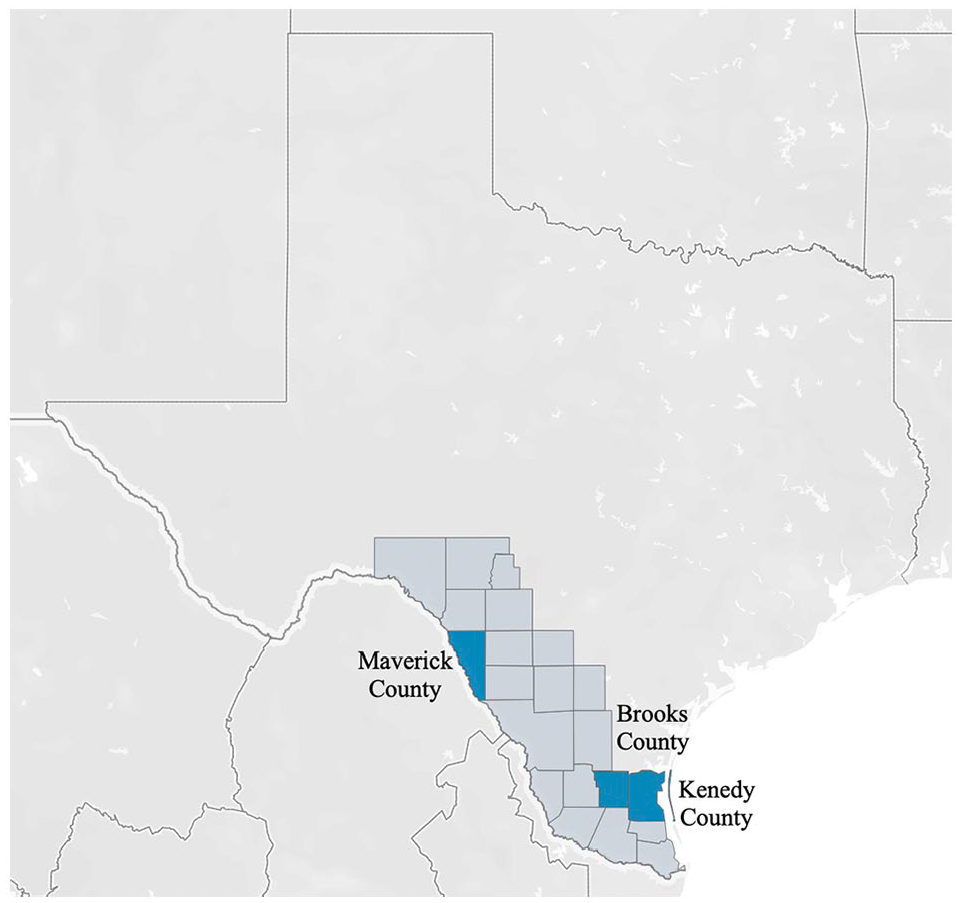
Map of South Texas Counties.
To answer the research questions, this article relies on comparative data analysis. In particular, it compares two person-level datasets: the Border Patrol’s dataset on migrant deaths from 2009 to 2017 and county-level records from the Brooks County Sheriff’s Office, the Kenedy County Sheriff’s Office, and Maverick County Justices of the Peace over the same time period. It then attempts to match each county-level record to a recorded death in the Border Patrol’s dataset. Through this process, the article quantifies migrant death undercounting in South Texas, highlights geographic and temporal trends, and tracks the uncounted cases’ specific characteristics.
From 2009 to 2017, the comparative data analysis confirmed that the Border Patrol was undercounting migrant deaths in the three South Texas counties. Specifically, the article finds that the Border Patrol failed to include 139 cases, which totaled 19 percent of the counties’ 749 recorded migrant deaths during the study period. This undercounting ranged from 16 percent in Brooks County to 24 percent in Maverick County and 29 percent in Kenedy County, with fluctuating rates over time. The uncounted cases also had common characteristics, which highlight the various factors behind the Border Patrol’s undercounting. In particular, they were more likely to be skeletal remains, lack an identification, and be discovered by an external entity. These characteristics highlight the various factors behind the Border Patrol’s undercounting, such as issues surrounding the Border Patrol’s migrant death definition, incomplete inclusion of county-level officials’ migrant death records, and the agency’s low prioritization of migrant death tracking.
Border Patrol’s Migrant Death Counting
For more than 200 years, the US government has tracked basic data related to migration. In 1820, the US Department of State began collecting continuous statistics on migrant arrivals at seaports along the Atlantic Ocean and Gulf of Mexico, adding in Pacific Ocean seaports some 30 years later (US Census Bureau 1949). By the late 1800s and early 1900s, restrictive US immigration policies began banning certain types of individuals from entering the country. As a result, the data also shifted to track these blocked individuals and the increase in migrants arriving along the Mexico and Canada land borders. In 1924, the US government officially allocated money to create the US Border Patrol, and the new agency began counting migrant apprehensions between ports of entry.
Yet, tracking migrant deaths along the United States’ borders is a more recent phenomenon. In the late 1970s, writers and journalists documented the Border Patrol’s first piecemeal attempts to count these deaths. In 1979, Border Patrol agents in the Yuma Sector kept a file titled “Desert Deaths” that systematically tracked recovered remains (Annerino 1996). That same year, then Immigration and Naturalization Service Commissioner Leonel Castillo also requested a survey of migrant deaths along the entire border, after becoming alarmed at the number of Rio Grande drowning deaths (Los Angeles Times Services 1979).
However, it was not until 1998 that the Border Patrol began formally tracking migrant deaths border-wide. At this time, the agency was under pressure to acknowledge and address the mounting number of deaths occurring in the California and Arizona deserts. Just a few years prior, in 1994, the Border Patrol had launched its “Prevention Through Deterrence” strategy, which explicitly aimed to deter migrants from crossing the border in urban areas and push them to more rural and rugged terrain, where the agency believed that it had the tactical advantage (US Border Patrol 1994). Soon after, scholars began documenting shifting migration routes — with migrants traversing rougher terrain for longer periods — and more people dying from environmental factors, such as heat exposure and dehydration (Eschbach et al. 1999; Cornelius 2001; Eschbach, Hagan, and Rodriguez 2001, 2003).
On June 16, 1998, the Border Patrol responded to this external pressure by launching the Border Safety Initiative, which was billed as “an aggressive, border-wide public safety initiative designed to reduce injuries and prevent fatalities” (Immigration and Naturalization Service 1998). The Border Safety Initiative was structured around three main elements — prevention, search and rescue, and identification — and included a range of activities, such as placing warning signs at dangerous crossing points and improving Border Patrol’s cooperation with local authorities to identify deceased migrants. Soon after, the agency also launched the Border Patrol Search, Trauma, and Rescue (BORSTAR) Unit, which trained agents in tactical medicine and search and rescue techniques. However, most importantly for migrant death counting, Border Patrol agents also began to record migrant deaths in the new Border Safety Initiative Tracking System (BSITS).
Currently, the Border Patrol continues to use BSITS to track migrant deaths along the US-Mexico border. Border Patrol agents within the agency’s operations centers and stations collect and upload the available information on each migrant death’s location, cause of death, and the decedent’s name, sex, date of birth, and nationality. The Border Patrol then publishes the aggregate migrant death numbers on its website, and uses this data to operationalize other border safety initiatives. For example, in certain sectors, the Border Patrol uses migrant death locations to help determine where to place rescue beacons (US Government Accountability Office 2022a, 13). 1
Border Patrol Undercounting Criticisms
Since the Border Patrol began counting migrant deaths along the US-Mexico border, it has also simultaneously faced criticisms that it was not including a large number of deaths. In 2001 — only three years after the agency began collecting migrant death data — US immigration organizations and human rights activists were already documenting these issues (Kerwin 2001). In particular, they claimed that Border Patrol agents were excluding “many skeletal remains, car accident victims and bodies discovered by local law enforcement agencies” (Almond 2004). Soon after, a 2006 Government Accountability Office report also highlighted inconsistent Border Patrol data collection, and a Tucson Sector Border Patrol spokesman admitted that “mistakes were made . . . that resulted in undercounting border-crosser deaths” (Sorenson 2006; US Government Accountability Office 2006).
Overall, several issues have contributed to the Border Patrol’s migrant death undercounting. The first issue is who exactly should be included in the agency’s official tally. Initially, the Border Patrol counted only deceased individuals who were “in furtherance of an illegal entry” and within a target zone of 45 counties on or near the US-Mexico border (US Government Accountability Office 2006). As a result, Border Patrol agents excluded any case that did not fall within these specific parameters. This included some of the era’s most high-profile migrant death tragedies, such as the 2003 case of 19 migrants who suffocated in a tractor-trailer in Victoria, Texas. The Border Patrol omitted this case because it occurred outside the Border Patrol’s geographic target area (Almond 2004).
In the following years, the Border Patrol expanded its migrant death definition. By 2016, the agency’s definition included individuals who died: “1) while in furtherance of an illegal entry; 2) within the designated target zone [of 45 border counties] whether or not the Border Patrol was directly involved: and/or 3) outside the designated target zone when the Border Patrol has direct involvement with the incident” (US Customs and Border Protection 2017). As of January 2024, the Border Patrol continues to use this official definition to determine who should be included in its count (US Border Patrol 2024a). However, it is unclear whether agents across all of the Border Patrol’s sectors have consistently followed this definition in their data inclusion processes (US Government Accountability Office 2022a).
The Border Patrol’s second undercounting issue centers on its need to incorporate external entities’ migrant death records into its official count. Border Patrol agents are not always present when an external entity discovers migrant remains. In these cases, the Border Patrol must seek out the responding local actors and request their migrant death information. However, Border Patrol agents have never adopted a standardized approach to this type of outreach. In 2004, the Tucson Sector’s Border Patrol complained that local law enforcement did not always notify them when they discovered a deceased migrant (Almond 2004). While in 2006, the Government Accountability Office found that the Border Patrol’s coordinators had diverging approaches for building relationships with external entities, leading them to miss numerous cases (US Government Accountability Office 2006, 25).
Currently, the Border Patrol has coordinators who are tasked with conducting outreach and collecting external actors’ migrant death data. In September 2021, the Border Patrol issued official guidance for standardizing these activities (US Government Accountability Office 2022a, 22). However, as of January 2024, they were still finalizing updates to their approach (US Government Accountability Office 2024, 4). In this void, numerous reports have documented migrant death undercounting. In 2018, a CNN article accused the Border Patrol of leaving out 560 migrant deaths that were in local authorities’ datasets (Ortega 2018). While in 2021, scholars at the University of Arizona also documented a growing divergence between the Pima County Medical Examiner’s Office migrant death count and the Border Patrol’s official tally (Martinez et al. 2021, 15). An April 2022 GAO report addressed this specific undercounting, finding that the “Border Patrol was not recording all migrant deaths in instances where an external entity first discovers the remains” (US Government Accountability Office 2022a, 14).
Finally, the third undercounting issue revolves around the Border Patrol’s seemingly low prioritization of migrant death counting within its broader mission set. This low prioritization is clearest in moments when the Border Patrol becomes aware of overlooked migrant death cases. For example, in 2005, the Tucson Sector Border Patrol Chief acknowledged that the Border Patrol might be undercounting migrant deaths and promised to “rectify any discrepancy with medical examiners numbers” (LoMonaco 2005). However, of the suspected 50 missing cases, the Border Patrol appears to have only amended the data to add four additional cases (Almond 2004; US Border Patrol 2024b). 2 Further, after an April 2022 Government Accountability Office report highlighted 140 uncounted migrant death cases in the Tucson Sector, the Border Patrol stated that it could not review and include the cases due to “the need to address other priorities” (US Government Accountability Office 2022b). This low prioritization of migrant death counting, particularly compared to the agency’s enforcement efforts, means less attention, resources, and personnel, for inputting these identified cases and for addressing overall undercounting.
Since the Border Patrol is the official source for migrant death data along the U.S.-Mexico border, its migrant death undercounting can have significant implications for policy and research. Various actors — including policymakers, journalists, and researchers — rely on the Border Patrol’s estimates to understand contemporary and historical migrant death trends across the border. Additionally, within the Border Patrol, migrant death numbers can also drive attention and help attract resources for the agency’s initiatives that address migrant deaths. If the Border Patrol’s migrant death counts are inaccurate, then any entity that generates a decision or makes a conclusion from this data is doing so upon an incomplete and possibly inaccurate foundation.
Methodology
This article uses comparative data analysis to determine and analyze the Border Patrol’s migrant death undercounting. Specifically, it compares two datasets: the Border Patrol’s BSITS person-level data on migrant deaths and county authorities’ migrant death records. To compare these datasets, the article attempted to match each county-level record to a death within the Border Patrol’s dataset. This approach allows for tracking the deaths that the Border Patrol included in its official count, the undercounting patterns across the three counties, and the types of cases that were left out of the official tally.
This article’s first dataset is the Border Patrol’s BSITS data on migrant deaths, which was requested and compiled through two Freedom of Information Act requests. 3 This Border Patrol dataset contains 9,026 migrant deaths from October 1997 through August 2021, and includes a range of variables such as the recovered remains’ discovery date, GPS coordinates (from October 1997 through October 2017), presumed cause of death, responding local agencies, and the decedent’s demographic information.
The second dataset contains local officials’ records, specifically from the Brooks County Sheriff’s Office, the Kenedy County Sheriff’s Office, and Maverick County Justices of the Peace. These county-level officials create records when a migrant dies in their jurisdictions. Typically, members of Sheriff’s Offices create incident reports for migrants who drown in the Rio Grande or die on private ranchland and Justices of the Peace carry out an “inquest” for each death. This dataset includes information from these three county-level officials since they were the only South Texas authorities that maintained and shared complete migrant deaths records from 2009 to 2017. 4 In total, the dataset includes 749 death cases from 2009 to 2017, with 580 cases from Brooks County, 90 cases from Kenedy County, and 79 cases from Maverick County. It includes variables on death location, discovering party, belongings, and the migrant’s demographic characteristics.
The comparative data analysis involved two primary steps. The first step was to clean the Border Patrol dataset, creating a “county” variable and coding each migrant death to the county where the remains were discovered. These activities meant mapping the Border Patrol’s GPS coordinates and confirming the appropriate county through additional variables, such as the presence of any local agencies. While this activity was not technically essential, it facilitated the matching process. The second step was then to match each county-level record to a death in the Border Patrol’s dataset using a range of variables. Specifically, the author first sorted the cases by county and attempted to match the cases by a combination of discovery date and GPS coordinates. 5 If necessary, the author then used available demographic data to confirm the match.
The case matching created two categories: migrant deaths that appeared in the Border Patrol’s dataset and migrant deaths that were not counted. The author then compared various characteristics across these two categories to determine if any conditions or circumstances influenced undercounting. This secondary analysis focused only on the Brooks County Sheriff’s Office and the Kenedy County Sheriff’s Office data, which both had sufficiently detailed records to track a range of variables. By comparison, the Maverick County Justices of the Peace inquests often contained only basic location and date information. To conduct this secondary analysis, the article uses descriptive data analysis to identify differences and inferential statistical analysis (two tailed t-tests assuming unequal variance) to determine these differences’ significance.
Trends for Uncounted Migrant Deaths
From 2009 to 2017, the Border Patrol commonly failed to include all migrant deaths that occurred in Brooks County, Kenedy County, and Maverick County. During this period, county-level authorities documented 749 cases of recovered migrant remains within their jurisdictions. When comparing these deaths to the Border Patrol’s dataset, 610 cases, or 81 percent, had a corresponding match. However, the remaining 139 cases, or 19 percent, could not be matched to any Border Patrol cases. These latter unmatched cases represent the Border Patrol’s migrant death undercounting rate.
This Border Patrol undercounting rate looked different in each county. In Brooks County, migrants die from exposure to the elements — such as heat exhaustion, cold temperatures, or dehydration — while hiking around the Border Patrol’s highway checkpoint in Falfurrias. The Brooks County Sheriff’s Office creates an incident report for each of these deaths, which totaled 580 cases from 2009 to 2017. Of these documented deaths, the Border Patrol failed to include 94 cases in their official dataset, which is a 16 percent undercounting rate. This undercounting rate varied over time. From 2009 to 2011, the Border Patrol had an undercounting rate of between 28 percent and 41 percent. But over the following years, the undercounting rate in Brooks County steadily dropped to between 7 percent and 10 percent, which equaled between four and eight missed migrant death cases each year (Figure 2).
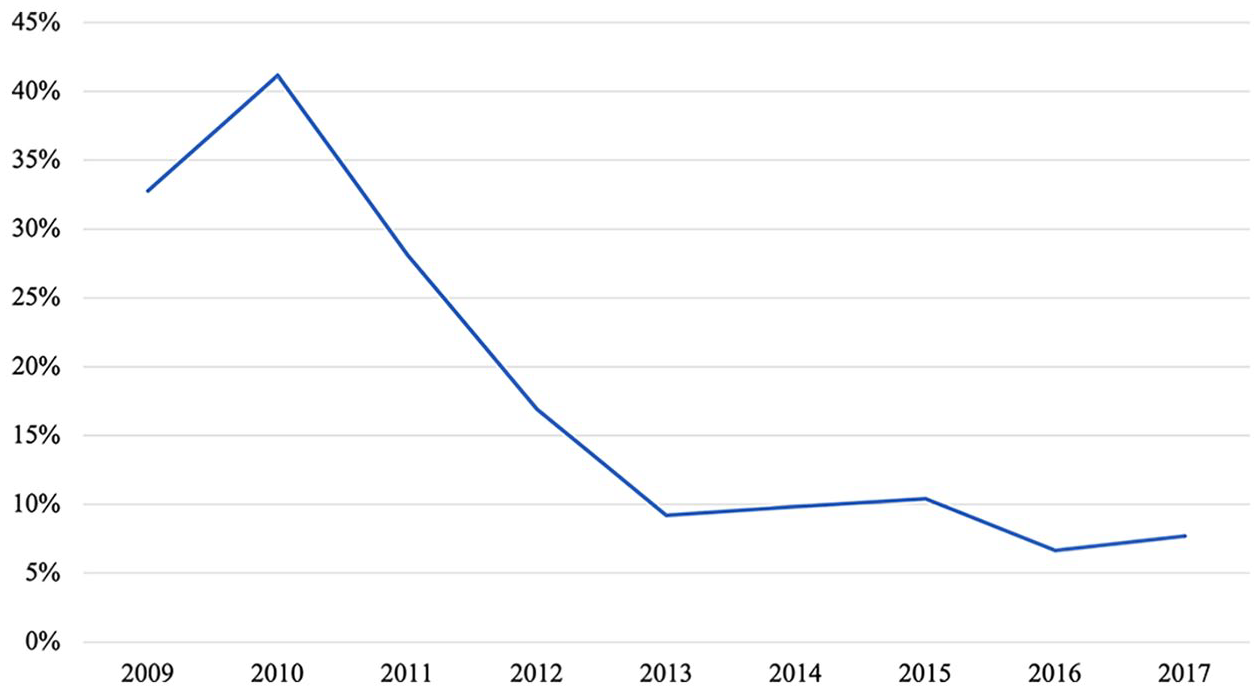
Border Patrol’s Undercounting Rate for Brooks County (2009–2017).
In Kenedy County, most migrants die from exposure to the elements as they attempt to circumvent the Border Patrol’s highway checkpoint in Sarita. 6 From 2009 to 2017, the Kenedy County Sheriff’s Office also tracked these deaths and documented 90 cases through its incident reports. Of these deaths, the Border Patrol failed to include 26 cases, which totaled a 29 percent undercounting rate. Similar to Brooks County, the Border Patrol’s undercounting followed a declining pattern. During the earliest years, the Border Patrol’s undercounting rate was at its highest, and the official undercounting rate was between 44 percent and 60 percent of migrant deaths. However, by 2012, the undercounting rate in Kenedy County had decreased and stabilized to a range of 15 percent–40 percent, which equaled between two and four migrant deaths a year (Figure 3).
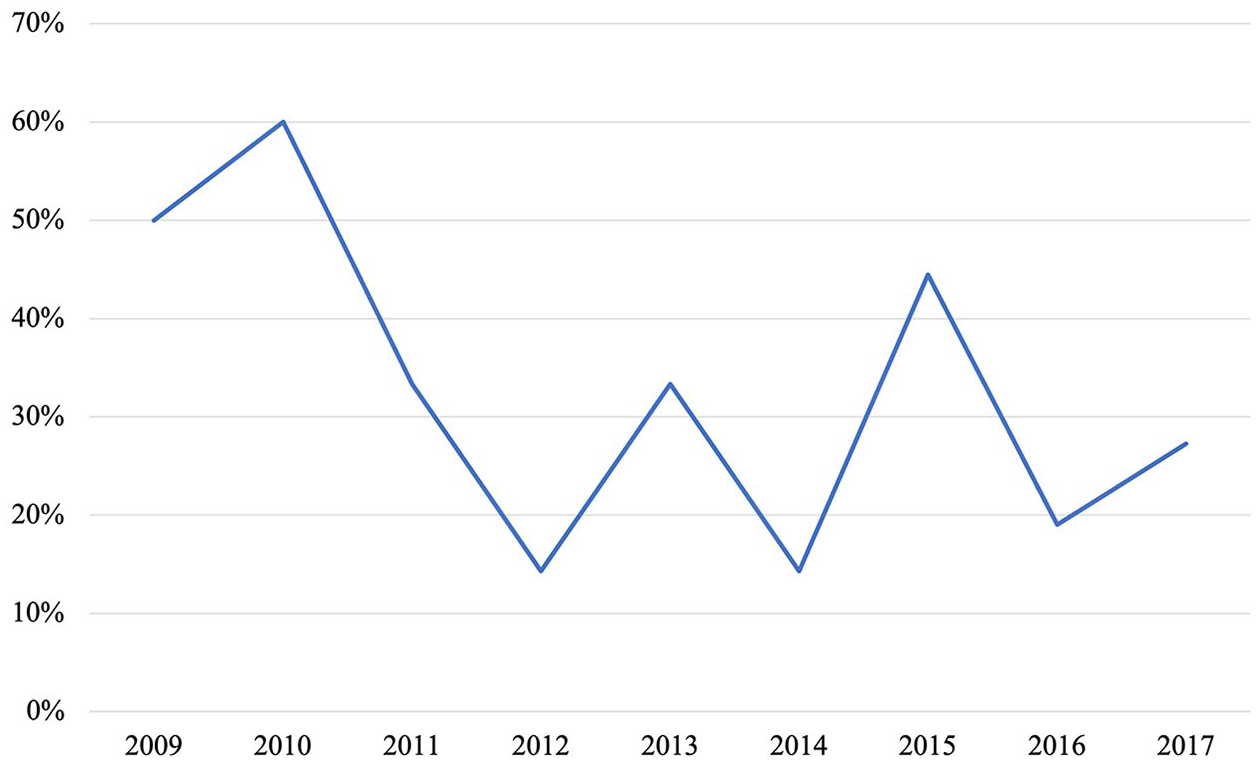
Border Patrol Undercounting Rate for Kenedy County (2009–2017).
In Maverick County, migrants drown in the Rio Grande or die from exposure to the elements while circumventing the Border Patrol’s highway checkpoint in Eagle Pass. A Maverick County Justice of the Peace conducts an inquest for these deaths and, from 2009 to 2017, these Justices of the Peace documented 79 migrant death cases. Of these cases, the Border Patrol failed to include 19 cases in their official count, creating an undercounting rate of 24 percent. The undercounting rate for Maverick County also varied over time but followed a distinct pattern. In 2009, the Border Patrol documented eight migrant deaths, but Justices of the Peace did not document any cases. While in 2010, these local officials documented only two deaths, both of which were in the Border Patrol’s dataset. However, from 2011 to 2017, the Border Patrol consistently failed to include all of the county’s migrant death cases, leading to an undercounting rate of between 20 percent and 33 percent, or between two and three cases a year (Figure 4).
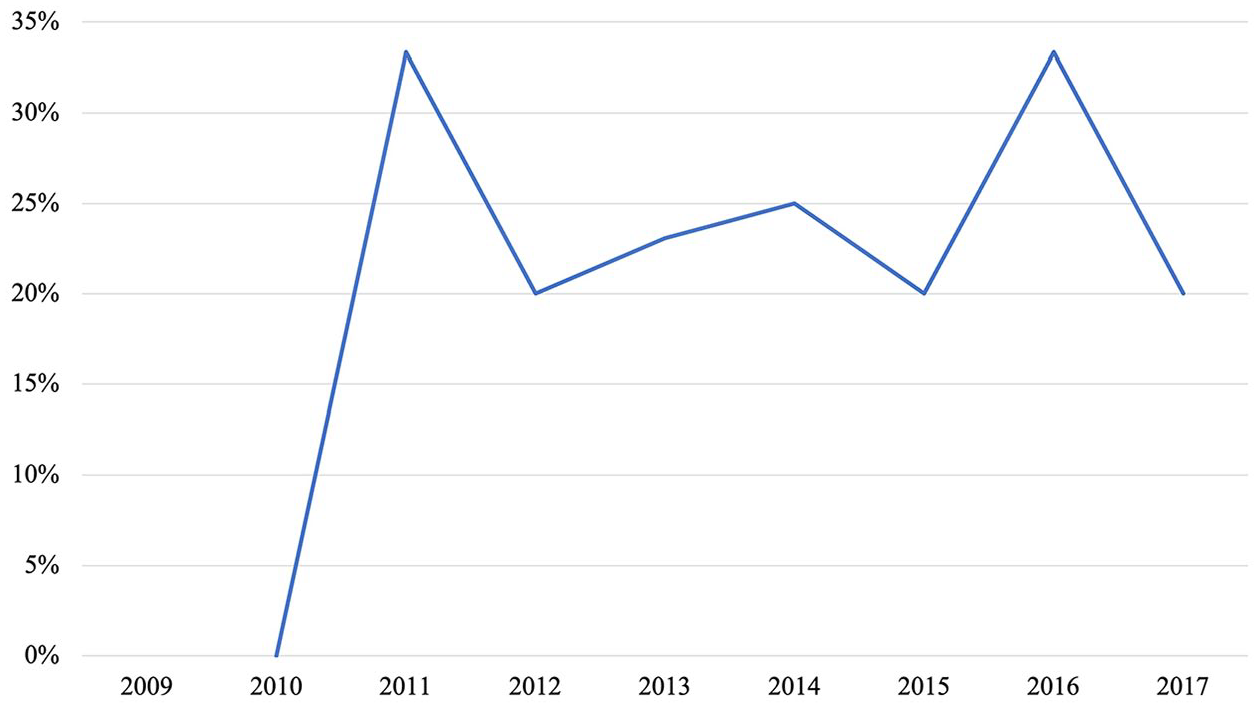
Border Patrol Undercounting Rate for Maverick County (2009–2017).
Yet, no dataset was fully complete. For the three South Texas counties, the Border Patrol dataset included 68 cases that were not found in any county-level records. These Border Patrol cases were concentrated in the time period’s earlier years, with 40 percent occurring in 2009 and 2010. Some of these cases may be missing from county records because they involved other responding authorities — such as the Texas Department of Public Safety for vehicle accidents — or if the migrant died in a nearby hospital. However, the Border Patrol’s data reported that the Brooks County Sheriff’s Office and Kenedy County Sheriff’s Office were directly involved in 10 of these missing cases. Additionally, the Maverick County Sheriff’s Office was involved in another seven missing cases, which likely would have meant notifying a Justice of the Peace. While it is not immediately clear why county officials’ records did not include all of these cases, it likely reflects some level of poor or inconsistent record keeping.
Uncounted Migrant Death Cases
To better understand why the Border Patrol failed to count certain deaths, this section relies on the data from the Brooks County Sheriff’s Office and Kenedy County Sheriff’s Office. These local officials produce incident reports for each migrant death case, which generally include the recovered remains’ GPS coordinates, discovering party, state of decomposition, belongings, and any available demographic information. Each incident report also contains photographs of the remains and surrounding area. This section does not include information from Maverick County, since the Justice of the Peaces’ inquests generally contain only the date of discovery, location, and cause of death.
From 2009 to 2017, there was not one homogenous profile for an uncounted migrant death. The uncounted deaths included a human skull tucked into tall ranch grass; the skeletal remains of a 56-year-old Brazilian male whose spouse was living in the United States; and a recently deceased 16-year-old Honduran teenager who was found lying next to a ranch road. In fact, there were no clear demographic differences between the counted and uncounted remains. Men and women were represented at roughly equal rates between the counted and uncounted cases, and there was a similar nationality breakdown. 7 Proportions tests confirmed that the demographic differences were not statistically significant for cases that had identifying information (see Table 1).
Demographics and Conditions by Counted and Uncounted Cases (2009–2017). 8
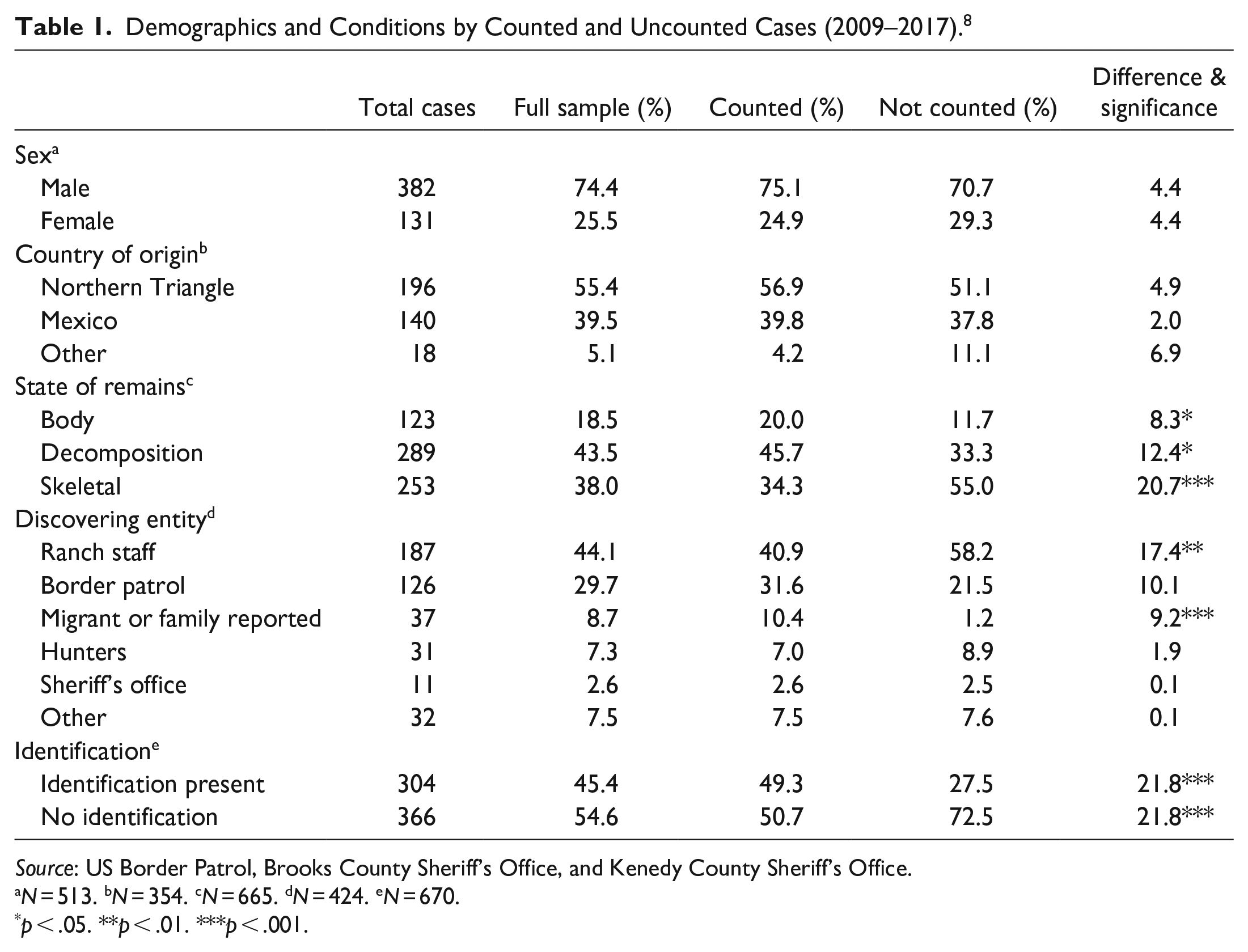
Source: US Border Patrol, Brooks County Sheriff’s Office, and Kenedy County Sheriff’s Office.
N = 513. bN = 354. cN = 665. dN = 424. eN = 670.
p < .05. **p < .01. ***p < .001.
Yet, there were some specific conditions and circumstances that were more common among the uncounted cases. First, the Border Patrol was less likely to count skeletal remains, compared to more recently deceased individuals. To reach this conclusion, this article used a coding metric for the remains’ state of decomposition, which was based on the photographs for each migrant death case. This coding followed three categories: (1) Body, for when there were no visible signs of decomposition; (2) Decomposition, which spanned all stages from initial decomposition to small pieces of tissue on skeletal remains; and (3) Skeletal remains, for when there were only bones. Using this imprecise coding mechanism, this section tracked the Border Patrol’s case inclusion by the state of decomposition.
While the Border Patrol failed to count recovered remains from all three categories of decomposition, they most frequently missed skeletal remains. Among the total cases with a known state of decomposition, 55 percent of the Border Patrol’s uncounted cases in Brooks County and Kenedy County were skeletal remains, with 33 percent in some form of decomposition and 12 percent as recently deceased individuals. By comparison, among the counted cases, only 34 percent of the cases were skeletal remains, compared to 46 percent that were discovered in some form of decomposition and 20 percent who were recently deceased. Proportions tests also revealed a statistically significant association between the state of decomposition and Border Patrol’s inclusion in its migrant death dataset.
Second, there is some evidence that the discovering entity influenced whether or not the Border Patrol included the case in its tally. In both Brooks County and Kenedy County, ranch staff were the most common entity to discover migrant remains. These individuals often found deceased migrants while going about their regular routines, such as feeding cattle, or when venturing into remote ranch areas for special projects. Yet, there were differences when ranch staff discovered migrant remains. Specifically, these cases were less likely to appear in the Border Patrol’s dataset and this difference was statistically significant (see Table 1). This dynamic was even more pronounced when ranch staff discovered skeletal remains. Within the dataset, there were 76 cases where ranch staff discovered skeletal remains, but only 46 of these cases (61 percent) ended up in the Border Patrol’s dataset. By comparison, of the 110 cases when ranch staff discovered decomposing or recently deceased remains, 94 cases (85 percent) were eventually counted.
Notably, the Border Patrol is also listed as the discovering party for some of the cases that were never included in their dataset. Border Patrol agents often find migrant remains in Brooks County and Kenedy County while tracking groups of migrants through the brush or conducting routine patrols. Throughout the Sheriff’s Office’s incident reports, Border Patrol agents were listed as the discovering party for 17 uncounted cases that spanned the dataset’s time period. These cases included an incident where Border Patrol agents found a Mexican woman who had stayed behind with her then-deceased husband; a Border Patrol agent who spotted a human skull in a creek bed; and another agent who stumbled upon a recently deceased man. For all of these cases, the responding Border Patrol agents alerted the county Sheriff’s Office but failed to input the case into their own system.
Third, and finally, the Border Patrol was less likely to include a case in its dataset if the remains lacked a form of identification. Migrants often travel with identification, such as a driver’s license, passport, or voter registration card. If the individual dies during the journey, these forms of identification mark the individual as a likely migrant and also provide officials with a starting point to confirm the person’s identity and alert their family. However, 73 percent of the uncounted migrants lacked a form of identification, compared to 51 percent of the counted cases. This finding did not depend on the state of decomposition, with the Border Patrol being less likely to include any type of remains if it did not have a form of identification. Proportions tests also confirmed a significant association between the presence of an identification and inclusion in the Border Patrol’s dataset.
Discussion
For 25 years, the Border Patrol has tracked migrant deaths along the border through its BSITS dataset. While for nearly the same amount of time, it has also faced
Between 2009 and 2017, the Border Patrol adopted its current migrant death definition. 9 At this time, the agency moved from a limited to a more expansive definition, to better capture the true number of migrant deaths along the border. Yet, for this definition to improve migrant death counting, Border Patrol agents would need to be aware of the new definition and apply it consistently across cases. This seems unlikely to have occurred immediately, as an April 2022 Government Accountability Office report noted that there was still confusion surrounding the agency’s migrant death definition (US Government Accountability Office 2022a, 16–17). Further, the Border Patrol’s higher undercounting rates for cases that lacked a form of identification also highlights the question of who Border Patrol agents may consider to be a migrant. Without an identification, agents may narrowly interpret the migrant death definition and be less inclined to include certain cases in their count.
Second, for at least 20 years, the Border Patrol has reported challenges related to collecting migrant death data from external entities. In general, if a Border Patrol agent was not present during the discovery of migrant remains, the agency’s coordinators would need to reach out to the responding entities to receive information about the case and upload it into the official dataset. Yet, during the article’s period, the Border Patrol’s non-standardized inclusion of these externally discovered cases appears to be a continuous factor behind its undercounting. In Brooks County and Kenedy County, the Border Patrol was less likely to include a case in their official count if ranch staff discovered the remains. Additionally, it does not appear that there were any changes to external case collection during the article’s timeframe, since the Border Patrol’s rate of undercounting for these cases remained steady each year.
Third, this article’s data also appears to suggest a lack of Border Patrol prioritization or, at least, a lack of attention to detail regarding its migrant death tracking. In particular, the Brooks County and Kenedy County datasets captured 17 cases where the Border Patrol discovered migrant remains but never uploaded the cases into the agency’s official system. Additionally, the Maverick County Justices of the Peace’s inquests did not generally track the discovering entity, but 3 of the 19 uncounted cases mentioned the presence of a Border Patrol agent. While these numbers are low, they reflect a separate undercounting issue that goes beyond migrant death definitions or collaboration with external entities. This factor is the Border Patrol’s low prioritization of migrant death counting among its broader mission set, which allows some cases to slip through the counting cracks. This low prioritization also likely seeps into the previous two factors listed as contributing to undercounting. In particular, this low prioritization leads to less agency attention toward developing standardized protocols and training Border Patrol agents in the latest migrant death definitions, along with fewer resources and personnel to collect migrant death cases from external entities.
Policy Recommendations
This article provides a historical account of the Border Patrol’s migrant death undercounting in three South Texas counties, but recent government reports have highlighted that this undercounting remains an ongoing challenge (US Government Accountability Office 2022a). To address and remedy Border Patrol undercounting would require tackling each of the underlying factors. First and foremost, it would require that the Border Patrol fully train its agents on the agency’s migrant death definition and ensure consistent and standardized outreach to external entities. Yet, the Border Patrol could improve its migrant death count’s accuracy — both to correct the historical record and avoid undercounting in the future — through additional operational changes. The proposed changes are outlined in the following recommendations:
Footnotes
Declaration of Conflicting Interests
The author declared no potential conflicts of interest with respect to the research, authorship, and/or publication of this article.
Funding
The author received no financial support for the research, authorship, and/or publication of this article.
1
These beacons are tall towers where migrants can push a button to turn themselves in and receive assistance.
2
This compares the Border Patrol’s initial migrant death count for Arizona in fiscal year 2004, as cited in historical newspaper articles (177 deaths), to its currently listed count for that year (181 migrant deaths).
3
The first request asked for migrant death data from 1997 through 2020. The second request asked for migrant death data through 2021.
4
From 2018 to 2022, the author periodically solicited data from local authorities in each of South Texas’ 21 counties, and traveled to multiple counties to review migrant death data. While many county-level officials maintain these records, most do not go back more than a few years.
5
The Border Patrol and local authorities’ GPS coordinates often varied slightly. The author did not require exact GPS coordinate matches, and frequently relied on location and demographic information to confirm the match.
6
A small number of migrants also drown in the Gulf of Mexico as they attempt to enter the US interior on boats.
7
The migrants’ ages also appeared to follow the same pattern, but only one third of uncounted deaths had a listed age.
8
The Northern Triangle countries are Guatemala, Honduras, and El Salvador. Due to rounding, the percentages in the counted category total 101 percent.
9
The exact date is unclear.