



Abstract
Lindsay Kahle on The Prescription Drug Problem: A New American Crisis?
The Prescription Drug Problem: A New American Crisis? by Ryan D. Schroeder, Jason A. Ford, and George E. Higgins Praeger 202 pages
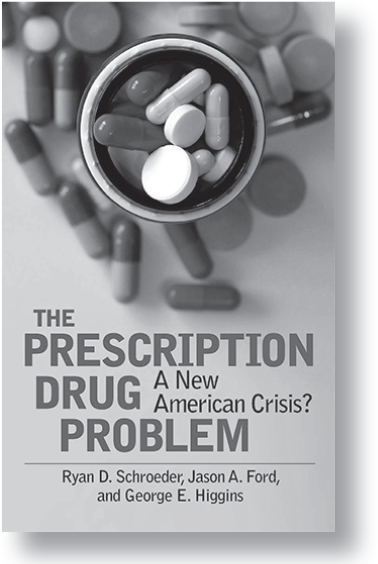
The prescription drug problem in the United States is no secret. Stories about prescription drug use have flooded the daily media cycle—a basic search across outlets would reveal page after page of headlines around the “opioid crisis.” An endless number of shows and documentaries dedicated to covering the issue are also widely available today. For example, TV shows such as Intervention, a miniseries Do No Harm, and a PBS documentary Understanding the Opioid Epidemic are all popular. It’s also not uncommon to see series like Heroin(e), Recovery Boys, Dope, and Drugs Inc. scroll across your Netflix watch list. The prescription drug problem has been sensationalized and normalized simultaneously; this is an underlying premise of Ryan Schroeder, Jason Ford, and George Higgins’ The Prescription Drug Problem: A New American Crisis. The authors tackle what the reality of the current prescription drug problem looks like beyond popular news and media representations.
A strong element of the book—one that makes it a great read for undergraduate and graduate students—is the attention the authors give to contextual details. At the outset, Schroeder, Ford, and Higgins give an extensive overview of the history of drug epidemics in the United States, and where exactly the current opioid crisis fits in this historical trajectory. Juxtaposing the current prescription drug abuse issue to the crack cocaine epidemic of the 1980s, the authors draw out the differences between their existence and persistence, inevitably hitting on the sociological components other discussions often overlook.
Despite the sadness in the sensationalized stories of the individuals and communities struck by the opioid crisis, the reality of the issue takes a bit of a different form when looking at the data. Using the National Survey on Drug Use and Health (NSDUH), the authors attempt to challenge the common “opioid epidemic” narrative by arguing that the U.S. does not have a prescription drug misuse epidemic, but rather a prescription drug overdose death epidemic. Shifting the focus beyond misuse rates expands the entire framework of understanding and provides more hope in finding possible solutions to the issue. The issue at-hand is multilayered, and solutions must consider the interconnections among drug use, societal perceptions of its use, political attention, availability of services, care for those affected by opioid addiction, and much more. The book is a major step in this direction.
So what are the major trends, and who is misusing? The authors use both the NSDUH data and Centers for Disease Control and Prevention (CDC) data to explore this issue. The NSDUH data is the most comprehensive nationwide survey of drug use to date, where respondents are representative of the general population 12 and older. Presenting a uniquely thorough set of descriptive analyses, Schroeder, Ford, and Higgins investigate whether or not the current opioid crisis mirrors the same trends as those of past drug epidemics, which were dominated primarily by males, poor people, racial and ethnic minorities, and urban areas. Some of their major focal concerns include (1) who represents prescription drug misusers, (2) major trends in drug misuse from 1991 through 2014, (3) investigating if prescription drug users are new drug users, and (4) examining trends in prescription drug misuse deaths from 1991 through 2014.
Overall, Schroeder, Ford, and Higgins find that all forms of drug use increased between 1994 and 2001, with the exception of heroin use, and prescription drug misuse increased the fastest. What is unique is that a much narrower gap exists for prescription drug misuse than any other form of drug use. The authors suggest that “although prescription drug misuse is not primarily a white, female, or rural problem in the U.S., prescription drug misuse is more of a problem,” among these groups than ever before (p. 40).
In reference to if prescription drug users are new drug users, the authors find only 8.3 percent of the increase in drug use (from 1994 to 1998, the time period where society saw explosions in drug use) was due to prescription drug use as the majority of the increase was due to increases in marijuana use. As noted earlier, the authors contend that the real opioid epidemic lies in the tragically alarming rates of prescription drug misuse deaths. Here, using the CDC Wonder database to investigate the underlying causes of death for people in the U.S. since 1999, Schroeder, Ford, and Higgins find that death rates associated with prescription drug misuse increased significantly since 1999. Although prescription drug misuse death rates increased by 18.5 percent between 1999 and 2001, the authors found these death rates constituted an “epidemic” as they skyrocketed by 102.5 percent between 2002 and 2014.
All is not lost behind these numbers, however. The authors also highlight that prescription misuse rates have, in fact, fallen 10.1 percent between 2002 and 2014. They contend this decline is likely the result of a variety of programs and policies including Prescription Drug Monitoring Programs (PDMPs), drug treatment featuring multipronged approaches, along with important legislation changes with the adoption of the ACA, and the distribution of Naloxone (Narcan). Despite the somewhat shrinking misuse rates, there is still much room for concern with such astonishingly high rates of prescription drug overdose deaths. Additionally, the authors draw attention to the fact that heroin use is increasing, and a possibility exists that people are moving away from prescription drugs toward heroin use. Better grasping the complicated nature of the opioid crisis is crucial to working towards a solution, including contributing to more empirically-informed public and political responses to the problem.
As teachers in the field, it’s often commonplace to find resistance among students to further recognize the “why” behind a social ill, rather than just the “what” of its basic statistical patterns and prevalence. When analyzing drug use trends and consequences, people cling to popular stereotypes and misunderstandings, rational choice explanations, victim-blaming, and “bootstrap” narratives. Another strong point of Schroeder, Ford, and Higgins’ book is that it provides an easy outlet for overcoming such misconceptions by holistically analyzing the issue beyond mere trends. In addition to significant discussions of historical context and trends, the authors also consider broader institutional structures shaping the problem. Such structures include, exploring why people misuse in the first place, subcultural shifts in how pain has been viewed and treated, the role of the medical industrial complex and pharmaceutical companies, sources of diversion for prescription drugs, the lack of medical school training on addiction, and how the healthcare system treats addiction.
An array of factors play into opioid addiction. One of the nuanced differences in the current crisis is an important shift in who is using and abusing these types of drugs. Schroeder, Ford, and Higgins note, compared to hard drug users of past epidemics, millions of Americans are now drug users, questioning the concept of drug users as “deviant” members of our communities. Beyond the normalization associated with prescription opioid use, prescription drug misuse affects groups of Americans not traditionally involved in drug use. The authors note that the public reaction to the opioid problem in the U.S. is best summarized by the late Richard Pryor, “they call it an epidemic now. That means white folks are doing it” (p. 165). Pryor was clearly referencing the ignored cry for help during the crack cocaine epidemic that primarily plagued poor people and people of color throughout the 1980s, and the authors use it to demonstrate the political saliency of social problems that affect those with greater power and privilege in society.
The authors do a fantastic job of discussing the issue in terms of the role of power. They suggest how power has manifested through the media’s portrayal of the issue. They also show how individuals internalized a “real” and dangerous drug problem (compared to those deserving treatment and leniency from the criminal justice system). Finally, they illustrate how powerful groups use drug laws to protect their own interests. The authors are aligned with a broader sociological discussion of prescription drug misuse. This reality of power circulating drugs is particularly notable as thousands of state and local lawsuits are being filed against major opioid distributors and manufactures said to be “fueling the opioid crisis.” A recent New York Times article discussed how four major companies responsible for profiting billions selling OxyContin, like Purdue Pharma, are filing for bankruptcy and paying out millions in settlements.
In their closing chapter, Schroeder, Ford, and Higgins note that there are many reasons to be hopeful about the future. As they state, “stories of hope, resilience, and recovery are becoming more common in media representations of the prescription drug misuse problem” (p.171). Not only are stories of hope receiving more media attention, but so too are the crimes of big pharma and the opioid epidemic. As sociologists and criminologists, we may not consider settlements and filing for bankruptcy “justice,” but perhaps we can pull a bit of positivity from these issues by focusing on the fact that these companies are finally being called out for their contributions to the issue.
As academics, and more importantly, as human beings, we have to understand this issue sociologically. As noted by the authors, a more effective policy approach to the prescription drug problem facing the nation’s death problem would better incorporate the “sociological factors that underlie prescription drug misuse and death…such as income inequality that has caused widespread despair” (p. 170-171). In sum, we need to continue state and local level research and provide “data driven solutions in solving the issue” (p. 173). We need to continue seeking grant-funded opportunities to study these issues, and not forget the importance of working alongside communities to provide solutions that work for them. Overall, if we continue to move with this momentum of accountability towards the entire system of opioid use and addiction (not just personal misuse patterns), we can certainly turn sensationalized narratives into stories of hope.