



Abstract
This trend piece is an exploration of the evolution of attitudes on the division of domestic labor since the turn of the twenty-first century.
The labor force participation rate of American women, including wives and mothers, increased dramatically in the 1970s and 1980s. It then rose much more slowly until 2000, when about 75 percent of women aged 25-54 were employed. This “stalled gender revolution” in labor force participation left a gap between women and men—approximately 11 percentage points in 2018 (73 percent vs. 84 percent). Some sociologists have attributed the persistence of this gap to a slowdown in the liberalization of gender attitudes. Most notably we have seen an ongoing cultural ambivalence about married women’s market participation and the rise of what Sharon Hays has dubbed an “ideology of intensive mother” in the American upper and middle classes.
Public opinion data from the late 20th century show that trends in women’s employment tracked closely to trends in attitudes about divisions of domestic labor: two decades of liberalization in the 1970s and 1980s and then little change into the early 2000s. Here, we explore the evolution of attitudes since the turn of the twenty-first century. Has support for egalitarian divisions of family labor stagnated alongside women’s employment rates, or do American men and women view a shared breadwinner role more favorably in the aftermath of the Great Recession? Is there growing demographic polarization on these issues? Or evidence of a partisan culture war? Data from the General Social Survey (GSS), that have been collected at about two-year intervals for more than four decades, allow us to address these questions for representative samples of U.S. adults.
Measuring Attitudes With the General Social Survey
We assess attitudes about men’s and women’s ideal family roles based on responses (strongly agree, agree, disagree, strongly disagree) to three GSS survey items:
(1) It is much better for everyone involved if the man is the achiever outside the home and the woman takes care of the home and family; (2) a working mother can establish just as warm and secure a relationship with her children as a mother who does not work; and (3) a preschool child is likely to suffer if his or her mother works.
We presume that support for feminine domesticity is strongest among survey respondents who report strong agreement with items one and three and strong disagreement with item two. We focus on attitudes about divisions of domestic labor because these have been more resistant to change than attitudes about equal opportunity within public-sphere domains such as education and employment.
Because people’s responses cohere strongly across the three survey questions, we do not lose much information by averaging them into a unitary index of support for “feminine domesticity.” Higher scores on this index indicate more support for traditional divisions of family labor with women tending to the home and family and men working for pay outside the home. It’s also important to note that the three survey questions considered were originally developed for the 1977 GSS, and all presume a heteronormative family structure that leaves out many contemporary households.
What is Happening to Attitudes About Gender and Family Labor?
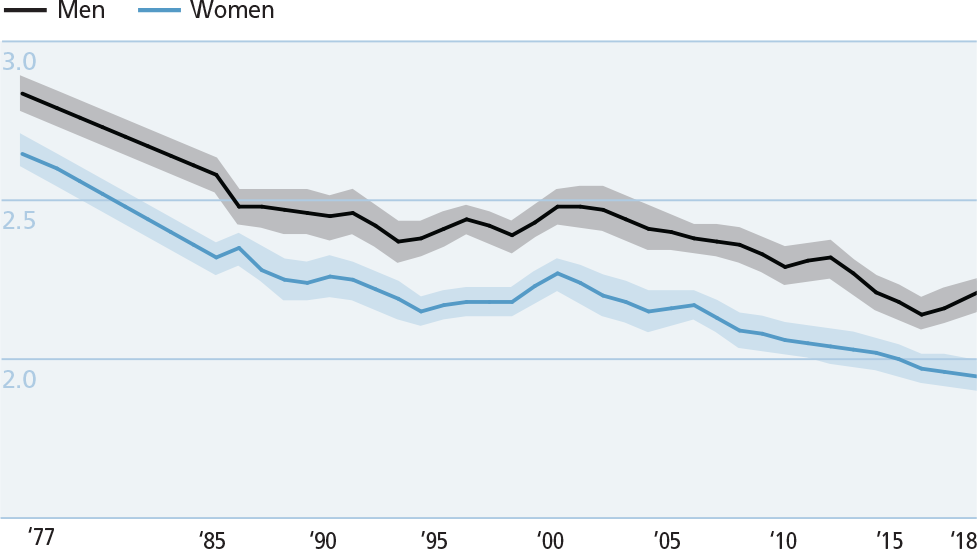
The lines in the figure below, on the left, show average levels of support for feminine domesticity by year. The shaded areas surrounding these lines are “confidence intervals,” meaning that they identify a range of plausible values for the averages that we computed from the GSS data. Essentially, we can be 95 precent confident that the true population average falls within this range. Scores vary from about 2.0 to 2.8 over the years, where a value of 4 means strong agreement with feminine domesticity on all three survey items, and a value of 1 means strong disagreement with feminine domesticity on all three survey items.
Support for feminine domesticity, by gender
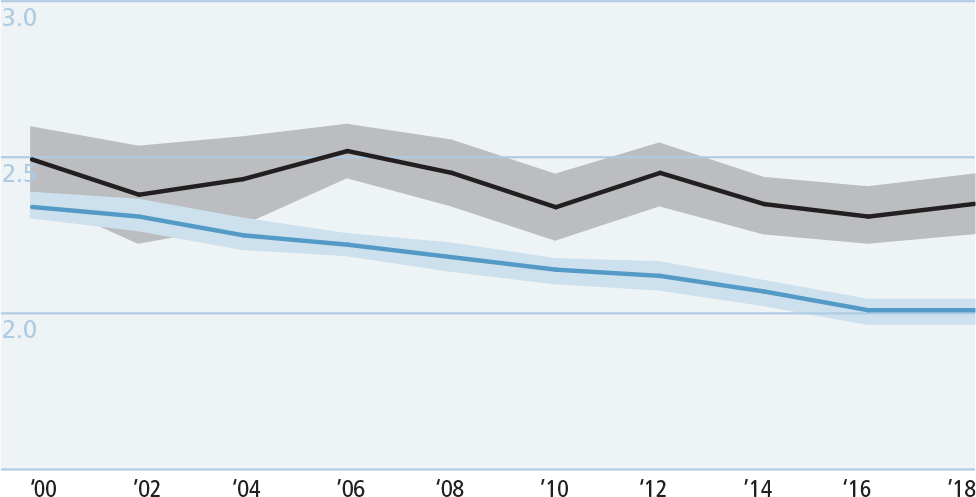
Support for feminine domesticity, by nativity
Note: Data are from the U.S. General Social Surveys of 1977-2018. Values give average scores on three measures of support for feminine domesticity. A value of 4 means strong agreement on all three items and a value of 1 means strong disagreement on all three items.
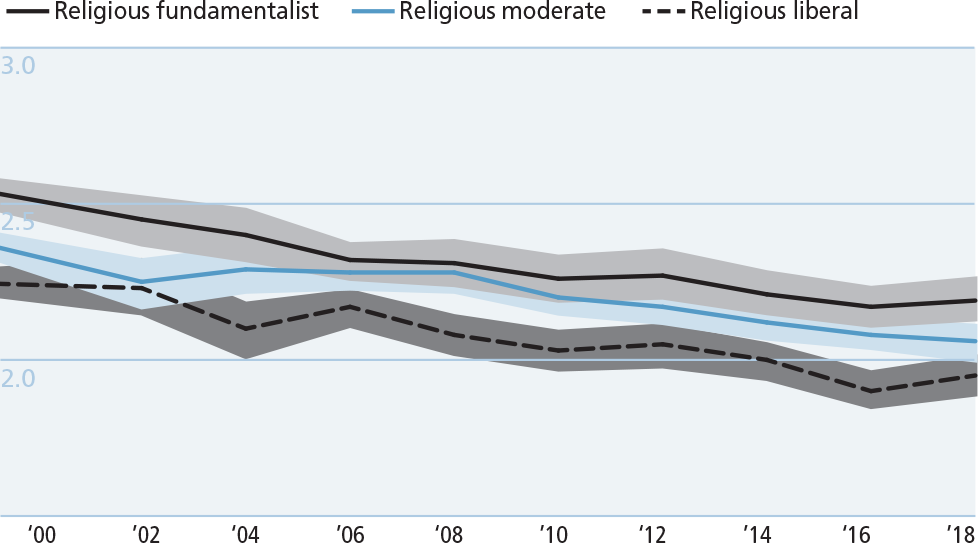
Support for feminine domesticity, by religious intensity
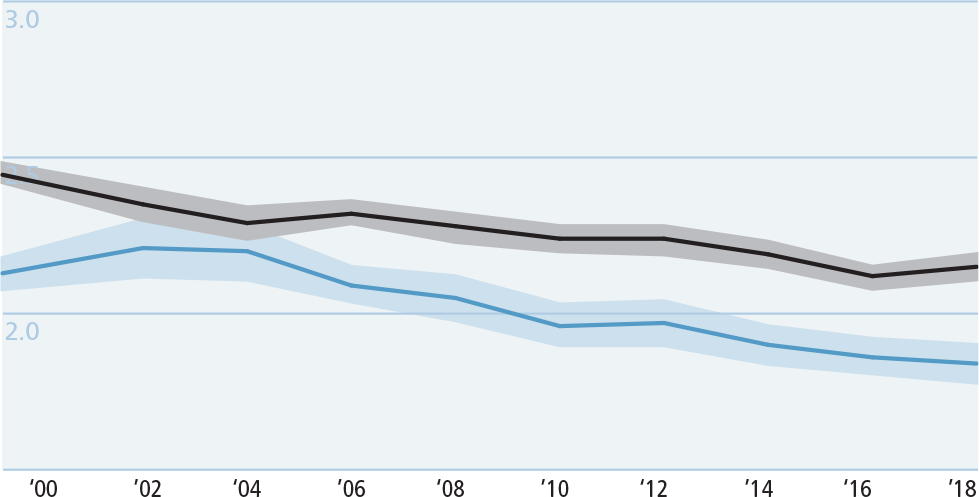
Support for feminine domesticity, by education
In other words, the lower the score, the less support for traditional gender roles of women as homemakers and child caregivers. Women report less support than men consistently, and this gap widened slightly between 2016 and 2018, when men’s support grew. In further analyses, we found that the uptick was restricted to persons without a college degree. This trend may reflect a growing gender divide following the election of President Donald Trump; it will be interesting to see whether it continues through the 2020 survey wave.
Consistent with an earlier study by sociologist David Cotter and his collaborators, the figure above on the left shows declining support for gendered divisions of family labor in the 1970s and 1980s, followed by a flattening and even reversal of this decline in the 1990s and early 2000s. However, more recent data reveal that this support began to decrease again after the early 2000s. Interestingly, the rate of decline for women in the last decade is more or less the same as it was during the so-called gender revolution of the 1970s and 1980s.
In short, we find a persistent gender gap in levels of support for feminine domesticity since 1977, but a downward trend in this support for both men and women. This decline reflects two types of historical change: the replacement of more with less gender-traditional cohorts, and the liberalization of people’s attitudes over time. For example, we find less gender-traditional attitudes among millennials than other generations, and we find declining gender traditionalism within generational cohorts.
There is a clear disconnection between liberalizing gender attitudes and a persistent gender gap in employment rates. This fact raises the question of whether pockets of ideological resistance may be obscured when all men and all women are lumped together. To answer this question, we examine how attitudes break down across some relevant American subgroups in the first two decades of the 21st century.
We first consider differences by race and ethnicity. Results show that black respondents have been least likely to support feminine domesticity in most, likely because this option has been economically available to fewer black households. The data also show consistent declines in support of a gendered division of family labor for white, black, and Asian Americans over this period.
Latinx Americans report somewhat higher levels of support for feminine domesticity than members of the other three major ethnoracial groups. However, further analyses suggest that this difference is mostly attributable to more gender-traditional attitudes among first-generation immigrants, who comprise about half of the Latinx sample. Pooling across all major ethnoracial groups, the figure above on the right shows that support for gendered divisions of family labor is generally stronger among persons not born in the United States. The figure above on the right also shows that gender attitudes have continued to liberalize among both US-born and immigrant respondents, albeit at a faster rate for the former group.
Overall, the GSS data do not reveal any major pockets of demographic resistance to gender-egalitarian family structures.
Is There a Culture War?
In American political discourse, attitudes about a woman’s role in the family are often represented as occupying discrete poles in a culture war that divides the public into two opposing moral camps. By this account, cultural traditionalists, often religious fundamentalists or Republican partisans, aim to preserve gendered divisions of family labor. Cultural progressives, on the other hand, often religious moderates and Democratic partisans, support more egalitarian divisions of family labor. Might religious and partisan divides on gender roles have widened since the 1990s? To explore this possibility, we examine trends separately by political party and religious intensity.
The figure above on the left shows that persons who identify as religious fundamentalists are indeed more likely than religious moderates and religious liberals to espouse stay-at-home mothering. However, more importantly, all three groups show declining support since 2000. Major political parties—Democrats, Republicans, and Independents—show roughly parallel downward trends, with the expected differences in levels of support between Republican and Democratic partisans. In short, we see little evidence of widening religious or political chasms.
Education is another supposed front in the culture-war narrative. It is well-known that education is associated with more liberal positions on issues related to gender and sexuality. However, it is also highly educated professionals who have been most dedicated to intensive parenting styles since the 1990s. Is it possible that support for feminine domesticity has been growing among college-educated men and women? Figure 4 shows no evidence that this is the case; support is declining among persons with and without college degrees. As mentioned above, we do find a slight uptick in the latter category between 2016 and 2018. Without more data, we cannot determine whether this is a reversal or a bump on a continual downward trend.
Where are We Now With Stay-at-Home Mothering?
During the first two decades of the 21st century we have seen the continuation of attitudinal trends that began in the post-civil rights era. Although support for feminine domesticity varies in intensity across social groups, declines in this support cut across major demographic and cultural divides. In other words, Americans’ views on men’s and women’s family roles do not appear to be splitting apart across major demographic or cultural axes.
The social forces that are maintaining the steady gender gap in employment in an increasingly gender-liberal ideological climate warrant more attention. Sociologist Mary Blair-Loy has argued that American middle-class culture today prizes such intense devotion to work careers and childrearing that fulfilling both sets of obligations is all but impossible. Since both professional market careers and motherhood are understood to require huge commitments of time and energy, many women face the dilemma of choosing one or the other—if they can afford to make this choice. Work-family conflict is especially intense in the United States, where social policies provide working parents with less support than is found in other Western industrial countries.
Time demands are growing in both market and domestic realms in ways that make it increasingly difficult to combine work and family responsibilities. The economic returns for working very long hours have increased greatly in recent decades, especially in the financial, high-tech, and legal sectors. Large income advantages accrue to managers and professionals who are willing and able to make themselves available around the clock, and this has implications for their partners. Using over-time survey data, Youngjoo Cha finds that women were three times more likely to quit their jobs when their husbands worked more than 60 hours per week.
Flickr cc, Taylor MacKenzie

Norms of childrearing are intensifying as well. Sociologists Giulia Dotti Sani and Judith Treas estimate that mothers’ caring time nearly doubled between 1965 and 2012 (from 54 to 104 minutes per day) across 11 Western countries. Although actual parenting behaviors vary by class, a new study by Patrick Ishizuka finds that cultural norms supporting time-intensive parenting are very similar across social classes in the United States.
Increasingly “greedy” work and family institutions appear to thwart gender-egalitarian intentions of many young couples. In-depth interviews summarized in Kathleen Gerson’s book, The Unfinished Revolution, suggest that an overwhelming majority of young men and women aspire to egalitarian divisions of family labor. However, many report being forced into conventional breadwinning-caretaking roles because of gendered work and family norms and unsupportive social policies. In a series of experiments, David Pedulla and Sarah Thébaud confirm that young women’s “opting-out” of the labor force represents a constrained choice that can shift with the introduction of more family-friendly workplace arrangements.
Further evidence of constrained choice is found in two new policy reports featured recently in The New York Times. Men report that they want to take leave and spend more time with their children, but feel blocked by a lack of paid leave and by workplace norms that represent men’s leave as damaging to the organization and their coworkers. When difficulties come to a head in heterosexual couples, it is women who pick up the slack through unpaid leave, reduced work hours, and weaker labor force attachment.
The recent decline that we have seen in support of feminine domesticity is broad-based and is a continuation of egalitarian trends that began in the post-civil rights era. On the other hand, liberalizing attitudes have coincided with intensifying pressures for single-minded devotion to work and family that make it very difficult to live out gender-egalitarian ideals. Contemporary workplace cultures and state policies have clearly not kept pace with growing aspirations for more egalitarian divisions of work and family labor. More family-friendly workplace norms and expanded access to paid family leave and quality, affordable child care would help American women and men meet their egalitarian aspirations.