




Abstract
Social poverty comes from lacking high-quality, trustworthy, dependable relationships. This is distinct from the experience of financial poverty and has consequences for wellbeing. Without adequately recognizing the multidimensional nature of human needs, we cannot understand individuals’ behavior and motivations, nor can we develop policies that successfully respond to their needs.
Who you know matters, sociologists have shown time and again. Need a loan? Need a job referral? Need a place to crash in a housing crunch? A wealth of research has established how social capital shapes individual outcomes and patterns of social stratification. Yet, for all of the attention shown to wealth and poverty—that can come from social ties (or the lack thereof)—researchers often fail to appreciate the ways in which relationships themselves are a resource.
When we treat relationships merely as a mechanism through which financial resources can flow, we are not accurately capturing how relationships matter to people in the real world. Of course, loans, referrals, and a spot on the couch are valuable, but so is knowing that someone is there for you no matter what. We must use a more multidimensional approach in assessing people’s resources. Part of this entails engaging with the risks of social poverty—lacking an adequate number of high-quality, trustworthy relationships to meet one’s socioemotional needs. Relationships, in their meaning to people, effect on people, and motivation for people, have inherent value, not just a “use value.”
Mark, 21, and Ashley, 20, were among the 62 young adults I recruited from an Oklahoma City-area program for new parents. I interviewed them for the first time right around their child’s birth, and the strength of their relational needs came through forcefully, even in the presence of their deep financial needs. Ashley said of Mark, “I don’t think of him as just a fiancé. I think of him as a best friend, and he is. He’s my best friend. If I didn’t have him, I’d probably be the loneliest person on the earth right now.” One of the changes Mark was looking to see in his life was to, “at least be able to have some type of stability or being nearing stability.” While one might assume Mark means financial stability since he and Ashley were struggling financially—getting by on his $1,000 a month in fast food wages as they welcomed their daughter—Mark had other concerns. He continued, “Not the case of financial, ‘cause with the way kids are nowadays, we’re not going to be financially stable for years now. And I know that. But just get to the case where we’re not trying to rip each other’s heads off… Just family stability.” Ashley and Mark wanted to secure their relational resources, not just their financial ones. As I interviewed these 62 parents—both individually and together as a couple—multiple times over the course of a year (for a total of 192 interviews), the importance of escaping or avoiding social poverty emerged time and again.
What is Social Poverty?
Social poverty entails social isolation that is more than momentary, and that cannot be addressed through one’s current relational resources. As an analogy, feeling hungry is different than being food insecure, just as feeling lonely is different than being in social poverty. Like social poverty, hunger is a subjective feeling—we all have different caloric needs and different levels of tolerance for being hungry (before we get “hangry”). Most of us feel hungry or lonely from time to time, some more often than others. However, what sets these feelings apart from being food insecure or socially poor is whether or not the person experiencing these feelings can access the resources necessary to address these issues. Further, when food insecurity or social poverty are not pressing concerns, we eat and socialize nonetheless; that is, our pursuit of these resources is not an activity we undertake solely as a purposeful effort to avoid impending hardship. While individuals’ experiences of being hungry or lonely are not social problems that need to be addressed through policies and programs, being food insecure or socially poor may be. That social poverty is a subjective experience makes its consequences for physical and mental health no less real—unaddressed social isolation can raise the risks of morbidity and mortality. However, this is not the lens through which sociologists often view social relations.
An expecting couple sits down to rest on a park bench.
Flickr cc, Joris Louwes

Social capital literature conceives of social ties in terms of their use-value — e.g., job leads, loans. This treats relationships as a form of currency, as opposed to them being inherently of value to people due to their relational needs. While relationships certainly can serve as a form of social capital, the social poverty lens requires us to view relationships in a different way than is traditionally done in the social capital field. As an example of the contrast between the social poverty and social capital lenses, consider Ivan Light’s focus on “mutual metamorphosis,” in which he argues that social capital is made up of those social ties that can turn into other forms of capital (financial, cultural, etc.). In focusing instead on people’s risk of social poverty, we see the ways in which they value and are motivated by their social needs for trusted connections, understanding, compassion, and companionship, none of which need to convert into other forms of capital to be deeply consequential.
While the utility of the existing research on social isolation is limited by the less-than-nuanced way in which this construct is often measured (e.g., number of friends or frequency of social interactions), it is still instructive in motivating the importance of social poverty. Health researchers have shown that social isolation is associated with having a weaker immune system, a higher rate of mental health struggles, and increased mortality rates—on par with the consequences of smoking. These associations between social isolation and health hold over and above one’s individual and neighborhood poverty status.
While most research on social isolation focuses on these experiences among older adults, social isolation may be just as common earlier in the life course, among young adults. Given the myriad of changes to roles and daily activities they face, struggling to meet social needs during this stage of life should, perhaps, be expected. For example, as young people transition their primary relational foci from parents to friends to romantic partners, these transforming relationships may be strained.
Research on the demographics of social isolation also tells us that this experience is more common among those with limited financial resources. Scholars have documented the structural factors that shape social isolation and erode the development of trust among those with low incomes; these factors then increase their risk of social poverty. It is important to note, however, that financial and social poverty are not synonymous. In fact, some evidence indicates that the social ties through which financial resources flow can be sources of stress, rather than relational resources, for low-income parents. There are also suggestions of deep loneliness and isolation among elites, such as celebrities and the super-rich, as fears of one’s wealth and status corrupting others’ intentions may undermine trust. One form of deprivation may increase the likelihood of the other, but they need not co-occur. As I discuss below, we can develop policies and programs in ways that attend to both needs simultaneously.
Empirical Evidence of Social Poverty
Kristina and Lance, both 20, were preparing to welcome their first child when we met, but their relationship was on the rocks. Fundamentally, they did not trust one another, and this mistrust stemmed in part from them transitioning to parenthood on different schedules from one another. At the sight of the positive pregnancy test, Kristina began to see herself as a mother, and so she withdrew from her friends and their partying, which she didn’t see as appropriate for a parent. She said of Lance, “It’s not about him anymore, it’s not about me anymore, it’s about the baby and our family. I see that. I’m perfectly fine with that. I’m perfectly fine with not hanging out with anybody… The only person I go see is my mom. I don’t hang out with my friends…” But Lance didn’t feel like a father until his newborn son was placed in his arms for the first time, and so he spent Kristina’s pregnancy out with friends, behaving in ways she didn’t see as fitting a “family man.”
They emerged from this period with their relationship semi-intact. While they had not regained their footing as a couple, each so enjoyed the other as a parent and wanted to give their son the stable family life they both missed out on as children, that they ended our year of interviews still together. Kristina’s risk of social poverty rose during her pregnancy, as she purposely separated from her friends, leaving her that much more reliant on her relationship with Lance to meet her socioemotional needs. Lance, for his part, would be hard pressed to balance his role as a parent with his relationships with his friends—whose ways of socializing conflict with what our culture—and his girlfriend—demand of a responsible father.
Parents help their little one up a large flight of stairs.
Flickr cc, Gauthier Delecroix

There are several reasons why tackling so many transitions at once—to adulthood, parenthood, and partnership—would raise the risk of social poverty. First, people may disconnect themselves from friends whose young adult lifestyles clash with the way they want to live as parents. One father explained, “I stay away from my friends.” This means they have less social support at a time when perhaps more is needed, as they face the stresses of new parenthood. Second, when it comes to partnership, it can be hard to develop trust in a relationship when so much of who you are and what you’re doing is up in the air. Should Lance be a responsible father or a carefree kid during Kristina’s pregnancy? How can you trust someone, or even yourself, to act with your needs and desires in mind when those needs and desires are changing and might not even be clear to you yet? In transitioning to parenthood at a young age and on different time frames from one another, Kristina and Lance face a real risk of experiencing social poverty as their relationship with one another may fail to serve as a steadfast social resource.
Another set of factors that repeatedly emerged in the life stories of those I met was how their earlier experiences, especially in childhood, set the stage for their current experiences with social poverty.
Another set of factors that repeatedly emerged in the life stories of those I met was how their earlier experiences, especially in childhood, set the stage for their current experiences with social poverty. Jessica, 19, was expecting her first child with her high school boyfriend Will, 22, and the two were raising his toddler together as well. She explained how difficult it was for her to trust anyone, including Will, after what she saw growing up. “That’s why it’s hard for me to have relationships, anyways, because with my dad, …he has never been there, and my step-dad, he is just not a father figure at all. And losing my grandpa, it was just like, there’s nothing left.” She saw herself as having been born into mistrust, “My dad cheated on my mom when she was pregnant with me. I know I wasn’t there for it, but the stress that she felt I felt.” Jessica’s dad walked out on the family when she was young, and then lost himself to drugs. A few years later, she had to watch history repeat as her stepfather walked out on her little brother and sister, just as her dad had on her. Not two weeks later, her beloved grandfather died. Jessica’s mother was wrapped up in her failing relationship and caring for her other children. Jessica didn’t trust her friends all that much, after several had pursued Will in high school. This was why her grandfather’s death left her feeling “there’s nothing left,” a statement of her social poverty.
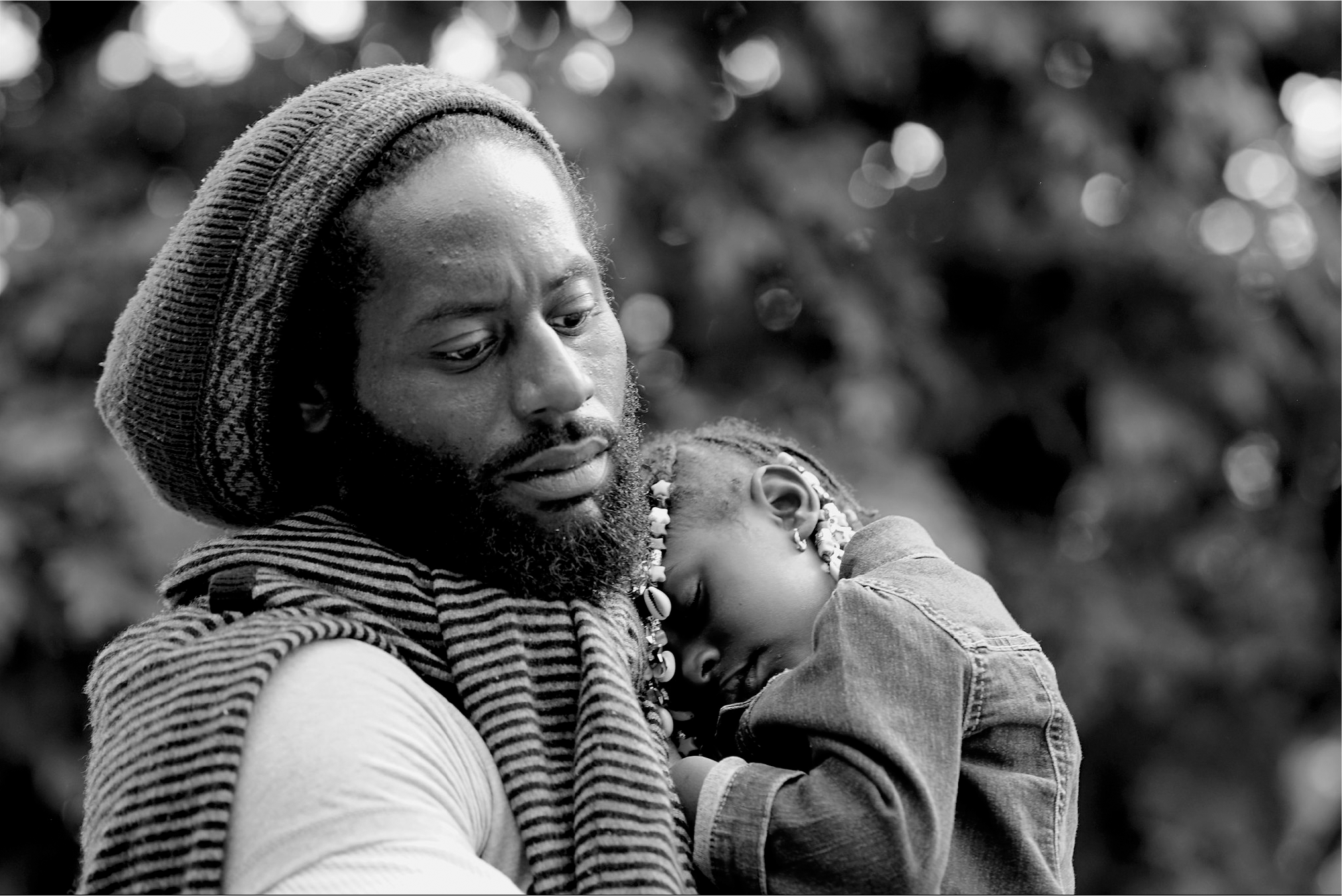
A father holds his daughter tight.
Flickr cc, Miki Jourdan
Will was Jessica’s main support in life, and she wanted to trust him, to feel that their relationship was a steady relational resource in her life, but after everything she had seen, she said, it was hard to be vulnerable in the way trust required. “The past males in my life, figures that were supposed to be good, weren’t. So the trust issues are always going to be there. But I’m working on it. … I’m still stuck on the past.” Like Jessica, many of the young parents I met struggled to construct the family lives they desired for themselves and their children. Due to their experiences growing up, they felt it was more difficult to trust, communicate, and build a life with their partners today. Their risk of social poverty, therefore, came, in part, from current challenges created by their previous experiences as children and in their earlier romantic relationships.
Due to their experiences growing up, they felt it was more difficult to trust, communicate, and build a life with their partners today.
In explicating the concept of social poverty, the focus is not on describing personal failings among those experiencing it. Rather, we can see the ways in which life course events, the cultural norms around social roles, and interpersonal dynamics, among other factors, can come together to raise the risk of social poverty. As such, addressing the risks and consequences of social poverty is not just about “fixing” individuals but rather building social structures that facilitate the growth and strengthening of high-quality relationships.
Policy Responses to Social Poverty
While the problem of social poverty is more subjective and slippery than our official federal financial poverty measure, it is nevertheless amenable to policy solutions. Here I focus on two guidelines for developing policy informed by the social poverty framework.
Design Programs and Communities to Promote Human Dignity and Connection
We see the power of this approach across fields. Education researchers have found that at-risk youth are less likely to drop out of school when they receive emotional and instrumental support from trusted adults. Healthcare researchers found that family caregivers of Alzheimer’s patients, who are often overwhelmed by their caregiving responsibilities, experienced an easier adjustment to their role when involved in a program that offered social support. While healthcare provision is often focused on the health needs of the patient, this research indicates how important the social needs of caregivers—essential to the wellbeing of patients—are to the equation. Likewise, in setting up senior living facilities, options for young people to live alongside older residents can be mutually beneficial; these help to meet the financial needs of university students, for example, and facilitate intergenerational relationships, addressing the relational needs of both groups. Local development plans can be done in ways that facilitate opportunities for social interaction and connection, such as around accessible public infrastructure, like walkable neighborhoods, community gardens, and libraries.
Deliver Social Services in a Way That Builds Relationships
Again, across fields we see the gains of delivering services in a way that anticipates both people’s financial and social needs. Victor Chen’s research in comparing the services offered to factory workers following mass layoffs in the United States versus Canada illustrates this point. While the layoffs were difficult for all involved, the social poverty Chen saw among the American workers was distinct. He highlighted the role of the Canadian “action centers,” which were set up in response to the layoff and staffed by former factory workers. These centers not only helped laid-off workers to navigate and secure financial and educational resources but also provided a site for fellowship, allowing them to process and experience their job loss collectively, rather than alone.
Relatedly, Mario Small has shown the power of community institutions, such as child care centers, to connect parents to local resources, with knowledge often flowing through informal relationships among parents and staff in the center. These relationships can be purposefully nurtured with, for example, regular opportunities to get to know one another, such as at cookouts. By facilitating relationship building, social service organizations may become more effective in achieving their missions while also addressing social poverty among their clientele. This requires that services be delivered in ways that are not stigmatizing for participants. By recognizing and accurately modeling social poverty, social scientists can provide the research base to facilitate work by policymakers and program developers in alleviating social deprivation.