




Abstract
Students major in sociology because they want to understand social life and social change, but does wanting a meaningful career equal a large salary? As it turns out, while sociology graduates do not earn top dollars in their first year out of undergraduate school, their salaries do increase and usually double by ten years out.
Our guess is that when you tell your parents or friends that you are a sociology major, they turn to you and ask, “Can you earn any money with a sociology degree?” We know from our analyses of data from the 2012 Bachelor’s and Beyond study, sponsored by the Nationg Science Foundation, that students major in sociology for a variety of reasons. They want to understand social life and social change, and they want a meaningful career as well. We have shown previously that many of these sociology majors move successfully from their undergraduate studies into a range of career-type jobs. Here we will show that sociology graduates earn salaries that are comparable to those of graduates from other humanities and social science fields. While sociology graduates do not earn top dollars in their first year out of undergraduate school, their salaries do increase and usually double by 10 years out.
It is reasonable that sociology majors are concerned about their career options, especially because employers rarely advertise entry-level jobs specifically for sociologists. Students fund their studies with sizeable loans and graduate with debt because of declining state support for public higher education and rising college costs. Even when additional tuition payments end with graduation, the monthly bills, including payments on student loans and accrued interest, don’t stop. The College Scorecard shows that among the four universities we analyze below, about a third of the graduates had taken out federal student loans. Depending on the student’s field of study and institution, the median amount of this debt incurred ranged from $8,000 up to $29,000. According to studies by Hart Research and the Pew Research Center, sizeable numbers of Americans and employers express concern about the extent to which undergraduates are learning appropriate skills that they will be able to use to secure and advance on the job. Students, parents, and legislators want to hold colleges accountable and are asking about “return on investment.”
The federal Department of Education has reacted to public pressure for accountability by publishing the College Scorecard. The website provides information on college costs and graduation rates, along with factors such as financial aid and debt, acceptance rates, and student body demographics for each American college and university. More recently, the Census Bureau has teamed up with higher education institutions in four states (Colorado, Michigan, Texas, and Wisconsin) to create the Post-Secondary Employment Outcomes (PSEO) database. While maintaining confidentiality, the database links transcript information to a national database of jobs, allowing for an exploration of earnings for college and university graduates by degree level, major, and institution.
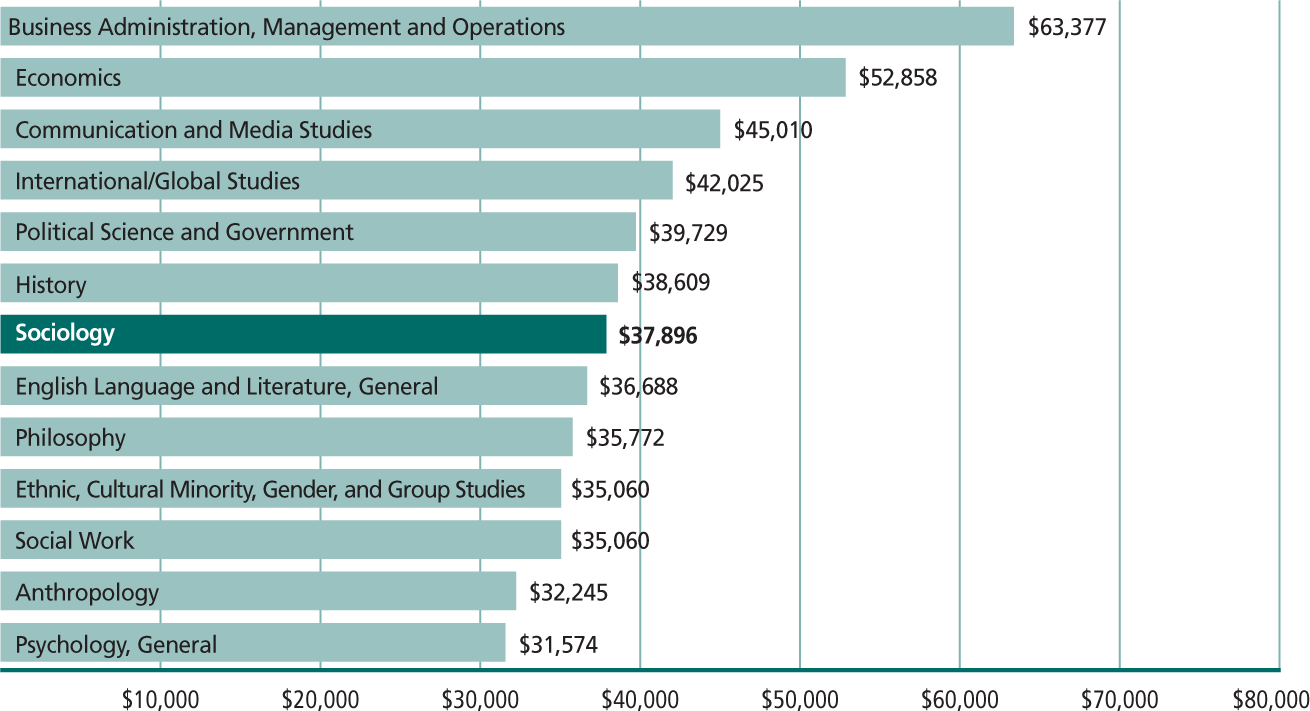
Median salaries of Texas graduates, 2013-15, one year after graduation, by major, 2016 dollars
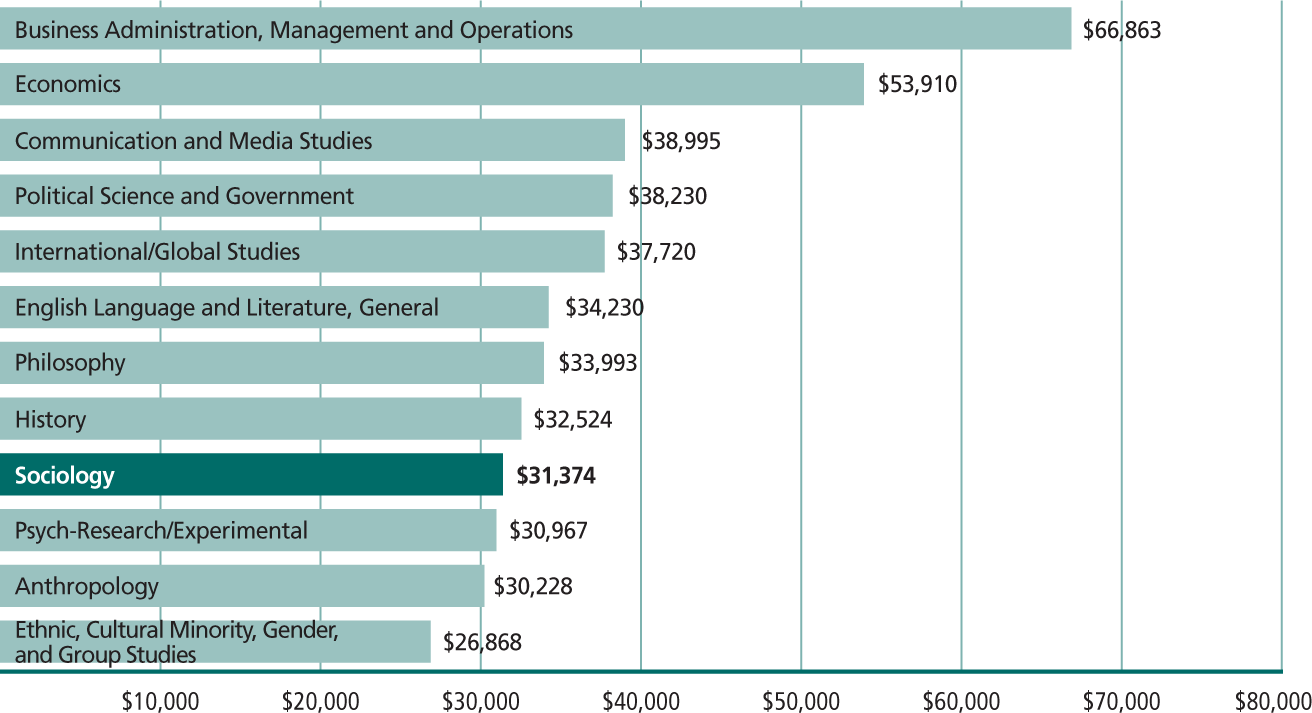
Median salaries of Michigan graduates, 2013-15, one year after graduation, by major, 2016 dollars
A student in sociology class
Truckee Meadows Community College, Flickr CC

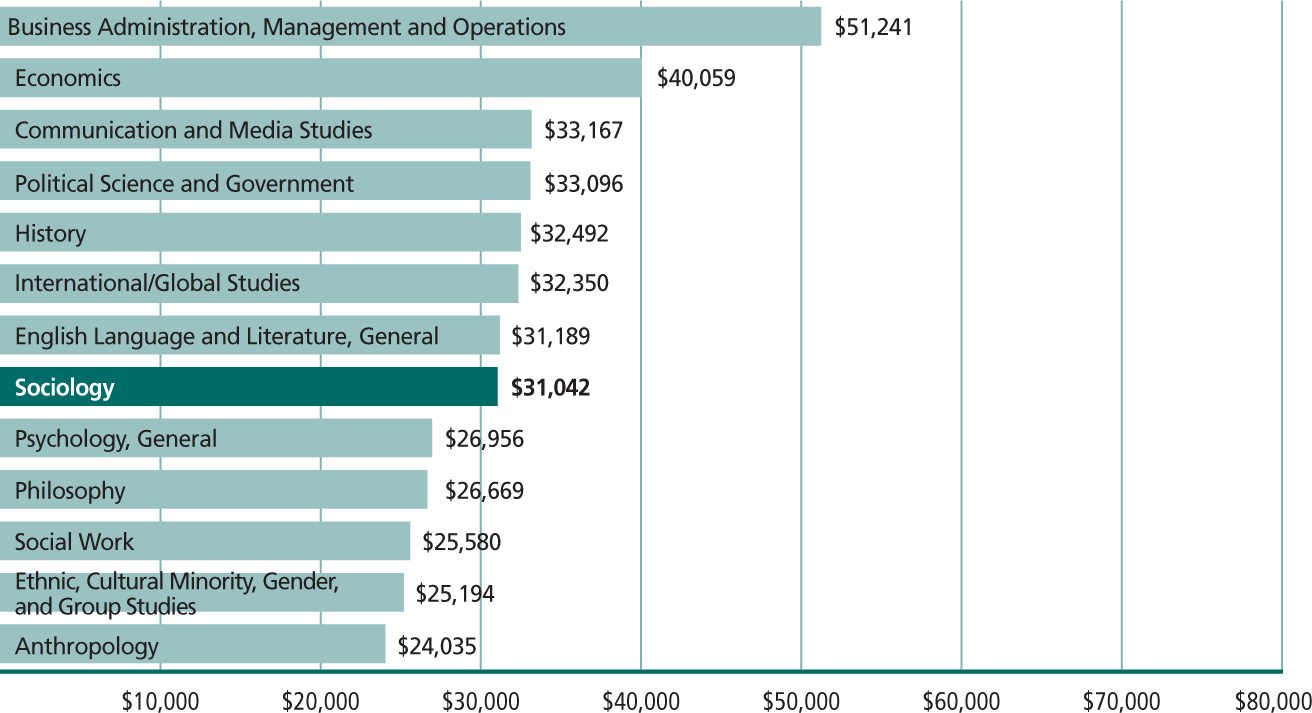
Median salaries of Wisconsin graduates, 2013-15, one year after graduation, by major, 2016 dollars
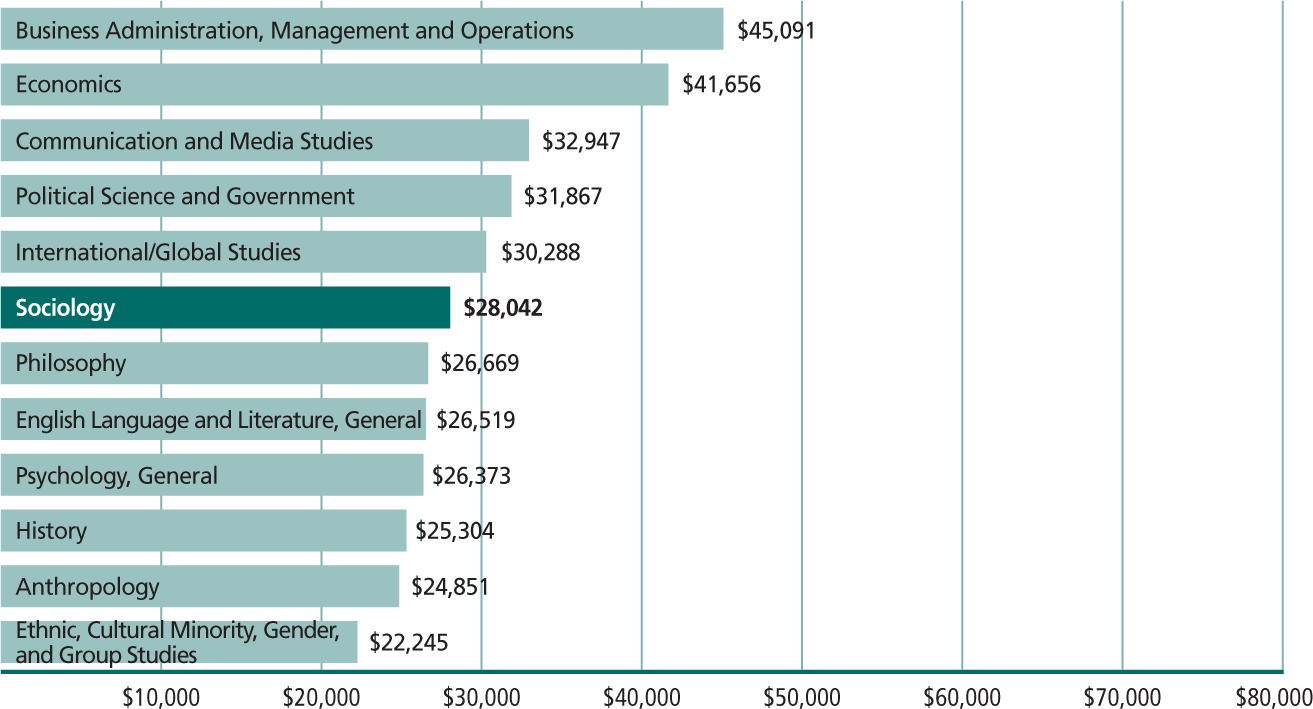
Median salaries of Colorado graduates, 2013-15, one year after graduation, by major, 2016 dollars
Note: Michigan and Colorado do not offer Social Work majors at the undergraduate level. Michigan’s psychology program is Research/Experimental Psychology rather than General Psychology.
Source: Post-secondary Employment Outcomes, U.S. Bureau of the Census
Median salaries of 2004-06 University of Wisconsin graduates, 1, 5, and 10 years after graduation
Source: Post-secondary Employment Outcomes, U.S. Bureau of the Census
The PSEO database allows us to compare the salaries of sociology majors to those of graduates who chose up to 12 other majors at the flagship institutions of these four states. The most current data are the median salaries of majors one year after graduation, with the graduation cohorts from 2013 to 2015 combined to protect confidentiality. Because the cost of living changes over time, data are presented in 2016 constant dollars, recognizing that 2020 dollars would be higher. The figures above and to the left are salary data from each of the four university graduates with these humanities, social science, and applied social science majors.
The list of 12 other majors reflects fields that are similar to sociology. Sociology shares characteristics with other disciplines in the social sciences and humanities, and sociological approaches have informed the work of practitioners in economics, psychology, education, social work, and business. We do not examine natural science and engineering majors because it is unlikely that a college student interested in social life and improving society faces the decision of whether to major in aeronautical engineering or sociology or goes on to graduate study in the natural sciences or engineering.
Salaries of sociology majors are, in each case, in the middle of the pack. They are always near the middle, neither the highest paid majors, nor the lowest paid.
The pattern of salaries for the 13 majors for each of the states is similar across the four universities. Graduates with majors in business administration, management, and operations; economics; communication and media studies; political science and government; and international/global studies earn more than sociology majors. By contrast, graduates with majors in anthropology; ethnic, cultural minority, gender and group studies; social work; and psychology earn less. Differences between the earnings of sociologists and those of majors one, two, or even three ranks above sociology often do not amount to much. English language and literature graduates from Wisconsin, for example, earn $147 more annually than sociology majors. In fact, as is evident in the figure above, it is not until the top two earning majors, economics and business, that we see a substantial difference from sociology majors’ earnings.
The salaries of graduates from these schools do vary, with graduates from the University of Texas receiving the highest salaries and graduates from the University of Colorado receiving the lowest. Car-nevale, Fasules, Huie, and Troutman also found that salaries of graduates from the University of Texas system “earn more on average than Bachelor’s recipients nationally. “ The salaries of sociology graduates from the University of Michigan and the University of Wisconsin are in the middle of the four state schools.
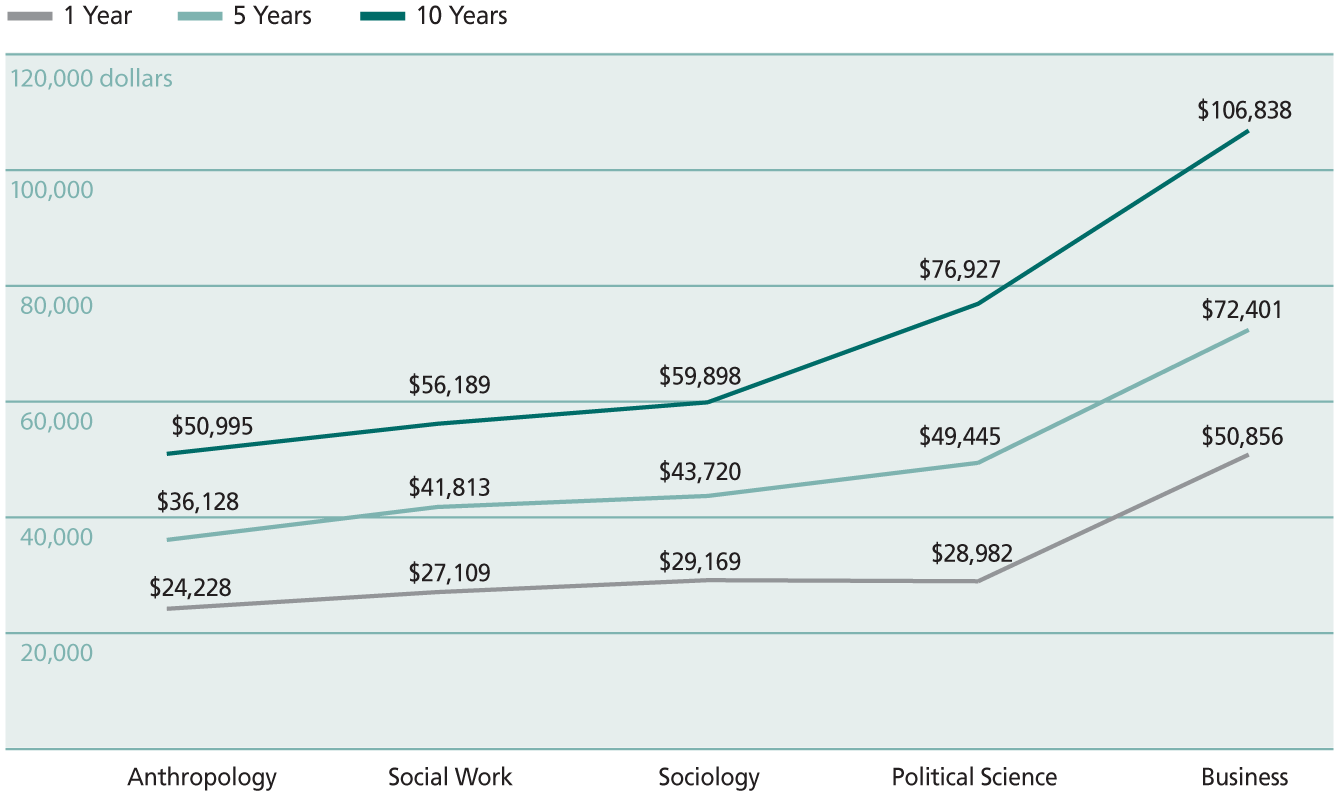
The data from PSEO allow us to see how salaries change as graduates move from one, to five, to 10 years away from graduation. To chart the movement of returns to investment over time, we look in the figure to the left at the 2004-2006 cohorts of sociology graduates and those of four other majors (two majors with higher and two majors with lower salaries as seen here) from Wisconsin. Again, because what a dollar buys has changed over time, we make comparisons using 2016 dollars.
Several conclusions are clear. Sociology graduates’ earnings increase substantially over time. The salaries of graduates 10 years after college ($59,898) are about double the salaries one year after college ($29,169). Ten years after graduation, the median sociology major’s individual income is at or above the 2017 median U.S. household income (often coming from two income earners, who may or may not have college degrees).
Other majors, of course, see an increase in salaries over time as well. The salaries of business majors tend to double over time, as do the salaries of anthropology majors. Sociology majors do not catch up to the highest paying majors, and they do not see increases in constant dollars that are as large as those of some other majors (such as political science and government), although their salary increases are substantial.
The main conclusion of this analysis is that students should not shy away from sociology for fear of low earnings. While the choice of major is a critical decision made by college students affecting both what they study and what they will eventually earn, salaries are influenced by other factors as well. The excellent analyses undertaken by the Georgetown University Center on Education and the Workforce show that factors including gender, race and ethnicity, type of institution from which a degree is achieved, and state of residence all impact one’s earnings. Further, based on research from Carnevale and colleagues, graduates with some majors see a greater dispersion in salaries than those of other majors, and the median, by presenting the 50th per-centile, does not capture this variation.
Graduates from San Francisco State
San Francisco State, Flickr CC
Additionally, salaries are not the only metric to consider when thinking about the returns on investment in a college education. Data from the national sample of sociology majors who graduated in 2012 suggest that the benefits to a sociology degree go beyond the dollars and cents found in a paycheck. We found that graduates who used their sociological knowledge and skills on the job 18 months after graduation were more likely than others to see themselves as embarking on a career, were more likely to have advanced on the job, and were happier with their choice of sociology as a major. In addition, Senter and Spalter-Roth found that a majority of graduates reported that sociology “helps them a great deal with volunteering, making political choices, and understanding current events.” Sociology offers great benefits beyond salary, and the PSEO data show that sociology graduates can expect to see substantial growth in earnings over time as well as experiencing other types of well-being.
We found that graduates who used their sociological knowledge and skills on the job 18 months after graduation were more likely than others to see themselves as embarking on a career, were more likely to have advanced on the job, and were happier with their choice of sociology as a major.