




Abstract
Since February 2018, the Disney Company has been exposed in the media for its mistreatment of its workers at the Disneyland park in Anaheim, California. A year and a half later, Disney’s labor practices and the compensation of its CEO continue to highlight larger issues of wealth and income inequality in America.
Keywords

Since February 2018, the Disney Company has been excoriated in the national and international media for its mistreatment of its workers at the Disneyland park in Anaheim, California. The headlines that month speak for themselves. “By Day, a Sunny Smile for Disney Visitors. By Night, an Uneasy Sleep in a Car.” (New York Times). “Study finds three quarters of Disney’s Anaheim resort employees can’t afford basic living expenses.”( Los Angeles Times). “Disneyland staff ‘living on streets’” says (The Times of London). “Homeless and Hungry: Survey Finds Disneyland workers are Massively Underpaid.” (Newsweek). “Why Anaheim’s Low-Wage Workers Struggle To Keep a Roof Over Their Heads.” (PBS News Hour)
After the initial stories broke, Senators Elizabeth Warren and Bernie Sanders attacked Disney CEO Robert Iger’s $65.6 million annual compensation; they called on the company to pay all of its employees a living wage. Faced with a negative media onslaught, the Disney Company voluntarily raised its minimum pay for some Disneyland employees to $15 an hour.
However, the criticism of the company did not subside. In November 2018, Anaheim voters approved a ballot measure to require the company to pay all 30,000 Disneyland employees at least $15 an hour by January 2019 and increase the minimum salary by one dollar a year, up to $18 an hour in 2022, with subsequent annual raises based on the cost of living. Disney’s labor practices and the compensation of its CEO have become a surrogate for the larger issue of wealth and income inequality in America.
The origin of this controversy over the Disney Company’s practices began with a report that we authored and released in February 2018, Working for the Mouse: A Survey of Disneyland Resort Employees.
The 126-page report, based on a survey of 5,000 of Disneyland’s 30,000 employees, caught the company off-guard and challenged the company’s carefully crafted public image. As one of the world’s most high-profile corporations, the company—which not only owns twelve theme parks throughout the world, but also, movie studios, media networks, and retail stores—puts forth a positive public image to attract consumers. The iconic Disneyland—which the company calls “the happiest place on earth”—is one of the world’s most popular tourist destinations, with over 27 million visitors annually and annual revenues over $3.3 billion.
Anaheim: A Company Town
In the early 1950s, Walt Disney purchased 160 acres of former orange groves in the farming community of Anaheim, about 25 miles southeast of Los Angeles. In 1954 construction began for an amusement park he called Disneyland. Opened in 1955, it soon brought in staggering profits for Disney and altered the economic trajectory of Anaheim.
Since Disneyland opened, Anaheim has essentially been a company town. Its population grew from 14,556 in 1950 to 104,184 in 1960, to 349,732 in 2015. It is now home to two professional sports teams, large business parks, and a major medical center. However, tourism is still the city’s largest industry, and Disneyland is Anaheim’s (and Orange County’s) largest employer. City leaders and many residents have long viewed Anaheim’s fate as intimately tied to the success of the theme park.
The Disney Company works hard to guarantee a friendly political culture. In 2017, the Los Angeles Times published a series of explosive stories describing how the company had, over many years, used of a web of political action committees to make campaign contributions that influenced the City Council. By far the largest donor to local politicians, the company used its influence to secure subsidies, incentives, rebates and protections from future taxes in Anaheim that, in aggregate, were estimated to be worth more than $1 billion.
For example, subsidies include $108.2 million that Anaheim spent to build a massive six-story 10,241 car parking garage in 1996 that is currently leased to Disneyland for just $1 a year. The structure generates roughly $50 million a year in parking revenue for the resort. After Anaheim finishes paying for the garage in 2036, it will transfer ownership to Disney at no cost.
In 2015, Anaheim approved an agreement to shield Disney’s theme parks from any potential entertainment tax for as many as 45 years. A tax of $1 per ticket could have generated more than $1 billion for Anaheim that year according to the Los Angeles Times.
Some working-class residents said they didn’t see enough upside from the subsidies. A resident observed, “The area immediately around Disneyland is beautiful, but you go a few blocks in any direction and the streets are run-down, the sidewalks are cracked and broken.” While Disneyland received these municipal subsidies, Anaheim accrued unfunded pension liabilities totaling $590 million and dealt with a growing homeless population.
Origins of the Report
Approximately 25,000 of the 30,000 Disneyland employees are represented by more than 20 different unions. For most of their histories, each union negotiated separate contracts with the Disney Company and rarely worked together on bargaining, collecting information, or engaging in local political activities, such as influencing the City Council. By 2017, however, leaders of several unions concluded that their failure to collaborate had contributed to a decline in the real value of their members’ wages and benefits, and they resolved to join forces. Union leaders had anecdotal information about their members’ lives — for example, that some full-time Disneyland employees were living in their cars or utilizing local food banks—but had no systematic data.
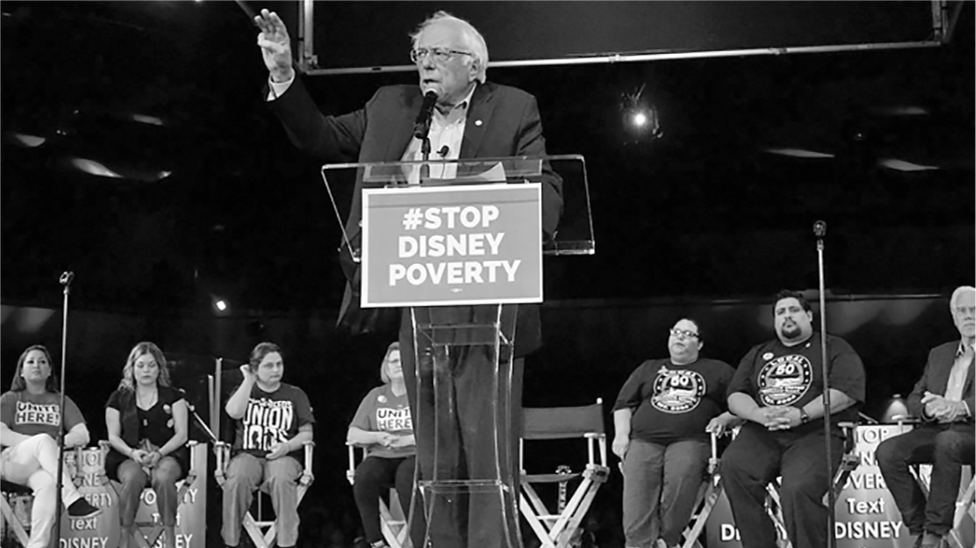
Bernie Sanders at Disneyland Rally Local 706
Coalition of Resort Labor Unions
Recognizing the potential benefits of collaboration and anticipating the next round of contract negotiations with the company, 11 of the unions (representing 17,339 employees) formed the Coalition of Resort Labor Unions (CRLU). These unions represent food service workers, hair stylists, costumers, candy makers, security guards, custodians, hotel workers, retail workers, ticket takers, musicians, puppeteers, singers and dancers.
In January 2017 the CRLU asked us to conduct a scientific survey of resort workers to assess their working and living conditions. We spent several months designing a survey, with the clear condition that we wouldn’t share the responses of the individual respondents with the unions and that we would have complete control of the data analysis and writing the report.
Methods
We selected an internet survey platform, Qualtrics, to administer the survey.
The first step in organizing the survey was to collect member records for 17,339 workers represented by the 11 unions in the Coalition. We used this information to create a population profile for monitoring the representativeness of survey response with regard to race, ethnicity, and gender, wage categories, full vs. part-time work status, and which union they belonged to.
In November 2018, Anaheim voters approved a ballot measure to require the company to pay all 30,000 Disneyland employees at least $15 an hour by January 2019 and increase the minimum salary by one dollar a year, up to $18 an hour in 2022, with subsequent annual raises based on the cost of living.
We offered the survey in English and Spanish. It covered demographic information, hours worked, attitudes about their jobs, housing conditions, food security, ability to pay for basic necessities, and an open-ended comments section.
The survey received a 29 percent response rate and the distribution of survey respondents closely matched the total population of Coalition workers based on wages, gender, race/ ethnicity and tenure at Disneyland Resort. There was a slight over-representation of full-time workers.
Key Findings
Our report revealed that Disneyland employees report high instances of food insecurity, ever-shifting work schedules, extra-long commutes, and low wages. The facts from the report that generated the most headlines and public debate were that 85 percent of Disneyland workers earned less than $15 an hour and ten percent had been homeless at some point during the previous two years.
Almost three-quarters (73 percent) said that they did not earn enough to cover basic living expenses. More than two-thirds (68 percent) were food insecure. Over half (56 percent) reported concerns about being evicted from their homes. Many couldn’t afford healthcare or dental coverage. Almost one-third (31 percent) spent one or more hours commuting to work compared to only 4 percent of the workforce in Los Angeles and Orange Counties. Among workers who were parents of young children, 61 percent of female employees—and 69 percent of single parents—said that their work schedules made it difficult to care for their kids. Almost three-quarters (72 percent) of female employees, and 61 percent of male employees, with young children said they would use subsidized on-site childcare if Disneyland made it available.
The image of Disneyland Resort workers as young people with few financial responsibilities did not match reality. Less than a third (32 percent) of workers were under 25 years of age, 14 percent were 55 years of age or older, and over half (54 percent) are in the prime working years of their lives—25 to 54 years of age. The Disneyland job was the primary source of income for 91 percent of workers, but full-time employment was provided to only 54 percent of workers. More than three-quarters (80 percent) of employees said that they were “proud of the work I do at the Disneyland Resort,” but many felt undervalued, disrespected, and underpaid.
We also conducted a corporate analysis of the Disney Company, a $60 billion global firm that not only employs low-wage workers at its theme parks, but also relies on sweatshop labor to produce the clothing and toys it sells at the parks and in stores. There is an extraordinary pay gap between the Walt Disney Company CEO and frontline workers at Disneyland; in 2018, Disney CEO Robert Iger’s compensation equaled the total pay of 9,284 Disneyland workers. Meanwhile, the average hourly wage for Disneyland Resort workers in real dollars dropped 15 percent from 2000 to 2017, from $15.80 to $13.36.
There is an extraordinary pay gap between the Walt Disney Company CEO and frontline workers at Disneyland; in 2018, Disney CEO Robert Iger’s compensation equaled the total pay of 9,284 Disneyland workers.
In our report, we examined the potential impact of raising wages on Disneyland workers and the regional economy. We noted that Disneyland produces large profits and can afford to pay workers a living wage. In the decade from 2007-2016, Disneyland’s attendance grew 21 percent, ticket prices grew 59 percent, and revenue grew 98 percent. Each full-time-equivalent employee at Disneyland generates an average of $144,900 a year in revenue for the company. It would require only 5.7 percent of park revenue to raise the wage floor for Disneyland workers to $20. It would also increase their buying power by $190 million a year and help improve the local economy.
Coalition of Resort Labor Unions
The Campaign for a Living Wage
We provided an advanced copy of the study to a New York Times reporter, recognizing that a story in one of the nation’s prominent papers would generate news and that other media outlets would follow its lead. The Times reporter spent several weeks interviewing Disneyland workers in order to include the human element in her story. The story appeared on February 27, 2018. That morning, we held a press conference at Occidental College which included several Disneyland workers, and the two of us. A press release was also sent out to media outlets around the country.
What followed was a blizzard of media coverage highlighting the report’s key findings, which put the Disney Company on the defensive. More than one-hundred print and broadcast news organizations covered the report including the Los Angeles Times, Orange County Register, Bloomberg News, The Guardian, La Opinion, Newsweek, ABC, CBS, NBC, NPR, PBS, and Fox News. We also published an op-ed column in the Los Angeles Times summarizing the report’s key findings.
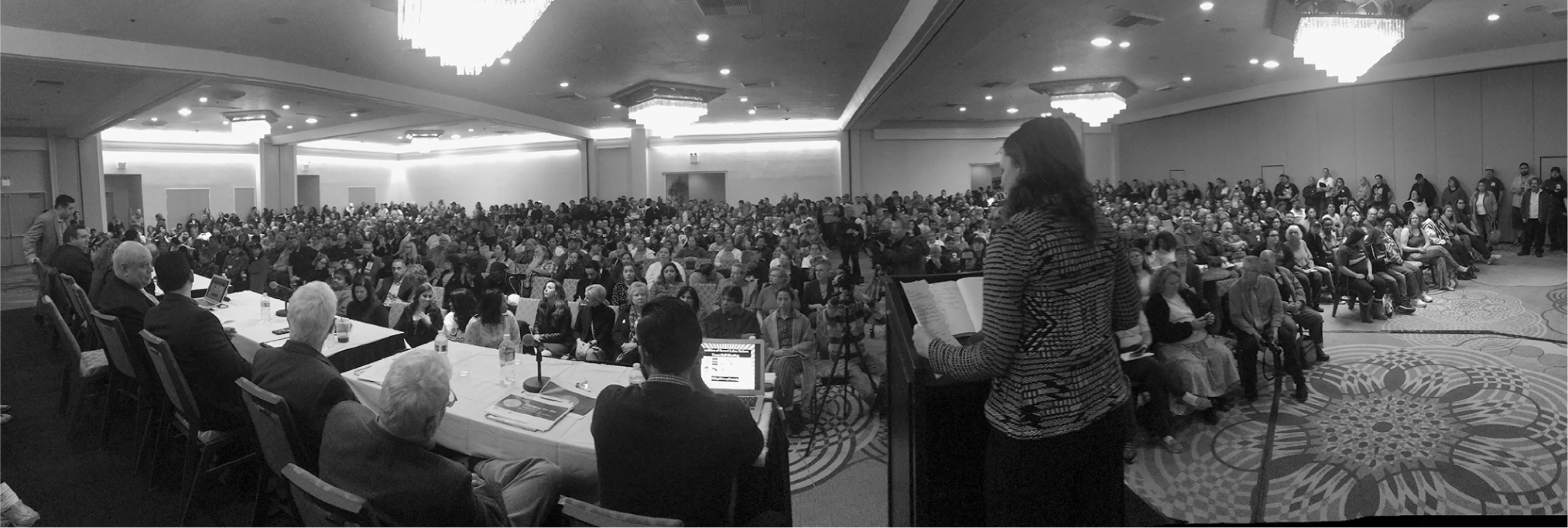
The day after we released our report, the CRLU and several local community and faith-based organizations sponsored a town meeting at a local hotel and invited us to discuss the report with a standing-room-only crowd of more than 1,000 people— most of them Disneyland employees. It was the largest meeting of its kind that resort workers could remember.
Workers who spoke at the meeting put a human face on the report’s statistics. A 35-year old night-shift janitor, who earned $12.21 an hour after working at Disneyland for five years, described the difficulties of raising her 6-year-old child. She used food stamps to feed herself and her child and occasionally slept in her car because she could not afford rent. The cleaning supplies she uses in job exacerbated her asthma, but she had to pay $250 for the medication, despite being on the company’s health insurance plan. A 28-year-old fry cook cried as she described how she and her husband, also a Disneyland employee, lived in their car for several weeks. “I love working at Disney because the cast members are my family. I just want Disney to do the right thing,” she said. A licensed cosmetologist at Disneyland described how she was unable to make ends meet on her $11.68 an hour salary and often found herself also having to sleep in her car.
At the end of the meeting, the CRLU leaders announced that the coalition would sponsor a citywide initiative on the November 2018 ballot, Measure L, requiring any large hospitality business benefiting from Anaheim city subsidies to pay at least $15 an hour to their workers beginning in 2019, increasing by $1 an hour in annual increments until it reached $18 an hour by January 1, 2022, after which it would increase annually by the rate of inflation.
“We are not attacking Disney,” said Christopher Duarte, president of Workers United Local 50, the resort’s largest union with 6,700 members, and head of the CRLU. “But if taxpayers are going to subsidize a large corporation, then that corporation should pay a living wage and not contribute to poverty.”
Their plan built on the “living wage” movement of the previous two decades. Hundreds of cities around the country have adopted laws linking municipal subsidies to wage requirements, while dozens of cities, including Los Angeles, have passed laws requiring all employers (not only those with municipal subsidies) to pay a minimum wage substantially higher than the federal level, which has been stuck at $7.25 since 2009. This movement is often called the Fight for 15.
The coalition of unions, community groups, and faith-based organizations waged a grassroots campaign that involved door-to-door canvassing, rallies, and other activities to increase awareness and voter turnout. Ada Briceño, co-president of Unite Here Local 11, which represents employees at Disneyland hotels, called it a “campaign of the people.”
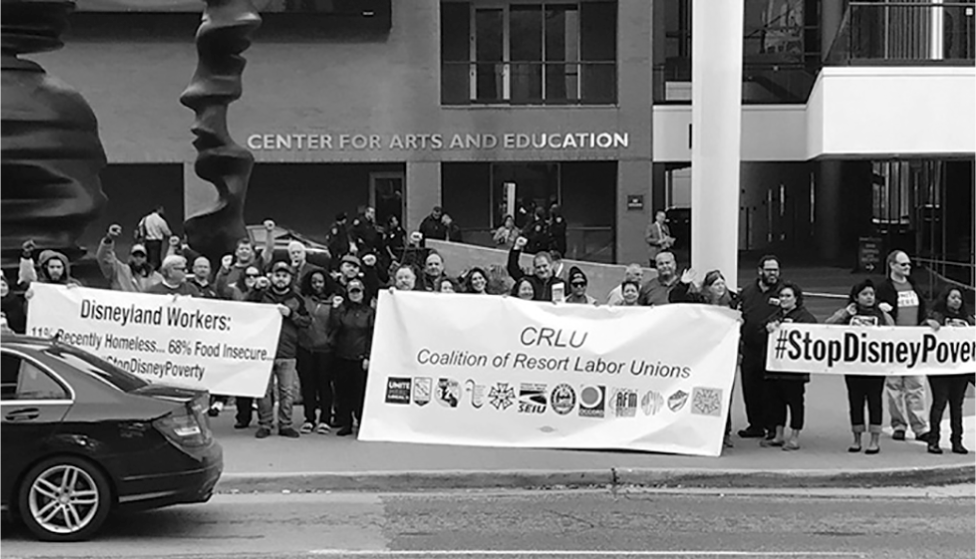
During the campaign, the CRLU used a variety of tactics to keep the report—and the issue of company labor practices—in the public eye. For example, a delegation of Disneyland employees, as well as one of the researchers, travelled to Houston to participate in the Walt Disney Company’s annual shareholder meeting. They obtained company shares to participate in the event and publicly requested a meeting with Iger to discuss the report’s findings. We also testified at an Anaheim City Council meeting about the report.
On June 2, 2018, Senator Bernie Sanders spoke at an Anaheim rally to support Measure L. “The struggle that you are waging here in Anaheim is not just for you,” he told a large crowd. “It is a struggle for millions of workers all across this country who are sick and tired of working longer hours for lower wages.” Later that month, Sanders, Senator Elizabeth Warren, and 21 other Democratic Congress members signed a letter to Iger, urging him to use the company’s huge profits to pay Disneyland employees a living wage, citing our report’s findings. “The people who walk around all day in Mickey Mouse and Donald Duck costumes, the workers who prepare and deliver the food, the men and women who collect tickets and manage the rides make wages so low that they are barely surviving,” they wrote.
Houston; the CRLU Banners
Coalition of Resort Labor Unions
Responding to the pressure, in July the company agreed to raise the minimum wage for 9,700 Disneyland employees (those represented by several of the unions) to $13.25 for the remainder of 2018 and to $15 in 2019. Under the agreement, employees already at or above the minimum wage would receive an annual 3 percent wage increase. The agreement did not, however, weaken the CRLU’s support for Measure L.
The Disney Company, Wincome Group (a developer that had one hotel under construction and another in the planning stages, both with city tax breaks), and the Anaheim Chamber of Commerce led the campaign to oppose Measure L, calling it the “job killer initiative.” They spent at least $392,000 in their efforts for TV ads and mailers.
A few months before voters went to the polls, the president of the Disneyland Resort requested the city to nullify tax subsidy agreements for two proposed hotels, including a $267 million tax break for a 700-room luxury hotel. After the Anaheim City Council voted to end these subsidy deals, the city attorney claimed that, even if passed, Measure L would not apply to Disneyland.
Measure L nevertheless earned a majority of voter support. There were 45,237 “yes” voters (54.2 percent) and 38,229 “no” voters (45.8 percent). “This is a tragic outcome for Anaheim,” said Anaheim Chamber of Commerce president Todd Ament.
The Impact and Aftermath
The Anaheim government refused to require Disneyland to abide by Measure L’s provisions because it claimed that that the resort no longer had any municipal subsidies. The unions and its supporters, including the attorney who wrote the ballot measure, argued that Disneyland was covered because of the parking garage that the city leases to Disneyland for one dollar a year and whose bonds won’t be paid off until 2036. (In December 2019, UNITE HERE Local 11, on behalf of its members, filed a class-action lawsuit to require the city to implement Measure L for Disneyland employees).
Despite this dispute, the campaign for Measure L had a positive impact in putting pressure on the company. Workers at the Disneyland Resort voted overwhelmingly on July 26, 2018 in favor of a three-year contract that raised hourly wages by as much as 20 percent immediately and an additional 13 percent in January 2019. The minimum hourly rate for Disneyland workers immediately increased from $11 to $13.25, then to $15 in January 2019, and to $15.50 in June 2020. Disneyland workers achieved a $15 wage floor three years before California’s minimum wage will reach that level. Resort employees with higher salaries, such as truck drivers, also received wage increases, As a direct result of the union victory at Disneyland, the company gave similar pay increases to over 37,000 workers at Disney World in Orlando, Florida.
These victories, however, did not end the controversy. It dramatically escalated in April 2019 when, at a conference sponsored by Fast Company magazine, Abigail Disney, granddaughter of Disney co-founder Roy Disney and grandniece of Walt Disney, said that Iger’s $65.6 million compensation was ‘insane.’ She also said that excessive CEO compensation in general has “a corrosive effect on society.” Disney, a filmmaker who owns stock in, but plays no role in the management of, the company bearing her family name, told the audience that many Disneyland employees struggled to pay for basic needs.
“I like Bob Iger,” she said. “But I think he’s allowing himself to go down a road that is the road everyone is going down… When he got his bonus last year, I did the math, and I figured out that he could have given personally, out of pocket, a 15 percent raise to everyone who worked at Disneyland, and still walked away with $10 million.” She criticized “this class of people who—I’m sorry this is radical—have too much money. There is such a thing.”
Her comments generated headlines around the world, as did her Washington Post column, “It’s Time to Call Out Disney—And Anyone Else Rich Off Their Workers’ Backs.” She called Iger’s compensation “naked indecency.” She made similar remarks, and headlines, in testimony before Congress. “[C] orporate excess has become so normalized that they and their peers can’t really see the problem anymore,” she said. “We need to change the way we understand and practice capitalism.” She told Town and County magazine that the problem facing America was “fundamentalist capitalism.”
Before expressing these views, Abigail Disney had met with Disneyland workers in Anaheim, read our report, and talked with us, so we weren’t surprised by her speaking out about the inequities at the Disney Company and the wider society. Nor were we surprised by the huge public response to our report and to her criticism of the company.
The Disney Company and its allies pushed back. It issued a statement, reported in the New York Times and elsewhere, saying that it paid starting minimum wage of $15 and claiming that 90 percent of Iger’s compensation was based on the company’s financial performance. A Yale business professor wrote an article in Fortune magazine, “Why Bob Iger Deserves His $66 Million Pay Package.” The conservative National Review attacked Abigail Disney as “My Least Favorite Disney Princess.”
The battle over Disneyland’s working conditions and Iger’s compensation served as a surrogate for a wider debate over the social responsibility of big corporations and the dangers of unfettered capitalism. Fox Business News ran a story headlined “Warren Buffett’s Kids: Abigail Disney is Right, Corporate Big Shots Often Overpaid.” “Rage over Bob Iger’s payday masks how little we know about income gaps in America,” read a headline in the Los Angeles Times.
Our report and the ensuing controversy went beyond Disney, touching a nerve about watershed issues in America— widening wealth and income inequality, skyrocketing CEO compensation, and the persistence of low-wage jobs that makes it increasingly difficult for families to make ends meet. According to a report by the Economic Policy Institute, the CEOs of America’s top 350 companies made an average of $17.2 million in 2018—278 times the salary of their average worker. The CEO-average worker ratio was 20-to-1 in 1965 and 58-to-1 in 1989. Since 1978, CEO pay has grown nearly 1,000 percent while the average pay of all private-sector workers grew by about 12 percent. Meanwhile, four in 10 American adults can’t cover an unexpected $400 expense with cash, savings or a credit-card charge, according to a 2018 report by the Federal Reserve. A Brookings Institution report released in November 2019 found that more than 53 million people, or 44 percent of all workers ages 18 to 64, earn low hourly wages.
These trends account for growing opposition to corporate influence in our economic and political system, including large campaign donations and government subsidies to big business, often labeled “corporate welfare.”
Our report appeared during an upsurge of labor activism in the wake of the 2008 Wall Street-fueled recession and the emergence of Occupy Wall Street in 2011. Workers and their unions have become more active after more than a half-century of decline. Union organizing campaigns and strikes by janitors, hotel workers, retail clerks, schoolteachers, flight attendants, auto workers, and other employees have boosted union membership and drawn favorable public attention. A 2019 Gallup poll found that sixty-four percent of Americans approve of labor unions, an increase of 16 percentage points since 2009, due in part to concerns over widening inequality and wage stagnation.
Throughout this research project, we viewed our roles as both social scientists and advocates for social justice, which we don’t consider to be mutually exclusive. We conducted a scientific study, explained our findings to reporters, authored an op-ed column about our report, testified at the City Council, and spoke at rallies sponsored by the unions. Like other applied researchers, we provided the facts needed to explain social conditions and the workings of institutions. We hoped our findings would help activists engage in advocacy in order to inform public opinion, change corporate practices, and shape public policy. We sought to follow the mission articulated by sociologist C. Wright Mills: “I try to be objective. I do not claim to be detached.”