



Abstract
In a period of ambiguous legal culture between the U.S. Civil War and the legal imposition of Jim Crow, court cases reveal Black women navigating race, class, and gender as they sought a seat in the Ladies’ Car and claimed their right to dignity within American society.

Currier & Ives, “A Kiss in the Dark,” 1881.
Library of Congress Reproduction #LC-USZ62-1382
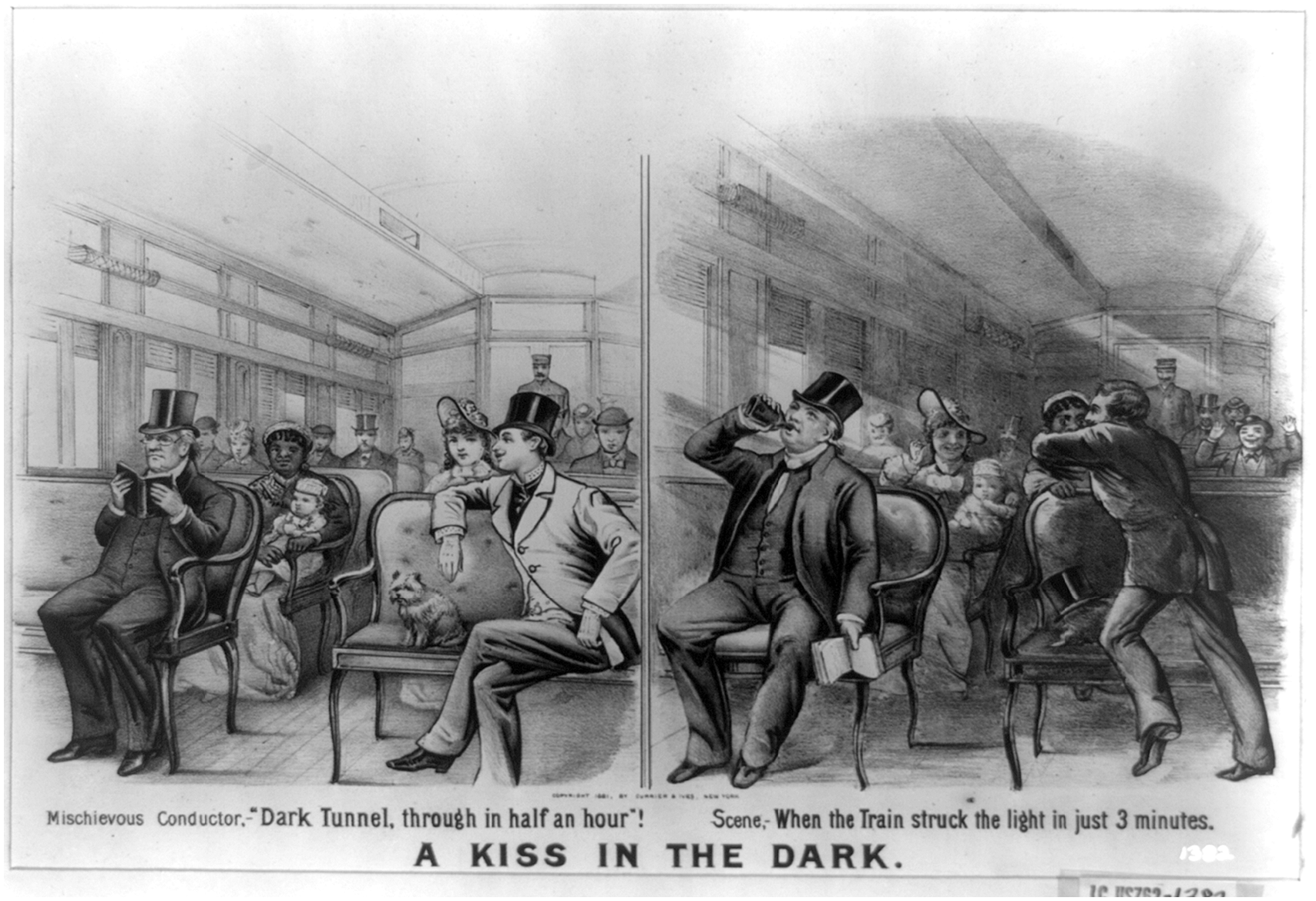
A popular American anecdote from the 1800s goes: “A White man traveling through Illinois asks a veiled lady if he may occupy the seat next to her. She consents, and the two travel side by side in the poorly lit car. After discussing the weather and politics the conversation takes a more personal turn, and each confides that he or she is widowed. The man grows ‘more affectionate in his remarks,’ and as his station approaches he requests the honor of a kiss. Again the lady consents. As the man lifts her veil, the conductor enters with a bright lantern and illuminates the car to reveal the ‘luscious lips, glistening teeth, extensive nose, white eyes, charcoal countenance, and wavy hair of a she American of African descent.’” The account concludes succinctly: “He did not take that kiss.”
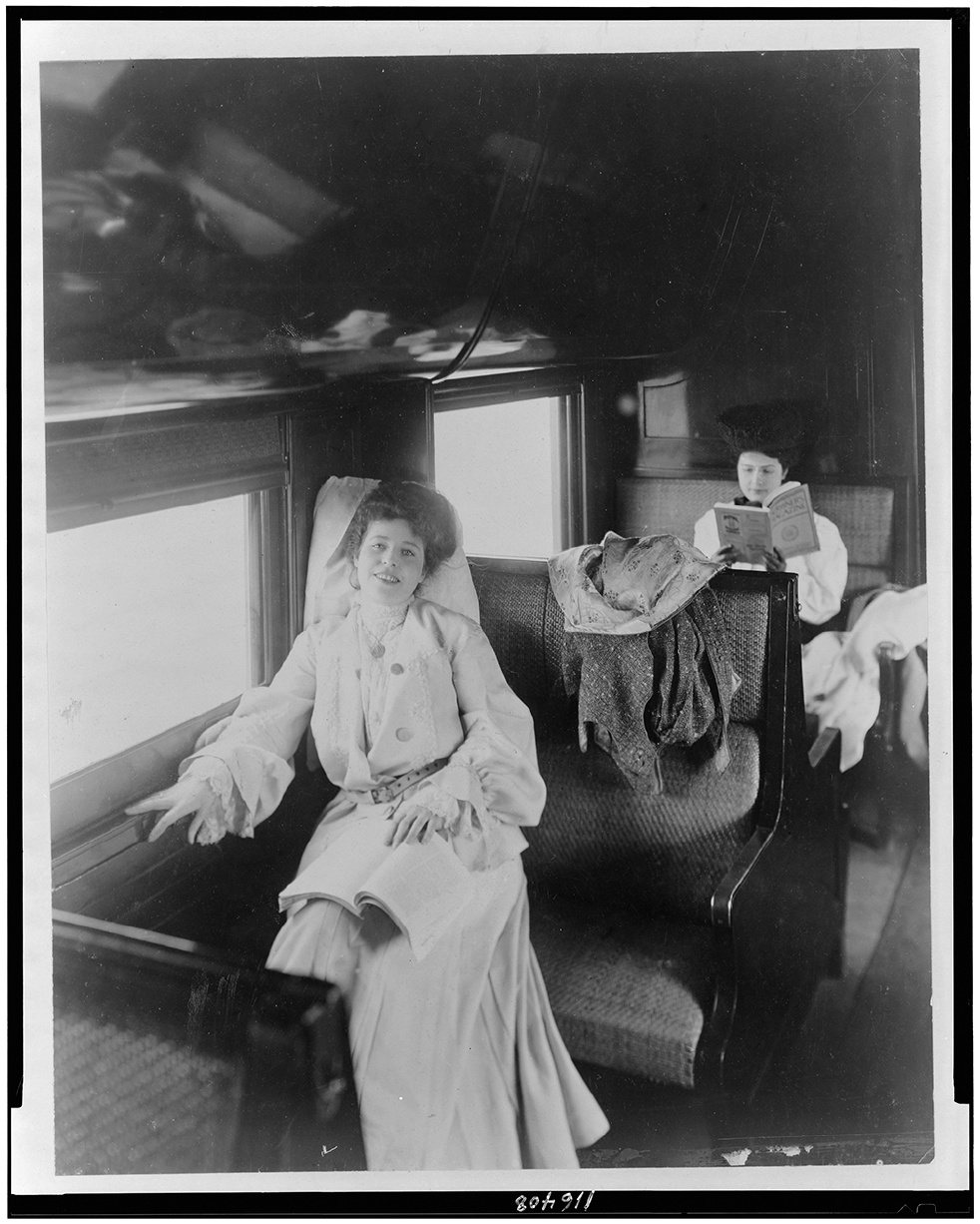
George R. Lawrence and Co., “Two Women Reading in Railroad Passenger Car,” ca. 1905.
Library of Congress Reproduction #LC-USZ62-116408
In her book Home on the Rails, historian Amy Richter unpacks how this story and others were told and retold, mocking Black women’s “displays of respectability” on the railroad. The Currier & Ives postcard cartoon, “A Kiss in the Dark,” she writes, also plays on the social unease felt by upper-class White riders as they moved within train cars, intermingling with lower classes and different racial castes. Here, as a train goes through a dark tunnel, one gentleman produces a bottle of alcohol while another “mistakenly” kisses a Black woman. To Richter, “this image plays upon the anonymity of railroad car life and suggests how moral uncertainty, social danger, and racial confusion merged in popular railroad stories.”
Only when the decision-makers were presented with an empathetic story were Black women able to make strides toward integration into White women’s spaces.
Following Emancipation, the White supremacist establishment faced a dilemma: how could Whites maintain privileged boundaries in spaces where different persons now had a legal right to occupy? Particularly when it came to Black women, confusion about place and social structure was rampant. They lived within an ambiguous legal position, and court case records reveal numerous instances of Black women arguing for their right to sit in the same spaces as White women on the railroad.
Railroads, then, provide a unique historical space in which we can examine the intersection of gendered, classed, and racialized segregation. Train cars were traditionally designated by the different groups of people they were meant to transport. Luxury Cars, Smoking Cars, Ladies’ Cars, and (eventually) Jim Crow Cars were common demarcations on American trains, though not on other forms of transport. Steamboats, for example, were only divided into an upper deck and lower deck, and street cars by a front section and back section. On the train, rough men could smoke and drink and be rambunctious in the Smoking Car, while the “fairer sex,” sometimes with their gentlemen, were separated and protected from these men in the Ladies’ Car.
The Ladies
“Lady,” in the context of a Ladies’ Car, conjured an image of a woman who was more delicate, demure, polite, and handsome than the average woman. Implicitly, this image was upper-class and White. Then Black women began to bring lawsuits, arguing for their right to sit, separated from the rougher male travelers, in the Ladies’ Car. By the late 1800s, the question of where to place free Black women within the social framework of this transitional space was a contentious social dilemma.
Legal decisions about Black women’s access to Ladies’ Cars allow for a discussion about the intersectional challenges Black women faced in this period. Certain claims for racial inclusion and accommodation after the enactment of the Civil Rights Act of 1875 were framed in the language of class and gender—specifically, “ladylikeness”—rather than race. To tease out the plaintiffs’ intersectional identities, I analyzed judicial opinions from 34 total cases representing 20 Black female plaintiffs between 1865-1909. These included cases in which Black women claimed damages against railroad companies for being denied access to the Ladies’ Cars or other Ladies’ accommodations, as well as cases in which Black women were harassed or in some other way not provided the protections afforded to White women on the train.
The years 1865-1883 represent a particular period of “ambiguous” legal culture regarding where to place Black women on the train (and in society). These years book-end the end of the Civil War, and the determination, in 1883, that the Congressional Civil Rights Act of 1875, which prohibited racial discrimination in all accommodations and conveyances, was unconstitutional. Throughout, the federal government, the states, and private entities all vied through legislation and practice for dominance in determining the legal and social position of free Black persons. Legal historian Lawrence Friedman defines legal culture as the “public knowledge of and attitudes and behavioral patterns toward the legal system.” A part of “general culture”—customs, structures, and norms—legal culture can “bend social forces toward or away from the law and in particular ways.” Thus, as we will see, court rulings in this period of ambiguous legal culture were based on subjective arguments of femininity, sometimes allowing Black women to successfully argue for their right to sit with White ladies on the train.
Black Women’s Unique Perspective
Women of color have long lived at an intersection in the United States, making their experiences unique. Kimberlé Cren-shaw, civil rights advocate and celebrated scholar, coined the term intersectionality to draw attention to the everyday experiences of Black women dealing with multiple and simultaneous forms of discrimination. That is, intersectionality reminds us that women of color do not experience sexisim and racism separately, but concurrently, and that they experience discrimination differently than both men of color and White women. For example, in the mid- to late-1800s and early 1900s, Black female activists were fighting against different social norms than were White women’s-rights activists. The Black women arguing for equal access to White lady’s spaces were not challenging the gender norms of the period, but leveraging them. Both explicitly and implicitly, they aimed to embody an upper-class, White ideal of femininity in order to enter White, privileged spaces.
Freed Black women were considered exempt from the feminine, middle-upper class ideal of full-time domesticity. Like other women of color, they were traditionally excluded from White norms of womanhood, purity, and domesticity. After Emancipation, Black women focused on the domestic sphere to assert their claims to femininity and respectability. According to historian Jacqueline Jones, freedwomen cut their work hours to raise children and worked alongside their husbands as family units, to the ire of former slave-owners, so accustomed to the availability of Black women’s labor and sexuality.
A lady’s sexuality was closely guarded and regulated, while the sexuality of other women was often considered more liberally available. White men had enjoyed almost unlimited sexual access to Black women during slavery, and in fighting to claim their social womanhood, Black women were fighting for social and sexual protections afforded to White women. The White supremacist establishment was not happy with Black women’s efforts to attain the ideal of protected, domestic womanhood. Stereotypes of the “Jezebel” were deployed to justify the social exclusion of Black women after the Civil War and prior to the widespread implementation of Jim Crow segregation.
In that interregnum, free Black women using railways began asserting their status as “ladies.” Some Black women successfully claimed they were as equally deserving of protection as White women on the train. Others were relegated to sitting in inferior spaces, including sitting out in the elements on the train’s open platform, or were forced off the carrier altogether. Lawyers on both sides of the issue manipulated the ambiguity around Black women’s class position to win court cases.
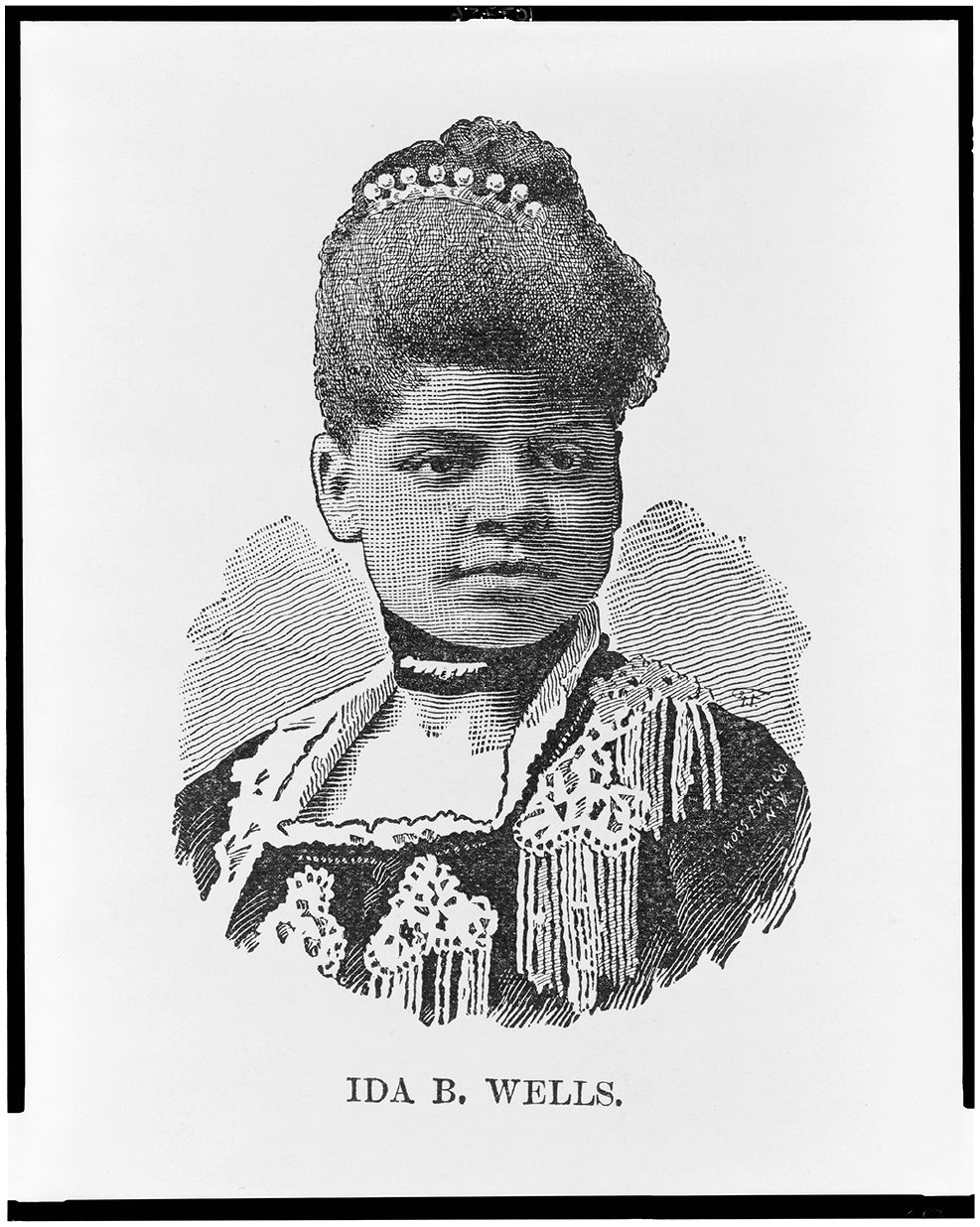
Ida B. Wells, about the time of her lawsuit against the Chesapeake, Ohio & Southwestern Railroad Company.
Library of Congress Reproduction #LC-USZ62-107756
Taking the Train to Court
Lawyers defending railroad company employees who denied Black women the same amenities and protections as the White women travelling in their cars were constrained by law and precedent. Between emancipation and the voiding of the Civil Rights Act of 1865, company lawyers avoided claiming the lawfulness of racial discrimination. Some courts had affirmed that segregation was lawful so long as the spaces were entirely equal, but “separate-but-equal” arguments were rare before 1883. So, generally, if a Black woman was denied access to a space for “ladies,” it could not be purely because of her skin color. Class-based discrimination, on the other hand, was entirely lawful when applied to behavior, appearance, and general conduct. If a Black woman could be shown to be not “ladylike,” her exclusion could be warranted.
Companies’ defense attorneys made explicitly gendered arguments rather than explicitly racial arguments for their denials of carriage. In many of these cases, lawyers asserting Black women’s exclusion from Ladies’ Cars referred to skin tones (“mulatto”, “less ‘negro’ blood”), wealth indicators (“nice dress”), education (“graduated from a girl’s school”), maternal characteristics (“pregnant”, “married”, “with children”), polite or impolite conduct, and handsomeness in constructing the Black plaintiff’s ladylikeness (or lack thereof). Plaintiffs’ lawyers, of course, had to assert the opposite, using the same culturally salient language around femininity. These arguments were inherently subjective and ambiguous, and some Black women won their cases. After 1883, a railroad company could choose to openly discriminate as long as they followed certain technical rules around what the courts decided was “separate-but-equal,” but during the period of ambiguous legal culture, lawyers could experiment with the language around social positionality, even poking holes in cultural “common sense” around gender norms.
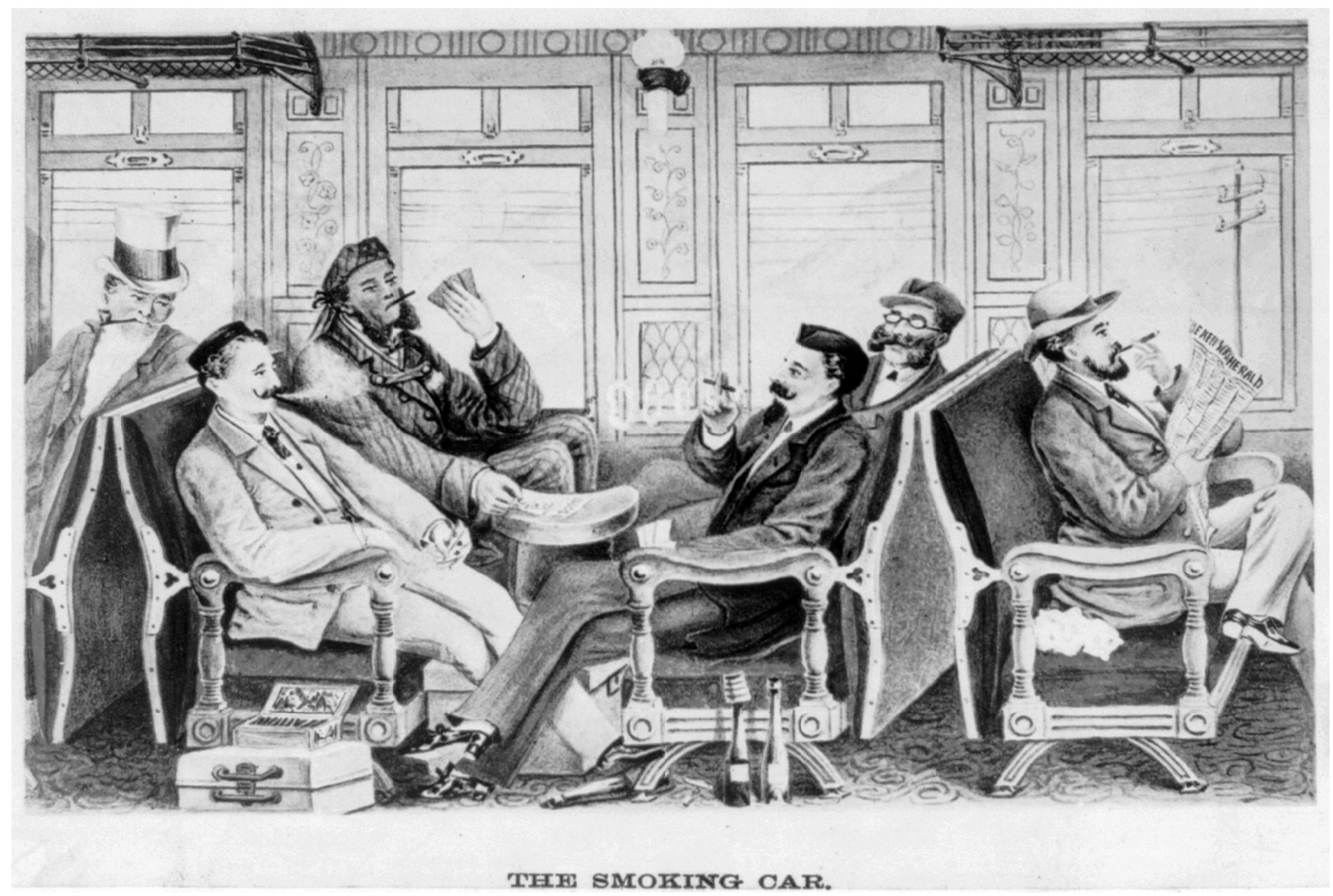
“The Smoking Car,” ca. 1884.
Library of Congress Reproduction #LC-USZ62-54183
That Ladies’ Cars were designed to keep ladies separated and protected from other riders was important in a number of the court cases I examined. As stated in two decisions regarding a Miss Brown in 1880 and 1881: “carriers, acting upon the notions of chivalry… seek to protect women from rude conduct of the disorderly by providing for them a special Ladies’ Car” and “the Ladies’ Car was set apart to be exclusively used and occupied by persons of good character, and genteel and modest deportment.. it was… the duty of [the] conductor to exclude all persons of improper character.” The plaintiff was forcibly removed from the Ladies’ Car by a train conductor in Tennessee on account of her “allegedly unchaste reputation.” When she sued for damages, her very ladylike conduct on the train was described: “She is not repulsive in appearance; is accustomed to dress well and even handsomely; behaves in a lady-like manner, and that on this occasion her conduct was unexceptionable.” Witnesses said Brown’s employment entailed serving refreshments to “virtuous ladies, wives, mothers, and daughters, and their husbands and fathers and to nurse them in sickness,” and many passengers testified to her good behavior. And the court ruled that the conductor had no right to judge a passenger on their character beyond their behavior while on the train. Brown was awarded $3,000.
Many court case arguments hinged on vivid descriptions of Black women’s credible fear regarding being subjected to the attention of men in the Smoking Car and their desire for protection in the Ladies’ Car. In the well documented Chesapeake, Ohio & Southwestern Railroad Company v. Wells case of 1885, acting as a witness for the plaintiff Ida B. Wells, G. H. Flowers described the Smoking Car as, “no fit place for a Lady.” The narrative of protected femininity was common when it came to determining who and who did not fit the profile for a rider in the Ladies’ Car.
On a Texas train, Mrs. Lola Houck, who had purchased a ticket for the Ladies’ Car, was denied entry to it by a brakeman. Though it was raining, Houck chose to sit on the platform rather than with the rowdy men in the Smoking Car’s “inferior, uncushioned seats.” Married, pregnant, and traveling to visit the bedside of her sick child, Houck suffered a miscarriage after her ride in the rain. Time and again, in the courtroom, her perfect ladylike conduct was described. The conductor said she acted “very ladylike” all the time, and it was mentioned that, though she had “some degree of negro blood in her veins… casually looking at her or her husband it would be difficult to distinguish either of them from White persons.” On several other occasions, Houck had been allowed to ride in the Ladies Car, and on this occasion several White passengers remonstrated the brakeman for his conduct toward her. The court awarded Houck $5,000 in damages.
These cases suggest that technical distinctions were far less important than the stories being presented to the jury. When Lola Houck was denied access to the Ladies’ Car, the jury was presented with a heartfelt tale of a mother travelling to visit the bedside of her sick child, who was so abused at the hands of the railroad that she suffered a miscarriage. In this narrative, Houck strikingly and perfectly fit the image of victimized womanhood. Only when the decision-makers were presented with a story in which they could empathize were Black women able to make strides toward integration into White women’s spaces.
Legal ambiguity could also be used against Black women. As mentioned above, when she was excluded from the Ladies’ Car, Ida B. Wells sued for damages. After Wells won her case, the Memphis Appeal Avalanche proclaimed, “A Darky Damsel Obtains a Verdict for Damages against the Chesapeake & Ohio Railroad,” and Wells wrote extensively about the case in her own writings. Ida B. Wells was an overt activist, and this activism was used against her. In the 1887 appeal of her case, the Supreme Court of Tennessee asserted: “We think it is evident that the purpose of the defendant in error was to harass with a view to this suit, and that her persistence was not in good faith.” Further, Wells “had no right to arbitrarily determine where she wished to sit.” Activism was viewed as harassment—certainly not the polite conduct of a lady who needed protection in the Ladies’ Car.
After the Civil Rights Act was declared unconstitutional in 1883, Jim Crow segregation was officially lawful. Plessy v. Ferguson in 1896 corroborated the rights of railroads to impose such racial separation, and Black women completely lost their ability to claim the right to sit in the Ladies’ Car except in explicitly anti-segregation states. By the end of the 19th century, segregated cars had eliminated the grey area around where Black women could situate themselves in the vehicle. Court rulings became increasingly inflexible. For the next 80 years or so, Black women could no longer fit into the cultural conception of ladylikeness. White society and its legal apparatus deemed them a specifically segregated class necessitating specifically segregated space.
But the Civil Rights Act of 1964 is not the end of this story. Black persons continue to fight to fit into White dominated spaces today. In her memoir, Becoming, former First Lady Michelle Obama discusses “talking like a White girl” and operating in “two different worlds”—the sort of “code-switching” required for one person to move across socially segregated spaces. Even this accomplished lawyer, professor, and spouse to the nation’s president consciously developed a different mode of speaking among White persons in order to better fit into White social spaces. Similarly, Hedwig Lee and Margaret Takako Hicken discuss Black individuals’ struggles for acceptance in White spaces in their aptly titled article, “Death by a Thousand Cuts: The Health Implications of Black Respectability Politics.” Lee and Hicken’s interviewees discuss donning “visible armor” in the form of dress clothes to avoid racial stereotyping, assert higher class status, and combat negative attention from police and White neighbors. That is, by adopting upper-class ways of dressing and speaking, their respondents are not only trying to gain White acceptance but also avoid White harassment and discrimination.
One important take-away from my review of these Ladies’ Car cases is that narratives can sometimes serve Black women well in legal settings. In her study of domestic violence law reform in Maryland, Jane Murphy describes how lawmakers had “no interest” in and were “unsympathetic” to domestic violence reform until activists changed tactics to present personal stories from victims harmed by the archaic laws. Narratives, according to Murphy, are better tools for empathetic persuasion than technical arguments or abstract legal jargon. In looking toward contemporary discrimination claims, telling sympathetic stories of Black individuals facing bigotry and exclusion may be one fruitful avenue for fostering awareness of—and remedies against—the multifaceted discrimination borne by Black people in this country.