




Abstract
Nancy Wang Yuen on Going Public.
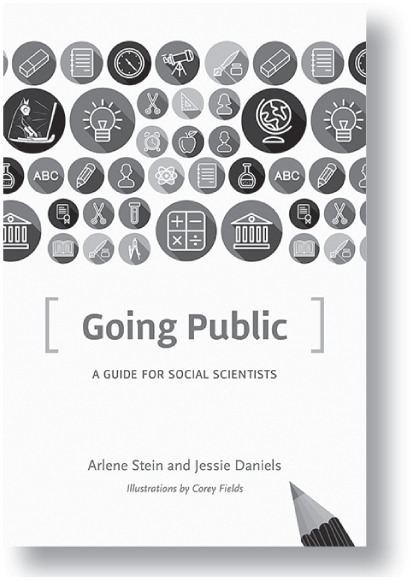
Going Public: A Guide for Social Scientists
By Arlene Stein and Jessie Daniels University of Chicago Press 2017 224 pp
My first experience of “going public” was in graduate school. I assembled a team of co-researchers at UCLA to produce the first policy report on Asian Americans and Pacific Islanders (AAPIs) on television. With the support of a civil rights organization—Asian Americans Advancing Justice (AAJC)—we found that AAPIs, who played only 2.7% of regular characters on TV in 2005, were egregiously underrepresented and underutilized on screen. Our research received national media coverage, and AAJC shared the results with television networks, our site of advocacy. Though our research had real-world impact, it veered outside the traditional bounds of academic writing. Our partner organization, not a traditional academic journal, published our policy report. To legitimate our research, we had to repackage the results as journal articles and book chapters.
Nonetheless, the reach and influence of our policy report made a lasting impression on me. When I turned my dissertation into a book, I rewrote it with a popular audience in mind. The task was much harder than I anticipated. I wish I had a book like Going Public: A Guide for Social Scientists—a readable guide packed with how-to steps for public writing and engagement.
The first three chapters of Going Public help scholars “unlearn” academic journal writing. The authors discuss how social scientists rely on data and theory and frequently neglect to tell a good story. This resonates with my experience. Even though I collected stories through in-depth interviews with Hollywood actors, I separated the data points from their narrative husks. When I decided to reach a public audience, I imagined someone browsing a bookstore and picking up my book to test drive a chapter or two. I reviewed my chapters and saw that each one began with a theoretical or analytical statement (boring!). I rewrote them to open instead with evocative stories from my interviews and from popular media.
Besides storytelling, Going Public also urges academics to “develop your voice.” Coming out of graduate school, my default mode was to remove myself from—not center my voice in—my writing. Yet, in reviewing my book manuscript, an editor asked, “Where is your voice?” A Huffington Post editor suggested I describe my personal feelings about the TV show Fresh Off the Boat and discuss my favorite episode to give my article more “pathos.” Academic writing generally precludes divulging of personal feelings and preferences—the need to present an “objective” voice as a way to establish authority. Yet, stories and “pathos” are often the most important draws for general audiences. It makes our work more relatable.
Just before my book went to press, I wanted to publish an op-ed, or an opinion piece, in a major newspaper to create some buzz. But I had no clue how to begin. I took a day-long seminar from an organization called The OpEd Project. Nearly half of the participants were academics from business, medicine, and sociology—all seeking professional help on how to translate our research for the general public. Going Public is a great resource for writing op-eds. The authors provide clear how-to steps on building an op-ed, illustrated with excerpts from an actual New York Times piece written by sociologist Ruth Milkman.
The second half of Going Public takes a “digital turn” by focusing on the pivotal role of social media in establishing a public presence. The authors document how a tweet can lead to conference presentations, articles, and even book deals. One colorful story is how Danielle Henderson’s “Feminist Ryan Gosling” memes blew up on social media, which led to her getting a literary agent and a trade press book deal. For digital novices (say, if you don’t know what a “meme” is), the authors assemble a list of resources at the end of chapter four. The book also taught me that Google Scholar automatically compiles a scholar’s academic publications and citation numbers, prompting me to put the book down and immediately open an account. Going Public shines in covering a wide range of public writing—from op-eds and books to blogs and tweets. Both new and seasoned public scholars will discover gems on how to write for a broader audience.
Despite the ubiquity of social media, the mechanics of cultivating an online presence are tricky. Explaining best practices in “building an audience” is akin to trying to pin down the formula for a hit Hollywood film. When I opened a Twitter account to promote my book, I had no idea I would use it to build a public scholar platform. As I gained followers, the rules of engagement evolved. One limitation of Going Public relates to cultivating a social media presence. Specifically, though the book provides a good introduction to Twitter, I want a deeper dive. For example, though the authors discuss using and following hashtags, they do not mention how creating or leveraging original hashtags can increase community engagement. For my book, Reel Inequality: Hollywood Actors and Racism, I created the hashtag #ReelInequality and asked readers to post book selfies using the hashtag #ReelSelfie. I also created a separate Twitter handle for my book, @ReelInequality. A passage from my book inspired the viral hashtag #ExpressiveAsians, which I leveraged to raise my public profile, linking it to my book in my tweets. As a result, CNN dedicated an entire article to the hashtag, with a reference to my book.
Legitimating “going public” for academia’s sake feels hollow. Let us lead by “going public” for the public’s sake.
My main motivation as a public scholar is to stimulate social change. Shortly after I published a HuffPost article on why ABC should not cancel Fresh Off the Boat, one of the writers emailed me and said it helped save the show. That was one of my most fulfilling moments. Going Public’s final focus on making public scholarship count for academia shortchanges scholars who thrive in public spheres. Rather than trying to pull academia’s teeth to recognize and reward public scholarship, I would rather learn more about scholars who successfully carve out public spaces. There are a variety of successful public scholars, from high-profile public intellectuals like Melissa Harris-Perry, Reza Aslan, and Michael Eric Dyson appearing on national television, to author-scholars like Roxane Gay and Eve Ewing shedding light on key social issues of our times through social media and writing memoirs, poetry, and Marvel comic books. There are also activist-academics like sociologist Leisy J. Abrego serving as a pro bono expert witness for asylum claims and Anthony C. Ocampo sharing his story of coming out to his immigrant parents in Sheryl Sandberg’s Option B project. I want to hear from public scholars like these in their own voices—what drives them, what sustains them and how they make it work. With families torn apart at the borders, the persecution of Black and Brown folks, and the rollback of civil rights in this country, we urgently need social scientists to speak up and take action. Legitimating “going public” for academia’s sake feels hollow. Let us lead by “going public” for the public’s sake.