




Abstract
Lynn Comella on the social camouflage surrounding Texas sex toy sales.
The sign was simple: “If human sexuality offends you, do not enter.” It was 2001, and I was making my first visit to Forbidden Fruit, a small, woman-owned sex-toy shop in downtown Austin, Texas.
I was in the early stages of conducting research for Vibrator Nation, the first book to take a deep dive into the history and retail culture of feminist sex-toy stores in the United States. I had already done research in New York, San Francisco, and Boston, but Texas was different. How did a business sell sex toys in a state where it was technically illegal to do so? Now, as U.S. lawmakers implement increasingly draconian measures to regulate women’s sexuality, it’s worth revisiting Texas’s “dildo laws” to better understand the subversive possibilities that exist at the intersection of sexual politics and retail activism.
For years, the standing joke was “it’s easier to buy a handgun in Texas than a vibrator.” It wasn’t exactly an exaggeration. In 1979, Texas followed Georgia’s lead and amended its anti-obscenity statute to criminalize the sale of sexual devices. A handful of other states, mostly in the South, eventually followed suit. Although it wasn’t illegal to own sex toys, selling them was a different story and could result in jail time and hefty fines.
For years, the standing joke was “it’s easier to buy a handgun in Texas than a vibrator.”
These legislative statutes emerged during an era when many feminists were publicly making the case that sexual liberation was a fundamental part of women’s liberation. They wrote essays about the myth of the vaginal orgasm, spoke publicly about female masturbation, and opened vibrator shops created specifically with women in mind. So as many women were taking their pleasure, and their orgasms, into their own hands, lawmakers began to position vibrators and other sexual devices as a threat to public morality.
The door to Forbidden Fruit in 2001.
Jude Galligan, Towers.net
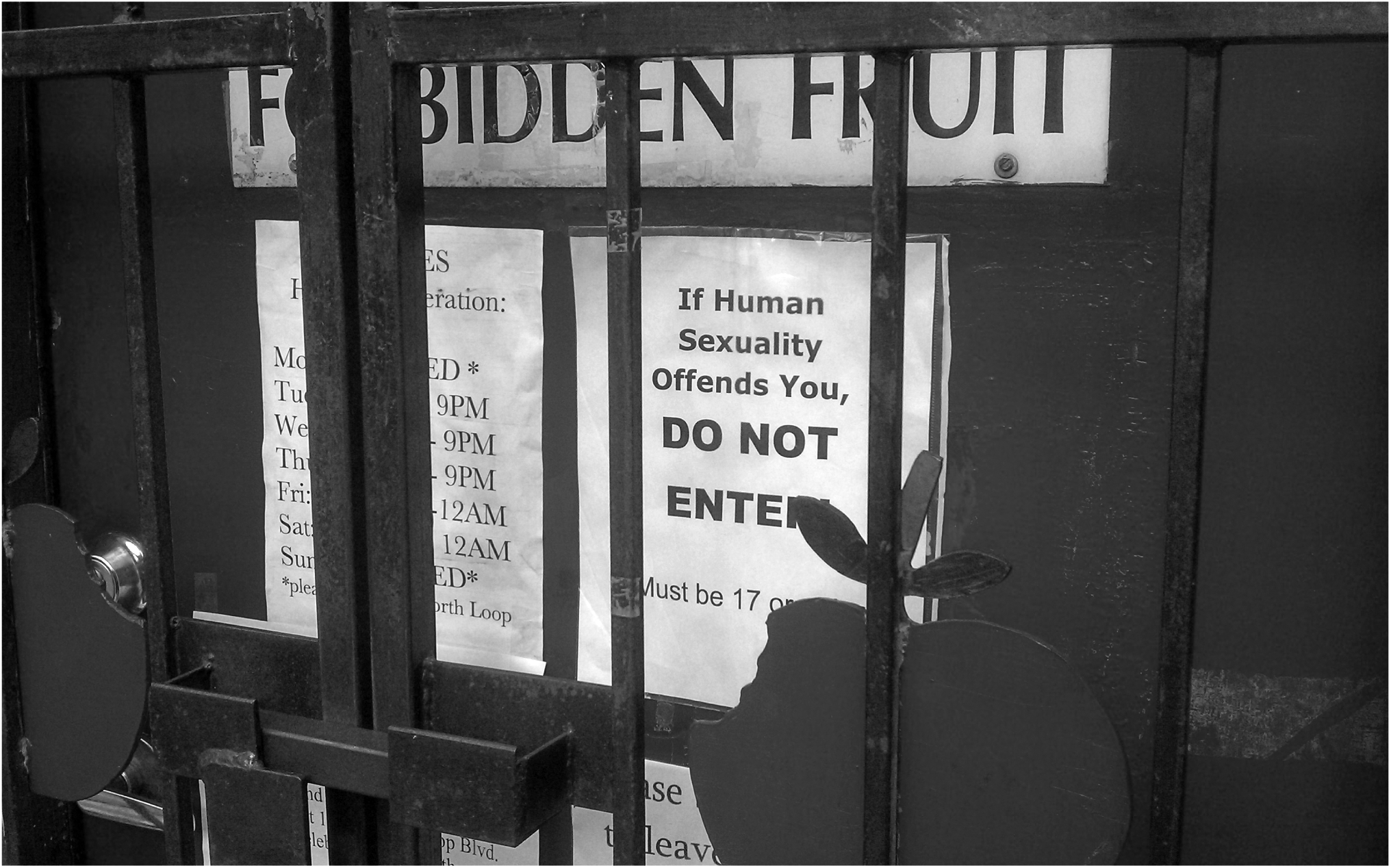
To fly under the radar, Forbidden Fruit adopted a highly coded language masking the sexual uses of its products and insulating the store from potential legal repercussions. I learned firsthand that saying the word “dildo” in the store would prompt a swift rebuke from staff. These were “educational models,” not dildos, and customers who wanted to buy one were required to sign a release form indicating they were purchasing it for “strictly educational and/or scientific purposes.” Shopkeepers had to, at least on paper, divorce the dildo from sexual pleasure and, by extension, the illicit realm of the obscene.
So, despite the fact that it wasn’t illegal to talk about sex in Texas, explicit references to sexual products and their uses were strictly off-limits at Forbidden Fruit. Such discussions risked sexualizing merchandise in ways that undermined the practice of social camouflage that employees worked so hard to maintain. Unlike the women-friendly sex-toy businesses I had visited in other parts of the country, such as Good Vibrations in San Francisco and Babeland in Seattle and New York, which prided themselves on being sexually open and affirming, Forbidden Fruit’s retail model was steeped in calculated evasion and semantic obfuscation.
Despite the fact that it wasn’t illegal to talk about sex in Texas, shop employees established a practice of social camouflage in talking with customers.
What I learned from interviewing the store’s owner and a handful of employees was that Forbidden Fruit’s retail culture was not always an intentionally non-sexual one. Things changed in the late 1980s after Austin’s vice squad raided the business for allegedly violating the state’s anti-obscenity statute. In a well-orchestrated sting, undercover officers visited the store. Under the pretense of shopping for items for a bachelor party, the officers made their purchases, went to the courthouse, secured a warrant, and returned to the store to arrest the manager and confiscate approximately 400 devices.
Years later, Forbidden Fruit’s owner, Lynn Raridon, described the dramatic raid for the Austin Chronicle: “They came flying through the door, busted in, and ransacked the place, and took everything they could get their hands on.” It was never clear what prompted the raid—it could have been a complaint or something else—but police seized the store’s checkbooks and most of its inventory. Charges against Raridon were eventually dropped, but not before the confiscated items were paraded in front of a Grand Jury tasked with determining whether they were obscene under Texas law.
In Texas, this product was sold as an “air freshener” to skirt obscenity laws.

The Grand Jury determined that inflatable sheep were permissible, because they were clearly novelty items, but inflatable dolls were not. Selling items that resembled a penis or a vagina that vibrated was illegal, but products that had to do with the anus—butt plugs and anal beads, for example—were acceptable, because the grand jurors didn’t consider the anus to be genitalia. While these outcomes might seem arbitrary, they reflected the logic of heteronormativity at work.
Following the raid, Forbidden Fruit changed how it did business. Every exchange on the sales floor now operated under the pretense—and indeed the elaborate ruse—that nothing Forbidden Fruit sold was intended for sexual purposes. Risk management became a key component of the job. Employees policed the boundary between acceptable and unacceptable speech, and customers were expected to “get with the program” or leave. The linguistic dance produced ways of talking about sex and selling sex toys that were not only cloaked in ambiguity, but occasionally strained believability. A vibrating cock ring was recast as a “big toe massager” and a grape-scented dildo was sold as an “air freshener.”
These strategies were hardly gender neutral. In fact, debates about obscenity and public morality have a long history of reinforcing taboos regarding female sexuality and pleasure. It was perfectly okay for sales staff to talk about penis pumps and cock rings (as long as they didn’t vibrate) without resorting to euphemism, because these devices were intended to help men achieve or maintain erections and were thus understood as having a procreative purpose, which made them lawful. The same was not said about vibrators, dildos, and other items women might use to enhance their sexual pleasure. Employees at Forbidden Fruit and elsewhere believed that laws prohibiting the promotion and sale of “obscene devices” were a roundabout way of regulating female sexuality. “The g-spot doesn’t exist in Texas,” one female staff member lamented. “But you can talk about the male prostate gland. It’s so sexist.”
Despite the law’s chauvinism, almost all the employees I spoke with suggested there were benefits to Forbidden Fruit’s policy of restricting sexual speech in a religiously conservative state like Texas. “In Texas, people don’t want to talk about sex. We make it pretty comfortable for anybody to come in and they don’t have to talk about sex,” one staff member told me. “People are so uncomfortable with sex, so to not have to talk about it makes them comfortable with it. ‘I’m [a customer] here on a quest or a mission, but I don’t have to talk about it, but we understand each other. Maybe you’re going to give me the information I need to make a good, informed decision about what it is I am looking for, and I didn’t have to talk to you about sex or be explicit.’ I think in some ways it can be rather liberating for a lot of people.”
In 2018, after years of courtroom battles, a dildo was suddenly a dildo again.
Michel Foucault argues that silence—the things one refuses to say or are forbidden to speak—is not the absolute limit of discourse, but an “element that functions alongside the things said.” In the case of Forbidden Fruit, sexual silence was reconfigured as potentially liberating and even subversive, allowing customers to purchase items that the government considered contraband.
In the post-Sex and the City era, sex toys are increasingly mainstream. A 2009 study conducted by researchers at Indiana University found that close to 50% of women have used vibrators and, of those, 80% have used them during partner sex. References to sex toys are routine in popular lifestyle magazines, and, in many communities, vibrators can be purchased in the sexual wellness section at the neighborhood Walgreens.
In 2008, after years of courtroom battles, the U.S. Fifth Circuit Court of Appeals overturned Texas’s ban on the sale of sex toys. The legal decision was heralded as a major victory for sexual privacy and the business of sex in the Lone Star state. Adult retailers no longer had to worry that their businesses would be raided, and school teachers moonlighting as home pleasure party associates could breathe easier knowing they wouldn’t be arrested for selling vibrators to their suburban neighbors. Sex-toy manufacturers that had long avoided messing with Texas began to explore the market. In Texas, a dildo was suddenly a dildo again. It was a win for sexual autonomy, a win for open and frank conversations about sex, and a win, especially, for female pleasure.