




Abstract
This essay evaluates the state of the debate around basic income, a controversial and much-discussed policy proposal. I explore its contested meaning and consider its potential impact. I provide a summary of the randomized guaranteed income experiments from the 1970s, emphasizing how experimental methods using scattered sets of isolated participants cannot capture the crucial social factors that help to explain changes in people’s patterns of work. In contrast, I examine a community experiment from the same period, where all residents of the town of Dauphin, Manitoba, were eligible for basic income payments. This “macro-experiment” sheds light on the community-level realities of basic income. I describe evidence showing that wages offered by Dauphin businesses increased. Additionally, labor market participation fell. By ignoring the social interactions that characterize real-world community contexts, randomized studies underestimate the decline in labor market participation and its impact on employers. These findings depend to a great extent on the details of the policy design, and as such I conclude that the oft-proposed right–left ideological alliance on basic income is unlikely to survive the move from basic income as a broad policy umbrella to basic income as a concrete policy option.

In the standard portrayal, basic income is like motherhood and apple pie: everyone seems to like the idea. Much has been made of the fact that support for the scheme runs the ideological gamut, from Charles Murray and Milton Friedman, Grand Poobahs of the libertarian right, to leading intellectuals of the left like Erik Olin Wright and Philippe Van Parijs. But whenever there is this much agreement about an idea, one can be sure that there is disagreement about what it means and what it is expected to actually do. (And as it turns out, the whole history of feminism attests to a good deal of disagreement about motherhood; even apple pie, as comedian Paul F. Tompkins has shown, resists easy consensus. Look it up.)
Indeed, the right and the left paint starkly different pictures of basic income. In short, basic income refers to a monthly payment sufficient to bring all residents to a decent, culturally respectable standard of living. But behind the superficial agreement about the concept are two diametrically opposed visions of economic life. As Friedman well knew, the devil is in the details. He favored a minuscule guaranteed income alongside a dramatically shrunken welfare state. Advocates on the left, on the other hand, propose to keep the welfare state intact and add to it a generous and universal guaranteed income. The difference is both quantitative and qualitative.
Sections of the right find Friedman’s plan appealing because it allows individuals to make their own spending decisions while junking what they see as the massive kludge of education, social security, and healthcare expenditures. The scheme is designed to reduce overall government spending on social purposes. On the left, basic income is appealing because it gives poor and working people “the power to say no” to employers, reducing their vulnerability to exploitative relations in labor markets. It partially “decommodifies” labor by securing a standard of living for workers outside of the market. If for Karl Marx labor under capitalism is doubly free—to select the best available capitalist to work under and, failing that, to starve to death—basic income counters this hollow freedom by loosening labor’s dependence on employers for survival. It could undermine the relations of domination inherent in capitalist everyday life. Another Marx—Groucho— made essentially the same point about the emancipatory potential of basic income: “Money frees you from doing things you dislike. Since I dislike doing nearly everything, money is handy.” Freeing people from the things they dislike is not a principle on which there is right–left consensus.
The heterogeneity in the meaning of basic income is matched by the heterogeneity in expectations about its concrete impact. Disagreement about what it would do is about as wide as any subject permits. Basic income would inculcate a culture of laziness! No, work is an inherent source of meaning—people would continue to work! In fact, cutting out poverty traps would permit greater labor market participation! Businesses would have to raise wages! No, a government supplement would allow firms to lower wages!
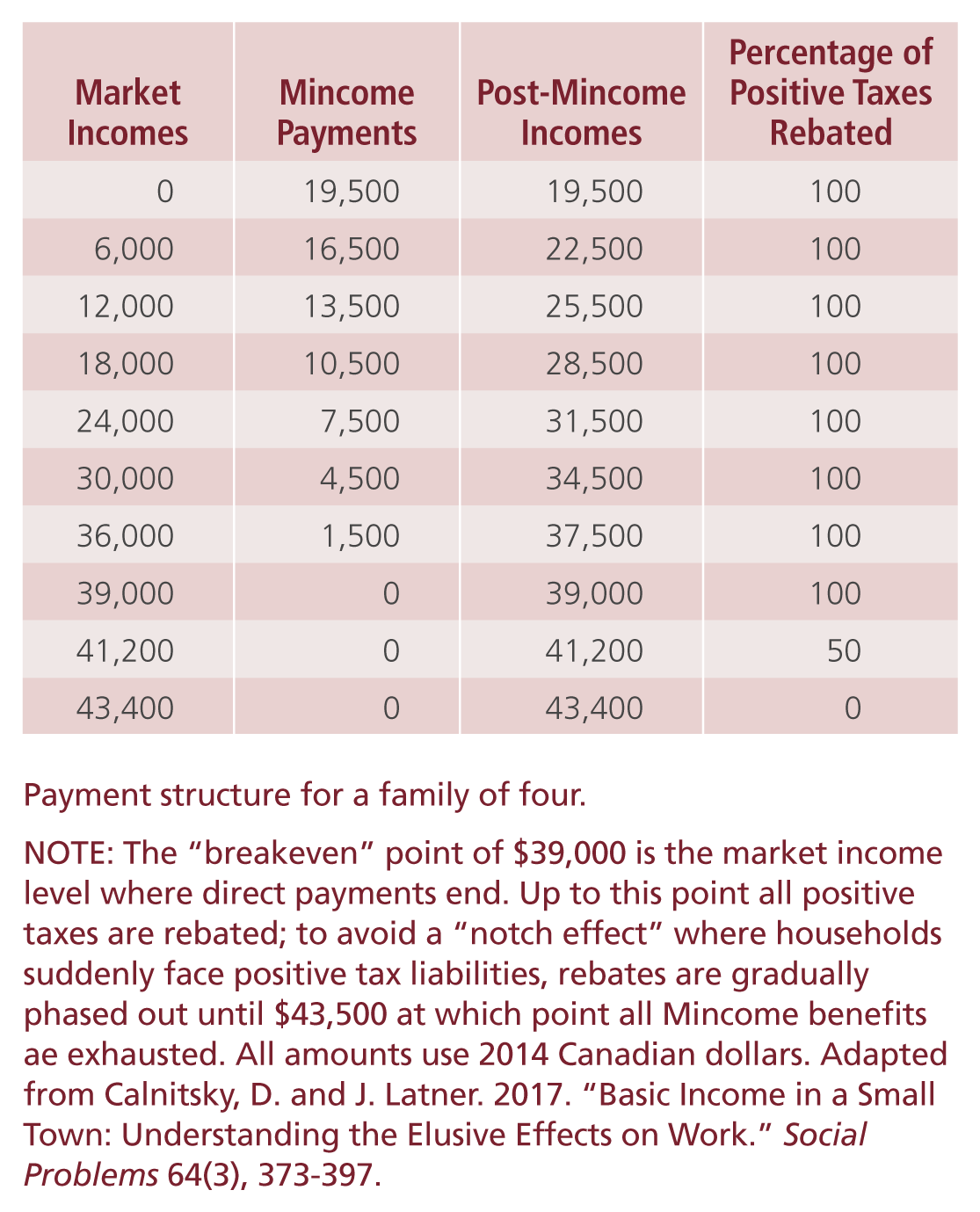
Payment structure for a family of four.
NOTE: The “breakeven” point of $39,000 is the market income level where direct payments end. Up to this point all positive taxes are rebated; to avoid a “notch effect” where households suddenly face positive tax liabilities, rebates are gradually phased out until $43,500 at which point all Mincome benefits ae exhausted. All amounts use 2014 Canadian dollars. Adapted from Calnitsky, D. and J. Latner. 2017. “Basic Income in a Small Town: Understanding the Elusive Effects on Work.” Social Problems 64(3), 373-397.
Testing Basic Income
But what would happen if we guaranteed a decent standard of living to all citizens? The truth is, we don’t know. The introduction of a universal basic income into a rich economy would likely produce a tangle of direct and indirect consequences that are difficult to foresee in advance. This is what motivated a series of large-scale guaranteed annual income experiments in the 1960s and 1970s.
Whenever there is this much agreement about an idea, one can be sure that there is disagreement about what it means and what it is expected to actually do.
There were four main experiments in the U.S. (and one unique experiment in Canada, discussed below). These were run as randomized controlled trials, with treatment families given varying levels of guarantee under which their incomes would not fall. This type of scheme is not identical to universal basic income, because guarantees phase out with higher incomes, but the plan does make exiting the labor force universally viable. The central motivating question behind these multimillion-dollar undertakings was whether or not people would goof off. For the most part, they did not. Across the experiments, men receiving the income supplement worked between 0.5 and 9% fewer hours than men not receiving the supplement. Women reduced work hours somewhat more.
Mincome handbook, retrieved from Library and Archives Canada (Winnipeg, MB), Department of Health fonds, RG 29, Policy, Planning and Information Branch sous-fonds, Branch Accession Number 2004-01167-X, “Operational Files of Manitoba Basic Annual Income Project (Mincome).”

These ventures were among the largest and most innovative social experiments ever attempted. In the U.S. and Canada, they were the natural outgrowth of the political context of the War on Poverty (Prime Minister Pierre Trudeau’s “Just Society” was a Canadianization of U.S. President Lyndon Johnson’s “Great Society”), and a newfound confidence that poverty ought to be abolished in rich countries. The experiments are widely, and rightly, considered a high-water mark in the art of studying poverty. In particular, thinking about concrete impacts by way of a field experiment is an unambiguous improvement on making inferences from roughly comparable observational data or exercises in pure theory. The best way to understand changes in a system as complex as the work-income relationship is through direct observation.
Unfortunately, the environments set up in the American experiments were highly artificial. By giving guaranteed incomes to a randomized and dispersed set of families, the studies assumed that all relevant decisions were made in the isolated setting of the home, uninfluenced by broader social factors. This scientistic behavioral model suggests that people look at the size of their check, hold all else equal, and then optimize their work hours. When you set the question up that way you have a narrow and tractable empirical problem. But if we want to understand what actually might happen to the labor market, we must consider a variety of factors that depend crucially on social context.
Experiment participants

This is why the real world of work is poorly captured by randomized control trials. Fortunately, a portion of the Canadian experiment was conducted at the community level, one that would reflect the social milieu of an implemented scheme. Here, everyone, not just scattered households, had the option to collect payments.
Mincome and the Virtues of Social Context
The Mincome experiment, conducted in the 1970s in Manitoba, was modeled after the U.S. experiments, but included a “saturation” site where guaranteed incomes—amounting to as much as half of the town’s median household income—were available for three years to all residents of the small town of Dauphin. Archival documents suggest that Dauphin was selected on the basis of its relative labor market isolation as well as its socioeconomic and demographic similarities with Manitoba on the whole. The program was publicized to Dauphin residents through a series of letters, a handbook (shown on the previous page), and an in-person introduction—Mincome staff knocked on every door in the town. The full guarantee amount was available to families who had no income; the table on the previous page presents the treatment structure for a family of four, showing the guarantee level and the phase out of payments as market incomes rise. The figure above diagrams the experiment’s participation structure. All Dauphin residents were eligible for payments, provided they lived in the town for a year prior to the experiment. If they decided to drop out of work, or if their income, for whatever reason, was below the “break-even” point shown in the table on the previous page, they could access payments. As displayed above, a randomized group of treatment and control participants in the “dispersed” sites across Manitoba (in Winnipeg and smaller towns) provided comparisons to the Dauphin group. Throughout Mincome’s experimental years, a mountain of survey data was collected on the Dauphin participants, most of which was archived but never digitized. I have been digitizing a number of these surveys and found that the experiment’s qualitative and quantitative data shed light on basic income in its full social context.
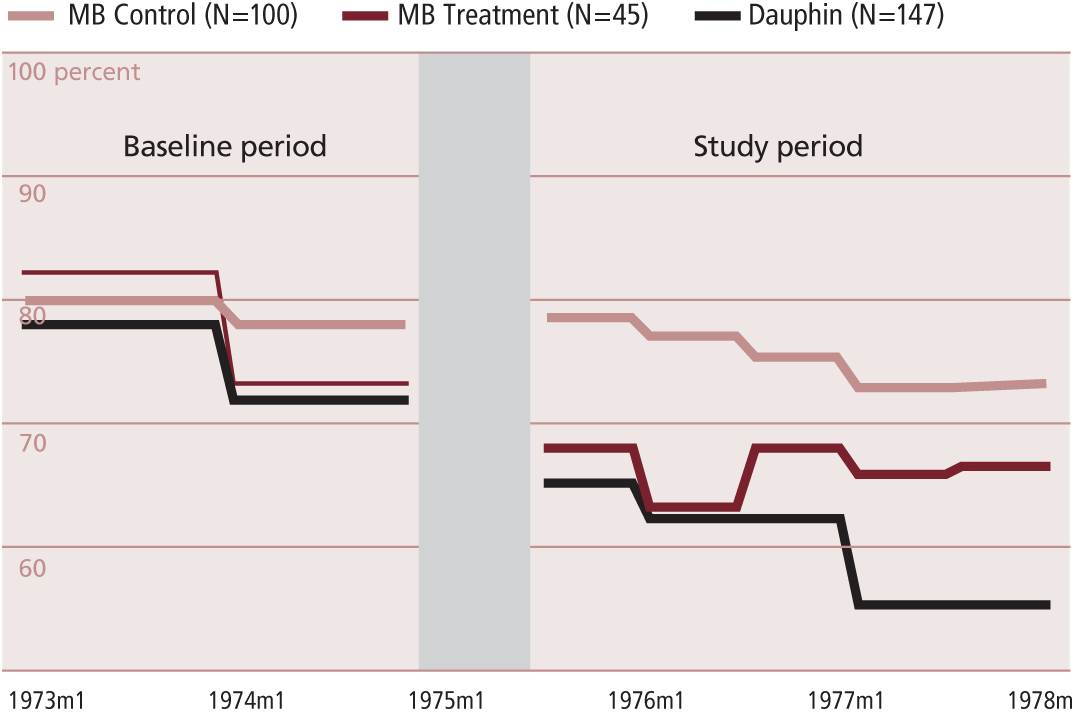
Labor market participants as a percent of total population
Labor market participation in Dauphin, Manitoba dispersed treatment, and control groups, during baseline and study periods, Calnitsky and Latner, “Basic Income in a Small Town.”
There are (at least) five bits of social reality that make randomized experiments less useful than usually acknowledged, and “community” experiments more useful in exploring the impact on work:
Role modeling. If people see others reducing work hours (or, say, returning to school) they might follow suit. And vice versa: If no one around you is part of the experiment and no one is adjusting their work schedule, you might not want to be the only one cutting back work hours.
New social norms. If a new, universalistic policy fosters a more pragmatic and less moralistic attitude toward program participation, the social stigma attached to government assistance and work reduction might diminish. Although a short experimental period may not allow new norms to develop, the sudden introduction of a radically different system of social provisioning might interrupt common sense around “appropriate” labor market behavior.
Business response. If people reduce work and labor markets tighten, firms might try to pull people back into the labor market with higher wages. Alternately, people might work less at higher wage rates. In either case, the randomization model assumes, implausibly, that local business would overlook the fact that their whole workforce has obtained an exit option from the labor market.
Collective action. If basic income increases the likelihood that employees pursue their material interests collectively, one of the objectives sought after might include reductions in work time.
Work for the underemployed. If some people reduce work hours, new work opportunities may open up for involuntarily unemployed or discouraged workers.
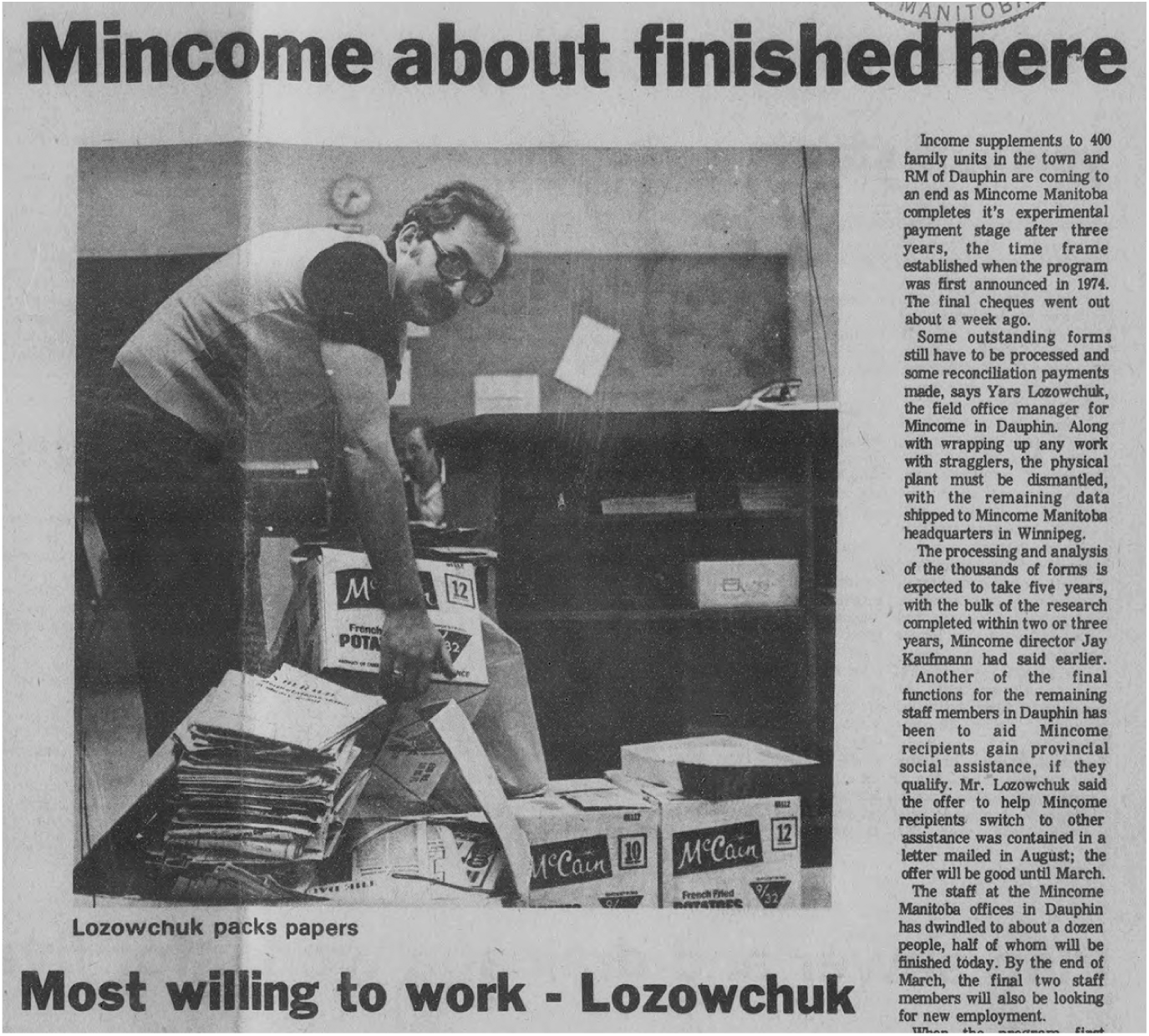
The Dauphin Herald, 1978
These are all plausible mechanisms—and they were all systematically overlooked by the randomized experiments studying isolated participant households. The social sphere was excluded by design and by assumption. Questions about the social context of work are simply unaskable in a randomized trial format. They can, however, be studied in community-level experiments. Indeed, the Dauphin experiment gives us clues about their significance.
What would happen if we guaranteed a decent standard of living to all citizens? A series of large-scale guaranteed annual income experiments in the 1960s and 1970s aimed to find out.
First, some Dauphinites might have “role-modeled” responses to Mincome. The ultimate role-modeling example comes from education. A student may be affected both by a new policy designed to affect schooling decisions and by her friends’ newly altered decisions to complete their schooling. In the case of Mincome participation, it is clear that at least some people’s decisions were affected by peer decisions. For example, according to a one-off, self-administered qualitative survey that I digitized and analyzed, one man joined Mincome simply because “everybody else was” and another “just to be in it like the others.” The basic sociological fact that humans influence other humans reveals limitations to the randomized control trial approach. Analyzing hitherto unexamined administrative data—information that was collected by Mincome’s Payments Department and organized into datasets by economist Gregory Mason in the early 1980s—I found, with my colleague Jonathan Latner, a non-trivial amount of work withdrawal among Dauphinites. Withdrawals among Dauphin treatment households exceeded those in the control group, who received no Mincome payments. But they also exceeded withdrawals among participants who received Mincome in isolated contexts that were dispersed and randomized across Manitoba, suggesting that context effects intensify labor force participation reductions. There is actually an additional mechanism here: even if you’re not copycatting, free time is more valuable when you can spend it with others. Finally, it is worth noting that participants who provided reasons for work withdrawals in the qualitative data—some of which might have been role-modeled in Mincome’s social milieu—typically cited care work, disability and illness, uneven employment opportunities, or educational investment.
A second, related but separate, aspect of this story concerns shifting social norms around the “appropriate” response to government income support. Mincome, as a universalistic social policy, did not come to acquire the social stigma typically attached to targeted “welfare” schemes. Instead, I found that Dauphinites interpreted the program through a pragmatic lens, not the moralistic one through which welfare was viewed. Mincome participants cited a variety of casual, pragmatic, or seemingly incidental reasons for participation—often failing to mention any actual or potential material benefits. As a practical program, Mincome participation did not appear to signal a person’s moral worth. A man who refused welfare, stating, “I wouldn’t want to destroy my dignity and pride,” joined Mincome simply because they “asked us to be on the program.” One woman declared emphatically that social stigma was reduced under Mincome: “I think that Mincome is one of the best programs the government has today. It trusts the Canadian people and leaves a man or woman, their pride.”
The social meaning of Mincome was powerful enough that even participants who saw welfare recipients in a negative light and believed strongly in the principle of earning one’s own living, felt able to collect Mincome payments without a sense of contradiction. One participant refused to join welfare under any circumstances, saying, “Welfare to me was accepting something for nothing.” But he joined Mincome because it “Would be a benefit to me at some time.” Another participant avoided welfare, stating, “I am able to support myself”; he joined Mincome because “I might get some assistance.”
A third social determinant of work life under an actually implemented guaranteed income—again, entirely absent in the randomization approach—is the reaction from business. How would firms respond when the whole labor force has an alternative to selling their labor on the market? One view sees the guaranteed income as an employer subsidy—perhaps like the Earned Income Tax Credit—which facilitates exploitation, low wages, and a low-road industrial strategy. Another view suggests that if people reduce (or threaten to reduce) work in the labor market, business demand may kick in to pull wages back up. From this perspective, making work optional will shift power dynamics in favor of workers and against employers.
To gain some purchase on the business reaction to Mincome, I digitized an archived survey of local firms—essentially a census of all businesses in Dauphin, as well as in seven control towns before and during the study period—and found a large increase in wage offers by firms in Dauphin, but no change in the control towns. The employer subsidy hypothesis was not borne out. By providing an exit option from work, the guaranteed income may help workers negotiate higher wages. A social policy that dramatically expands the autonomy and power of working people in capitalist labor markets is thus an unlikely candidate for business endorsement.
Indeed, this may be why some Dauphin employers expressed concerns about the program. The survey of businesses included little space for qualitative comment, and few used it; however, at least one Dauphin business owner expressed overt hostility: “If the government wants to do something about the basic annual income in Manitoba the best thing they can do is get out of the picture and let supply and demand rule and govern what the wages and hours should be. At this rate if one wanted to eat they would have to work. …[The program is] just spoiling people rotten and upsetting the workforce something unreal. The hours people have to work, the wages they get, and the output they give (which isn’t much) just make it impossible for the average employer to even stand a chance at hiring help.” Another employer with a 40-person workforce complained that applicants were “unacceptable” because they were “Not willing to train at reduced salary.”
While a meaningful “exit option” would improve individual bargaining power, it might equally enhance the ability of workers to collectively advance their interests. It is worth noting that when the U.S. debated Nixon’s Family Assistance Plan—a guaranteed income proposal nearly passed by Congress in 1970—the National Association of Manufacturers worried in their Congressional testimony that the plan could be leveraged as a strike fund: “We suggest that anyone directly involved in a labor dispute should be ineligible for benefits under the Family Assistance Plan.”
Insofar as basic income reduces the costs of participation in risky efforts to advance material welfare as well as the temptation to “defect” (as game theory terms it) or “scab” (as ordinary language would have it), it can be seen as an important component of class formation. By blurring the lines of demarcation between low-wage workers, unemployed workers, and social assistance recipients, basic income may actually help build social solidarities and mitigate collective action problems. By obscuring the distinction between those not employed because they are unable to find employment and those not employed because they have chosen to commit to other activities, universalistic income maintenance programs can sidestep the stigmatization of the “undeserving poor,” thereby reducing the barriers to alliances across social categories.
By blurring the lines of demarcation between low-wage workers, unemployed workers, and social assistance recipients, basic income may actually help build social solidarities and mitigate collective action problems.
There is good reason to think that Mincome began to blur these distinctions, where the welfare system aggravated them. One married man, reflecting on differences between Mincome and welfare in the qualitative survey, described welfare as follows: “I feel that [welfare] is more for disabled or people which are too lazy to work. It doesn’t include us, we’re both able and willing to work but can’t get a job due to the low employment rate.” They joined Mincome simply because they were “short of money.” Where it was easy to distance oneself from welfare recipients, Mincome was not tarnished as a program for specific kinds of people. No equivalent linkages were made between the program and particular, “undeserving” groups.
The argument here goes a step further than the point about stigma. However, reducing barriers to social inclusion does not quite equal the active nurturing of social solidarity. Moreover, the germination of collective action is harder to evaluate given the limited information in our case study. If this mechanism played out in the Dauphin context, it was most likely limited to simple cooperation, such as co-workers jointly demanding wage increases in a small workplace. As the National Association of Manufacturers suspected, though, basic income can be seen as an inexhaustible strike fund; at the national level, there’s no reason to rule out the more advanced forms of cooperation it might facilitate.
Although the final mechanism is difficult to decipher empirically, it may be underappreciated. It stands to reason that if some people reduce work hours, it may be easier for unemployed and underemployed workers to find work. This mechanism predicts a flatter distribution of available work, with more people working fewer hours. From the list of five social context effects, this mechanism is the one most rife with contingency. It may be entirely absent in a tight labor market. Still, if basic income is introduced in a world with significant numbers of discouraged and involuntarily unemployed workers, we should expect people to happily enter labor markets as opportunities emerge from the work-hour reductions of others. Randomized experiments, however, ignore these indirect effects on non-participants. Similarly, the randomized controlled trials offered income guarantees only to low-income families; but as Hyman Minsky pointed out, an implemented guaranteed income makes exits from work possible for both poor and non-poor people. Randomizing among the poor ignores that the middle class might goof off too.
There are plenty of other possible social consequences of basic income, ones that are important but could not be tracked by randomized studies that ignore macro-level variables. For example, looking at aggregate crime statistics with my colleague Pilar Gonalons-Pons I found that relative to other Manitoba towns, rates of property crime and violent crime in Dauphin declined during the Mincome period, and afterward returned to their prior upward trend. Likewise, health economist Evelyn Forget, who was the first scholar to renew interest in the Dauphin experiment, found important town-wide improvements in health and education. With new experiments on the horizon worldwide, the Dauphin case study serves as a reminder that social world is real and by ignoring it, the randomization approach ignores reality.
Basic Income in the Material World
Advocates and opponents of basic income debate its normative underpinnings and often profess to have a well-grounded sense of its negative or positive empirical consequences. However, we can be confident that no side of the debate really understands what might happen in a society that actually implemented a basic income.
In fact, these discussions and debates rarely even settle on the details of what is being debated. It is safe to say that, on the one hand, a meager basic income, perhaps along the lines of the Alaska Permanent Dividend Fund, is feasible—even if it does little to realize the left vision of blunting exploitation and freeing workers from work. On the other hand, there is a paucity of evidence on the feasibility and empirical consequences of a generous and universal basic income. While these debates are interesting, confident prognostications about the multiple and interacting outcomes must be taken with a grain of salt.
This is why community-level experiments can play a useful role. They help not only in adjudicating between different theoretical expectations, but also in considering them in the first place. They help to narrow the debate, to see which mechanisms are in play and under which conditions.
The Dauphin case provides the only example of a reasonably generous and universally available guaranteed income offered in a rich country. Universal eligibility—or “saturation,” as the experimenters called it—facilitates a realistic account of community life. Mincome simulated a delivery and administration system where people’s experiences would resemble, at the community level, a nation-wide program. It made possible the direct observation of social consequences and shed light into the black box of a hypothetical future that might one day become reality. Meanwhile, the randomization approach—which is again being implemented in nearly all of the recently planned basic income experiments around the world—assumes out of existence huge swaths of social life. If we wish to use experiments to understand the actual consequences of basic income and clarify our thinking on right- and left-wing variants, emphasis must be placed on community-level experimentation. The conflicts that are hidden in the randomization model come into view with social context.
Mincome simulated a delivery and administration system where people’s experiences would resemble, at the community level, a nation-wide program. There were winners and losers. This is essential knowledge in the struggle toward comprehensive and universalistic income-maintenance policies.
When implemented in the real world the policy had winners and losers. There is every reason to believe that the proposal’s current ideological alliance is fragile. The interests of employers might collide with those of the recipients. But this is not a reason to withdraw support for basic income; instead it should be a wake-up call for advocates. Understanding who is helped and who is harmed is essential knowledge in the struggle toward comprehensive and universalistic income-maintenance policies. Advocates must abandon the fantasy of basic income as a panacea that inspires consensus among all social forces. Some version of basic income may take shape eventually, but there is no guarantee that an implemented version will be particularly liberatory.
For the time being, I believe there are a few scenarios worth considering. Either the proposals on offer are replacements for the existing welfare state and inspire merited dissent from the left, or they are robust and universal, inspiring a business revolt. In either case, as flesh is added to a skeletal proposal, advocates should expect that the groundswell of advocacy will peak and fragment. There may be a path between austerity and business revolt—indeed I have made this case in the most recent issue of Catalyst—but it will not unfold on its merits alone. To survive as an emancipatory social policy, basic income will require pressure from broad social forces to defend it against its own advocates, those who would transfer only cash—but not power—to poor and working people.