



Abstract
Trump’s political breakthrough fits a larger American pattern, from Andrew Jackson to the present, recalling red scares, racial wars, and fears of foreign subversion and terrorism.
At first, it almost seemed to be a joke. He had flirted with running for president multiple times in the past, and most political analysts and commentators refused to believe that Donald Trump intended to mount a serious campaign. Even after the campaign’s formal announcement, many commentators continued to dismiss his chances, with The Huffington Post declaring “we will cover his campaign as part of our Entertainment section. Our reason is simple: Trump’s campaign is a sideshow [and] we won’t take the bait [but] if you are interested in what The Donald has to say, you’ll find it next to our stories on the Kardashians and The Bachelorette.”
As the Trump presidency unfolds into a miasma of controversies, scandals, and domestic and international provocations, it is easy to forget how puzzling his rise to the GOP nomination was. Indeed, even his shocking triumph in the general election over Hillary Clinton might be viewed as less surprising, in retrospect, than his successful primary campaign. Given a macroeconomic environment and other factors which prompted all election forecasting models to predict a close election, combined with the strength of the partisan divide (and the simple unwillingness of almost all Republican partisans to cast a vote for Clinton), Clinton’s popular vote margin—a little over 2%—was right in line with most forecasting models. Only the unexpected Electoral College verdict, resting on Trump’s small margins in some key Midwestern states, would hand him the presidency.
So how did Trump muscle aside an experienced field of well funded and far better organized opponents to win the GOP nomination? The question is a genuine puzzle. He had virtually no endorsements from elected Republican office-holders or other party notables until the very end of the primary campaign, when he had locked up the nomination. He enjoyed a substantial advantage in the amount of media coverage he received, but the content of much of that coverage was negative (at least, as it would have been understood prior to the 2016 election). His performances in the GOP debates were uneven at best; most veteran observers consistently graded them as poor.
Two theories about Trump’s rise have been widely advanced. Both raise classical themes in political sociology. The first is that Trump’s populist, economic nationalist rhetoric drew strong support from downwardly mobile and struggling middle- and working-class voters. In one example, New York Times columnist David Brooks declared in March 2016 that “Trump voters are a coalition of the dispossessed [who] have suffered lost jobs, lost wages, lost dreams.” Veteran political commentator Bill Schneider suggested, “What we’re seeing right now in American politics is class warfare…[but] it’s not the working class versus the 1 percent. It’s the working class versus the educated elite. In fact, one of the richest men in the world is leading the revolt: Trump.” Sociologist Andrew Cherlin advanced an intriguing variant of this argument, suggesting that the key to understanding Trump’s support among non-college educated voters was their perception of being left behind and lacking opportunities to live as well as their parents had.
There are various reasons to suspect that economic distress and/or declining mobility chances could have motivated struggling GOP primary voters to support Trump. Evidence is mounting that younger cohorts are not, in fact, experiencing the same degree of mobility opportunity as cohorts born before 1950. Further, with populist rhetoric and policy positions sometimes sharply at odds with the GOP, Trump’s campaign stood out from the pack. In recent decades, the Republican Party had largely coalesced around on a number of policy positions: retrenchment of the welfare state (under the umbrella “entitlement reform,” which Trump opposed during the primary season before moving to more conventional GOP stance in the general election); deregulation and the promotion of free markets (including, critically, international free trade, which Trump strongly opposed); an interventionist foreign policy (which Trump opposed); and tax cutting (the one economic policy topic of the primary season on which Trump’s views were in line with the GOP mainstream, but always expressed as being in the interest of “working people”).
Trump’s political breakthrough fits a much larger set of patterns in American political life, from Andrew Jackson through to the present. It recalls past anti-immigrant movements, red scares, racial wars, and fears of foreign subversion and terrorism.
The central alternative view is that Trump’s rise reflected his ability to capture racial resentments and anti-immigrant and anti-globalization sentiment, a package of beliefs known as ethnonationalism. A key point of departure for this possibility is evidence that citizens harboring such sentiments were increasingly moving toward Republican identification prior to 2016. Two recent influential studies highlight this critical partisan shift among voters with anti-immigrant sentiment (by political scientists Marisa Abrajano and Zoltan Hajnal) and racially resentful Whites (by Michael Tesler); in particular, they reveal how party identifiers had been realigning on the basis of racial and ethnic attitudes, transforming the GOP from below.
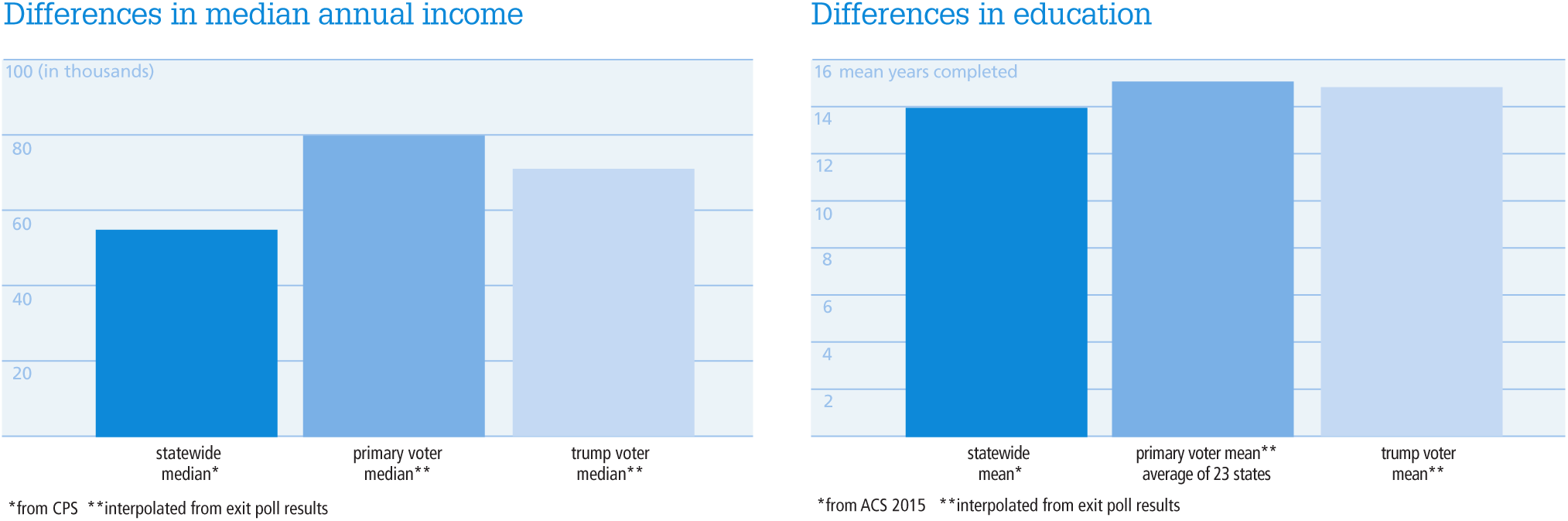
Median income and mean years education among all state residents, Republican primary voters, and Trump primary voters.
NOTE: State averages from Current Population Survey. GOP primary voter averages estimated by authors from state exit polls. Data from Republican primary exit polls, collected by Edison Research for the National Election Pool consortium of news media outlets. Average income and years education are estimates interpolated from cross-tabulations.
The upshot is that while there was a time when racially resentful White partisans could be found in both parties—thereby diluting their impact—by 2016, ethnonationalism had moved into partisan alignment. This outcome was the result of a slow-moving process. Its roots trace to the 1960s, when Northern and Western Democrats pushed through the major civil rights legislation over the strong resistance of their Southern bloc. The disillusionment of Southern Democrats led to the South slowly becoming more Republican, as Democrats in most Congressional seats without a minority-majority voter base either switched parties or were displaced by Republicans.
Trump did not benefit from a large bloc of poor or low-income voters or draw such voters into the GOP primaries. That’s a powerful myth.
Bill Clinton’s presidency and the centrist Democratic Party the Arkansas native sought to present to voters in the 1990s slowed the partisan divide over race. The Clinton Administration undertook various initiatives to address concerns of racially resentful Whites—most notably the 1996 welfare reform legislation, the 1994 crime bill, and in Clinton’s famously critical remarks about the hip-hop artist Sister Souljah. But these efforts were insufficient to reverse the long-term process of outflow.
The combination of rising population diversity and the 2008 election of Barack Obama fueled another wave of ethnonationalist realignment. In spite of Obama’s determined efforts to avoid politicizing race controversies, America’s first Black president was symbolically meaningful for many Whites. By 2016, the Democratic Party was increasingly seen as a vehicle for helping minorities and immigrants “jump the line” over White Americans, as Arlie Hochschild put it in her recent book Strangers in Their Own Land (See Q&A, this issue, for more). Obama, Hochschild finds in her study of Tea Party supporters in Louisiana, was himself viewed by many as a “line-jumper,” someone who got ahead because of affirmative action. Today, the increasing visibility of both the Black Lives Matter movement and the mobilization of immigrant communities (and the embrace of these efforts by many Democratic politicians) have sharpened the partisan divide over race and immigration.
Between the Clinton and Obama presidencies, the views of White Democrats and White Republicans had diverged substantially. Here’s one stunning example (identified by political scientist Michael Tesler): in 1994, there were no differences between White Democratic and White Republican voters in their views of the O.J. Simpson verdict, but by 2013, an enormous 40% gap had opened between White Democrats and White Republicans in their views of the decision in the Trayvon Martin case in Florida (in which Martin’s murderer, George Zimmerman, was exonerated).
Trump’s appearance as a candidate for the 2016 GOP nomination suddenly provided a voice for these voters. His candidacy offered ample, blunt, and sometimes even uncoded racial appeals. For example, in the run-up to his 2016 bid, Trump seized on a bizarre conspiracy theory about Obama’s birth certificate to challenge the legitimacy of America’s first Black president. His opening campaign speech referred to Mexican immigrants as “rapists” who are “bringing crime and drugs” to the U.S. And a federal judge with Mexican ancestors could not rule fairly on a case against Trump University, the candidate thought, because he was a “Mexican” who was inevitably biased against Trump. He repeatedly declared America’s “inner cities” and “African American communities” places where “you get shot walking to the store” and where “they have no education and no jobs.”
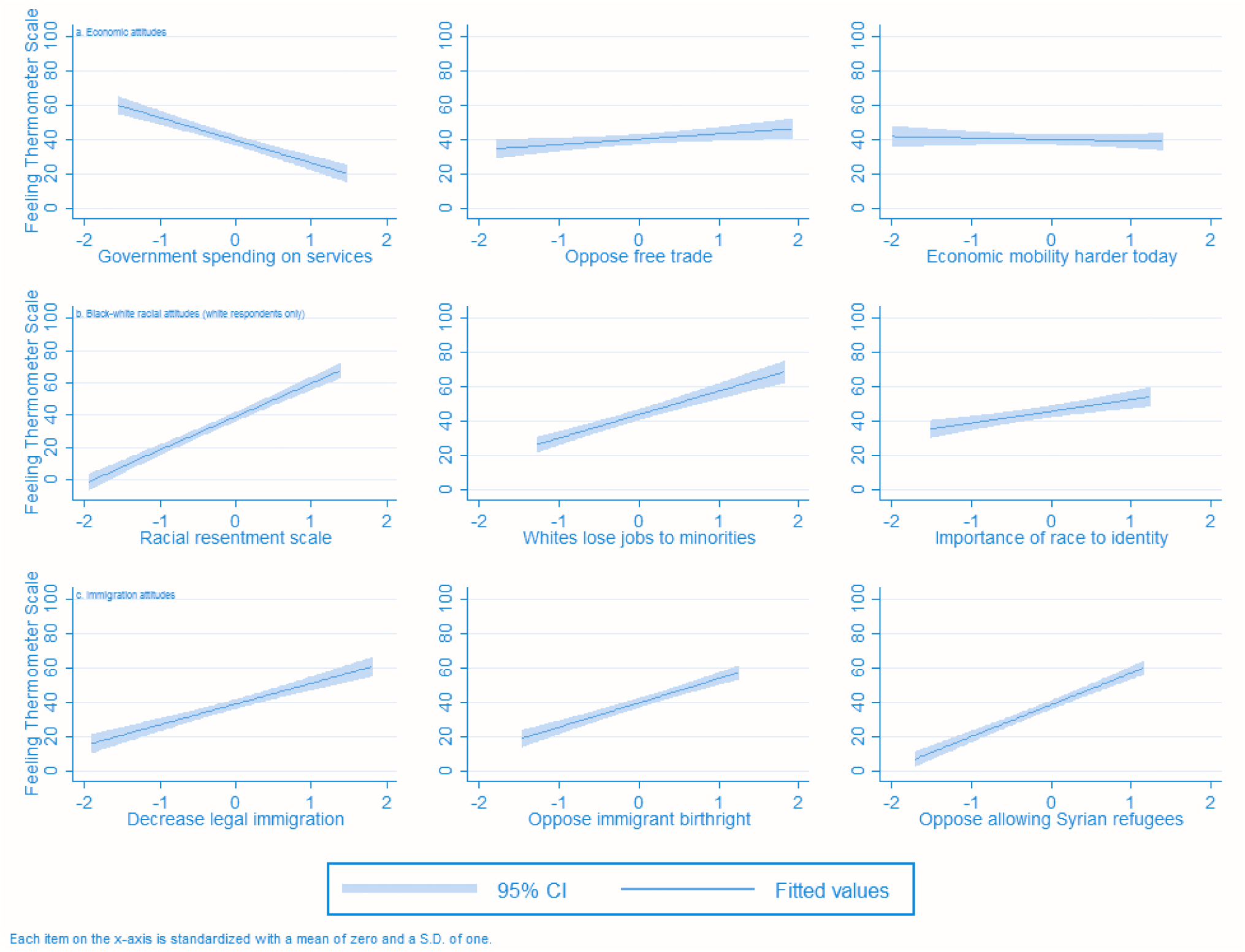
Donald Trump’s feeling thermometer score and standardized attitude items from the American National Election Study, January 2016.
NOTE: American National Election Study pilot survey from January 2016, available at electionstudies.org/studypages/anes_pilot_2016/anes_pilot_2016.htm. The survey was fielded from January 22nd to 28th, 2016.
Winning the Nomination
The two dominant theories of Trump’s rise are not, of course, mutually exclusive. Indeed, the longstanding sociological literatures on “working-class authoritarianism” and “racial threat” suggests linkages between downward mobility, economic frustration and hostility to racial and ethnic minorities. The notion here is that citizens who feel economically threatened will often look for scapegoats (especially racial and ethnic minorities or immigrants). It is entirely possible that Trump’s economic populism and ethnonationalist appeals worked together. Our research, however, strongly suggests that Trump’s rise to the GOP nomination did not draw upon a significant base of economically threatened voters. Instead, ethnonationalist views were very significant predictors of Trump support.
With regard to working-class voters, exit polling in states with competitive primaries (i.e., all contests through May 3, 2016, after which Trump’s remaining opponents withdrew) clearly showed that Trump voters were significantly better educated and more affluent than the median citizen of that state (see the figures on p.30). Trump voters were, to be sure, somewhat less affluent and educated than the average GOP primary voter, but they were nevertheless significantly above state averages.
This finding is suggestive. Trump did not benefit from a large bloc of poor or low-income voters or draw such voters into the GOP primaries (it is worth noting that about half of the competitive states had “open” primaries in which voters could vote in either major party primary, regardless of previous party registration). The claim that he attracted significant support from below-average voters was no more than a powerful myth.
It is, of course, possible to feel economically threatened even with above-average income and education. What about this possibility? Did Trump appeal to voters most concerned about their economic status or American trade policy favoring free trade? Here, we can draw upon the American National Election Study’s (ANES) January 2016 survey, which contained the best available items from the primary season for considering this question. Fielded right before the first primaries, the ANES allows us to assess the relationship between respondents’ feelings toward Trump (measured with the standard, 100-point “feeling thermometer” scale, a measure of the “warmth” a respondent feels for a candidate) and attitudes about social spending, economic mobility, race (a scale of standard items used to measure racial resentment), immigration, and letting in Syrian refugees (a particularly significant topic in the winter and spring of 2016). We standardized the responses, with more conservative positions coded positive.
When we look the ANES evidence, a clear picture emerges (see p. 31, top). In the top row, we see that Trump’s feeling thermometer score shows little significant movement toward voters expressing higher levels of economic distress. Similarly, attitudes toward free trade are not closely related to Trump support, with but a minor increase among those with the highest levels of anti-free trade views. Trump support grows among respondents who want less social spending—again inconsistent with the view that Trump primary voters were motivated by economic distress
While there was a time when racially resentful White partisans could be found in both parties—thereby diluting their impact by 2016, ethnonationalism had moved into partisan alignment.
By contrast, the role of anti-immigrant attitudes, racial resentment, and opposition to affirmative action all correspond with very substantial increases in enthusiasm for Trump as we move from more liberal to more conservative positions (as shown in the second and third rows in the feeling thermometer figure). These impacts are substantial—and entirely consistent with the notion that Trump’s appeal disproportionately connected to voters with those sentiments.
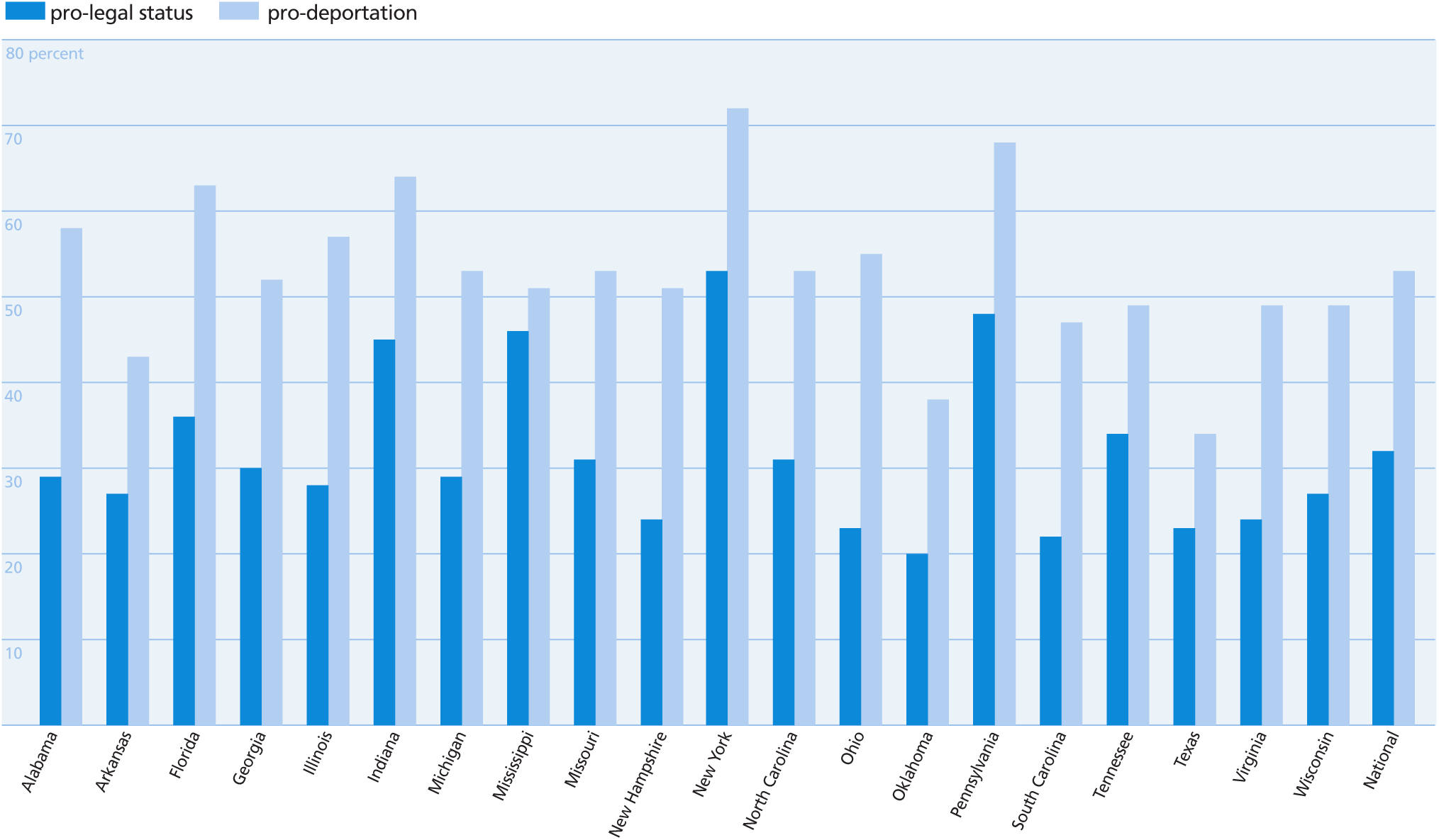
There is reason to object to a reliance on feeling thermometers from a survey taken before the first GOP primaries; although the feeling thermometer has a long history in public opinion research, it is a less direct measure than asking about vote choice (e.g., one can feel “warm” toward Trump but vote for someone else). However, we have at least one measure from exit polls asking about their immigration attitudes that provides confirmation. The question asked whether “illegal immigrants working in the U.S. should be offered legal status or deported”. Here, we see significantly greater support for Trump among respondents who favored deportation in every single state in which this item was fielded (see p. 33).
Overall, we think the evidence that Trump’s rise to the GOP nomination was driven by ethnonationalist sentiment is clear, though we would underscore that support for Trump in the general election, as well as approval regarding Trump’s performance in office, involves different dynamics and questions.
Trumpism after Trump?
There is widespread speculation about how and when the Trump presidency might end and what will happen after he leaves office. The conventional wisdom—shared by many across the political spectrum—is that Trump’s rise was sui generis, a unique and unrepeatable event that is unlikely to leave any lasting impact or policy legacy.
That conclusion may ultimately prove correct, but our analysis of how Trump captured the Republican Party nomination and the social forces that allowed it to happen suggest a different possibility. Trump successfully mobilized that strand of what the political historian Michael Rogin once characterized as the “countersubversive” tradition in American political culture or what political theorist Rogers Smith has described as the racialist or “ascriptive Americanism” model of citizenship. By countersuberversion, Rogin referenced the long-standing, deeply rooted fears of foreign ideologies and alien groups that have, throughout American history, prompted elites and sometimes ordinary people to build campaigns aimed at digging out these enemies. Trump’s appeal to those survey respondents who worry most about terrorism, a topic which also closely fits the Rogin model of the countersubversive mentality, was also very strong.
The Rogin-Smith frameworks provide, we think, a useful master lens through which to view Trump’s rise and his potential to shape the future. Trump’s political breakthrough fits a much larger set of patterns in American political life, from Andrew Jackson through to the present. It recalls past anti-immigrant movements, red scares, racial wars, and fears of foreign subversion and terrorism. While such sentiments have rarely commanded majority support, they are not ephemeral. They remain available for future mobilizations. The historian Richard Hofstadter famously described this as the “paranoid style” in American political life, an apt description for Trump’s political style.
Trump vote share by attitude toward undocumented immigrants
Data from Republican primary exit polls, collected by Edison Research for the National Election Pool consortium of news media outlets.
One reason why Trumpism may persist after Trump is that the partisan alignment of voters holding racial and ethnic resentments takes a unique form in American politics. In multi-party European party systems, anti-immigrant parties have emerged as independent parties capable of winning seats in the national legislature. But in the U.S., the institutional stranglehold of a two-party system precludes this possibility. Electoral institutions in which candidates are elected in “first past the post,” single-member district (or state) elections have made it virtually impossible for third parties to gain traction. This system pushes voters and politicians into one of the two major parties, and if they are a large enough force they can exert considerable influence. With ethnonationalist sentiment increasingly centered in the GOP base, the possibility of future Trump-like candidacies cannot be discounted.