



Abstract
Bianca Gonzales-Sobrino on post-Maria restructuring, from electricity to conceptions of citizenship.
On September 20th, 2017, Maria, a Category 5 hurricane, slammed into the Caribbean island of Puerto Rico. Its residents are still grappling with the humanitarian crisis that followed. Most Puerto Ricans were without running water for more than 30 days, and food continues to be scarce, particularly in the mountain region of the island. Nearly half the island was without electricity by New Year’s. Yet its plight is not forgotten: Citizens of the mainland United States are crying out on social media for the government to move more quickly with food, water, and medicine. Media outlets continue to run news articles with titles like “Puerto Ricans are Americans—They Need as Much Help as Any State” (The Hill) and “Are Puerto Ricans American Citizens? Yes, They Are” (Atlanta Journal-Constitutional). Still, the U.S. federal and local governments have been slow to deploy aid—Federal Emergency Management Agency (FEMA) even announced that aid would stop in early February 2018 (though it backed down from this threat. Why is Puerto Rico such a low priority for its federal government?
Today, the post-Maria migration of Puerto Ricans to the mainland U.S. echoes the numbers of Cubans emigrating in the 1980s. It’s a big problem wrapped in a century of denigration.
Those calling for the immediate help of 3.5 million Puerto Ricans reflect the belief that the U.S. government has a responsibility to all of its citizens, but polls show that only about half the mainland’s citizens know that Puerto Ricans are their fellow citizens. I have to wonder if this reflects a real deficit in our education system, or if it reflects the more insidious issue of racism around popular conceptions of who belongs and who does not?
Puerto Ricans have been U.S. citizens since 1917 (via the Jones Act), yet they have never been truly “American.” As a Puerto Rican woman, I struggle with this presumption of not belonging in my own country. Every time someone asks if I have a visa or if I can legally work in the U.S., I am reminded of the disjuncture between my legal citizenship and my substantive citizenship (social belonging). Hurricane Maria meant that push came to shove—the sense that Puerto Ricans do not really belong among Americans impacted how much relief aid and how much effort was and is invested in saving the lives of those perceived as not quite “American.”
Questions like “Where are they going to go?” and “What are we going to do with them?” are, in this light, fair. It isn’t clear where Puerto Ricans can go. Not only has their homeland been ravaged by a hurricane, the 500 years of colonialism, oppression, and non-belonging that preceded that disaster have been largely absent in the American imaginary.
Puerto Ricans were already migrating to the U.S. before they were given citizenship in 1917. At the turn of the century, they were settling in the eastern states of the mainland, and, in 1902, the U.S. Treasury Department issued immigration guidelines that categorized Puerto Ricans as foreigners. After a legal battle that went all the way to the Supreme Court, Puerto Ricans were deemed “non-citizen nationals” by way of being residents of a U.S. colony. They have remained in this limbo, legally belonging yet historically unwelcomed, ever since. It’s a strange social position that affects both their material and symbolic resources.
During a mass migration in the 1940s and 1950s, Puerto Ricans sought better economic opportunities on the mainland. However, they often ended up in low-skilled, low-paid jobs, such as picking tobacco in the Connecticut River Valley or picking cherries in New York. White Americans saw the inflow as a threat. The New York Times, the country’s paper of record, framed Puerto Ricans as burdens to the state, a public health threat, and culturally inadequate for assimilation into mainstream (White) society.
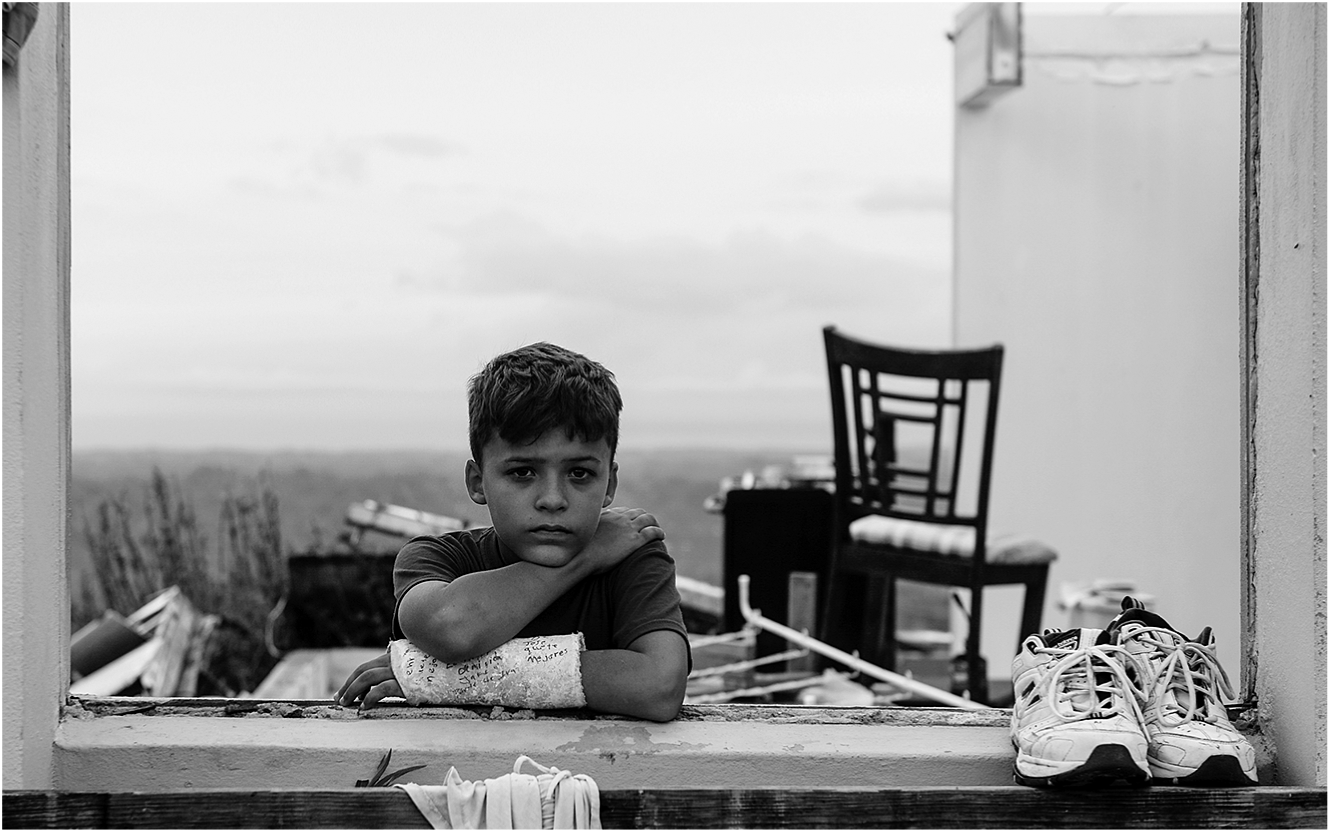
Nine-year-old Jake Rios Torres watches as humanitarian aid is delivered to the single room left in his family home after Hurricane Maria.
U.S. Dept. of Agriculture, public domain
In addition to describing Puerto Ricans as culturally different than “Americans,” The New York Times claimed they brought “bad values”—the kind that explained why they were in such bad economic shape, both on the island and in the U.S. The Times failed to mention the discrimination Puerto Ricans faced and the structural limitations that pushed them into poverty. Adapted to the time, these ethnocentric narratives continued to attend later in-flows of Puerto Ricans to the mainland. Today, that post-Maria migration echoes the numbers of Cubans emigrating in the 1980s. It’s a big problem wrapped in a century of denigration.
Within the U.S., broadly, many Puerto Ricans lay claim to a White identity even as they are simultaneously racialized experience frequent ethno-racial discrimination. Their social outcomes, from educational attainment to income and home ownership rates, find them ranked below other Latinos in the U.S., and their income is the lowest per-capita rate in the entire country. For Puerto Ricans, exclusion has come at great cost to their life chances and fulfillment.
Many people are asking who is to blame. Similar questions arose after Hurricane Katrina, when we saw poor, Black New Orleanians left to fend for themselves, to live and die without the government assistance that seemed to flow so much more swiftly to their White neighbors. But the response after Hurricane Katrina reflected deep-seated racism tied to who counts as a full person in the U.S., the emergency in Puerto Rico is raising new questions around race, formal citizenship, and foreign status. After Maria, Texas and Florida saw immediate, intensive federal help. Puerto Rico endured mockery from the president.
After Maria, Texas and Florida saw immediate, intensive federal help. Puerto Rico endured mockery from the president.
Though colonialism is often seen as a relic of the past, we need to explore the ways in which the U.S. perpetuates colonial relationships with territories including Puerto Rico. Though citizens, Puerto Ricans are treated as though they are clinging, grasping, whining hangers-on, trying to exert a citizenship that is but a technicality. I urge people who are concerned with the Puerto Rican plight to find grassroots organizations already working on the ground. Governmental aid is rarely effective in providing sufficient aid after a disaster, and the effects have been exacerbated in the context of a colonial relationship that continues the invisibility of Puerto Rican citizenship. Through recognizing the scope and sources of the crisis, hopefully we might begin restructuring the popular U.S. imagination toward a more just ideology of belonging.