For five seasons, HBO's hit series The Wire delivered sharp social commentary on topics from poverty to failed institutions in urban America. Now, professors in a range of fields are enlivening their classrooms by using the show as a platform from which to launch discussions on social problems, urban policy, and social science.
It’s been years since the last episode of The Wire, a crime drama set in Baltimore, Maryland, aired on HBO, but its dedicated fan base, including many social scientists, still continues to grow. Every term, another course in sociology, public health, or media studies is formed around the show, and students form long lines to enroll. Contexts reached out to several illustrious professors (and one eager student) to learn more about the social importance and pedagogical value of this groundbreaking series which examined Baltimore’s drug trade, seaports, government, schools, and media in five critically-acclaimed seasons.
Our Informants
Todd M. Sodano is a professor of communication and journalism at St. John Fisher College. He taught “Inside HBO’s America: A Case Study of The Wire” at Syracuse University, and his research has examined The Wire and the influences of TV critics.
William Julius Wilson is in the Kennedy School of Government at Harvard University, where he taught “Urban Inequality and The Wire.” His book When Work Disappears has been cited as an inspiration for the show’s second season, and he has a forthcoming article (with Anmol Chadda) in Critical Inquiry tentatively titled “Sociology Looks at The Wire.”
Peter Beilenson is a health officer with Howard County, MD and is in the public health studies department at Johns Hopkins University, where he taught “Baltimore and The Wire: A Focus on Major Urban Issues.” As Baltimore’s former Health Commissioner, Beilenson is portrayed on The Wire, and he’s now developing a textbook for teaching with the show.
Marc Levine is in the department of history at the University of Wisconsin-Milwaukee, where he taught “The Crisis of the American City—Viewed through HBO’s The Wire.” His work focuses on economic change, urban development, and cultural diversity in the North American city.
Eva Smith is a student at Johns Hopkins University. She took Beilenson’s course on The Wire and is now its TA.
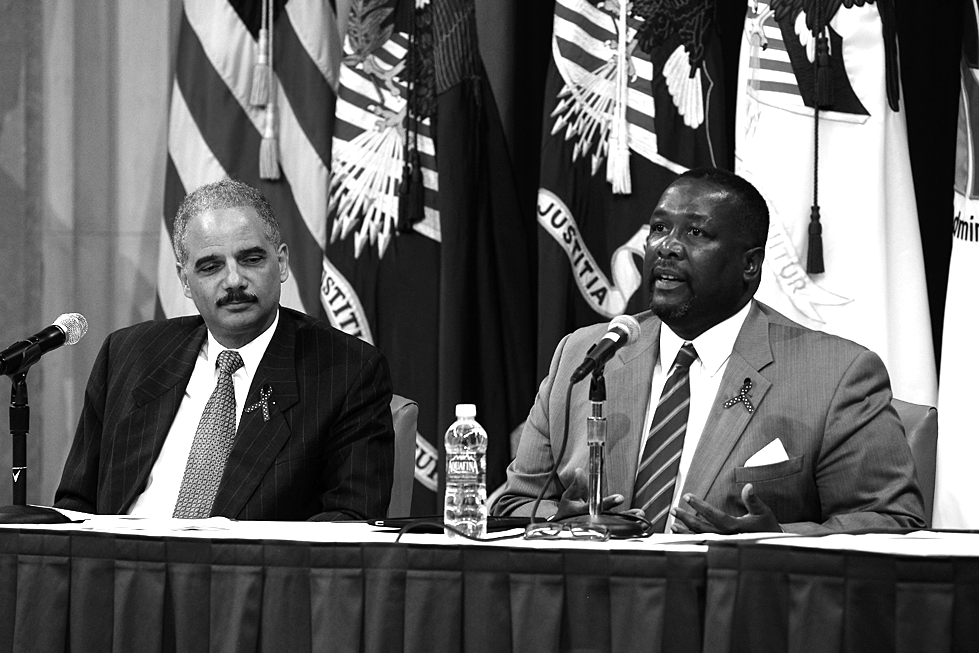
The Wire is part of many public discussions—in this case, Attorney General Eric Holder hosted actors from The Wire as panelists during a Federal Interagency Drug Endangered Children Task Force event at the Justice Department in 2011.
Contexts: People don’t generally think of popular television and critical social sciences as going hand-in-hand. What drew you to The Wire and using it in the classroom?
Marc Levine: I’ve been teaching and writing about cities and their challenges for years, and it struck me that The Wire portrayed the nature of the “urban crisis,” the malfunctioning of urban institutions, and the dilemmas of class and race, in more penetrating and evocative ways than I had ever conveyed in the classroom. I think it was Bill Wilson who called The Wire “social science fiction” and it seemed to me that was exactly right... Better than almost any material I can think of, The Wire delves into the fundamental question of why cities are in the shape they’re in, and why we’re not doing much, as a society, to deal with the crisis.
Todd M. Sodano: I wrote my doctoral dissertation on The Wire. I remember realizing that the length of a semester mirrored the length of an HBO season: there were 14 weeks in an academic semester at SU and 13 one-hour episodes in a season. It was a match made in heaven. The Wire doesn’t feel like television. The series masterfully interwove dozens of characters into its dense narratives and expected its viewers to pay attention and make a full commitment. ...It challenged the viewer consistently through thought-provoking, heartbreaking, bleak, and sometimes uplifting stories.
William Julius Wilson: Several students and professors suggested that I organize a course around the show. Given the show’s sophisticated depiction of urban inequality, I thought it would be a good idea, however, I did not make a final decision until after David Simon told me that my book When Work Disappears inspired the writing of season two. That conversation thrilled me and was the final factor that made me decide to teach the course. It does an excellent job of portraying fundamental sociological principles that have been the focus of social scientists on urban inequality. It is part of a long line of literary works that are often able to capture the complexity of urban life in ways that have eluded many social scientists.
Peter Beilenson: I’m actually portrayed in the show. I was the City Health Commissioner of Baltimore during the time that The Wire took place. [At first], I didn’t really pay attention to the show—and we didn’t get HBO—but then, someone said, “you’ve got to watch it.” I watched every single episode within three weeks. I realized a few things: one, it was phenomenally good television; and two, that through drawing on the experiences I had in real-life Baltimore and the people that I know, that this would be really good to shine a light on urban issues for students.
Contexts: It seems like the goals of the course extend beyond just talking about The Wire. How did you manage the logistics of a course like this?
Wilson: Over 140 students sought enrollment and we selected the final 30 on the basis of essays... We used The Wire as a thread to integrate topics that form the basis of a thorough understanding of urban inequality: crime, incarceration, work and labor markets, the unregulated economy, urban politics, and education. Academic research comprised the main content of the course, and this research was examined in conjunction with the series.
Levine: The course examined various facets of the urban crisis through the lens of The Wire. We explored such issues as urban poverty and inequality; the drug trade, the mass incarceration of black males, and the decline of inner city neighborhoods; deindustrialization and shrinking urban economic opportunity; the follies of political leaders; and the failures of urban institutions such as the schools, police, and the media. The course was structured to examine these themes through several pathways: the vivid, powerful, and profound depictions of these themes in The Wire; appropriate social science readings; and a mixture of lecture and discussion in the classroom. In addition, guest lecturers provided “real world” takes on the themes of The Wire. The students heard from Milwaukee’s health commissioner on whether drug legalization should be considered, from the city’s police commissioner on “data-driven” policing, and from the managing editor of the city’s daily newspaper, who discussed the declining health of urban newspapers.
Beilenson: I decided to do a course for fifty freshman—I wanted to get them before they had heard negative comments about Baltimore from being on campus, and sort of encourage them to think differently about things from the time they were freshman. The class was based loosely on the [show’s] five seasons—drugs, the port, politics, schools, and journalism. I put it together with discussions on crime, drugs, cultural history of the city, a bit on the city’s economic decline, and politics. We had guest lecturers each week: former Mayor Schmoke—who played me in the show and was very well known for pushing for drug legalization—a mayoral candidate, the superintendent of the schools, the head of the local alternative schools, TV journalists, the Washington Post editor, housing non profit workers, and former drug addicts—then David Simon did the wrap up.
“We used The Wire to integrate topics that form the basis of an understanding of urban inequality.”
William Julius Wilson
[As to coursework] the students were asked to pick an institution that is part of civic life … They wrote five pages on their impressions before they got there, their impressions after they went, and their suggestions for improving these institutions. The final was in a similar vein: the students ...wrote a briefing for the incoming mayor. One group did the juvenile justice system, and it was such a good paper I recommended the students submit it to the Sun, and it turned into an op-ed. Another one, on educational alternatives, had a recommendation that was addressed in the state legislative session this year.
Contexts: One of the challenging things about a course organized around a television show is figuring out how to include and guide the viewing experience. Did you consider only showing a few clips from the show, as opposed to the entire series?
Levine: The brilliance of The Wire—to borrow from Lester Freamon, a character on the show who is something of a moral conscience—is that “all the pieces matter.” All the episodes matter, all connect, building to a bigger, synthetic and more meaningful understanding of the urban crisis. What really brought things together was not one or another clip. Rather, it was the nuanced, slowly-building tapestry of the city created in The Wire. “The Game”—a constant expression in The Wire—is shorthand for this tapestry, and it’s difficult for me to imagine fully understanding this interpretation of “The Game” without watching entire episodes and the entire series.
Sodano: I wanted to make sure that the class and I watched each episode together. The shared viewing experience is a vital one. Viewers are distracted too easily... texting, eating a meal, surfing the web, and folding laundry. Because of these distractions, students likely are not necessarily sharing the same consumption experience with that of their classmates. To minimize that and to maximize the attention that ought to be paid to TV shows in higher education, it behooves the instructor to cultivate a shared viewing experience. Like sitting in a movie theater, when something tense or upsetting happens, the emotions can be magnified if one is surrounded by others who are experiencing it simultaneously.
“The Wire portrayed the nature of the ‘urban crisis,’ the malfunctioning of urban institutions, and the dilemmas of class and race in penetrating and evocative ways.”
Marc Levine
Contexts: Alongside the social insights provided by The Wire, it is also entertaining television with compelling characters. When does The Wire as “drama” end, and as “course material” begin?
Wilson: Although the series is fictional, not a documentary, The Wire offers a sophisticated depiction of systemic urban inequality that constrains the lives of the urban poor. To be clear, this course was not intended to teach students about the show, per se. Instead, the course integrated academic research with the series to develop a rigorous examination of urban inequality.
Levine: The sustained argument of The Wire, and the powerful depictions of the key themes in multiple episodes, is what makes it so valuable as a pedagogic tool. There is, of course, the temptation to get caught up in the brilliant drama, the humor, and the inherently interesting, multi-faceted nature of the characters, and I do “permit”—indeed, enjoy—some of that... [but] The students clearly understand that we’re using The Wire, in conjunction with a wide range of readings to get an interdisciplinary, social science handle on the complex layers of the urban crisis.
Sodano: Much as I made sure we examined the television aspects of The Wire in our [media studies] class, I also made sure that we did cover social issues...The Wire inspired discussions related to these topics of drugs, power, and politics; and while neither the show nor the class offered any concrete solutions to “make the world a better place,” the conversations I had with my students showed me that what we did collectively and individually that semester did have some kind of impact on all of us.
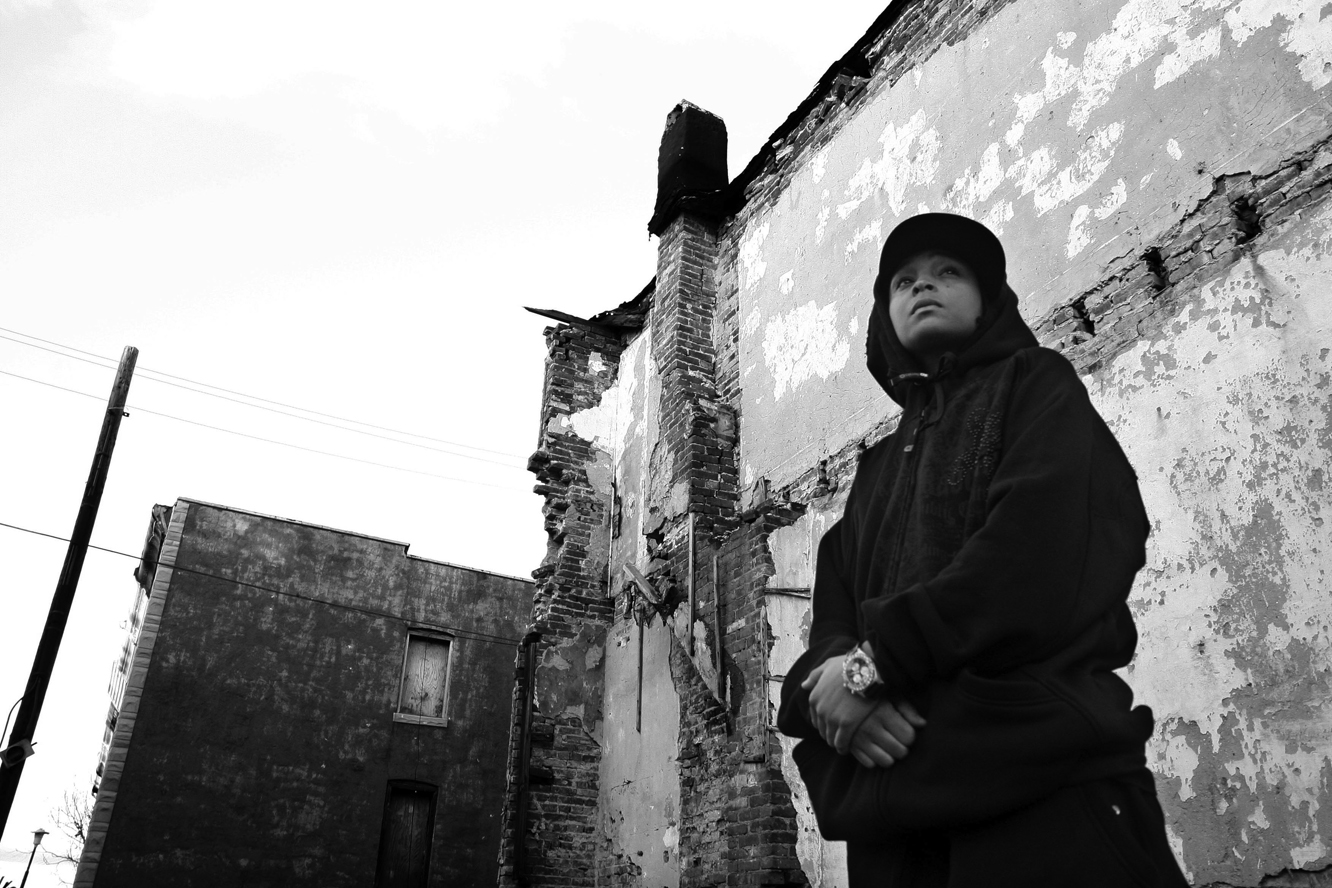
Felicia Peterson, who plays Snoop on The Wire, was born and raised in East Baltimore. Like many of the series’ actors, Peterson brought real-life experience (in her case, with Baltimore’s legal and foster care systems) to the screen.
Contexts: How did the students respond to the course? Did particular themes resonate more than others?
Wilson: This was one the best classes I have taught in more than forty years of teaching. The students were brilliant, dedicated, and enthusiastic. ...The students did an excellent job of integrating materials from the episodes and the academic works. Four themes that particularly resonated were crime, policing, and incarceration; work and labor markets; urban politics and economic development; and youth and education.
Levine: The response has been enthusiastic... The themes of institutional failure, entrenched inequality, endemic bureaucratic corruption, moral ambiguity, skewed incentives and limited opportunity all resonate strongly. The “failure of the war on drugs” theme is particularly strong... The depiction of two worlds—the illegitimate world of the drug trade and the legitimate world of urban capitalism—as driven by similar incentives and structures, albeit skewed by the structures of opportunity and power in the city, has also been quite resonant.
Eva Smith: What happens when governments and institutions fail their people really resonated with me, as well as themes of injustice, race, love, and the struggles of daily life. [And] I really had never thought about decriminalization of certain drugs until the class... There were a few speakers who came and talked about decriminalization that provided a range of very in-depth educated perspectives that I’m glad I was exposed to.
Contexts:The Wire features diverse characters and story lines. How did the racial and class dynamic of the classroom impact the course?
Sodano: The racial and class dynamic informed most of the heated discussions we had throughout the semester. We had graduate students and undergraduate students, students who came from privileged backgrounds and students who did not, and students who actually lived (or were raised) in or near Baltimore. One student, for a brief time, was a teacher in Baltimore.
Levine: The class has had a somewhat higher percentage of students of color than in most classes at UW-Milwaukee. Indeed, my graduate seminar last fall was a “majority minority” class, with quite interesting dynamics. Largely, suburban white students came at the issues somewhat differently than did the more urban African American and Latino students. In my undergraduate class, I had a wonderful moment... A guest lecturer, a reporter who covered Milwaukee’s drug trade, was talking about his investigation of the city’s most prominent drug dealer—kind of the Avon Barksdale of Milwaukee. As it happens, one of my students had been a classmate of this dealer at a Milwaukee inner city high school and offered some really thoughtful and insightful comments about what life was like in their neighborhood, and why, perhaps, the dealer turned out the way he did. It was a moment of extraordinary authenticity in the classroom, and the students paid wonderfully rapt attention to their classmate; moreover, the entire discussion built on what we’d seen in The Wire and read about the structure of the drug trade in inner city neighborhoods.
Contexts: Finally, to end with a big question. Do you see The Wire as providing an intellectual critique of society? And if so, is The Wire “public sociology”?
Beilenson: I asked the students at the beginning of the class to write down why they were taking the class. And, you know, almost everybody said, “I love The Wire, I want to hear about The Wire.” But most of them also said “I want to learn about issues.” By the end, [they were considering how] there is no single reason that people are in these situations. There is no single silver bullet that was going to solve [urban problems]; it has to be a multi-pronged approach that is going to take a while … Since The Wire, there is a lot more [city-level] discussion… about institutional change, but without the right mayor, you won’t get that change. I also get asked, “Doesn’t this make Baltimore look bad? Do you think this is Baltimore?” No, but it certainly is a part of Baltimore. Any city, any inner-city, is that way.
“The backlash surrounding academia’s fetishization of Simon’s series is just as important as the critical praise.”
Todd Sodano
Sodano:The Wire was a groundbreaking, socially-relevant TV show. But it is also a work of popular culture, which means it may not be as timeless, interesting, relevant, or accessible as some of us hope it will be… this is an important piece in this dialogue about the “transformative powers” of The Wire. It didn’t feel that way when I was writing my dissertation or teaching my class while the show was still on the air. If and when I teach this again, I would be remiss if I didn’t mention the backlash surrounding academia’s fetishization of Simon’s series that’s just as important as the critical praise.
Levine: Prior to The Wire, years of relentless civic boosterism had created an illusion, generally and uncritically accepted in urban policy circles, that Baltimore was a “renaissance city,” a model for a certain style of urban redevelopment. That kind of boosterism now rings hollow in the face of the sustained and powerful argument in The Wire about realities on the ground and the functioning of “The Game.” I know some critics argue that The Wire is, in some ways, “too negative,” that it underplays the extent to which change is possible and, in fact, occurring in cities like Baltimore. I disagree: The Wire doesn’t highlight community mobilization efforts, [but] there are ample episodes depicting how one person or groups can make a difference in cities. But the larger and important contribution of The Wire is to explain, to quote Bunny Colvin, “why this shit don’t ever change,” why the structures of inequality remain so tenaciously intact.