



Abstract
kenneth r. hanson on an unsettling convergence.
Volcanoes, earthquakes, and tsunamis: For those living along the tectonic fault lines of the Pacific Rim, these are all relatively regular occurrences. According to the Centre for Research on the Epidemiology of Disasters (CRED), the six countries most affected by natural and environmental disasters are China, the United States, India, Japan, the Philippines, and Indonesia, with five out of six of those countries suffering 29.3% of the world’s natural disasters in 2015.
Many of our grandparents, the world over, live where Mother Nature hits the hardest.
But for all the property damage, loss of power, and loss of services that accompany natural disasters, the loss of life is even more shocking. Many of the Pacific Rim countries are among the world’s most populous: China, India, the U.S., and Indonesia are the four most populated countries in the world, with Japan and the Philippines just shy of the top ten. Between fault lines and population counts, we have a lot of people living in harm’s way. In fact, CRED estimates that the 10 countries most affected by environmental disasters suffer 87.4% of the deaths caused by environmental disasters. Making matters more complicated, past sociological research shows us that some segments of our population suffer more from environmental disasters than others. One group that is disproportionately affected is elderly people.
In 2005, the world watched Hurricane Katrina unleash its wrath on New Orleans. Images of people stranded on freeway overpasses filled the news media as the U.S. fumbled its attempt to rescue survivors. After the water receded, final counts showed that more than half of the deaths resulting from Hurricane Katrina were people 65 or older. St. Rita’s nursing home in St. Bernard’s Parish proved a particularly poignant example: Its owners were forced to choose between buckling down and preparing for the worst (as they had done in the past) or evacuating. Evacuating elderly patients is risky, since many nursing home patients are on life-supporting systems. Plus, they may be frail, stubborn, or both. So they chose to stay. Thirty-five of St. Rita’s patients died when the floodwaters overwhelmed the nursing home in less than 20 minutes.
And in September 2017, Hurricane Irma left a Florida nursing home without power—and thus without air conditioning. Eleven residents died, succumbing to the Florida heat.
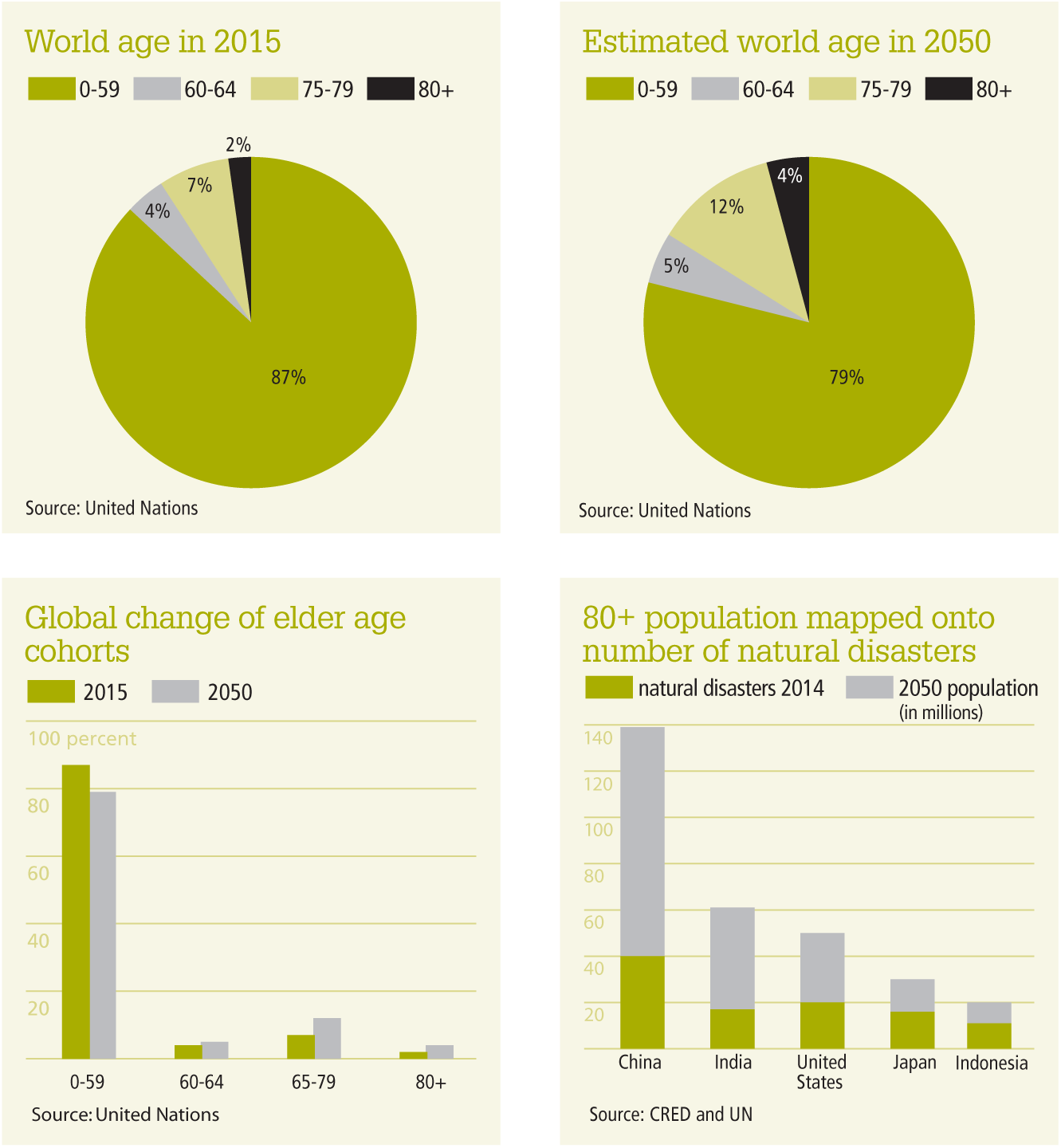
The number of people aged 65 or over is growing in our most populated countries. Take China and India, which may not have the oldest-aged population on average, but by sheer volume, are home to the greatest numbers of the world’s elders. China alone holds about one-fifth the global population of people 65 or older. Octogenarians are particularly clustered in the countries most prone to environmental disasters. Currently, people who are 80 or older account for about 1% of the world’s population, but the UN projects this group will represent 4% of the world population by 2050, with China, India, the United States, Japan, and Indonesia each boasting 10 million or more individuals over 80.
Our world is moving toward having a majority of its elderly people in harm’s way. At the same time, environmental scientists warn that as global climate change worsens, so do meteorological and climatological disasters. These converging trends paint some bleak possibilities. Certainly, each country has its own unique hurdles and each type of natural disaster has its own challenges. Together, country-specific challenges and disaster-specific effects make it difficult to prepare for imminent disaster.
Typical emergency preparedness follows a familiar, individualistic logic. Individuals are responsible for getting out of harm’s way, which requires them to be aware of the risks of their local environment. Residents in disaster-prone areas are prepared in a variety of ways; they may participate in drills or take workshops on storing and using canned foods. The elderly, however, are less able to prepare than more able-bodied adults. They are more likely to die because they have a harder time taking care of themselves until help arrives. This is why community-level involvement is crucial in forestalling some of the issues that individual-focused solutions cannot address.
In 2011, the strongest earthquake in over 20 years registered a 9.0 on the Richter scale not far off the eastern shore of Japan. Consequently, a tsunami taller than 40 meters devastated much of Japan’s shoreline. Almost 400,000 Japanese residents were displaced into sparse temporary housing, some allocated by lottery. Nor should we forget the Fukushima nuclear reactor spillage, and the many residents still unable to return home. Many of the victims were in rural areas, which as a result of economic trends in Japan are disproportionately populated by older and poor citizens. Some communities demonstrated the strength of joining local experience with custom and care, providing instructive lessons for the rest of the Pacific Rim countries.
The Minamisanriku Council of Social Welfare (MCSW), for instance, formed in a rural Japanese town where over half of the population was in temporary housing from the tsunami. The community was fearful of kodokushi, which roughly translates to “death by loneliness.” The MCSW activated the large elderly base as volunteers who were enthusiastic about helping and held deep-seated knowledge about the area, culture, and community. Rather than let their less-mobile neighbors suffer from loneliness, the elder volunteers offered their time to visit other disaster victims in shelters. The elders’ involvement fed a sense of community and positive rebuilding, and even helped the volunteers’ regain a sense of identity in the wake of destruction. The volunteers framed their experiences in terms of yui, best translated as a norm of reciprocity. Together, yui and active involvement in the community brought not only the volunteers, but also the community, to a place where they could envision a better tomorrow despite all that had been lost.
As our world population ages and climate change takes its toll, we will be forced to reconcile the fact that millions of people—many of them elderly and particularly vulnerable—live in a red zone. We cannot sit in horror, watching as another hurricane or tsunami wipes out communities. We must face our challenges together and bridge community relationships before the storm. Our world is aging toward disaster unless we prepare for the fact that many of our grandparents, the world over, live where Mother Nature hits the hardest.