



Abstract
The purpose, emergence, and accessibility of public restrooms in the U.S. have always involved battles over privacy, cleanliness, segregation, and legislation.
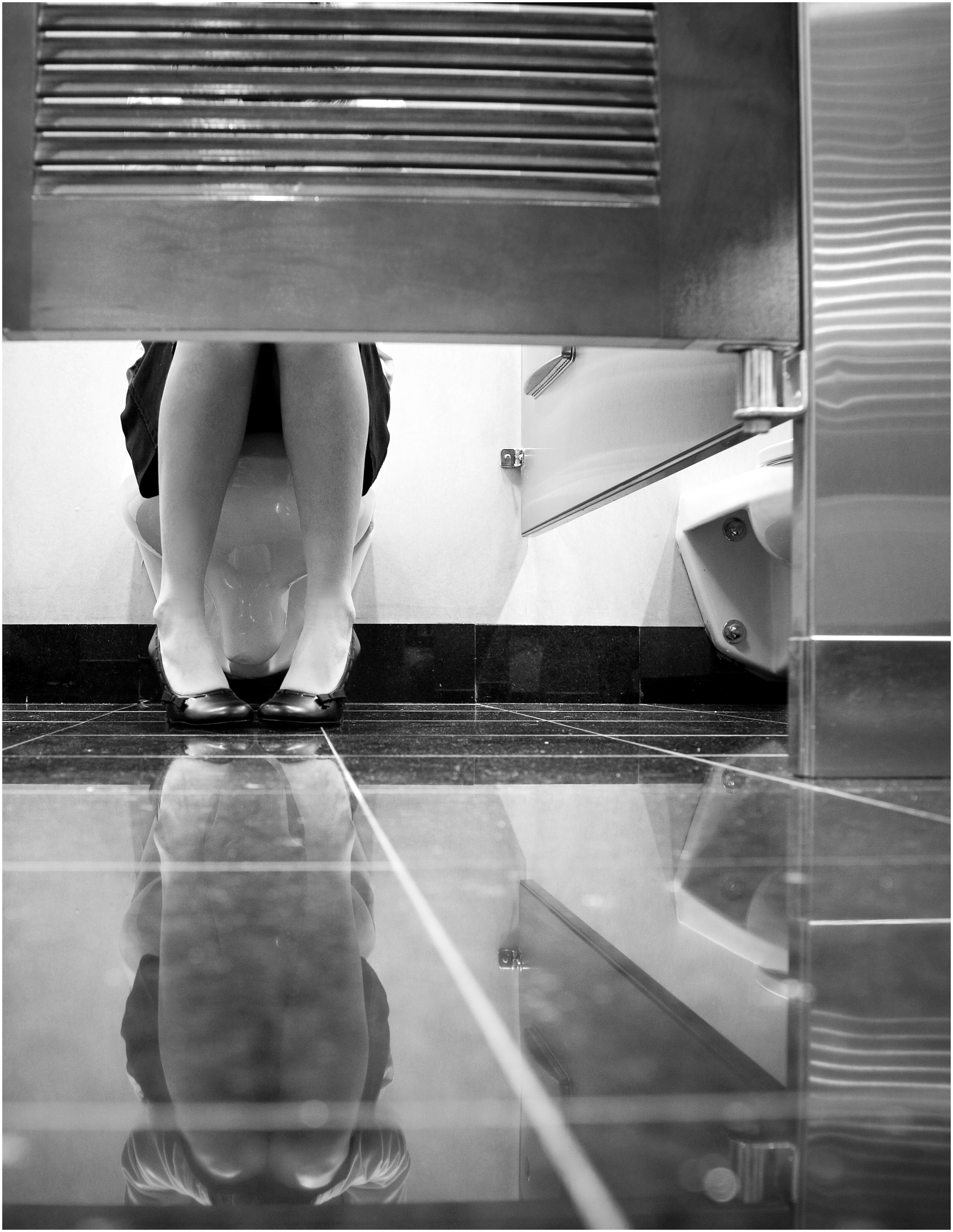
In March 2016, the North Carolina state legislature made headline news across the United States for its controversial passage of the Public Facilities Privacy & Security Act. Better known as HB2, the Act proposed a stringent new restriction on restroom access in government buildings across the state: individuals would only be allowed to access facilities that matched the sex officially listed on their birth certificates.
Supporters of HB2, including Governor Pat McCrory, argued that such guidelines were a necessary and “common sense” response to other political developments across the state—especially the Charlotte City Council’s recent approval of an ordinance prohibiting discrimination on the basis of gender identity in public accommodations. For McCrory, such antidiscrimination statutes threatened to “create major public safety issues” by allowing “deviant actions” to endanger restroom users across the state. Critics, on the other hand, pronounced HB2 and its like the true threat to public safety: first, by enabling harassment and discrimination against transgender citizens and second, by paving the way for a costly influx of litigation and political embarrassment.
But North Carolina is far from today’s only bathroom battleground. Since the start of the 2017 legislative session alone, eight states have moved to limit access to public restrooms and other sex-segregated facilities, like locker rooms, on the basis of a user’s assigned sex at birth, and, in cities like Philadelphia and New York City, measures to henceforth designate all single-occupancy restrooms as gender-neutral have grown in scope and popularity—all prompting vituperative political battles to erupt over the meaning of personal privacy and the public good.
The initial emergence of gender-segregated restrooms was a tacit byproduct of genteel taste in the Progressive Era, where the twentieth-century institutionalization of separate men’s and women’s restrooms into local, state, and federal law was anything but incidental.
To some, debates like these may seem uniquely contemporary, as elected officials, political activists, and ordinary citizens alike grapple with the meaning and consequences of increased transgender visibility. To others, “potty politics” feel excessively myopic: a “bizarrely outsize” distraction, as one Washington Post commentator put it, from other, more pressing dimensions of gender inequality in the twenty-first century. And still others will find the recent deluge of civil discourse about public restrooms decidedly un-civil, as any discussion related to bodily excrement troubles the limits of acceptable political rhetoric. But as my research investigating the cultural history of American public restrooms reveals, such debates are neither new nor marginal. Instead, they are merely the most recent in a long history of substantive cultural conflicts over gender and public restrooms—conflicts that have been as integral to upholding social class distinctions as they have been to, as sociologist Erving Goffman puts it, “honoring” gender difference.
Tom Hart, Flickr CC
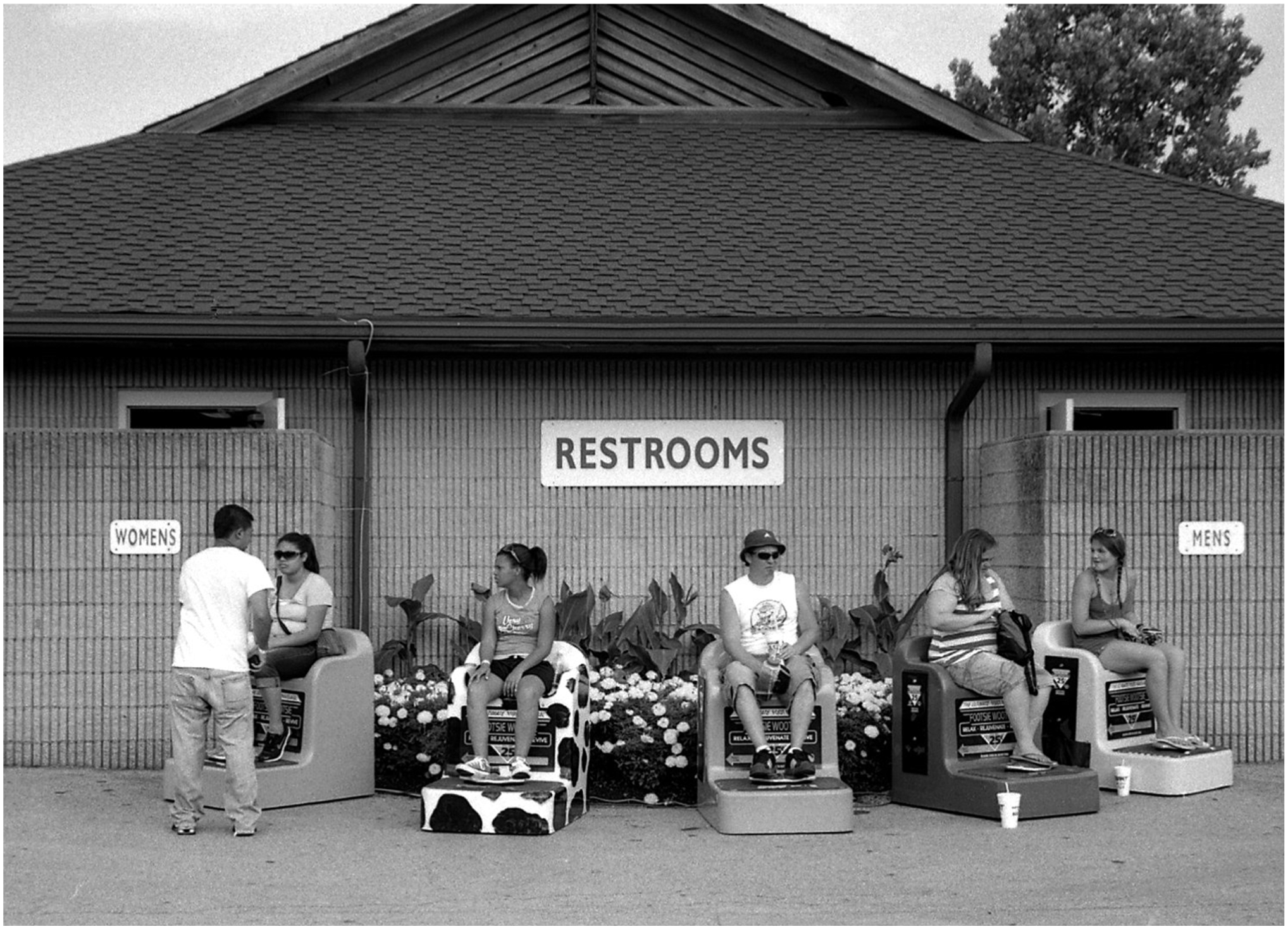
Even the popularization of family restrooms was an explicit marketing strategy meant to lure the growing upper-middle class into consumption meccas like suburban shopping malls.
Social Sanitization
For proponents of the very first “comfort stations”—the nineteenth-century precursors to modern public restrooms—the promise of personal cleanliness offered by such conveniences was of paramount public importance. Although the body’s evacuative processes had been an American cultural priority since well before the nation’s founding, the nineteenth century ushered in an unprecedented valorization of the sanitary body. In part, such shifts were driven by an increasingly tight connection between an individual citizen’s personal hygiene and their moral character: to have a clean body was not just polite or healthy, it was also a public demonstration that one was an upstanding and virtuous member of their community.
In part, however, that value placed on the clean body derived from a more collective quest: showcasing the unique strengths and virtues of American democracy as a whole. For men, the practice of good personal hygiene was imagined to yield a strong and masculine citizenry that could readily protect the nation from the perils of effeminacy. For women, learning how to maintain clean and respectable bodies for themselves and for their families formed the foundation of successful “republican motherhood.” Hygiene, it seemed, could not only uplift the masses; it could uplift gender and sexual mores, as well.
Several institutional developments also nudged along that Progressive Era revolution in American hygiene. Technological advancements brought running water to more American homes than ever before, and advertising was emerging as a nascent corporate enterprise. Most consequential of all, though, was the rise of a new American institution: the field of public health. Previously a scattered, localized series of moral reform campaigns, the American public health movement morphed through the late nineteenth century into a centralized scientific enterprise. Vested with a new professional authority and compelling evidence for the organismic foundation of disease, medical professionals transformed disgust at bodily dirtiness from a visceral experience into a political engine: they advocated for amendments to civic law, investments in health education, and most pressingly, the expansion of water-cleaning technology and public plumbing infrastructure—all under the promise to better protect American citizens from the deficiencies of their own bodies.
Yet local politicians and civic organizations met those efforts with a divided response. When it came to private homes and the cleanliness of the water supply, municipal leaders were quick to implement design standards that would standardize domestic plumbing, filter wastewater more effectively, and ensure the safety of drinking water. But rather than investing extensively in public infrastructure (as many European nations were doing toward the close of the nineteenth century), local politicians dismissed proposals for public restrooms on the grounds that they were too costly or too trivial to merit government expenditures. The scant few comfort stations that were genuinely open to the public, then, tended to be financed by interested philanthropists—who, owing to the moral charge of hygiene from prior decades, were typically more committed to providing the city’s underclass with the opportunity to bathe than to funding toilets for the public at large. Undervalued and underfunded, nineteenth-century comfort stations were often poorly maintained, not connected to a sewer, and within plain view of passersby. Urban women thus avoided them, local business owners protested their existence, and city officials pursued their immediate removal—sometimes, succeeding mere days after a new facility’s construction.
And so, the overwhelming majority of turn-of-the-twentieth-century American “public” restrooms were not public at all. Instead, they were located within privately-owned establishments, such as hotels, railroad stations, and department stores—all bastions of the growing consumer class, and, owing to the ubiquitous gender separation of nineteenth-century spheres of affluent sociability, all gender-segregated spaces. At that time, businesses interested in creating a fashionable and exclusive atmosphere for their guests did so by heightening spatial gender distinctions: even where men and women socialized in shared quarters, separate parlors, separate waiting rooms, and separate “conveniences” for their female and male patrons were commonplace.
A lack of available, clean, and separate workplace restrooms for women was, in professional and political rhetoric alike, a sure harbinger of community disintegration.
The rise of gender distinctions in American public restrooms, then, did derive from a particular set of cultural beliefs about gender difference and distinctive roles for men and women, as gender-segregated social spheres were themselves a means of protecting a respectable vision of femininity and masculinity for their inhabitants. But that gendered influence was more indirect than direct, as gender-specific public restrooms were a side effect of the respectability politics of nineteenth-century American affluence more than a direct, concerted effort to imbricate gender ideologies into public architecture for their own sake.
Separating the Sexes
But where the initial emergence of gender-segregated restrooms was a tacit byproduct of genteel taste in the Progressive Era, the twentieth-century institutionalization of separate men’s and women’s restrooms into local, state, and federal law was anything but incidental. As medical research about sanitation and disease gained traction in public discourse, the dawn of the twentieth century brought about a revolution in defining the gendered body—moving away from visual markers, like secondary sex characteristics, toward more “properly” biological markers, like gonadal tissue and hormones.
The power and authority vested in that new science of sex differences had far-reaching implications for how women would be treated in a variety of institutional spheres, but they were unusually resonant in early twentieth-century labor markets—where two other cultural transformations were also underway. First, lawmakers were becoming increasingly responsive to the labor movement’s calls to protect members of the American workforce from exploitative and hazardous workplace conditions. Second, scientific management, which promoted the scientific method as a means of enhancing workplace efficiency, was gaining traction as a reigning paradigm in the world of work. New scientific findings about the sexed body interlocked seamlessly with both shifts: many state legislatures passed protective laws mandating rest periods and shorter workdays for women to meet their purportedly unique bodily needs, and scientific management provided a fertile foundation from which such differential treatment of men and women could be justified as economical workplace practices.
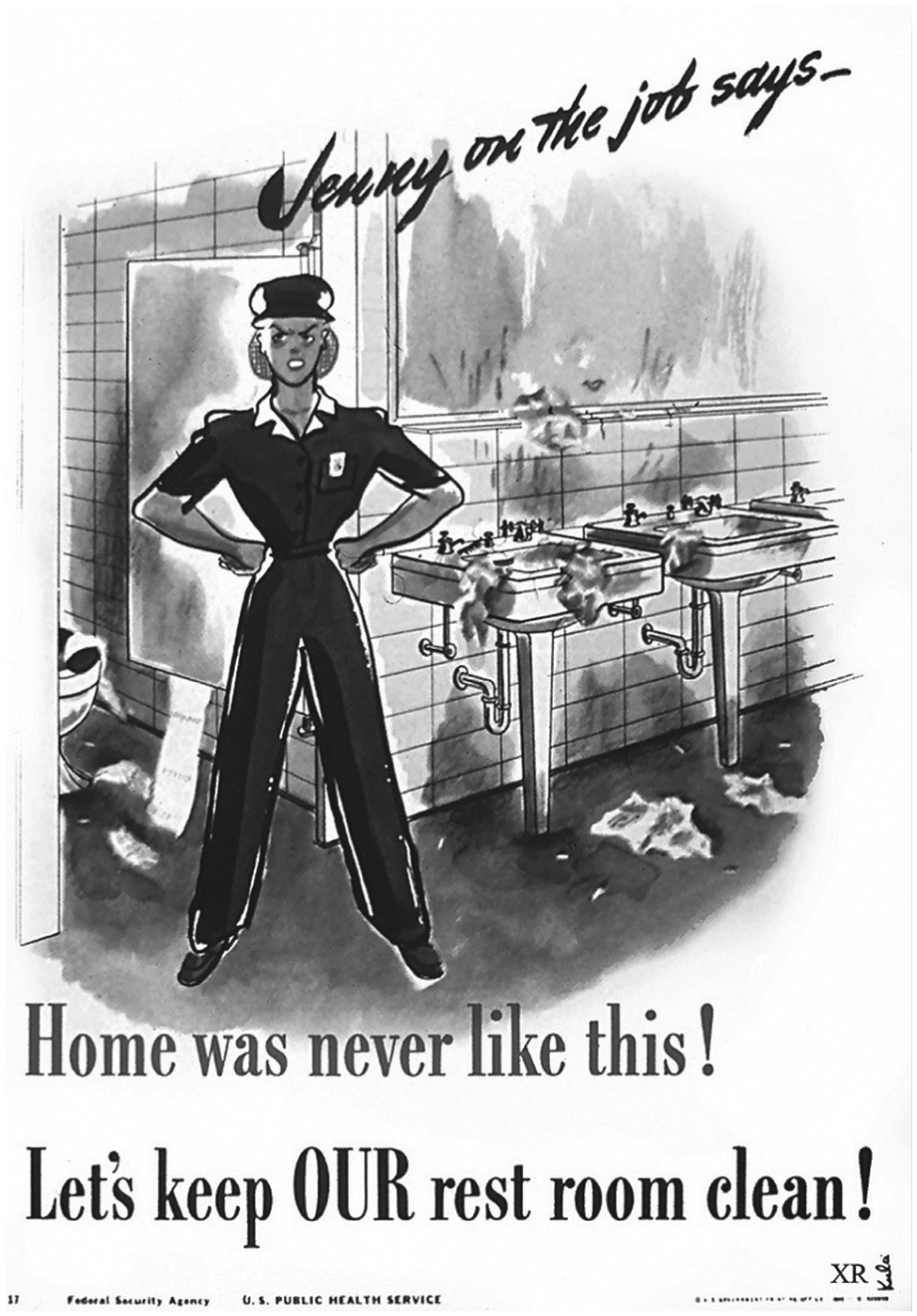
A WWII-era poster emphasizes bathroom cleanliness to keep work restrooms palatable for “Jenny on the Job”—the “postergirl” for women working in the war effort.
U.S. Public Health Service/Kula Robbins, 1943
By the close of the twentieth century, moral panics about sexual deviance and social disorder caused the overwhelming majority of true public restrooms in the U.S. to shut down. Where they remained, they underwent a renaissance of restricted access.
Gender-segregated restrooms were an obvious complement to such ideological osmosis. Managers, labor reformers, and government officials alike believed that young, unmarried women working outside the home needed separate restrooms to maintain their modesty and privacy in public. Without such provisions, male workers might be distracted from the often-dangerous factory work at hand—or worse yet, fall prey to a slippery slope of moral degeneracy that would draw them away from their jobs and families entirely. More importantly, affluent women’s groups—the most outspoken advocates for protective statutes, including those geared toward restroom separation—framed physical labor as an untamed threat to women’s physical condition for pregnancy and motherhood. A lack of available, clean, and separate workplace restrooms for women was thus, in professional and political rhetoric alike, a sure harbinger of community disintegration.
Yet those heavily gendered justifications were, at their core, inextricably intertwined with the class politics of the early twentieth century. In Florida and New York, for instance, White middle-class women’s groups pushed most fervently for separate men’s and women’s restrooms in workplaces populated with new immigrants—so as to expedite the “Americanizing” of their hygiene practices and community values toward White, middle-class standards. From the Northeast to the Midwest, wealthy lobbyists pushing for separate restrooms for women promoted misogyny as a public good, insinuating that women who deigned to set foot on a factory floor could not be trusted to safeguard either their virtue or their fertility. And in federal reports on working conditions in American factories, factory inspectors wrote the rules of upper-class propriety into their research on plumbing infrastructure: their notes about the necessity of screens, doors, and locks for women’s restrooms spoke to increasing factory efficiency but also to keeping the ravenous eyes of working men in check.
Consequently, far from mere political posturing, such class-inflected ideologies of gender, race, and sexuality were woven into the fabric of the law: by 1920, nearly every state had at least one statute in place requiring separate workplace restrooms for men and women. But instead of leveraging the rhetorical strategies that led to feminist successes around women’s suffrage rights—such as imagining a less stringent distinction between public and private—legal efforts to require gender-specific workplace restrooms drew their frameworks from ideologies of intrinsic gender difference and upper-class moral superiority. Paradoxically, then, emerging legislation about workplace bathrooms required employers to provide equal restroom facilities for their female workers, but the racialized and sexualized logics involved were fundamentally geared more toward preserving middle- and upper-class ascendancy than toward the true bodily needs or legal rights of individual female citizens.
David Howard, Flickr CC
Uneven and Stalled
As the twentieth century continued to unfold, however, such regressive respectability politics formed a surprisingly progressive impetus for the expansion of public restrooms. Due to their beliefs that their moral guardianship of the home extended into the public sphere, affluent White women across the country launched a series of campaigns in the 1910s, 1920s, and 1930s to improve American cities and towns. Public restrooms were a cornerstone of such work—not only could they quite literally enhance the cleanliness of the streets, but they would enrich moral cleanliness to boot: by providing proper toilets and resting areas to workers and travelers, for instance, women’s groups hoped to dissuade men on the streets from frequenting saloons, where restrooms and tempting vices like alcohol and prostitution were both freely available.
But that golden age of American restrooms was still far from an egalitarian new future for public facilities. In urban comfort stations, suburban service centers, and rural railway terminals, the high cost of restroom maintenance led many small business owners to charge fees for toilet access, making them virtually inaccessible to lower-income users. In cities, affluent women tended to avoid the public restrooms they lobbied so ardently for, preferring the quieter and better-kept options available to them in department stores, hotels, and restaurants. And as the popularity of public restrooms diffused through the South, Jim Crow laws mandating racial segregation in schools, workplaces, and public transit centers led to the construction of separate and decidedly unequal facilities for use by people of color—largely, as Elizabeth Abel writes, to “defend” middle- and upper-class White women “from unwanted racial or sexual intrusions.” In effect, the net number of public toilets in the U.S. in the first half of the twentieth century was steadily increasing, but so, too, was the fracturing of access to those toilets along classed and racial lines.
Paradoxically, the racialized and sexualized logics involved in early legislation about separate male and female workplace bathrooms were fundamentally geared more toward preserving middle- and upper-class ascendancy than toward the true bodily needs or legal rights of individual female citizens.
Consequently, restrooms were one among many targets for federal lawmakers and federal courts interested in expanding equality in postwar America. The Congressional passage of the Federal-Aid Highway Act provided ample federal funding for highway expansion and maintenance in the 1950s and 1960s—an investment that also created a revenue stream for rest stops and public restrooms. As the successes of the Civil Rights Movement began to aggregate in those same decades, architectural traces of racial segregation—such as separate building entrances, duplicate water fountains, and basement toilets—were one of the first physical effects of Jim Crow laws dismantled throughout the American South. Over the course of the 1960s and 1970s, the growing women’s movement found its calls for legal inclusion met through a series of new federal protections against sex discrimination; these, in turn, led the new Occupational Safety and Health Administration to require equal and separate toilets for women in permanent workplaces and Congress to mandate facility access and equity for women in education through the Education Amendments of 1972 (better known as Title IX). Even the tyranny of the pay toilet fell, as multiple states banned the ten-cent charge for public restroom access. In short, the future of public restrooms in the U.S. seemed decidedly more optimistic.
Gender minorities who are unemployed or possess lower levels of education are much more likely to experience restroom-related discrimination in public spaces. Worse yet, they’re more likely to suffer adverse psychological and physiological consequences in the wake of that discrimination than are their more affluent counterparts.
Yet once again, such moves toward the appearance of restroom democratization were quickly followed with a parallel decline in access and equity. With the rise of conservative activism against a constitutional ban on sex discrimination, long-standing cultural fears about women’s bodily vulnerability in public restrooms found new life: as Jane Mansbridge infamously chronicles, the notion that all public toilets would become unisex and literally open the door to “rape by predatory males” was integral to political mobilization against the Equal Rights Amendment. And with the revenue that came from pay-locks on restrooms now unavailable and no municipal funding streams available to replace them, public restrooms became more broken, more dirty, and more abandoned. That abandonment, in turn, allowed perceptions of illicit bathroom behavior to flourish: police reports related to vandalism, drug dealing, and sex work in public restrooms skyrocketed in the 1980s, and psychological research framing homosexuality as a mental disorder fueled widespread panics about same-sex sexual activity in those very same spaces.
By the close of the twentieth century, such moral panics about sexual deviance and social disorder caused the overwhelming majority of true public restrooms in the U.S. to shut down. Where they remained, they underwent a renaissance of restricted access: many hotels and restaurants began limiting restroom access to paying customers alone, and free restrooms remained, de facto, only accessible to a wealthier and whiter subset of the public—with interstate rest areas, for instance, requiring access to an automobile. Public restrooms had therefore come full circle: as fixtures ubiquitous within commercial and leisure establishments but rarely present as true public facilities.
So while the 1990s and early 2000s engendered numerous shifts toward restroom inclusivity—such as Congressional approval of the Americans with Disabilities Act, the spread of “potty parity” laws geared toward equalizing women’s restrooms with men’s, and the debut of gender-neutral “family” restrooms—their reach was largely limited to middle- and upper-class spaces. The ADA would only apply to new construction or existing buildings undergoing substantive renovations—either of which required a sizable infrastructural budget to enact. The spaces most commonly covered under new gender equity statutes were white-collar workplaces and multimillion-dollar venues for concerts and professional sports. Even the popularization of family restrooms was an explicit marketing strategy meant to lure the growing upper-middle class into consumption meccas like suburban shopping malls. Restroom accessibility and inclusion, then, were increasingly open to affluent Americans at the turn of the twenty-first century, but remained much less available to the majority of citizens on the street.
In her recent lecture-turned-article, “The Gender Revolution,” feminist sociologist Paula England characterizes twentieth-century progress toward a more egalitarian gendered future as “uneven and stalled.” So, too, with the history of “the stall”: middle- and upper-class men and women have largely been able to access clean and safe restrooms whilst out in public since the advent of nineteenth-century water-closets, yet adequate public toilets have only been available to poor and working-class people (and especially women) during the intermittent historical moments in which more affluent Americans have taken an interest in public facilities. But even when such interest has been at an apex, true public restrooms have remained underfunded, under-serviced, and underwhelming compared to the options available in less-than-public establishments—and even when progressive efforts have scored victories to equalize restroom access, they have disproportionately benefited those occupying privileged social and physical locations.
Amid today’s rising tide of transgender equality and gender diversity, then, that imbalanced legacy persists. Discourses of “deviant individuals” preying on women in public restrooms—like those Kristen Schilt and Laurel Westbrook characterize as “penis panics” (Contexts, Summer 2015)—recall the deceptive distinctions of previous centuries, echoing deep cultural anxieties about the vulnerability of (White, middle-class) women and the uncontrollable depravity of (supposedly lower-born) men. As USA Today and Inside Higher Ed celebrate the “changing climate” for gender diversity within higher education, elite private universities like Harvard, Princeton, and Yale disproportionately reap the benefits of having cutting-edge, “trans-friendly” reputations. And contemporary statutes requiring single-occupancy restrooms to be relabeled gender-neutral, like the one signed into law in California in late 2016, apply only to buildings in which a single-user restroom is already available. This readily allows institutions that renovated post-ADA to claim progressive and transgender-friendly intentions—even if their gender-neutral restrooms were, like the very first gender-segregated restrooms in the nineteenth century, a side effect of bourgeois privilege rather than a signal of their true cultural commitments.
For transgender and gender-variant individuals, too, the classed character of restroom access is likewise unavoidable. As lawmakers like former President Barack Obama signal a monumental commitment to transgender lives through the construction of gender-inclusive restrooms in government buildings (as in the Eisenhower Executive Office Building in 2015), those buildings remain white-collar workplaces largely off-limits to everyday citizens. Nationwide Insurance and Genentech may be among the Human Rights Campaign’s most transgender-inclusive companies, but Fortune magazine also ranks them as among ten of the most difficult corporations to land a job with—at least without the social capital facilitating a network connection to a company insider. Even health research within the social and biomedical sciences is beginning to reveal the pernicious consequences of class for transgender individuals: recent peer-reviewed publications suggest that gender minorities who are unemployed or possess lower levels of education are much more likely to experience restroom-related discrimination in public spaces. Worse yet, they’re more likely to suffer adverse psychological and physiological consequences in the wake of that discrimination than are their more affluent counterparts.
So, as lawmakers clash over the moral improprieties thought to result from “youth comingling in bathrooms,” as one South Dakota lawmaker recently opined, or the social value of “becoming a place where all can live with dignity, free from fear and free from judgment,” as New York City mayor Bill de Blasio asserted, what is at stake is not just the power to intervene in one of the civil rights movements of our time or even to negotiate the meaning and social consequences of gender itself. Instead, the “potty politics” of gender are now—and, for nearly two hundred years, have been—tied up with a very different kind of institutional inequality: the all-too-often hidden privilege of convenience held by the American middle and upper classes.