



Abstract
Examining the rhetorical claims to freshness, authenticity, and artistry in America’s elite sushi restaurants reveals commodity-driven ugliness alongside beautiful meals.
“We’ve been making a living by catching codfish for over a hundred years. We’re not interested in other fish. You’re trying to tell me that tuna would sell in Japan? Who’d eat such a fish?”

In the United States, the best sushi is the freshest sushi. It is the sushi that is almost too beautiful to eat, prepared by a chef who is more artist than a cook. It is the sushi that offers a gateway into a minimalistic, ancient, and unchanging Japanese culture. Yet, the sushi that is served at the best restaurants is frozen and shipped across continents. Such elite sushi can be beautifully prepared, but is not purely other-worldly art.
Rather, it often comes from the flesh of threatened species harvested by exploited workers. And the demand for contemporary sushi is just that: contemporary. It is a relatively new culinary phenomenon, determined largely by changing patterns and capabilities in production, preservation, and transportation technologies.
By performing a content analysis on elite sushi discourse, I demonstrate how haute sushi in the U.S. is depicted as fresh, ethereal, and the embodiment of Japanese traditional culture. I define elite, fine, or haute sushi according to Zagat ratings of the best sushi restaurants and parallel my analysis with discussions on how sushi is actually harvested, produced, and transported. In doing so, I hope to show some of the contradictions that are so problematic in concealing unsustainable aspects of an ever-expanding industry.
Fresh, Never Frozen
What does it mean to suggest that a meal is fresh? As popular “locavore” enthusiast Alice Waters would argue, freshness is located in the ingredients or products themselves: the closer you are to the site of production in terms of both supply chain and actual geography, the better and fresher. In a similar vein, chef and restaurant makeover artist Gordon Ramsay once quipped of a fish fillet, “Fresh-frozen? There’s no such thing! It’s either fresh or it’s frozen!” And in another, more popular example, fast-food franchise Wendy’s has made a marketing slogan of its supposedly “fresh, never frozen” beef patties.
Elite sushi restaurants capitalize on the popular desire for freshness. Indeed, on the website for Masa NYC—frequently cited as the country’s best sushi restaurant—we read that their meals “build on seasonal properties utilized only in their freshest most delicious state.” Yet, for all of culinary culture’s fear of the freezer, the expansion of haute sushi would not be possible without it.
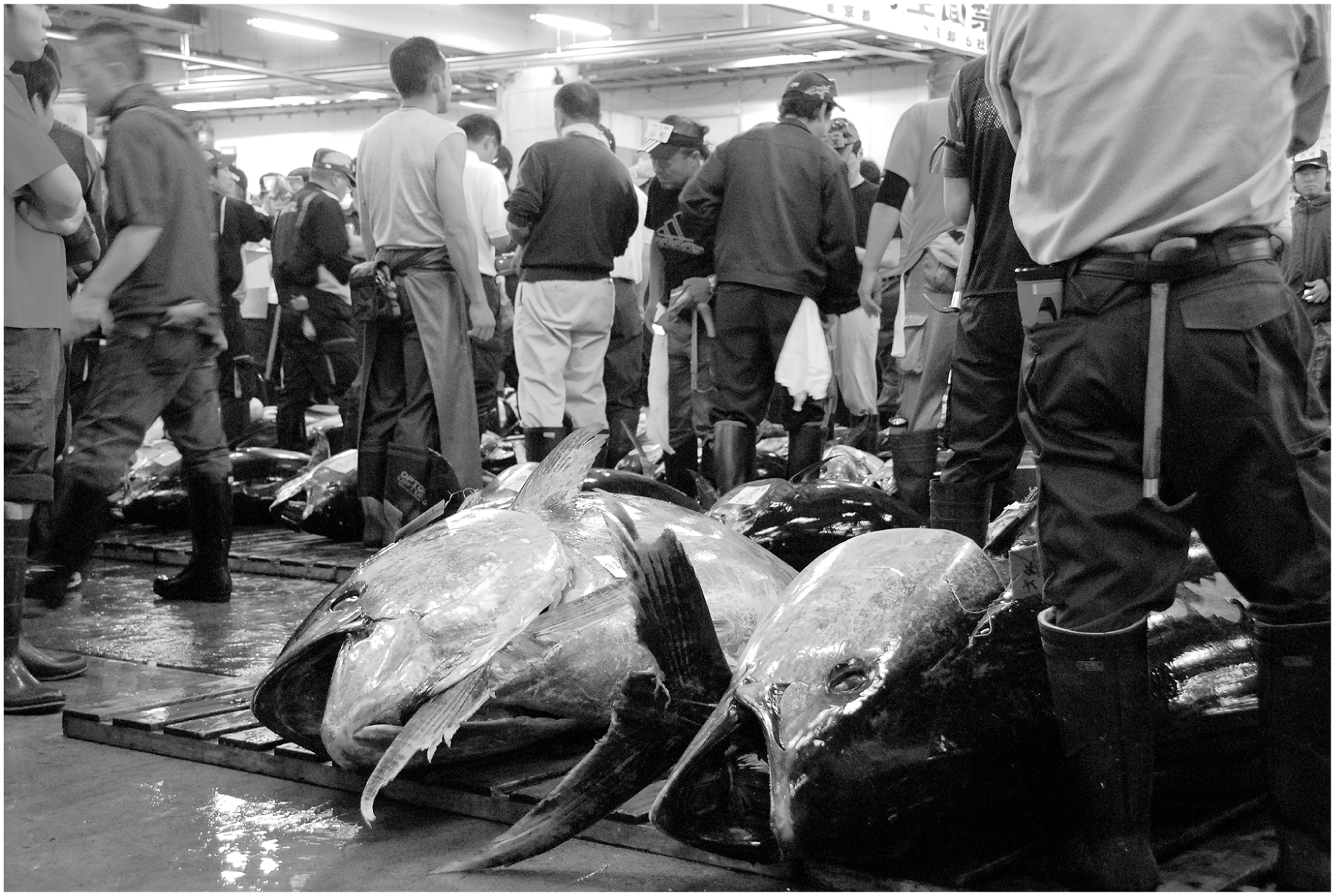
Massive effort is required to harvest, transport, and—most importantly—preserve fish as a consumer commodity traveling back and forth across the globe. In an age where the threats from climate change are more and more evident, the ecological footprint of such an intensive industry is undoubtedly vast, and today’s sushi industry depends on enormous technical efforts. As an example, the prized flesh of blue fin tuna is often harvested in the North Atlantic Ocean, purchased by commercial buyers in Maine, flown out of New York to Japan’s Tsukiji market—what anthropologist Theodore Bestor calls “the fishing industry’s answer to Wall Street”—bought and sold again in Japan, then transported back across the globe to be sold in fine North American restaurants. This energy intensive process requires multi-staged cooling and “super-freezing” technologies at every step. Despite some ambiguity in enforcement, FDA regulations mandate that raw fish sold in the U.S. must be frozen in order to kill and prevent the spread of parasites.
The rhetoric of haute sushi conceals the uglier, commodity-driven aspects of the industry.
Khanh To, Flickr CC
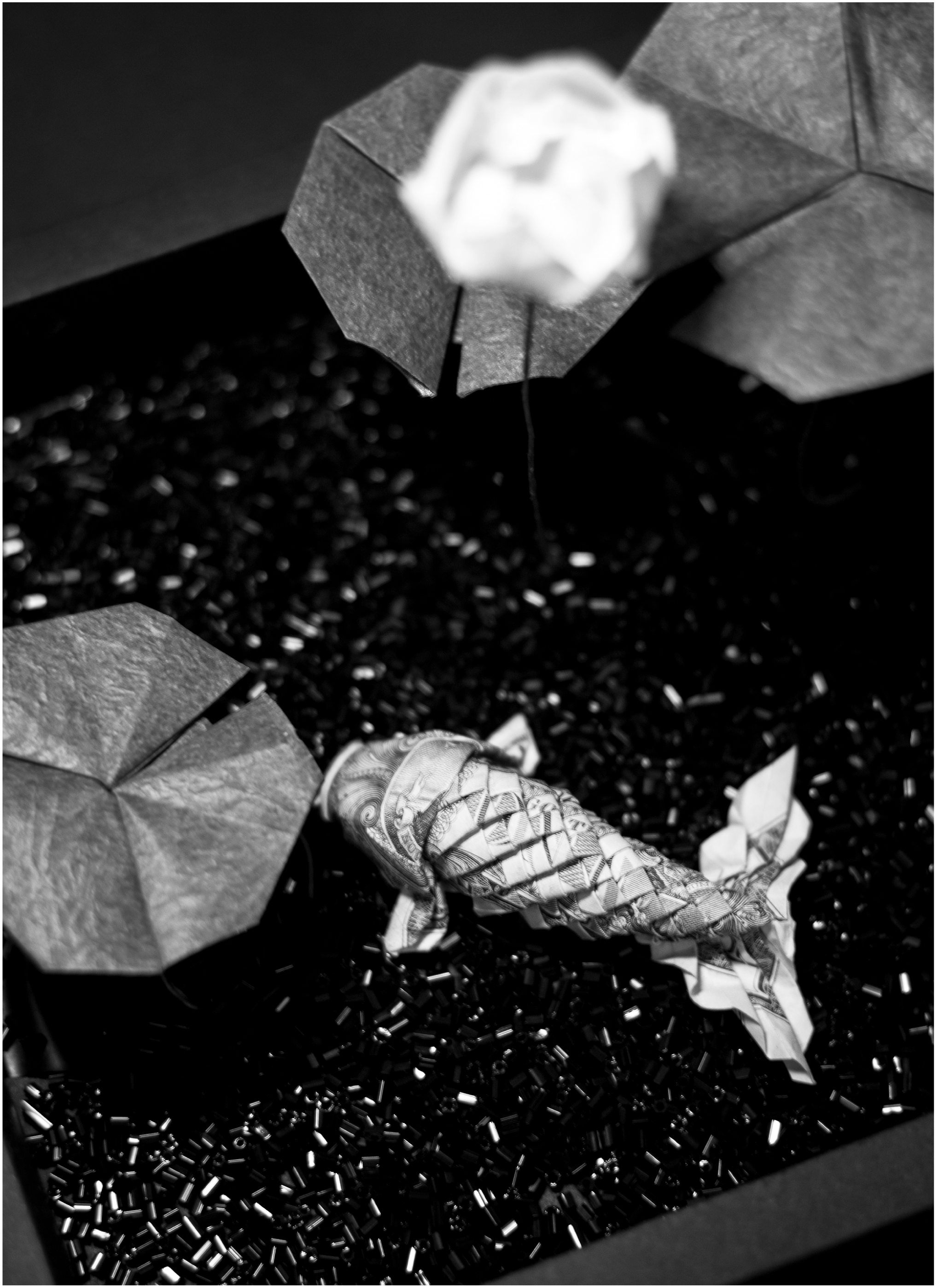
Ironically, the expansion of such refrigeration technologies was originally coupled with a rhetoric of freshness. Sushi’s pathway to the palates of southern Californian consumers hinged on the perception that sushi used fresh, healthy, and simple ingredients as seen in sushi cookbooks written around the popularization of sushi in the U.S. The foreword to the 1981 Book of Sushi reads, in part, “My friend and manager introduced me to sushi. I don’t recall exactly when and where, but probably in a small place in the Tsukiji district, which is famous for restaurants serving fish. I thought sushi was fabulous, absolutely fabulous, from my very first bite. The completely natural taste of fresh fish and the delicately vinegared [sic] rice on which it is served make for a perfect marriage.”
Sushi, by most popular standards, is not fresh in the most idealized sense, cannot be considered ethereal due to its environmental and social consequences, and is more an embodiment of the ever-changing social construction of taste than of supposedly unchanging Japanese tradition.
Here, the “completely natural taste of fresh fish” serves as a justification for experimentation with the ingredient. The freshness is reassuring and appealing—as essential to sushi in the U.S. as any technique of preparation. For example, the late food critic Craig Claiborne attempted to define sushi as “an assortment of small morsels of the freshest raw fish and seafood” combined with rice. And in marketplaces across the country, the highest quality cuts of fish are commonly referred to as “sushi-grade” to imply a high level of freshness, despite the fact that the term has no regulatory meaning.
Fresh tuna are auctioned at Tsukiji Fish Market in Japan. The photographer notes that each fish pictured here weighs over 400 lbs.
Noah Dropkin, Flickr CC
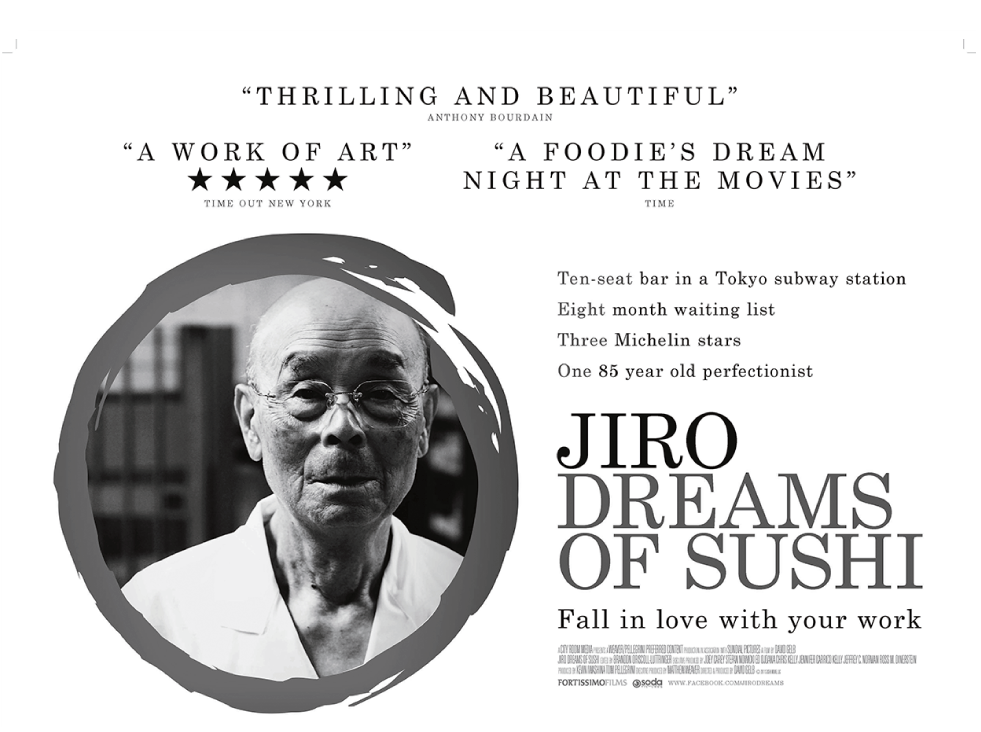
Award-winning Independent Lens production “Jiro Dreams of Sushi” explores and reinforces the ways sushi is supposed to represent Japanese culture and the “unchanging” craft of the sushi chef.
Independent Lens/Netflix
To underscore the sense of freshness, sushi discourse popularizes a “catch of the day” mentality. Many of Zagat’s most highly rated sushi restaurants emphasize their usage of seasonal ingredients and “locally sourced” products. For example, Uchi Austin states that they “serve the freshest product we can procure every day. We maintain close relationships with local farmers and we fly in seafood every day from both Fukuoka and Tsukiji markets in Japan.” On the menus of Morimoto and Kiss, the word fresh appears numerous times, and in a Chicago Reader review of Katsu, the author describes the meal as a “long slab” of “that day’s most beautiful fish.” Kiss’s website describes their product as a “one of a kind meal” using “the freshest seafood available that day,” while an Eater review of Urasawa emphasizes the chef’s hand-preparation of “daily seafood deliveries from Japan.”
For all of culinary culture’s fear of the freezer, the expansion of haute sushi would not be possible without it.
So, is elite sushi really fresh? It is unclear what the term freshness actually means, but there is some reason to believe that the emphasis on freshness conceals the complex, energy intensive processes that the globalized sushi economy requires. Uchi’s assertion that “ingredients and flavors from all over the world are easily accessible now” is highly questionable; it conflates efficiency with ease to convey a close, immediate connection to the product and inspires consumers to think of a recently caught, perhaps never even frozen ingredient. The connotation renders the exotic less intimidating and more exquisite, but conceals the intensive labor and energy required to produce this fine-dining experience.
Food as Art, Chef as Artist
The most prevalent theme I found in the discourse of elite sushi restaurants was the depiction of the preparer of sushi as an artist and the sushi itself as a form of art. Constructing sushi as art distinguishes it from the ordinary: it is more than a meal. The sushi at elite American restaurants is depicted as “delicate,” “divine,” “pristine,” even an item in possession of “purity”—an out-of-the-world commodity emerging from the mind of a great artist and craftsman. At O Ya Boston, for example, a Zagat reviewer writes approvingly that, “each plate is presented as a work of art.” As food critics and avid diners say so frequently, this sushi is “almost too beautiful to eat.”
The websites of elite sushi restaurants often cultivate this notion by adding galleries of professional photographs. Sakedokoro’s online gallery reveals that the plates truly do seem more art than fuel—the apex of the too beautiful to eat trope.
Masa’s website, for its part, also offers an “experience” section for potential diners. It describes a dining atmosphere of “refined beauty that isn’t affected by time or social changes… Purity of being, of living, of sensing is inherent in all elements of the Masa experience.”
This discourse goes back decades, and it is closely tied to the notion that the sushi chef is not simply a preparer of food but a “master,” “truly an artist,” as some reviewers write. Indeed, a reoccurring theme across all of these restaurants is that the sushi chef is master craftsman (all of the chefs at Zagat’s top-rated sushi restaurants are men) deserving our trust, admiration, and awe. The status granted to these chefs is not surprising given sociological research on men and food: men tend to dominate the higher levels of the culinary profession, and masculine cooking generally tends to be performative, enacted on special occasions and in an effort to demonstrate skill and prowess.
The discourse on elite sushi “artists” goes a step beyond, however. To many American consumers, sushi remains exotic. It is not an item commonly prepared within the home and, as Masa’s webpage reminds us, the best sushi in the U.S. is more than a meal—it’s an “experience.” Thus, the sushi chef presents himself as a master, preserving the elite statuses of both the chef and the cuisine. Diners are encouraged to sit back, relax, and let the master do his work. “Today’s special: trust me,” proclaims Sasabune. At Kiss in San Francisco, “the cozy, jewel-box space… allows the Chef to give you his most dedicated attention. In turn, this intimate setting allows you to observe a master at work.” Several elite restaurants stress the training of the chefs and their close association to other sushi masters. The reinforcement of associations and lineages of mastery promotes the elite status of the sushi and its chef and encourages the diner to give in, as one website asks, to an “ethereal” adventure.
An art installation, “Just Right Sushi,” by Taku Satoh.
Dick Thomas Johnson, Flickr CC
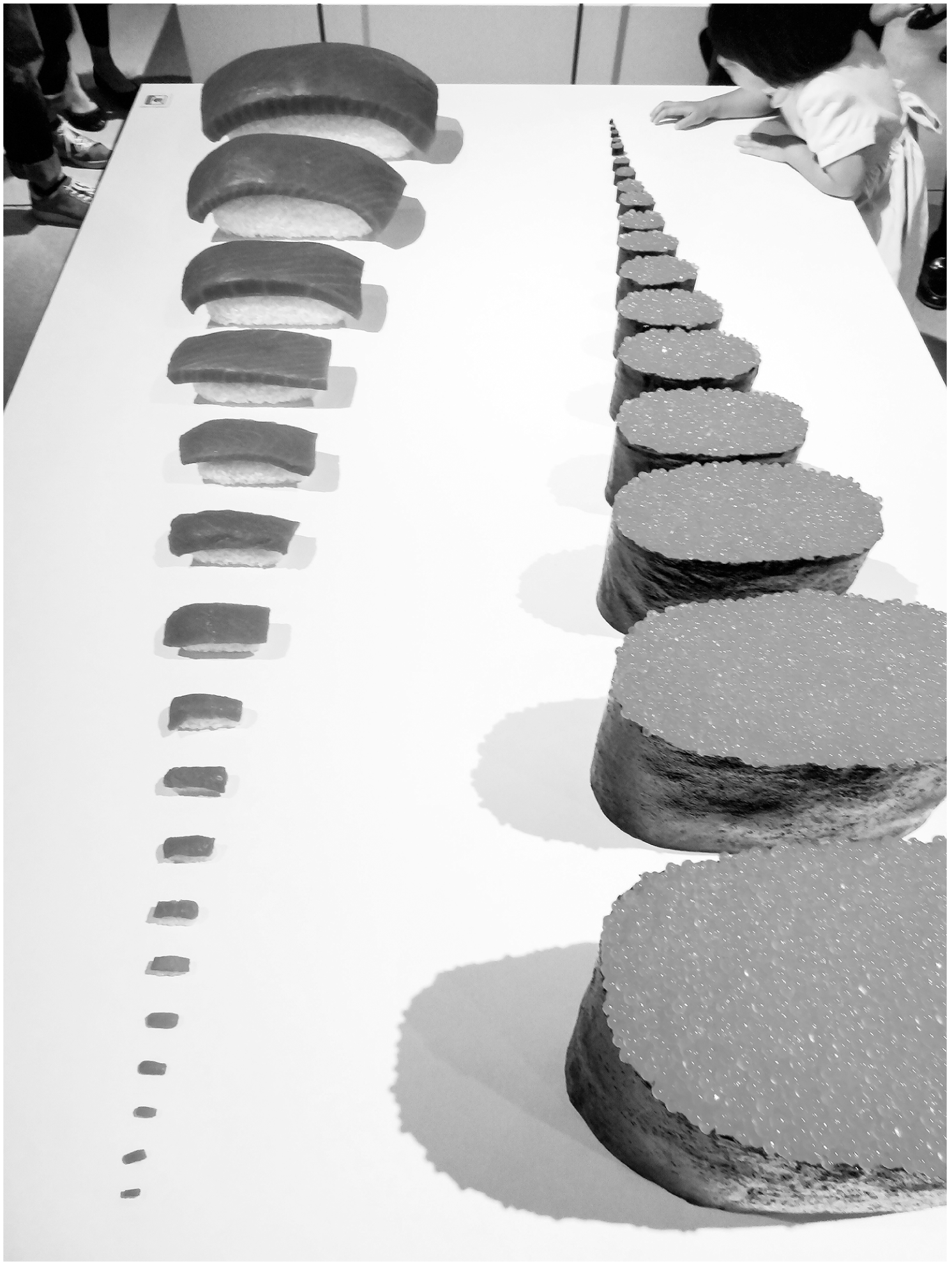
The construction of elite sushi as art and sushi chef as artist has contributed to the growing, global demand for prized cuts of fish. Despite restaurants’ allusions to purity, the flesh harvested to produce sushi is very much of this world, and the political economy of sushi production has serious material consequences. In the Mediterranean—a critical breeding area for blue fin tuna (BFT)—commercial fisheries exploit regulatory loopholes and threaten BFT populations to keep up with the ever-increasing demand, and North Atlantic fish populations are under threats due to overfishing in breeding areas near the Gulf of Mexico. More generally, the intensification of global capitalist development needed to meet consumer demand has led to wider issues across marine systems. Today, according to the UN Food and Agriculture Organization, only 3% of all monitored ocean species are currently under-exploited. In short, there is no area of the ocean untouched by the effects of overfishing—much of it to supply commodities for consumption in the U.S.
Additionally, the production of fine cuts of fish depends on the rapidly growing aquaculture industry. Fertilizer inputs for these high-trophic, farmed species (like tuna and salmon) are massive and require non-market, processed fish once considered worthless “by-catch,” and the fish are commonly caught by highly exploited migrant workers. The International Labor Office’s report “Caught at Sea, Forced Labour and Trafficking in Fisheries” details how, to remain profitable, some fisheries rely on slave labor and human trafficking.
The website for Masa NYC emphasizes the chef’s lineage, artistry, and dedication to the art of sushi.
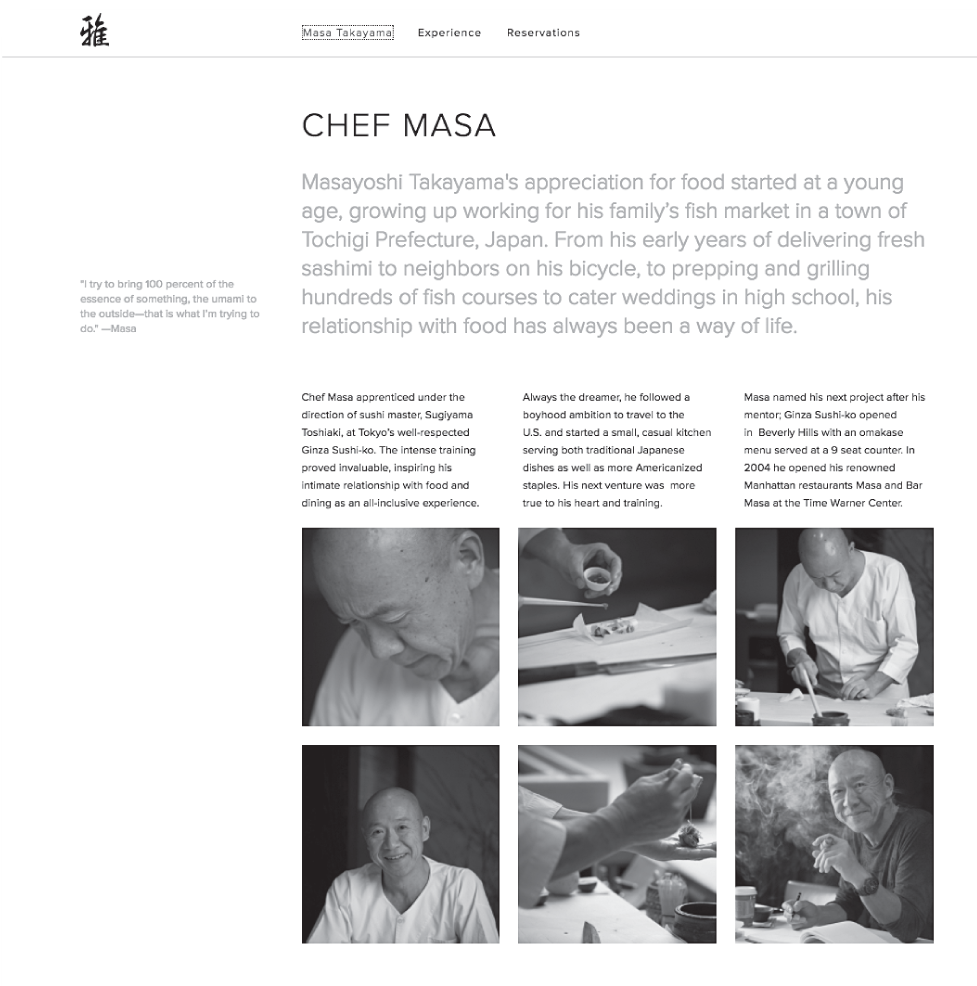
The reality of migrant slave labor and a collapsing food web are concealed in the sushi discourse. We should thus pay special mind in this analysis to the word “ethereal,” (used above) which literally means that something is so exquisite that it seems too perfect for this world. No amount of artistry can change the truth: sushi is a product that may be presented beautifully despite its reliance on some very ugly realities.
Much of what is considered the highest quality and most traditionally admired cuts of sushi today are only recently elevated fishes.
The Essence of Japanese Cuisine
Food can be constructed to symbolize cultural identities. The discourse on sushi is no exception. Sociologist Michaela DeSoucey’s concept of gastronationalism is instructive here. Food and eating, she explains, are expressions of culture and shapers of identity. How and what we eat therefore reveals a great deal about how cultures are perceived and lived.
In regards to perceptions of Japanese culture, sushi is commonly recognized as an embodiment of a kind of unchanging, static, and ancient lineage. In the foreword for The Book of Sushi, Japan is called “the most colorful nation, probably because Japan seems to have more living traditions than the other countries I’ve visited.” The cookbook Sushi Made Easy stresses the association between sushi and Japanese culture, calling sushi “one of Japan’s most representative foods.” These admirable perceptions of Japanese culture give Japanese cuisine a distinct advantage in ascending the culinary hierarchy.
In his book The Ethnic Restaurateur, food scholar Krishnendu Ray empirically demonstrates a hierarchy of cuisines. Interestingly, Japanese cuisine has moved beyond a relegated “ethnic” status in the U.S. to achieve a “haute” status on par with French and Continental cuisine. The unique admiration for Japanese culture and the idea of Japan as an elite, unchanging, and culturally rich nation helps to explain why Japanese cuisine has made this move, while other Asian cuisines remain undervalued.
Elite sushi restaurants play into their cultural advantage. Sushi chefs cultivate their authenticity by emphasizing their training, handed down from high-status, Japanese sushi masters. They refer reverently to their collection of knives, “traditional Japanese culinary tools,” and vie to earn the designation of their city’s most authentic “Japanese experience.” Direct links to Japan through birth and training serve to produce deeper a sense of authenticity. And even minimalism—whether in terms of the simplicity of ingredients, presentation, or restaurant décor—is lauded as a marker of Japanese food and identity. This confirms prior social research about how sushi is idealized internationally in a way that promotes Japanese culture as traditional and unchanging—even unchangeable. A sign inside Sasabune drives home its opposition to passing trends and fads, telling its customers “No California rolls. No spicy tuna rolls.” At America’s elite sushi venues, they want you to understand, you should find only the most traditional and authentic Japanese fare. There should be no concessions to whimsical trends in the finest dining.
Overfished, Overvalued, and Obscured
Yet another irony emerges in elite sushi discourse. Much of what today is considered the highest quality and most traditionally admired cuts of sushi are only recently elevated fishes. North American fishers, who now seek out BFT as if it were pure gold, used to consider the fish a worthless sport fish with no market value or even a nuisance apex predator that threatened stocks of more-valuable cod. With the exponential increase of tuna’s Japanese market price—soaring nearly 10,000% in recent decades—the fish’s humble reputation can seemingly go no higher.
The changes in market prices are reflected and spurred on by changes in the taste preferences of Japanese consumers, too. Surprisingly, for a cuisine marketed as a timeless and unchanging, the consumption of sushi is fairly new as a culinary phenomenon in Japan. Prior to improvements in transport and preservation technologies, uncooked fish was usually served fermented or salted. Raw sushi, as it is consumed today, did not begin to appear until after World War II. Moreover, until recently in Japan, consumers considered the now prized belly of BFT as basically unfit for human consumption due to its richness. It was more commonly used as pet food.
Despite historical changes, food critics argue that elite sushi’s “secret” is to avoid “cower[ing] to passing trends”. Yet, taste and what is considered haute cuisine are socially constructed and reproduced by elite discourses that parallel and reinforce trends in global production and trade. Our popular conceptions of elite sushi wouldn’t be possible without revolutionary changes in preservation technology, transportation, and labor relations.
Overall, the discourse of elite sushi in the U.S. is fraught with historical and social ironies. Sushi, by most popular standards, is not fresh in the most idealized sense, cannot be considered ethereal due to its environmental and social consequences, and is more an embodiment of the ever-changing social construction of taste than of supposedly unchanging Japanese tradition.
The story of sushi also demonstrates the interplay between changes in production and changes in cultural understandings. Scholars often disassociate these two areas of study or argue that one is more influential or worthy than the other, but sushi cannot be understood without a thorough analysis of social constructions and material, productive processes. Where the discourse on elite sushi contributes to a cognitive decoupling from its own social and ecological impacts, we can see that how we understand and enjoy a food product is often deeply related to misunderstandings about the processes of food production.
Investigating the history and future of elite sushi must address the sustainability of a globalized, ever-expanding sushi industry, including a critical evaluation of the discourse of its finest proprietors, who argue, like Uchi Austin, that their product strives “to maintain a responsible policy towards sustainability” against the actual social-ecological costs of the sushi trade. In cultural studies of food discourse, we must remember that rhetoric can drive demand and therefore perpetuate potentially unsustainable productive processes.