



Abstract
This article looks at the degree to which spatial inequalities reinforce other forms of social inequality in cultural labor markets. It does so using the example of London, an acknowledged hub for the creative and cultural industries. Using pooled data from 2013 to 2015 quarters of the United Kingdom’s. Labour Force Survey, we consider the social makeup of London’s cultural labor force, and reveal the extent to which, rather than acting as an “engine room” of social mobility, London’s dominance in fact reenforces social class disparities in cultural employment.
Introduction
The figure of the artist has a strong hold on the urban imagination. Whether starving in garrets, kick-starting gentrification or inventing the next trend, movement or scene, the artist is invested with huge symbolic agency when it comes to influencing the image of cities (Hall, 1998). At the same time, artists are often described as being “drawn” to cities, the implication being that there is no choice for the ambitious or even the curious, but to go to the big city and try to make it. In the British imagination, London has played such a role at least since the middle ages (Fielding, 1992). A city whose fortunes have long been decoupled from that of its host nation, London is the financial, political, educational, and cultural capital of the United Kingdom. It represents a degree of centralization which has, wisely, not been replicated by most other countries.
This article looks at the role of London in reproducing a particular form of both social and spatial inequality in cultural labor markets. Its starting point is the discourse of the “creative city,” within public policy, the argument that urban areas would retain their historic advantages in cultural production, even as digitalization made dispersed production a possibility (Mould, 2015). For many policy makers, this opened up opportunities for cities in the Global North suffering the effects of deindustrialization and has thus been embraced as an economic development strategy from Detroit to Derby. Also central to this strategy was the idea that the cultural and creative industries (CCIs) represented a labor market which was meritocratic, and which opened up opportunities to women, those from Black, Asian, and Minority Ethnic (BAME) backgrounds, and working-class people, who had been not only disadvantaged in other professional labor markets but particularly hard hit by the form of neoliberal economic growth (Oakley, 2014). These assumptions have proved to be ill-founded, as even advocates of this position, such as economic geographer Richard Florida (2017), have recently admitted. Culture labor markets, far from opening up opportunities, in fact tend to be dominated by White men from relatively privileged backgrounds (Friedman, O’Brien, & Laurison, 2016).
This article considers this relationship between place and other forms of inequality, particularly as it applies to global cities like London. Specifically, the article looks at how the cultural dominance of world cities like London operates at the level of the labor market, and the way in which, by clustering particular sorts of cultural activities, it reinforces other socioeconomic, for example, gender, ethnicity, and particularly class-based, divides. It also considers the role of higher education and particularly arts education within this phenomenon. London is not simply home to high-level cultural employment but to some of the United Kingdom’s more elite art colleges (Banks & Oakley, 2016). Does higher education, as is sometimes the case within other professional labor markets, have an “equalizing” or mitigating effect on these inequalities? How does the relatively weak link between credentialization and professional cultural practice play into this? And what are the challenges from this analysis for arts educators at a time of rising inequality?
The first section of the article sketches out the relevant literatures and the policy discourses of which they are a part. The CCIs have become central to the economies of many countries (United Nations Conference on Trade and Development, 2015) but they are also used to make other normative claims of meaning, identity, even equity (Oakley & O’Brien, 2015). The second part of the article challenges some of those claims, using data on industry composition, class origin, and the “London effect.” Our analysis provides an important frame for discussions of the role of arts graduates in society. The analysis demonstrates that an important policy story—the link between arts education and the CCIs (Ashton & Noonan, 2013)—is not supported by data on this section of the labor force. Moreover, by reading this data from a spatial perspective, a crucial element in how CCIs cluster together (Markusen & Gadwa, 2010; Zukin, 1998), we show the need for more attention to be given to the nexus between arts education, place, and the creative economy. If, as we demonstrate, arts education cannot mitigate the broader inequalities of class, race, gender, and place underpinning the creative economy, then it is vital for new lines of defense to be found in discourses of the role of arts in society.
Literature Review
London: The Creative City as an Idea and as Policy
We begin with the importance of London as a site for intersecting inequalities in the United Kingdom’s approach to the creative city. The evidence suggests that most CCIs are biased to the urban; that is CCIs are more likely to be found within cities (Hall, 1998; Zukin, 1998). There are a variety of reasons for this. The tendency for cultural workers to colocate is driven by the opportunity of employment in urban networks, alongside the need for cultural producers to swap ideas and contacts, socialize together, and trade industry gossip (Currid, 2007; Lloyd, 2006). Communicating these ideas is best done face-to-face, even in activities such as videogames production that make much use of digital technology. Indeed research suggests that the higher up the value chain—and the closer to the creative elements of production—the more likely it is that face-to-face interaction will be important.
At the same time, these urban networks of cultural production have an interdependence with cultural consumption. Opportunities for cultural consumption are generally greater in cities than elsewhere, and the link between production and consumption in these places is strong, often manifest in “scenes” associated with particular sites (Crossley, 2015). Indeed, while specific cultural occupations, for example, artists, are present across national and regional geographies (Markusen, 2013), they tend to cluster in one or a handful of core cultural centers (Menger, 1999).
For firms in the CCIs, and for the associated leisure sectors from bars and clubs to coffee shops and independent retail, being located in certain areas can be invested with what is sometimes referred to as “symbolic capital” (Lloyd, 2006; Zukin, 1998). The growth in importance of creative city policies and the ideology of urban competiveness means that cities have, in recent decades, sought to “operationalize” creative activities and the associated symbolic capital to produce economic results. There has been a rise in “active state” policies from the expansion of higher education, including arts, design, and media subjects, to public investments in workspaces, studios and incubators, publicly funded networks, and intermediaries and tax incentives devised to lure firms, particularly in the media sectors, from one urban location to another (O’Connor & Gu, 2013).
Efforts to capitalize on CCI as an urban growth strategy have not been without some success. In the United Kingdom, jobs in the CCIs have continued to grow and according to the United Kingdom’s Department for Culture, Media, and Sport (DCMS), they made up just over 5% of the U.K. economy in 2016, accounting for some 1.9 million jobs. Between 2013 and 2014, these sectors grew by 8.9% as opposed to 4.6% for the economy overall (DCMS, 2016). Recent data (Mateos-Garcia & Bakhshi, 2016) suggests that more than 90% of local economies in the United Kingdom have seen increases in cultural sector activity, but, crucially, regional differences remain and have deepened. The counterpart to the tendency of cultural activities to cluster together is that they seem to cluster more effectively in some cities than in others (Scott, 2000). Other towns and cities attract web designers and some back-office software production, but, in the United Kingdom, little troubles London’s long-standing cultural and economic dominance. Together with the Southeast region that surrounds it, London accounts for half of all cultural sector employment in the United Kingdom, has 40% of the United Kingdom’s cultural workers, and a third of all its businesses in that sector (Mateos-Garcia & Bakhshi, 2016). There is thus a clear geographic imbalance associated with cultural work in the United Kingdom. Indeed, this is reflected not just in cultural production, but in cultural consumption and associated state funding. The concentration of “national” cultural institutions helps ensure that public arts funding is more than 10 times greater per capita in London than the rest of England (Stark, Gordon, & Powell, 2013). Concurrently, debates and campaigns associated with arts education (e.g., Arts Emergency, 2017) have asserted a relationship between inequality in cultural jobs and arts courses in higher education. London is especially important to this story as a result of its dominance with U.K. cultural production networks and its status as host to key arts schools, drama schools, and other creative education facilities.
In the policy imagination, far from reinforcing inequality, London has long been seen as the “engine room” of social mobility, an “escalator region” where the talented and hardworking are most readily able to get ahead in the education system and labor market (Fielding, 1992; Greaves, Macmillan, & Sibieta, 2014; Social Mobility Commission, 2016). Yet this view has recently been strongly challenged. Cunningham and Savage (2015, p. 321) argue that contemporary London is not so much an escalator region but an “elite metropolitan vortex”—“a space where the coming together of intense economic, social and cultural resources enable the crystallization of a particular elite social class formation” with “an increasing propensity toward self-recruitment.” This argument has been further substantiated by Friedman, Laurisn and McMillan (2017) who uncover a marked “class pay gap” in London’s higher professional and managerial sector. These authors find that those in these occupations working in the capital from working-class backgrounds earn, on average, £10,660 less per year than those whose parents were in higher professional and managerial employment. The inequality that separates London from the rest of the United Kingdom is mirrored, spectacularly, within the city itself. London is home to some of the United Kingdom’s poorest citizens, while such is the concentration of the global super-rich that even many of its middle-class residents feel squeezed out of its housing market (Atkinson, Burrows, & Rhodes, 2016). The wealth of the best-off 10% living within London is over 100 times greater than that of the poorest 10%.
Yet while one might expect that traditional professions such as law and medicine are dominated by the privileged—many, including in the policy community, would be surprised to learn that the same is true of the CCIs. The promotion of cultural industry strategies in economic development discourse has long suggested that not only is this sector open to talent from anywhere but that such diversity is part of their life blood (Arts Council England, 2015). Indeed, the current minister for culture in the United Kingdom has declared that the arts “are one of the greatest forces for openness and social mobility” (Hancock, 2016).
Inequalities in Cultural Labor Markets
The type of policy rhetoric associated with diversity and social mobility has gone hand in hand with questions of representation and inequality in cultural production. These questions have, in turn, been matched by the growth in academic work on cultural labor in general (Banks, 2017). What has long been apparent to scholars in the field (see Oakley & O’Brien, 2015, for a summary of this work)—that the CCI workforce is less ethnically diverse, more male, and skewed toward those of a higher socioeconomic background than most other sectors of the economy—is being increasingly recognized by the media, policy makers, and a wider commentariat, prodded in part by media coverage and by policy interventions such as the ones noted in the previous section.
O’Brien, Laurison, Friedman, and Miles (2016) have demonstrated the range of social exclusions in CCI occupations. For example, the exclusion of those from less affluent social origins: 43% of people working in publishing, 28% in music, and 26% in design come from privileged backgrounds, compared with 14% of the population coming from this same social origin. At the same time, fewer than 7% of employees in many CCI occupations were from Black or minority ethnic origins, an underrepresentation compared with the rest of the population as a whole and a major underrepresentation compared with the Black and minority ethnic origin population of London. There were also underrepresentations of women in key cultural sectors such as film, TV, radio, photography, IT, and architecture. Other data suggest a loss of women from these industries, even where the numbers entering are similar. A survey of the media sectors (film, TV, radio, and photography) reveals that women aged 35 years or more are particularly underrepresented, compared with both men of the same age and women aged less than 35 years (Creative Skillset, 2014).
Our focus within this article is primarily on class-based inequalities, and how these inequalities complicate the narrative of the creative city. Until very recently, this area has received less attention than other aspects of inequality, in part because of the difficulty of providing data on class. This is because unlike other “protected characteristics” such as age, ethnicity, disability, gender, and sexual orientation, there is no requirement on public agencies to collect data in terms of social class. Moreover, the historical narratives of class and creative work common to policy makers such as Hancock (2016) occupy an important position in distorting class as a category in cultural labor research. As Banks (2017) has commented, there was of course no “golden age,” in terms of equality, class based, or otherwise in the CCIs. The “opening up” of cultural employment in the 1960s and 1970s, often symbolized by working and low-middle class success stories from the Beatles to David Hockney, coincided with a general expansion of White-collar employment in much of the Global North and a growth in postsecondary and higher education. Yet while this created a greater sense of opportunity, there is little evidence that working-class people did better vis-à-vis the middle class. There was simply “more room at the top” (Goldthorpe, Catriona, & Clive, 1980). What the narratives of CCIs during this period did however—via a “Swinging London” myth revived at the turn of the millennium—was to cement the idea of the CCIs as open, meritocratic, even classless. Thus, the intersection of creative city, class inequality, and the economic imaginary of creative labor (Campbell, 2014) require critical scrutiny.
The Role of Arts Education
One of the starting points for this critical scrutiny is education. One of the ways in which opportunities in cultural work were said to have opened up was via Britain’s postwar expansion of higher education, and its diversification into polytechnics and colleges. For most of the 20th century, many smaller U.K. towns and cities had their own independent art school, predominantly serving local working- and low-middle class populations at a time when only a few universities offered fine art degrees and tended to recruit their students from more privileged social groups (Frith & Horne, 1987). The art school thus came widely to be known as an accessible alternative to university, offering the “masses” the viable prospect of practically oriented craft and aesthetic education.
This hypothesis—of higher education as the “great equalizer”—has some precedent in the literature on social stratification (Bernardi & Ballarino, 2016). For example, in a seminal paper, Hout (1988) found no association between social origin and occupational outcomes among people with a university education in the United States. A similar effect was also reported more recently in Sweden (Breen & Jonsson, 2007). Education, on this reading, served to combat class-based discriminations, albeit only for those able to gain entry in the first place.
Yet there is a crucial difference between the CCIs and other sectors of the economy, which is the relative unimportance of formal educational qualifications. Although research on arts school graduates in particular suggests that they do try to pursue careers within the arts (Oakley, Pratt, & Sperry, 2008), the relatively small number of such graduates, the importance attributed to “learning on the job,” and the possibilities for developing relevant skills outside of higher education (e.g., as a hobby or pastime) means that relevant higher education qualifications are simply less important in these sectors than in others (Comunian, Faggian, & Jewell, 2011). Employers in the CCIs themselves have often shown equivocation about the relevance of formal vocational education. Many employers have not been “trained” in the crafts they practice. They may have studied something else at college, are self-taught, or have failed in a variety of jobs and careers before they found their niche (Towse, 1996). Then, where they have specialized education programs in fields like film or music, aspirants must nonetheless “gift” their labor (often as unpaid interns) to build the skills and networks to be considered for employment (Banks & Oakley, 2016; Frenette, 2013). This has produced a culture of skepticism among employers and reliance instead on demonstrated experience, or, on what might be called the “guru” method, whereby people’s credentials are established by the quality of those they have worked with, rather than by paper qualifications.
Indeed, even those who have argued most eloquently for the importance of the arts school as a route into the CCIs (e.g., Banks & Oakley, 2016; Childress & Gerber, 2015; Frith & Horne, 1987) have not done so on the grounds of credentialization, but of socialization. In the milieu of the art school in the 1970s and 1980s, the role of the institution was as much about commitment to a cultural practice and the creation of a “scene,” as it was about formalized, targeted, or vocational education. As Frith and Horne (1987) pointed out, it was college bars and student unions, equipment and studio space, combined with exposure to contemporary debates in politics and the arts, which acted as an incubator.
The period from the late 1980s onward have seen arts schools move away from this more informal, experiential, and institution-based type of learning toward greater credentialization, formal work-based learning and internships, and absorption into the University system. The art school in every U.K. city is disappearing and where it exists is likely to be part of a (high fee-charging) university. At the same time, and more disturbingly, in fields where credentialization is weak, a whole host of other social factors become more important. In the case of working in the CCIs, these include parental background, location, social networks, and cultural capital (Duffy, 2016; Friedman et al., 2016; Randle, Forson, & Calveley, 2015). The equalizing effect of education that was the basis for the optimistic narrative of cultural work as open and meritocratic is much problematic in the current context.
Data and Method
To understand the impact of London on the cultural workforce, and thus on the production of Britain’s national culture, alongside the impact, or otherwise, of specific routes into this workforce, the article now turns to an analysis of the Office for National Statistics’ Labour Force Survey (LFS). The LFS represents the largest nationally representative sample of employment in the United Kingdom, with around 100,000 respondents surveyed annually. We draw on data pooled from nine quarterly LFS surveys from July 2013 to September 2015, obtained under a special license agreement so that we could match individuals across quarters, and in order to access the detailed occupational codes (four-digit standard occupational classification [SOC] 2010) for their parent’s occupations. We first used the DCMS (2016) creative industries estimates in order to assign occupations (based on four-digit SOC2010 codes) to the nine sectors of the CCIs (outlined in Table 1). To consider class composition, we then identified the respondents employed in these occupations who also responded to the social origin question in the July-September 2014 or 2015 survey. This question asks respondents the occupation of the main earner parent when they were 14 years old. We then group respondents’ social origins into four groups based on the National Statistics Socioeconomic Classification (NS-SEC) 1 classes; 2 those with parents in NS-SEC 1 (higher professional and managerial occupations), in NS-SEC 2 (lower professional and managerial positions), NS-SEC 3, 4, or 5 (intermediate occupations or self-employed), or NS-SEC 6-8 (semiroutine, routine occupations, or unemployed). We also removed all those younger than 23 years, in full-time education, or older than 69 years, as the LFS collects data on those older than 69 years differently, since most people in this age group have moved into retirement. This leaves 2,677 respondents in CCI occupations, 1,514 of whom also have earnings information (1,293 with data on all covariates used in regression models). 3 It is important to note that the LFS does not collect earnings information for respondents who are self-employed, which we recognize is an important part of the cultural economy; thus, all reports of earnings below are only for those who are employees. The self-employed are included in our descriptive statistics below, but we are unable to say anything here about the earnings situation for self-employed workers in the CCIs. We can see, then, the three areas for analysis of the current settlement in cultural and creative jibs: the impact of broad social inequalities associated with class; the impact of specific social inequalities associated with geography, particularly the role of London; and the mitigating, or otherwise, effects of education, in particular arts education.
Basic Characteristics of CCIs.
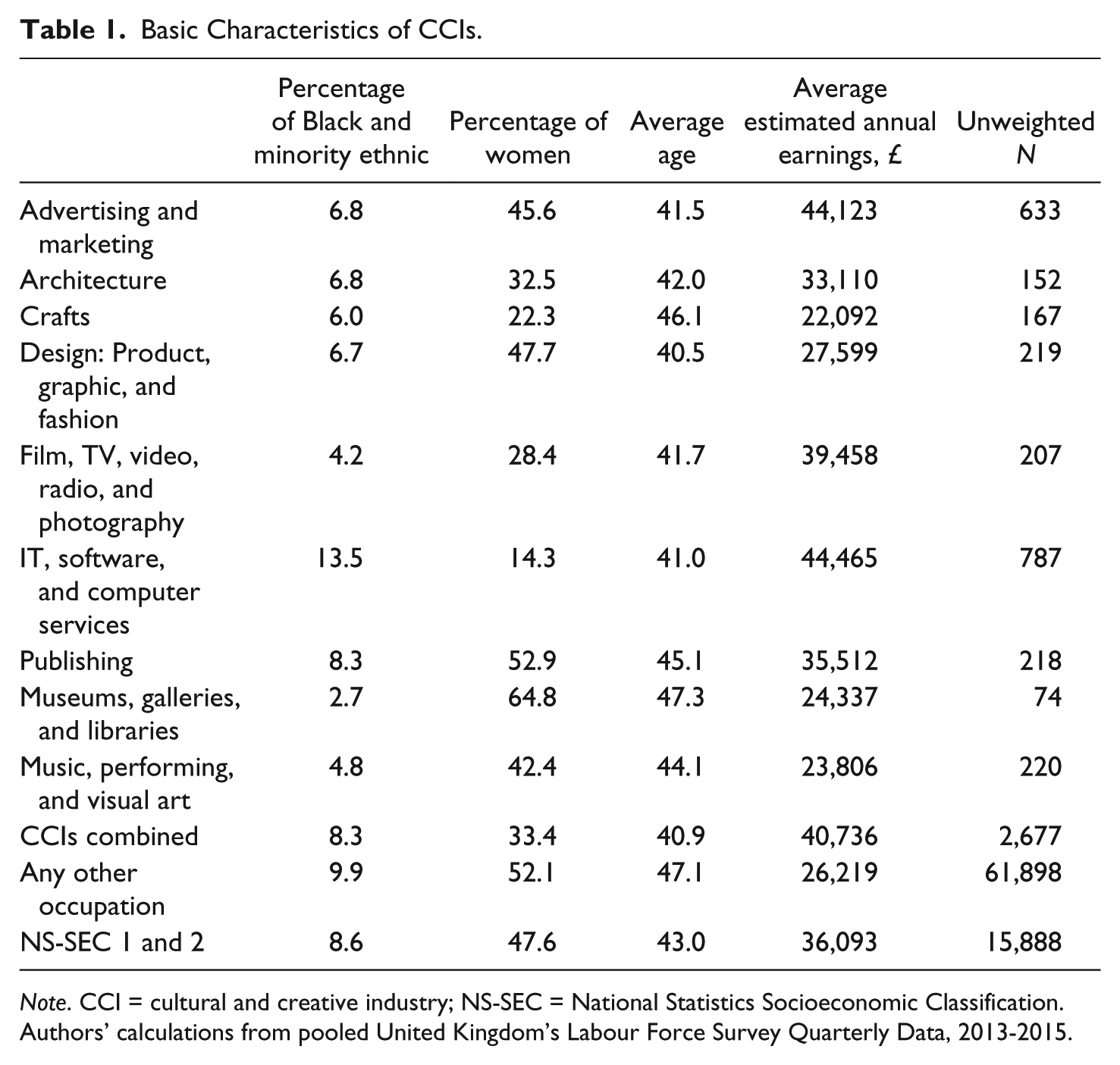
Note. CCI = cultural and creative industry; NS-SEC = National Statistics Socioeconomic Classification. Authors’ calculations from pooled United Kingdom’s Labour Force Survey Quarterly Data, 2013-2015.
The Social Composition of U.K. Cultural Employment
We begin our analysis with a descriptive portrait of the demographic makeup of cultural employment in the United Kingdom. Table 1 shows the social composition of the CCIs in terms of ethnicity, gender, age, and earnings. It demonstrates what is now a familiar pattern that women, and to a lesser extent those from BAME backgrounds, are underrepresented in Britain’s CCIs compared with the rest of the population. This finding builds on existing work by O’Brien et al. (2016) that demonstrates similar patterns in earlier LFS data, as well as the extensive literature (exemplified by Conor, Gill, & Taylor, 2015) on the gendered nature of exclusions within CCI occupations.
Table 1 also demonstrates demographic variations within the nine individual sectors that make up the CCIs as defined by the U.K. government. These data are consistent with inequality highlighted in previous research, with women particularly poorly represented in IT and BAME groups constituting less than 5% of those working in film, television, music, and museums (Banks, 2017; Oakley & O’Brien, 2015). It is also important to note the striking variations in earnings in different areas of cultural employment. Average earnings in areas such as IT and advertising, for example, are far above the national average, whereas those working in crafts, music, and museums report earnings significantly below the national average. This wide variation echoes long-standing critiques (e.g., Campbell, 2014) of the aggregation of very different forms of occupation into “creative” industries, in particular the differences in occupational structure between IT and the more “cultural” occupations associated with performance and the arts.
Next, we turn to the class composition of the CCIs. A focus on the class origins of those employed in different sectors within the CCIs, as shown in Table 2 and Figure 1, points to two significant findings. First, it is notable that those from privileged backgrounds—with parents employed in higher (NS-SEC 1) or lower (NS-SEC 2) professional and managerial occupations—form the majority in almost every part of the cultural sector. For example, those from elite origins (NS-SEC 1) make up 13.7% of the total U.K. labor force, but represent 30.2% of advertising and marketing; 22.5% of design; 25.8% of film, TV, video, radio, and photography; and 28.9% of music, performing, and visual arts. Figure 1 demonstrates the same findings but displays the results in terms of how overrepresented or underrepresented people from certain class backgrounds are in CCI occupations compared with the United Kingdom as a whole. 4 This shows that those from higher managerial or professional backgrounds are more than two times more common in advertising and marketing, publishing, or music, performing, and visual arts, than in the population as a whole. Second, there is also significant variation by individual sector. Craft employment, for example, is largely made up of those from working or intermediate class backgrounds, whereas areas such as architecture and publishing are dominated by the privileged.
Class Origins.
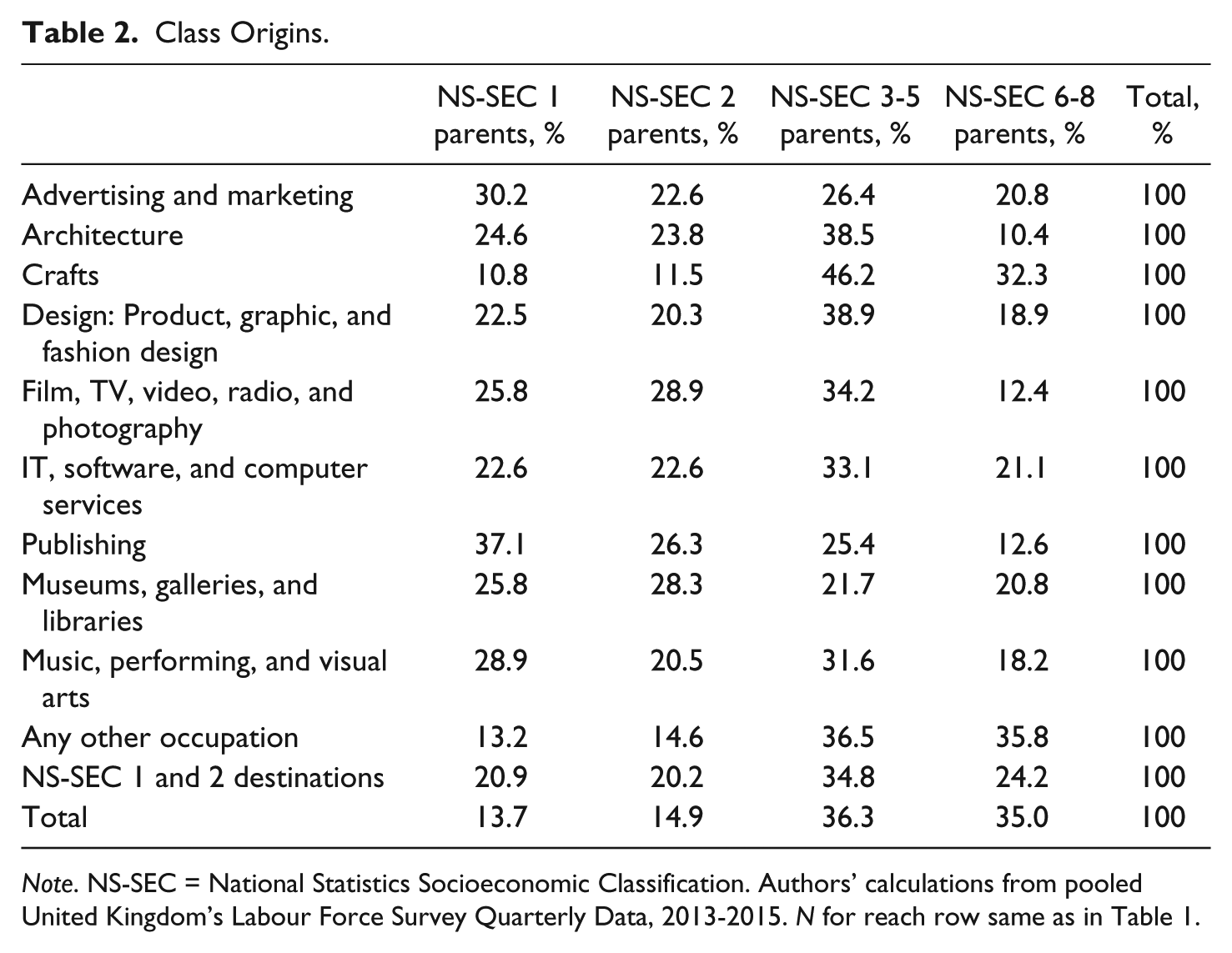
Note. NS-SEC = National Statistics Socioeconomic Classification. Authors’ calculations from pooled United Kingdom’s Labour Force Survey Quarterly Data, 2013-2015. N for reach row same as in Table 1.
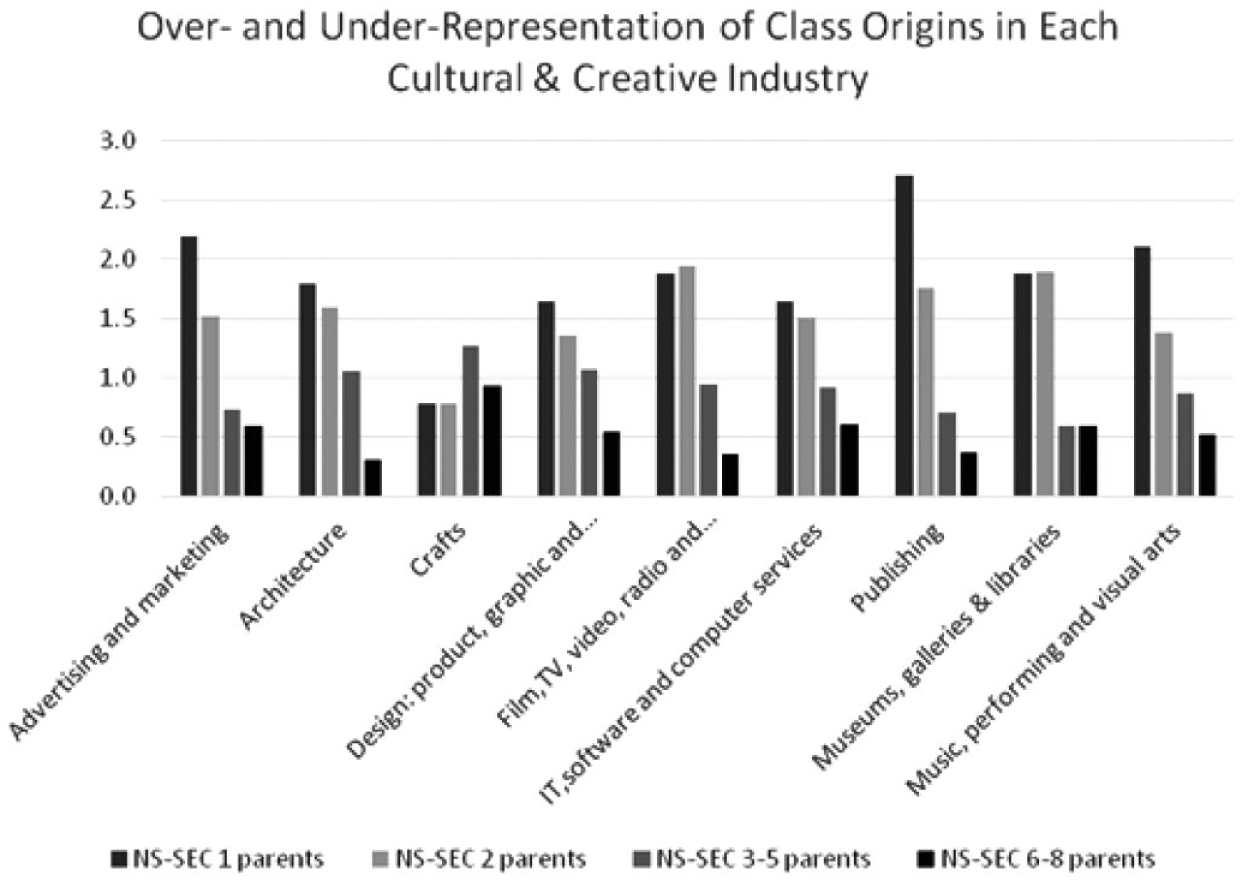
Overrepresentation and underrepresentation of class origins in each cultural and creative industry.
Results
The London Effect and Inequality
While the data presented so far updates (and largely echoes) previous analyses of inequalities in the United Kingdom’s CCIs (O’Brien et al., 2016), in this article, we are especially interested in examining whether this inequality is patterned spatially in ways that reflect London’s dominance within the United Kingdom.
In Table 3, we therefore examine how the demographic makeup of cultural employment in London varies relative to the rest of the United Kingdom, both the urban and nonurban areas. The demographic differences are immediately obvious: cultural workers in London have less gender skew and are more ethnically diverse and younger than those in the rest of the United Kingdom (though there is not much difference in age between those in London and those in other urban areas in the United Kingdom). It is also striking that those employed in London’s cultural sector tend to come from significantly more privileged backgrounds. While over 60% of those working in the CCIs in London are from professional or managerial backgrounds, the figure elsewhere in the country is around 45%. Those in London also earn on average 19% more than elsewhere in the United Kingdom. 5 This both reflects the higher cost of living in the capital but also indicates that such employment tends to be higher status and higher profile. 6
The Makeup of the CCIs in London and the Rest of the United Kingdom.
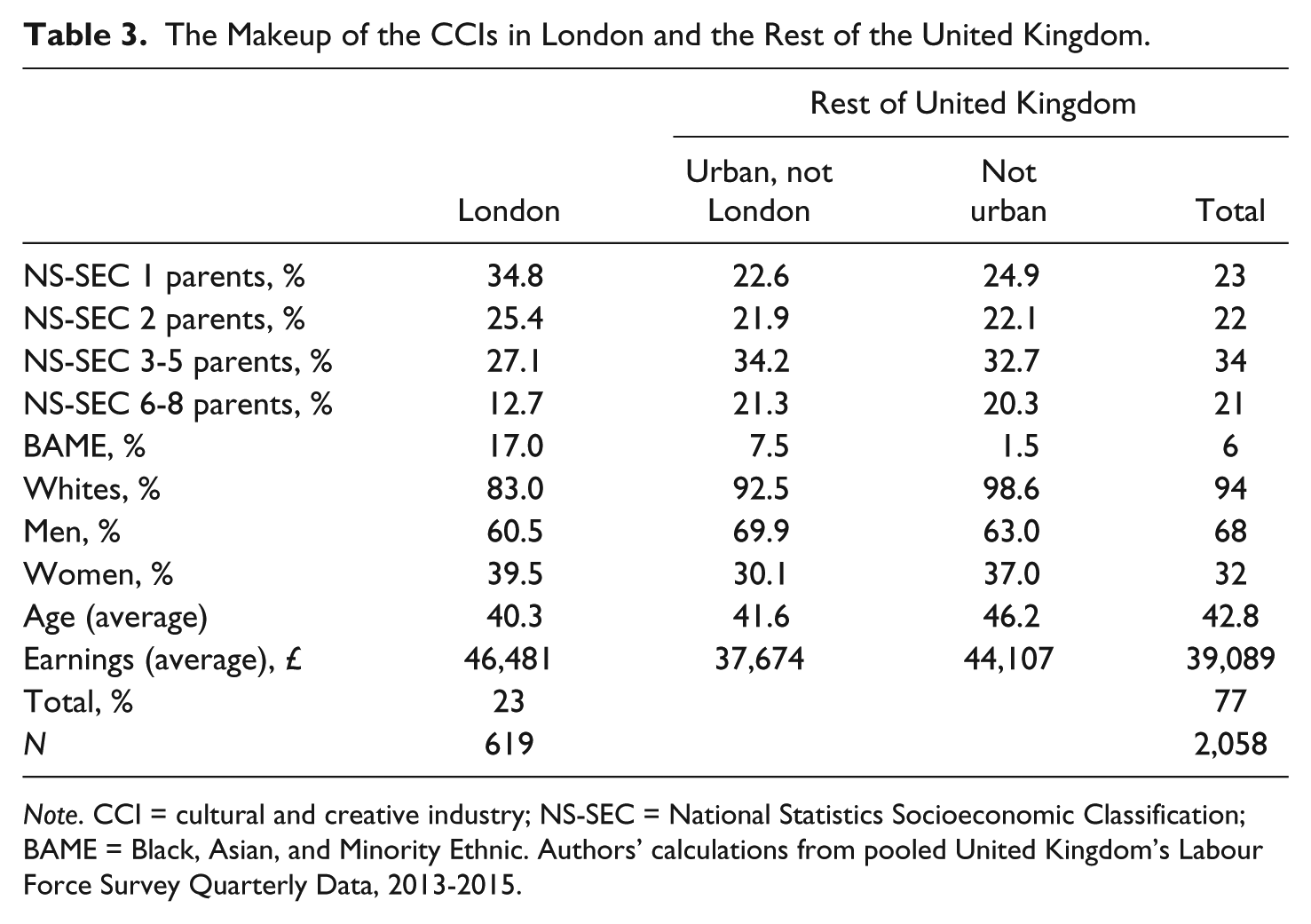
Note. CCI = cultural and creative industry; NS-SEC = National Statistics Socioeconomic Classification; BAME = Black, Asian, and Minority Ethnic. Authors’ calculations from pooled United Kingdom’s Labour Force Survey Quarterly Data, 2013-2015.
While those from more modest social origins are underrepresented in London’s cultural labor force, it is also important to ask whether they face barriers to progression once within these jobs. Existing research on the professions in the United Kingdom (Laurison & Friedman, 2016) has demonstrated a clear “class pay gap” between those from affluent and those from more humble social origins. There is also evidence that such barriers to progression exist in some sectors of the CCIs, such as acting (Friedman et al., 2016). Next, we examine this issue more widely in the CCIs as a whole, exploring how average earnings vary by social origin in London and elsewhere in the United Kingdom. Of course, earnings do not represent a definitive indicator of career progression, but in the absence of data on occupational position they represent the best available proxy and an important indicator of success in their own right. Table 4 shows two key findings. First, it demonstrates that those from lower social origins in the CCIs earn somewhat less on average in both London and the rest of the United Kingdom—a “class pay gap” across the aggregated CCI sector. Moreover, this class pay gap appears larger in London. Those from working-class backgrounds earn on average only 85% of what those from higher professional and managerial backgrounds earn in London, whereas elsewhere in the United Kingdom the same figure is 90%.
Earnings in the Creative Sector by Class Origin, London Versus the Rest of the United Kingdom.
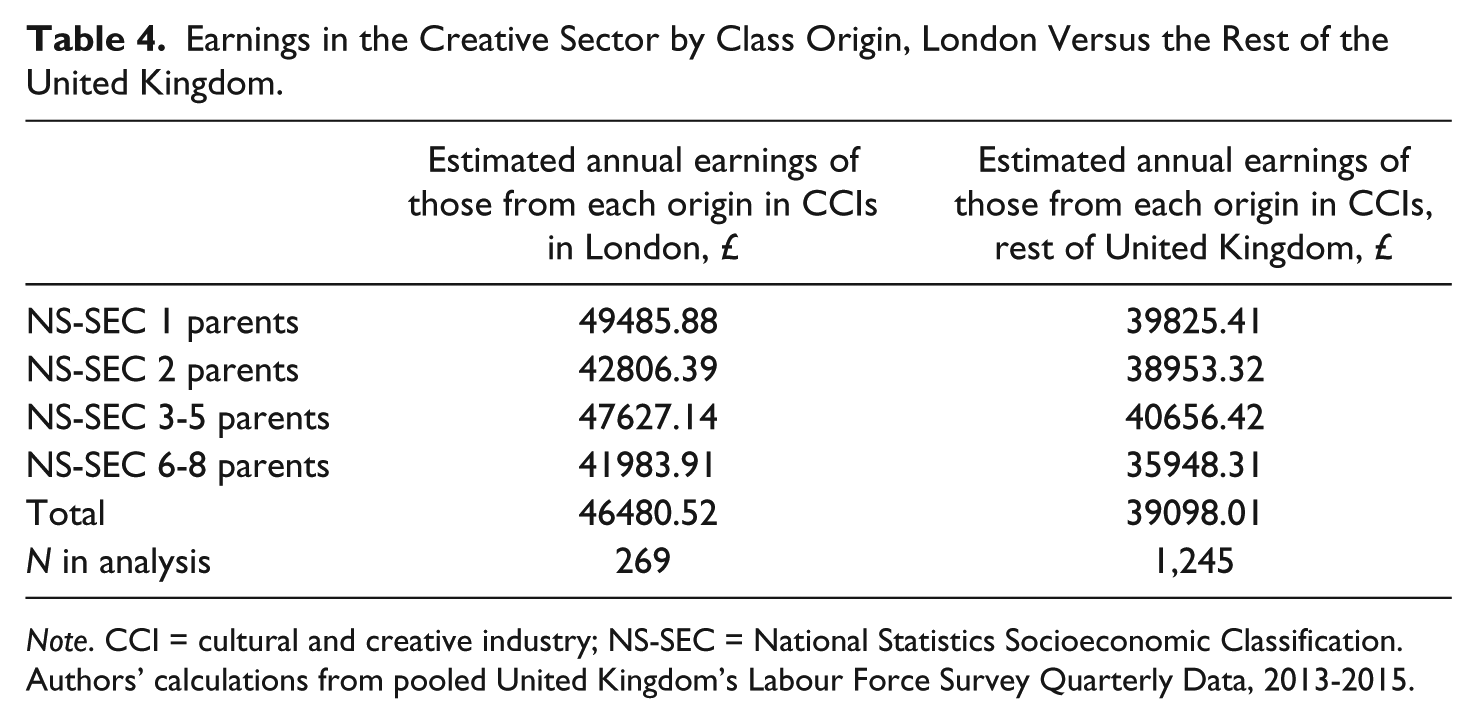
Note. CCI = cultural and creative industry; NS-SEC = National Statistics Socioeconomic Classification. Authors’ calculations from pooled United Kingdom’s Labour Force Survey Quarterly Data, 2013-2015.
While this class pay gap is striking, it is important to note that a distribution of earnings averages cannot tell us whether the upwardly mobile face a “class ceiling” or pay discrimination. After all there may be simple demographic explanations for this difference—the privileged could simply be older on average, which would explain these higher average earnings. Similarly, there may also be “meritocratic” explanations for the pay gap difference. For example, of particular interest to the readers of this special issue may be the hypothesis that the privileged are simply more highly or specifically educated, and if we examine cultural workers who are all graduates, or more specific types of graduates such as arts, humanities, or social sciences, it may be that the pay gap disappears.
In order to interrogate this hypothesis and to disentangle other potential sources of class-origin income difference; in Table 5, we take the CCI class pay gap in the United Kingdom as a whole and show a series of nested linear regressions that control for other potential sources of income inequality. In the first column, we include controls for gender, ethnicity, country of birth, and age as well as for paid hours worked and the quarter in which the respondent gave earnings information. 7 In the second, we add measures of education: the highest degree or qualification the respondent has achieved. The third column adds a dummy variable for whether a respondent lives in London; 8 in the final column, we add dummy variables for each of the individual sectors within the CCIs.
Regressions of Pay in the CCIs.
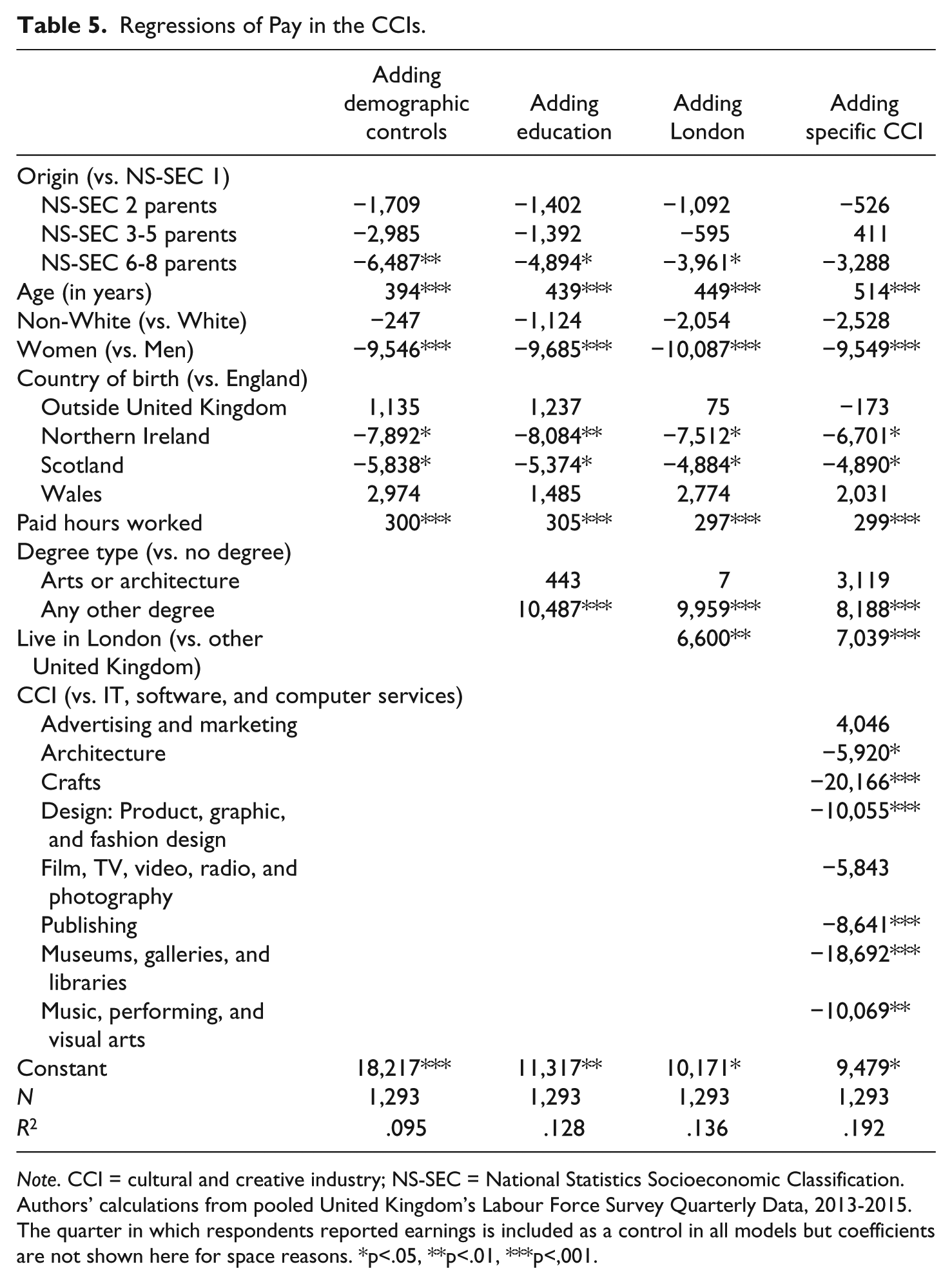
Note. CCI = cultural and creative industry; NS-SEC = National Statistics Socioeconomic Classification. Authors’ calculations from pooled United Kingdom’s Labour Force Survey Quarterly Data, 2013-2015. The quarter in which respondents reported earnings is included as a control in all models but coefficients are not shown here for space reasons. *p<.05, **p<.01, ***p<,001.
Significantly, Table 5 illustrates that the class pay gap in the United Kingdom CCIs is actually larger once we control for demographic variables. For example, those from working-class backgrounds who are otherwise similar in all the demographic ways we can measure, face a statistically significant pay gap of, on average, nearly £6,500 a year compared with those from higher professional and managerial backgrounds.
Table 5 also shows that this gap is somewhat ameliorated once we control for education, but the difference remains both statistically and substantively significant: working-class-origin people have predicted earnings of nearly £4,900/year less than privileged-origin people in the CCIs even net of the effect of education. Education, then, certainly does not act as the “great equalizer” in the CCIs and the direct effect of social origin persists. It is also worth comparing this with other professional and managerial occupations in the United Kingdom, where research has shown that controlling for education reduces pay gaps from £7,600 to £4,400 (Friedman, Laurison, & Macmillan, 2017), or about 40%, while here we see a 25% decrease in the estimated pay gap.
Table 5 also adds further insight into the role of London, the engine for the growth, but seemingly also the inequality, of the CCIs. Table 3 has already demonstrated that those working in London’s CCIs tend to be from more privileged backgrounds, and earn more, but Table 5 demonstrates that even once we control for living in London, the class pay gap remains statistically significant. In other words, the class pay gap in the CCIs is not being driven by the fact that people from working-class backgrounds are less likely to enter London’s more lucrative CCI labor market.
Indeed, it is only once we control for the specific sectors of the CCIs that the class pay gap loses statistical significance. In other words—and as demonstrated in previous analysis (O’Brien et al., 2016)—the class pay gap is partly explained by the fact that the privileged are more likely to enter higher paying sectors such as advertising, IT, and TV and Film, while those from working class, or more humble social origins, are more likely to work in sectors such as Craft, which are associated with lower pay.
Art Education, Credentials, and the Labor Market
Although cultural labor markets have above-average representation of those with undergraduate degrees (see Tables 6 and 7), there is no simple coupling of qualification with employment trajectories. There are of course areas, from acting to museum curating, where formal training in a specific discipline is strongly linked to employment. But it is equally likely to be the case that a general humanities or social science degree, coupled with interest in consumption or personal practice, is what leads to a career in the cultural occupations. Similarly, as Table 6 shows, those with arts degrees work throughout the economy.
Destinations of Those With Arts Degrees.
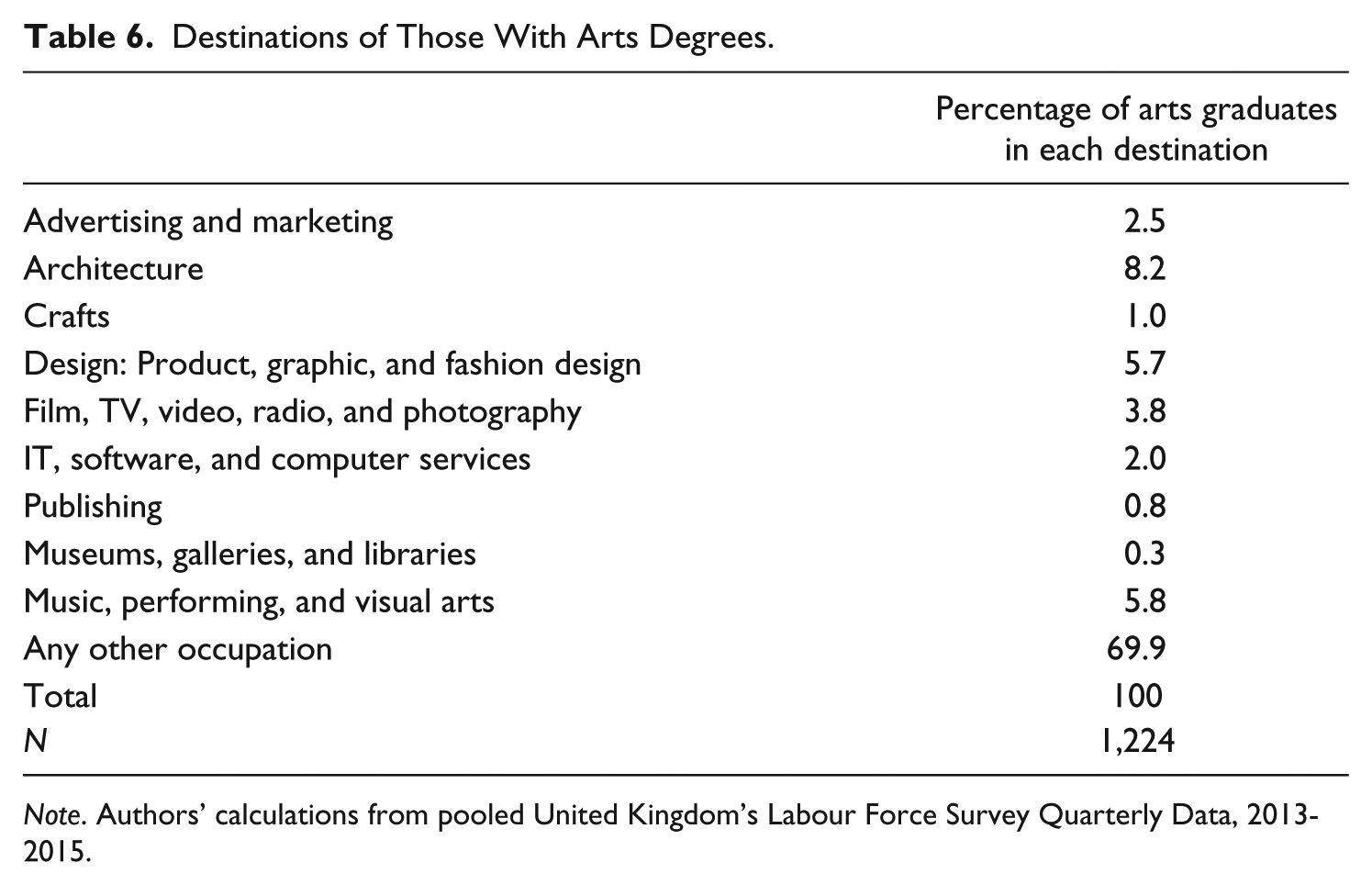
Note. Authors’ calculations from pooled United Kingdom’s Labour Force Survey Quarterly Data, 2013-2015.
Degrees and Arts Degrees in the CCIs.
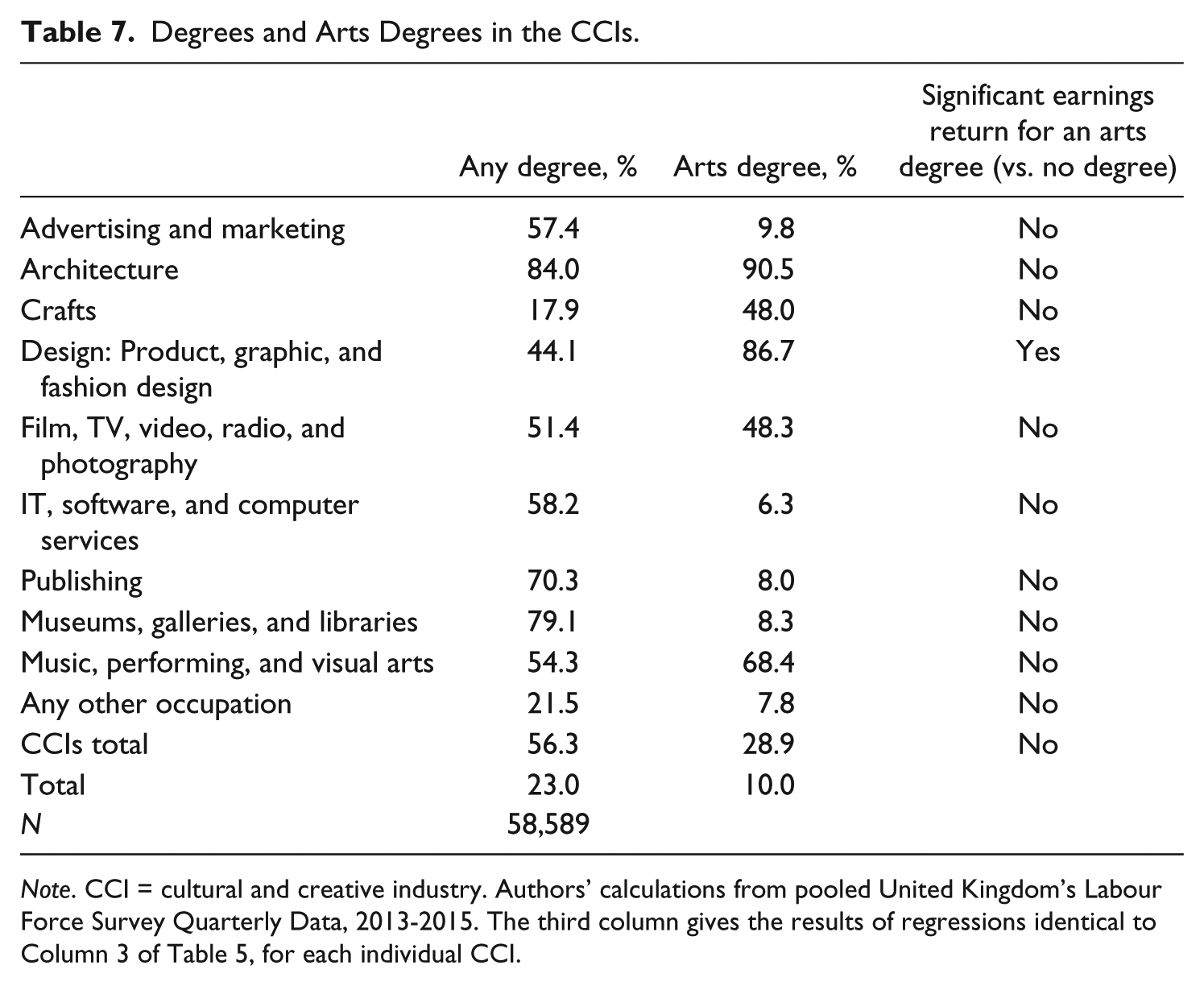
Note. CCI = cultural and creative industry. Authors’ calculations from pooled United Kingdom’s Labour Force Survey Quarterly Data, 2013-2015. The third column gives the results of regressions identical to Column 3 of Table 5, for each individual CCI.
As Table 7 shows, while over half of those (56%) working in the United Kingdom, CCI occupations have a university degree, only 29% are arts graduates. Moreover, and most notably, in every CCI occupation apart from design, we do not find a statistically significant earnings return (based on conducting regressions of earnings for each CCI separately) for having studied an arts degree compared with not having been to university at all.
The relatively weak link between credentials and employment therefore mean that arts education cannot perform the same equalizing function that it may do in other cases, because its impact on the labor market is simply less important.
Discussion and Conclusion
The closing comment of the previous paragraph gestures toward an uneasy conclusion for those seeking to hold onto meritocratic narratives of cultural work. Indeed, it suggests that even higher education, which the literature on professions suggests might assist in mitigating the effects of social inequality, is insufficient to overcome the impact of class and geography on creative occupations. As our analysis shows, cultural labor markets are highly unequal. From our case study of the United Kingdom, we can see women, those from racial and ethnic minorities, and individuals from working-class backgrounds are all underrepresented in professional employment, with notable skews in some of the more prestigious sectors. For example, in the cluster of occupations containing film and TV, less than 5% of the workforce is from an ethnic minority and less than 30% are women. There is also strong evidence that those from working-class backgrounds are underrepresented across the board, again particularly in those sectors with the greatest symbolic capital and (arguably) the greatest influence, for example, film and TV or publishing. Such findings also support the major media and public debates over the struggles for cultural representation.
What has been less discussed, however, are the ways in which space and place, and particularly spatial inequality, plays into this story. There is a huge and long-standing literature, particularly within economic geography, on the location of cultural production (Pratt, 2008), the dominance of particular urban centers (Scott, 2000) and on the way in which public policy has sought to develop the CCIs outside of these dominant areas (Lee, Hesmondhalgh, Oakley, & Nisbett, 2014). Behind much of this work is an implicit story about inequality—why some cities rather that others? Why is symbolic capital so vested in Paris, New York, or Milan, but not Montpelier, Dayton, or Catania? Can public policy change this dynamic and can, as Richard Florida and others have claimed, any place become a hotspot for the creative class? It is against this background that, as scholars who write about inequality, we sought to bring together work on space and place and on labor markets and to examine the ways in which the cultural, social, and economic current of this story reinforce one another.
In our case, the focus of attention was London, which as the article explains, dominates British cultural, political, and economic life in ways which are extreme and unusual, though we believe that the findings do have implications for other, less centralized societies, where cultural and symbolic power is nonetheless vested in a small number of specific “cultural capitals.” Our findings suggest that there is a “London effect,” with those employed in London’s cultural sector more likely to come from privileged backgrounds than in the rest of the United Kingdom. Those in the cultural sectors in London earn more than in the rest of the United Kingdom, which is hardly surprising, but there is also a class-related pay gap; workers from lower socioeconomic origins in the CCIs earn less on average in both London and the rest of the United Kingdom—a “class pay gap” across the aggregated CCI sector. But this class pay gap is larger in London, where those from working-class backgrounds earn on average only 85% of what those from higher professional and managerial backgrounds earn, whereas elsewhere in the United Kingdom, the same figure is 90%. As a reminder, our findings on earnings only apply to those who report earnings, not to the 12% of CCI workers who say they are self-employed, or the 33% of CCI workers who do not report earnings for other unknown reasons. That is an important limitation, however, this is the best available data on earnings in the CCIs, and while there may be other patterns for the people who do not report, we believe these patterns are an important basis for future research.
In other professional sectors, there is evidence that higher education substantially mitigates this class origin pay inequality. However, in the CCIs, the equalizing effect of higher education is significantly more modest. This may, of course, change over time, as the workforce, along with the rest of society, becomes more credentialized. We will, of course, need to return to this question over time. However, our current analysis has two important implications for arts graduates and their educators. The first is that the economic case for arts education must be rethought in the face of evidence suggesting arts education is yet to deliver a secure, credentialized, route into the CCIs (see Martin & Frenette, 2017, for more on unequal professional outcomes among U.S. arts graduates). The second lies in the defense of the art school and arts education. In our analysis of British data, the financial case for arts education, in terms of future earnings (and leaving aside exceptionally successful “stars”), is weak. Other nations’ artistic labor markets may have different dynamics protecting returns on arts education (e.g., Bille & Jensen, 2016 on Denmark) and it may be the case that arts education is providing valuable skills for other sectors of the economy and other forms of economic activity beyond CCIs (Bridgstock & Cunningham, 2016). Entrepreneurial activity is clearly part of that; the Strategic National Arts Alumni Project data suggest that some 16.1% of arts graduates in the United States claim to have founded a nonprofit or for-profit at some point in their working lives (Frenette & Tepper, 2016). The specific dynamics of British cultural labor markets, along with the destinations of artistic graduates, suggests that justifying these experiences in terms of social justice or in terms of broader economic impact, as has become de rigeur, is limited.
The traditional narrative of the art school, and the sorts of defense offered by Frith and Horne (1987), drew on the importance of place in association with the values of the institution. As our analysis of the uneven geography of the creative labor force suggests, there is a need to return attention to spatial issues when considering cultural work. As it stands, the interventions to make towns and cities “creative” in the United Kingdom has not challenged London’s dominance of this section of the labor force. Nor has the creative ethos and the meritocracy of talent seemingly fostered by the arts degree overturned this settlement.
If we are to see society fairly reflected in its cultural workforce, then creative city policy must interact with broader issues of the uneven geography of the nation. Moreover, the assumption that any single policy intervention, whether urban, educational, or cultural, will untangle the Gordian knot of CCI inequality must be challenged. This challenge, as we have shown, requires the intersection of cultural, educational, industrial, and urban policy to address both the well-known inequalities of culture and the “London Effect” we have demonstrated. The challenge is steep, but the opportunities for cities and towns offered by a fairer, more diverse, cultural labor force served by an open and meritocratic education system, are rich goals worth pursuing.
Footnotes
Declaration of Conflicting Interests
The author(s) declared no potential conflicts of interest with respect to the research, authorship, and/or publication of this article.
Funding
The author(s) received no financial support for the research, authorship, and/or publication of this article.