



Abstract
Robert M. Adelman, Shelly M. Kimelberg, Joanne Tompkins, and Watoii Rabii on visual arts teachers’ not-so-pretty future.
At the end of her first week of elementary school, one of our daughters announced that her favorite “special” was art. Around the same time, another mentioned that art and the other “supplemental classes” in her school were her favorites, as well. The terms our children used initially caught us off-guard due to their not-so-subtle implication that the visual arts are considered marginal—or, at least, not “core” academic subjects—in their schools.
Perhaps we shouldn’t have been surprised. At the time of this writing, rumors are swirling that the Trump administration will substantially reduce funding to—or even eliminate—the National Endowment for the Arts (NEA), a move which would alter not only the material conditions of the arts in the U.S., but also their symbolic status. Whether or not this comes to pass, other changes in the educational landscape have moved visual arts education to the background in many K-12 schools. In particular, the deployment of standardized curricula, like the Common Core, and the reliance on high-stakes testing to evaluate the performance of—and in some cases determine the fate of—teachers, schools, and districts have resulted in an increased emphasis on “testable” subjects like math and English Language Arts, often at the expense of other subjects, like art and music.
Art matters for kids; it matters even more for low-income kids. Scholars James S. Catterall, Susan A. Dumais, and Gillian Hampden-Thompson illustrated in a 2012 NEA report how art can deliver academic and social benefits for children. Similarly, education researchers Daniel H. Bowen, Jay P. Greene, and Brian Kisida demonstrated in 2014 that even modest exposure to an arts-based curriculum improves critical thinking and nurtures the development of cultural capital.
Less attention has been paid to the impact of the current educational landscape on art teachers. What is it like to teach visual arts during this era of educational reform? We asked K-12 visual arts teachers in the western part of New York State to tell us about their experiences. We collected survey data from teachers who work in public, private, parochial, and charter schools in urban, suburban, and rural districts across eight counties, which include the Buffalo metropolitan area. In the end, 295 visual arts teachers (about half of all visual arts teachers in the area) answered our call.
A Shrinking Presence
Standardized curricula and high-stakes testing have reduced staffing, resources, and instructional time for most K-12 art educators. Teachers in our sample reported experiencing a range of cuts throughout their careers. Roughly three-quarters (74%) of respondents have seen art teacher positions eliminated from the staff, while 69% have experienced art classes cut from the curriculum. Two-thirds (67%) have dealt with substantial budget cuts that affected their ability to teach, while 65% cited the regular cancellation of individual art classes to allow time for assemblies, events, or other academic priorities. And 6 out of 10 respondents (61%) noted that instructional time with students has decreased during their careers.
Overall, these reductions have fallen disproportionately on teachers in traditional public schools, where 83% of teachers reported job cuts (eliminated art teacher staff positions) during their careers as compared to 37% of teachers in other types of schools. Similarly, of the respondents in traditional public schools, 78% (versus 33% of those in other school types) have seen art classes cut from the curriculum, 74% (versus 40%) reported substantial budget cuts that affected their ability to teach, and 69% (versus 51%) reported the regular cancellation of individual art classes to allow time for other school activities.
Show Me the Money
Although budget constraints are a common concern of most teachers, those who are not at the center of educational reform efforts, like art teachers, may be especially vulnerable. The average annual budget among the teachers in our survey was about $2,700. However, just over 20% of teachers work with an annual budget of a mere $1,000 or less for all of their classes. This means that most teachers can buy the basics—paper, pencils, crayons—but must forgo things like canvases, clay, or oil pastels. Extras, such as art clubs, visits from artists, or field trips, quickly fall by the wayside. As a consequence, 60% of the teachers reported being forced to adjust their lesson plans at least occasionally due to limited financial resources.
Art teachers’ budgets vary across geography. While the percentage of teachers with budgets exceeding $5,000 is virtually the same across urban, suburban, and rural schools (roughly 11-12% each), 42% of teachers in urban schools have to make do with an annual budget of less than $1,000. Only 18% of teachers in suburban schools and 8% of teachers in rural schools reported budgets of $1,000 or less.
Like many other teachers, art teachers regularly use their own money to buy what they need in the classroom; respondents spend, on average, $329 a year out of their own pockets. However, more than twice as many teachers working in schools serving predominantly low-income families (33%) spend more than $500 of their own money annually, as do teachers working in schools serving predominantly middle- and upper-class families (12% and 13%, respectively).
Overloaded
Most teachers (80%) in our survey are either the only, or one of just two full-time art teacher(s) in their schools. What this means, then, is that art teachers are typically responsible for large numbers of students. While roughly half (55%) of respondents teach fewer than 200 students in total, about 19% teach between 201-400 students, and another 19% teach between 401-600 students. Remarkably, 20 teachers (around 7% of our respondents) reported teaching more than 600 students in all of their classes.
Source: Original survey data collected for the Education Discovery Project, University of Buffalo, 2015. With appreciation for the support of the Albright-Knox Art Gallery.
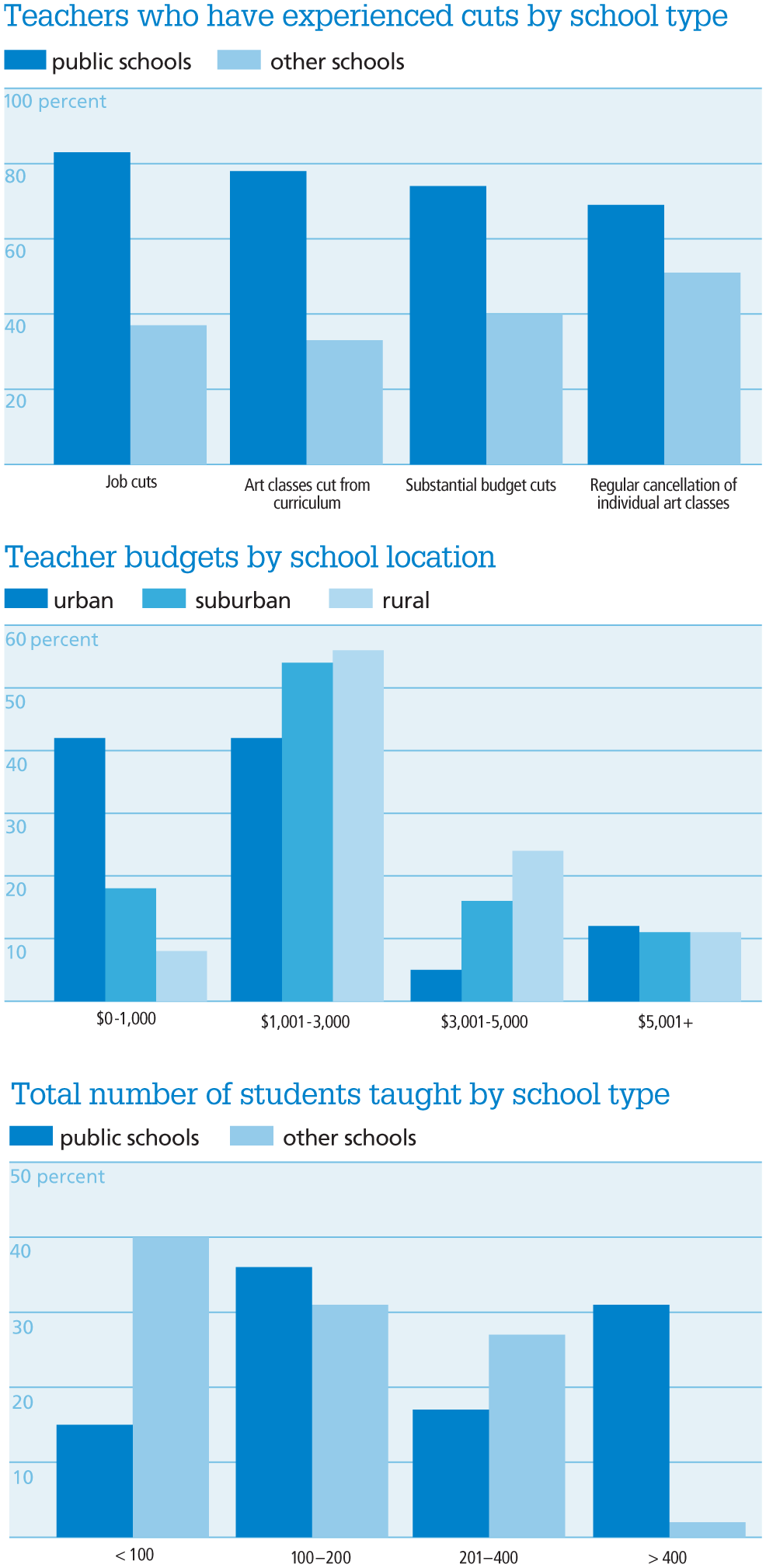
Those teachers employed in traditional public schools tend, on average, to shoulder a much greater workload than their colleagues in other institutions. About 30% of teachers in traditional public schools teach more than 400 students, while only about 2% of their peers in other school types are responsible for that many students. In contrast, 40% of teachers in private, parochial, or charter schools teach fewer than 100 students across all of their art classes, as compared with only 15% of teachers in traditional public school settings.
Not So Special after All?
Our survey only captured the viewpoints of teachers from one part of one state, but our findings should raise red flags throughout the country. The types of educational reforms—standardized curricula, an emphasis on testing and assessment—that are typically promoted as a means to rectify educational inequities in our schools can lead to other troubling outcomes. A shift in resources toward “testable” subjects means that art teachers are increasingly being asked to do more with less; teachers in our urban public schools, in particular, must do even more with even less. As art recedes further into the background at many schools, it is not merely art teachers who stand to suffer. Children have fewer opportunities to engage in the types of creative activities that can bring not only joy, but also improved academic skills and overall wellbeing. Less art would undoubtedly disappoint our daughters, who look forward to their favorite “special” every week. But for low-income children who have limited means to learn and experience art outside of school, the loss would be especially great.