



Abstract
Alice Fothergill and Lori Peek on the post-disaster culture created by kids.
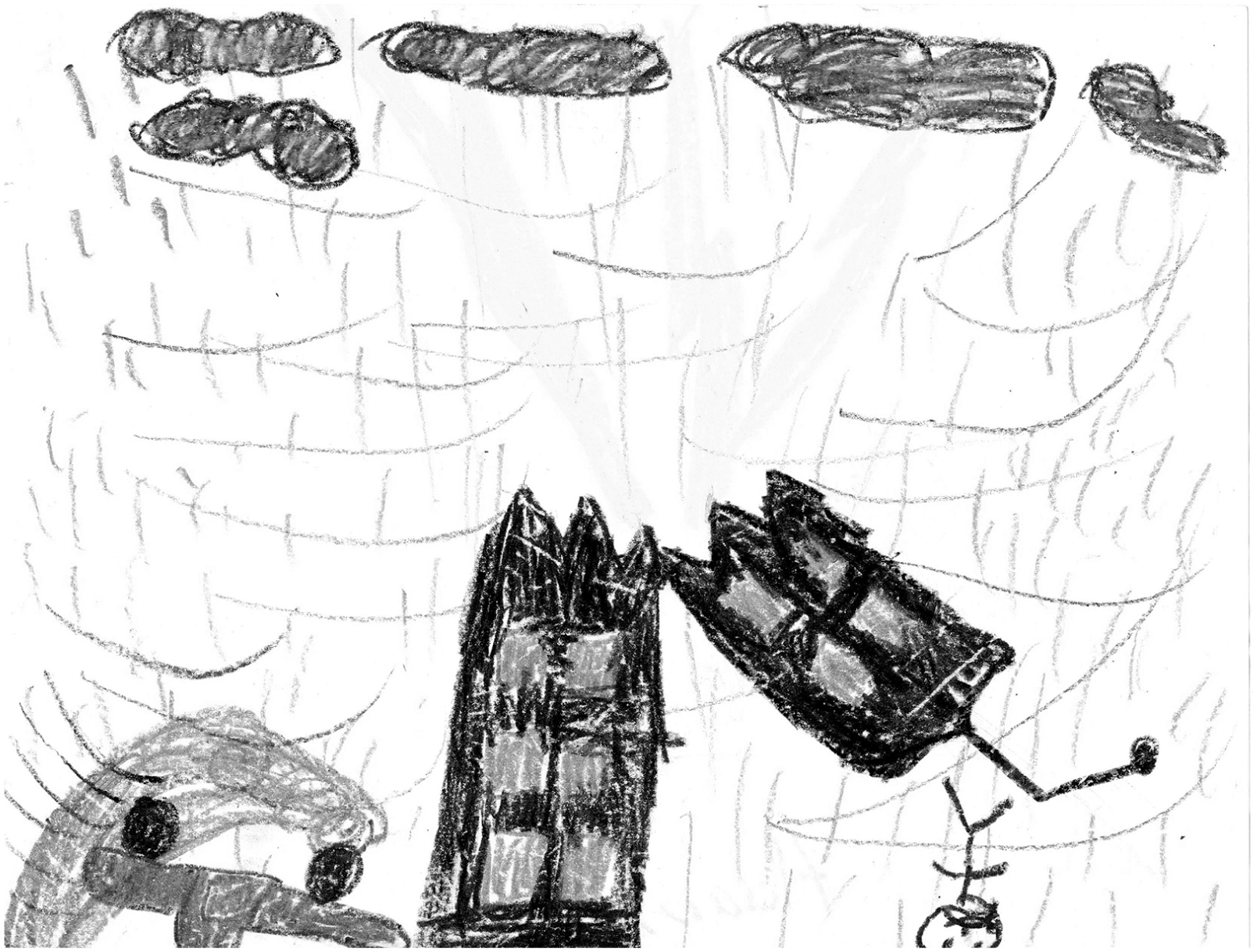
Isaac sat upright at his mom’s kitchen table as he carefully selected a black crayon. Holding it tightly, he pressed hard on the paper, using short strokes to make dark clouds. He then used the same crayon to draw an apartment building, broken jaggedly into two pieces. Isaac paused for a moment, looked up at us, and said, “That’s what happened to houses.” When he was finished drawing “what Katrina looked like,” he held it up. It was a scene of destruction. Isaac was only 5-years-old when the storm hit and the powerful floodwaters overwhelmed the levee system on August 29, 2005, but his memories were vivid.
William Corsaro, who studies the sociology of childhood, has long argued that children are creative social beings who produce their own social worlds, even as they are influenced by the adult culture, organizations, and institutions external to them. In a seminal paper, sociologist William Anderson also called on disaster researchers to extend their analyses to children’s lives and cultures in the aftermath of extreme events. They are not just “dependent observers of the scene,” Anderson wrote. Rather, they are active agents and potential risk communicators. Corsaro, Anderson, and others who have underscored the value of learning from children—who make up nearly 25% of the population in the U.S.—inspired us to capture and collect materials regarding children’s post-disaster culture.
“What Katrina Looked Like,” by Isaac, age 5 at the time of Katrina.
Courtesy Alice Fothergill and Lori Peek
We spent seven years, from 2005-2012, studying children who were directly affected by Hurricane Katrina. That storm still stands as the nation’s costliest disaster and one of the deadliest on record. Our research culminated in the 2015 publication of Children of Katrina. In the book and throughout our years of field research, we explored how children, ages 3 to 18 at the time of the storm, fared in the disaster. We describe three post-disaster trajectories—declining, finding equilibrium, and fluctuating—and explore the social forces and factors that influenced children’s recovery. Ultimately, we were interested in how children experienced the disaster and displacement in all spheres of their everyday lives, including school, family, neighborhood, health, and friendships, as well as how children helped adults, other children, and themselves.
We observed and listened to our respondents and were especially attentive to gathering “material artifacts” that children created after Katrina, including pictures, stories, songs, poetry, and games. These items helped reveal children’s experiences and vulnerabilities before, during, and after the storm. Their creative expression also shed light on their strengths and capacities. Cierra, an 11-year-old Black girl, expressed her hope and fragility in her journals and poetry and through song. She and her mother had barely escaped the floodwaters, having taken refuge in one of the city’s hospitals which then lost power, flooded, and became its own nightmare for those trapped inside. When we first met Cierra at a mass shelter, she asked if she could sing “Amazing Grace” to us. Everyone within earshot was moved to tears.
We listened to other children sing at home, at school, at church, in parades, and with friends. One boy, Daniel, even started his own boys’ a capella group after the storm. Others, like Darik, danced, spending hours with his friends creating YouTube videos of gravity-defying physical feats. Darik was one of the many teenagers who returned to the city with no adult guardian, and dancing gave him an outlet for creative expression while also connecting him to peers who could offer various forms of emotional and financial support.
How children fared after Katrina was not simply a matter of their individual traits, but also a result of social inequality and social structural constraints.
“You have to move fast,” explained Kimberly. She was telling us the rules of a game called “Evacuation,” that she and her siblings had created and played in the weeks following their families’ evacuation from Katrina. “You take a trash bag, you say ‘go,’ and you see how fast you can throw stuff in your bag.” The children would run from room to room in their temporary home, recreating their urgent flight. Just a few months prior, the game had been a horrific reality for tens of thousands of New Orleanians who fled before Katrina made landfall and for those who only escaped after the levees broke. In a situation where children had little control, playing “Evacuation” helped these young survivors to make sense of what they went through.
What the children did and what they created—the art, the games, the songs, the writing—also helped them to work toward stability in the face of many losses. For instance, when we asked Zachary what was most difficult after Katrina, he drew a large sign: “New Orleans. Population=0.” He explained that one of his main concerns was that the people he cared about had left the city and weren’t coming back.
Drawing of “What Katrina Looked Like,” by Isabel, age 9 at the time of Katrina.
Courtesy Alice Fothergill and Lori Peek
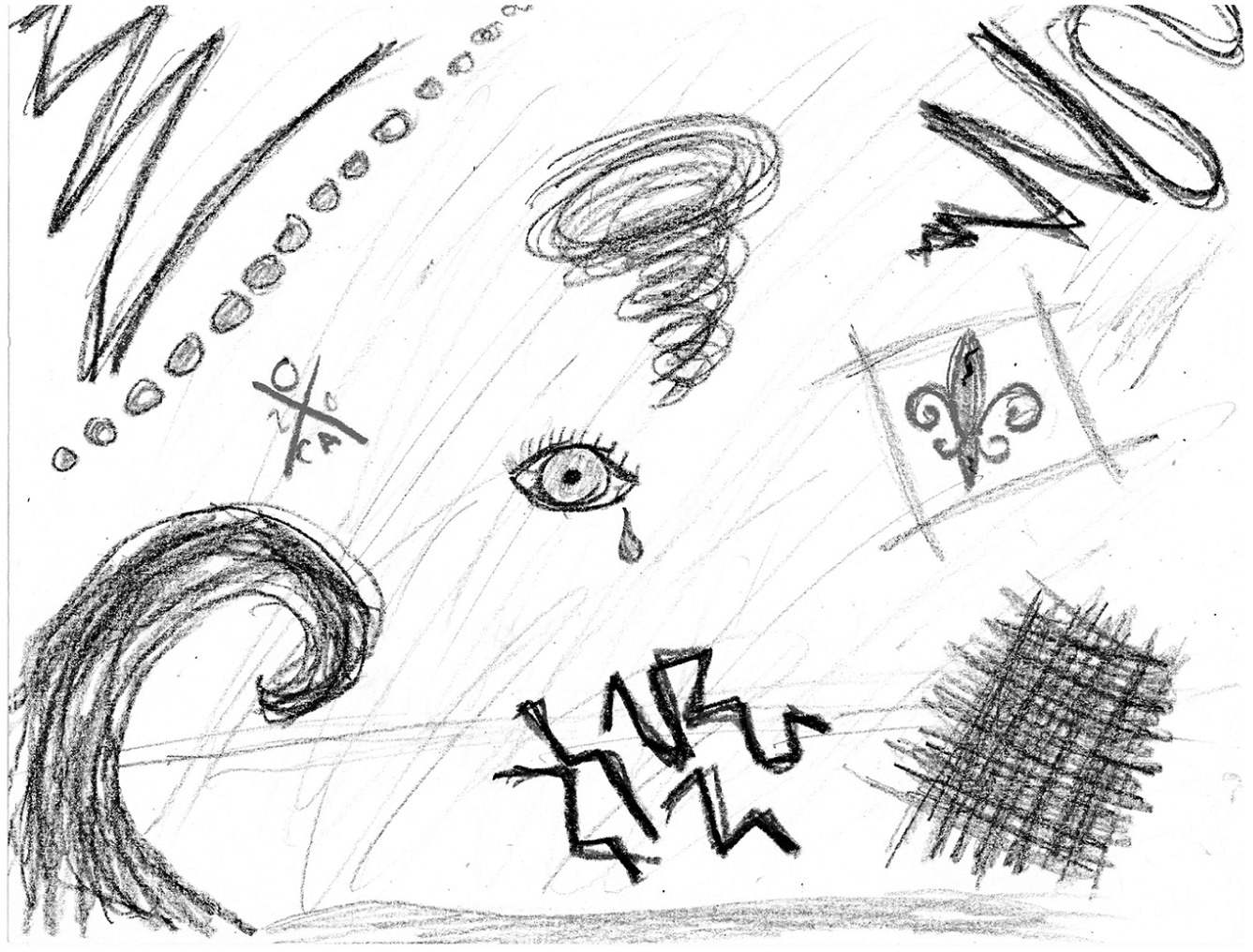
Isabel, an 11-year-old White girl, drew the storm and its consequences in a more abstract way. She included floating objects, such as a fleur-de-lis, the omnipresent symbol of her city; a wave representing the floodwaters that poured down her street and contaminated surrounding parks; and the large “X” that was spray-painted on every home in New Orleans, letting those outside know the number of dead found inside. Right in the middle, she carefully added an eye with a tear: “This is a crying eye because it was so sad, and everybody was upset.”
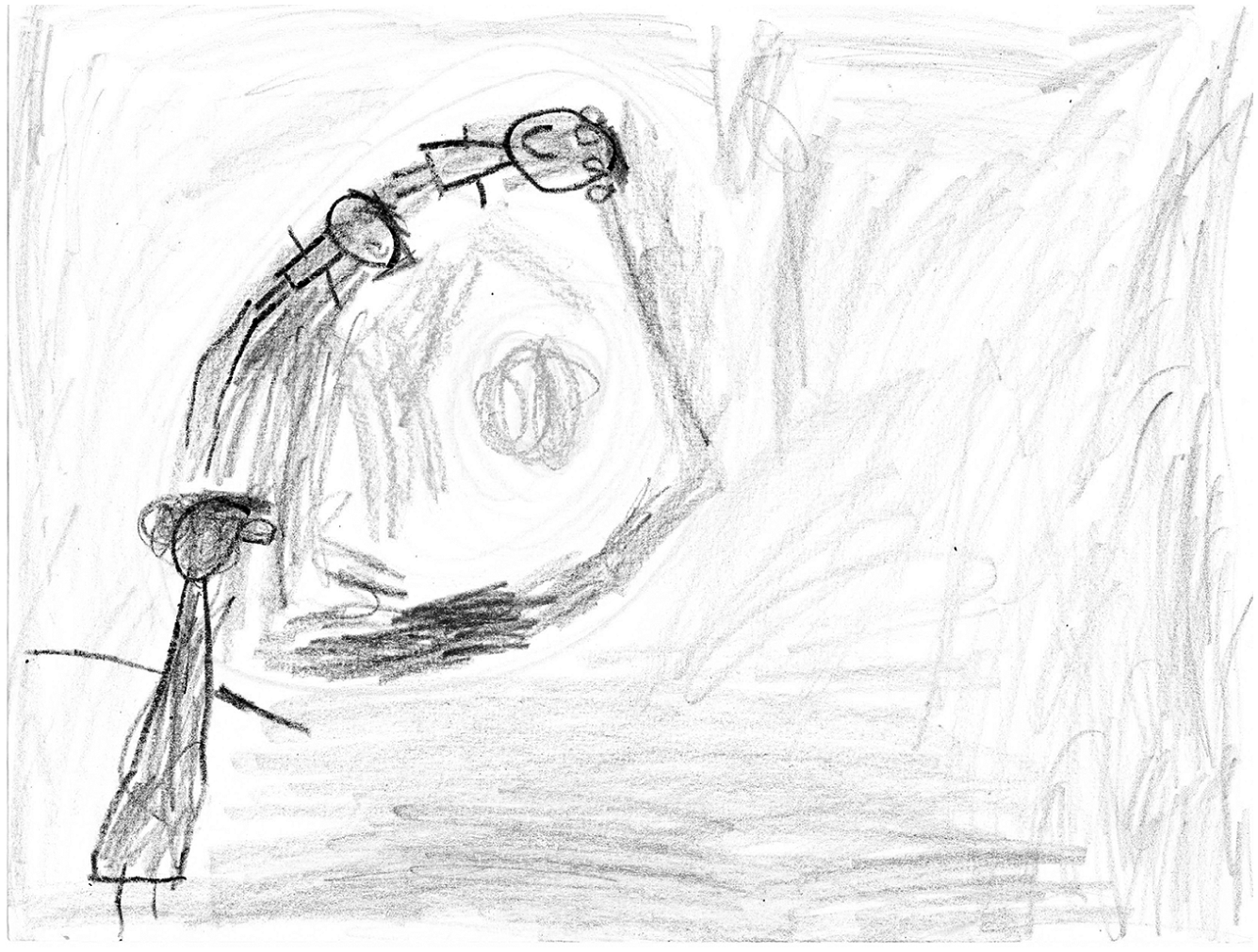
Not only did we ask the children to draw what was difficult or what was lost, but we also inquired about what or who helped them after the disaster. Mary, a 5-year-old Black girl, considered her answer for several minutes as she sat at a small table in her kindergarten classroom. It was her teacher, Miss Lila, she announced, who had helped her the most since the hurricane. She took her time drawing a stick figure with arms outstretched to represent Miss Lila and two smaller figures, to signify students. Mary had lost her mother to drug addiction, and her father was working multiple jobs to feed and clothe his children. He was gone a lot. Miss Lila was what we refer to as an “anchor,” someone who helped children like Mary from descending on the declining trajectory.
Children are often thought of as hyper-resilient, like rubber balls that can bounce right back after disasters. It is true that children can endure tremendous challenges, yet without proper support, their odds of experiencing many negative health, educational, and behavioral outcomes increase. Our research demonstrated that how children fared after Katrina was not simply a matter of their individual traits, but also a result of social inequality and social structural constraints. Many of the children suffered immensely, had enormous losses, and struggled to find a balance as they and their families faced years of temporary homes and uncertainty. This blend of resilience and vulnerability could be seen in the stories they told and the art they created.
“What Helped: My Kindergarten Teacher, Miss Lila” by Mary, age 5
Courtesy Alice Fothergill and Lori Peek
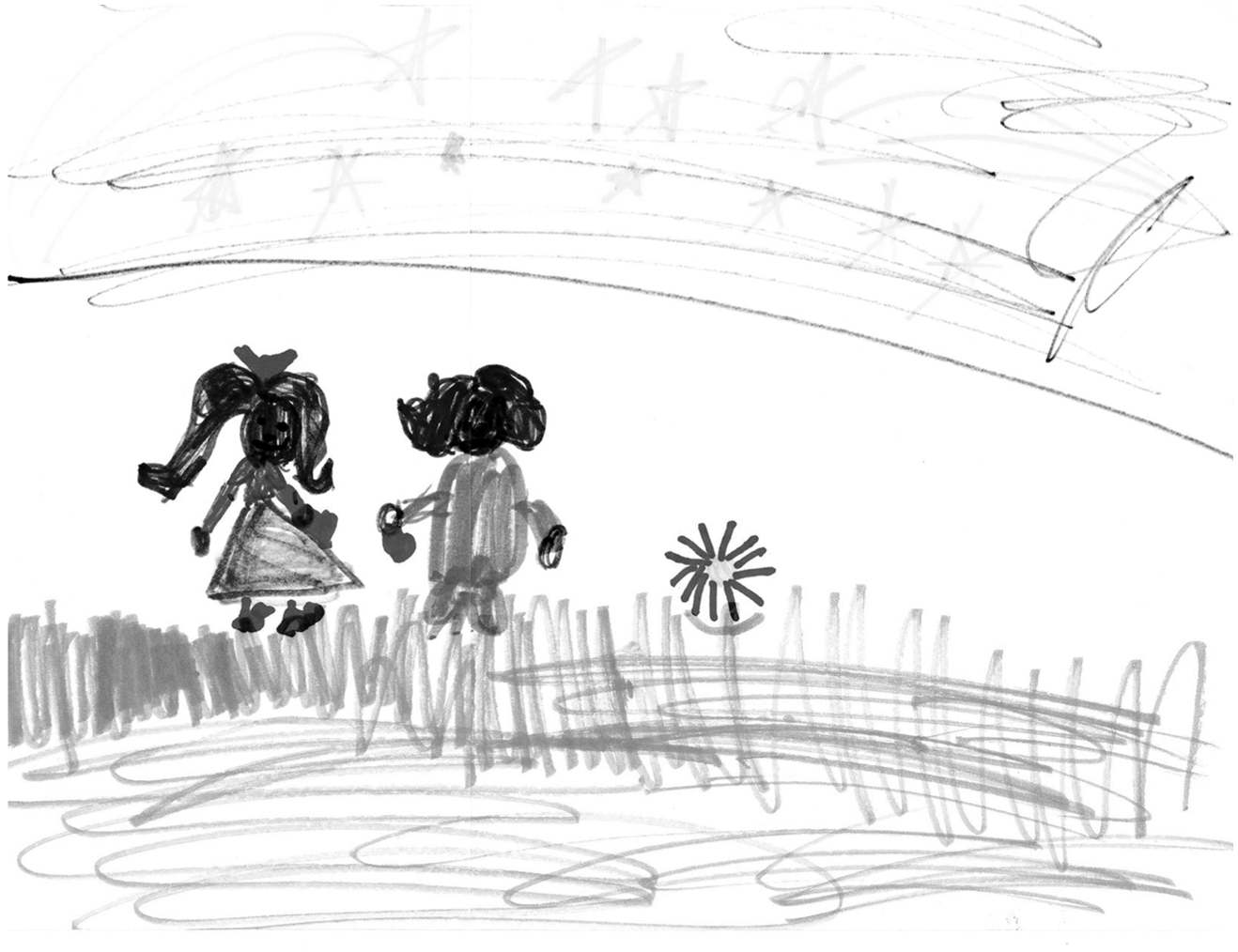
Drawing by Alexandria, who was one-year-old at the time of Katrina, of herself and her brother several years after Katrina.
Courtesy Alice Fothergill and Lori Peek
Cierra, who sang “Amazing Grace” to us, confided: “Sixth grade year I was… just very angry because I wasn’t with my family and I was missing my aunt so much.” When we asked if she was able to let the anger out, she replied, “Yes. I like to write poetry a lot, and I like to write stories and stuff. Sometimes I keep it to myself, and some I show to people.” She shared with us a poem she had written when she and her mother finally found permanent housing and she settled into school. Living in poverty with a single parent and going through a traumatic evacuation, her chances for finding equilibrium were not good. But Cierra, with the help of advocates, including staff at the mass shelter and teachers at her new school, was an exception. Her ability to finally feel settled and find stability came through in her words:
… Pain invited itself into the life of the child, with its waters
and winds who removed the child from the love of her city into a new
one she knew exactly nothing about. Now three years have gone.
That city turned from her house to her home.
Children often have very little control in disaster. They don’t issue warnings and they rarely make evacuation decisions for themselves or their families. They depend on adults for safety and protection, although they may influence the actions adults take.
In the worst disasters, children may miss days or months of schooling. They may lose some or all of their possessions. And when displaced, they must make new friends and navigate unfamiliar communities and schools. The disruption is tremendous in all spheres of their lives. But we found that even in these situations, children continue to create their own cultures, on their own and with their peers, and this process of creation is both an expression of their experiences and a part of their recovery.