



Abstract
Kimberly R. Huyser considers the power of stereotypes and self-image as she participates in a project to create modern images of Native Americans.
Will Wilson’s tintype portrait of Dr. Huyser.
Courtesy Kimberly Huyser/Will Wilson
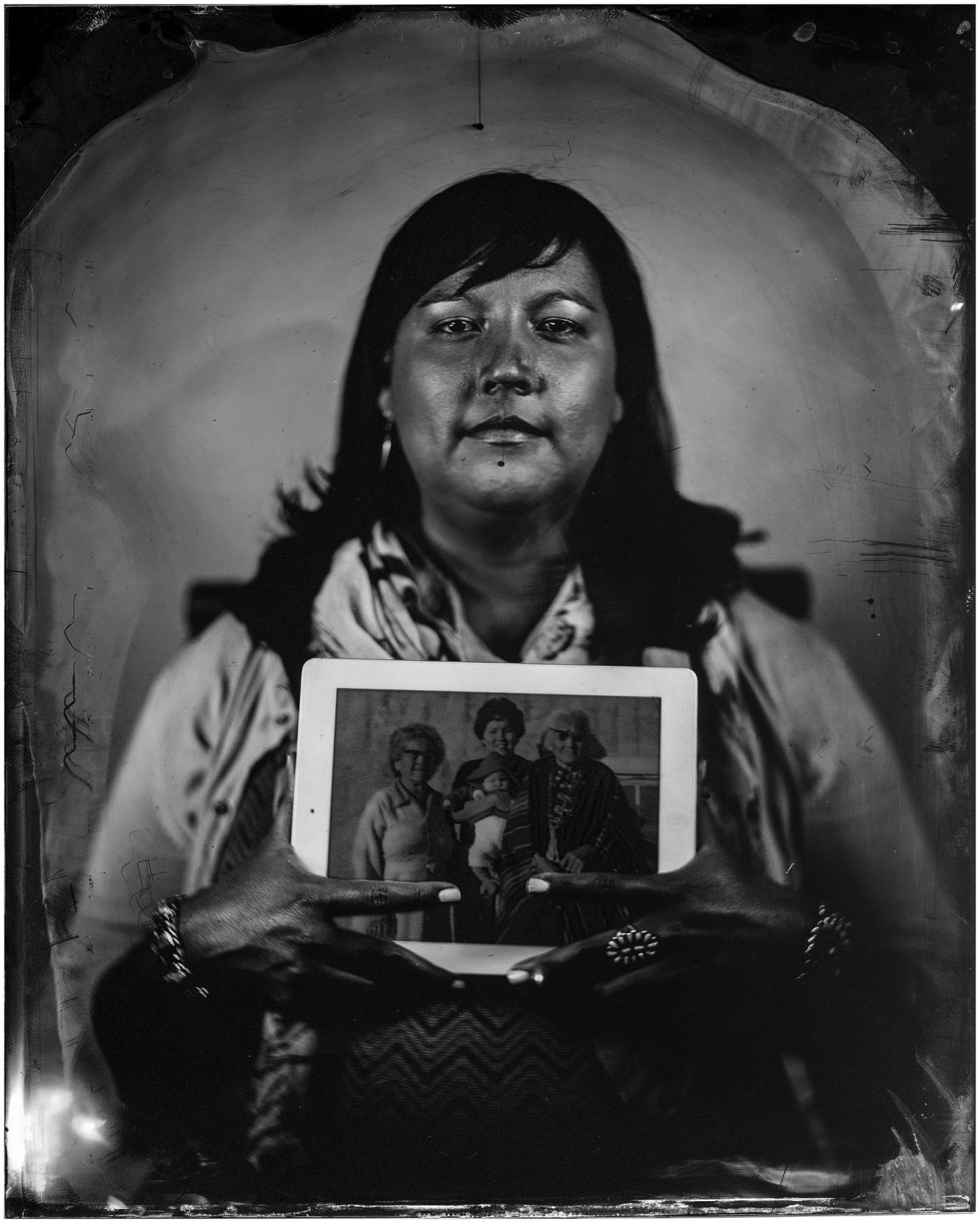
As I sat for my portrait in front of the 19th century camera, I realized that I was in slight physical pain. Rarely have I needed to sit perfectly still, holding a pose and facial expression, and trying not to blink—let alone while attempting to balance a nearly one-pound photograph. The photograph was taken on the day I received my Diné name from my great grandmother, and it is a four-generation photo of mother, my grandmother, great grandmother, and myself. As I waited for the aluminum plate to expose, my arms shook, my cheeks muscles quivered, and my eyes burned. I hoped that, despite the discomfort, I was representing my most authentic self—a Diné woman who was proud of her heritage.
The portrait was part of the exhibition project, The Critical Indigenous Photographic Exchange, by Diné photographer and Indigenous artist, Will Wilson. As I watched Will develop my tintype portrait, I was shocked at the image that appeared. I did not recognize myself. In modern photography, my expression usually boasts a friendly smile, perhaps a little twinkle in my eyes, and a tan complexion. In the tintype, my expression was removed of pleasantries and emotion, showing a rigid expression and a darker, almost olive complexion. The photo revealed a very different Native woman than the one I am used to seeing. My shock deepened when I saw my photograph next to another of a Native woman in traditional regalia. My first thought was, “I wish I was a real Native.” Until then I had not realized I could or would fail to meet my own expectations of what an American Indian should look like.
When I step back and think about the American Indian, my mind evokes one of three representations: a black and white image of a stoic American Indian, Tonto from the Lone Ranger, or the Washington Redskins mascot. This is ironic, because I grew up on the Navajo Nation and am myself American Indian. You’d think my image of Native people would come from my lived experience rather than from common stereotypes. But these images are what sociologist Patricia Hill Collins calls “controlling images,” powerful stereotypes that assault a group’s humanity and can affect members’ self-valuation. Controlling images of Indigenous peoples limit popular understandings and representations of those Indigenous peoples.
I had not realized I could or would fail to meet my own expectations of what an American Indian looks like.
One widespread, controlling image of the Native American is the Indian in an ornate feather headdress. The feather headdress can be found in Hollywood movies, in sports mascots, and on hipsters at Coachella. The most recognizable headdress comes from the Oceti Sakowin (or the Sioux-style headdress: Lakota, Dakota, Nakota), with flared eagle-feathers attached to buckskin that begins at the top of the head and cascades down the back. It is a ceremonial item worn for special occasions primarily among men of the Plains tribes. But U.S. cultural depictions of the feather headdress have lifted this sacred object from its traditional, sanctified meaning to be used at will by individual, non-Native Americans. In his book Playing Indian, historian Philip Deloria suggests many Americans use items or rituals with tribal significance to demonstrate the cultural values of rebellion and freedom. He further argues that “playing Indian” allows non-Natives to feel they can connect with a true, unrestrained self, closer to their supposed primitive roots. “Playing Indian” relies on the adoption of controlling images that collapse hundreds of distinct Native cultures into a few stagnant stereotypes and depict Native peoples as “uncivilized” in buckskin that evokes life in the pre-colonial era.
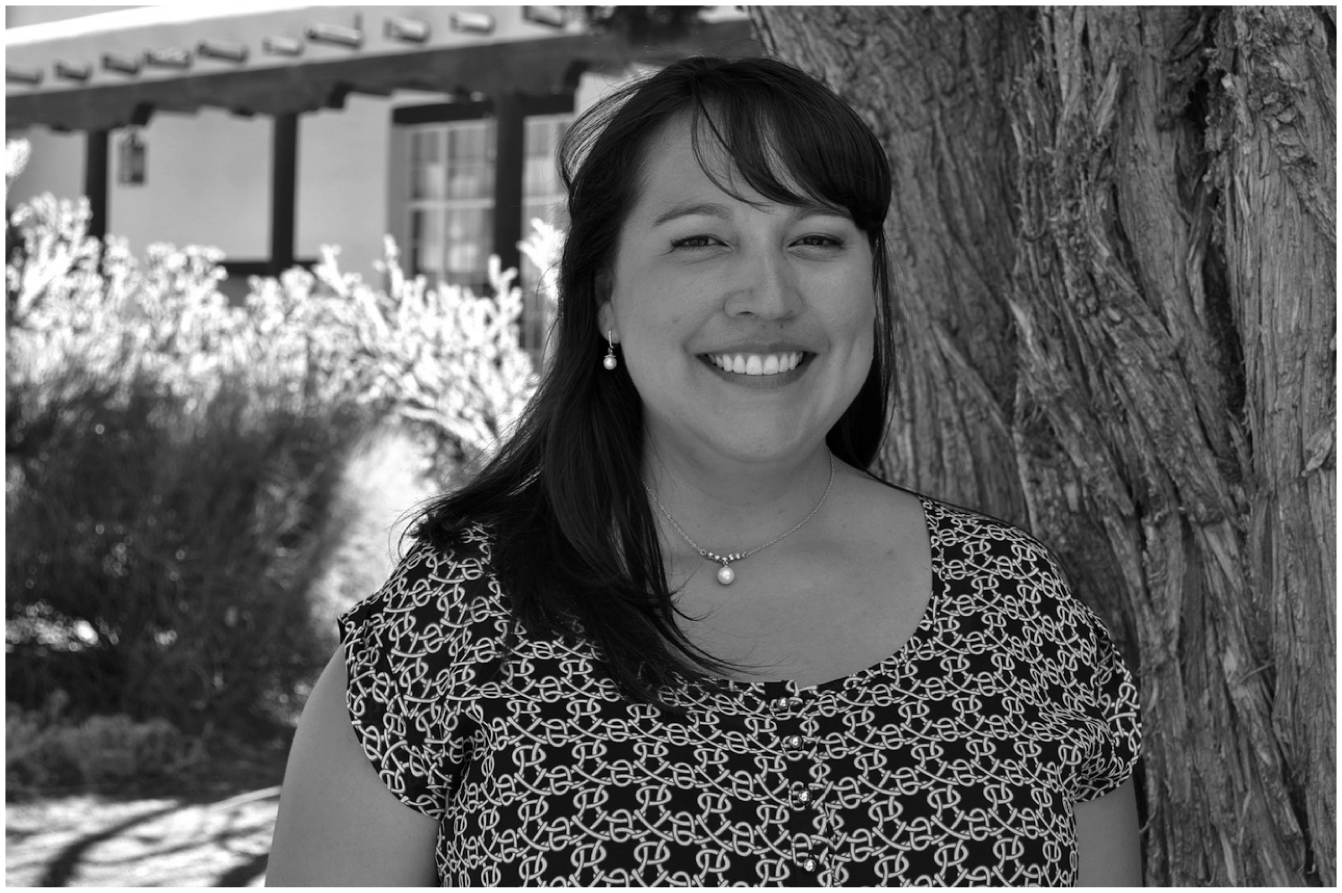
The author
Courtesy Kimberly Huyser
I have been invited to give cultural presentations to elementary students during Native American month. I typically arrive in my usual clothes, and students often ask why I don’t “look like an Indian,” what my “Indian name” is. They excitedly show me the “Indian clothes” they made out of brown t-shirts that had been shredded and decorated with black marker. And they tell me the “Indian names” they have created for themselves, such as Shining Shell or Straight Arrow. These sorts of class projects are fun for students, but partly because they are disconnected from the history of genocide and continued colonialism of Native peoples. I do my best to explain what it means to be American Indian, that traditional regalia are reserved for special events like weddings or powwows, and that a Native name is given only through ceremony—in Diné culture, these names are used only during healing ceremonies. Well-meaning, non-Native teachers often create curricula to engage mostly non-Native students in Natives’ lives. These teachers should not shy away from discussing contemporary Indigenous lives and current social issues, like why some cities and states are changing Columbus Day to Indigenous People’s Day. These discussions would help students understand that American Indians exist in real time and that Indigenous people’s symbols and rituals should be honored as much as their own.
Cultural appropriation would be tough for elementary school students to understand. This might be because it is so common for especially whites to claim an American Indian identity through family folklore, cultural affiliation, or self-identification. Elizabeth Warren, the Massachusetts Senator, is one example of an individual who has a family story about being Cherokee, but has yet to enroll as a member of the Cherokee Nation. Internet sites and social media have not been kind to her claim, calling her a “fake” Indian who should not be allowed to claim the identity. Others claim an American Indian identity because they feel being Native is a lifestyle choice or they feel they have a link to a tribal community through a non-biological family connection.
The only way to legally claim an American Indian identity that is also recognized by the U.S. government is to enroll in a federally recognized tribe. The U.S. Constitution, treaties, court decisions, and Federal statutes have established a government-to-government relationship between the United States and American Indian tribes and Alaska Native entities. Within the U.S., there are over 567 federally recognized tribes. These are eligible for services from the Bureau of Indian Affairs within the Department of the Interior and the Indian Health Services, an agency within the Department of Health and Human Services. There are also state-recognized tribes that are not eligible for these services and tribes currently petitioning for state or federal recognition. To be a member of a tribe, an individual must meet the minimum requirements for enrollment, and each tribe sets their own requirements. A common minimum requirement among federally recognized tribes is a minimum of ¼ Indian blood (that is, a member must have at least one grandparent who was a full-blooded tribal member). The need to provide proof directly to the tribal government makes it quite difficult to become an enrolled member of federally recognized tribe, and the legal component of the American Indian identity makes claims to an American Indian identity contentious. Sociologist have suggested identities are fluid and can change over time; however, the use of a legal definition for American Indians produces a static and narrow identity that many tribal governments and peoples continue to debate.
A contemporary image of American Indians can also de-colonize the imagination of its subjects.
My racial and ethnic identity has been challenged at different times of my life. Despite being a formal member of the Navajo Nation, people have questioned my Diné identity: my father is White, I am not a fluent Navajo speaker. They ask questions like, “Are you sure you’re American Indian? You don’t look like you’re Native.” And challenges to Native authenticity are not limited to my experience. Sociologist Eva Garroutte’s book, Real Indian, for example, lays out the ways some people form a Native racial identity. Regardless of the way in which a person develops and defines one’s own Native identity, it is questioned and debated based on not living up to controlling images, not meeting U.S. legal definitions, or simply not meeting another person’s definition of American Indian.
As a member of the Navajo Nation and a sociologist who studies American Indians, I never expected that participating in The Critical Indigenous Photographic Exchange would mean not recognizing myself as a true Native woman. I am thankful for artists like Will Wilson who are working to bring a contemporary image of American Indians to the U.S. imagination and that this work also de-colonizes the imagination of the participants. Now that I am aware of how controlling images of Natives shape my own imagination, I am even more dedicated to developing a scholarship that seeks to understand the current issues and challenges of Native peoples.