



Abstract
Millennial activism, so often maligned, finds new purchase in a revival of spoken word poetry as an adaptable advocacy, organizing, and mobilizing tool.
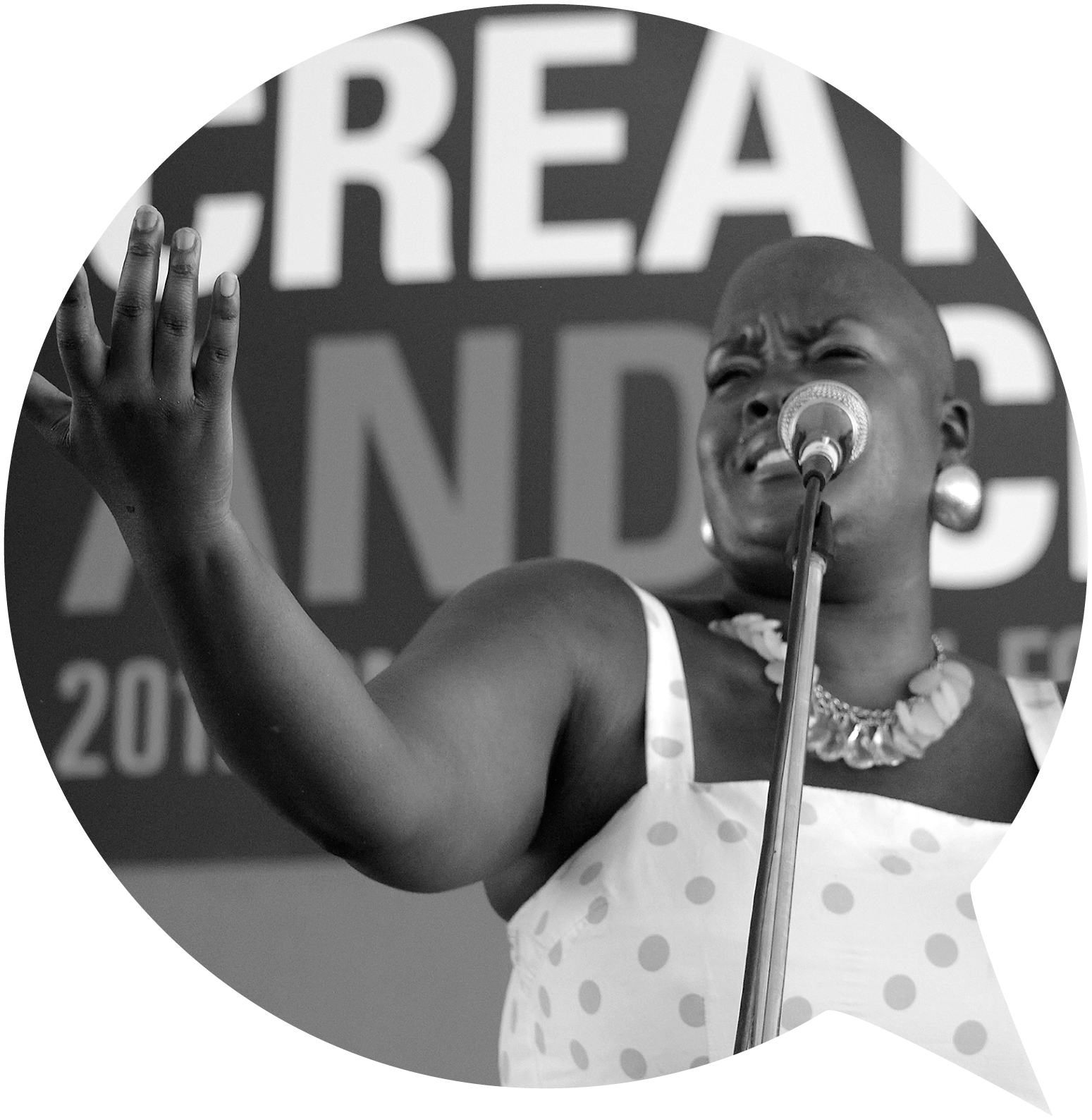
Sonya Renee Taylor performs at the 46th Annual Smithsonian Folklife Festival, 2012.
Elvert Barnes, Flickr CC. elvertbarnes.com
In February 2011, Sonya Renee Taylor posted a selfie to her Facebook page. She had taken the picture as she was getting dressed for an event where she’d be performing spoken word poetry. The photograph depicted Sonya alone, in front of a mirror, her eyes gazing downward at her reflection holding a hot pink cell phone; her other hand seductively yet casually perched on her right hip. She wore a tight, sexy black corset and black underwear, which accentuated her curvy, 230-pound figure and pronounced cleavage. A nude photo of plus-size super model Tara Lynn in French Elle which had recently gone viral, inspired Sonya.
She told me, “I was like, ‘I look really hot in this picture,’ but I had a tremendous amount of shame about the idea of sharing it. It felt like I’d be judged. Either people would think I was arrogant or people would think that I was unattractive or, like, I’m too big to have this on or put this out there. There were all of these ‘you’re not good enough’ [thoughts] that were showing up around it.”
Despite her trepidation, Sonya posted the photo with the caption, “Tara Lynn inspired me to post this picture and I encourage everybody else to post the picture where you feel sexy, you feel good about yourself.” The next morning, she woke up to eighty comments, hundreds of “likes,” and people posting and sharing their own anti-shame, self-empowerment selfies. “I was like, ‘Okay, there is something here,’” she remembers. “People are looking for an opportunity to feel good about themselves.”
Sonya set up a Facebook page to collect the pictures that people were sharing. She called the page The Body is Not An Apology (TBINAA), from the title of a spoken word poem she had written the previous summer. TBINAA now has over 78,000 Facebook followers from around the world. In 2014 Sonya launched an Indiegogo campaign to build “the world’s #1 online resource for radical self love as a tool for personal transformation and social change.” What started as a spoken word poem has evolved into a multi-issue social justice advocacy organization that connects individual body empowerment to broader—and intersectional—racial, feminist, queer, disability, and economic justice issues. Made up of a leadership circle and an “unapologetic posse” of members from around the globe, TBINAA reaches more than 100,000 people each week through online and offline modes of social interaction; it consists of an online magazine, e-newsletter, community forum, webinars, online courses, workshops, 30-day healing challenges, and lectures.
Poets use spoken word as a platform to advocate for issues, a mechanism to build allies and networks, and a means to engage and mobilize these networks.
I met Sonya while doing 2-1/2 years of ethnographic research on the spoken word poetry community in Washington, D.C. In addition to long hours and late nights of participant observation, I interviewed twenty-three poets who served as poetry leaders, hosts, featured performers, educators, coaches, and organizers in the D.C. spoken word scene. Sonya, then a 35-year-old, self-identified queer African-American woman, was one of the most successful poets in my study. She had won multiple national competitions and toured internationally, performing and speaking at universities, professional associations, and advocacy organizations. Although Sonya is a bit older and has received more recognition for her poetry, she is similar to other poets in my study—many of whom are “millennials” (born roughly between 1980 and 2000)—in that she uses poetry to do progressive activist work.
This activist side of spoken word poetry drew me to the research. I wanted to know how poets understood their participation in this intensely personal yet communal artistic practice to be a way of inciting progressive social change. Why spoken word? And, perhaps more importantly, what difference does it make? I found that poets strategically use spoken word’s narrative and emotive features—along with social media—to propel their progressive politics locally and globally, online.
The Right Tool for the Job
“Do you think spoken word has the power to dismantle oppression?” My question for Sonya was motivated by a workshop she had recently facilitated, “Slam as a Safe Space?” Sonya smiled and said, “That’s a big task for such a little art form.” But she went on, “I believe that humans have the power to dismantle oppression. I think that spoken word can be one of the many tools that go into that work. Unto itself, no. Because unto itself a clarinet can’t play music; it’s only about how people use it. So I think that if people choose to use this as a tool for that work, then it absolutely can be done.”
Poets frequently refer to spoken word as a tool. Like other cultural tools described by sociologist Ann Swidler, poets use spoken word to strategically carry out particular functions, and for these poets the functions are tied to activist goals: raising awareness about social inequalities and building communities that are healthy and politically empowered. As illustrated by TBINAA, the poets’ have an intersectional and multi-faceted understanding of inequality. Poets use spoken word as a platform to advocate for issues, a mechanism to build allies and networks, and a means to engage and mobilize these networks. An outcome of this activist approach entails poets’ ability to amplify their political messages to large audiences on- and offline, strategically integrating poetry, personal storytelling, and social media.
Storytelling and Activism
“Using poetry to raise awareness around HIV and AIDS, a lot of times, it’s taking the HIV message and structuring it in a way that’s more digestible,” Dwayne told me. Dwayne Lawson-Brown is an African-American, self-identified activist. When we met, he was 28 years old. He describes himself as a break-dancer, poet, pacifist, fashion designer (he crochets), and co-founder and co-host of the legendary Spit Dat—the longest running poetry open mic in Washington, D.C. Standing no taller than 5’4” and often draped in baggy, oversized clothes, Dwayne has a playful demeanor and youthful face. At his “day job,” he works at a youth organization dedicated to HIV/AIDS education and prevention. Every Thursday night, he can be found at Spit Dat, holding a clipboard or his smartphone to manage the performer sign-up list, or sometimes jumping around, cartwheeling, and swinging his long, thick locs through the air as he raps in a duet with Drew, the open mic’s other lead organizer. Dwayne identifies spoken word’s narrative structure as an effective awareness-raising tool.
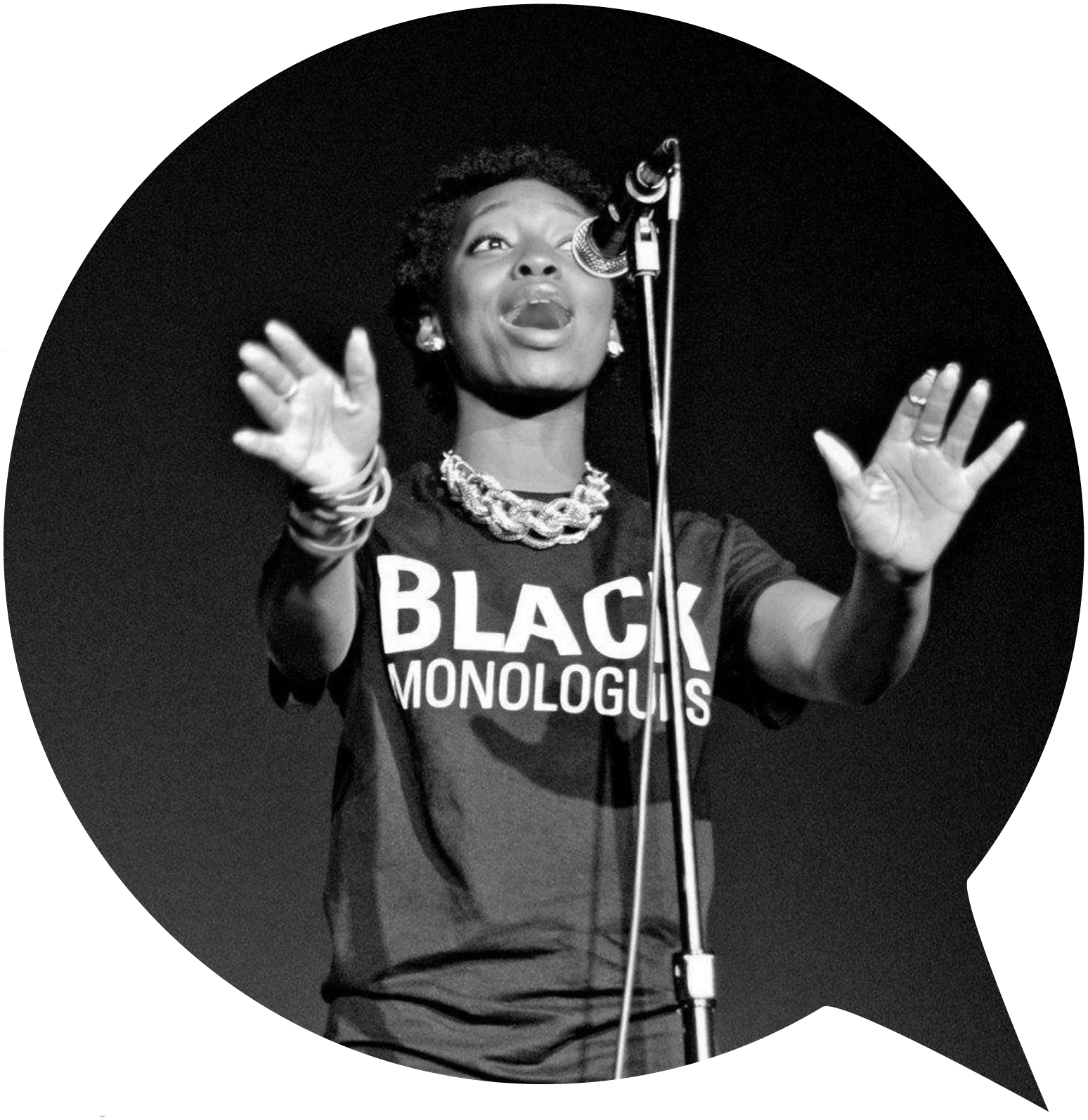
Abisola Kusimo
Courtesy Abisola Kusimo
“When I get in front of a group and I say, ‘HIV stands for Human Immunodeficiency Virus’ and like, break down the science behind HIV, there are some folk who get it because that’s interesting to them. …There are other folks that think differently, and science isn’t for them. So when I say, you know, ‘She was fourteen / She was close to the edge / Life pushed her too hard / God’s really there / This will be time for one of those miracles / She just found out she’s HIV positive,’ they’re ready to receive some sort of message. They realize, ‘OK, he’s telling a story. I can follow the story.’”
Spoken word is a type of storytelling. Poems contain a plot, a moral (or “message”), and various points of view (e.g., narrator, protagonist, antagonist) held together by a narrative structure. The performative element means that the storytelling is as important as the story itself, drawing attention to the practice or doing of spoken word, as well as to the context in which spoken word stories are told. Often, the point of view is that of the narrating poet and the plot is rooted in the poet’s biography. The message often has a social justice focus.
Storytelling and performance poetry have long been features of social justice activism in the United States. Autobiographical slaves’ narratives were central to the abolitionist movement, and the telling of these stories contributed to the movement’s success by placing a human face and moral urgency on slavery’s injustices. Second-wave feminists famously declared “the personal is political,” and they showed how women’s personal stories, and their collective telling of them in small consciousness-raising groups, generated solidarity and illustrated how sexism was systemically embedded in diverse social settings, such as the workplace, the home, and the bedroom. Politicized and performance-based forms of poetic storytelling were practiced by the counter-cultural Beat poets of the 1940s and 1950s, and the feminists and poets of the Black Arts Movement of the 1960s and 1970s. As an activist tool, stories help recruit movement participants, weather movement setbacks, and integrate movement politics into mainstream debates.
Counter-Stories and Testimony
As a little girl, Abisola Kusimo struggled with low self-esteem. Today, a mechanical engineering student at the local state university, Abisola was, when I interviewed her, a tall, slender 19-year-old poet whose parents are from Nigeria. Much of Abisola’s poetry centers on issues of self-esteem, particularly among Black girls. Like Dwanye, she uses spoken word for her activist message.
It is clear that some poets use spoken word to engage in what critical race scholars have called “counter-storytelling,” in which those on society’s margins challenge and analyze “majoritarian stories” with narratives of domination and resistance. Abisola strategically employs her own biography to transform dominant messages around Blackness and femininity to invoke a counter-story about racism and White beauty ideals. She locates individual experiences with low self-esteem within a larger social context, connecting personal troubles to public issues (as C. Wright Mills would say). She challenges a neoliberal discourse rooted in personal accountability with a more sociological understanding of inequality and injustice.
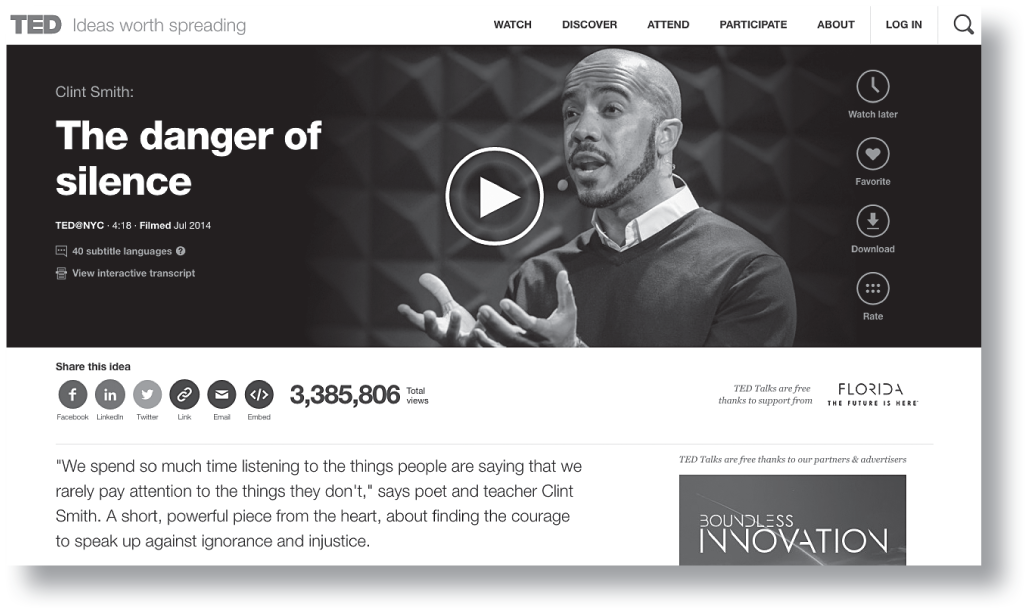
Clint Smith’s TED talks boast millions of views.
screenshot via ted.com
I asked Abisola why she chooses to advocate on this particular social justice issue, and why she uses spoken word to do so. “I wanted to bring it out through my poetry ‘cause I didn’t know how else to share that information—how to get a whole bunch of people to listen to what you have to say.” For Abisola, spoken word is a unique platform.
These poets’ desires to be heard and focus on their personal experiences are not simply another instance of millennials acting as selfie-obsessed narcissists and excessive self-promoters, as the common critique would have it. Rather, their approach to activist storytelling follows the political tradition of “testifying,” speaking in public to inform opinion by deploying one’s own subjective experience or vantage point. Like counter-storytelling, it provides a space for experiences that have been marginalized or omitted from mainstream discourses. Rather than an individualistic practice, testifying is linked to a broader community ritual of affirmation and learning.
As an activist tool, stories help recruit movement participants, weather movement setbacks, and integrate movement politics into mainstream debates.
Testifying has been central to African-American religious traditions and politics. As in the legal environment, testifying in the Black religious context is aimed at articulating the truth in pursuit of justice. But rather than a code of justice rooted in law, religious testifying is organized around a moral and sacred understanding of right and wrong. Bombarded with cultural messages, laws, and institutionalized practices premised on Black inferiority, the Black church has historically served as a space where African Americans can express—and a listening public affirms—an alternative truth in pursuit of racial justice.
From what they know to be true about the world, poets tell spoken word counter-stories to build a case for what is socially just, fair, and right. This activist tradition invites individuality without sacrificing speakers’ accountability to the public they are part of.
Spoken Word and Impact
By participating in this spoken word community, poets create allies and build networks based on friendship, experience, emotions, artistic kinship, and a commitment to progressive politics. They also build an organizational infrastructure—often in a “do-it-yourself” fashion—aimed at maintaining sustainability and longevity for their art and activism. This infrastructure consists of self-organized poetry workshops, open mics, slams, an awards ceremony, and the production, publication, and selling of their poetry in self-produced “chapbooks.” Given the art form’s peripheral status in the larger art world, these initiatives provide ways for poets to hone their craft, disseminate their work, and lend professional legitimacy to their poetry; these efforts, in turn, extend their ability to raise awareness and build community.
The structure of this community also involves mentoring the next generation of poets. Many D.C. poets facilitate youth poetry workshops, coach teen slam teams, create performance opportunities for up-and-coming poets, and organize the annual regional teen poetry slam festival Louder than a Bomb, which attracts hundreds of high school poets. These practices build intergenerational sustainability into the art and activism.
Finally, the poets promote political engagement and mobilization. This entails getting others involved in or donating money to social justice causes, encouraging people to “think and do something differently,” or embarking on a journey of self-healing and self-love. The idea is that change happens when people are healthy, self-fulfilled individuals who have access to expressive, supportive outlets. “Despite the sort of machine that makes a lot of money off of us hating ourselves, it’s a radical notion to decide that we don’t,” Sonya told me. “Lasting, positive change can only be built on a foundation of love; you cannot sustain positive change in a body that you hate.” For poets, a commitment to loving oneself and living without shame is a radical existence rooted in a larger political framework in which a healthy individual and a healthy community are prerequisites for long-lasting social change.
Despite the poets’ clear commitment to raising awareness about social inequalities and building healthy and politically empowered communities, the question of political impact undoubtedly looms large in the minds of scholars. At the end of the day, why does spoken word matter? What difference does it make? When I asked poets these questions, they often focused on what youth activism scholar Shawn Ginwright calls “radical healing.” Cultivating healthy selves and communities is not typically recognized as a political outcome; in general, sociologists aren’t looking for these types of behaviors, nor are they connecting them to political impact.
But beyond this, an outcome of this activist approach entails spoken word’s ability to give poets unique access to on- and offline political spaces and activist opportunities, allowing them to amplify their messages to even larger networks. For example, Sonya recently delivered the 2015 commencement speech at Hampshire College. Mary Bowman, an HIV-positive activist-poet told me, “[Poetry] just opens doors. It helps people know who I am.” Mary tells me she’s still surprised by the attention she receives: “I never imagined that people in other states would know my name without me even knowing them. That’s crazy to me.”
Other examples include how Clint Smith’s involvement in spoken word helped him secure two TED Talks focused on racial inequality and speaking out against injustice, one of which has more than 3 million views, the other over 1.5 million. Teen poets added that their participation in spoken word factored into their college admissions essays and provided high-profile performance settings, such as the White House, U.S. Capitol, university classrooms, and venues overseas.
Poets use spoken word to build relationships and community, and they have an expansive understanding of where and how activism takes place. Activism can happen online through social media, such as on Twitter, Facebook, or YouTube, or it can happen face-to-face during poetry events, through hosting, performing, or mentoring. Still, scholars who study social change can easily overlook these poets’ style of activism. It is not located inside a single recognizable social movement; rather, it’s diffused, touching on a wide array of progressive issues. It’s not affiliated with a specific activist organization; rather poets work with numerous local and national organizations, in coordinated and uncoordinated ways.
In this way, the poets’ activism resembles a “group-centered leadership” approach, as historian Barbara Ransby describes youth racial justice organizing. Looking at efforts like the Black Youth Project and Black Lives Matter movement, Ransby connects group-centered leadership to the organizing tradition of civil rights activist Ella Baker. As in Ransby’s analysis, the D.C. poets’ activism has a decentralized, non-hierarchical leadership structure. Yet, the poets’ activism is even more obscured in that they have no mission statement or articulated set of core values. While there are many poetry leaders in the community, no protocol exists for how leaders are selected, nor are there explicit social justice obligations that leaders must follow.
The poets’ activism is also easy to overlook because it takes place in nontraditional spaces. Researchers such as Black studies scholar Mark Anthony Neal are just beginning to explore the implications of social media for activism and finding ways to measure and account for this activity. Consider the difficulty of measuring activism driven by today’s Black political protest, touched off with the Ferguson protests and carrying forward under a lasting and sprawling movement known powerfully if amorphously as #BlackLivesMatter.
“Lasting, positive change can only be built on a foundation of love; you cannot sustain positive change in a body that you hate.”
The poets in my study operate within this new paradigm of protest and #hashtag politics, coupling social media with spoken word. Spoken word’s short narrative structure and highly emotional content is conducive to online video sharing. Organizations like Button Poetry, which produces high quality video recordings of spoken word poems to share on YouTube, facilitate this process, as popular progressive websites like Upworthy, Daily Kos, and Everyday Feminism are able to spot these videos and make them viral. The process and medium pushes the poets’ activist messages and public personas into wider public spheres.
This portrait of millennial activism is more nuanced and expansive than those often recognized in most media depictions or scholarly literature. The poets I met in D.C. not only participate in activist pursuits, but also create overlapping artistic and political spaces to incite change, cultivate community, and inspire political commitment that lasts far beyond the latest #hashtag.