



Abstract
First-generation immigrants studying as sociology majors see excellent employment outcomes.
These days, getting through college and finding satisfactory work after graduation is tough. College costs have gone through the roof, and the labor market since the Great Recession has been anything but friendly to new college graduates. The 40-to-50% of students who are the first members of their families to enter colleges and universities in the U.S. face additional challenges.
Compared to peers whose parents graduated from college, first-generation college students have a limited knowledge of campus life, less understanding of college expectations, greater chances of dropping out, and a lower likelihood of graduating within five years. Moreover, first-generation students do not catch up during their college years because they are less likely to develop relationships with faculty and with peers. Given these circumstances, readers should not be surprised that researchers have found that first-generation college students, across majors, were less satisfied with their college experience than their fellow students whose parents have college degrees.
But here is the good news! Earlier studies of first-generation students have only told half the story. They have not examined the post-graduate experiences of first-generation students who did not drop out but persisted to graduation. Using the American Sociological Association’s longitudinal survey of sociology majors (funded by the National Science Foundation), we have compared the undergraduate experiences and satisfaction with post-graduate jobs of 911 first generation students with the rest of their sociology major peers.
Why Sociology?
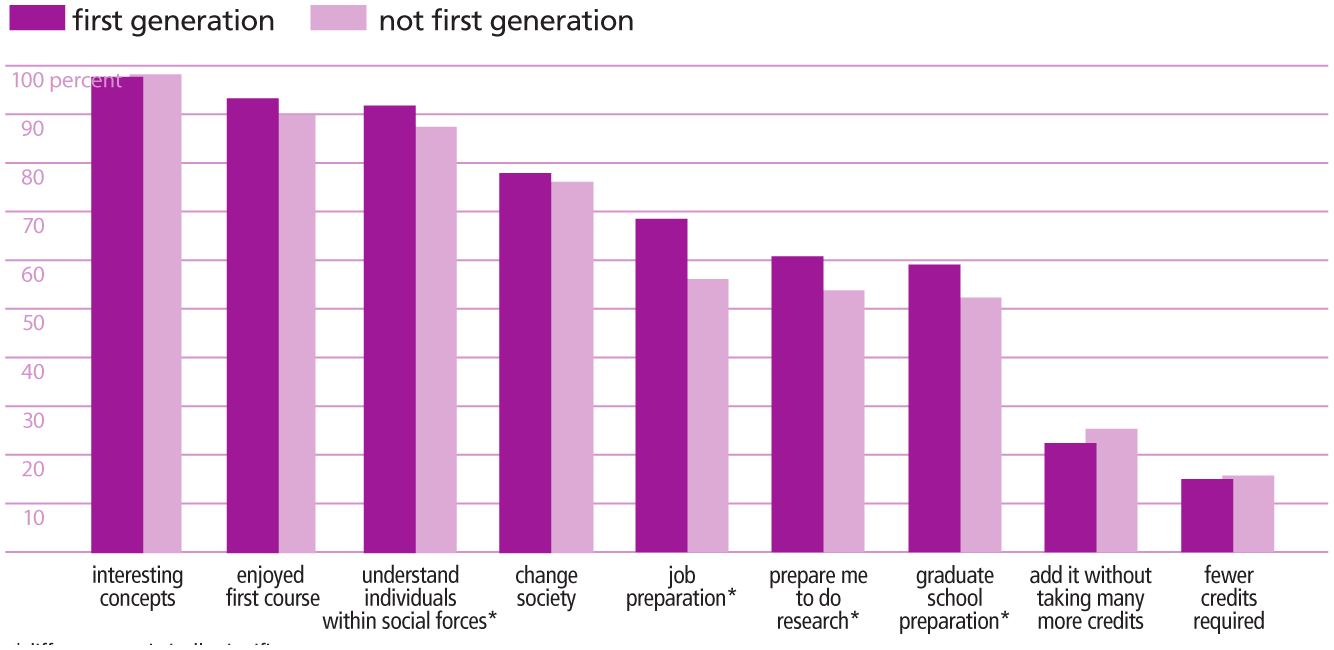
Sociology departments and their faculty will be happy to hear that students decide to major in sociology for solid academic and conceptual reasons. At left, we see that undergraduates, regardless of generational status, majored because they enjoyed their first sociology course (about 90%), were excited by sociological concepts (about 98%), and thought the major would help them change society (more than 75%). Neither first-generation students nor their peers majored in sociology for “convenience” reasons, such as fewer course or credit requirements.
First and not first generation students major in sociology for similar reasons
*difference statistically significant
Source: American Sociological Association. Social Capital, Organizational Capital, and the Job Market for New Sociology Graduates, 2012, Waves I and III.
A few successful sociology majors: Michelle Obama, Rev. Dr. Martin Luther King, Jr., and Ronald Reagan.
Photo collage sociology.hawaii.edu

Still, first-generation students were more likely to major for more utilitarian reasons: they were significantly more likely to expect that a sociology major would prepare them for a job (68.5% versus 56.1%), prepare them to do research (60.8% versus 53.8%), or prepare them for graduate school (59.1% versus 52.3%). As with other first-generation students across disciplines, their goal is to improve their social, economic, and occupational standing, which makes sense given the importance of education for upward mobility. These students may have seen the difficulties that their parents faced lacking a college degree.
“The world has less secrets now. I will value the education I’ve received all of my life.”
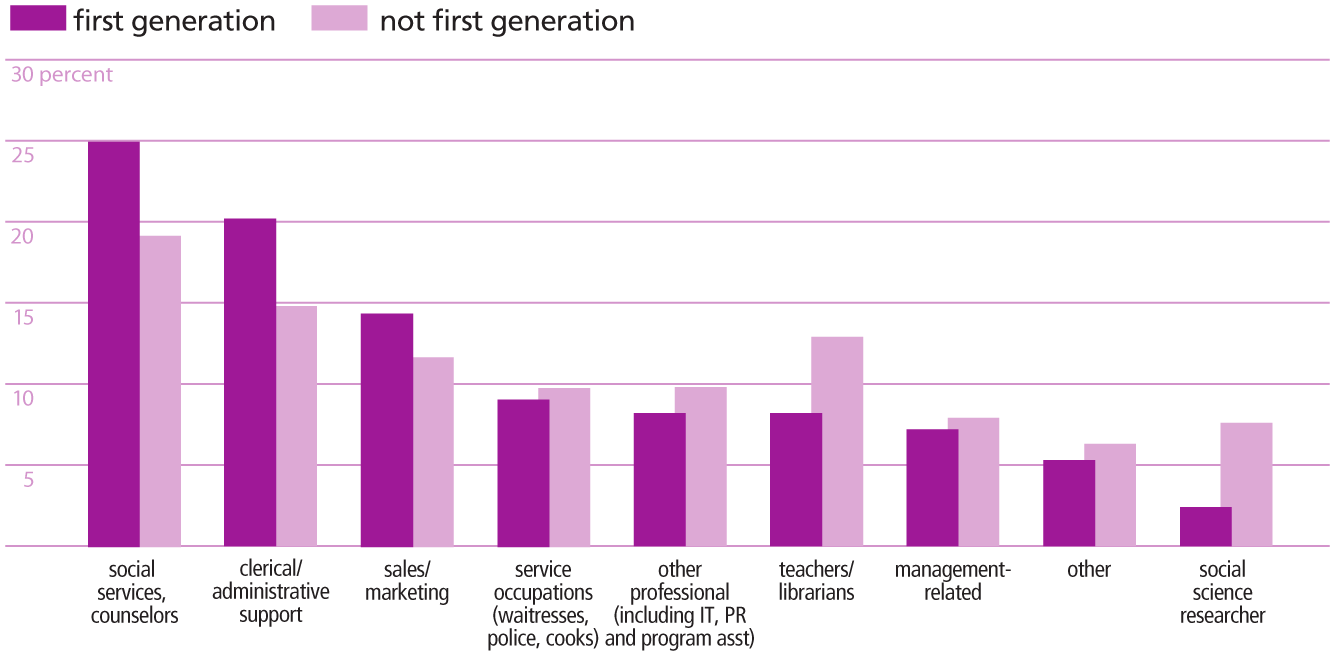
First and not first generation respondents have the same types of jobs
Although the experiences of first-generation sociology graduates and their peers whose parents had graduated college were not identical, there were few statistically significant differences in participation in the type of out-of-class activities that could provide contacts and skills that improve chances of future success. However, first-generation students were significantly less likely to participate in internships (49.5% compared to 60.6%), an experience that might especially benefit them in searching for jobs. It may be difficult for first-generation students to complete an unpaid internship as opposed to working at a paid job, and they may have less well developed social networks for seeking out those opportunities. They were also less likely to have worked on research projects with faculty members—mentoring that might provide useful skills and contacts.
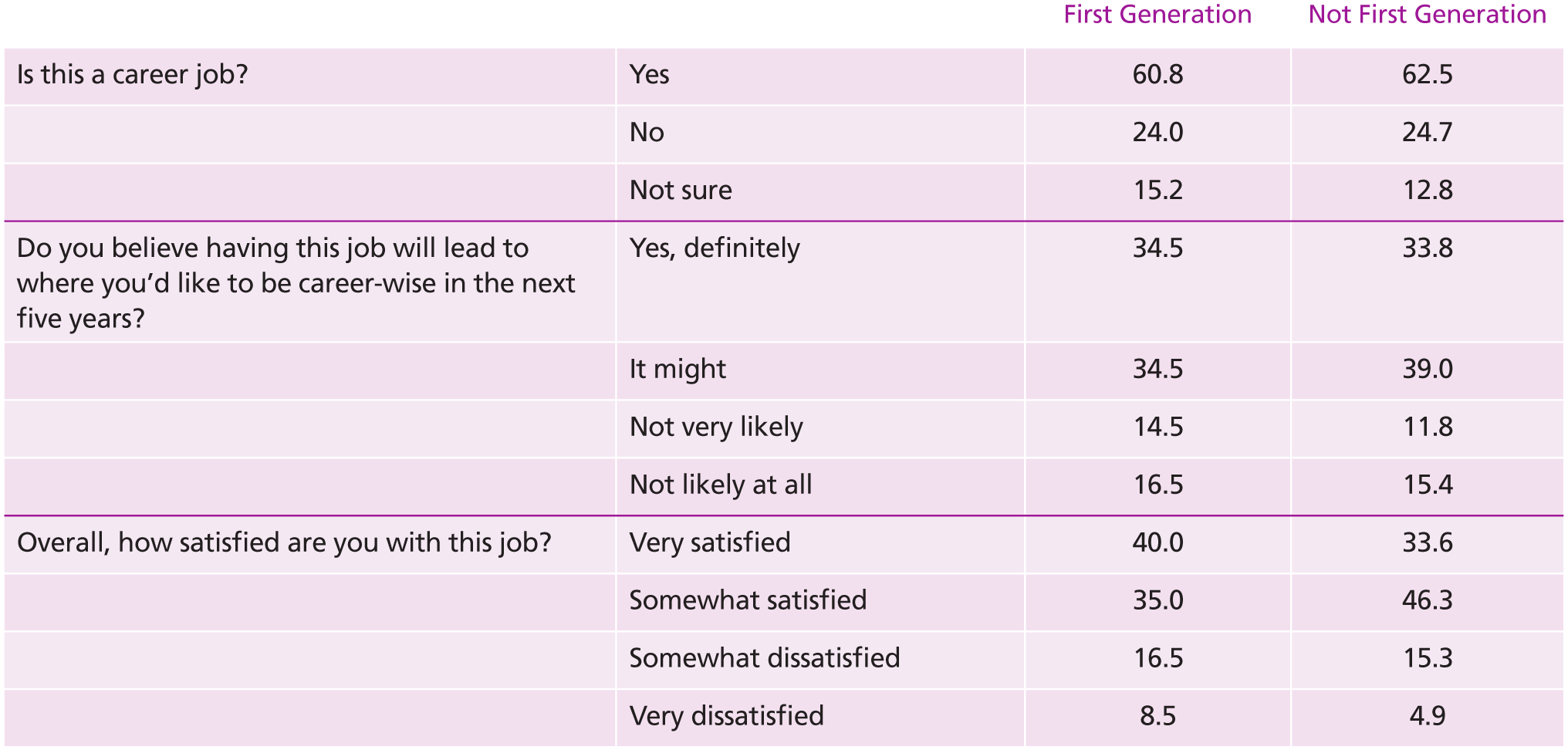
First and Not First Generation Students View Jobs Similarly: Percentages by Generation
Note: Statistical test shows the overall pattern does not differ between the two groups.
SOURCE: American Sociological Association. Social Capital, Organizational Capital, and the Job Market for New Sociology Graduates, 2012, Waves I and III
Eighteen months after graduation, our respondents were asked whether they would major in sociology again if they had the chance to relive their college years. Majorities of both first-generation students (57.0%) and their peers (53.0%) responded that they “definitely” would choose sociology again. One first-generation student maintains a kind of love affair with the field a full year and a half after graduation: “I love sociology. It’s the best major because it teaches people how to think.”
“Sociology lays a great foundation for social understanding and diversity—something that can be transferable at all levels.”
Another reported: “The world has less secrets now. I will value the education I’ve received all of my life.”
Success in the World of Work
The best news involves first-generation students’ success in the world of work. Eighteen months after graduation, most sociology majors have moved on to the next stage in their lives, and the employment patterns of the two groups are similar: they are equally likely to be employed and in graduate school (more than half of both groups were in the labor force and an additional one-quarter were both working and going to graduate school). First-generation students were slightly less likely to enroll in graduate school full-time, but only a small minority of either group took this graduate-school only path (8% of first generation graduates and 11.2% of their peers).
When asked to characterize their job, close to 60% of both groups considered their job a “career-type” job. Graduates in social service/counseling, management-related and other professional jobs, teachers/librarians, and social science researchers were most likely to see themselves in career jobs (above). Similarly, more than two-thirds of both groups reported that having their job definitely will or might lead them to where they would like to be career-wise in the next five years. More than two-thirds of both groups expressed at least some satisfaction with their job.
For the first-generation students, the connection between sociology and their careers was obvious. Among many similar comments, they told researchers, “Sociology lays a great foundation for social understanding and diversity—something that can be transferable at all levels,” and, “Sociology is a great major to have if one is interested in working with people. All the careers I am interested [in] work with diverse student clientele.”
Both Generations Making Career Advancements: Percentages by Generation
Statistical test shows the overall pattern does not differ between the two groups.
SOURCE: American Sociological Association. Social Capital, Organizational Capital, and the Job Market for New Sociology Graduates, 2012, Waves I and III.
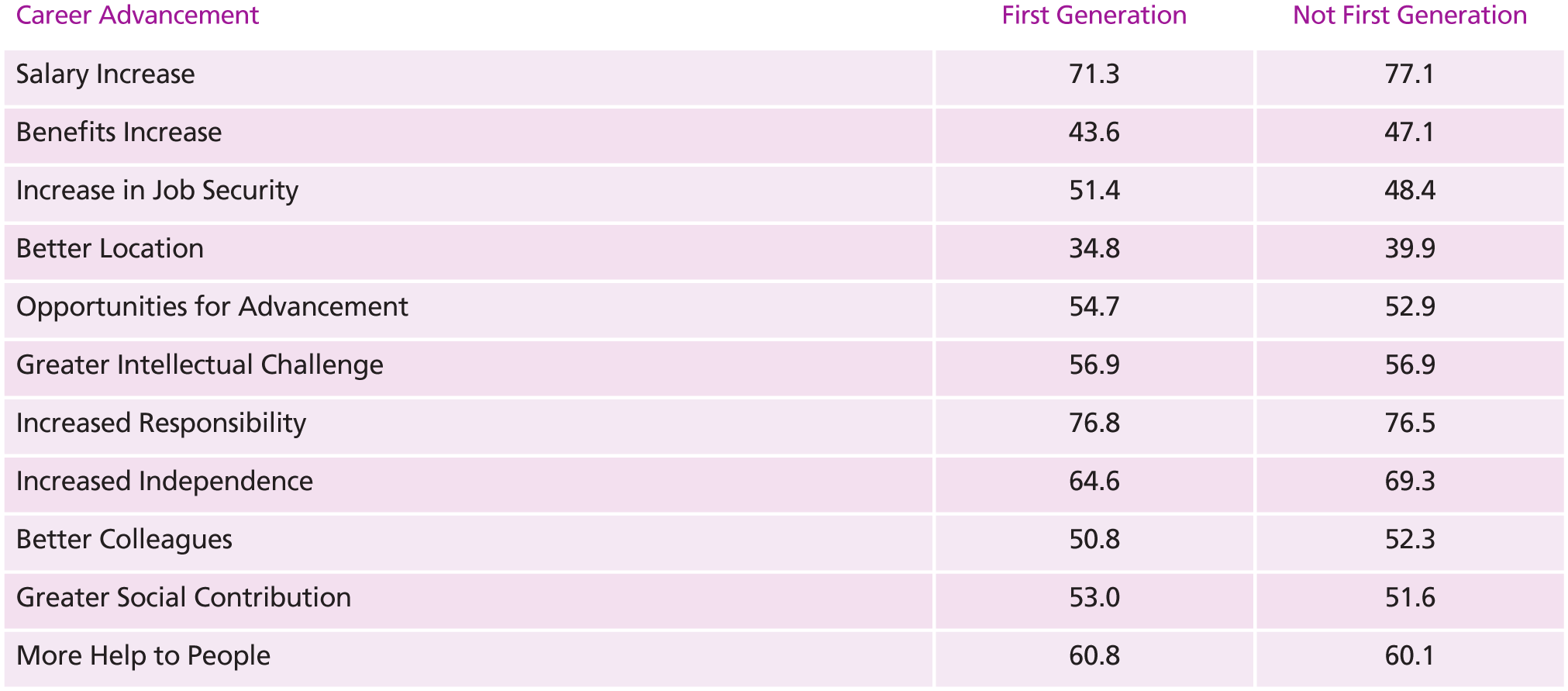
Most impressive was the job advancement experienced by first-generation students. Respondents were asked several questions regarding whether they had experienced specific job advancements (in salary, responsibilities, and independence). In general, both first-generation sociology graduates and their peers experienced positive changes on the job, with each group experiencing an average of six of the 12 advancements. The greatest job improvements experienced by both groups were increases in salary and responsibilities, with about three-quarters reporting these career advances (see above). More than half experienced greater opportunities for advancement, greater intellectual challenges, increased independence, and a sense that they were providing more help to the people with whom they came into contact. Almost half reported having better colleagues and making greater social contributions compared to when they started working after graduation.
We have a positive story to tell to faculty, administrators, and students. Sociology, given its core concepts that focus on understanding inequalities and how social forces impact daily lives, can be especially appealing to first-generation students as they attempt to navigate the undergraduate experience and pursue their goals of economically successful and socially meaningful lives. Our research comparing first-generation college graduates to their peers whose parents have college degrees tells us that first-generation students who major in sociology and graduate are just as positive about the major and are just as successful in the working world. First-generation students who graduate with degrees in sociology overcome deficits, especially if they work hard as undergraduates and use what they have learned as a major on the job.
“I love sociology. It’s the best major because it teaches people how to think.”