



Abstract
The difficult work of expanding beauty ideals.
Plus-size models made headlines in 2015, signaling a shift towards greater size diversity in fashion. Robyn Lawley became the first plus-size model featured in a swimsuit issue of Sports Illustrated. Another (Ashley Graham) was featured in an ad in the same issue. Graham gave a TEDx Talk on body acceptance in the spring, was featured in Lane Bryant’s #ImNoAngel and #PlusIsEqual campaigns, and debuted her lingerie collection at New York Fashion Week in the fall. In the design field, Project Runway made history when it crowned plus-size designer Ashley Nell Tipton as its season 14 winner.
Size bias is hanging on in the very sector of fashion believed to be immune to size discrimination.
Both Lawley and Graham, along with a number of prominent plus-size models including Denise Bidot, Stefania Ferrario (who launched the #droptheplus campaign), and actress and now clothing designer Melissa McCarthy have used their recent successes to ignite a movement to encourage a fashion industry built around a thin body beauty ideal to include women of every size and eliminate the categorical system that segregates both models and consumers on the basis of size.
Are these successes part of a spectacle that will soon fade or, rather, the start of a fashion revolution? Developments indicate this is not a passing fad, as significant institutional changes have occurred within modeling agencies and designers are responding to a consumer-driven demand for a greater representation of larger models in the fashion landscape. However, as the plus-size sector works to expand the definition of beauty and unify the modeling market, it, too, is plagued by elements of thin privilege; there is still a commercial preference for models on the smaller end of the plus-size spectrum who have “thin” faces.
As I found while researching the fashion industry as a plus-size model for more than two years, size distinctions are starting to erode within modeling agencies. Jag Model Agency, founded in 2013 by the former directors of Ford Models’ now-defunct plus-size division, formally began this trend. The agency represents models from size 6 to size 20. And unlike other agencies, Jag does not group their models based on size category. IMG Models (the world’s top modeling agency) announced in the fall of 2013 that they, too, would no longer segregate models into different boards based on size. As it stands, the distinction between straight- and plus-size models is based solely on size—“plus size” is everyone above a size 8. The basic model requirement of proportionate facial and bodily features is standard among all models and, quite simply, the nature of modeling work is the same, no matter the model’s size. Modeling agents saw little justification for the continuation of this division.
Still, modeling work is divided into different types (runway, commercial print, fit, etc.), and each requires a specific look and size of model. The commercial print world is dominated by a specific image of plus-size beauty. Modeling agencies that focus on commercial print work represent plus-size models who fit within a narrow range in size (from an 8 to a 16) because there is not enough work for models larger than a size 16. As one agent claimed, “that is what advertisers want,” even plus-size ones. This rationale explains the increased visibility of models (like Lawley at a size 12 and Graham at a size 16) who inhabit the small end of the plus-size spectrum. Consequently, size 18 and up models are virtually absent in print, working predominately as showroom and fit models.
Plus-size fashion companies produce lines of clothing that range from a size 14 to 24. These companies usually build their lines from a pattern based on a size 18 fit model. Designers and clothing manufacturers hire fit models to try on garments at various stages of production to determine the fit and appearance of the pieces on a live person. When it comes to selling these garments, however, smaller models more often appear in the clothes. “Larger” plus-size models work behind the scenes in fashion while the “smaller” ones are out basking in the public’s attention.
While the gradual elimination of separate modeling divisions and increased media presence of plus-size models like Lawley and Graham mark a progressive move by fashion to embrace larger bodies, more striking are developments involving Tess Holliday, a model who is revolutionizing the commercial definition of plus size.
Tess Holliday models one of her own shirts, spawned from the hashtag #effyourbeautystandards.
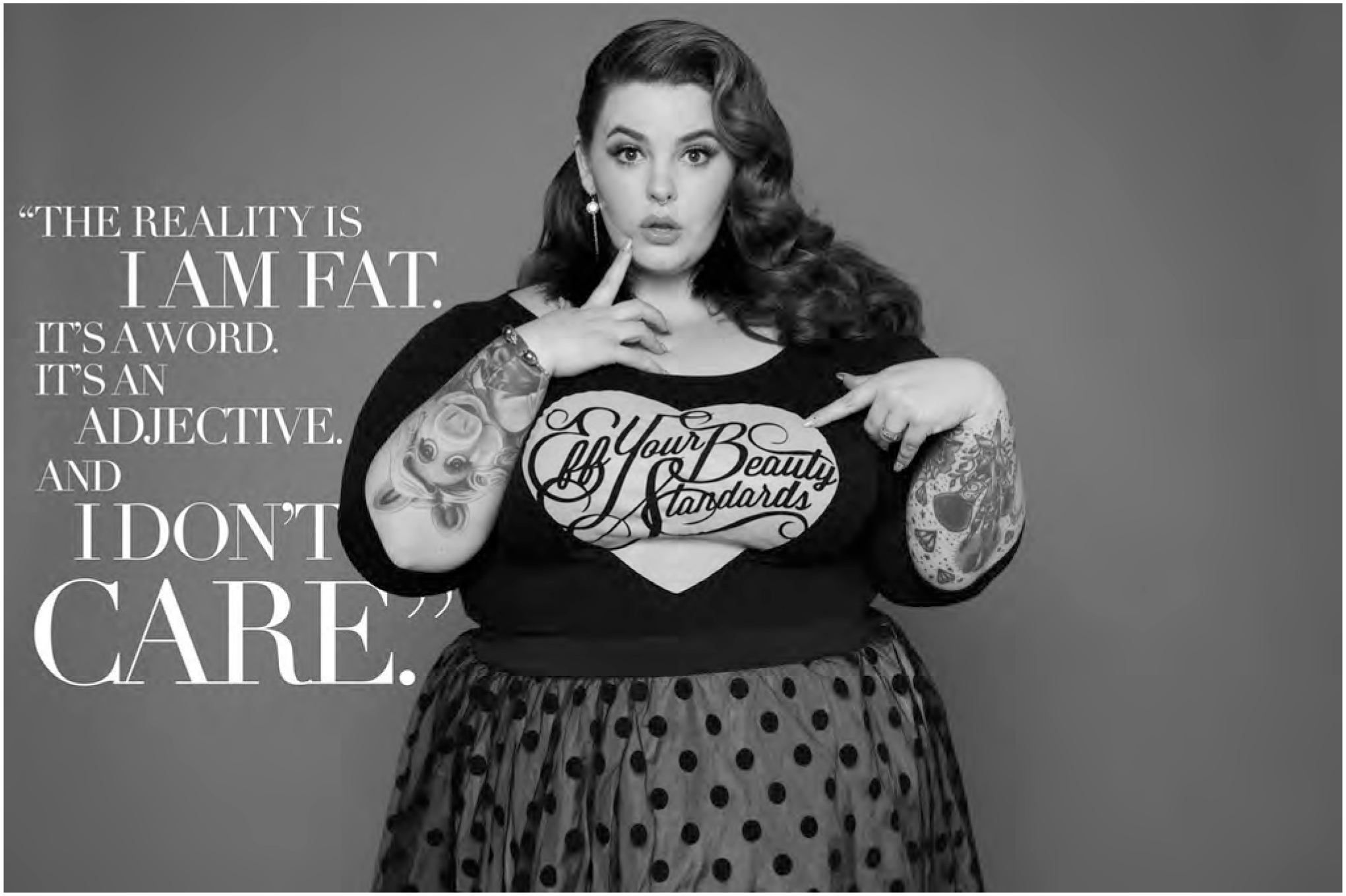
The typical, commercial, plus-size model is tall (minimum height of 5’8’’), wears a woman’s size 10 to 16, and portrays a conservative style of appearance. Most casual observers would probably fail to identify these models as plus size. In sharp contrast, Tess Holliday is short, large, and tattooed.
In January, MiLK Model Management in London signed 5’5”, size 22 Holliday, making it the first major agency to represent a model of that size. Since then, Holliday has become the face of a number of campaigns and made high profile appearances. She has led the Sea by Monif C swimwear campaign (the first model over a size 18 hired by the swimsuit line), Torrid’s Photoshop-free spring 2015 campaign, and the #SimplyBekini summer body confidence campaign for the UK’s plus-size brand Simply Be, and she has modeled for Benefit Cosmetics and Vogue Italy. Holliday even appeared on the June cover of People Magazine with the headline, “the world’s first size 22 supermodel.”
It is not uncommon for size 10 and 12 models to advertise plus-size clothing lines they could not actually wear. It’s not that they’re too big, but too small. Many use body padding because clients want a curvy body but a thin face.
Holliday and her booming career are remarkable given the tendency of fashion to hide bodies over a size 16 in designer studios and showrooms, out of sight from consumers. But those consumers are starting to notice the absence of larger bodies.
Newer, web-based retailers have begun using “larger” plus-size models. For instance, one owner of an online boutique explained, “I prefer to use size 16 models so my customers can identify with them. I’ve had complaints in the past that our models didn’t look plus-size enough. I actually used a size 22 for some pictures.” Competing with national retailers who do not use models larger than a size 16, these newer brands do not want to risk alienating consumers. This concern prompted designer Monif Clarke to hire Holliday. “We’ve always featured size 14 plus models,” Clarke explained to Yahoo, “But, we thought, ‘How do we make this more compelling for our customer?’ The feedback we were getting was, ‘We love that you show women in size 14 and 18 but what about the 22s and 24s?’” The “larger” plus-size model, shunned by certain sectors of the fashion industry, is gaining visibility in a burgeoning virtual marketplace of e-commerce.
Ultimately, the distinction between “smaller” and “larger” plus-sizes reveals the continuation of thin privilege and size discrimination in fashion. It is not uncommon for size 10 and 12 models to advertise plus-size clothing lines they could not actually wear. It’s not that they’re too big, but too small. Many of these “smaller” plus-size models use body padding to effectively size up, because clients want a curvy body but a thin face.
Each of plus-size fashion’s milestones has seen mixed reception: there is a persistent cultural sigma around fat.
This padding technique, which involves strategically inserting foam pieces underneath hosiery or shapewear, allows a model who may be in-between sizes or on the lower end of the plus-size spectrum to temporarily add to her dimensions and “size up” to meet client demands. “Whenever I get a call from my booker about a casting,” one size 10/12 model confided, “I make sure to ask which size they [the client] want.” Depending on the client, this model will either present herself as a size 12 or, with padding, a size 14.
“Fat pads” accentuate the breasts, butt, and thighs while providing the illusion of a slimmer waist and face.
Kristiina Wilson/thelicensingproject.com
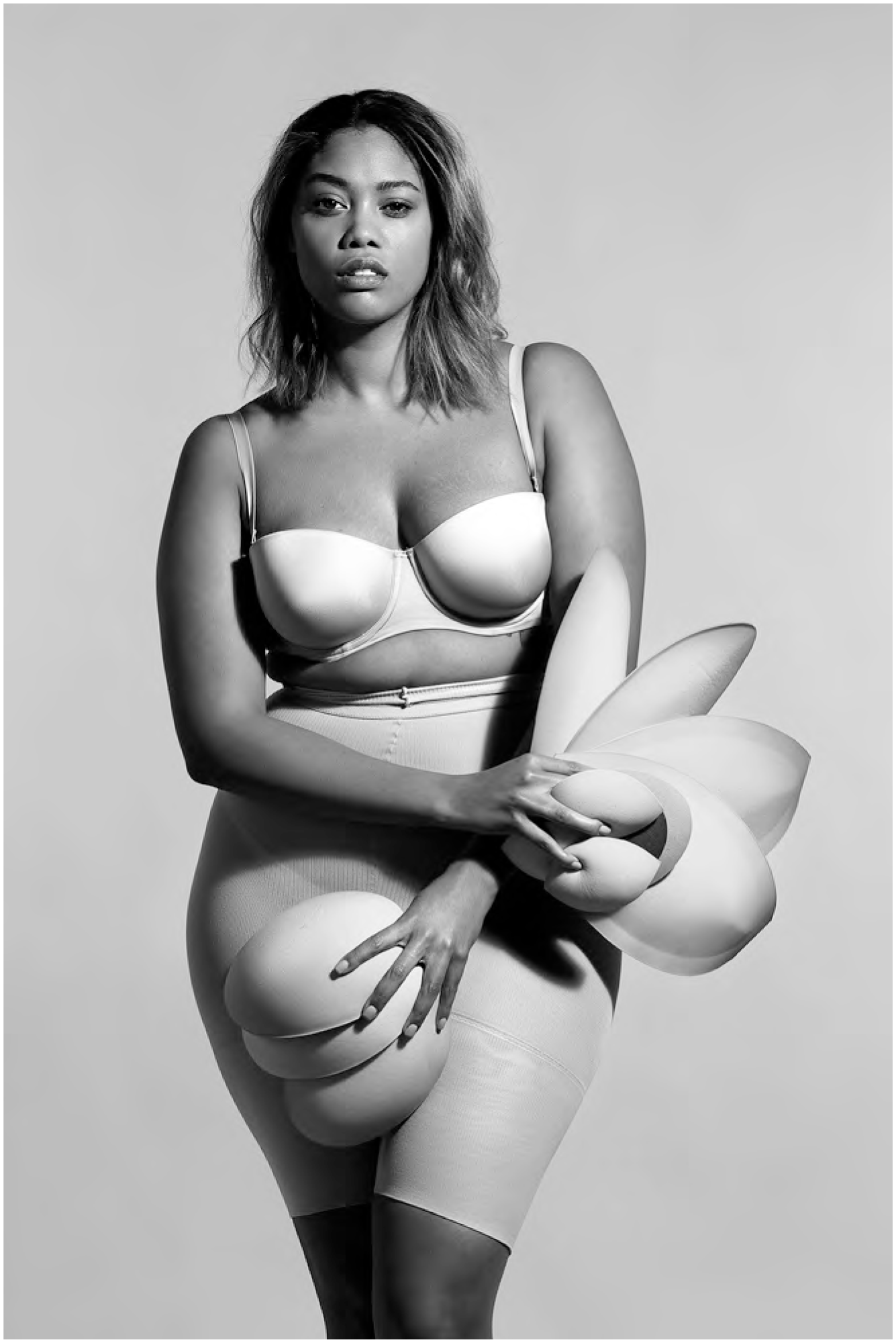
These “fat pads,” as fashion insiders call them, accentuate the breast, butt, and thighs while providing the illusion of a slimmer waist and face—that is, the “perfect” hourglass figure clients want of plus-size models. As another plus-size model explained: “They’ll use padding to size a girl up. A girl may be a size 10/12 but the client wants a solid size 14. They like her thinner face but want a bigger body, so they’ll make her wear foam padding under her clothes. It’s a win-win situation for smaller models. The model gets the job and the client gets the look they want. Unfortunately, it hurts larger models.” The model experienced this form of size discrimination firsthand when she lost a commercial print job to a “smaller” model while working for the client as a fit model. The irony was that the designer hired this model to shape the very garment used in the print advertisement—but not to sell it in a catalog spread. The designer did not deem her body (or face) desirable for commercial advertising.
Sharon Quinn, a veteran plus-size model with over twenty years experience, acknowledged this all too common practice of hiring “smaller” models in PLUS Model Magazine: “Look more closely at some of the current window display ads for some of the major plus sized stores. Notice anything off? It doesn’t seem to matter that the models look like little girls playing in their mother’s clothing—all that seems to matter is that their faces are slimmer.” Even Lane Bryant, the nation’s leading women’s plus-size apparel retailer, admitted that the company used models in their commercial print campaigns who were sometimes “only size 14 on the bottom half of their bodies.”
As a photographer who has shot for catalogs and a model who graced the runway for John Galliano and Jean Paul Gaultier, Velvet D’Amour asserts that advertisers rely on “smaller” plus-size models to boost sales, “If they put a size 11 girl in, and she’s wearing butt padding and boob padding and they sell a muumuu with this girl in that outfit, they’re going to get more sales having her in that outfit than they are me [at nearly 300 pounds].” D’Amour argues that the nature of media and retail fashion creates this size inconsistency in marketing: “They need to create the unattainable, because the unattainable is what drives capitalism. If everyone accepted themselves, just as they are, imagine how sales would go down the tubes.” So the tactic of hiring “smaller” models and then padding them up and pinning them into garments for photo shoots is simply part of a larger process of image manipulation aimed at increasing sales. But such manipulations further distort our sense of what bodies should look like, creating ever-more impossible ideals. And they perpetuate thinness, albeit of the face, as an ideal component of beauty.
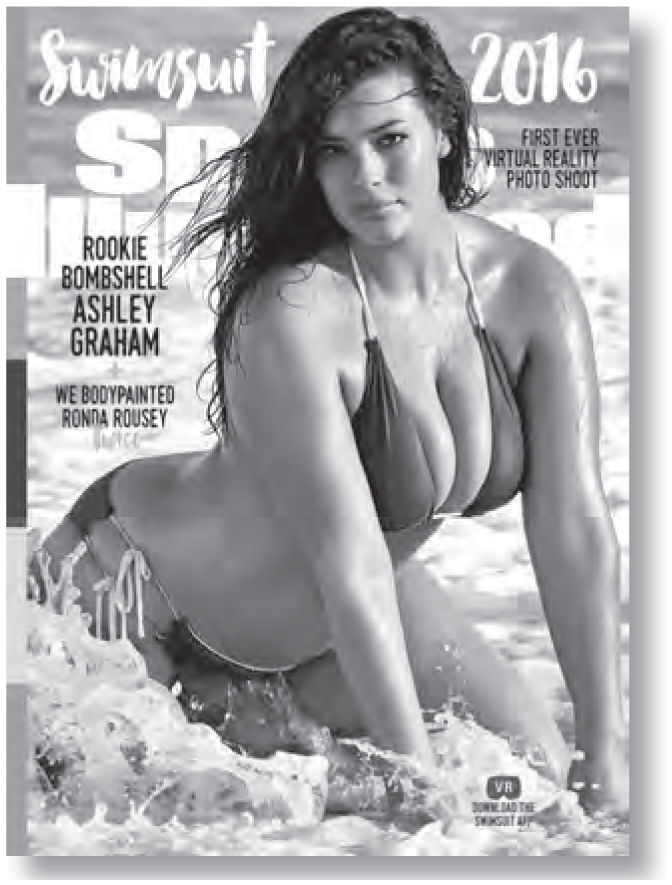
Ashley Graham covers the 2016 Sports Illustrated swimsuit edition.
Given the persistence of thin privilege within the plus-size industry, it is quite an accomplishment for models larger than a size 16 to be in the limelight. As one of these “larger” plus-size women, model and photographer D’Amour highlights the importance of capitalizing on what seems a rare moment in fashion’s spotlight: “I try to create opportunity for other people because I know that that opportunity is very limited… I think that the reason people admire me is because I give them that sense of possibility. I was able to do it. I was able to break through that barrier.” “Larger” plus-size models work to expand the definition of beauty beyond not only a size 6 but also a size 16.
First, it was the “smaller” plus-size models like Lawley and Graham who made history (the latter appeared on the cover of Sports Illustrated’s 2016 swimsuit edition). Then, it was Holliday on the cover of People Magazine and size 18 Erica Schenk on the cover of Women’s Running. Today, given the mixed reception each milestone received under the persistent cultural sigma of fat, “larger” plus-size models still have trouble establishing themselves as legitimate models. Their current celebrity status in the fashion industry is a statement and not the norm, but, ultimately, it serves as our wake-up call to size bias hanging on in the very sector of fashion believed to be immune to size discrimination. It reveals just how deeply our culture’s narrowly constructed ideas about bodies and beauty go.