




Abstract
Thinking through a notoriously expensive city’s low-income housing by focusing on residents and community.
At least since the demolition of St. Louis’s Pruitt-Igoe public housing development in the 1970s, the typical narrative is that affordable housing in the United States is a failure. Considered unsanitary, crime ridden, and toxic, affordable housing—particularly high-rise public housing—is seen as having exacerbated the characteristics of the tenements it was designed to remediate.
By the early 1990s, this interpretation found voice in the federal HOPE VI Program, which encouraged local housing authorities to address “severely distressed” public housing through demolition and redevelopment. Nearly $400 million in federal demolition grants were awarded to initiate this objective between 1996 and 2003.
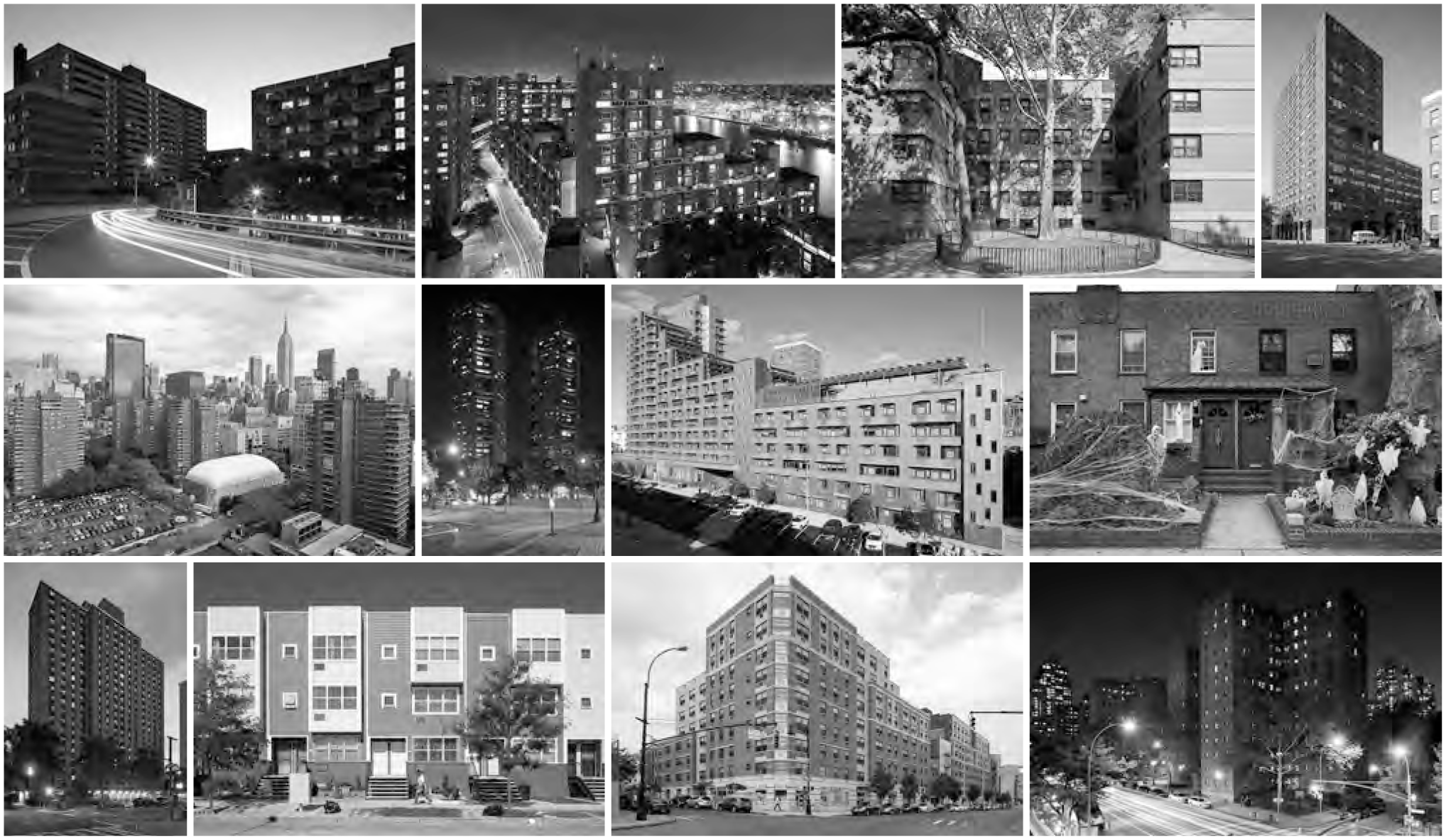
The demolition-driven approach is canon in Chicago, where I’ve spent 13 years exploring radical housing changes. With the support of the largest concentration of HOPE VI funds in the country, the Chicago Housing Authority demolished all of its major high-rise—and many low-rise—developments. It redeveloped many of the sites with low-rise, mixed-income projects. So when urban historians Matthew Lasner and Nicholas Degan Bloom approached me to produce a photographic project for Affordable Housing in New York (Princeton University Press, 2016), I jumped at the opportunity to delve into the life of affordable housing in a different environment.
New York is a special case. While infamously expensive, the city is also home to a long history of attempts to deliver quality housing to low-income and middle-class residents through private philanthropic initiatives, limited equity cooperative housing, and the New York City Housing Authority’s own developments. Moreover, despite the unprecedented demolition of public housing around the country, NYCHA demolished few of its properties, providing exceptional opportunities to compare longstanding modes of below-market housing throughout the city.
My hope is to translate concepts of the history and current condition of affordable housing into a photographic series that expresses the rich and varied lives of these communities. Readers should not only understand the developments as manifestations of urban policy, but as living places.
My New York study was constrained to just a few weeks, timed to witness how residents use outdoor common spaces in a variety of conditions, as well as how they use indoor community centers as the weather changes. Given our short timeline, the editors and I labored for months before my visit to coordinate meetings with residents and to schedule unstructured time in the developments at all times of day and night.
Once in New York, I went to affordable housing projects in all five boroughs, from early 20th century philanthropic projects like Harlem’s Dunbar Apartments to new public-private redevelopments like Staten Island’s Markham Gardens. I called on residents in their homes as they met with extended family and prepared meals and in community spaces, where I participated in baby showers and senior center bingo games. I met the people who make the developments work, including NYCHA officials, property managers, maintenance workers, and public safety officers. And I spoke with impassioned defenders and detractors of the developments, sometimes in the same buildings.
Some experiences confirmed stereotypes about affordable housing, including slow, fetid elevators and suspects fleeing police officers, but those incidents were the exception. More typically, I saw common spaces where verdant courtyards, staffed community spaces, and shopping centers increased the reported well-being of community members and facilitated social interaction.
Amid the successes, New York’s affordable housing crisis is growing. Mayor Bill de Blasio’s plan to “build and preserve” 200,000 affordable units in the city over the next decade is an example of how New York remains an outlier. Housing costs are climbing in many urban centers, yet policymakers are still slowly working toward proposals that may lead to solutions. I hope this project is a reminder that there is a wide range of potential housing models, including successful high-rise developments, in looking toward a more affordable future.
Thomas Morales and Luis Franco sit in their apartment in El Jardin de Selene, a mid-rise mixed-use building that is part of the Melrose Commons Urban Renewal Area. The multi-decade development project was created in response to a plan that would have displaced many of the neighborhood’s residents.

A view of North Queensview Homes with Manhattan beyond from another cooperative development, Queensview. Queensview opened in 1950 and North Queensview followed in 1958.

Senior Queensview and Queensview North residents watch a screening of “Born on the Fourth of July” during the “NORC Coffee Hour.” As the percentage of older tenants has increased in the developments, they have become “naturally occurring retirement communities” (NORCs) with services designed to keep residents in their homes. Many limited equality cooperatives provide ideal conditions for the development of NORCs because they remove the incentive to sell for market rates, are well designed for those with limited mobility, and have built in community spaces.

Children walk towards a common area at Markham Gardens. Unlike most New York affordable housing projects, the development is a new mixed-income, affordable housing development built on the site of a traditional public housing development. It is primarily composed of Section-8 voucher units offered by NYCHA, with a significant number of affordable housing units reserved for residents who do not have vouchers.

Artist Tracy Winston works in his Dunbar Apartments studio. Winston moved into the apartment so that he could afford to have a bedroom and a studio in his home.

Co-op City, the largest cooperative housing development in the world, contains a number of community and commercial spaces. The locations are important focal points for community life, not only providing informal social spaces, as seen here, but multi-purpose rooms that see use for anything from baby showers to exercise classes to political meetings.

Two young residents of Co-op City talk outside of the Baychester Library. The library opened to serve residents in 1973.

As with Co-op City, Rochdale Village was designed with commercial spaces. The mall seen here is the larger of two on the property and is currently undergoing a major renovation. In addition to shops and restaurants, this mall once housed amenities such as a rollerskating rink and an indoor tennis facility.

Yolanda Cruz visits with her son in her El Jardin de Selene apartment.

The New York City Housing Authority operates a number of community and senior centers for the benefit of residents. The bingo event seen here is regularly hosted by the Ralph Rangel Houses Senior Center.

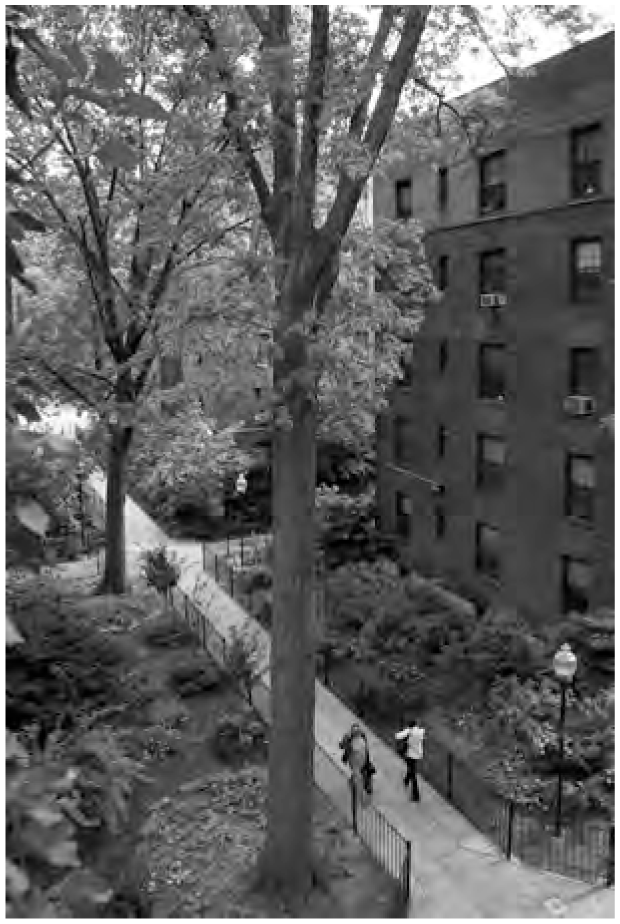
John D. Rockefeller, Jr. developed the Paul Laurence Dunbar Apartments for African American families in 1926. As a private philanthropic effort, it was constructed as a repudiation of the presumed need for state subsidies; however, it faltered as a cooperative and is now a privately owned rental development. The grounds are among the features most celebrated by the tenants.
Polo Grounds Towers maintenance staff clear an apartment and clean an elevator.
