




Abstract
Black-brown coalition activism is changing hearts, minds, and legislation in Mississippi and across the American South.

It was a brilliantly sunny morning in Jackson when a group of activists amassed at the offices of the Mississippi Immigrant Rights Alliance (MIRA). They were there for the organization’s annual Civic Engagement Day, and the hallways were lined with coolers of drinks, pots of beans, and stacks of tamales—fuel to sustain the activists during the afternoon of lobbying and marching that lay ahead. It was January 2015, and the state legislature was poised to begin debate on 11 bills designed to restrict the rights of undocumented immigrants.
MIRA’s offices were packed with Latino immigrants, mostly of Mexican origin, who had raised money for a coach bus to travel the three hours from the Gulf Coast to Jackson for the events. State police regularly pull people over for “driving while brown” so traveling the interstate in cars would have been risky for the undocumented in the group. Arranging and paying for a chartered bus took tremendous commitment and coordination from the activists. But their resolve was strong and their goals were clear: convince legislators to defeat the eleven anti-immigrant bills and begin the push for in-state tuition benefits for undocumented students.
Before the group began its walk to the capitol, Bill Chandler, MIRA’s director, introduced many of the faces in the room and then quickly got down to business. A veteran labor and civil rights organizer, Chandler has spent the last ten-plus years organizing rallies, filing lawsuits, and lobbying Mississippi’s political leaders to support immigrant rights. On this day, he handed out worksheets that explained how a bill gets processed in the state legislature. Speaking of MIRA’s challenges and triumphs, he energized the group for the upcoming march, a press conference on the capitol steps, and an afternoon of lobbying sessions with legislators. Shortly thereafter, the crowd headed out the door.
When the activists donned their red, white, and blue caps and gowns and grabbed their placards and buttons, their chances of success seemed slim. They lobbied and marched against the backdrop of Mississippi’s grizzly history of slavery, sharecropping, and civil rights repression. The recent and rapid growth of Mississippi’s Latino immigrant population and the backlash against that growth are but the latest chapters in the state’s long and tumultuous history of racial inequality and political conservatism. But when the legislative session came to a close, two months after MIRA’s coordinated lobbying and advocacy efforts, all of the so-called “bad bills” were dead. Not a single anti-immigrant bill even reached the floor for debate. It was a significant victory, but it was hardly the first of its kind for MIRA. Since 2005, and during a time when anti-immigrant measures have spread like wildfire in other states, MIRA and its allies have spearheaded the defeat of 282 anti-immigrant bills in Mississippi. Only one such bill has passed in the state in over a decade. No funding was ever appropriated for the measure, and it has never been enforced.
When we first arrived in Mississippi, we wanted to understand the array of policy approaches that “new immigrant destination” states have taken to their changing demographics. Some states, like Alabama and South Carolina, have captured national attention with their sweeping anti-immigrant measures, but the less told tale is of the places that, despite conservative racial and political histories, are witnessing increasingly successful resistance to this punitive turn. To understand these patterns, we combed through archival materials, marched with activists, and interviewed key stakeholders involved in immigration politics in Mississippi. We found that, even more surprising than the state’s rejected anti-immigrant bills, was the coalition behind these defeats. MIRA counts among their friends and allies not only the Black Legislative Caucus, but also every major civil rights and labor organization in the state. Over the course of our research, informed by our previous work on race and public policy in North Carolina and Georgia, we came to understand that this Black-Latino coalition was not only influencing the sphere of immigration politics in Mississippi, it was part of a strategic political vision slowly being realized across the South.
Natural Enemies?
The powerful Black-Latino coalition that has emerged in Mississippi flies in the face of what social scientists generally assume about Black-Latino relations. Researchers and the media have long contended that the two groups have a contentious and adversarial relationship. Political scientists Paula McClain and Claudine Gay, for example, claim that Blacks and Latinos are in near constant competition for resources. This competition supposedly breeds contempt between the groups and leads Blacks and Latinos to adopt stereotypes and negative attitudes toward each other. The result, scholars claim, is that Black-Latino political coalitions are unlikely because the groups’ political interests are fundamentally incompatible. So widespread is the presumption of Black-Latino conflict that media outlets across the country—from Los Angeles to Miami, from Charlotte to Dallas—have published stories about ongoing tensions brewing between the groups. Stories of coalitions and cooperation are few and far between.
MIRA was founded on the principle that “all immigration laws from the beginning are about two things: racism and managing labor.”
Armed with this knowledge, we were fascinated, in the early stages of our research, to see evidence of a seemingly cohesive and politically influential Black-Brown alliance in Mississippi. As we combed through more than a decade’s worth of news articles from Mississippi’s largest newspapers, it became increasingly clear how central this alliance was to the state’s political scene. Mississippi’s pro-immigrant movement, we learned, is run by a close-knit team of immigrant rights workers, civil rights movement veterans, and labor leaders, most of whom are Black or Latino. The staunchest allies of Latino immigrants in the legislature are members of the Black Legislative Caucus. So strong is their support that immigration is widely known as a “Black issue” in the state.
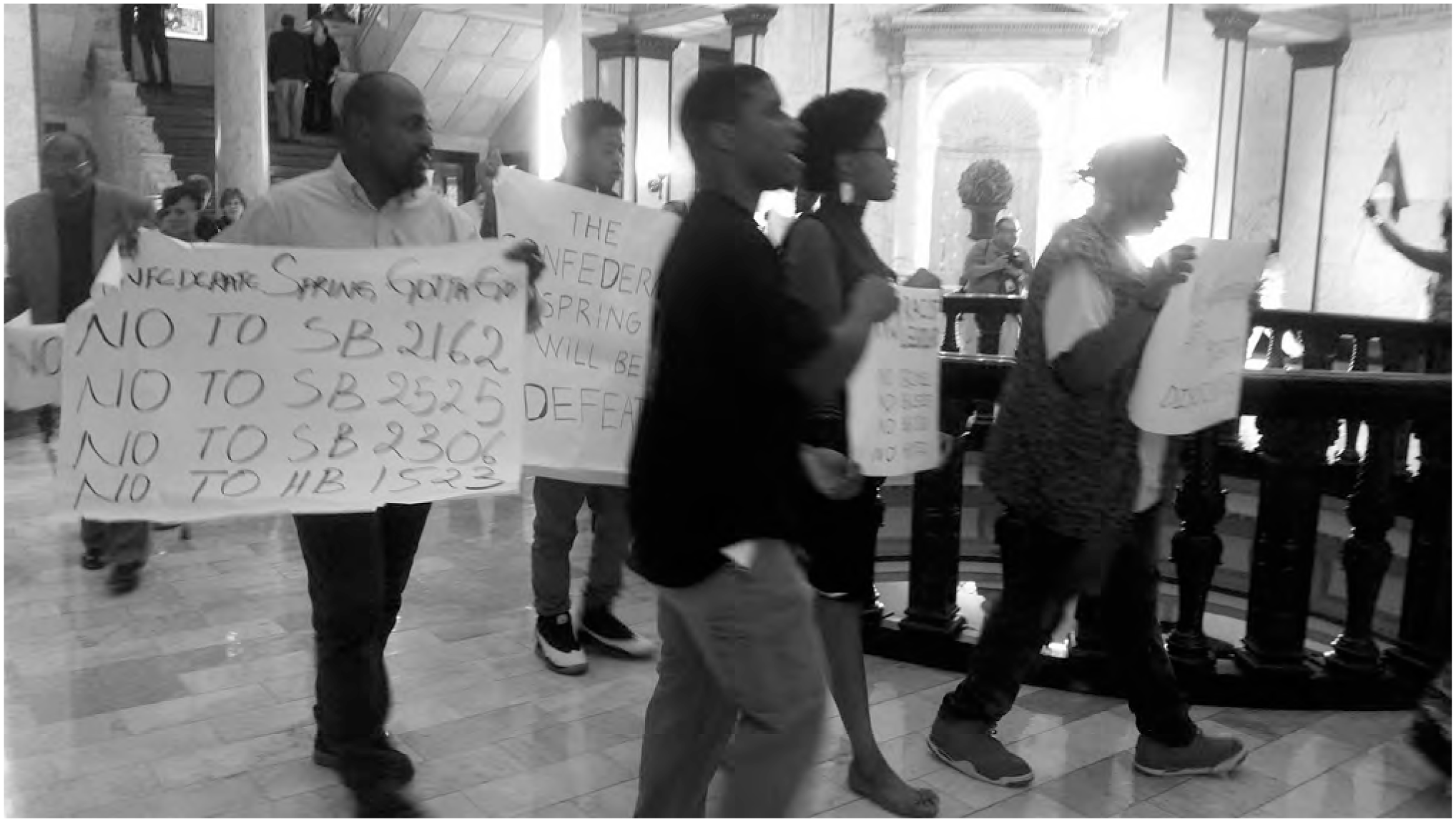
We saw this cooperation in action when we accompanied MIRA on its march and rally that January day in 2015. Latino immigrant activists marched with Black representatives from the Southern Christian Leadership Conference, the ACLU, and local unions, and these Black leaders joined Latino youth in chants of “Si Se Puede!” and echoed with cries of “Yes We Can!”
MIRA members protest in a photo accompanying 2016 press release, “Will It Be Illegal To Be Brown in Mississippi?”
Mississippi Immigrants Rights Alliance
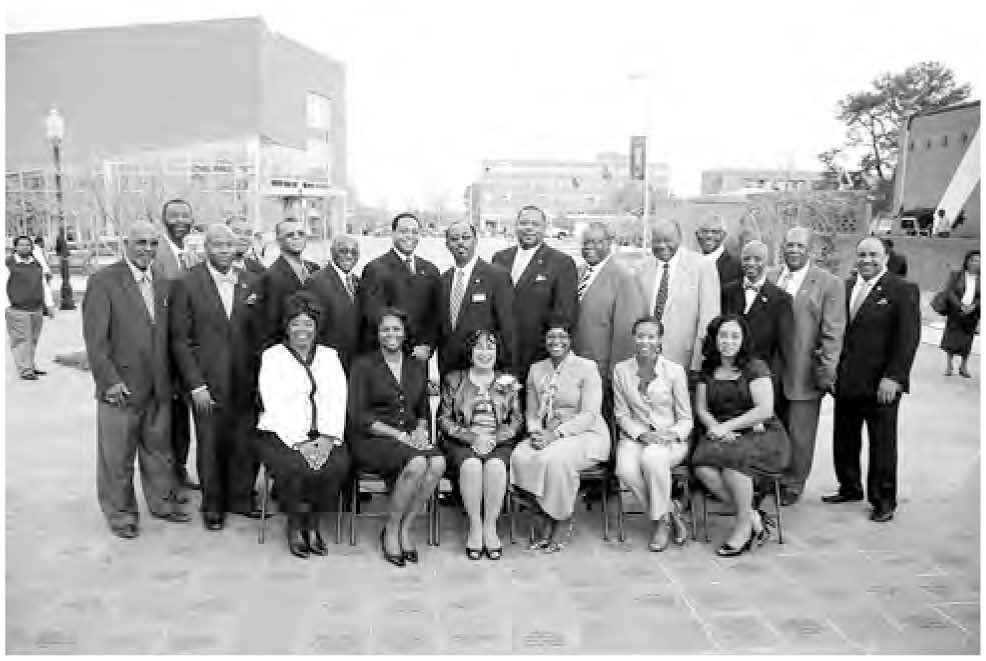
Members of the MS Black Legislative Caucus pose at Jackson State University.
JSU Newsroom
The deeper we dug into the Mississippi story, the more interested we became in this alliance and its effects on state politics. We learned that the alliance was not accidental, but strategic—and years in the making. MIRA, journalist David Bacon writes, has built its well-oiled advocacy machine around the belief that “Blacks plus immigrants plus unions equals power.” They have worked diligently over the last decade to build a broad interracial coalition strong enough to resist the force of the state’s violent racial past and the racial conservatism of the present.
Immigrant Rights are Civil Rights
As its name suggests, MIRA’s central focus is on immigration issues in Mississippi. But one look at the organization’s archives makes clear the decades of organizing and activism that have given shape to the organization. A room with binder-lined walls tells the story of how the contemporary Mississippi immigrant rights movement grew out of earlier struggles for social justice in the 1960s and ‘70s. Virtually all of the major players in MIRA are veteran activists and religious leaders who understand, much like social movement scholars do, the complex, strategic, and painstaking work of creating social change.
The biographies of MIRA’s leaders make this clear. Take Bill Chandler, a White Californian who looks a bit like Kenny Rogers. Chandler moved permanently to Mississippi in 1989 as a labor organizer, following long stints in Texas and Detroit where he registered voters and organized nurses and other skilled workers. Earlier in his career, he had organized Latino grape workers in California with such luminaries as Dolores Huerta and Cesar Chavez, before moving eastward to work on Charles Evers’ campaign for Mississippi governor. By the time Chandler returned to Mississippi, his organizing work had instilled in him a belief that the future of progressive politics depended on a strong Black-Latino coalition. This was particularly true in Mississippi, where African Americans accounted for over one-third of the population (more than any other state) and the Latino population was beginning to grow.
Dancers perform at the annual MIRA fundraiser dinner.
Natalie Maynor, Flickr CC

This knowledge weighed in Chandler’s mind when casinos began booming on Mississippi’s Gulf Coast in the ‘90s. The gaming industry aggressively recruited undocumented Latino workers who began arriving in the state in numbers for the first time. Later, the casinos contracted out their hiring to recruiters who, in turn, abused the workers. Rather than go underground, several of the Latino casino workers began to organize. They presented a number of demands regarding working conditions and wages. Management met with them, agreed to the demands—and, the next day, had the immigrant workers arrested and put into deportation proceedings.
The contemporary Mississippi immigrant rights movement grew out of earlier struggles for social justice in the 1960s and ‘70s. Virtually all of the major players are veteran activists who understand, like social movement scholars, the complex, strategic, and painstaking work of creating social change.
The veteran labor organizer, Chandler, went to the coast immediately to support the largely Black union leadership responding to the incident. Just as unions in the state began to embrace immigration as an issue, rumors were spreading that Latino immigrants were being denied enrollment in public schools—a clear violation of federal law. Given the state’s legacy of Jim Crow segregation and racially unequal schooling, many Black leaders saw these practices as a direct affront to their decades-long civil rights agenda. Chandler and a small group of religious leaders seized the opportunity to recruit SCLC leader and ALF-CIO organizer, Jim Evans, to the fight for immigrant rights. Soon after, they also recruited former Civil Rights leader (and soon to be Jackson city Mayor) Chokwe Lumumba to the cause. Chandler had marched in Detroit with Lumumba, who had recently returned to Mississippi to serve as a public defender. Together, the group built an organization that, from its inception, was intentionally composed of civil rights, labor, faith-based, and community organizations from around the state, all working alongside and on behalf of Latino immigrants. Chandler captained the ship, but it was the state’s Black leadership who embraced immigration as the new civil rights issue of their time.
Doug McAdam and other movements scholars have shown that participants in the Civil Rights movement often moved on to participate in other social justice campaigns, leveraging their activist networks and organizing experience to build new movements. The ability of Lumbumba, Evans, and Chandler to erect MIRA and build a Black-Latino alliance rested on exactly these kinds of ties from movements past. When MIRA’s leaders approached the state’s Black legislative caucus for support on immigration issues, they knew how to frame immigration in a way that would resonate with the group’s commitment to racial justice. “When we took migration issues to the Black caucus,” Chandler recounted, “they jumped on board. It didn’t take much for them to adjust their thinking and see that [immigrant rights and civil rights] were the same issues.” Unanimous supporters of immigrant rights, Black caucus members have leveraged their seniority and control over key legislative committees to prevent most anti-immigrant bills from ever reaching the floor for a vote.
By 2005, MIRA had established its bona fides, marshalling enough support in the legislature to kill several anti-immigrant bills and launching a media campaign designed to spread the message that Blacks and Latinos were not enemies, but allies.
In Mississippi, Black-Latino alliances have produced not only legislative successes, but have changed the way many in the state think and talk about racial politics.
When Hurricane Katrina ravaged the Mississippi Gulf Coast in August of that year, MIRA took on new relevance. After the storm, an estimated 350,000 Latino construction workers, mostly undocumented, arrived in Mississippi. They labored in hazardous conditions to clean up the area and rebuild devastated properties, only to have their wages stolen by ruthless contractors. At the same time, many emergency shelters refused to admit established Latino residents who had lost their homes and often forcibly evicted those who managed to gain entry. MIRA and its team of largely Black and Latino legal advisers soon became the main lifeline for Latino immigrants in the region, forcing shelters to change their practices and, more impressively, winning over one million dollars in back wages for immigrant workers cheated by their employers.
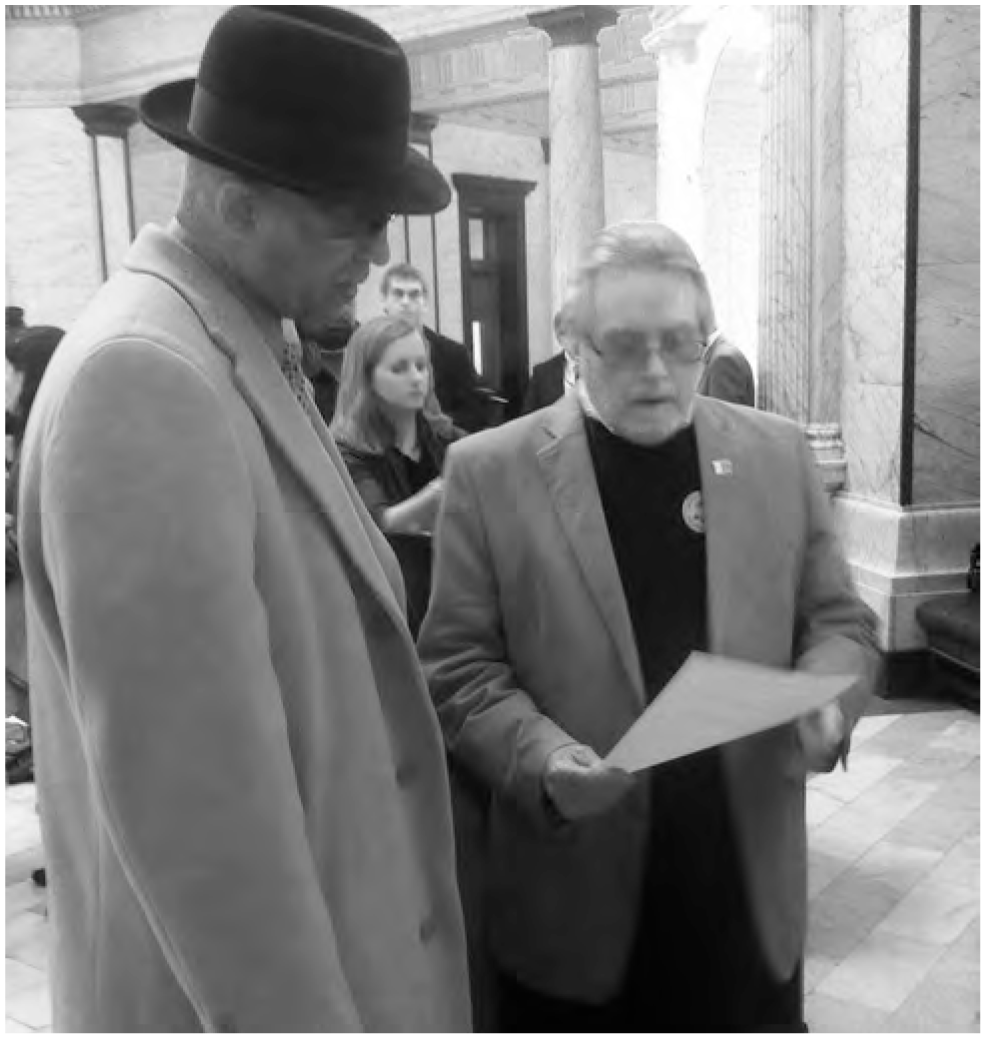
Bill Chandler talks with Chokwe Lumumba, known for ending his speeches with the slogan “Free the Land,” a nod to workers’ rights.
Mississippi Immigrants Rights Alliance
In the coming years, anti-immigrant policy efforts swelled in states across the nation and federal immigration enforcement escalated. In 2008, federal immigration officials undertook what remains the largest immigration raid in U.S. history. Descending up on a Howard Industries plant in Laurel, MS, they arrested and deported over 600 undocumented Latino workers. The raid left a scar on the community, particularly the African-American employees of the plant, many of whom watched their coworkers and fellow union members get taken away from their jobs and families. In the coming weeks and months they worked with MIRA to find the families of those arrested and deported and to raise funds to support them.
MIRA not only fostered social ties between Blacks and Latinos on the ground, they doubled down on their legislative work. As they did in so many other states, national organizations like the Federation for American Immigration Reform (FAIR) and the American Legislative Exchange Council (ALEC) had partnered with state Tea Party representatives to craft a spate of anti-immigrant bills. In 2009 alone, thanks largely to MIRA and the Black Caucus, 77 anti-immigrant bills died in committee. By 2015, the group had killed nearly 300 bills, leaving Mississippi the only state in the Deep South without any enforceable anti-immigrant bills.
These efforts were facilitated by MIRA’s continued boots-on-the-ground work of building a strong Black-Latino alliance. Over the last decade MIRA has regularly held joint press conferences with the Black caucus and engaged in lobbying days and protests alongside Black legislators. Nearly every year, Latino immigrants and Black leaders hold unity conferences, designed to build ties between the groups. Equally important, immigrant rights activists now serve as allies to labor unions and civil rights organizers, joining workers on the picket lines, calling on Latinos to support investment in Black communities, and participating in affiliate events.
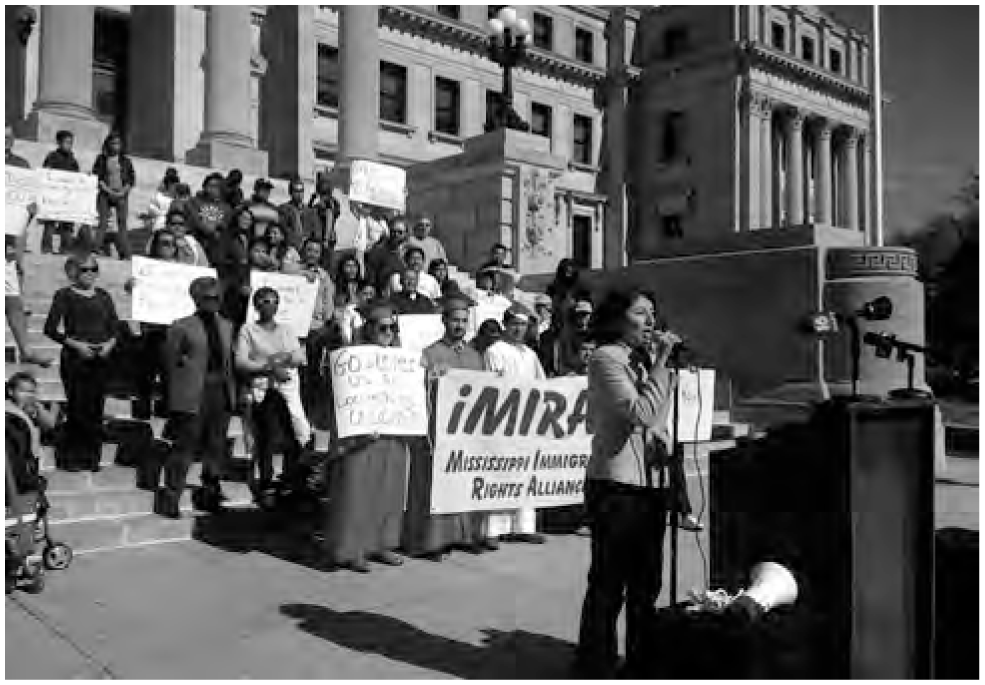
Civic Engagement Day mobilizes citizens to gather at the state capitol every February.
Mississippi Immigrants Rights Alliance
MIRA’s key players also established strong ties with local media outlets, giving them a key forum to advance the idea that Blacks and Latinos share a common experience of discrimination and a common goal for change. When we analyzed the language Mississippi newspapers used to discuss Black-Brown relations, the effects of MIRA’s strategic meaning work were clear. Up until 2006, news media in the state characterized Black-Brown relations as rife with conflict and indifference. Yet by 2009, nearly 100% of stories about Black-Brown relations in Mississippi discussed similarity and cooperation rather than conflict, a trend that persists today. The sense of linked fate is so prominent in the political arena that Mississippi NAACP president Derrick Johnson has publicly announced, “Any legislation that discriminates against Latinos, discriminates against African-Americans.” In Mississippi, Black-Latino alliances have produced not only legislative successes, but have changed the way many in the state think and talk about racial politics.
A New Politics for a New South
MIRA’s leaders attribute their success to coalition-style politics and its rootedness in the social justice battles of earlier eras. “I think what helps us,” Chandler explains, “is that we have relationships we’ve built up over the years, we have people coming from different struggles. That is the power of the South I think. And we saw right away the potential for significant political change.”
He is not alone in this assessment. Few states managed to build an influential Black-Latino coalition as early as MIRA, but alliances are emerging now across the region. After the passage of sweeping anti-immigrant bills in South Carolina, Alabama, and Georgia in recent years, local organizers have galvanized efforts to build precisely the kind of Black-Brown networks that have fueled MIRA’s success. In fact, immigration advocates in many states have looked directly to MIRA and Mississippi to replicate their efforts. In Alabama, the Hispanic Interest Coalition of Alabama (HICA) has recruited African-American leaders to its board, taking MIRA’s leadership on as advisers in the process. A newer coalition, the Alabama Coalition for Immigrant Justice (ACIJ), includes Black-Brown unity as one of its core tenets and is a lifetime member of the Birmingham NAACP chapter.
MIRA was founded on the principle that “all immigration laws from the beginning are about two things: racism and managing labor.” In treating these issues as interwoven, the coalition has established a political campaign and style premised on the idea that Black and Latino issues are inextricably linked, that there are “power connections” between racism against African-Americans and discrimination against immigrants. As the group’s leaders are well aware, the implications of this alliance are vast. Mississippi’s Black-Latino coalition and the emergent alliances in other parts of the South aim not only to protect the rights of immigrants but to spark a new “power politics” that spans beyond immigration to other causes. Rather than shore up racial divides, these coalitions have their sights set on forging a new progressive political alliance that can reshape the region’s political landscape for years to come.