




Abstract
This paper argues that the (re)framing of the Kurdish movement from national liberation to radical democracy in Turkey has set the ground for a redefinition of strategies from ethnic rights to civil rights. In this sense, the Kurds have put forward a meta-political critique of society by going beyond ethnic claims. We show how, as the result of criticizing the neoliberal representative democracy and the capitalist state, the Kurdish liberation movement’s strategies were transformed to advancing broader civil claims. Based on original research, we elaborate on three concrete expressions which have emerged as the result of this transformation: The Democratic Society Congress, the women’s movement and the environmental movement. Finally, we explore the emancipatory potential of this shift for recognition of the rights of minorities in particular and for broader social change in general.
Introduction
Kurds are an ethnic group who appeared in the Middle East around 600 BC. Originally nomadic and rural-based people, they started to flourish around the two main rivers of the Tigris and Euphrates, close to the Zagros Mountains, in what we today identify as Mesopotamia. From this very first stage, Kurds have been growing through their own kingdoms, with their own languages, cultures and diverse religious beliefs.
Following the collapse of the Ottoman Empire in 1923, the Republic of Turkey was established and Mustafa Kemal Atatürk served as its president until his death in 1938. Atatürk was a secularist and a nationalist whose main objective was to transform the multi-ethnic and multi-religious Ottoman Empire to a secular, modern nation-state. He was strongly influenced by European notions of modernity, nationalism and state and by the Young Turks Movement which emerged in the early years of the 20th-century and believed the West provided a model for the ideal society of the future (Hanioğlu, 2017). Atatürk implemented a number of reforms directed toward the westernization of the country. He followed a radical secularization and modernization program which included a series of political, economic, social and cultural policy changes. It was within this framework that Turkish became the official language of the country and different ethnic and religious groups were systematically suppressed. As Jongerden (2001: 81) puts it, the political heritage of Atatürk can be summarized with reference to its ethnic nationalist ideology and the authoritarian state. Consequently, the realization of a ‘nation-state with a single ethnic identity’ became the main objective (Jongerden, 2001: 81). 1 While the government embarked upon a radical program of nation-building, ethnic diversity was perceived as a danger to the integrity of the state, and the Kurds, as the largest non-Turkish ethnic group, constituted the most serious threat. They were decreed to be Turks, and their language and culture were to be Turkish.
Since then, Kurds in Turkey have been struggling, in different ways, for recognition of their ethnic background. In 1925, Shaik Said Piran led an uprising for an independent Kurdistan. However, the revolt was quickly suppressed and Shaik Said and a number of his followers were executed. In 1927, the Republic of Ararat was declared independent by rebel Kurds in south-eastern Turkey, but the revolt was put down and in 1931 Turkey resumed control over the territory. In 1937, an uprising in the Desrim region of eastern Turkey was brutally suppressed. Thousands were killed and displaced and southeast Anatolia was put under martial law. Many Kurds were displaced and their villages were destroyed. Moreover, the Turkish government settled other ethnic minorities in Kurdish areas to change their ethnic composition. The Kurdish language was banned, and official discourse began to refer to Kurds as ‘mountain Turks’ (Ghaliand, 1993). These measures had a dramatic influence on the Kurdish independence movement and it was only in the 1970s that the Kurdish ethnic revival transpired and became a potent political force on the national stage.
The Kurdistan Worker’s Party (PKK) was founded by a group of students and led by Abdullah Öcalan; the PKK combined Kurdish culture, nationalistic ideologies and Marxist–Leninist theories and demanded an independent and united Kurdish state. For the first twenty years, the PKK fought for the creation of an independent Kurdistan. Similar to many national liberation movements, it initially believed that the establishment of an independent state would be an emancipatory solution to the oppression the Kurds were experiencing. However, after the collapse of the Soviet Union, the party began to develop a fundamental self-criticism as well as a criticism of the dominant socialist politics of the time, and a focus on seizing state power. Hence, ‘the PKK disconnected the idea of self-determination from the idea of state establishment and reconnected it to that of self-government’ (Jongerden, 2016: 106).
In the 1990s, Abdullah Öcalan, the imprisoned leader of the PKK, started to move toward a new ideology for social change. In 2005, he called for a radical democracy project and advocated Democratic Confederalism. Democratic Confederalism rests on three primary ideological pillars: direct democracy, women’s liberation and ecologically oriented human–environment interactions. Öcalan defines Democratic Confederalism as democracy without a state and a system of governance based on bottom-up decision-making processes. Moreover, for Öcalan, women’s freedom is one of the most important characteristics of a democratic nation and he believes that, without women’s freedom, a society cannot be free. That is why he advocated Jineology or the science of women as one of the important ideologies of the new paradigm. Ecology and ecological well-being is another core principle of this paradigm. To a large extent, this can be attributed to the influence of the social ecologist Murray Boockchin on Öcalan, who believed that the roots of our ecological problems can be traced to social problems and that these two are deeply interconnected. The introduction of the concept of Democratic Confederalism to the Kurdish liberation movement marked the beginning of a new paradigm for the struggle. In this article, we show that the concrete expression of this shift can be seen in the emergence of the Democratic Society Congress (DTK), the environmental movement and the women’s movement.
The article proceeds as follows: in the next section, we discuss the existing literature on the Kurdish liberation movement in Turkey and show that the academic literature on the movement has paid scant attention to the concrete consequences of the shift from national liberation to radical democracy at a grassroots level. Consequently, the transformative potential of such a shift has not been truly explored. In the third section, we briefly discuss the methodology and the challenges we faced during the field work. In the fourth section, we illustrate the shift in framing of the movement over time. In the fifth section, we draw on DTK, the women’s movement and environmental movement as three concrete expressions of this shift and elaborate on significance of redefining strategies within the movement. Finally, we summarize and conclude the paper by demonstrating the emancipatory potential of the Kurdish liberation movement for recognition of the rights of minorities in particular and for broader social change in general.
The Kurdish struggle: State of the art
A large number of scholarly writings on Kurds in Turkey have been either on Kurdish nationalism and national identity (Al, 2015; Casier, 2010; Donmez, 2007; Ekmekci, 2011; Ergin, 2014; Gunes, 2007; Olson, 1989, 1996, 2009; Romano, 2006; Tezcur, 2009; Van Bruinessen, 1992; White, 2000) or on the Kurdish conflict in the 1980s and 1990s (Barkey and Fuller, 1998; McDowall, 2000; Olson, 1996; Romano, 2006). However, what seems to be striking in the literature is the conceptualization of the Kurdish struggle as the ‘Kurdish question’ or the ‘Kurdish problem’ (Icduygu et al., 1999; Van Bruinessen, 1989; Yeğen, 2007). With regard to the so-called Kurdish question or problem, most of the academic literature has focused on the PKK and its guerrilla insurgency against the Turkish state (see, e.g. Gunter, 1997; Marcus, 2007; Saraçoğlu, 2010; White, 2000). One problem which has emerged as the consequence of this emphasis is a neglect of the fact that the Kurdish struggle is a struggle of an ethnic minority group (Barkey and Fuller, 1998). Moreover, this emphasis on the PKK has also created a large body of scholarship addressing the Kurdish question from the angle of criminology (Kubera, 1999; Roth and Sever, 2007; Walter and Fricke, 1988) or of terrorism (Demir and Zeydanlioglu, 2010; Roth and Sever, 2007).
After the beginning of discussions between Abdullah Öcalan and the Turkish government in the wake of the 2007 elections, when the DTK (Democratic Society Party) obtained 22 seats in the National Assembly, the social and political significance of the Kurds started to be discussed increasingly, within society and among academics. Hence, academic literature started to move from discussions about the PKK to the DTP (Regional Kurdish Party). In other words, the Kurdish struggle started to be recognized as a broad social issue and an emancipatory project rather than associated with criminology or terrorism. Furthermore, the sixth cease-fire on 13 April 2009 with the PKK made academia and public opinion aware of the possibility of having Öcalan as a possible interlocutor. Since then, not only has the image of the PKK and its leader changed, but also the entire legitimacy of the Kurdish liberation movement has been transformed. For example, Gambetti (2009: 44) defined the Kurdish question as ‘the potential of social movements to alter power structures in a given polity’, contextualizing the Kurdish struggle within a wider context of neo-colonial state policies. Jongerden (2016) asserted the importance and resonance of the shift within the PKK and emphasized its potential to redefine democracy, not only in Turkey, but also in Syria and Iraq. Thus, the Kurdish Question finally became a concern of democratic citizenship (Öcalan, 2012). The emergence of this new perspective toward the Kurdish struggle did not lead to a proliferation of literature on the radical democratic aspects of the movement, with the exception of two books that particularly focused on this shift. In The Kurdish National Movement in Turkey: From Protest to Resistance, Gunes (2011) traces the historical development and transformation of the Kurdish political identity by drawing on discourse analysis. The author shows how and why the discourse of national liberation was replaced by the discourse of democracy within the Kurdish movement and discusses further implications of this transformation for mainstream conceptions of democracy in Turkey. This work remains focused on discursive analysis of the shift toward radical democracy, and in The PKK: Coming Down from the Mountains, White (2015) illustrates the shift from national liberation to radical democracy by focusing on the historical transformation of PKK and the ways this shift has impacted on its internal dynamics. These two books remain very significant in understanding the discursive and organizational aspects of the shift to Democratic Confederalism but they do not discuss the concrete expressions of this shift at the grassroots level which is the main focus of this paper.
Methodology: Where, why and how
The article is based on one month of participant observation and informal discussions in different parts of Bakur, 2 in late 2015. This was complemented by 14 in-depth, semi-structured interviews with a variety of actors involved in the movement, ranging from mayors, to members of the DTK, women’s movement activists, environmentalists and guerrilla-fighters. 3 The research was conducted by one of the authors and in collaboration with a colleague. Local residents and activists provided a tremendous amount of support during the research which ranged from arranging the meetings and interviews to organizing trips and providing accommodation. Depending on the nature of the city or town, the site of participant observation, the focus of informal interviews and selection of interviewees for semi-structured interviews varied. The research was conducted in seven cities and towns (See Map 1). Each of these towns and cities has its own particularities and, taken together, they constitute a broad sample. In the following, we first explain the rationale behind choosing each city and explain their importance for the research before briefly discussing the challenges faced during the field work.
The research started in Amed (Kurdish name of Diyarbakir), a city of particular importance, believed to be the capital of Bakur and overall, of decisive relevance in the entire Kurdish region. All the main institutions associated with the movement such as the main buildings of the DTK and many commissions are located here. Batman was the second city where the research was conducted. The city developed in the 1960s due to the discovery of oilfields in Anatolia. Originally oil companies working there were from other countries (e.g. Shell), but today the operations are conducted by the national Turkish oil company. For this particular reason, the ecological commission is very active in the area working hand in hand with the environmental movement. The third site of research was Cizre which lies at the corner between Turkey, Syria and Iraq. The population of Cizre has been heavily affected by the bordering Rojava canton and many young people have left to join the youth militia on the other side. Also, in September 2015, a conflict between Turkey and the PKK broke out in Cizre and the YDG-H, an organization closely linked with PKK declared a state of self-rule. Located in between the high Candil Mountains, Şırnak was the fourth site of our research. Şırnak has always been a hub of training for many members of the PKK. Thus, given the fact that almost the entire population of the city is Kurdish, the sensitivity of the struggle is among the strongest in the region. Hakkari, a city that was the site of one of the biggest Armenian massacres in the 20th-century, and is currently a PKK enclave, was the fifth site of research. In Yuksekova (formerly known as Gever), it became possible to have an intensive engagement with head-covered militants of the YPG-YPJ. Finally, Van, on the Iranian border, was the last research site. It is a relatively affluent city in which the assemblies work quite well.
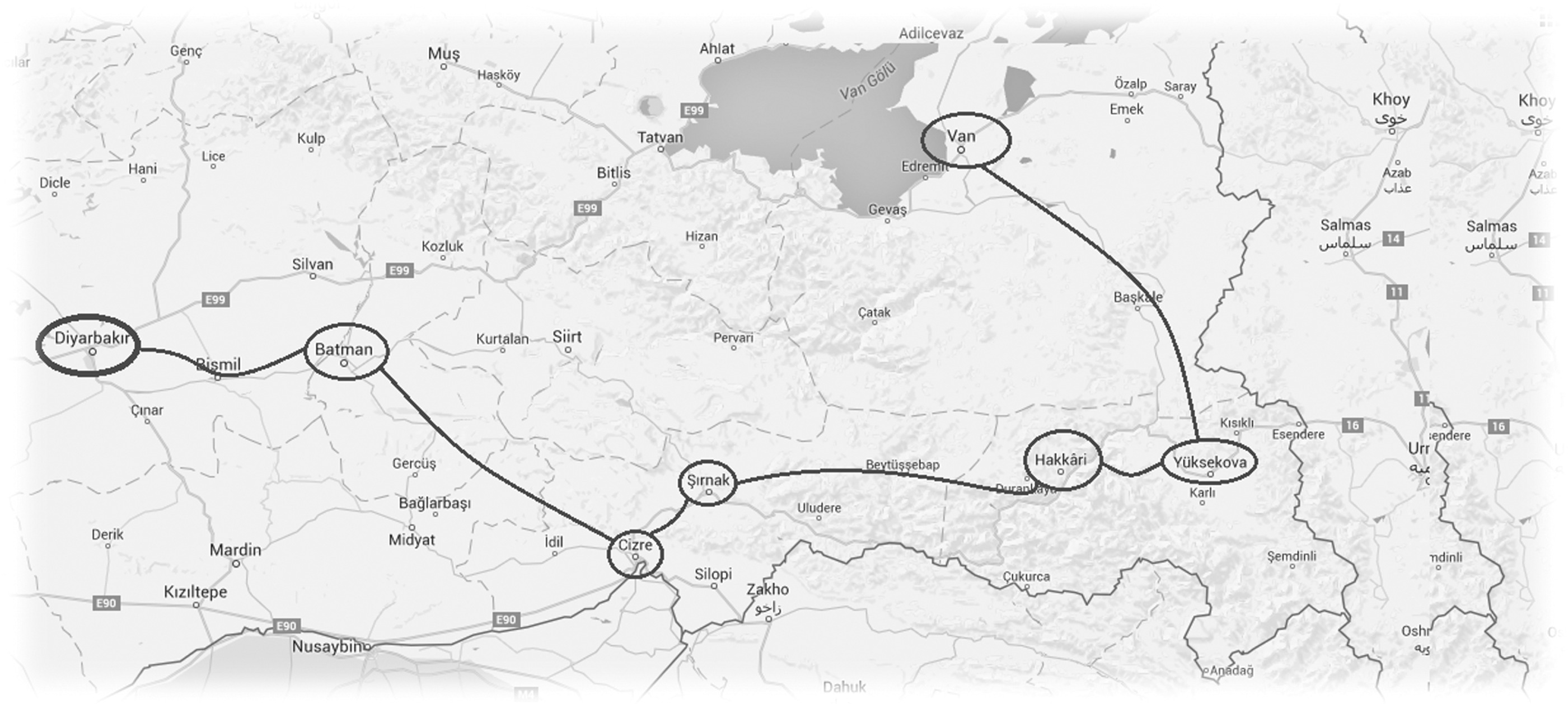
Research sites.
Similar to any research being done in highly contentious areas, the process of data collection for this research was not anything but smooth and, without the help of activists and ordinary people from the area this research would not have been possible. Moreover, studying a highly controversial phenomenon linked to ideological beliefs carries great risk of bias. Having this in mind, the researchers remained cautious of this issue throughout the field work and attempted to leave any personal considerations aside. However, research from a totally different viewpoint would definitely be complementary to this study.
(Re)framing the movement: From national liberation to radical democracy
The origin of the concept of frame can be traced back to the work of Erving Goffman. He introduced this notion as a basic cognitive structure which shapes our perception of social reality or a ‘schemata of interpretation’ (Goffman, 1974). Based on Goffman’s work, Benford and Snow (2000) and Snow and Benford (1988, 1992) developed the term ‘framing’ in social movement studies. They defined framing as the process of constructing meaning by activists belonging to a social movement or social movement organizations. Moreover, they argued that frames simplify ‘the world out there by selectively punctuating and encoding objects, situations, events, experiences, and sequences of actions within one’s present or past environment’ (Snow and Benford, 1992: 137). The most significant aspect of framing in the literature is its emphasis on the symbolic aspects of mobilization and the work carried out by activists to articulate rationale for their collective action and proposed solutions. This process is claimed to be contentious in the sense that ‘it involves the generation of interpretive frames that not only differ from the older ones but may also challenge them’ (Benford and Snow, 2000: 614). In this section, we discuss the process of frame transformation (Snow et al., 1986) in framing the Kurdish liberation movement in Turkey by focusing on two aspects of framing: diagnostic and prognostic frames. While the former refers to the identification of the problem(s), the latter outlines the solution(s) (Snow and Benford, 1988). In the next section, we show how this transformation has impacted on mobilization strategies.
Like many national liberation movements of the time, the PKK originally fought for the creation of an independent Kurdistan and considered the establishment of an independent state as a solution to violence and oppression. It was believed that the most effective way of protecting the rights of Kurds as an ethnic minority would be to secure them a territory in their control. Nevertheless, after the collapse of the Soviet Union, the armed struggle and the Marxist–Leninist approach to liberation gradually lost its legitimacy as a political strategy and support among ordinary citizens declined. The global crisis of capitalism and the failure of nation-states to solve the social and economic problems of their citizens provided another ground for reconsideration and reframing of the movement. Hence, the movement began a process of self-criticism, and the PKK started to distance itself from armed struggle with the first unilateral ceasefire in 1993. However, it was only after Öcalan’s imprisonment in 1999 that his ideology changed significantly, and he advocated a new mode of struggle (White, 2015).
This new political strategy focused on developing people’s capacities in order to make them govern themselves (Akkaya and Jongerden, 2013; Jongerden, 2018). Hence, this shift led to a transformation of the diagnostic and prognostic frames within the movement. Öcalan (2012) heavily influenced by Murray Bookchin, developed the argument that the creation of a state will eventually bring about an unequal system; it will create hierarchies; unfair economic distribution and a fascist retention of power. Moreover, he emphasized the fact that, in contrast to what the notion of ethnic nationalism would suggest, the traditional homelands of the Kurds were neither just Kurdish, nor were Kurds entirely Kurmanji 4 speakers. People from different backgrounds, beliefs and cultures, from Armenians to Alevis and Christians have been historically living in these lands (McDowall, 2000). This signaled that a predominantly Kurdish state would exercise power over those minorities, eventually leading to the same oppression Kurds have experienced for centuries. Öcalan concluded that humanity's ‘freedom problem’ was not related to statelessness, but has its roots in the emergence of the nation-state (diagnostic framing). He emphasized that: ‘the PKK never regarded the Kurdish question as a mere problem of ethnicity or nationhood. Rather, we believed, it was the project of liberating society and democratizing it’ (Öcalan, 2011: 7).
Öcalan claimed that, through a radical democracy project, different groups of people would participate in the democratization process and therefore the perception of participation among different segments of society would be redefined and this eventually would lead to real social change. This shift in emphasis was followed by making a clear distinction between a ‘democratic nation’ and the ‘nation-state’. According to Öcalan, the basis of a ‘democratic nation’ is ‘civic nationalism’, and thus the creation of an ethical society, where all the diverse individuals and groups within it take part in the democratization process, regardless of any personal background. For Öcalan, the nation-state is inherently anti-democratic, hierarchical and based on repression of language and ethnic diversities. In contrast, a democratic nation is not defined by political boundaries, a particular language, culture or religion but by recognition of equal and free citizens living together in solidarity. Moreover, Öcalan believes the nation-state is involved in constant accumulation of capital and maximization of profit. Therefore, he consciously rejects the formation of a state as a solution for Kurds and advocates creation of a nation which does not rely on any state and is instead materialized by the creation of autonomous institutions (prognostic framing).
Based on these theoretical assumptions and with the objective of transcending capitalist modernity and the nation-state, Öcalan developed a political system which is referred to as Democratic Confederalism. Democratic Confederalism recognizes ‘the roots of democracy in tribal and village communities’ (White, 2000) and advocates a project of Libertarian municipalism, as theorized by Murray Bookchin. Bookchin (1993) proposed building a network of administrative councils whose members are elected from democratic assemblies, in the villages, towns, and neighborhoods. Hence, the establishment of a ‘democratic autonomy’ through local democratic structures such as community assemblies, town meetings and neighborhood councils started to play a central role in Öcalan’s project. This new form of framing the struggle illustrated a new political project and paved the ground for flourishing of diverse practices and strategies within the Kurdish struggle. In the next section, we focus on the three concrete expressions of this transformation.
(Re)defining strategies: From ethnic rights to civil rights
Although the violence and the civil war that erupted in Turkey in the 1980s and 1990s led to a partial de-legitimization of the PKK, many Kurds still believe that ‘the majority of the population of Bakur supports the PKK, in the sense that the majority recognizes the PKK as the only actor able to protect them and lead them to freedom’, one of the mayors noted. Despite their support for the PKK, the majority of the civilians interviewed in the course of our research preferred Öcalan’s proposal of Democratic Confederalism to armed struggle. This is due to the fact that, because of their particular structures, democratic confederal entities have the potential to include large numbers of people in different ways and on multiple levels. This inclusive character of the Democratic Confederalism project has been particularly attractive to many ordinary people who for the first time could see themselves as part of the struggle on an everyday basis.
5
For example, in an interview with a mayor of one of the cities he stated that: It took more than 50 years to create a legitimate structure for Kurds. Before it was all about the PKK! Now we have more freedom in speaking our language and developing our own educational system. Nowadays, rather than focusing on our differences [in Bakur], the attention is on the common points. (personal communication)
The Democratic Society Congress
The DTK is an umbrella organization founded in Bakur in 2007 with the aim of establishing democratic autonomy and guaranteeing the coexistence of Kurdish people with Turks and other minorities on the basis of people’s democratic organizations. It aims at empowering ordinary people to work with each other as individuals as well as in collectives and groups.
The DTK is comprised of nine commissions namely ecology, economy, education and language, religion, culture, science, diplomacy, women and young people, and martyrs. The main task of these commissions is the creation of local assemblies. Although in some districts and cities these commissions are still not active, the objective is to implement these commissions in all parts of the region. The DTK has 501 delegates from four provinces and 16 districts. Three hundred and one delegates are elected from the people living in the region while the rest of the delegates are chosen from municipalities, organizations, political parties, etc. Delegates are obliged to constitute 50% women. DTK members hold a congress every two years and, with all the delegates, a general meeting every three months where the commissions give their reports. Starting from the smallest nucleus, through a system of delegates, decisions make their way up to higher levels. This means that people organize themselves through the system of communes to build assemblies and councils. The communes send elected delegates to the councils. Afterwards, village councils send delegates to the towns, town councils send delegates to the cities, and so on. Each unit is detached from one others and operates autonomously, but they are in constant communication in order to build up the network of a confederalist structure. In other words, each commune is autonomous, but they are linked to one another through the confederal structure. The ultimate decisions are passed on to the People’s Democratic Party (HDP) which is a pro-Kurdish political party with 59 seats in the Turkish Parliament. 6
The creation of a non-hierarchical and democratic system which functions differently from the liberal democracies has been the focus of DTK. One of our interviewees from the Economic Commission referred to the DTK as ‘an alternative Kurdish Parliament’ and indicated that: The DTK system, contrary to the capitalist state systems, aims to be totally fair and democratic, with no room for hierarchy. Unlike the capitalist state system the emphasis is on working together and the creation of real democratic and fair structures. The DTK is also working within the so-called people’s houses, places in which people can gather and discuss. So you see the entire structure is totally different from the capitalist state system. (personal communication) What is important is that every region, neighbourhood and street has the potential to arrange meetings. The smallest level is the most important for us and that is the street level at the moment which requires electing two representatives, one male and one female. In every assembly, there is a street level representative. Then we have representatives from the neighbourhoods, then districts, and so on. (personal communication)
DTK works with different organizations such as unions, worker’s organizations and political parties. Furthermore, it represents different ethnic groups such as Armenians, Arabs and Assyrians. What is fascinating is that the ideology of Democratic Confederalism is widespread among Kurds and, all over Bakur, people widely admire it. The embodiment of this ideology in the majority of the Kurds has played a role in the functioning and survival of the DTK.
Women’s movement
In a region which has a strong patriarchal background, gender equality and the construction of female active political agents in society have been important achievements of the Kurdish liberation movement. From the beginning, Öcalan strongly encouraged the emancipation of women through his critique of patriarchy. However, not only did he inspire women to overcome structural hierarchies, but he encouraged the establishment of a women’s movement and institutions to promote this.
Today, the women’s movement in Bakur is present everywhere: women play an active role in the guerrillas (the co-founder of the PKK was a woman and a large number of its members and armed fighting forces are women); they are active in various civil society organizations; one can see old women in Cizre
7
and young women activists in several commissions of the DTK. From the female fighters
8
in Rojava
9
to the Peace Mothers
10
in Bakur, women have taken up strategic roles within the Kurdish liberation movement. All-female assemblies have been established in towns and cities. Moreover, in many mixed assemblies, men and women have been equally represented. Moreover, all assemblies and institutions from the smallest local commune to municipalities and the HDP are obliged to have one woman and one man serving as co-presidents. Today, however, the women’s movement in Bakur is mostly represented through the Free Women’s Congress (KJA). The KJA is the largest umbrella organization for women who work parallel to the DTK, but in close collaboration with it. It consists of 501 women delegates and aims at establishing a solid network to give a political, economic and social voice to women. It brings together women from a variety of groups and organizations such as political parties, civil society organizations, unions, the media, academia, and assemblies. Moreover, it represents women from different ethnic, religious and cultural backgrounds. They are involved in different forms of activity such as holding workshops, counseling sessions and unifying women’s cooperatives throughout Bakur. For example, during a visit to the KJA Rajhin Centre in Van, we interacted with a team of social workers, therapists and volunteers helping women to achieve autonomy and emancipation through the organization of workshops where they would teach women certain skills such as carpet and jewelry making. Moreover, through different channels they provide women with psychological support as well. One of the women working in the center articulated their work in the following sentences: Women are victims of different kinds of violence, not only physical violence. Women are scared because they cannot stand male repression. They are scared because they are not economically independent, so they are not really able to find a way out. This is the reason why, in this centre, we are developing new forms of (not only) economic emancipation for women. (personal communication)
Environmental movement
Bookchin (1993, 2005) initiated social ecology as a critique of anti-ecological trends dominant in the present world. He believed that the roots of ecological problems should be connected to social and political problems. To overcome the problematic relations between people and nature he suggested transforming the hierarchical structures of politics and society through confederation of free municipalities. In other words, Bookchin assumed that a federation of directly democratic municipalities and the creation of a just social and ecological system go hand in hand. Öcalan’s similar interpretation of social ecology has played a significant role in bringing ecology and environment to the center of the Kurdish struggle. Many involved in the environmental movement consider capitalism as the main source of exploitation of both humans and nature. Often, the capitalist policies of the Turkish state are connected with the environmental struggle in the region. Hence, it is believed that environmental consciousness is one of the strongest tools to enable people to challenge the central policies of the capitalist state. For example, in responding to why ecology is important for the people of Bakur and the larger Kurdish struggle, one of the mayors we interviewed stated that: It [ecology] is important because it strengthens the fight against the destruction of public spaces and the re-designation of the environment. Ecological consciousness makes it easier for everybody to become part of the struggle and this makes the final goal of self-governance and direct democracy more feasible. (personal communication)
The relevance of ecology is also given by the fact that the ecological commission is one of the biggest among the nine commissions of the DTK. This has acquired prominence because of the large-scale socio-ecological destruction caused by different investment projects in the region.
The Mesopotamia Ecological Movement started in 2011 and operates in four Bakur provinces: Diyarbakir, Van, Batman and Gaziantep. At the moment, the most important engagement of the movement is with the Southeastern Anatolian Project (GAP)11—an economic dam project which was promoted by Atatürk in the 1920s and has been heavily supported by Erdogan recently. The project’s objective is to build 22 dams on the major rivers: Tigris and Euphrates. It has been suggested that more than 20 rural villages will be flooded as a consequence of the dams’ construction. The people in the region believe that this project aims to move the rural ‘out of control’ Kurds from villages to the urban areas to make them ‘controllable’. In this sense, the whole anti-dam struggle has become part of the larger Kurdish struggle. As one activist stated: Many villages are far from capitalist cities and obviously this is a real danger for state power because they cannot control the people and their land. So the destruction of these villages and the consequent relocation of people in new buildings close to the cities is strategic and has a particular meaning. (personal communication)
Conclusion: (Re)inventing the Kurdish liberation movement
According to Laclau and Mouffe, the identities of subjects, social groups or institutions are not fixed and given but only gain meaning as a result of interaction with other signifiers—i.e. foundations of the symbolic—and, according to their configuration around a master signifier or point de capiton which is a nodal point that ‘involves the notion of a particular element assuming a universal structuring function within a certain discursive field’ (Laclau and Mouffe, 2001[1985]: xi). Signifiers are floating and meaningless until they are threaded into a discursive structure. In other words, each situation creates its own configurations and relations. Signifiers of a certain configuration can lose their relevance in the new configuration (or discourse) in which new signifiers assume importance. In the Kurdish liberation movement today, ‘Kurdishness’ acts as the master signifier which has united different forms of struggle under the umbrella of a broad democratic project.
As Axel Honneth (1995: 90) has argued: The real task is to equip the ‘generalized other’ with a ‘common good’ that puts everyone in the same position to understand his or her value for the community without restricting the autonomous realization of his or herself. In this kind of society, subjects with equal rights could mutually recognize their individual particularity by contributing in their own ways to the reproduction of the community’s identity.
Following on from Hardt and Negri, who reverse Foucault and argue that it is resistance which is the primary productive force and not power, Gambetti (2005) argues that the Kurdish liberation movement has formed a new ‘communitarian space’ (Laclau and Mouffe, 2001[1985]) where several publics, be it feminists, environmentalists or ordinary citizens participating in assemblies and meetings have become connected. Hence, the struggle bypasses the traditional distinctions and different struggles have merged into one and have created a new form of community. In the Kurdish liberation movement today, various people identify with each other and all act as part of the same battle for Democratic Confederalism, albeit in different ways. The entire movement is based on the collective and constant participation of ordinary people and it is this collective consciousness which is being translated into actions. One constantly feels and realizes that the whole population is in one way or another part of the movement.
Finally, we need to emphasize that the Kurdish liberation movement has provided a ground for creating a community which, despite its ethnic origins, has bypassed ethnic claims. This community does not articulate its demands with regard to the limited rights of Kurds, but it has pushed the boundaries of rights to self-determination for other minorities and for Turks as well. In this sense, one can say the Kurds are involved in an opposing process to what has been referred to as ‘acting ethnic’ (Grosswirth Kachtan, 2017).
Developments of the last few years in the western part of Kurdistan—in Rojava/northern Syria—where a grassroots struggle gave birth to even more communes, academies, cooperatives, and assemblies than the case presented here, are particularly important as this provides the best example of a Democratic Confederalism project in practice. Rojava is among a few places in the world which has implemented a thoroughly radical program of utopian autonomy and has made possible the creation of an alternative inside that remains outside of the nation-state. This shows that the Kurdish liberation movement has brought together humanistic values, debates and practices which are transnational and geared toward the implementation of a universal emancipatory project of social justice.
Footnotes
Declaration of conflicting interests
The author(s) declared no potential conflicts of interest with respect to the research, authorship, and/or publication of this article.
Funding
The author(s) received no financial support for the research, authorship, and/or publication of this article.