




Abstract
M. V. Lee Badgett with three steps for changing hearts, minds, and policy.
Sociologists’ research can change the world. Bruce Western’s op-ed in the Boston Globe helped the public make connections between mass incarceration and the police killings in Ferguson and Staten Island. Media coverage of Amy Schalet’s cross-cultural research on teen sexuality gave American parents new ways to talk to their teenagers and earned her a media nickname, “the sleepover sociologist,” before she even got tenure. Sara Goldrick-Rab translated her research on college affordability for low-income students into Congressional testimony that led to a proposed change in financial aid formulas.
We become scholars because we study something important that we want to change: we want to help make the world a fairer, greener, healthier, more democratic, more abundant, or happier place. Once we enter the ivory tower, though, our ideals can be swamped by competing demands. We learn how to write for our disciplinary journals and to talk to our students, but most of us don’t know how to get our ideas and findings into a public debate.
How do some scholars land on the public stage and use their research to change hearts, minds, and policy?
So how do some of our colleagues land on the public stage and use their research to change hearts, minds, and policy? To figure out how they got there and to lay out a path that others can follow, I studied the careers of some influential public professors who’ve effectively bridged the gap between their scholarly work and the public that needs it. I also drew on my own experiences as a scholar, expert witness, think tank co-founder, and policy analyst in the marriage equality debate—an effort in which social scientists made an enormous contribution.
The first thing I learned is that effective public professors still play by scholarly rules. To be successful academically, they understand the academic focus on theory and professional standards, and they’ve got the peer-reviewed journal articles, books, and grants to prove it. They don’t stop there, though.
Effective and engaged scholars also do three things that the rest of us can learn.
First, they develop a sense of the big picture of a policy debate to identify a role for their research and ideas. Think about social change as a team sport. Public professors can identify key players and teams, whether in the context of policymaking, business decision-making, social movements, or communities. For us, the action is in the arguments between players and the extent to which our research addresses those arguments’ central questions. Fairness might motivate efforts to increase the minimum wage, for example, but the debate will center on whether jobs will be lost—and research has something to say about that.
The best public professors master the rules of the game that shape the debates and players’ decisions. Labor economist Teresa Ghilarducci studied pensions early in her career, learning enough about unions’ and employers’ interests and the regulatory details to make her a valued player on pension boards. Eventually she decided that the U.S. system is broken, and she has developed a new idea for Guaranteed Retirement Accounts that’s gaining traction in California and Connecticut.
The second thing public professors excel at is communicating their research to diverse audiences. Conservative communications guru Frank Luntz gets right to the point: “It’s not what you say, it’s what people hear.” Figure out your message and get it out there effectively. Having a clear message and stripping it of academic jargon goes a long way to engaging public audiences.
We’ve also learned that people believe research-based messages that fit their existing beliefs, so we need ways to get them to hear our ideas, like working with messengers who share your audience’s values. Find some unlikely validators of your work, like ministers, military officers, or people with a different political ideology; they can help build trust in your knowledge.
Other communications tips might seem counterintuitive to academics. For instance, don’t repeat things you think are wrong. Historian Stephanie Coontz learned that from her non-academic husband: “He said, ‘Do not start with what somebody that you disagree with believes in academia. People will think that’s what you believe.’”
Instead, repeat your own message. In fact, as you engage with the world, you will say the same things many times. Over and over. And if you get tired of it, congratulations—you are in demand!
Experienced public professors can provide more tips for communicating with different audiences, from talk radio to Twitter. If a journalist interviews you, have a conversation with them to make sure they understand your perspective. When it comes to live audiences, don’t forget good old-fashioned stagecraft. Don’t read a paper to an audience, even for your fellow academics. Tell us the story, look us in the eye, and let us see your passion for your work. And if you want to reach journalists, then get on Twitter. Just do it, because that’s where the news lives these days.
The third and final essential practice is building a broad professional network. Get to know journalists, policymakers, lawyers, community activists, businesspeople, and other leaders. They can take our ideas and research into important places that we don’t have access to—the backrooms and boardrooms where decisions get made. If you’ve got something that’s useful for them, they will want to get to know you, too.
These relationships aren’t always easy to start or maintain, but they can be very rewarding. To make these connections you will have to overcome what political scientists who study the use of science in policymaking call the “two cultures” problem. Academics and policymakers have different training, different incentives, and different timeframes. Learn a little about their culture, and you’ll communicate better. The same goes for other kinds of players, whether in business, nonprofits, or social movements.
Obviously, getting the big picture, learning to communicate, and building a broad network takes time. What academic has time to spare? So take it a step at a time. Building a public platform for your research can’t happen overnight. Spreading it out over a career is more manageable.
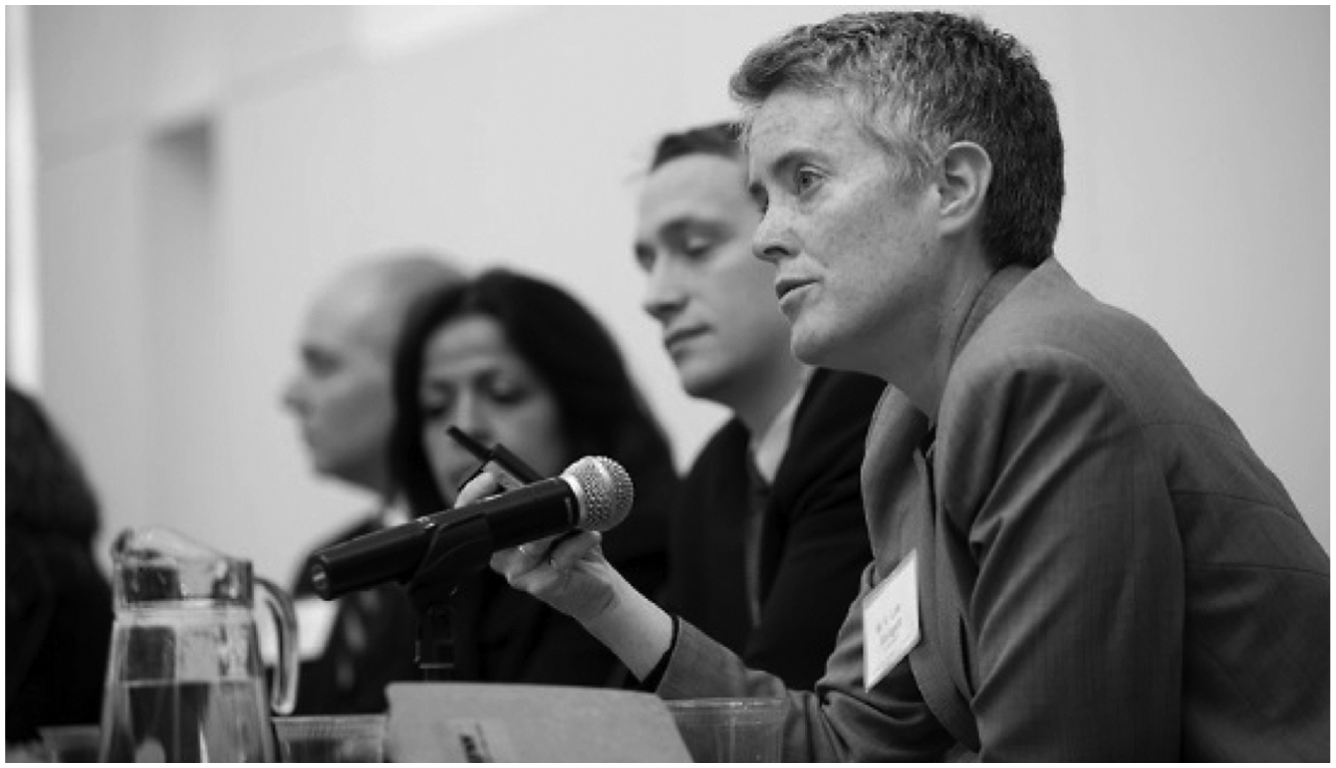
The author on a 2015 panel.
Courtesy M.V. Lee Badgett
Some worry about making a trade-off, and that time spent engaging is time stolen from research or teaching. However, many experienced public professors find benefits for teaching and research. Coontz has said that participating in public discussions outside of academia improves her ability to communicate as a teacher and researcher. Goldrick-Rab writes about the value of engagement in her research: “What I learn from doing leads to new research ideas, lends shades of grey to my current theories, and helps me identify appropriate partners for the next stages of my work.” Other scholars have used their connections with the larger world to get access to new data and funding.
Effective public professors still play by scholarly rules. They just don’t stop there.
Public engagement could even enhance career prospects. The key is to effectively demonstrate to tenure, promotion, and hiring committees how your participation enhances your research and teaching. Learn to tell your own story in a way that integrates your public engagement. Get to know other scholars in your field and share your research and engagement experiences. If they are more senior, they can make excellent outside reviewers at promotion time since they can assess the intellectual value of your engagement work within your discipline. Get letters of support from public partners who matter to your university, like state legislators or members of Congress.
Forming those relationships is easier when you have a guide. We have a lot to learn from each other as we become public professors, and that’s starting to happen. For instance, Schalet now directs the faculty-led Public Engagement Project at UMass Amherst, which supports mutual mentoring among faculty members who want to be more publicly engaged.
It’s worth the effort. Somewhere, somebody needs what you know, and they need you to be the conduit for that knowledge. The best way to figure out your potential contribution and to explore your own commitment is to jump in. Make that first connection and see where it takes you. We have the potential and opportunity to collaborate with the public and make a real difference in peoples’ lives.