



Abstract
Decades of successful integration efforts are at stake when one school district fights over school proximity and school “balancing.”
Dean Hochman, Flickr CC

Wake County, N.C. citizens are divided. Some believe that school integration—by race and social class—is important for the wellbeing of all children. One citizen told us of the dangers of the opposite: “It is not OK to segregate our schools. It is not OK to deliberately create high-poverty schools and claim that you are going to have all these fixes, whether it is funding or innovative programs, etc. It is just wrong, and that is why I am in this debate.”
Another parent’s concerns reflected the costs of implementing a “diversity” policy: “I see young children standing out there in the cold and dark at 6:30 in the morning, and it is totally obnoxious that any polite society would do this to the children. It is not safe, it is not fair, and it certainly is not fostering any good educational system; people generally want good schools close to home.”
Heated debates around these issues culminated in a watershed Wake County school board election in October 2009 that switched the board from majority Democratic and liberal to majority Republican and conservative, which resulted in consequences. By early 2010, this new board voted to discard the district’s diversity policy in favor of one that placed more emphasis on neighborhood schools.
These events garnered attention because they threatened to roll back decades of successful school integration, a policy vehicle for promoting positive race relations and facilitating upward mobility. Integration had also been associated with county growth and prosperity. Would these trends now be reversed and mean the end of Wake County’s economic and social progress? Would Wake become more like other large school districts characterized by strong school re-segregation, with negative educational and social consequences?
School classrooms are often homogeneous by race and class.
Ed Uthman, Flickr CC

Consensus and its Dissolution
Wake’s history shows that a large southern county comprised of urban, suburban, and rural populations could sustain successful school desegregation over many years. In 1976, after federal pressure, Wake County and the city of Raleigh merged their school districts to create one countywide system of 55,000 students. Innovative superintendents used magnet schools located in central Raleigh to entice White and middle-class families to enroll their children, thus promoting voluntary school integration through school choice. This worked: there were rising test scores, decreased racial gaps in student achievement, and strong satisfaction with schools among parents. Wake County’s population rose, but the county was able to educate this growing numbers of students, many of them from families migrating to Raleigh from other parts of the country.
To promote desegregation in the early 1990s, up to 1,000 African-American and White children were bused across the county each year, with minority children more likely to be bused than Whites. This strategy meant that some children were transferred to new schools for reasons beyond graduating to middle or high school. Children were often re-assigned in groups, which preserved social ties but parental relationships with schools and teachers were inevitably disrupted. Still, at this time, complaints were few, especially compared to other communities in the South.
Heated debates around integration in Wake County’s October 2009 school board election threatened to roll back decades of successful policy promoting positive race relations and facilitating upward mobility.
The county prospered both socially and economically, but prosperity had its price. By 2000, suburban communities such as Cary and Apex had acquired the reputation of some of the “best places” to live. Population growth in these areas exceeded school capacity, while parts of central Raleigh were decreasing in population. The county was now responsible for educating close to 100,000 children. By 2000, court rulings had largely disallowed race as a basis for school assignments, so Wake began using social class and achievement data instead. Estimates varied regarding how many children were bused for purposes of achieving diversity along economic and achievement lines, with the board arguing it was always less than 5% of children each year. But county growth appeared to increase this proportion and board reliance on reassignment increased over time. By 2008, the board proposed that more than 25,000 children be reassigned over the next three years. Some children from kindergarten through high school had already been moved multiple times. Younger children could not be assured they would attend the same schools as older siblings. Parents could not be guaranteed that relationships they formed with teachers, administrators and other parents would pay off in the future. Population growth was also increasing commute times for both parents and children, who might be traveling many miles from home. Complaints about annual reassignments increased.
A second school board strategy proved even more controversial. To make good use of fixed resources, the board created year-round schools, which had some elementary and middle-school children on three out of four nine-week tracks, but rotated one group of students out at all times. Although year-round schools required more personnel, this strategy cut costs by slowing down the need for school construction. Some parents liked year-round schools and sought them out. Board policy eventually mandated large groups of families to enter the year-round system or face unattractive alternatives. For example, opting out of a year-round school could saddle some kids with a longer bus ride and earlier pickup times. Families with a child in a year-round magnet school who also had a child in a public high school automatically had kids on two different school calendars, because all county high schools remained on traditional calendars. By 2009, these conditions were politically unsustainable. We wondered, what is the price of diverse schools? Had adherence to the diversity policy come at too high a cost?
We began our study by reviewing media reports, and continued by interviewing 24 locals who were either pro-diversity or favored neighborhood schools. We conducted two focus groups, and used those discussions to help us develop a telephone survey for more than 1,700 Wake County adults. We asked questions about learning benefits for children when they experience economic and racial diversity in schools and in classrooms; learning benefits from neighborhood schools; opinions on the length of bus rides; implementation of student assignment policy, general thoughts about the school board, and a variety of social and background characteristics.
Diversity vs. Neighborhood schools
Wake’s debate seemed to originate with two different views of how children should be assigned to public schools. One promoted a county-wide perspective in which the school board would assign children so that no schools were disproportionately poor or low-achieving. This would disrupt any connection between residential segregation and school segregation. Proponents of this policy feared the county’s economic future would be threatened if public schools were viewed unfavorably by firms and middle-class employees considering re-locating to Raleigh. Since the county’s assignment policy was associated with rising test scores and decreased achievement gaps, they viewed diverse schools as an investment in county well-being.
Year-round schools, similar to this one in West Virginia, offer Wake County a good cost-cutting option that would slow new school construction.
USDA

The other side championed proximity of home and school, so that children’s school attendance reinforced neighborhood social ties and vice versa. Under these conditions, however, schools would replicate residential segregation, a familiar condition in many American communities. Such realities would intensify inequality across generations, a situation that diversity advocates disliked.
Media reports, interviews and focus groups reflect either pro-diversity sentiments or worries about the disadvantages of diversity policy implementation. However, our findings showed other sentiments as well. First, disrupting the proximity of home and school was clearly a challenge for families. As a former superintendent noted in an interview, “I was having a forum over at Moore Square Middle School and it was about 200… predominantly African-American parents… and I will not forget the parent who stood up and said, ‘Well, we do not understand why we have to put our five-year-old on that bus and ride for an hour and twenty minutes to a school that is a [significant] distance from the house’.”
Others suggested that having children attend school far from home affected their capacity to meet parental responsibilities. It meant challenges for parents who were often juggling the demands of multiple jobs and commuting to work, as well as managing children’s school assignments and their changes. One African-American interviewee recalled a storm when half an inch of snow accumulated, causing icy roads, early dismissals, and long traffic delays. Some students ended up spending the night at their schools. She said, “But that assignment [plan], how far is [too far]? For the parent, how quickly can I get to my child? That was exhibited when we had that freak storm. How quickly can I get to my child in an emergency, from [my] workplace or home?”
By 2000, court rulings had largely disallowed race as a basis for school assignments, so Wake began using social class and achievement data instead.
Second, citizens worried that children’s academic well-being would be harmed by reassignments to distant schools. As one interviewee stated: “Really, if you think about elementary school, you know a lot of it is creating a love for school and so if you are putting a heavy burden on a child and… they are having to get up extra early… you would think (this situation) would potentially, in some students, create more of a negative taste for education and send them down the wrong road.”
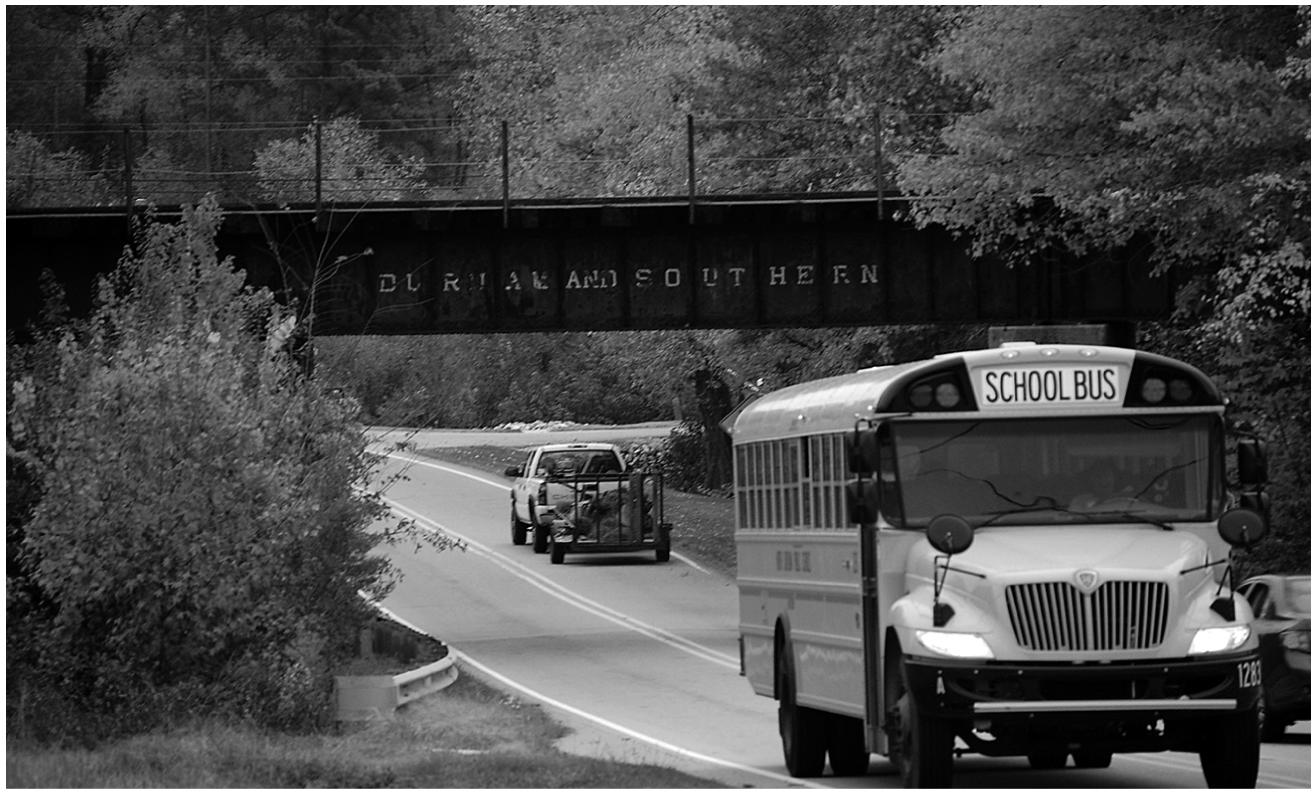
A school bus makes its daily trek on North Salem Street in Wake County.
Donald Lee Pardue, Flickr CC
Similarly, one African-American community leader suggested: “I just don’t think diversity, shipping kids around, really matters as much as them getting a good education, and at the end of the day, there is a job.” Nor was this concern confined to those skeptical of diversity’s benefits. An African-American, pro-diversity parent at a focus group said: “I will use the word ‘repulsive,’ and the reason I say it is repulsive is because I am tired of all of this sitting on the backs of the children. …It is the children that you are busing; it is the children that you are manipulating. …It is not on their back to take the long bus ride or be pulled out of your class.”
Wake’s debate had two camps: one that viewed diverse schools as an investment in county wellbeing and favored school “balancing,” the other that championed proximity of home and school.
Third, the process of changing student assignments created uncertainty for families and for children. Each winter the school board identified groups of children they were proposing to move to keep up with uneven population growth and to avoid schools becoming disproportionately low income. Hearings with the board followed. Sometimes parents were granted exemptions from proposed moves. Others applied for magnet schools, preferring those placements, and their certainty, to the possibility of future reassignments. Board decisions came out in May, which meant that some families were unsure about school placement for several months during each year. Emotions of both parents and children ran high.
One involved parent stated, “The discontent that I was hearing was the unbelievable inconsistency in feeder patterns. People would not know from one year to the next where their kid was going to school, and not only would they not know where they were going to go this year, they did not even have a sense of, OK, well, you will go to this elementary school, this middle school, and then this high school. It switched with no rhyme or reason.” This uncertainty meant parents felt unsure about how to protect child wellbeing, clearly at the heart of the conflict, but seemingly beyond the debate between preferences for diversity and neighborhood schools.
From our survey we also learned that preferences for diversity and neighborhood schools were not even diametrically opposed. Citizens who favored diversity were less likely to favor neighborhood schools and vice versa, but the relationship was far from perfect. We found that nearly everyone favors neighborhood schools. They are well ingrained in American life and likely reflect the type of school arrangement many of today’s adults experienced when they were young. However, a significant subset of Wake County citizens who favor neighborhood schools also strongly support diversity as a basis for children’s school assignments.
Finally, our survey also showed that attitudes among African Americans in Raleigh were complex. They were more supportive of diversity-based school assignments than Whites, and less supportive of neighborhood schools. But social class also mattered. Affluent African Americans favored diversity more than their lower income counterparts, who were managing both work and family with fewer resources. For them, having children assigned to schools far from their homes, even in the name of diversity, was less attractive. More highly educated African Americans worried less about the challenges, dangers, and uncertainties inherent in assignment policy implementation than those with less education.
Is Wake Typical?
We wondered how unique Raleigh was. Wake’s history lacked examples of “massive resistance” to desegregation characteristic of other southern communities during the 1960s and 1970s. The district was never under a court order to desegregate; it had done so voluntarily (although within the context of federal pressure). Wake’s public education system had improved for more than thirty years after its creation in 1976. These factors, we reasoned, made it at least somewhat unique, and had created a social and political climate supportive of diverse schools. In addition, the county began creating diverse schools before significant amounts of White flight and “bright flight” occurred. While the diversity policy was in effect, middle-class residents had less incentive to locate in just a few neighborhoods because street address did not strictly dictate which schools children would attend, thus discouraging residential segregation.
The debate over school diversity in Wake County means balancing competing, if both laudable, goals and perspectives.
O Palsson, Flickr CC. “Gyre,” Thomas Sayre, NC Museum of Art.

We concluded that compared to other large school districts, Wake is relatively unique in the longevity of its school diversity policy, which we see as based both on the demographic capacity to create diverse schools as well as the collective political will to make that happen. For example, it sustained diverse school assignments longer than Charlotte, and it avoided the substantial segregation of schools experienced in places like Richmond. Despite the challenges involved in implementing economically diverse schools, Wake persevered longer than many other school districts. This means Wake was an exemplar for other large school districts that had the demographic capacity and political will to create diverse schools.
What does the Future Hold?
The 2011 and 2013 elections returned the school board to firm Democratic majorities, likely because of citizen concerns with a lack of transparency by the Republican board. However, this new board chose to maintain past reassignments, not initiate new ones. This approach responded to concerns regarding the challenges, dangers and uncertainties previously associated with mandatory reassignments and year-round school attendance. This also meant that school re-segregation based on socioeconomic status increased. Magnet schools remain popular, while parents now also have an increased number of charter school options. The impact of greater school choice on the traditionally strong middle-class character of Wake public schools is still unclear.
Demographics remain important. Currently the district enrolls more than 155,000 students, making it the 16th largest school district in the country, and managing district growth continues to be challenging. Wake’s public school-aged population has now become majority-minority, largely because of Latino immigration. Given the association between race and family income, in the future Wake will find creating schools mixed by family income to be more complicated. More than ever, it will need to rely on its strong traditions of maintaining diverse schools to promote both equal opportunity and encourage county prosperity.