




Abstract
The “Single Mother by Choice” is far rarer than media depictions. A look at the numbers.
Keywords
You’ve probably already been introduced to the new mom in town, the “single mother by choice” (SMC for short). Perhaps you met her in 2010, when The Switch featuring Jennifer Aniston, and The Back-Up Plan, featuring Jennifer Lopez, came out in theaters. Or maybe you learned about her from a profile in a magazine or followed a link to her parenting blog. You can picture her: she’s in her mid-to-late 30s, smart and professionally successful, but she just never met the right guy at the right time, and her biological clock is ticking. She’s the epitome of the modern independent woman who wants to have it all, career and family—taking her future into her hands, acting decisively, and doing what it takes to achieve her goal of motherhood, with no need for a man. The SMC represents a new phenomenon, appealing to some and worrisome to others. But does she really exist? Has there been a dramatic rise in well-educated single women choosing to have children on their own, or is this new approach to motherhood more common in the media than in reality?
She’s the epitome of the modern independent woman.
Growing Visibility
The term “single mother by choice” first emerged in 1981, when New York City psychotherapist Jane Mattes (herself an SMC) founded an organization to provide support and resources to such moms (singlemothersbychoice.org). But it wasn’t until 2005 that the concept really entered the mainstream with Mikki Morrissette’s popular book, Choosing Single Motherhood: The Thinking Woman’s Guide, and her organization (choicemoms.org). Attention snowballed from there.
Sociologist Rosanna Hertz’s book, Single by Chance, Mothers by Choice, a qualitative study of single mothers, came out in 2006, and four documentaries on SMCs were released between 2007 and 2013. Movies and TV shows often feature SMCs either prominently or as secondary characters, and there are reality shows in the works—one to follow women through the journey of becoming an SMC and another seeking single moms who all used the same sperm donor.
The rising visibility dovetails with the growing ease in becoming an SMC, thanks to the proliferation of sperm banks and fertility clinics since the 1970s. Although initially many sperm banks would not serve unmarried women, the clientele has shifted over time. Some sperm banks, like California Cryobank, report nearly 30% of their clients are SMCs. And changes in the population mean that there are plenty of women eligible to become SMCs. The proportion of employed women with college degrees or more has more than tripled since 1970, accompanied by increases in the proportion of women in highly-paid professions, such as law, medicine, and engineering. A substantial minority (about 20%) of college-educated women never marry, and many more are single after a divorce. Put together, these medical, social, and demographic trends support the notion that SMCs have grown over time.
Articles on SMCs frequently cite the growing proportion of births that take place to unmarried women (41% in 2013) and the rising age of unmarried mothers (23% of nonmarital births are to women 35 and older). But it is not clear that these trends indicate an increase in the affluent single mothers typically described by the SMC label. We know, for instance, that the growth in nonmarital childbearing is primarily due to increases in births to cohabiting women (who are technically unmarried, of course, but aren’t single). In fact, there is a notable lack of concrete statistics on the characteristics of SMCs or their overall prevalence. The Choice Mom and Single Mothers by Choice websites, respectively, note that “sadly, there is no comprehensive survey of who [SMCs] are” and describe SMCs vaguely as “career women” in their 30s or 40s with a college degree or higher. One thing, however, is quite clear from both the media and organizations—SMCs emphasize the role of “taking initiative” and “deciding to have a child,” distancing themselves from mothers who became single after a break-up or with unplanned pregnancies. The intentionality of motherhood for these women contrasts with what social scientists know about unmarried mothers and nonmarital births. By and large, most pregnancies that occur outside of a coresidential relationship are unintended, and women having births outside of marriage tend to be relatively disadvantaged.
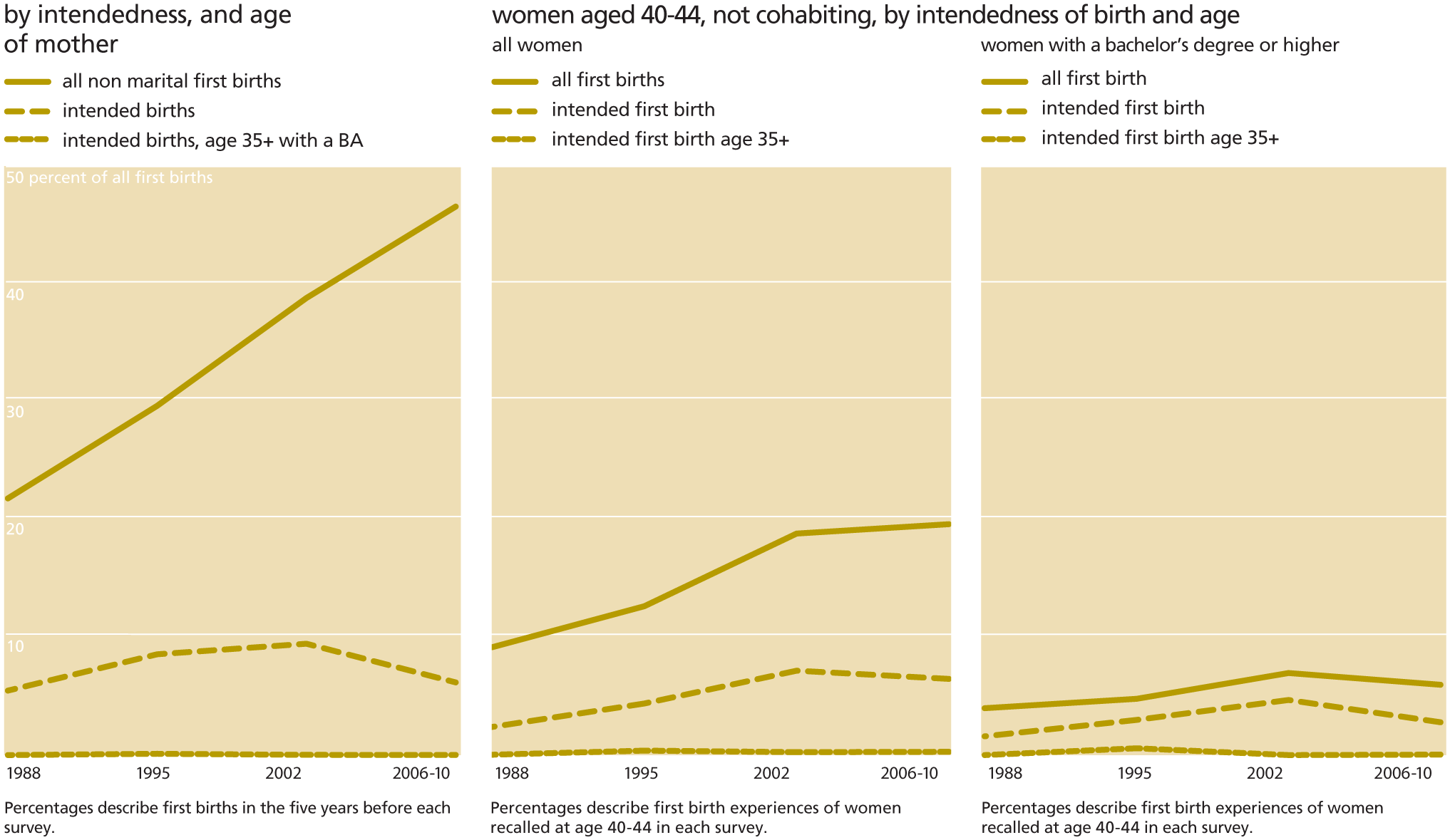
Nonmarital First Births, 1988–2006-10
Source: National Surveys of Family Growth, 1988, 1995, 2002, 2006-10.
Is the SMC Real?
In fact, the choice mom remains a relatively rare phenomenon. We analyzed the 1988, 1995, 2002, and 2006-2010 National Surveys of Family Growth, which surveyed women aged 15-44 to provide nationally representative data on families and childbearing. This allows us to show trends in first births to SMCs and the proportion of women who follow this model. We define SMC by the context of the first birth: The mother is neither cohabiting nor married and the conception is intended. We separate out mothers who are age 35 or older with at least a bachelor’s degree in some figures. Unfortunately, we are unable to identify mothers who adopt children or mothers who are age 45 or over.
We are also unable to account for women’s responses to an unintended pregnancy. Surveys typically measure intendedness by asking women how they felt at the time of conception. But of course, even women who didn’t plan to get pregnant may feel happy about the birth of the child, and women may make a deliberate decision to carry an unintended pregnancy to term. (The 1990s TV character Murphy Brown, for instance, an early version of the fictional single mother by choice, became pregnant by accident, but decided to have the baby as a single mother.) Women who carry an unintended pregnancy to term have, in some sense, chosen single motherhood. But they don’t fit the SMC image of taking the initiative and deliberately planning to become a single mother.
As shown above, the proportion of first births that take place outside of marriage increased dramatically between the 1980s and the 2000s—from 21.9% of births to 46.8% of births. If we look only at first births to women who aren’t married or cohabiting, and who intended the pregnancy, both the proportion of births and the increase is much smaller. In the five years before 1988, 5.5% of first births were intended births to unpartnered mothers; in the early 2000s, the corresponding figure was 6.2%, although levels were slightly higher in the 1990s. And if we further restrict to women who match the characteristics of the SMC archetype—women age 35 and older with a college degree—the numbers drop to almost zero.
What if we consider the experiences of women rather than the distribution of births? Looking at the lifetime experience of women who were aged 40-44 in each survey, we can see (above right) that the proportion single at the time of their first birth—not married or cohabiting—more than doubled between the 1988 and 2006-2010 surveys, from 9.2% to 19.7%. But few of these women were single mothers by choice. Less than a third of the women who reported a nonmarital, non-cohabiting first birth said that the birth was intended, and only a tiny fraction of unpartnered women with intended first births had these births at age 35 or over. Among women with a college degree, many fewer became single mothers—only 6% by the most recent survey. Although about half of births to these women were intended, it’s still the case that less than 3% of college-educated women became single mothers by choice in the early 2000s. (This proportion was slightly larger, around 4.7%, in the 2002 survey.) Over the past few decades, then, remarkably few college-educated women became single mothers by choice at age 35 or older.
The Meaning of the Myth
By any definition, there are few “single mothers by choice,” and there are even fewer women who match the age and educational profile proposed by media portrayals and SMC support organizations. Why, then, is the image of the SMC so persistent? One possibility is that SMC are much more common in the social networks of journalists and media professionals, who tend to be well-educated and often delay family formation as they establish careers, than in the population overall, and these individuals are making the mistake of generalizing from their own lives and experiences. Perhaps more concerning are the implications of this portrayal. The SMC archetype is implicitly contrasted with other stereotypes of unmarried mothers—reckless teens with unplanned pregnancies and “welfare mothers” who have children without being able to provide for them. Each of these portrayals frames childbearing as an individual decision (and an individual responsibility) rather than a reaction to social change or economic constraints. By focusing on the (very few) affluent, older single mothers by choice, media narratives at best ignore and at worst disparage other single parents. Most importantly, the focus on SMCs takes attention away from the high levels of single motherhood, often not by choice, that have existed for decades among the disadvantaged and are linked to structural social and economic conditions.