




Abstract
Popular discourse continues to equate ‘good’ motherhood with middle class, heterosexual coupledom and lone motherhood with dysfunctionality, despite ever-increasing diversity in family life. Drawing on interviews with lone mothers in two locations in the north of England, this article introduces the concept of ‘good lone motherhood’ to capture a process whereby women internalise nuclear family ideology while simultaneously resisting stigma and taking pride in their achievements in fulfilling practical and emotional demands of lone parenting. Application of a family practices framework is expanded through insights into what ‘doing’ good lone motherhood entails in everyday life and how it is ‘displayed’ to different audiences. Taking a comparative approach involving women in areas with contrasting socio-economic profiles highlights the contextual nature of display. Analysis of agential reflexivity and structural constraints demonstrates ways in which gender and class disadvantages can undermine capacity to ‘successfully’ convey a positive maternal identity.
Introduction
This article examines reflexive endeavours among women living alone with their children to assert a positive maternal identity within the prevailing socio-cultural context. With one in four British children now growing up in lone parent households (ONS, 2019), this is significant in illuminating women’s internalisation of, and resistance to, ideology that continues to equate ‘good’ motherhood with two-parent norms. Both the construction of good mother ideals (Hayes, 1998; Jensen, 2018; Smart, 1996) and stigmatisation of lone mothers (Carabine, 2001; Carroll, 2017) are well recognised sociologically. Whereas lone mothers’ negotiations of good mother ideals have been documented (Duncan and Edwards, 1999; Elliot et al., 2015; Herbst-Debby, 2018; May, 2008), this article makes a valuable conceptual contribution by introducing ‘good lone motherhood’ as a distinct maternal identity that has not been explicitly articulated in previous examinations. Identification of good lone motherhood arose from analysis of data from comparative, qualitative research involving a diverse sample of women in two locations in the north of England with contrasting socio-economic profiles (Carroll, 2017). The women were highly conscious of misrepresentation in popular discourse (Tyler, 2011) and keen to lay claim to a more favourable self-identity. Analysis of good lone motherhood provides a useful sociological tool for understanding a process whereby women internalise normative models while simultaneously emphasising their achievements in responding to additional practical and emotional demands of lone parenting (Carroll, 2018; Nieuwenhuis and Maldonado, 2018).
After establishing the salience of ‘good lone motherhood’, the article explains the pertinence of family practices (Finch, 2007, 2011; Morgan, 1996, 2011, 2013) as a framework through which to consider the phenomenon. Morgan’s approach has been influential in shifting focus from family as an institution to exploration of how family, in all its diversity, is ‘done’ in everyday life. Finch (2007, 2011) extended family practices research through emphasis on the imperative for families to be ‘displayed as well as done’ (2007: 66) and subsequently invited investigation of how families are displayed and to whom. This article thus furthers empirical knowledge of diverse parenting practices by exploring common themes on what good lone motherhood entails from interviews with 26 women, during which participants spoke about: ‘being mum and dad’, putting the children first; and pride in their children, resilience and autonomy. It extends the framework by examining the relationship between self-identity and display and illustrating how women in diverse situations orient good lone mother attributes towards varying target audiences, which can be ‘internal’ and ‘external’ (Finch, 2011), real or ‘imagined’ (Almack, 2008).
Morgan (2020) was clear that family practices research is not aligned to any fixed theoretical position. Rather, its fluidity, openness to ‘a continuous process of engagement with other scholars’ and overlaps with gender and class practices can facilitate ‘contributions to social theory well beyond the confines of any particular families’ (Morgan, 2020: 734). Morgan also recognised critiques of family practices for an accent on agency at the expense of attention to structural constraints (Heapy, 2011; Morgan, 2013). Examining the interplay of agency and structure in local contexts is a priority for lone motherhood research (Carroll, 2017; Duncan and Edwards, 1999; Klett-Davies, 2005; May, 2006). A theoretical contribution thus lies in considering both agentic subjectivity and structural constraints in displays of good lone motherhood. Taking a comparative approach involving mothers in areas with contrasting socio-economic profiles is particularly useful in analysing factors that affect women’s perceptions of ‘successful’ display. This highlights the contextual nature of display and demonstrates ways in which persisting structural inequalities, including intersecting class and gender disadvantages, local family norms, labour markets and social networks, can render lone mothers’ displays ‘unsuccessful’, despite reflexive endeavours.
Why ‘Good Lone Motherhood’?
This article is based on interviews with lone mothers, who overwhelmingly emphasised their ‘good mother’ credentials as a means of negotiating what they commonly regarded as a stigmatised identity. Significantly, women who took part in the research were not making claims on ‘good’ motherhood per se but were articulating a distinct maternal identity. This section establishes the utility of ‘good lone motherhood’ in encompassing the complexities of forging a positive maternal identity through fulfilling a role that is more practically and emotionally demanding than coupled parenting while navigating normative family expectations.
The construction of ‘good’ versus ‘bad’ motherhood is well recognised sociologically. Smart (1996: 47) describes how this binary was imposed by a growing band of health visitors, social workers and other professionals during the 20th century, who scrutinised ever-expanding realms of children’s physical and psychological development and presented mothers with ‘myriad ways of failing’ to reach ever-higher standards in ‘minute practices’ of care. Hayes (1998) drew on in-depth interviews with mothers in the USA to reveal the pernicious effects of maternal ideals in western culture. Her characterisation of the prevailing contemporary model of ‘intensive’ motherhood as labour-intensive, financially expensive, self-sacrificing, child-centred and competitive has been applied extensively in discussions of maternal subjectivities (e.g. Elliott et al., 2015). Perpetuation of the good mother ideal in popular culture and its circulation on social media make maternal behaviour more visible than ever before (Pedersen, 2016; Tyler, 2011). Parenting in the UK has, furthermore, become politicised (Gillies, 2005), with heightened expectations to manage intensive parenting alongside paid work (Miller, 2005, 2017). Giving children an ‘appropriate’ upbringing now requires not only providing sufficient time and resources to fulfil their practical, emotional needs and developmental potential, but also being an appropriate role model for future worker citizens (Gillies, 2005: 840). Gendered parenting discourse lays personal ‘blame’ on the shoulders of mothers who fail to conform (Jensen, 2018).
Perpetuation of the good mother myth is predilected upon intersecting gender, class and ethnicity constructs by which mothers whose relationship status, age, race, class or material resources do not match the ‘ideal’ become vulnerable to categorisation as ‘bad’ parents (Ladd-Taylor and Umansky, 1998, cited in Jensen, 2018). While everyday parenting practices occur in specific contexts, dominant maternal ideology is inherently classed, with ‘good’ parenting judged according to white middle class nuclear family norms (Miller, 2005, 2017) and working class parents’ emotional investment commonly overlooked (Gillies, 2005). Cultural representations and political rhetoric convey an imperative for the ‘good’ mother to be sufficiently well positioned to optimise her children’s life chances or face moral censure for irresponsibly reproducing cycles of deprivation (Jensen, 2018). This requires mothers to follow a trajectory of higher education and employment prior to child-rearing at the ‘right’ age (Allen and Osgood, 2009). Importantly, conferring sufficient advantages upon offspring also requires the putative ‘good mother’ to be heterosexual and married or cohabiting with her child/ren’s father (May, 2008; Smart, 1996).
Smart (1996: 47) notes that, historically, married and unwed motherhood was ‘presumed to coincide with the boundary between the good and the bad mother’. Feminists lay bare patriarchal relations and material motivations that have underpinned gendered moral discourses on lone motherhood over centuries (see, for example, Carabine, 2001). Feminist analyses have drawn on Foucault’s (1977) concepts of ‘normalising judgement’ and ‘self-surveillance’ to explain lone mothers’ internalisation of heteronormative family ideals. Stereotypes of ‘broken families’ were reinvigorated during a decade of austerity politics via ministerial rhetoric and television coverage equating single parents with irresponsible, benefit dependent working class families (Jensen, 2018; Tyler, 2011). Recent qualitative studies document how welfare reform and media misrepresentation have contributed towards lone mothers’ sense of stigmatisation, shame and inferiority (Carroll, 2017; Morris and Munt, 2019).
A rich body of research has targeted lone mothers’ negotiation of good mother ideals (see, for example, Herbst-Debby, 2018; May, 2008) and explored their reflexivity in relation to paid work, local labour markets and welfare (see, for example, Duncan and Edwards, 1999; Klett-Davies, 2005). May (2008) illustrates how ‘being a good mother’ is closely entwined with ‘presenting a moral self’ in narratives of women in Finland. Mantovani and Thomas (2014) describe agential investment in the ‘good’ mother identity among young black lone mothers in the face of normative judgements that position them as bad parents. Case studies involving black, low-income single mothers in the USA by Elliott et al. (2015) exemplify internalisation of ‘intensive mothering’, performance of which requires time, energy and money that are more readily available to white, middle class parents. Herbst-Debby’s (2018) study involving disadvantaged mothers in Israel found they created their own ‘responsible single mother model’, which prioritises children’s needs over paid work. As with insights into navigation of maternal identities among mothers generally (e.g. Pedersen, 2016), studies find that lone mothers both absorb and resist good mother ideals (e.g. Herbst-Debby, 2018).
Where previous sources have discussed lone mothers’ assertion of good motherhood in response to prevailing norms and discourses (Elliott et al., 2015; Herbst-Debby, 2018; May, 2008), they do not explicitly articulate what it means to be a good lone mother seeking to convey favourable family attributes. Focusing on what can be termed ‘good lone motherhood’ is therefore a useful addition to sociological understanding of contemporary families in three ways. First, it sheds light on women’s ‘dialogue . . . with norms relating to proper family life’ (May, 2008: 481) in accommodating a tendency for lone mothers to accept an assumption that children in one parent families are disadvantaged while simultaneously asserting their own good mother identity. Second, good lone motherhood reflects well-documented challenges in meeting children’s material, practical and emotional needs as a lone parent (see, for example, Nieuwenhuis and Maldonado, 2018). The third reason is that women’s accounts indicated that theirs can be a happy family form and were proud of their achievements. Asserting good lone motherhood is thus not only a tool for resisting negative discourse, but also a means of highlighting positive aspects of their parenting.
Doing and Displaying Families
First developed by Morgan (1996, 2011, 2013, 2020), family practices proved highly influential in moving sociological inquiry beyond analysis of the family as an institution to focus on the ‘doing’ of family, in ever-increasing diversity, in everyday life. Where family practices research uncovers activities and processes that constitute families, Finch (2007, 2011) expanded the framework through her emphasis on ‘displaying’ family. In a frequently cited article, Finch (2007: 66) describes display as the social aspect of family practices, which enables ‘the meaning of one’s actions to be conveyed to and understood by relevant others’. She, furthermore, states that the need for families to be ‘displayed as well as done’ is especially strong among those who do not conform to the nuclear model, using post-divorce families as an example (Smart and Neale, 1999, cited in Finch, 2007: 66). Normative discourse and societal attitudes leave lone parents at particular risk of failing to display ‘appropriately’ (Heapy, 2011: 27). Good lone motherhood then, arguably requires greater intensity of display than coupled parenting. To paraphrase Finch (2007), good lone motherhood needs to be ‘displayed as well as done’.
A range of topics have been examined through a family practices lens including lesbian parenting (Almack, 2008) and surnaming practices (Dempsey and Lindsay, 2018). Contributors to an edited volume (Dermott and Seymour, 2011), who apply the concept of display in various family circumstances, discuss its complexities and limitations. Acknowledging these issues, Finch (2011) invites further investigation of how display occurs and to whom. The present article draws on interviews with women in diverse situations to analyse how, specifically, good lone motherhood is displayed and to whom. It adds nuance to analysis of display by uncovering the relationship between self-identity and orientations towards various ‘internal’, ‘external’ and ‘imagined’ audiences (Almack, 2008; Finch, 2011), including children, parents, neighbours, professionals and strangers in public places, among mothers in contrasting locations. Attributes that are conveyed can either be accepted or rejected and misunderstood by audiences (Heapy, 2011). Examining women’s perceptions of their ability to forge a positive maternal identity thus provides insights into ‘successful’ or ‘unsuccessful’ display (Gabb, 2011).
Unrealistic standards against which maternal practices are judged, and women judge themselves, fail to acknowledge diverse circumstances in which family life is lived (Miller, 2005, 2017). Elliott et al. (2015: 366) found poor lone mothers ‘face structural barriers that make it difficult to demonstrate to the outside world that they are good mothers’. Researchers who have examined lone mothers’ experiences suggest that, while reflexivity is evident, further attention to social inequalities, material constraints and spatial contexts is also required (Duncan and Edwards, 1999; Klett-Davies, 2005; May, 2006). Morgan (2020: 733) saw family practices as open to ‘engagement with other scholars’ rather than being ‘a fixed theoretical elaboration’. Morgan (1996) was aware that ways of doing family are socially and culturally situated and recognised that the family practices approach has been critiqued for its emphasis on agency (Heapy, 2011; Morgan, 2013). This article therefore provides a theoretical bridge between family practices research and recognition of the importance of both agency and structure in lone motherhood literature through investigating how individual reflexivity and structural inequalities affect capacity to ‘successfully’ display good lone motherhood.
Data Collection and Analysis
Media stereotypes and moralising discourse commonly equate lone parenthood with working class families (Allen and Osgood, 2009; Jensen, 2018; Tyler, 2011) and there is a paucity of research involving lone mothers in affluent locations. This article provides broad-based experiential analysis by drawing on interviews with 26 women from diverse backgrounds and situations. Semi-structured interviews were conducted during a comparative PhD study (Carroll, 2017), which used a ‘purposive’ sampling strategy (Creswell, 2007) to recruit participants in two areas in the north of England that were selected for their contrasting socio-economic profiles. Location A is an estate of predominantly local authority-owned housing on the outskirts of a post-industrial city. It was chosen as it has among the highest proportion of lone mothers nationally, with its household composition comprising 14.5% lone mothers (ONS, 2012). It was ranked highly deprived on the Indices of Multiple Deprivation (DCLG, 2012), based on criteria including unemployment levels. The mean gross annual income was £26,700. Location B was chosen due to its geographic proximity to A, relative affluence and lower than national average proportion of lone mothers. The majority of households comprise couple families and only 4.1% are headed by lone mothers (ONS, 2012). It has a high proportion of owner-occupiers, low unemployment and was not ranked as deprived in the Indices of Multiple Deprivation (DCLG, 2012). The mean gross annual income was £45,000.
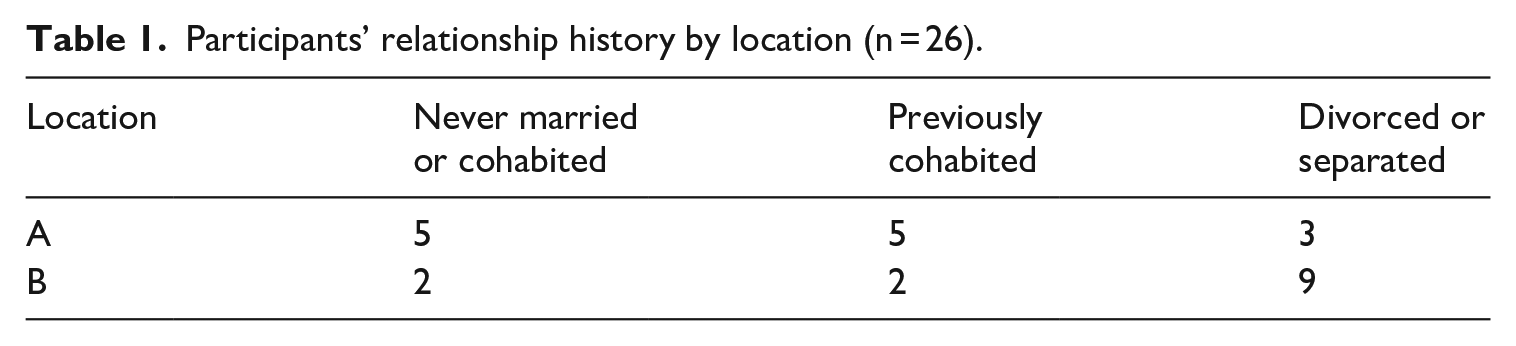
Participants were recruited via local children’s centres, community organisations and social media. To provide a diverse sample, lone mothers were defined as living alone with children aged under 16, regardless of whether they were widowed, divorced, formerly cohabiting or never married or cohabiting. The participants were aged between 19 and 54 and had between one and five children, whose ages ranged from 10 months to 15 years old. They were all primary carers for their children, with paternal involvement ranging from almost daily contact in one case to minimal or no contact in most cases. Presence of support varied between participants, but women in A were more likely to have their own mothers living nearby, whereas those in B were more likely to have friendship networks locally. Certain women were bringing up children without any practical or emotional support. As shown in Table 1, most women in the affluent location were divorced, while most women in the deprived location had previously cohabited or never married or cohabited. As shown in Table 2, most mothers in Location A were not in paid work, whereas most in Location B were employed. Extracts from interviews that follow include participants’ ages and locations, denoted ‘A’ and ‘B’, alongside their comments.
Participants’ relationship history by location (n = 26).
Participants’ employment by location (n = 26).

The comparative nature of the sample facilitated examination of factors affecting women’s perceptions of ‘successful’ display of good lone motherhood in localised contexts. Analysis was led by empirical evidence with the data first coded using substantive themes from interviews, such as recurrent references to ‘being mum and dad’, ‘putting children first’ and ‘pride’. Family practices (Finch, 2007; Morgan, 1996, 2011, 2013) offered an appropriate approach for analysing good lone motherhood. Conceptual coding was undertaken using the framework of ‘doing’, and ‘displaying’ good lone motherhood, with data from transcripts broken down to examine which ‘audiences’ the participants referred to and whether their display was perceived as ‘successful’ or otherwise. Framework analysis (Spencer et al., 2014) was used to arrange the data thematically and enable case comparison by location.
While the original study considered lone mothers’ experiences in more general terms, the focus here is on their assertion of a ‘good lone mother’ identity because this was a prominent concern among all participants regardless of their situations. Data were therefore re-analysed to explore this compelling aspect of women’s accounts. Participants’ accounts of their experiences and perceptions did not necessary fall neatly within conceptual parameters, however. Boundaries between ‘doing’ and ‘displaying’ were not always readily discernable. While Finch (2007) regards successful display as relational rather than existing purely in an individual’s consciousness, the interviews suggested women’s concerns about ‘doing’ good lone motherhood were based on authentic personal meanings and the extent to which individuals sought external validation varied. Drawing on the concepts of ‘normalising judgement’ and ‘self-surveillance’, which have been applied in lone motherhood literature (Foucault, 1977, cited by, for example, Carabine, 2001; Wallbank, 1998), proved a useful addition to the framework in reflecting the prominence in the data of internalised nuclear family norms and frequent references to audiences that participants acknowledged were often ‘imagined’, rather than concrete.
Doing Good Lone Motherhood in Everyday Life
Women who took part in interviews all described choices, activities and behaviours that can be viewed as ‘doing’ good lone motherhood in their everyday family lives. This section outlines the principal components of good lone motherhood identified in their accounts, which can be summarised as: being mum and dad; putting the children first; and pride in their children, their resilience and their autonomy.
Being Mum and Dad
Participants did not deny prevailing assumptions that children fare better with two parents. Instead, their comments reflected that being a good lone mother means being especially dedicated in fulfilling roles that are more usually performed by two cohabiting male and female parents. All 26 women were primary carers and only two of their former partners saw their children more than once a week. For instance, Shelia (54, A) described rearing five children with minimal paternal input as, ‘a bigger role being a single mum because you’ve got more to do and nobody else to help you with it’. Variations in support from former partners, parents and extended families influenced the extent to which they viewed being a lone parent as different from being in a couple on a practical level. Marta (40, A), who had no support in rearing her four-year-old and nine-year-old daughters, spoke at length of difficulties in ‘doing it all on your own 24/7’.
‘Being mum and dad’ was a phrase used repeatedly during interviews, which reflects both the acceptance of gendered nuclear family norms and a highly demanding ‘dual’ parenting role. Lucy (25, A) was typical in asserting: ‘I’m mum and dad in one, basically.’ While there is not sufficient scope to recount challenges participants encountered in balancing breadwinner and carer roles (see Carroll, 2018), it should be noted that this perception of being both ‘mum and dad’ meant meeting children’s material as well as their emotional needs. The mother’s salary or state benefits were the main income sources in all cases, with fathers’ financial contributions tending to be minimal or, in many cases, absent. Jasmine (36, B) regarded solo responsibility for her meeting her two teenage children’s needs as, ‘a job designed for two people’. Echoing worker citizen expectations as aspects of good parenting (Gillies, 2005; Miller, 2017), the women also commonly viewed being employed as important in setting a good ‘role model’ for children.
The idea that ‘good’ motherhood also involves taking responsibility for the quality of fatherhood (May, 2008) was echoed by a number of mothers. Some spoke of frustrated attempts to encourage ex-partners to have more involvement with children. Laura’s (36, B) narration of good lone mother activities included taking her 11- and 12-year-old sons to a traditionally masculine ‘monster truck rally’ on Fathers’ Day. While policymakers’ emphasis on absent fathers fails to acknowledge the presence of other male kin in non-nuclear families (Tarrant and Hughes, 2019), providing ‘a male role model’ proved a common aspect of good lone motherhood. Carrie (44, A) was typical in illustrating masculine influences in her son’s life despite lack of contact with his father: ‘I do think boys need men around, but I’ve got a lot of male family. My dad, my brothers, he had his godfather, who he looked up to . . . so he’s had a lot of male influence.’
Putting the Children First
A standard feature of the contemporary ‘good mother’ construct is the requirement for women to put their children before themselves, with ‘intensive’ mothering requiring self-sacrifice in providing abundant time, money and attention (Hayes, 1998). ‘Putting the children first’ seems to be especially the case in doing good lone motherhood. Indeed, several participants spoke of ending relationships to protect their children, as found by Morris and Munt (2019). Bella (36, A), for example, described leaving her husband to protect her eight-year-old twins from witnessing domestic violence.
The theme of self-sacrifice was stressed by all mothers in the research, as similarly shown by Elliott et al. (2015), who found good motherhood was often at the cost of single parents’ own emotional and physical well-being. Lucy (25, A), who had the word ‘mum’ tattooed on her hand, had a five-year-old son with disabilities, a four-year-old daughter born prematurely and was seven months pregnant. She was among several mothers who articulated a good lone mother identity in terms of finding emotional strength in responding to adversity for the sake of their children (as identified by Gillies, 2005): I have had a hard time with them both, it’s like hospital appointments, moving, domestic violence . . . you know I do sometimes break down and cry and stuff, but I think like ‘me kids, I’ve got to do it for them’.
Putting the children first also involved prioritising their needs over employment opportunities in several cases, which left mothers prone to welfare stigma (Carroll, 2018). Single parent families tend be significantly poorer than two-parent families (Joseph Rowntree Foundation, 2019) and mothers in the study repeatedly described prioritising their children when managing limited resources. This included going without food in certain cases and without new clothes in many cases. While self-sacrifice is a feature of dominant discourses on good motherhood, ensuring their children remained unaware of hardship was a further aspect of good lone motherhood, as epitomised by Bella (36, A): ‘I can’t remember the last time I bought myself something. If they want something, I do try to make sure they’ve got it. I don’t want them thinking “I can’t have it because mum’s on her own”.’
Another common aspect of equating good lone motherhood with self-sacrifice was that most participants had extremely restricted social lives as their limited time and money were concentrated on their children. Being a good lone mother tended to mean refraining from romantic relationships. Women commonly remarked that their sexual behaviour was in stark contrast with stereotypes associating single motherhood with being promiscuous and subjecting children to numerous relationships (Morris and Munt, 2019). Only three mothers had formed new partnerships since splitting up with their children’s fathers. They were not cohabiting and described organising their intimate relationship around the needs of their children. Carrie (44, A) was typical in attributing avoidance of relationships to a desire to protect her children: ‘If they get too close and it breaks down, I don’t want them upset.’
Pride
Importantly in examining the good lone mother identity, interviews showed that participants saw positives, as well as negatives, in their family situation. This was especially true when discussing pride in their children, their resilience and their autonomy. Being a good lone mother meant intense satisfaction in having done a ‘good job’ in bringing children up single-handedly. Participants spoke of having ‘closer bonds’ with children and enjoying more ‘control’ over parenting decisions than couples. The women made frequent references to how well their children were doing at school and how happy, healthy and well behaved they were. Alison (45, B), whose four children, aged between five and 11, had adjusted from living in a large house, going on expensive holidays and attending private school to a much more modest lifestyle since her divorce, expressed confidence in her parenting: Some single mothers I know question their parenting, but I do feel you know I am bringing the children up as best I can . . . It’s pride in how well they’re doing at school and how well adjusted they are, how polite and well behaved they are and how they get on with other children and adults.
A further point that warrants the good lone mother identity is the women’s personal satisfaction in their independence and resilience. Mothers spoke proudly of their ability to ‘just get on with it’ when facing challenges. Many of the women recounted moving beyond trauma including abuse, homelessness and acrimonious divorces and viewing lone motherhood as a more empowering identity now they had become ‘settled’. Having spoken during the interview of going through difficult times, Laura (36, B), for instance, ultimately expressed satisfaction in being ‘a single mum who’s made it on her own’.
The Interview as a Forum for Display
Having established principal themes in doing good lone motherhood, attention now turns to the question of the ‘multiple audiences’ (Dermott and Seymour, 2011) to whom this is displayed. In analysing lone mothers’ accounts of their ‘family practices’ (Morgan, 1996), the research interview itself must be recognised as a forum for display with the researcher as an audience. Participants welcomed the interview as an opportunity to display a positive maternal identity. Asserting good lone mother credentials was intrinsically connected to the women’s perceived need to display what they are not. For most, this meant emphasising that they had not chosen to be single parents, as stereotypes of irresponsible, state dependent mothers suggest (Allen and Osgood, 2009). Deflection of negative perceptions is illustrated by Julie (27, A), who was anxious to display ways in which she differed from media misrepresentations: I wasn’t some young girl wanting to be pushing a pram . . . I was with [son’s] father for 10 years but he left when I got pregnant . . . I was a decent age and I was more than providing for myself when I had him and I could afford to have a baby.
Interviewees conveyed their own ‘good lone mother’ behaviours while expressing frustration that the media fails to depict realities of single parenting. Mena (32, B), for instance, listed components of her own mothering that are absent from television portrayals: ‘They don’t portray mums on their own that are doing a good job, that are putting their children first, managing with their children, cooking home cooked food . . . a strong woman that is bringing up her children.’
Women commonly expressed a belief that being a good lone mother requires greater practical and emotional effort than dual parenting. Jasmine (36, B) illustrates the belief that additional effort is also expended in anticipation of prejudice. She gives the example of making sure her children go to school each day having completed their homework: Because of the connotations that go around single parents on this island, you know that we’re all promiscuous pissheads that let our kids do whatever they want, we’re having to go that extra mile and to say ‘well actually we are conscientious with our kids’.
As researchers we are concerned with what women’s accounts say about societal attitudes, rather than the veracity of those accounts (May, 2008) and what is displayed can inform us about current ideas of good parenting (Dermott and Seymour, 2011). Interviews tended to reflect internalisation of two-parent family norms, despite increasingly fluid family forms. Joanne (35, B), for example compared her own situation, in living alone with her five-year-old son, with what she referred to as ‘proper, you know, two-parent families’. The women’s frequent use of the word ‘failure’ in not conforming with a ‘normal’ family model reflects the insidiousness of ‘powerful nuclear family ideology’ (May, 2008: 471), with a process of ‘normalising judgement’ apparent (as found, by Carabine, 2001; Wallbank, 1998).
Women’s narration of their experiences during interviews sheds light upon a dialectical process by which they displayed good lone motherhood as a creative response to being both unable to cast off conventional expectations and unable to conform with these expectations. Laura (36, B), who described herself as a feminist, was critical of patriarchal family relations and commented on politicians’ use of ‘broken families’ rhetoric to justify austerity (Jensen, 2018). Yet, she was also highly conscious of ‘judging’ her own parenting according to middle class, coupled expectations. Her reflection on her priorities after her divorce indicates understanding of a compulsion to display ‘successful’ lone motherhood as an agential response to structural positioning: I fell into that whole social stigma of broken families . . . that I was seen as in some way dysfunctional because I wasn’t with the father of my children. So, my kids were somehow going to be disadvantaged either economically or emotionally because their dad wasn’t living at home. It made me fight even more to come across as a very in control family. You know, that I had a family that was functioning well, it didn’t matter that there was a dad involved or not, we were financially ok, the boys were happy . . . So, it made me fight really, really hard but I was still adhering to those expectations by trying to be the perfect family and to be both dad and mum.
Self-Identity, Internal and External Audiences
Where family practices involve taken for granted actions (Morgan, 1996), display is relational (Finch, 2007). Audiences for display can be ‘internal’ and ‘external’ (Finch, 2011), ‘real and imagined’ (Almack, 2008). Although Finch (2007) argues that display must be actively demonstrated rather than existing purely in individual consciousness, efforts to be a good mother appeared to be an intrinsic aspect of self-identity for women who took part in interviews and ‘self-surveillance’ (Foucault, 1977) sometimes blurred boundaries between individual consciousness and relational display. Certain women were reflexive in limiting their sphere of reference to an intimate ‘internal’ audience, comprising only their children and their parents. Others sought validation through what might be deemed ‘strategic’ display to much broader ‘external’ audiences, including friends, neighbours, professionals, strangers in public spaces and non-specific or ‘imagined’ audiences. Breaking down interactions between internal, external and imagined audiences is therefore valuable in understanding the relationship between self-identity and display.
Internal Audiences
Good motherhood can be understood as a ‘moral’ imperative (May, 2008) and ‘good lone mother’ sentiments expressed during interviews appeared heartfelt. For instance, Bella (36, A) not wanting her children to know about personal sacrifices she makes to be able to afford clothes and toys they want indicates good lone motherhood that is authentic in purposefully not being displayed. Children were the principal ‘internal audiences’ to whom the women communicated their love. Gina (31, A) was among several women who confined displays of maternal devotion to their children and explicitly stated lack of orientation towards external audiences. Having discussed challenges in running a business while caring for her eight-year-old son, Gina spoke about communicating her motives to him: ‘My whole life’s built around him. I said to him, “nothing is more important than you, everything I do is for you, to give you a better way of life”.’
Women’s accounts of conversations with offspring included discussing their family structure in ways that framed it positively. Moira (34, B), for instance, was pleased to tell her eight-year-old son and five-year-old daughter, ‘the lady who wrote Harry Potter is a single mum’. There were wide variations in women’s relationships with, and proximity to, parents. Most of the women regarded their own parents as internal audiences with whom they did numerous ‘family-like’ (Finch, 2007: 70) things such as meals, holidays and receiving practical and emotional support. Displaying good lone motherhood often involved stressing quality of relationships between children and grandparents. Joanne (35, B) did so visually in pointing out that her son’s family drawing featured herself and his grandparents, while his father was literally ‘not in the picture’.
External Audiences
Overlaps between the personal satisfaction gained from being a good lone mother and desire to display this externally were evident. For instance, having recounted her personal pleasure that being well disciplined at home had helped her son settle in easily when starting school, Mandy (25, B) added that she was determined to disprove to teachers ‘the cliche that children from single parent families will never amount to anything’. Mothers gave numerous examples of interactions in ‘webs’ of kinship relationships (May, 2006), which required good parenting to be displayed at social events involving siblings, aunts and cousins. Interactions with other parents at the ‘school gates’ proved an especially prominent site for display that often gave rise to anxiety. Meetings with teachers and medical professionals were occasions when mothers felt their single status led them to ‘overcompensate’ in displaying good lone motherhood. Nadirah (19, A) for example, believed that as a young, lone parent she must be sure to show maternal competence when accessing services from health professionals who, ‘take you more seriously if you’re older and in a couple’.
Black lone mothers can be especially susceptible to prejudice (Elliott et al., 2014; Mantovani and Thomas, 2014) and Joanne (35, B) was conscious of ‘feeling the ethnic single mother pressure’ in being surrounded by two-parent families in her predominantly white neighbourhood. She gave examples throughout the interview of ways in which she used her relationship history, education and managerial occupation to communicate a good lone mother identity when meeting people for the first time: ‘I explain to people “I’m divorced” because in the back of my mind I want them to know that my son hadn’t been the product of a one-night stand . . . I’m not that stereotype.’
Imagined Audiences
Most of the women who took part in interviews said they would not tell someone they met for the first time they were a single parent because they saw it as a ‘label’ that prompts prejudice. In addition to specific audiences they encountered, women’s positive self-identity often hinged on avoiding negative reactions from imagined audiences they tended to refer to as ‘just people generally’. Mothers used the word ‘judgement’ frequently and when probed as to the source, processes of ‘normalising judgement’ and ‘self-surveillance’ (Foucault, 1977) were apparent, as found in lone motherhood literature (e.g. Carabine, 2001). Laura (36, B) was typical in commenting: ‘I was judging myself because I’d listened to opinions that are out there in society.’
Women counteracted censure from imagined audiences by ensuring they displayed themselves and their children in a way that communicated respectability. Hannah (23, B), for instance, described making sure her daughter ‘always has nice clothes’ and drew a clear distance between her own parenting practices when out in public and those of parents she saw ‘shouting and swearing at their kids and stuff’. Nadirah (19, A) explained why she always dressed smartly: ‘I feel like if people see me in tracksuit bottoms and pushing a pushchair, the first thing they’ll think in their head is “she’s a single mum and she’s scrounging on benefits”.’
Unsuccessful Display in Local Contexts
Displays may not always be ‘successful’ (Finch, 2011; Gabb, 2011). They involve making claims that can be accepted or rejected, according to Heapy (2011), who argues that relationships between display and cultural constructs, power and structural constraints require consideration. The data clearly showed that despite lone mothers’ best efforts, they often faced structural barriers that prevented them from successfully displaying a positive self-identity. The impact of opportunities and constraints in individual participants’ situations was apparent when the same women who voiced pride in their achievements also spoke of situations where they were unable to display desired components of good parenting to external audiences. Recruiting participants in diverse situations from areas with contrasting socio-economic profiles also confirms the significance of local contexts, norms and discourses (Duncan and Edwards, 1999).
Location A
The 13 women who took part in interviews in Location A generally regarded their family form as ‘the norm’ in their immediate environment, where the proportion of single parents is higher than average at 14.5% (ONS, 2012). Those who had become mothers at a younger age and were not in paid work tended to exhibit the greatest ‘intensity’ (Finch, 2007) in displaying the personal meaning they gained from motherhood. This was arguably because negative discourse is directed most sharply at young, welfare dependent parents (Jensen, 2018). Debbie (22, A) was among the women who articulated their affection for their children most forcefully. Good lone motherhood was an authentic self-identity which was successfully displayed to the ‘internal’ audiences who were her immediate concern; she had close relationships with her parents and felt particularly validated by her mother’s approval.
Successful display to internal audiences can be regarded as unsuccessful in wider cultural terms, however (Dermott and Seymour, 2011). Lone mothers can face symbolic and practical challenges in meeting good mother expectations and ‘popular culture and political discourse predisposes [lone parent families’] displays to being judged as inadequate’ (Heapy, 2011: 27). Most participants from Location A regarded themselves as good mothers in prioritising their children’s needs but were unable to find work that was compatible with childcare. Being good lone mothers thus clashed with ‘good’ citizenship under a neo-liberal model equating workforce participation with responsible parenting (Carroll, 2018; Miller, 2017). Bella (36, A) shared common concerns among women from this location that lack of suitable jobs in a restricted local labour market left her unable to display appropriately: ‘Sometimes I have a doctor’s appointment with the kids, and I feel uncomfortable saying “I’m unemployed” because people judge, and I judge myself.’
Location B
All but one of the 13 women in Location B were working and they frequently stressed their breadwinner status as a device in asserting their good lone mother identity. With only 4.1% of single parents heading households locally, they were, however, much more conscious of failing to display good motherhood in terms that conform with middle class two-parent norms (Gillies, 2005). Women from this area cited examples of their self-identity being affected by themselves and their children not being invited to social events hosted by couple parents. Supporting a family with a single income in an area with higher-than-average earnings also left them worried about an inability to display good parenting as their children were ‘missing out’ on clothes, toys, holidays and activities available to their peers.
Mandy (25, B) voiced acute anxiety about being surrounded by older, couple families in her affluent neighbourhood. She saw herself as particularly vulnerable to failing to display an appropriate middle class parenting trajectory (Allen and Osgood, 2008), having become pregnant while at a prestigious local school and urged by her middle class parents to have an abortion. Her bank manager father’s embarrassment when she took her baby into his workplace can be read as a maternal display that backfired. She also described a visceral reaction at being the only parent attending her son’s school induction event without a partner: ‘I wanted the ground to swallow me up.’ Interviews with most women from this area suggested a process of ‘self-surveillance’ (Foucault, 1977). Joanne’s (35, B) perception of unsuccessful display is based on imagining strangers at local shops are judging her negatively: There have certainly been times when he’s been throwing these tantrums in shops. I think ‘I don’t want people looking at me thinking “there’s another black single mother who can’t control her child, we all know where he’s headed”’ . . . that’s what you think they’re thinking.
Morgan (2013: 66) acknowledges that lone parents can experience a ‘disjunction between what is desirable and what is practically achievable’. Women in Location B felt particularly stretched in finding sufficient time, energy and material resources required to meet prevailing middle class ‘intensive’ motherhood ideals (as found by Elliot et al., 2015; Herbst-Debby, 2018). The effect of this disjunction is expressed by Valerie (35, B) in perceived failure to correctly display good parenting as the main breadwinner and carer for her two pre-school children: My children are worse behaved than other people’s and you feel really conscious of it, and I don’t know if underneath that it’s from this underlying feeling of ‘you haven’t got a husband and you’re on your own’ . . . I’m doing 20 different things and I can’t spend the time with them and they are probably going to grow up damaged because I failed.
Conclusion
This article has drawn on interviews with women in diverse situations to discuss how ‘good lone motherhood’ is ‘done’ and ‘displayed’. In doing so, it has made unique conceptual, empirical and theoretical contributions to sociological understandings of family practices and the interplay between agential reflexivity, structural position and self-identity.
The introduction of ‘good lone motherhood’ responds to a need for more rounded conceptualisation of maternal subjectivity by articulating a dialectical process whereby women resist stigma and take pride in their parenting while also internalising gendered and classed ‘good mother’ constructs. Understanding of family diversity is enriched through women’s accounts of both self-sacrifice and satisfaction in filling the dual roles of ‘mum and dad’. In taking up Finch’s (2011) invitation to refine display, the analysis also adds nuance to the family practices framework by uncovering the relationship between self-identity, self-surveillance (Foucault, 1977) and ‘authentic’ and ‘strategic’ displays to various audiences.
The article contributes to development of theory in building upon Morgan’s (2013, 2020) attention to overlaps between family practices and gender and class practices and his recognition of a tendency for the perspective to over-emphasise agency. Taking a comparative approach involving mothers in a deprived location and nearby affluent area proved especially useful in analysing agential and structural factors affecting perceptions of ‘successful’ and ‘unsuccessful’ display. The contextual nature of display was highlighted as women encountered different local family norms, labour markets and social networks, and consequently, different ways in which they could fail to ‘display correctly’ (Heapy, 2011). This demonstrates that lone mothers’ best efforts to convey a positive identity can be undermined by intersecting gender and class disadvantages, as challenges in balancing employment and childcare and lack of time, support and material resources can render them unable to meet prevailing parenting expectations (Hayes, 1998; Miller, 2017).
The concepts, approach and findings presented here offer promising potential for further sociological inquiry. Identification of the interview as a forum for display has interesting methodological implications for future research. Developing ethnographic methods to capture researcher reflexivity in observing display during fieldwork could yield innovative outcomes in further studies. Certain limitations inevitably arise from retrospective application of the practices framework to existing data. The study involved mothers as they form the majority of lone parents (ONS, 2019) and focus of discourse (Jensen, 2018) and the sample was representative of predominantly white populations in the locations where participants were recruited. This means the discussion is predicated on female lone parents and white western family norms. A fruitful direction for future research would therefore lie in comparative analysis of ‘good’ parenting display among lone fathers and parents from diverse ethnic backgrounds.
Footnotes
Funding
The authors disclosed receipt of the following financial support for the research, authorship and/or publication of this article: this article is based on data from PhD research funded by the University of Huddersfield.