



Abstract
Indian-American spellers are known for dominance on the national stage and even host regional, culturally specific bees. How did the niche emerge?
“Shrewdness,” says the announcer to a young boy whose turn it is at the microphone to spell correctly. The boy stares at the pronouncer. Wearing a red t-shirt and blue shorts, with dark hair that covers most of his forehead, the boy rocks back and forth on his feet. Does he know the word? Is this going to be the one that sends him home? Will he make it to the next round? He tentatively asks a set of questions: “Can I have the definition of the word?” “Can you repeat the word?” “Can I please have the part of speech?” His arms are down and hands clasped over his waist, with his fingers rolling over one another. His eyes are open wide with a sense of fear. He tentatively starts, “Shrewdness. S-H-R-E-W-D-N-E-S-S. Shrewdness.”
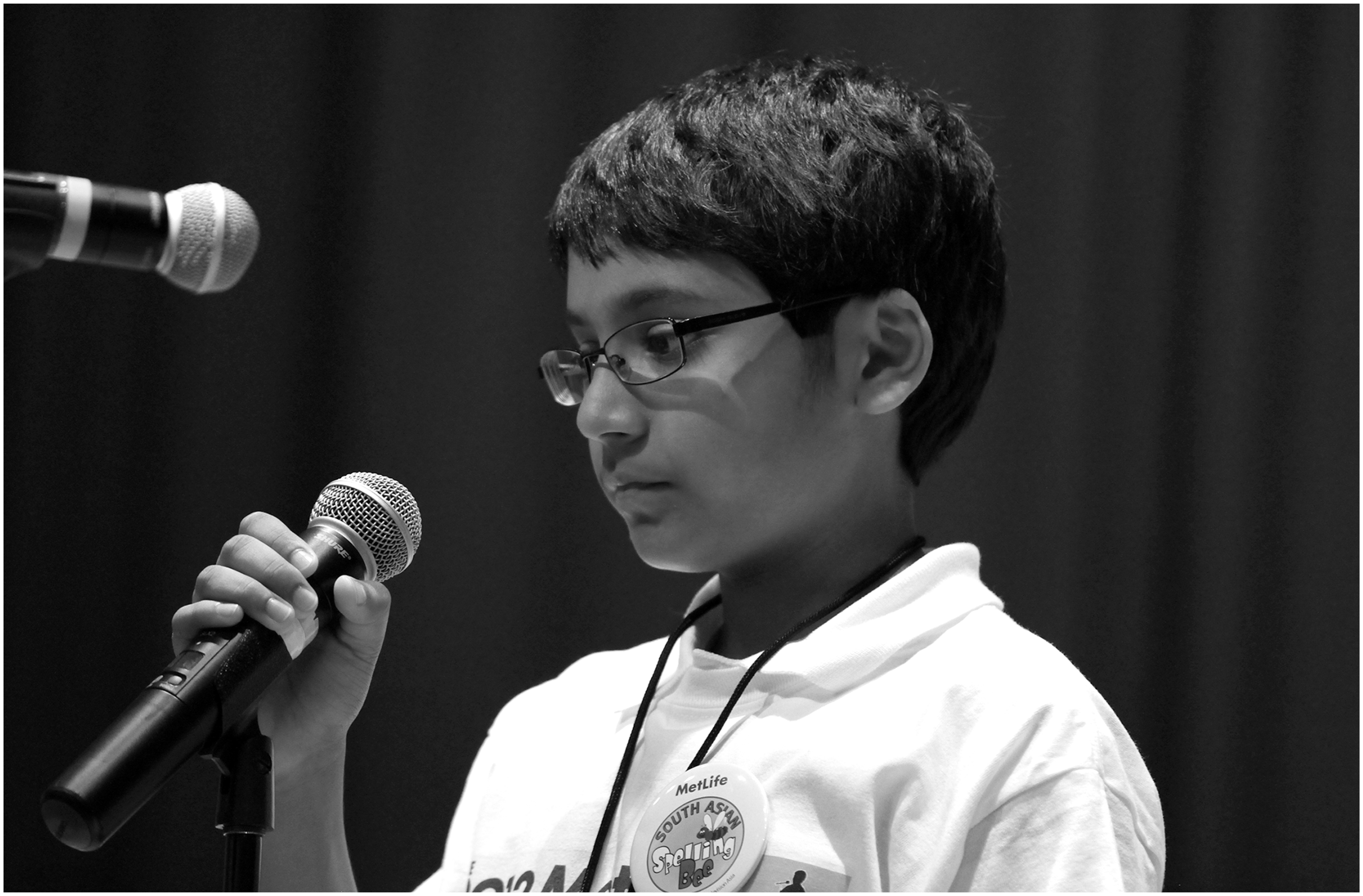
A speller pauses at the 2012 Rockville South Asian Spelling Bee.
Mark Taylor, Flickr CC
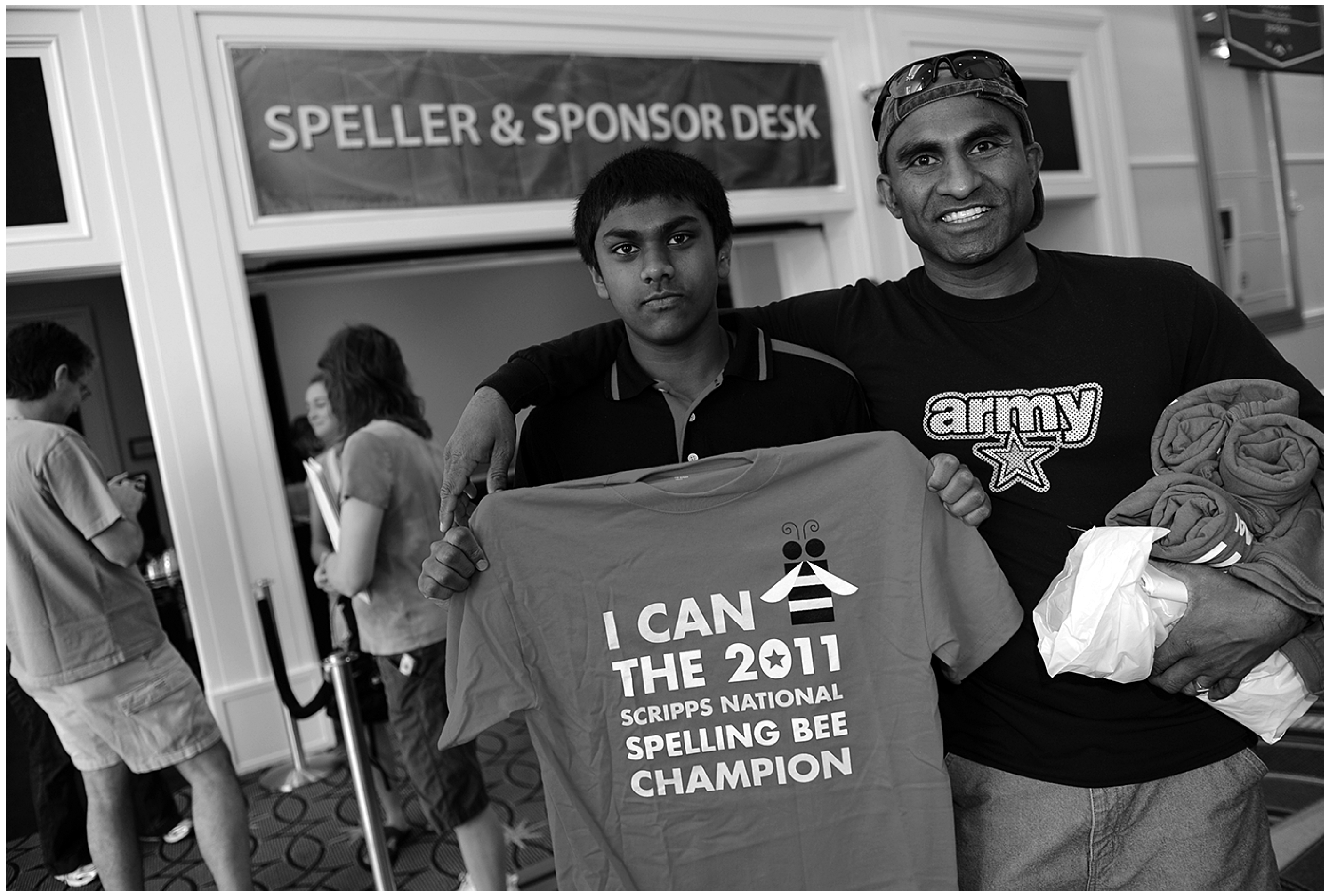
A spellers’ photobooth at the 2011 Scripps National Spelling Bee.
Scripps National Spelling Bee, Flickr CC

It is a long two seconds. “That is correct,” the judge says dispassionately, in effect adding to the tension that had been building up for the past minute. The boy’s eyes roll, equal parts relief and disbelief. As he takes his seat, another competitor steps up to the microphone, and the suspense starts again.
This is not the Scripps National Spelling Bee. It is a spelling bee organized by and mostly for Asian Indian Americans. Despite the heavily ethnic presence, a passerby could be excused for mistaking this for the Scripps National Spelling Bee, broadcast annually on ESPN. As of 2015, Indian Americans make up 15 of the past 19 champions (including co-champions) of the Scripps Bee, and, at the 2014 Bee, half of the 12 finalists were of Indian origin. At the 2015 Bee, out of the top 49 spellers to make to the finals, 25 were Indian American. The Scripps winner receives $30,000, does the television talk show and news program circuit, and becomes a hero to tens of thousands of children. Spelling bees aren’t even the only competition that Indian Americans dominate: they have won the past three National Geography Bees, with seven of the 10 finalists in 2015 being of Indian origin.
As Sameer Pandya wrote in The Atlantic, Indian Americans at the Scripps Bee have become “America’s great racial freaks-and-geeks show,” a spectacle that is as much gawked at as applauded by the general audience.
Most Indian American youth do not engage in competitive spelling, and about a quarter of Indian Americans have limited proficiency in English. Still, it is safe to say that spelling bees have a special resonance for many in this ethnic group. In fact, there are two major competitions designed by and for Indian Americans, each of which hosts regional competitions in about twelve cities and a finals competition for the top competitors in each city. Families drive for hours to reach these matches.
Indian Americans’ excellence in spelling bees has caught the attention of mainstream media and the general public, and not always favorably. News articles covering the trend often compare the parents of winners to “Tiger Moms and Dads,” meaning that the families push the children into the competitions and over-emphasize academics at the expense of children’s other interests—even happiness. Attention is placed on the long hours of study involved. As Sameer Pandya wrote in The Atlantic, Indian Americans at the Scripps Bee have become “America’s great racial freaks-and-geeks show,” a spectacle that is as much gawked at as applauded by the general audience. On top of this, racist social media responses to Indian Americans’ spate of victories are now commonplace, even expected.
Rather than ask why Indian Americans keep winning the bee, I have a different, more fundamental question: Why are so many committed to spelling bees in the first place? What motivates these families to spend so much time on bees? To understand this group dynamic, I have interviewed over 100 persons, including parents and children, from across the country, with a concentration in the Boston area. Families are mostly Indian Americans, but include many non-Indians, engaged in some version of extracurricular education like the spelling bee. I have conducted ethnographic observations at eleven spelling bee competitions, in people’s homes, and other related settings. This article draws from my interviews and observations with Indian American participants and their families.
The Push Beyond Educational Excellence
For parents, spelling is a form of hyper-education—a voluntary educational pursuit for their children outside of school. Extra education is a response, in part, to an anxiety over children’s college admission prospects. Contemporary parents of many backgrounds sense angst around college placement. Middle-class parents practice “concerted cultivation”, including organized extracurricular activities meant to foster life skills, with their young children with college admissions in mind. As Hilary Friedman argues, this cultivation can take the form of competitive activities. Families feel that the sooner a child specializes in an activity, the more likely the child will excel in it, thereby earning credentials to put on their eventual college applications. Amit, an Indian immigrant father, told me and a group of parents over lunch at a bee about the need to specialize when young: “You cannot be jack of all things, and that way gain nothing. So when you are focusing on something, focus. Then they will love that, okay. ‘If I focus, I will excel in this one thing, or if I focus on that [other] one, I will excel in that, too.’” Children must specialize or “gain nothing” in life.
Scripps National Spelling Bee, Flickr CC
For these Indian American parents, the notion of competition is not a hypothetical problem awaiting their children in late high school. Competition pervaded their own upbringings in India. Raju, a father of a speller in a bee finals competition, explained the “scarcity mentality” and its impact on his parenting: “Every resource in India is scarce. You have to be cream of the crop to get anything into it. Ok, so museum trips [for example]. I come from a very suburban school [in India]. Twenty kids from school are chosen to go on the museum trip, so you’ve got to be good at something [to be chosen]. … We have this scarcity mentality built in, that we need to be there first to get some resource. Otherwise it’ll be gone. So we have the competitive thing built into us, so we are pushing our kids to it.”
While sports present a common avenue for gaining competitive credentials for youth, these Indian immigrant families put more attention into education. The model minority stereotype contends that Asian immigrants “overachieve” in school because they are culturally drawn to education, but the reality is more complicated. These families prioritize education as a way to stand out within a competitive field, for one thing, because they did not think that their child could excel in sports. As one Indian American father explained while a group of fellow immigrant parents nodded in agreement, “Some of my [Indian] friends with whom I spoke said, ‘Well, our kids cannot compete with the other kids in swimming, they get tired out very easily.’ … So those physical aspects and also other issues come into play. That’s why you scale down at sports and look at other activities which bring you to the top.” I should note that many of these Indian American kids still participated in sports—though they weren’t expected to be champions. According to parents, sports were a way to make children “well-rounded.”
Academics resonated with the parents as an alternative competitive venue in part due to their own upbringing and immigration patterns. They had immigrated to the United States mostly through work visas, achieving upward mobility through education. As Jennifer Lee and Min Zhou argue, Asians who immigrated as professionals to the U.S. are a highly selected bunch, with higher levels of education not only compared to other Americans but especially so compared to those in their homeland. Well over two-thirds of Indian Americans (age 25 and above) have a college degree or higher—more than double the national average. While about one in ten Indian Americans has less than a high school degree, these tend not to be the parents of children involved in the bees. The parents of spellers are predominantly college-educated and often work in STEM fields.
Families feel that the sooner a child specializes in an activity, the more likely the child will excel in it, thereby earning credentials to put on their eventual college applications.
Why Spelling?
Given its commitment to education, why has the Indian American community chosen spelling bees? Parents find the preparation for the bee reminiscent of their study patterns in India, with an emphasis on logic and memorization. These parents are fluent or at least proficient in English, which gives them a significant advantage in not only training their children but also, more generally, in being comfortable with exploring English in greater depth. Similarly, parents and children appreciate that spelling and academic pursuits make them more knowledgeable about American culture. Families bond while studying.
2011 Scripps National Spelling Bee champ Sukanya Roy prepares for her CNN interview. She placed in the top 20 at the Bee in the prior two years.
Scripps National Spelling Bee, Flickr CC

But, a crucial part of the answer to “why spelling” involves co-ethnic role models. Spelling caught on as Indian Americans saw their co-ethnics achieve in this arena. It became a self-perpetuating cycle. When Nupur Lala won in the Scripps National Spelling Bee in 1999 and was profiled in in the Oscar-nominated film, Spellbound, she became a household name. Champions serve as role models and provide a crucial spark to get the trend going, for a community to identify with an activity. When I asked a mother why more families did not pursue chess, for example, as an extracurricular academic option, she told me to wait until the first Indian American chess champion prevails—then we’d see a flood of young Indian American players.
Even before Lala won Scripps, spelling bees had been a nascent interest among Indian Americans. The North South Foundation, one of the Indian American bee competitions, started its competition in the mid-1990s as a way to boost Indian Americans’ verbal SAT scores and support its charity efforts toward education in India. Since then, another South Asian American national spelling bee started, and local bees targeted Indian Americans. The rise of these spaces created not just opportunities to spell competitively but also the expectation to do so. A father, Mihir sat up in his chair, as the two of us spoke, to explain the impact of his peers on his parenting decisions, “When you’re in a community—if everybody in your family is a doctor, you want to become one, right? If everybody is an engineer in your community you want to become one, right? … Other kids are doing, you’ll do it.”
Champions serve as role models and provide a crucial spark to get the trend going, for a co-ethnic community to identify with an activity.
The Youth
Like with many other extracurricular pursuits, these kids first became interested in bees often through a friend. Hema, a former speller, explained her progression: “I initially started spelling bees because my oldest friends are Indian, and they would do spelling bees and stuff, and I hung out with them. So, um, then they, either aged out or stopped doing them, and I just continued to do them because I was winning, at least like little bees here and there.” Having competitions designed for your own ethnic group made it more likely that you would have friends participating in it, and that made you more likely to participate.
Friendships also serve as a continuing motivation at the highest levels of competition. Youth form friendships at the bees. At the Scripps bees, for instance, I have seen kids literally run around together in the hotel. They go up to each other’s hotel rooms to chat. They enjoy organized field trips together. Spellers want to repeat the bees in part to reconnect with past spellers. They keep in touch through social media.
While friendships provide an incentive to start and continue participating in bees, these children also embraced the competitive element. Naresh started spelling at age five and said, “I saw somebody in the paper holding up a trophy, and it was that year’s champion who, you know, seemed like was having a lot of fun. So I told my mom that I wanted to win the spelling bee and get that trophy.”
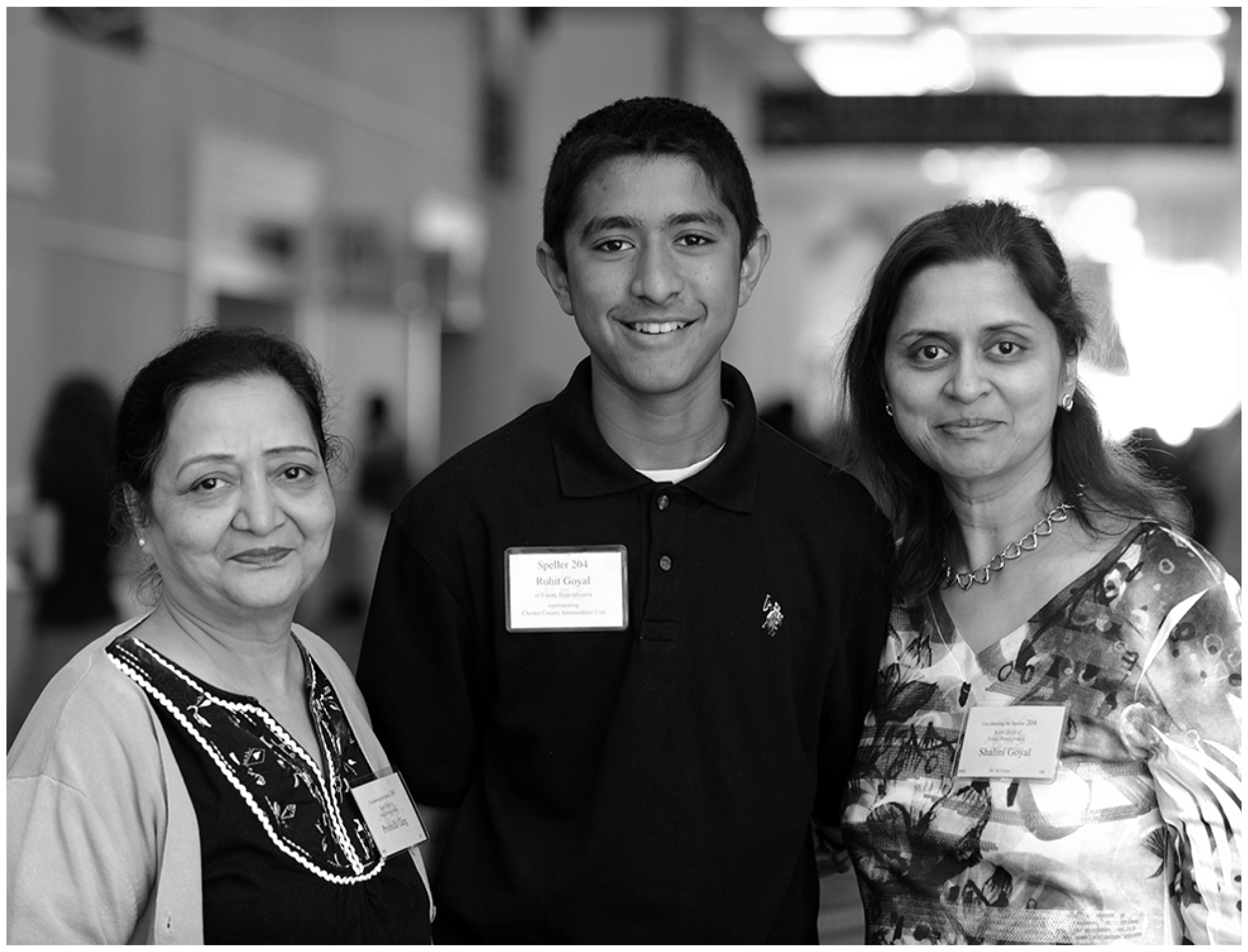
Speller Rohat Goyal poses with his family at the 2011 Scripps National Spelling Bee.
Scripps National Spelling Bee, Flickr CC
Many of the young people I interviewed compared the competitive dimension to traditional sports. One youth aptly called spelling “a brain sport.” Sonu told me, as we sat in his family’s home in Dallas, TX, “It’s like golf in a way, in that you’re really only competing against yourself. You have no control over the success or failure of others, so at the end of the day, if you don’t win, it’s something you could have done better. I took that to heart and used it as a measuring stick for myself, improving each year I did it.”
On top of these motivations to engage in bees, youth refer to what’s at the heart of spelling: a love of words. This is particularly the case for kids who show a penchant for spelling and stick with the bee for years. A common trait among competitive spellers is they were voracious readers when young. As Hari and I spoke during a lunch break at a bee, he reflected upon his pre-elementary and lower-elementary years, saying, “I probably read so many science fiction and fantasy books… I would get 20 books from the library, and I remember the librarians would always raise their eyebrow, ‘Can this kid really read all these books in three weeks?’ And I would be able to, because that’s what I wanted to do.”
This is a child whose commitment to reading surprised even librarians. Spellers quickly develop favorite words. They appreciate words that derive from certain languages. They develop rituals to study. And they are prepared for the pressure on stage when spelling.
Indian Americans’ commitment to bees is not that different from other communities’ commitments to specific extracurricular practices. The Indian immigrants see bees as an activity that promotes their children’s mobility. It makes sense to them, given their own histories with education and immigration and their sense of disadvantage in other competitive venues. Indian Americans participate not as individuals nor even just as families, but as community members inspired by co-ethnics.
I do not foresee asking my elementary-aged children to join a spelling bee, primarily because they do not show an interest in it, nor does my family feel any social pressure to get them involved. That said, I understand what families in the bees are trying to accomplish, much like I see worth in Little League baseball and gymnastic competitions. To each group (and subgroup), their own. And I await the day when the spelling bee champion is also the starting pitcher for her or his Little League softball or baseball team. Given the number of hours required to excel in both kinds of activities, I might be waiting a long time.
I await the day when the spelling bee champion is also the starting pitcher for her or his Little League softball or baseball team.