



Abstract
LGBT educators struggle to balance professionalism and pride in the classroom, splittling, knitting, or quittting, in the words of the authors.

“Out of the closet and into the streets!” has been the guiding principle of lesbian, gay, bisexual, and transgender (LGBT) activism in the U.S. since the 1960s. From the riots at Stonewall and Compton’s Cafeteria to the 21st century marriage equality movement, coming out has been the lynchpin in the politics of gay pride. Even the ubiquitous phrase “out and proud” explicitly links coming out and having pride as a package deal. The result is a sometimes subtle, yet pervasive message that coming out is tantamount to a sacred duty for contemporary LGBTs. But is there a drawback to that imperative? What happens when gay pride comes into direct conflict with professionalism?
How would this picture change if we knew the teacher’s sexual orientation?
U.S. Army/Lori Yerdon
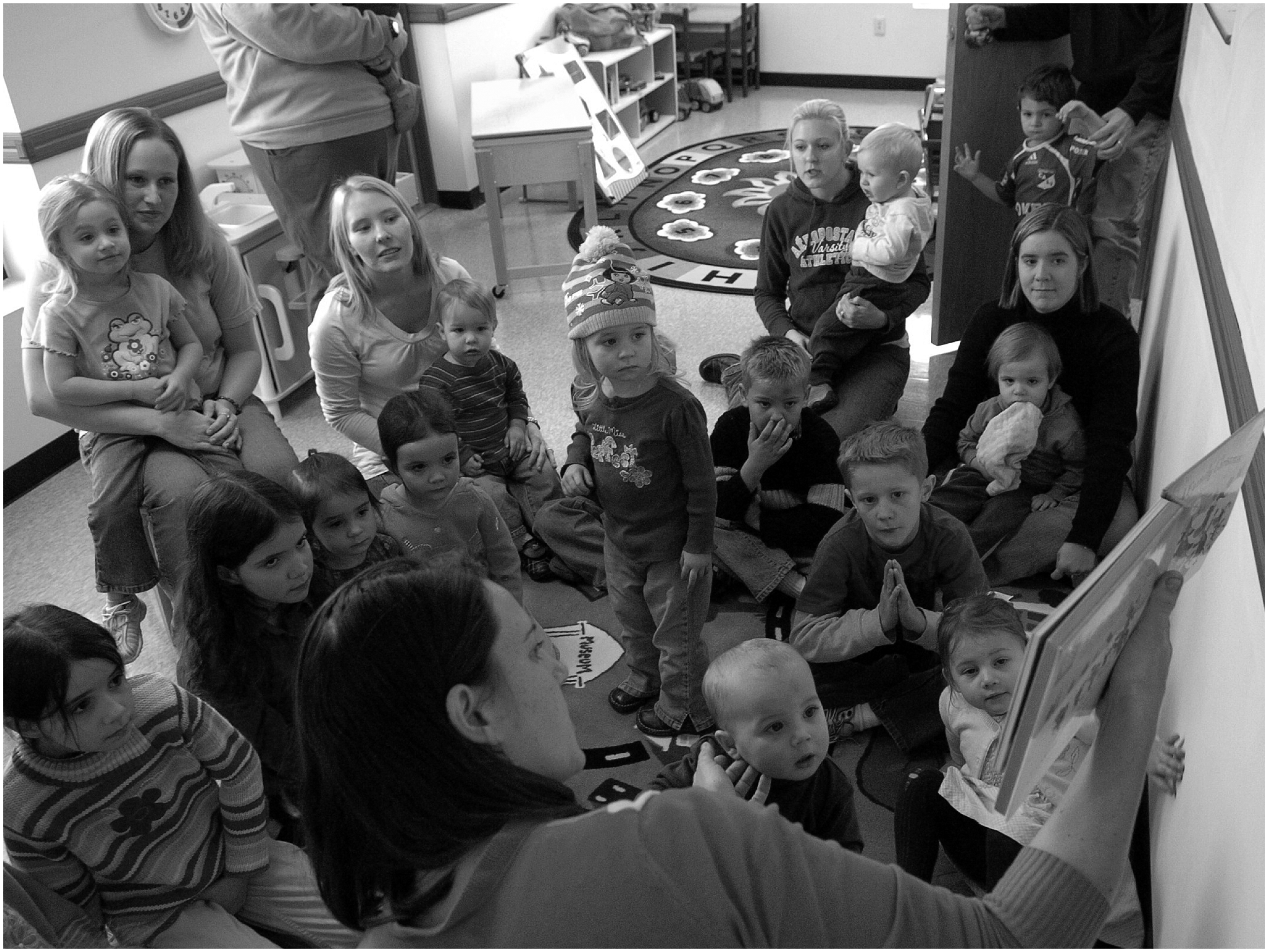
This question is especially relevant in the lives and careers of gay and lesbian public schoolteachers, for whom professionalism demands an ostensibly sexually neutral presentation of self. On its face, this ethic of sexual neutrality includes teachers both gay and straight, all of whom are expected to uphold strict standards of desexualized dress, talk, and biographical detail with their students. For heterosexual teachers, though, there’s a range of indicators of sexuality that are deemed within the bounds of professionalism—pictures of, talking about, and visits from their spouses in the classroom are considered benign displays of sexuality that don’t undermine their professionalism (and are often encouraged). Yet the idea that gay and lesbian teachers might do the same remains taboo in all but the most progressive and gay-friendly of schools. How, then, do gay teachers balance the demands of pride and professionalism?
In interviews with 45 gay and lesbian public school teachers in California and Texas, I found that most feel caught in a no-win situation, where coming out in the classroom feels like a fulfillment of their responsibilities to gay pride and a failure of their responsibilities as teaching professionals. This catch-22 is further complicated by the fact that the majority of gay and lesbian teachers (and LGBT workers more generally) can’t rely on nondiscrimination protections to mitigate the riskiness of coming out. To date, only 21 states prohibit workplace discrimination on the basis of sexual identity, while even fewer (18 states, plus Washington, D.C.) have nondiscrimination protections for transgender and gender nonconforming workers.
Mauricio: “I still believe my job here should be to be your science teacher, not your gay science teacher….”
The Pride/Professionalism Dilemma
When we spoke in 2008, Mauricio, a 20-year veteran of middle school teaching in Texas, still felt passionate and excited about going to work every day. Mauricio was not out to his students, because, in his words, “I literally am just their teacher, their science teacher. I see my sexuality as a gay man as being this much [holds up fingers to indicate inches] of my being. It’s a small, small part of who I am. I think the majority of my life is being a science teacher.” While Mauricio was initially adamant that his sexuality had no bearing on his work as an educator, he later articulated a sense of guilt about shirking another duty: to be out and proud in school. When I asked how schools could do better by LGBT students and teachers, Mauricio replied, “This is going to say a lot about me, but I wish there were more openly gay men and lesbians in the field. I’m not one of them, obviously, not to my current students, anyway. Because we have to be role models. We definitely have to be role models. …Again, I’m not going to run out and out myself because I still believe my job here should be to be your science teacher, not your gay science teacher. But, no, that’s important though. Wow, listen to myself.”
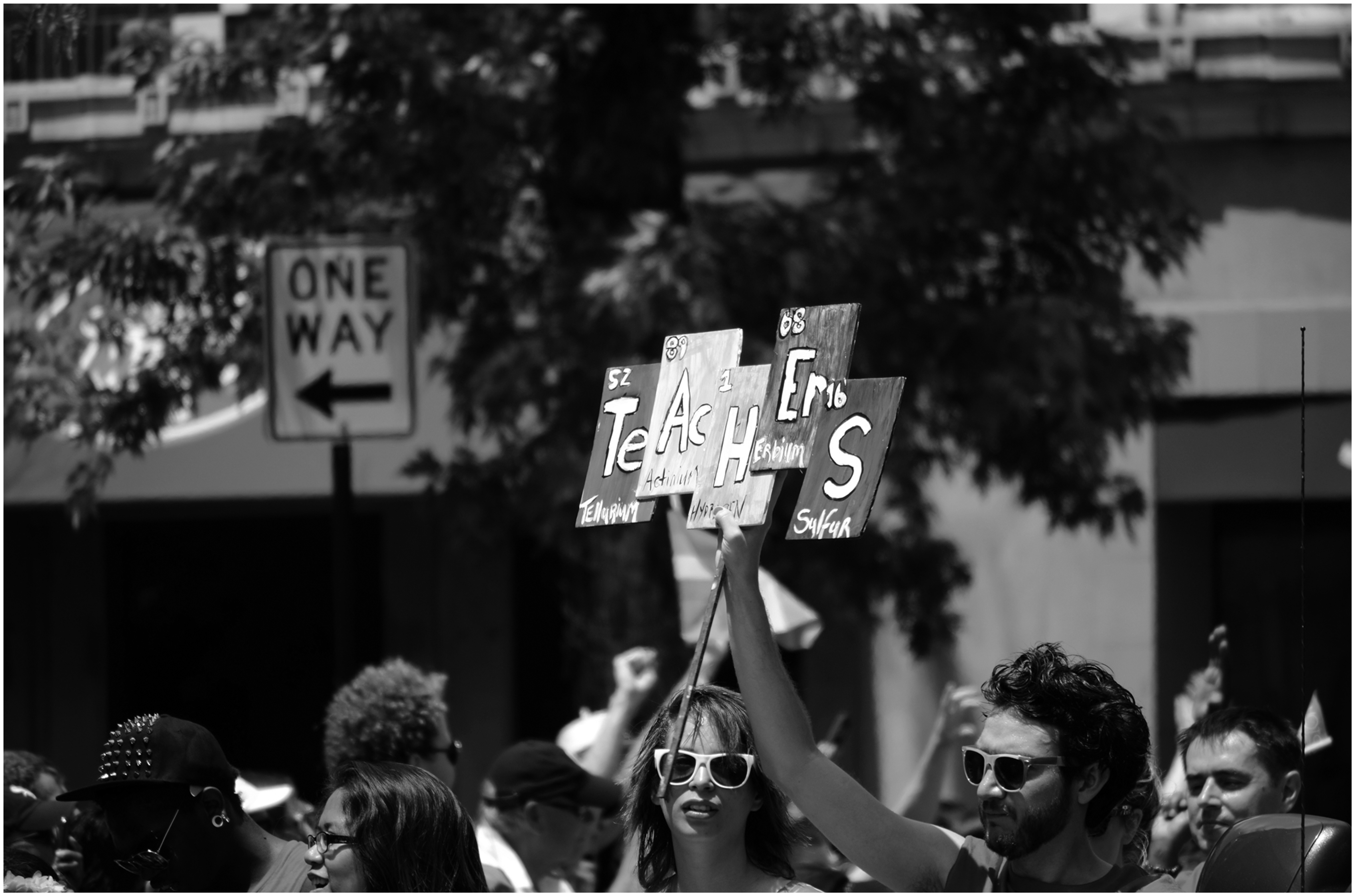
Chicago teachers in their city’s 2014 Pride parade.
NathanMac87, Flickr CC
Amy: “We help our students by being visible… If they don’t see adults feeling comfortable in their own sexuality, what’s it saying to them?”
Mauricio’s reply demonstrates how even teachers who don’t want to and don’t choose to be out at school feel the tug of the role modeling demands at the heart of contemporary gay pride discourse. At the end of our interview, he asked anxiously, “I’m not the only one who doesn’t come out, am I? There have to be others like me, right?”
I also spoke with Hugh, a Texas high school teacher who was not out to students, and he echoed Mauricio’s ambivalence: “You know, I’m kind of a hypocrite because—teachers coming out … It would definitely give [LGBT students] a positive role model.” Amy, a California high school teacher, articulated the predominant rationale of gay pride’s role modeling demand: “We help our students by being visible… If they don’t see adults feeling comfortable in their own sexuality, what’s it saying to them? How does it affect them? If you’re coy about it or secretive or whatever.” According to this rationale, teachers who are not out to students are being “coy” and “secretive” about their sexuality and in the process are modeling not pride, but shame. It’s no surprise, then, that the majority of my interviewees referenced the importance of role modeling gay pride in schools, regardless of their own decisions about coming out.
Part of what made many reluctant to fulfill this role modeling expectation was their acute awareness of how professionalism, in the context of teaching, is infused with heteronormativity. Teaching, as a profession, has a uniquely moral character, one that has been historically sex negative and anti-gay. Teaching contracts often include “moral turpitude” clauses, which allow a school district to fire any teacher who doesn’t comply with (vaguely and broadly defined) community standards of moral behavior. While the U.S. is, in many ways, becoming a gay-friendlier place, the idea that children should be protected from the supposedly confusing and even corrupting knowledge of LGBT issues has been very slow to change.
Groups like the Gay Straight Alliance support LGBT students, but what about teachers?
Quinn Dombrowski, Flickr CC

As a result, the prevailing advice about professional comportment that is disseminated through teacher education programs, professional associations, mentors, and administrators discourages even the mildest expressions of non-heterosexuality. Gay and lesbian teachers often feel this injustice keenly. California middle school teacher Rufus explained, “[Heterosexuality in schools gets to be] a range of experience, a way of being. [Straight teachers] talk about their husbands, wives, their straight lives in a way that has an impact on their students and their ideas,” while gay and lesbian teachers are rarely afforded the same kind of nuance and candor about their personal lives. In fact, many gay and lesbian teachers felt that the heteronormative strictures of teaching professionalism rendered them virtually invisible—as Mauricio put it, “We’re here, we’re among you. And I think about it in my own classroom, we’re sitting amongst you and you don’t even know it.”
As a result, gay and lesbian identity comes to be defined as at best, irrelevant to teaching, and at worst, unprofessional and inappropriate—even by gay and lesbian teachers themselves. Cheryl, a California elementary school teacher, explained, “No, [I’m not out at school] because I think, first and foremost, I see myself as a teacher. I don’t mix my sexual orientation with my career. You know, it’s my career first. I’ve never even thought about it.” Texas elementary school teacher Phillip took it a step further, arguing, “I just don’t think it’s appropriate for them to know about me at seven or eight years old.” Although Phillip referenced the young age of his students as a rationale, Hugh used nearly the same words when talking about high school students: “Children are impressionable…. I just don’t think it’s appropriate to bring up.”
“I think, first and foremost, I see myself as a teacher. I don’t mix my sexual orientation with my career. You know, it’s my career first.”
Again and again, teachers referenced the idea that identifying oneself as gay or lesbian was unprofessional, inappropriate, or overly personal, even as they readily identified ways that heterosexual teachers reference their straight identities in the classroom. Between the pressures of teaching professionalism, which ask gay and lesbian teachers to leave their sexual identity at home, and the pressures of gay pride’s role modeling expectations, many teachers feel stuck.
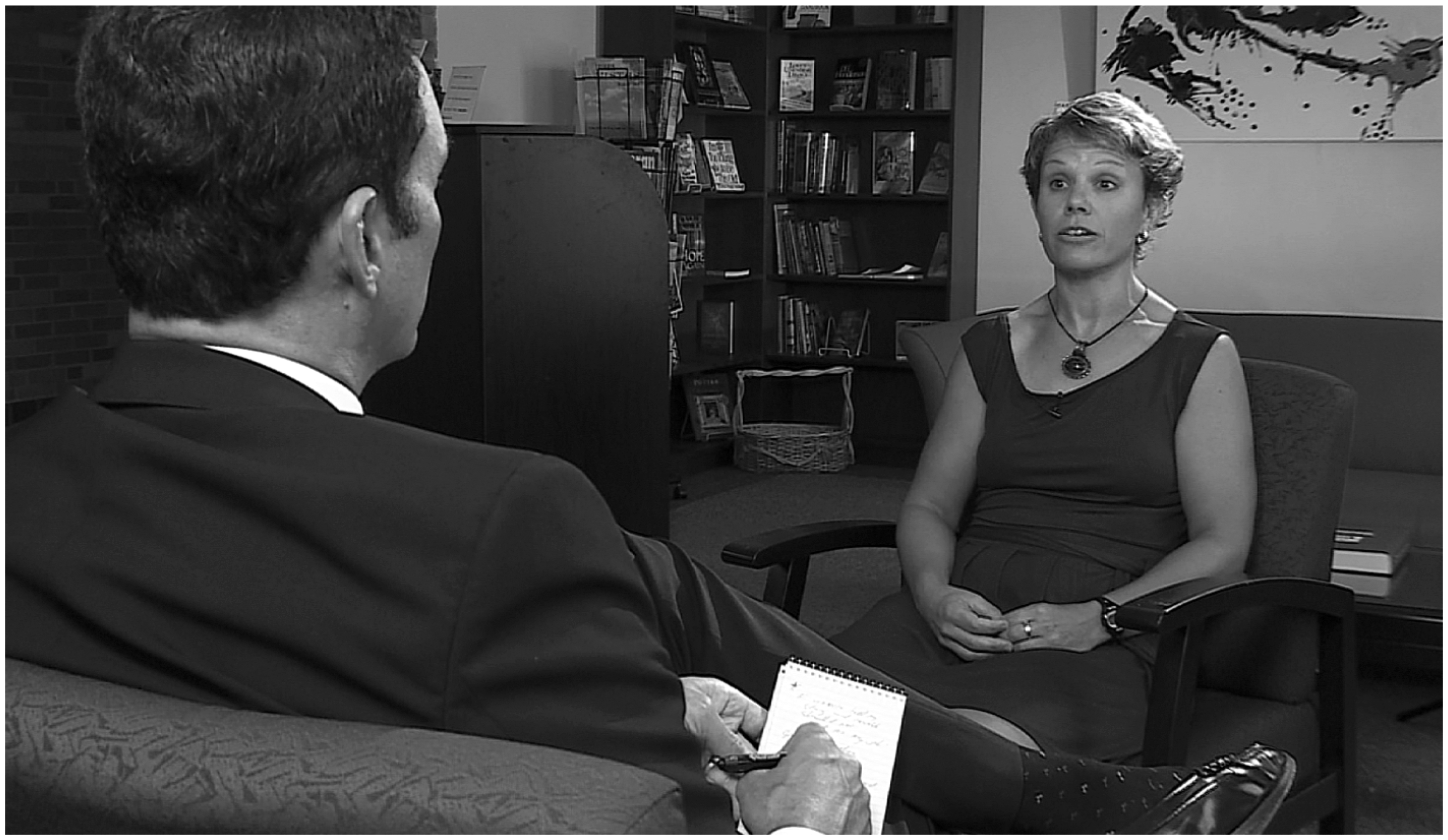
A Minnesota CBS affiliate interviews Kristen Ostendorf, fired by a Catholic school for coming out. She wrote in the Huffington Post, “I am Catholic and I am gay. This I know for sure.”
WCCO TV, screenshot
Splitting, Knitting, and Quitting
Teachers generally take one of three paths for managing this dilemma—they split off their professional selves from their sexual selves, they try to knit the two together, or they may decide to quit by moving into administration or out of the career entirely. Splitters tried to maintain a strict division between the identities of teacher and gay/lesbian. They felt that their sexual identity, like an overcoat or a hat, could be taken off at the schoolhouse doors and re-claimed at the end of the workday. Cheryl, quoted above, demonstrates this line of thinking when she insists that she doesn’t “mix” her sexual orientation and her career. Mauricio, too, wanted to be seen as just the science teacher, not the “gay science teacher,” despite the pressures of gay pride. He explained, “As a gay man, I should be proud to be out and stuff, and I am. But I’m here at work to do work.” Still, he said, he would be out in the classroom if he didn’t have to worry about administrators and parents penalizing him for it. Splitters came to their decisions with varying degrees of comfort and different kinds of motivations, but they were united by sense that the dictates of teaching professionalism required them to keep their workplace and sexual selves separate.
John: “I was just so tired of lying to them and lying to myself… like, almost eight hours a day, I had to hide who I was.”
Knitters tried to resolve the pride/professionalism duality by carefully integrating their gay and lesbian identities into their teaching performance. Chelsea, a California high school teacher, offered a common explanation: “For me, to not be open would be just defeating the purpose of going to work. So I, on the first day of school… I actually said, ‘And I’m a lesbian’ in my introduction…. I just think it’s really important, that teachers need to be out and open in order to support their kids.” Knitters chose to integrate their sexual and professional selves as both a gay rights strategy and as a way of feeling more authentic or whole. Rufus offered, “Just from my own personal experience, I think it has really benefited my teaching experience, by being out. And I see and hear from my students, just them knowing that, it makes them more comfortable with gay people.” Chelsea concurred, “I think the purpose of being a teacher is to connect with other human beings and guide them. And you can’t do that without being an honest person. And you’re not being honest if you’re not being yourself.”
While knitting may seem like the ideal solution to the pride/professionalism dilemma, it was a virtually impossible one for teachers who weren’t legally protected from employment discrimination, who didn’t have supportive colleagues and administrators, and who weren’t economically secure enough to risk possible fallout from their openness. Even for teachers who did have all this, the risks were steep—Rufus routinely faced harassment from students, including defamatory graffiti on his classroom door and taunts in the hallway. Knitters deeply internalized the out-and-proud dictates of gay pride and it shaped their on-the-job choices at a significant cost.
For many, splitting and knitting were unsatisfactory or unrealistic. For some, quitting became the only viable solution. John, a California middle school science teacher, started out his career by splitting, only to find it unbearable: “I was just so tired of lying to them and lying to myself… like, almost eight hours a day, I had to hide who I was.” He resolved to try knitting: “I wanted to just be honest with them, you know, this is who I am. And I’m still your teacher, I’m still the same person, and you know, accept me or not accept me.” Unfortunately for John, several students and coworkers chose the latter. He struggled through a year of harassment and isolation before deciding to quit and pursue a new career where he would not have to make these difficult choices. While quitting allowed teachers to escape the no-win choice between splitting and knitting, it did so only through opting out of classroom instruction entirely.
Beyond Pride or Professionalism
The fact that gay and lesbian teachers, regardless of geographic context, evinced a shared frustration with the incompatibilities of gay pride and teaching professionalism demonstrates a fundamental problem with the overreliance on coming out as a political strategy. It suggests that nondiscrimination legislation alone is not enough to improve LGBT working conditions. Instead of putting the onus on individuals to come out, we need to consider how institutions like schools are embedded in (and reproductive of) heteronormativity and homophobia.
Schools and workplaces are structured into what feminist sociologist Joan Acker calls “inequality regimes.” Acker argues that heterosexuality (alongside Whiteness, maleness, and middle-class status) is an obscured, but essential component of the day-to-day rules, practices, policies, and interactional norms of most organizations. By virtue of their distance from it, gay and lesbian teachers’ experiences show us how heterosexuality is embedded in the very fundamentals of teaching as a profession.
To ease the fundamental tensions between gay pride and teaching professionalism that make working in education so challenging for so many, a stronger and more expansive network of nondiscrimination protections for all LGBT workers is certainly important. Comprehensive employment rights are a necessary precondition for dismantling the heteronormativity built into the professional standards and expectations of teaching. But, as I demonstrated above, it’s not enough—even teachers who currently have those protections feel pressured to keep their sexuality out of the classroom. Once nondiscrimination policies are in place across the U.S., the norms of teaching professionalism will still need to change. Some educational advocates have begun the crucial work of developing “queer pedagogy,” a philosophy of education that challenges the sexually neutral ethic of teaching professionalism. A queer pedagogical approach not only breaks down normative assumptions about sexuality and gender through the everyday practices of education, it also encourages students to challenge intersecting inequalities, including racism, classism, ableism, and others. Queer pedagogy could help dismantle institutionalized inequality regimes. While this perspective is slowly gaining some traction within the field, it’s been slow and difficult going, as highlighted in a recent article of the journal Education and Urban Society. Increased support for and integration of queer pedagogical insight into the curriculum and policy of schools will go far to ease some of the burden gay and lesbian teachers face.
The responsibility for change, of course, does not lie entirely with schools. The one-size-fits-all model of gay pride that demands coming out at any cost is far too individualistic and exclusionary a rights tactic. The coming out mandate ignores the fact that some people are more vulnerable to negative outcomes than others. It asks all LGBT-identified people to foreground their sexual identities above all others. It also leaves organizational heteronormativity more or less unchecked.
Chelsea: “I think the purpose of being a teacher is to connect with other human beings and guide them. And you can’t do that without being an honest person. And you’re not being honest if you’re not being yourself.”
Rather than rely on coming out as the key strategy for combating sexual and gender inequalities, more focus should be placed on the ways that sexual normativity and oppression are woven into the daily fabric of our lives and sacred institutions.