




Abstract
Based on quantitative survey data collected during Pride parades in six European countries – the Czech Republic, Great Britain, Italy, the Netherlands, Sweden, and Switzerland – we analyse who participates in Pride parades. Engaging with the so-called protest normalization thesis we ask: are Pride parade participants, aside from sexual orientation, representative of the wider populace? In none of the countries could we find indications that Pride participants mirror the general populations. The parades remain dominated by well-educated, middle strata youth, rich in political resources. However, we find variation between countries, which we link to differences in elite and public support for LGBT rights.
Keywords
Pride parades are today staged in numerous countries and localities, providing the most visible manifestation of lesbian, gay, bisexual and transgender (LGBT) movements and politics. Pride parades, we argue, are foundational rituals for LGBT movements across the globe; as such they act as collective responses to oppression, encourage redefinition of self, and express collective identity (Engel, 2001: 140; Taylor and Whittier, 1995). But are LGBT individuals from all ages and all walks of life included in Pride parades? Or are Pride parades the privileged public spaces of young, highly educated, middle-class, white males? Can we speak about a genuine democratization of the LGBT movement expressed by the diversity of its Pride parade participants?
In this article we examine what in the social movement literature is designated as the ‘protest normalization thesis’. The protest normalization thesis can be broken down in two parts. Firstly, it is argued that demonstrations have become an increasingly normal and acceptable means of political participation. Secondly, the composition of people engaging in demonstrations is becoming increasingly ‘normal’ in a statistical sense, that is, representing more or less a cross-section of the population. Linking these two dimensions together, Verhulst and Walgrave claim that ‘the normalization of protest has brought on a normalization of protesters’ (2009: 457). Subsequently, if the protest normalization thesis holds true, then we should expect to find that Pride parades are no longer solely the domain of what Verhulst and Walgrave call the ‘usual suspects’. Instead, Pride participants would more or less mirror the general population in terms of socio-demographics, thereby conforming to the general, albeit weak, normalization trend in demonstrations. Hence our first question: Are Pride parade participants, aside from sexual orientation, reflecting the social diversity found in the wider population?
Commemorating the 1969 Stonewall Riots in New York City, the first Pride demonstrations were held in New York, Los Angeles and Chicago in 1970 to publicly demonstrate and assert lesbian and gay identity and pride. The tradition has since travelled globally (Herdt, 1997; Lundberg, 2007: 173). Despite its origins in the USA, the tradition has become ‘translated’ into new contexts to suit different national and local settings (Adam et al., 1999; Browne, 2007; Calvo and Trujillo, 2011; Duggan, 2010; Enguix, 2009; Nardi, 1998; Robinson, 2012; Ross, 2008). 1 Subsequently, we argue that the mobilizing and political contexts should also impact on the participant profiles in Pride parades (Holzhacker 2012; see later in this article). Hence, our second research question: How do these different mobilizing and political contexts influence participation in Pride parades, either encouraging a mobilization of a broad range of people or recruiting only a more limited segment of the LGBT population?
Hitherto there has been little systematic knowledge about the participants in Pride parades, with only a few studies based on relatively small samples of participants (Browne, 2007; McFarland, 2012). In this study we use quantitative survey data collected within the European Science Foundation Euroscores program ‘Caught in the Act of Protest: Contextualizing Contestation’ (CCC), to analyse who participates in Pride parades in six European countries: the Czech Republic, Great Britain, Italy, the Netherlands, Sweden, and Switzerland. This choice of countries is primarily based on available data from the CCC program, nonetheless the sample includes a range of different societal contexts that provide a basis for fruitful international comparisons. In the next section, we describe the normalization thesis of demonstration participation, and discuss its relevance for Pride parades. After a section outlining the data and research methods we will turn to an analysis of the socio-demographic and political composition of the Pride parades included in our study.
The ‘protest normalization thesis’ and Pride parades
Demonstration participation has become a normalized form of political activity in Western European societies. Since the 1960s more and more issues have been raised in demonstrations and a steadily increasing number of demonstrations and demonstrators have taken to the streets across Western Europe (see e.g. Barnes and Kaase, 1979; Meyer and Tarrow, 1998; Norris, 2002; Norris et al., 2005; Tilly, 1983; Van Aelst and Walgrave, 2001). According to Topf (1995), both the number and above all the legitimacy of all kinds of peaceful protest acts have risen to such an extent in Western Europe that any reference to ‘unconventional’ forms of participation is more or less outmoded. Demonstrations have become normalized resulting in what Etzioni (1970) very early proclaimed as ‘demonstration democracies’ and what Meyer and Tarrow (1998) call ‘social movement societies’.
The so-called new social movements that emerged in the 1960s, in addition to introducing new issues to the street, also produced a new kind of protester. The demographic profile of environmental, feminist or peace demonstrations differ radically from that of disgruntled workers: they are both younger and more educated. Demonstrations are no longer solely the means for the organized working class to air their demands, but (perhaps primarily) the domain of the politically active, well-educated middle class (Van Aelst and Walgrave, 2001; see also Norris, 2002). But the question remains, has the normalization of demonstrations developed to produce a normalization of the demonstrator? Van Aelst and Walgrave (2001:466) posed the following question: ‘Are the profiles of demonstrators different to those of the average man or woman in the street?’ Their answer was ambivalent. As protest issues have become more diversified, the diversity in social groups that today stage demonstrations has increased (what Van Aelst and Walgrave see as an increasing ‘external heterogeneity’). However, the internal diversity of demonstration populations has but slowly increased. While gender is less a factor today, there remains what they called ‘female’ and ‘male’ demonstrations. Furthermore, younger and better-educated demonstrators continue to dominate. However, they found that in specific types of demonstrations, linked to what they call ‘new emotional movements’, the heterogeneity, and therefore representativeness, of the demonstration’s rank and file is quite remarkable (Van Aelst and Walgrave, 2001: 477–78). These mobilizations are typically emotional reactions to criminal victimization and participants are predominantly mobilized directly through mass media rather than through associations or organizations. Nevertheless, they concluded, in regards to the normalization of the protester that the ‘underrepresentation of those with less education and the less affluent prevents us from speaking about genuine democratization of street protest’ (2001: 482).
In conclusion, while there appears to be a degree of normalization among demonstrators, the trend is still relatively weak. Nonetheless, there has been a social diffusion of protest. Van Aelst and Walgrave (2001: 481) maintain that the lower forecasting potential of socio-demographic variables has made way for situational variables. Individuals’ likelihood to take part in protests depends less on their age, gender and, to a lesser extent, their education, than on the context of the mobilization, as well as the issue of the demonstration. It can also be added that compared to other forms of political participation (e.g. contacting governmental officials, or working in a political party), the level of participation in protests is today more similar between different social strata (Schlozman et al., 2012: 122–124).
Prima facie, many Pride parades could be expected to be a good example of this normalization trend, since they explicitly seek to mobilize the breadth of the LGBT community. They are often organized as ‘open’ demonstrations encouraging everyone with a LGBT identity (or heterosexuals who sympathize with LGBT politics) to participate. In this sense Pride parades encourage social diversity and are a celebration of the social diversity of the LGBT community. By extension, as noted by Ross (2008), there is an increasing tendency to embrace diversity in society as a whole.
LGBT identities are transversal. Although not always in equal proportions across all social demographic categories, they are found in all parts of society and cut across perceived social barriers such as class, ethnicity/race, age and sex (cf. Gates, 2015). This suggests a potential for the ‘normalization’ of Pride parade participants. However, the notion of ‘normalization’ is hotly debated within the LGBT movement and among LGBTQ scholars and does not carry the same connotation as within the wider social movement literature discussed earlier. Queer critics contend that ‘normalization’ – in terms of LGBT people ceasing to challenge broader relationship norms and sexual norms in society – leads to a politics of assimilation into heteronormativity, which thereby undermines the LGBT movement’s emancipatory force and fundamental cultural challenge (e.g. Chasin 2000; Epstein 1998; Gamson 1995; Seidman 1997; Valocchi 1999; Walters 2003; Warner 2000).
Richardson (2004: 394) argues that, paradoxically, by drawing on respect for diversity LGBT movements ‘may further their efforts in seeking social conformity as “normal gays”, who espouse the norms and values of the “ordinary” citizen’. Despite the problematics associated with trumpeting out ‘we are just like the rest of you’, an underlying aim of the organizers of the Pride parades we studied is just that, to manifest the LGBT community as more or less reflective of the social diversity found within the wider population (Wahlström and Peterson, 2016) – ‘We are everywhere’ (Davis, 1995: 293) – the socio-demographic normalization of the Pride participants. We explore whether the normalizing tendencies in terms of socio-demographics outlined in the social movement literature, and the aims of some Pride organizers to maximize diversity, in fact holds for Pride parades. Hence the following hypothesis: H1 The participants in Pride parades are not statistically different from their respective national populations in terms of age, gender, class and education. H2 Among Pride participants, conservative political sympathies are underrepresented while liberal (centre) and left-wing sympathies are overrepresented, compared to national populations.
Walgrave and Verhulst make no distinction between the effect of elite opinions and public opinions, arguing that public opinions are ultimately a consequence of elite opinions. Be that as it may, it is clear that elite and public opinions on LGBT issues are not always concordant. Consequently, Ron Holzhacker (2007, 2012) explains differences between the character of LGBT movement organizations’ strategies with reference to the combination of elite and public opinions on LGBT issues. He identifies three modes of interaction of LGBT movement organizations and their political environment. First, in countries where the public and elite attitudes regarding LGBT people remain internally polarized (as in, typically, countries or regions showing strong religious influence), LGBT organizations are embroiled in morality politics. In these cases, Holzhacker argues, the organizations will most often pursue highly visible confrontational strategies, to be able to push their causes onto the political agenda. Where both the elite and public attitudes are supportive or even highly supportive, LGBT organizations will practice a high-profile politics mode of interaction vis-à-vis their political environment, staging large-scale celebratory public events, engaging in close cooperation with government authorities and exporting their ideas and resources. Whereas Walgrave and Verhulst (2009) treat public opinion on the war merely as an intermediary variable between elite orientation and who is mobilized, Holzhacker (2012) also discusses situations where elite and public opinions differ. In places where the elite opinion is relatively supportive, while public opinion is divided or negative, the organizations will seek incremental change, favouring small-scale events and working discreetly behind the scenes through lobbying, and cooperating with, government authorities.
In cases where elite and popular opinion are more or less in accordance, Walgrave and Verhulst’s (2009) assumptions about anti-war demonstrators should be applicable also for the social composition of Pride parades. Consequently, where both elite attitudes and public opinion are polarized or hostile towards LGBT rights, the threshold for participation is higher and Pride mobilizations should be likely to be composed of participants from more resourceful social groups, possibly also more politically radical and likely to already be part of the formally organized core of the movement (i.e. those categories which in most contexts are typically more prone to participate in political demonstrations). Conversely, when both elites and the public are predominantly supportive towards LGBT issues, participants in Pride should be more diverse and more closely correspond to the general population. The consequences of intermediary types of situations for the socio-demographic composition of Pride parades are less obvious. If a situation where there is relatively strong support from elites but little support from the population typically leads to backstage lobbying rather than mass mobilization, then Pride parades are not likely to be prioritized by the (organized) LGBT movement. A tentative hypothesis is that the degree of internal diversity in Pride parades is somewhere between those under the other two context types, while the degree of formal organization is comparatively low (since the formal organizations do not prioritize mass mobilization).
In conclusion, we expect that: the composition of the Pride parades in the six countries is influenced by public opinion and the support/nonsupport of political elites vis-á-vis LGBT demands. That is, in contrast to Walgrave and Verhulst (2009) who focus on the internal diversity of demonstrations per se, we focus on the degree of similarity with national populations as a whole. We further argue that Holzhacker’s analysis can be used to break down our broad assumption into hypotheses regarding the impact of the political and cultural context on the composition of Pride parades: H3 (a) In mobilizing contexts where there is broad support in society for LGBT rights, Pride participants will reflect the socio-demographics of the country to a higher degree than in other contexts. (b) In these contexts Pride participants will also reflect the party political sympathies of the general national population. H4 (a) In mobilizing contexts, which are strongly polarized or hostile, Pride participants will more often be well educated, middle class and significantly younger than those participating in highly supportive contexts. (b) In addition, in these contexts Pride participants will more often identify with left-wing politics, will be more active in unconventional forms of participation, and more organized in the social movement sector compared to those participating in the former context. H5 Participants within a mobilizing context where the movement finds relative support among elites but polarized attitudes among the population we expect to find in the middle of our normalization dimension, and to be less organized than those protesting under more strongly adverse conditions.
Methodology
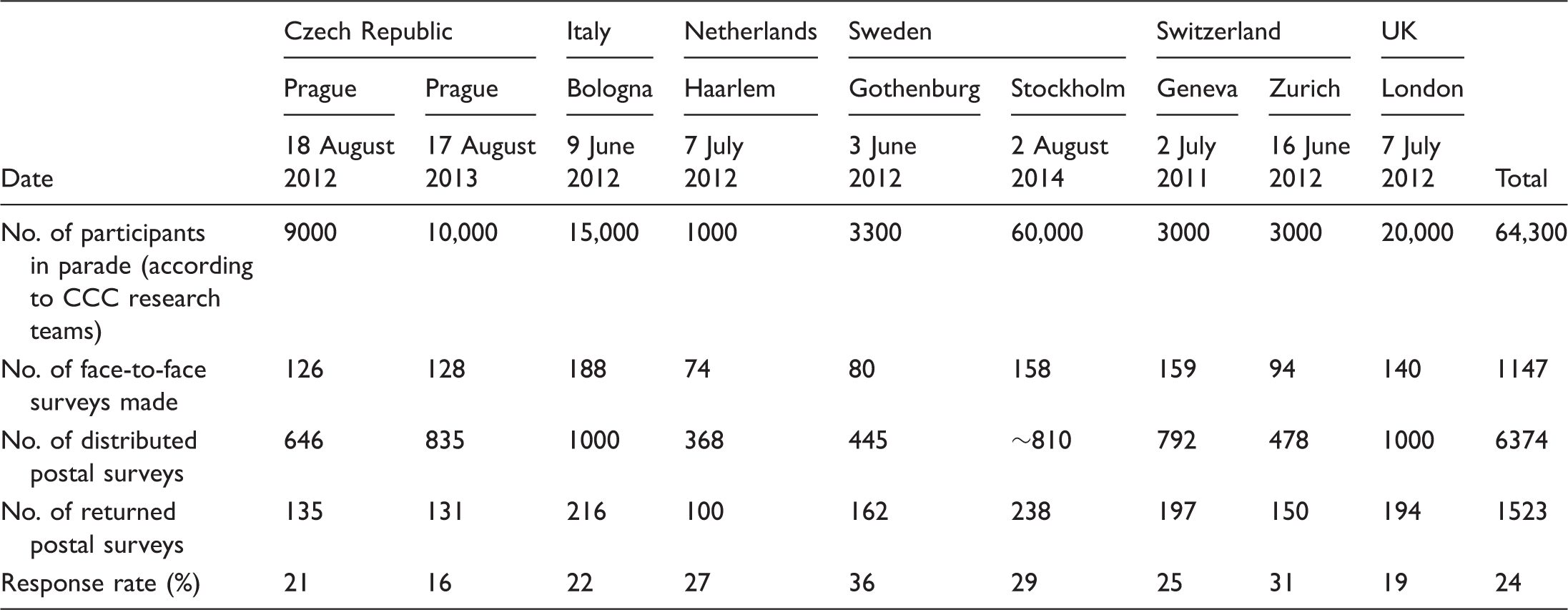
Pride parades surveyed.
Our country sample is analytically categorized following Holzhacker’s (2007, 2012) model of the expected modes of interaction of LGBT movements based on the movement organizations’ layered interactions with their political environment. We can roughly group the countries in our sample within Holzhacker’s model based on public opinion towards gays and lesbians measured by how European Social Survey respondents responded in 2012 to the statement: ‘Gay men and lesbians should be free to live their own life as they wish’ (alternatives: ‘agree strongly/agree/neither agree nor disagree/disagree/disagree strongly’), 2 together with existing LGBT-relevant legislation (ILGA-Europe, 2012).
‘Gays and lesbians should be free to live life as they wish’. Source: European Social Survey round 1–6 (2002–2012, see Note 2).
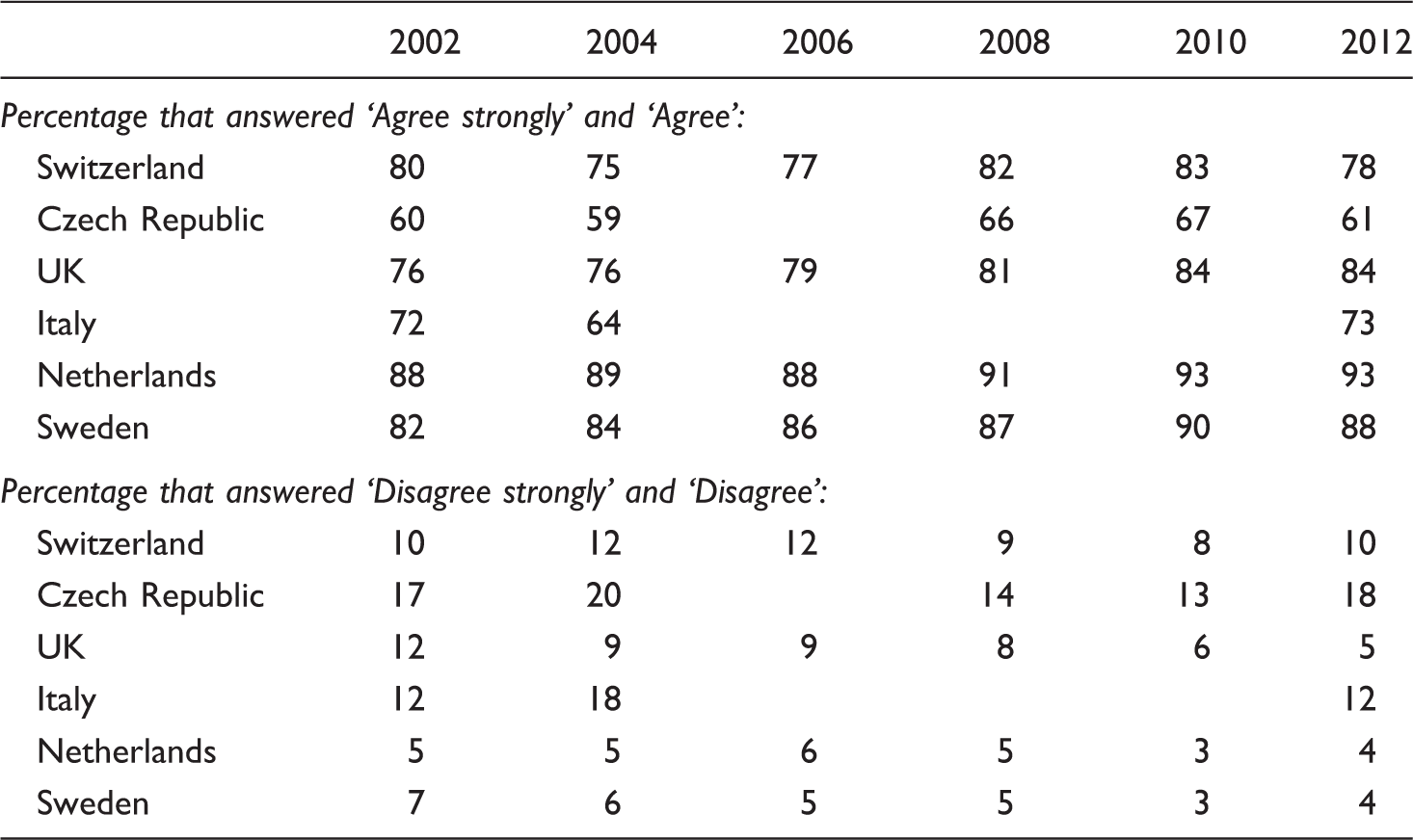
In category two at the other end of the spectrum we have Italy and the Czech Republic. In these countries we find the highest percentages of LGBT-unfriendly attitudes amongst the public. In Italy 12% disagreed/disagreed strongly with the statement ‘Gay men and lesbians should be free to live their own life as they wish’ and 73% agreed/agreed strongly; in the Czech Republic 18% responded negatively to that statement and 61% positively. According to Klicperová-Baker and Košťál (2012), elites in these countries rarely recognized the importance of taking sexual minorities into account. Both countries also scored relatively low in ILGA-Europe’s 2012 human rights review. Italy lacked a same-sex partnership law, 3 while the Czech Republic had a same-sex partnership law granting inferior rights compared to heterosexual partnerships (Fojtová, 2011). Both countries lacked legal protection against hate crime and hate speech. However, despite these ostensibly similar contexts, the categorization is complicated by the fact that the dominant strategy of the Czech LGBT movement seems to have been backstage lobbying rather than mass mobilization (O’Dwyer, 2013). We will return to this in the interpretation of the data.
In category three in the middle of our spectrum we placed Switzerland. Public opinion was far less polarized among Swiss respondents: 78% responded positively and 10% negatively. In the ILGA review of LGBT rights, Switzerland actually scored lower than the Czech Republic. However, Switzerland had a same-sex partnership law, which is almost equal to the heterosexual law, but lacked a hate crime law and a hate speech law.
The participant profiles in Pride parades taking place in these diverse contexts is compared to the national populations, as measured by the European Social Survey (ESS). One possible weakness of this approach is that the national populations from which the samples in the ESS are drawn are not necessarily equivalent to the populations that form the mobilizing potential of the demonstrations. First, the primary mobilizing potential of a demonstration in a particular city is the population of that particular city and its vicinity, and characteristics such as level of education and political opinion may differ in that city from the country as a whole. Second, the Pride parades in our sample also mobilized small proportions of participants from other countries, so in another sense the mobilizing potential extends beyond the borders of the nation state. 4 Nevertheless, we chose to regard the national populations as a reasonable approximation of the mobilizing potential, and therefore use the national ESS data.
Socio-demographic normalization
Socio-demographic profiles of Pride participants. Figures are percentages and those in brackets denote the corresponding figures for the country population, according to European Social Survey 2012.
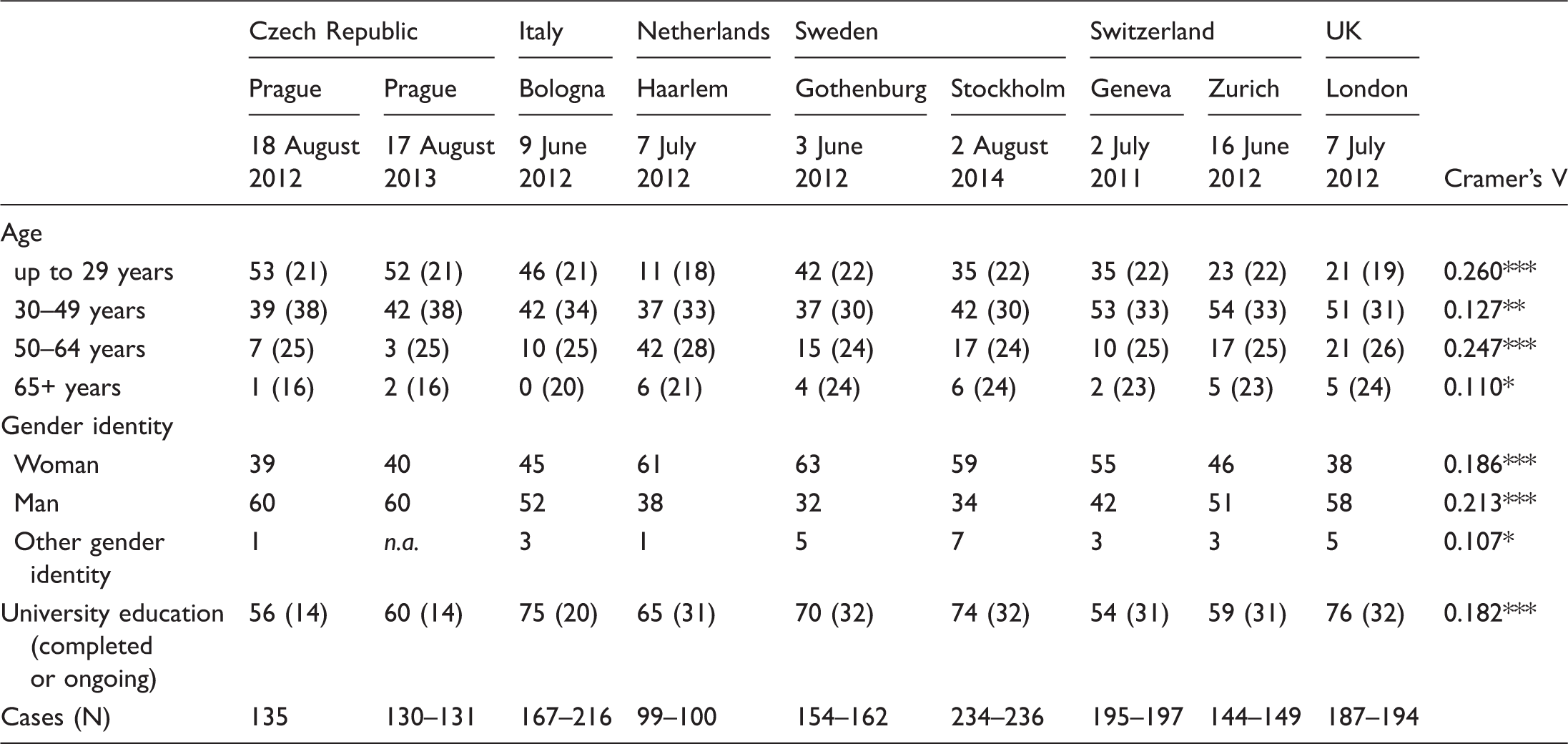
Note: * p < 5%, ** p < 1%, ***p < 0.1%.
Occupational profiles of Pride participants (Oesch’s class scheme). Figures are percentages and those in brackets denote the corresponding figures for the country population, according to European Social Survey 2010 (of which Italy was not part).
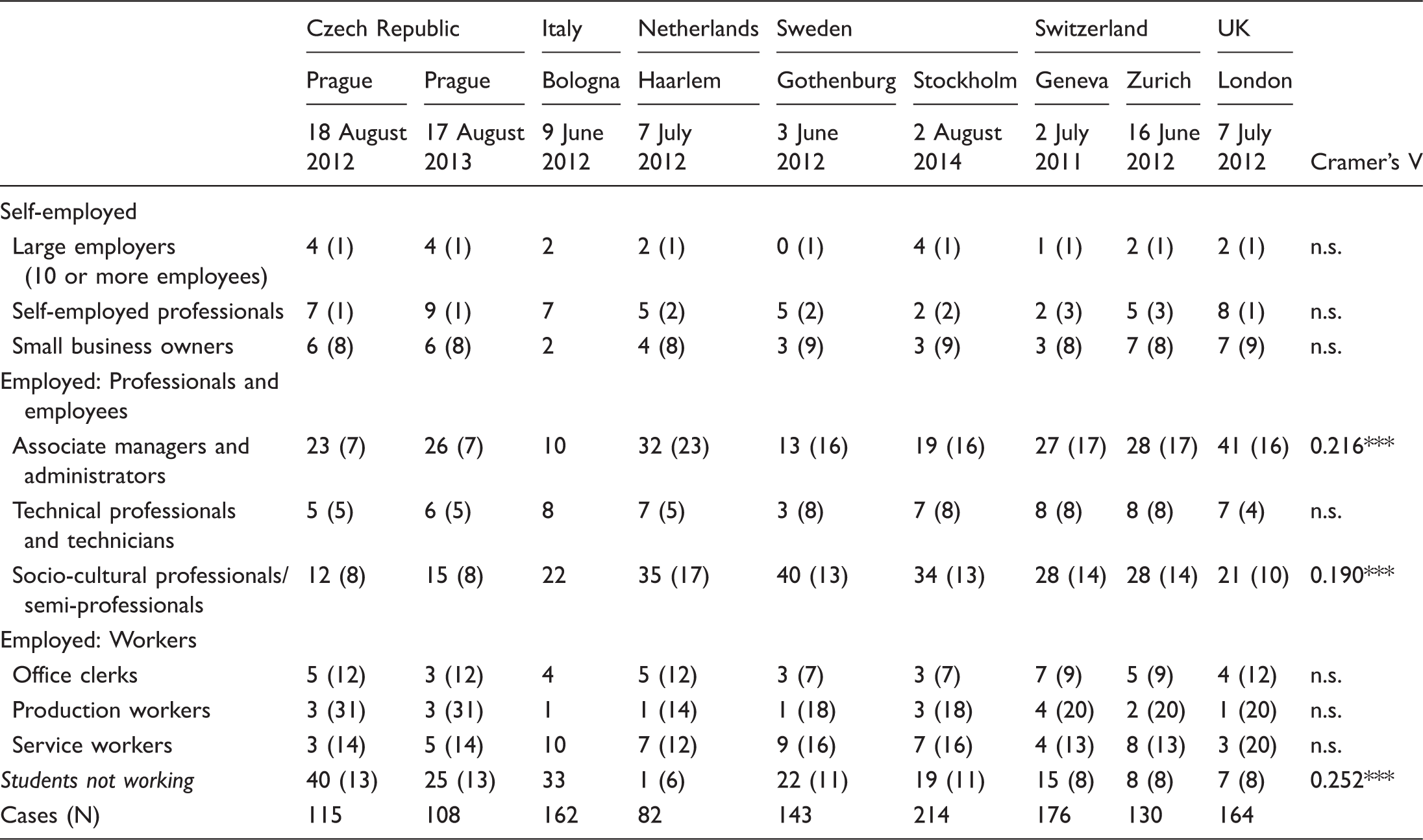
Note: ***p < 0.1%.
In all of the countries a majority of Pride participants have university education or are currently studying at the university level. The level of education is most dramatic in the UK and Italy, where 76% and 75% respectively are university educated. The demonstrators in the remaining four countries in our sample are also far from representative of the general population in their respective countries in regards to level of education.
Corroborating research on participants in the so-called new social movements in general, Pride parades are also overwhelmingly dominated by the middle strata, in contrast to, for instance, May Day marches and other trade union demonstrations (Wennerhag, 2016). The parades in our sample attracted few participants with working-class occupations (see Table 4). 6 In comparison to the general population, it is in particular individuals with middle-class occupations that are overrepresented amongst the Pride participants. In earlier research on class voting, it has been shown that especially the highly educated ‘socio-cultural professionals and semi-professionals’ (e.g. teachers, social workers, medical doctors) support left-libertarian political parties (Oesch, 2008), that is, parties that often have been at the forefront in supporting LGBT rights. Another occupational class that is overrepresented in the Pride parades in relation to the general population are self-employed professionals, another resourceful occupational class that generally tends to support, or participate in, ‘new social movements’ (cf. Kriesi, 1989).
Ideological and party political normalization
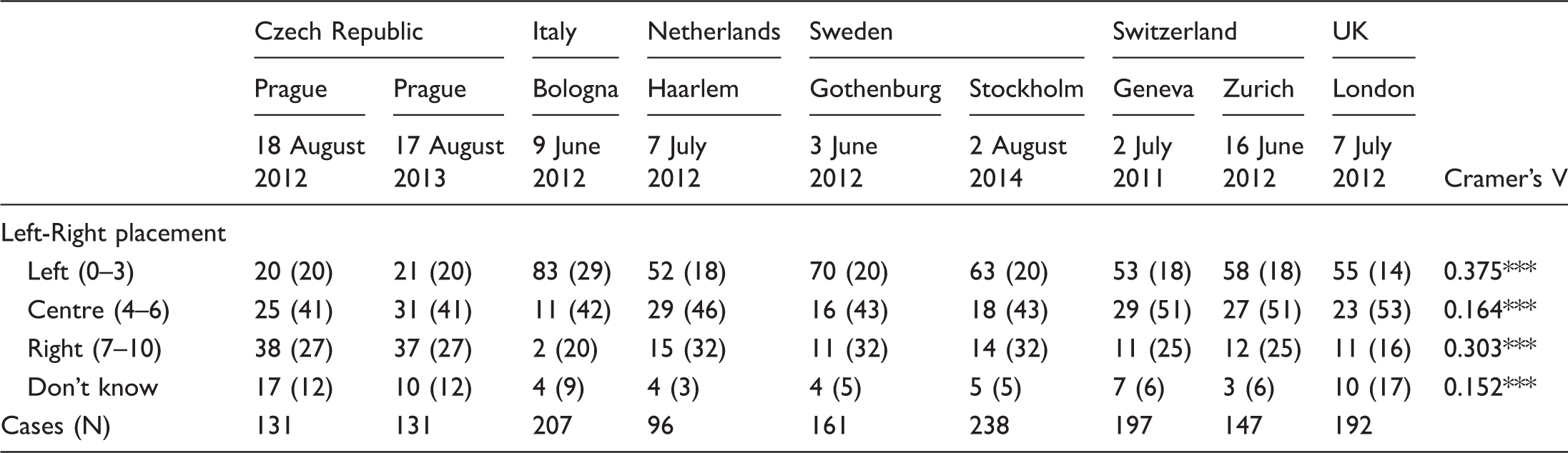
Left–Right political orientation of Pride participants. Figures are percentages and those in brackets denote the corresponding figures for the country population, according to European Social Survey 2012.
Note: ***p < 0.1%.
The exception to this ‘rule’, that Pride demonstrators lean decidedly to the left, are demonstrators in the Czech Republic. While Czech Pride participants are more representative of the general population with regards to left–right political orientation than demonstrators in the other five countries, they are nevertheless more orientated to the right and less centre orientated than the Czech electorate.
Scholars have reminded us that the left–right political orientation scale carries different meanings in different contexts (e.g. Huber and Inglehart, 1995). What has historically proved so valuable a tool for understanding political conflicts in established western democracies does not necessarily bare the same explanatory weight or meaning for post-communist societies (Deegan-Krause, 2006). Piurko et al. (2011) found in their study of the saliency of the left–right scale measured by personally held core values within the electorates in 20 countries that the Czech Republic exhibited a unique pattern. ‘A right orientation was associated with the openness to change values and a left orientation with security and conformity values’ (2011: 551–552). According to these authors, people who give high priority to openness to change values should prefer policies perceived as likely to promote and protect individual freedoms and civil rights. Given the meanings that left and right have for Czechs, it is not unanticipated that Pride participants who are challenging conformity to sexual norms and demanding change in the civil rights of LGBT persons position themselves on the right of the left–right political orientation scale. 7
In general, the participants in the Pride parades tend to support left-libertarian parties such as Green, Left Socialist, and Social Democratic parties. But in comparison to the general population it is in particular the Green and Left Socialist parties that are overrepresented, while Conservative, Christian Democrat and Radical Populist Right parties are underrepresented. However, the Czech Republic is again the exception in this case, at least regarding support for conservative parties (33% in both demonstrations). Czech Pride participants lend their support to conservative parties almost to the same degree as the Czech electorate. On the other hand, the one moral conservative Christian democrat party (Christian and Democratic Union – Czechoslovak People's Party, KDU-ČSL), received only marginal support among the demonstrators. Czech participants also deviate from the electorate in their support (33–39%) for the marginal Green Party, a typical ‘new social movement party’ that champions LGBT communities having the same rights as everyone else. In all Pride parades apart from the British, the support for Liberal and Left Liberal parties tends to mirror the general population. The Swedish demonstrators’ support for a feminist party (12–28%) reflects the newly formed party Feminist Initiative, which has LGBT rights as one of its primary foci.
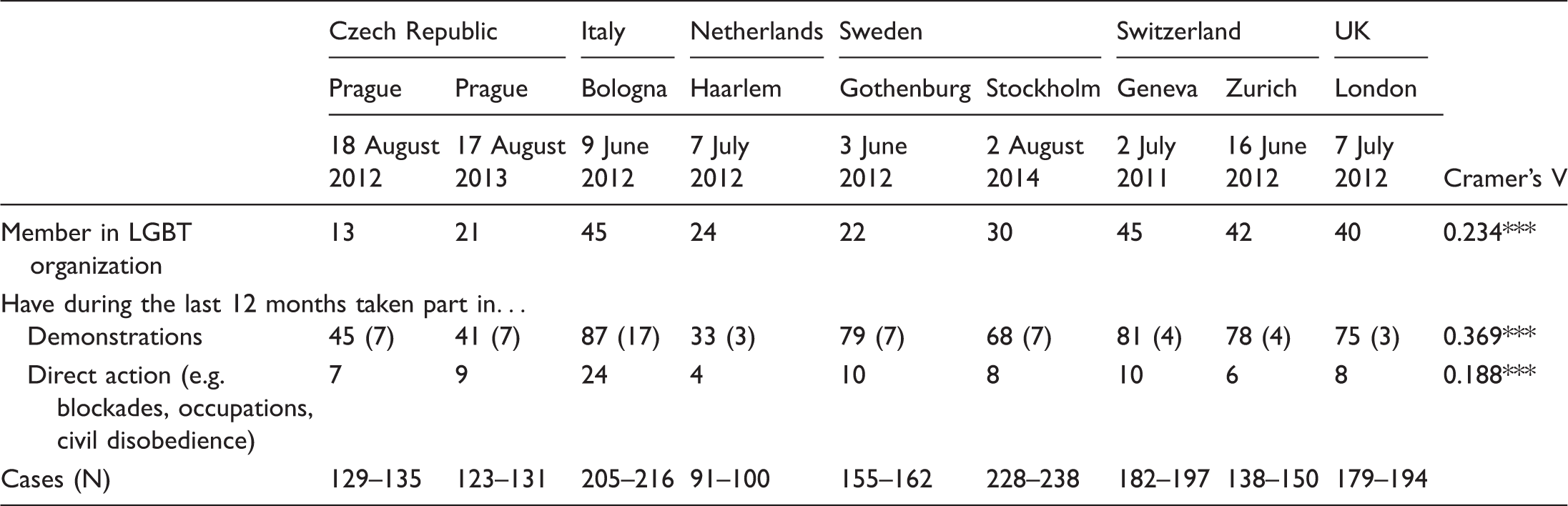
Organizational membership and political participation of Pride participants. Figures are percentages and those in brackets denote the corresponding figures for the country population, according to European Social Survey 2012.
Note: ***p < 0.1%.
Hypothesis H5, which predicted that Switzerland would be in the middle of the spectrum in regards to level of organizational ties, does not find support; the Swiss participants were often members of LGBT organizations, as often as the Italian participants.
As regards experiences of extra-parliamentary activism, such as demonstrating or taking part in direct action during the last year, the Italian demonstrators clearly conform to our expectations with a high degree of participation, while the Dutch demonstrators have a low degree of participation. The Swedish participants score unexpectedly high while the Czech participants score relatively low. However, compared to the national averages, Italy, Sweden, Switzerland, and UK turn out to be very similar.
Conclusions
Overview: relative diversity of protesters. The figures in the table are the differences in percentage points between the average among the protesters and the national average according to the European Social Survey 2012.
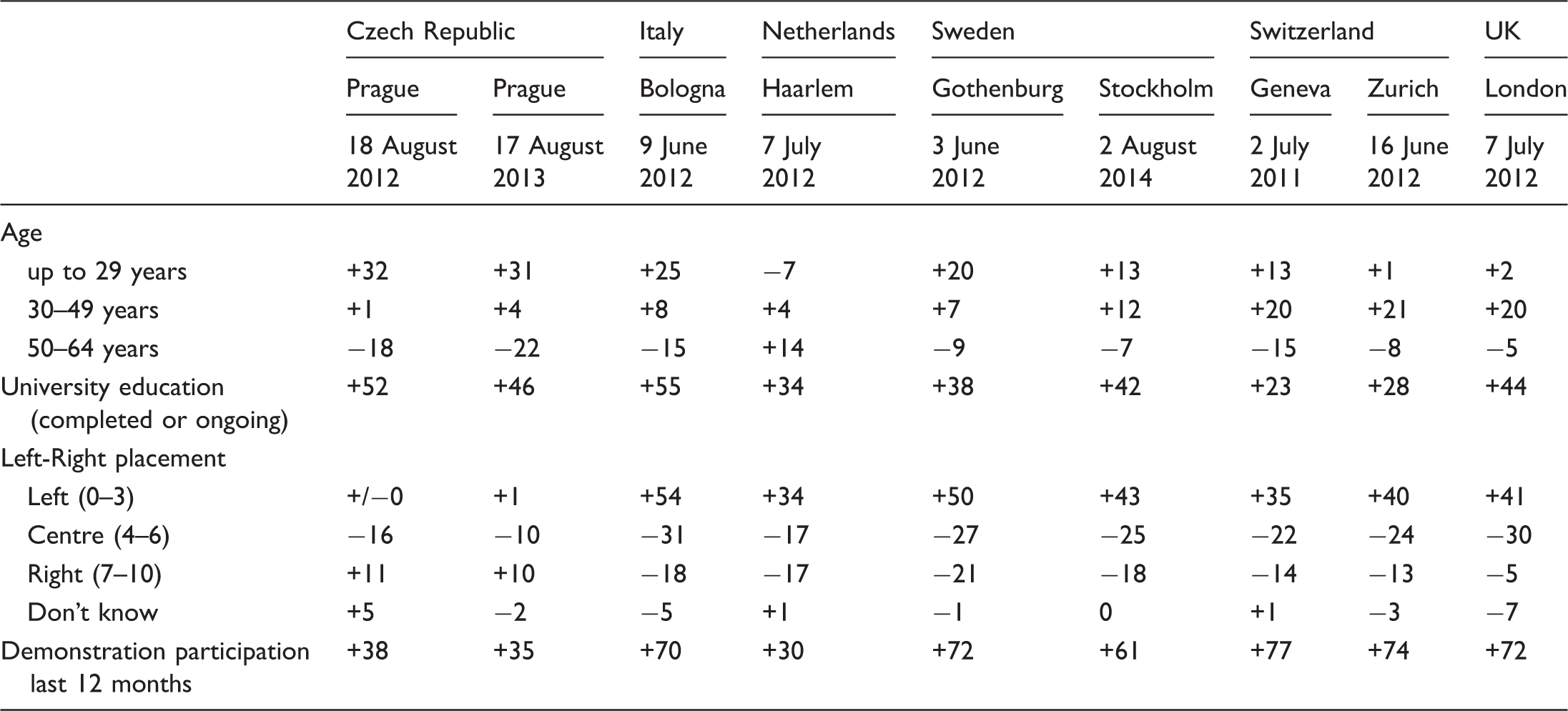
Even in countries where we expected that Pride parades would mobilize a broader cross-section of potential LGBT individuals and LGBT political supporters, namely the Netherlands, Sweden and the UK, the participants did not reflect the diversity within the general population. In short, we found no evidence for a normalization of Pride demonstrators. 8 Much like new social movement demonstrators more generally, Pride participants are overwhelmingly from the middle strata, highly educated, young, and are politically left oriented (aside from Czech participants, see next paragraph). In short, they are rich in potential political resources.
Nonetheless, we did find country-level differences in the mobilizing patterns of the surveyed Pride parades, which underline the impact of general political opportunities on the national level, as well as the mobilizing structures of LGBT movements. The different national patterns only to a degree corroborate the hypotheses that we derived from Walgrave and Verhulst’s (2009) study of anti-war demonstrators and Holzhacker’s (2012) ideal-typical model of different political environments for LGBT organizations in Europe. In countries where LGBT movements are ‘rowing against mainstream politics’, as well as being counter to public opinion, our hypothesis is at least partially confirmed. In both Italy and the Czech Republic, demonstrators were younger and significantly more highly educated than the general populations. They were also younger than Pride participants in the remaining four countries, although the same age pattern is also evident in Sweden. Pride demonstrators in Italy typically inclined far more towards the left than the Italian electorate, being what social movement scholars recognize as ‘left-wing radical’ in the context of Western European social movements, in other words, identifying significantly towards the left on the left–right political orientation scale, highly organized, frequent demonstrators, and familiar with disruptive protest tactics. The Czech demonstrators did not conform to this pattern. Pride demonstrators in the Czech Republic positioned themselves significantly more towards the political right than the Czech electorate, which can be interpreted as politically ‘radical’ in the Czech context where ‘right’ generally signifies change values, respect for individual freedoms and civil rights. That few Czech Pride participants were formally organized did not conform to what we expected from the political context. However, given the incremental change strategy of the Czech LGBT movement, this result becomes less surprising.
In contrast to Walgrave and Verhulst’s (2009) study we find more ambiguous patterns. A possible explanation is that the political positions regarding LGBT issues are more complex and less clear-cut compared to the support for or opposition to the Iraq war. Compared to anti-war mobilizations, there may be different mechanisms at work when a large share of the participants in the demonstrations comes from the aggrieved population, as in Pride parades.
While there is good reason to believe that LGBT individuals represent more or less a cross-section of the general population, Pride participants do not. Pride parades are not mobilizing the potential diversity of LGBT people. More or less like in other so-called new social movements, demonstrating on the streets remains the privileged arena of well-educated, middle-strata youth, rich in political resources and confident in their political capabilities. Our study is based on the actual participants in Pride parades. Future studies, either based on the mobilizing strategies of the organizers of Pride parades or on quantitative data on Pride parade bystanders, might be better equipped to provide answers as to why Pride parades are not mobilizing the full potential diversity of LGBT people leading to a genuine democratization of LGBT movements.
Footnotes
Acknowledgements
We would like to thank the editors of Sexualities and the anonymous reviewers for valuable comments on previous versions of this manuscript.
Funding
The author(s) disclosed receipt of the following financial support for the research, authorship, and/or publication of this article: This study was made possible by support from the Bank of Sweden Tercentenary Foundation (P2013-0861:1), the Swedish Council for Working Life and Social Research (FAS 2008-1799), and the European Science Foundation (ESF-08-ECRP-001).