




Abstract
Sociologist Janine Chi examines how rice-based dishes and cuisines in Asia are featured in culinary tourism to promote national distinction and identity.
<< A map of China created from assorted noodles.
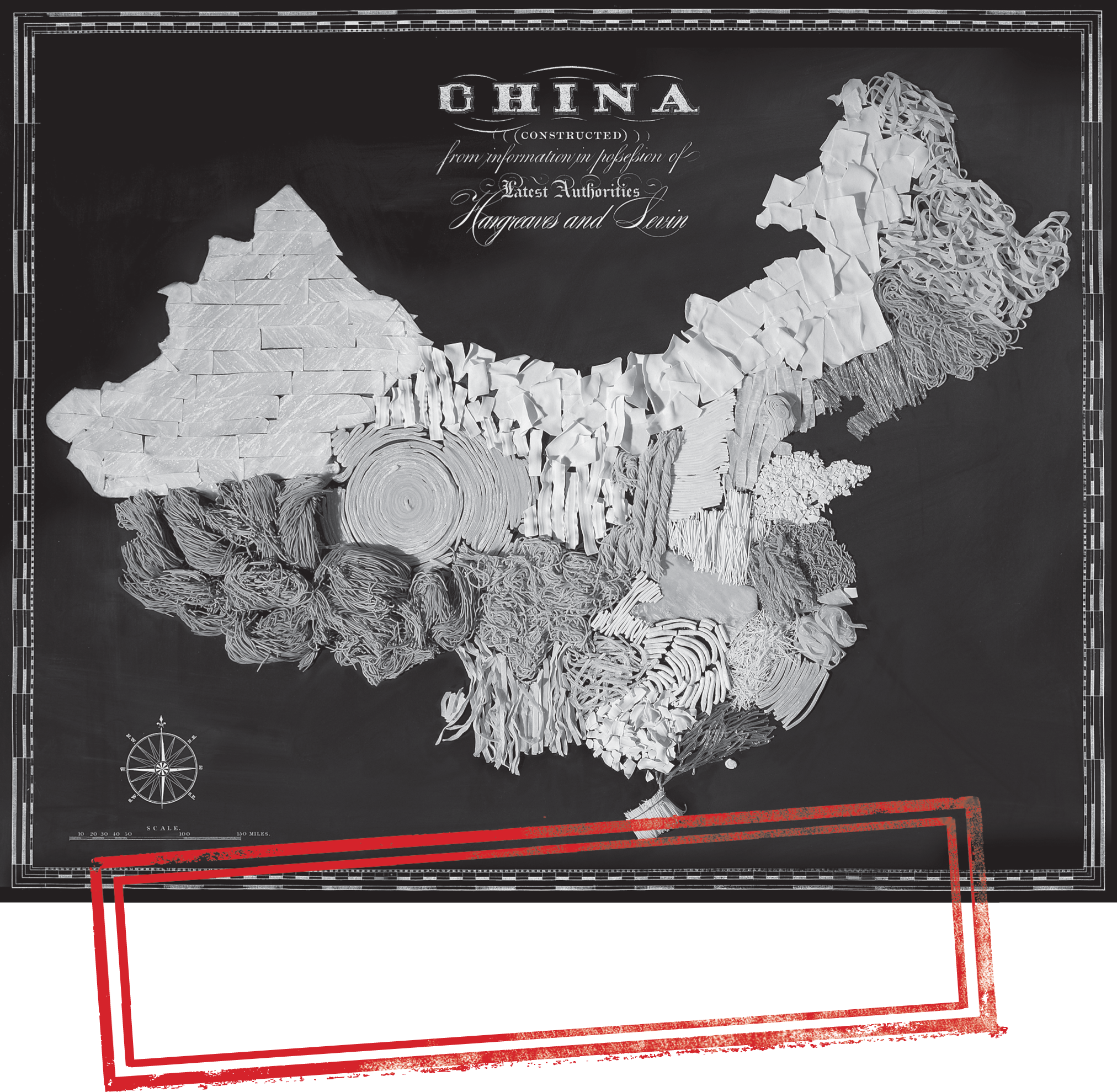
The food maps created by Henry Hargreaves and Caitlin Levin were inspired by their passion for travel and desire to explore cultural complexities through food. These maps not only showcase iconic foods from particular countries, but also show how food has traveled the globe. The full series is at henryhargreaves.com.
Rice is the primary staple of every major Asian cuisine. Japan and Thailand hold rice planting and harvesting festivals, and a common greeting in Chinese-speaking societies is “have you had your rice?” Growing up in Singapore, my father used to say that while vacations to Europe were fun, having rice-less meals for more than a couple of days was not. Even after having lived in the United States for the past two decades, I still have a hankering for rice several times a week.
But today, in Singapore, Hong Kong, and other nations, particularly among younger, affluent Asians, the growing popularity of Italian and Spanish cuisine, along with pastry, pizza, and other wheat-based products, is challenging the dominance of rice in Asian diets. Higher levels of education, greater propensity to travel abroad, and more accessibility to Western food items like bread and pasta, means that younger generations of Asians consume less rice; rice consumption is also declining in India, Bangladesh, and Indonesia.
As Asia’s rice consumption rapidly declines, will the fundamental nature of Asian cuisines change? What role is rice going to play in the New Asia? Increasingly, governments seem to be preoccupied with these and other questions of national uniqueness and cultural distinction. Across Asia, rice is a central component of government-sponsored tourist campaigns to reinforce nations’ uniqueness and distinction.
Historically, many multiethnic and religiously diverse Asian countries have used food to consolidate a sense of uniqueness and unity. Since the nineteenth century, China and Korea (two countries which are often erroneously assumed to be culturally monolithic) embarked on a variety of projects to construct a cohesive national identity. Today, at large international events such as the World Expo, Olympics, or World Cup, countries promote themselves to millions of visitors, showcasing national products and highlighting national cultures.
For several years, I’ve been collecting and analyzing national tourist promotion materials—government and industry websites, printed tourist promotion materials from government and private sources, as well as national and international food and travel magazines and online blogs—in the United States, Singapore, Malaysia, Thailand, and Indonesia, paying particular attention to the role of food.
What I found is that food plays an increasingly important role in how governments want others to imagine their nations. By highlighting the importance of rice, they are insuring Asians’ continued reverence for this seemingly mundane but necessary staple—and branding their nations as simultaneously global and local, cosmopolitan and distinctively unique.
Henry Hargreaves & Caitlin Levin

Food Cosmopolitanism
Watching shows on Food Network and Cooking Channel, or Bravo’s hit-series Top Chef and Master Chef, one can imagine that the world, at least the food world, is becoming smaller and more intimate. Andrew Zimmern’s show Bizarre Foods (Travel Channel) transports viewers to “strange” lands with “exotic” eats. Popular food writer and former chef, Anthony Bourdain has a CNN series, Parts Unknown, where he introduces the “different” and foreign “unknown” to mainstream America through eating practices and food cultures. These shows tout the possibility of being cosmopolitan through the experience of food; being a citizen of the world means being exposed to different cuisines, dishes, and ingredients, and knowing different world cuisines.
Rice in Asia is the symbol of humble beginnings and a shared cultural experience, conjuring up images of locality, specialty, and distinction.
At the same time, there is a growing tendency to favor familiar, local cultures; leading international celebrity chefs spotlight the flavors, ingredients, and recipes that hail from their own culinary backyards. These chefs are recognized for reintroducing the food world to heirloom products and traditional cookery. Copenhagen’s Noma, currently considered one of the best restaurants in the world, is renowned for reintroducing and elevating Nordic cuisine through its emphasis on local foraging and traditional methods of pickling. David Thompson, an Australian chef with award-winning Thai restaurants in London and Bangkok, relies on the unpublished cookbooks of former chefs in the Royal Thai court for recipes and techniques in an effort to “revive” Thai cuisine. American celebrity chef, Andy Ricker, a 2011 James Beard award winner, in his cookbook Pok Pok, documents the regional specialties of Thai cuisine and the different varieties of rice consumed in Thailand. He dedicates the first chapter of the cookbook to rice: “As long as I’ve known I would write a cookbook,” he says, and “I’ve known that the first chapter would be about rice.” A chapter entitled “One-Plate Meals” highlights the omnipresence of rice in Thai cuisine.
This map of France is constructed from bread and cheese.

Cosmopolitanism and localism is also celebrated in tandem in television food shows and food magazines that pay homage to local chefs and culinary experts who introduce and document the history and preparation of local dishes and regional specialties to viewers. For example, celebrity chef Ming Tsai, in Simply Ming, a public television series, “goes on the road” to places like the Azores in Portugal, where he visits local chef Eduardo Reis to learn about the history of popular dishes like Alcatra. In Osaka in Japan, he learns the art of ramen-making from new Iron Chef Japan Yuji Wakiya.
The presence of these local chefs and food experts is vital, legitimating the authenticity of the foods and dishes. At the same time, they also democratize food preparation and consumption for both readers and viewers, and their presence conveys the sense that “the love of making and eating food” is global and real.
Even locally produced magazines in Singapore like Savour and Food & Travel (distinguished from the U.S.-based Saveur and U.K.’s Food and Travel) contain recipes that use foreign cooking terms like “reduction,” combining aspects of familiar local dishes like kweh pie tee cups (a thin crispy pastry shell used for a popular Peranakan dish) with Western ingredients like Parma ham and offering mediated glimpses into what it might mean to simultaneously experience both the global and the local. But it is through food travel that the goal of becoming simultaneously globally cosmopolitan and authentically local is most fully realized.
Culinary Tourism
Food travel, also known as culinary tourism, has become an important and lucrative segment of both the food and travel industries. In an edited volume, Culinary Tourism, Lucy Long and her co-authors discuss how tourism offers opportunities for people to make familiar foods strange, and to turn everyday activities like shopping for food in an ethnic market into an act of exploration and discovery. Culinary tourism offers opportunities to engage in global and local experiences, and for individuals to fulfill the simultaneous desire to be both a global cosmopolitan and an authentic local.
The focus on gastronomy, and the promise of authentic and exotic eats, have furthered the development of niche travel and niche destinations. For example, the Napa wine region in California has long had a national and international reputation as a food and wine destination with numerous restaurants and vineyards highlighting the products of the region. Travel websites show companies incorporating “culinary highlights” and designing “culinary tours” to appeal to tourists. It is common to find tours specifically designed for those interested in learning about the culinary traditions of a place. Tour companies in “gourmet cities” like Singapore and Hong Kong offer travelers opportunities to experience gastronomy through a tour of local eats and participate in festivals like the Hong Kong Wine and Dine Festival, where visitors can expect to enjoy meals prepared by local celebrity chefs, take “food appreciation master classes,” and attend talks from local industry experts.
The map of India is comprised of cardamom, star anise, turmeric, and other spices.
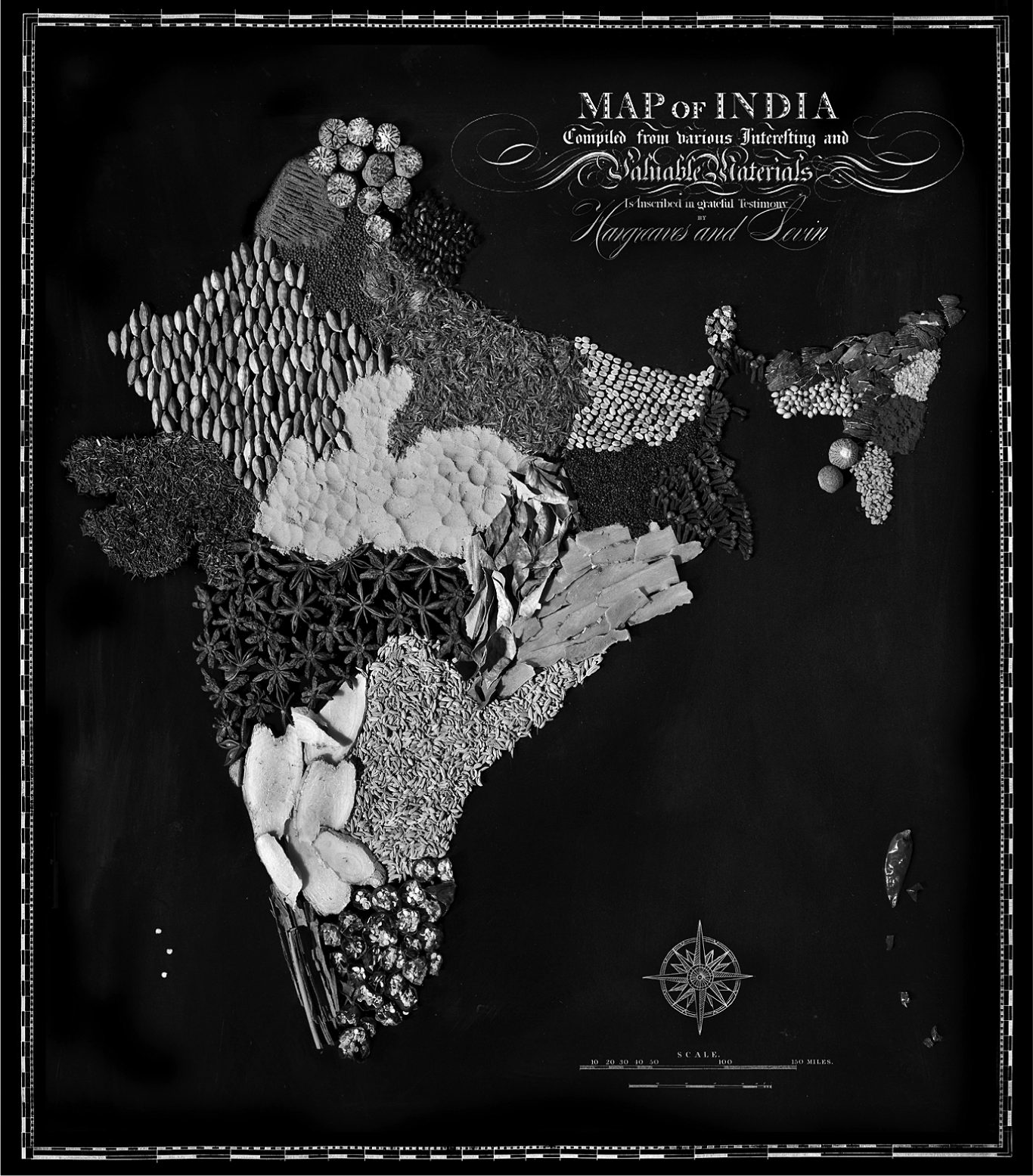
Culinary tours often include visits to local markets, guided tours of farms, as well as cooking lessons with local experts and chefs. Tour companies can provide access to local historians to history food buffs or arrange for detailed lessons on the science of winemaking to oenophiles. These tours are not only located or available in rural or less-traveled destinations. For example, Italy boasts a number of wine tours in Tuscany, particularly in the wine region of Chianti, where tour operators offer travelers the option of staying in a Tuscan villa or farmhouse, and participating in walking tours of Florence where food experts guide the group to coffee and gelato shops, wine bars, and food markets to sample the culinary highlights of the city. In Siem Reap, Cambodia, tour operators organize numerous half-day cooking classes that include a visit to the local market with a local Khmer chef, and a hands-on learning experience on preparing select Khmer dishes at a local restaurant.
Across Asia, rice is being transformed from a mundane everyday staple to a food that conveys national distinction.
Sociologist Priscilla Parkhurst Ferguson has described “culinary nationalism,” which Michaela DeSoucey terms “gastronationalism.” Food and cuisine, they argue, are tied to locality, place, and community, and become markers of national identity and nationhood. The French, for example, have used the Bocuse d’Or (a French biennial cooking competition held in Lyon, France) to codify French cooking techniques to represent and demarcate what is distinct “French” cuisine. Often referred to as “terroir,” the deep impenetrable connection between taste, tradition, and place is institutionalized through the European Union’s program for origin-designation labels, such as Italian balsalmic vinegar from Modena, Aceto Balsamico Tradizionale di Modena, or “champagne,” designated for sparkling wine that is produced only in the region Champagne, France, as an appellation d’origine contrôlée.
Henry Hargreaves & Caitlin Levin

The example of French foie gras illustrates how gastronationalism rests on claims of cultural tradition and national distinction. As DeSoucey describes, French poultry farmers and foie gras producers make national claims of tradition based on history and authenticity to defend their industry. “For France, gastronationalism is central to bolstering national self-identification.”
It is of little surprise that visitors to countries like France, Italy, and Spain expect good eating and culinary delights which represent a national experience. Likewise, it is evident that locals have a vested interest in producing and consuming what is increasingly perceived as national foods and culinary traditions, particularly if such products are targeted towards the tourist industry. Just as tourists to France expect to have authentic bistro staples like steak frites, one cannot imagine visiting Japan without having sushi or India without biryani. So, while the proliferation of different foods and cuisines may have expanded the palate and tastes of an urban middle class in Asia, increased pressures to associate locality with that of the nation transforms the meaning of familiar foods such as rice.
Representing the local while embracing the national, rice is a quintessential element in different national tourist programs.
An everyday meal of nasi campur or nasi uduk (a dish of rice served with different toppings of meat, vegetables, and seafood) in Indonesia and other parts of Southeast Asia begins to take on local and national identifications of authenticity; in Bali, this meal is often referred to as nasi Bali, with the addition of a specific mix of Balinese spice to the rice, while in Malaysia and Singapore, this meal is commonly known as nasi padang. A quick look at Trip Advisor reveals that the enthusiasm with which eaters consume this meal is matched only by the intensity of their opinions on the authenticity of the rendang (a curry side dish) or the appropriate spice level of the sambal (a chili paste that is often used as a condiment).
Clearly, the rising popularity of culinary tourism has much to do with its ability to provide the tourist with the simultaneous experiences of being a global cosmopolitan and an authentic local. Since rice remains the cornerstone of many Asian national cuisines, rice-based dishes have become an essential feature of food travel in Asia. Rice is being transformed from a mundane everyday staple to a food that conveys national distinction. It is precisely this ability to represent the local while embracing the national that makes rice a quintessential element in a country’s national tourist program and image.
National Cuisines, Iconic Dishes
“YourSingapore,” “Incredible India,” “Amazing Thailand,” and “Hong Kong: Asia’s World City” are some examples of “brands” that national tourist offices use to market cities as niche destinations. As specialty foods and products become synonymous with tradition, heritage, and belonging, they have also become integral to states’ construction of national identity through tourism. Just as corporations and companies use marketing and advertising to promote a brand, so do states use tourism to promote and develop a distinct and unique national brand, deploying colorful brochures and social media that highlight what the country has to offer and what the nation represents.
Food and eating is a ubiquitous feature of such campaigns, highlighting the gastronomic opportunities available to visitors, and emphasizing the uniqueness and distinction of national cuisines. Culinary tourism programs highlight “essential” features of the national cuisine, and cooking schools offer classes on national cuisine, focusing on dishes that are considered representative of the country’s cookery.
Thailand’s national tourist website lists a cooking class in a “reputable” local cooking school featuring local chef instructors; it begins with a tour of a local market to purchase everyday Thai ingredients for the preparation of a typical Thai meal. Activities include grating fresh coconuts to make coconut milk or pounding several different fresh herbs in a mortar and pestle for a Thai curry. There is a dual emphasis on national “Thai” flavors (a balance of sweet, spicy, sour, and salty) and local ingredients. Such classes not only teach students individual recipes and cooking techniques, and also instruct them how to eat them: family-style, with rice.
Of course, the very basis for claims of uniqueness and specialty is that of place and nation; one can find versions of such culinary adventures in many different countries, each offering the opportunity to learn what is local and national. It is of little surprise that rice features heavily in many of the different national cuisines. Popular rice-based dishes like Hainanese Chicken Rice and rice-based Peranakan cuisine feature heavily in Singapore’s national tourist website as national iconic dishes, representing the country’s unique blend of Chinese, Indian, and Malay multi-ethnic population and cultures.
Henry Hargreaves & Caitlin Levin

Food blogs in Singapore have entire sections devoted to the “Best Chicken Rice” in which contributors offer detailed support for their opinions. The dish is so popular that it can be found in school canteens, neighborhood hawker centers (semi-enclosed buildings housing rows of food stalls, each specializing in one particular dish), and even in the posh Mandarin Orchard Hotel’s restaurant, Chatterbox. Next to the Peranakan Museum in Singapore, where visitors are introduced to the distinctive hybrid culture of “locally born” Malay, Chinese, and Indian communities in the region, is the award-winning Peranakan restaurant, True Blue Cuisine, where museum visitors as well as local foodies can conveniently “round up” and “complete their Peranakan experience.” As much as featuring these local food favorites is part of a tourist strategy, it is also meant to appeal to Singapore’s own citizens, confirming dominant narratives and collective popular representations of nationhood.
Regional Travelers
Today’s tourist to Asia is more likely to come from the region than from the United States or Europe; in 2006, 78 percent of the outbound Asian tourist traffic originated from the region itself, according to the World Tourism Organization. This growth is due to the growing affluence of an Asian professional middle class, and is also tied to the growth of cities such as Bangkok, Shanghai, and Hanoi.
As these cities develop into tourist destinations for regional and domestic tourists, they are attracting a class of increasingly educated professionals who seek to visit to places that share facets of cultural heritage but which remain nationally distinct. Staying closer to home is less expensive than traveling to Europe or America; these cities also offer opportunities for quick weekend getaways. To regional travelers, Asian cities are cosmopolitan without being completely strange or foreign; they share a certain degree of cultural similarity with its regional neighbors. They’ve enabled rice-based cuisines and rice-based dishes to retain their foothold in Asian foodways.
Rarely do the national foods promoted by tourist boards come from tables of the powerful or elite. The very fact that cuisines are supposed to represent the nation means that these foods must appeal or have significant cultural meaning to broader publics, and be popular among locals, under everyday conditions. In fact, state elites are often the most ardent fans of local foods because it allows them to convey the impression that they legitimately represent the people.
Rice in Asia remains the symbol of humble beginnings and a shared cultural experience. It serves as a nimble vehicle, conjuring up images of locality, specialty, and distinction. As such, rice-based dishes and cuisines represent the local while remaining central to a country’s identity. That’s why, despite the growing popularity of European foods, rice will continue to appeal to locals as well as to culinary tourists who are searching for authentic Asian eating experiences.