




Abstract
Sociologist Michael A. Haedicke explores the world of organic foods co-ops and examines how these countercultural stores are defending their democratic ideals and practices in an increasingly competitive marketplace.
Keywords
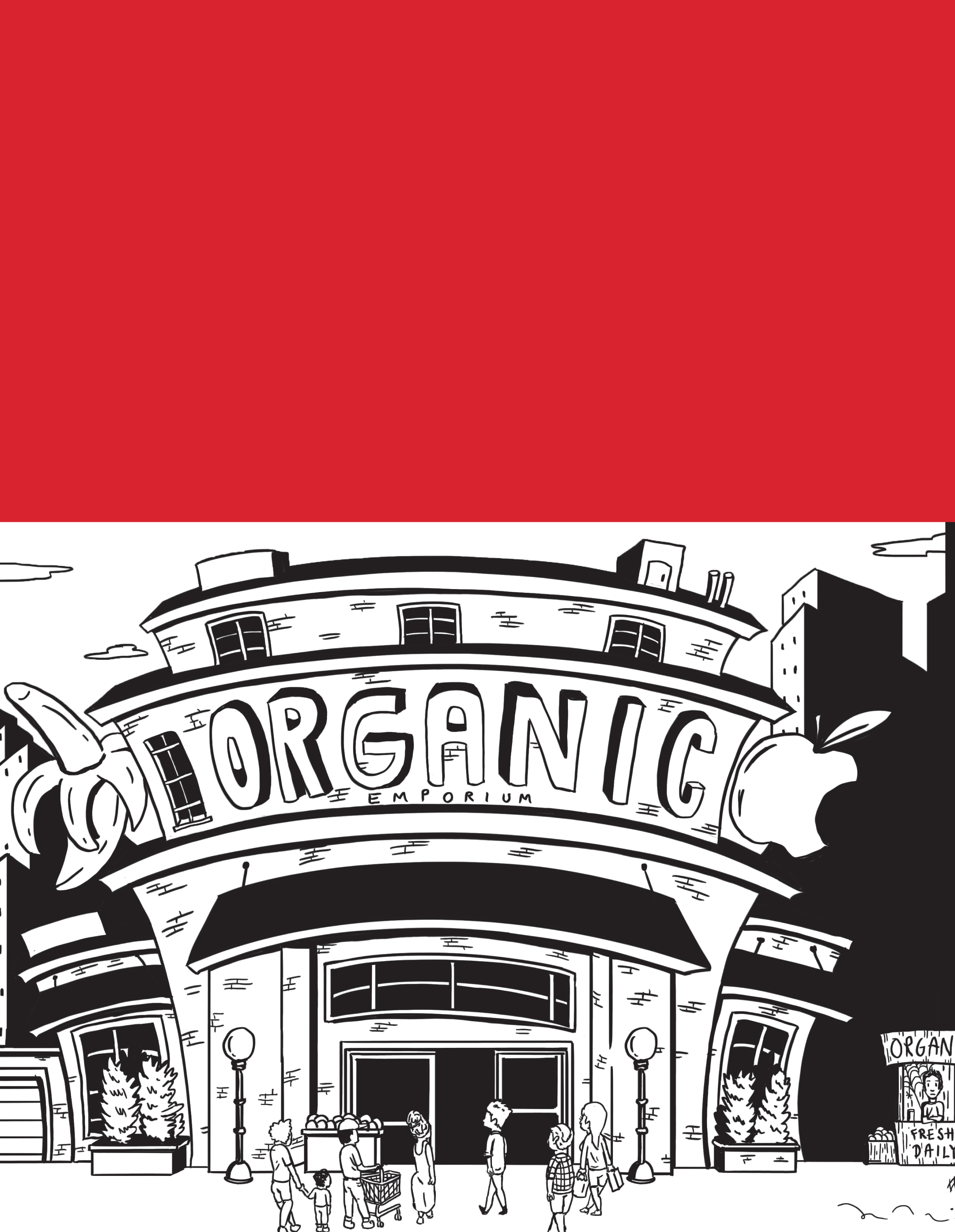
Housed in a custom-built storefront in a neighborhood studded with independently owned businesses, Pacific Food Co-op (a pseudonym) cheerfully announces its devotion to organic foods with the slogan “It’s time to eat organic!” A tidy sales floor, a fraction of the size of a standard supermarket, contains a variety of fresh, frozen, and packaged organic products. A small café on the upper level sells vegan and organic cookies and cakes, as well as a changing menu of hot organic lunch items. Flyers publicize farmers’ markets, gardening classes, and trips to local farms.
While a casual shopper wandering the aisles might mistake PFC for a miniature version of the natural foods superstore Whole Foods Market, the co-op has a more progressive history that is rooted in the efforts of a group of neighborhood activists who wanted to disrupt the control of big businesses over the food supply. In the 1970s, this group created a grocery-buying club that dispatched members to local organic farms and to the city’s wholesale market to buy food in bulk. Every week, they gathered in a nearby public park and distributed these purchases to the club’s members. The club provided an alternative to the neighborhood’s high priced, non-organic supermarkets.
The buying club grew in size, and moved into one member’s garage, and then into a rented storefront, and finally, into the larger building that the co-op now occupies. Despite these changes, it preserved its focus on natural and organic foods, as well as its goal of empowering community members against big food businesses. But now, PFC and other co-ops face a new challenge.
PFC is one of several hundred food co-ops in the United States that specialize in organic foods. Today, as more and more mainstream supermarkets offer organic foods to their shoppers, these small co-ops face growing pressure to become efficient, streamlined, and consumer-oriented, leaving longtime members wondering whether this new, more competitive marketplace will force co-ops to abandon their founding political ideals.
The co-op pioneers of the 1970s, who drew their inspiration from progressive political movements, aimed not only to farm without chemicals, but also to empower communities and to democratize food systems. But in the 1990s, as the organic sector experienced an influx of big businesses and profit-seeking farmers, many came to fear that market growth would “cost organic its soul,” according to journalist Michael Pollan.
Examining how this tension plays out in organic foods co-ops from the California coast to snowy midwestern towns to bustling neighborhoods in the northeastern United States, I interviewed members and staff, attended store meetings, and examined several decades’ worth of articles from newsletters and trade magazines. What I found is that even as co-op leaders creatively adapt to market pressures and continue to draw their customers into discussions of the food system, the rapidly growing organic foods sector is pushing many of their idealistic practices out the door.
Today, as more and more mainstream supermarkets offer organic foods to their shoppers, small co-ops face growing pressure to become efficient, streamlined, and consumer-oriented.
Illustrations by Sam Grinberg
From Co-ops to Food Democracy
In recent years, many activists and academics have focused attention on democratizing the food system in the United States, and indeed, globally. As the scholar-activist Neva Hassanein explains, this movement emphasizes “the idea that people can and should be actively participating in shaping the food system, rather than remaining passive spectators on the sidelines.” In a democratic food system, according to Hassanein, food producers and consumers would work collectively to construct agricultural policies and deliberate about how to balance social equity, commercial success, and environmental sustainability. This vision has animated a range of recent social movement organizations, from Food Democracy Now in the United States to La Via Campesina on the international stage—and it drives many small co-op leaders.
Activists don’t always practice the ideologies they preach, of course. Environmental radicals drive gas-guzzling cars, structureless anarchist groups choose de facto leaders, and movements devoted to social equality marginalize some of their members. When the rubber of activist idealism meets the road of real-life politics, outcomes can be difficult to predict. This is certainly true of the food system.
In her incisive book Food Politics, scholar Marion Nestle documents how the concentrated market power of a handful of food conglomerates gives them outsized influence over food policy, discouraging public participation. Through lobbying and advertising, these businesses stifle open debate about the social and environmental consequences of modern food production. Complex food chains, divided along lines of race, class, and gender, separate consumers and food producers.
In the 1970s, when many co-ops were created, the organic foods sector appeared to offer a real alternative. Organic advocates believed that small-scale agriculture and close relationships between producers and consumers would be building blocks for a regionally based, environmentally sustainable, and socially just food system. The number of organic foods consumers was tiny in relative terms, but as the historian Warren Belasco explains in his book Appetite for Change, they were more politically aware and committed to social change than mainstream shoppers.
In the 1990s, though, mainstream food conglomerates purchased small organic companies, large farms invested heavily in organic production, and retailers like Whole Foods Market came to dominate the organic foods retail market. As geographer Julie Guthman wrote in Agrarian Dreams, the organic sector “replicated what it set out to oppose.” These changes raise questions about the ability of organic advocates, including those in co-ops, to put their values into practice.
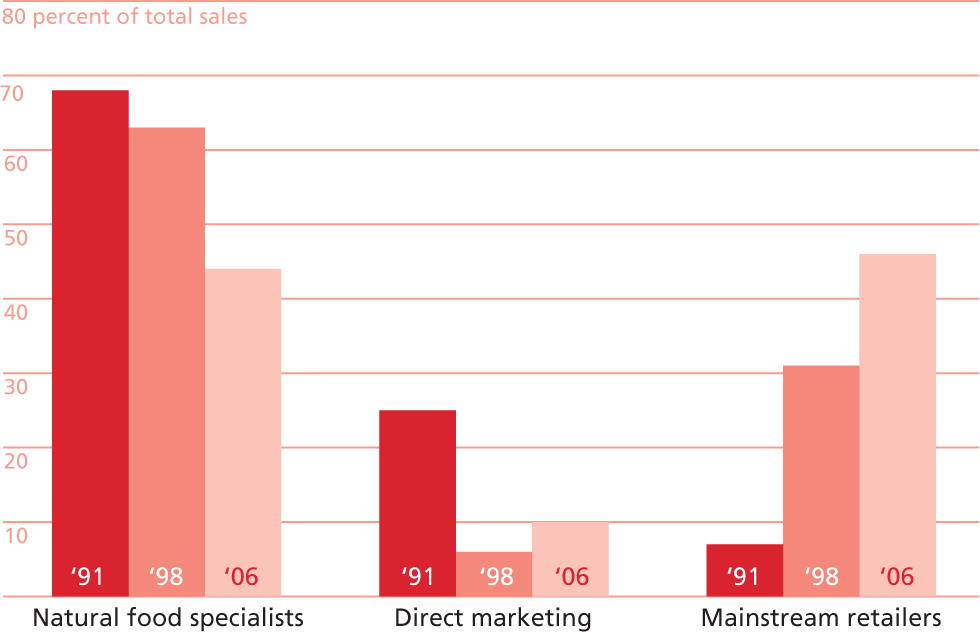
The chart below shows how these changes affected food co-ops. In 1991, the majority of organic foods sales occurred in natural foods specialty stores, a category which includes co-ops. Mainstream retailers controlled only 7 percent of the market. Fifteen years later, the mainstream stores had begun to edge the natural foods specialists out of the race—exacerbated by a 2006 decision by Wal-Mart, the world’s largest grocery retailer, to sell more organic products.
The fact that the “natural foods specialists” category also includes large chain retailers like Whole Foods means that the actual percentage of sales that occurred in co-ops was even smaller than that which appears in this chart. The overall volume of organic foods sales has increased since the early 1990s, and co-ops are selling more in absolute terms, but they have to work harder to keep their customers.
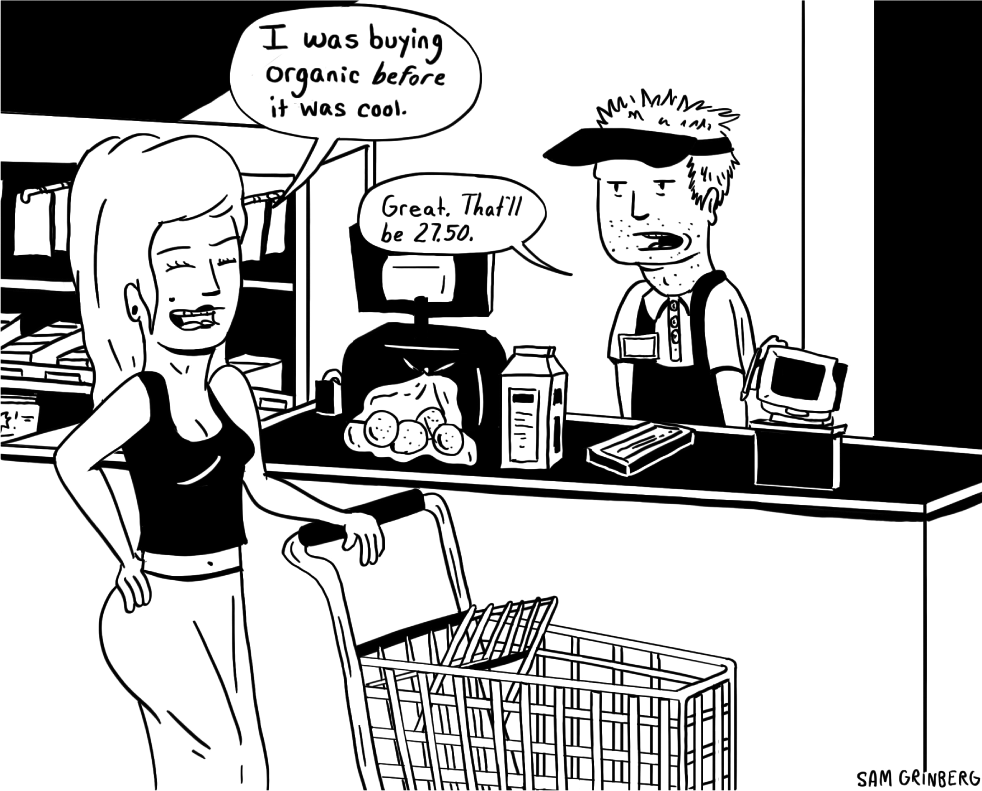
These statistics hint at other important shifts in the organic sector. Organic foods consumers in the sector’s early years were often what market researchers call “true naturals.” For them, organic foods were a way of life, tied to political engagement in environmental and social issues. Today’s shoppers, in contrast, are just as likely to buy organic foods to demonstrate affluence and sophistication, protect the health of their families, and be an ethical consumer—and they highly value a smooth, efficient shopping experience.
Democracy and Efficiency
In the 1970s, co-ops operated as democratic businesses, encapsulated by the slogan, “Food For People, Not For Profit.” Members of co-ops not only shopped at their stores, but also helped to run them by working volunteer shifts and by voting on store policies. Lengthy membership meetings meant that co-op democracy was time-consuming and sometimes acrimonious.
Sam, a longtime member of PFC, recalled early debates surrounding whether or not to carry eggs. Some vegan co-op members didn’t want eggs in the store, so “they would get all of their friends together and they would vote out eggs.” The next month, someone else would organize to keep eggs in the store. “So you had a very inconsistent base, at least for the business world, of products going in and out.”
Sales Channels for Organic Foods
Source: Carolyn Dimitri and Lydia Oberholtzer. 2009. Marketing U.S. Organic Foods: Recent Trends from Farms to Consumers. Washington, D.C.: U.S. Department of Agriculture Economic Research Service
“To the outside world, it looked cool,” said Sam. “But the store rarely made money.” Other co-ops experienced similar problems, which became more apparent as supermarket competitors began to sell organic and natural foods. Co-op customers, frustrated by meetings and debates, turned to these new stores, and many co-ops were forced to shut their doors.
During the 1980s, co-op leaders registered growing concern about this tension between commerce and democracy. A 1987 article in the co-op community’s national trade magazine, titled “Why Co-ops Die,” decried the “withering” of the movement’s democratic aspirations. The co-ops that weathered the market changes were doing so by abandoning their democratic practices and by parroting the commercial orientation of their competitors, the author explained. The article concluded that co-ops were “tied to the climate of their birth [and] may not be designed to live beyond the needs and the visions of the generation that conceives them.”
Today, when consumers expect organic foods marketplaces to look and act like mainstream stores, competitive pressures have forced co-ops to creatively adapt. In fact, I encountered only two co-ops that still practice democratic management and relied on members’ work to run the store, and both were located in densely populated neighborhoods with reputations for progressive activism. However, the remaining co-ops still differed from mainstream stores. While relying on professional managers and staff, they encouraged customers to literally take ownership of the stores. At PFC, for example, while customers do not work in the store, they have the opportunity to become members by purchasing a $300 share of the business—divided into $15 annual payments.
At first glance, member ownership sounds as democratic as purchasing a share of stock in General Mills. But as co-op leaders see it, while members receive shopping discounts and annual dividend checks, that is only a small part. As one manager put it, “We are such a capitalistic society. It so dominates our economic learning that the idea that people can pull together and actually have a society for mutual aid is a new concept. Ownership creates the sense that we are all in it together and as the business thrives, we will all do better.”
The manager of another store explained that co-op investments also strengthen bonds between members and local communities. “Democratic ownership is the main difference between co-ops and private businesses. Our goal is not to make money. We exist to provide services to our members and the community. We tell customers, did you know that you could own part of this business and that dollars that are spent here are more likely to stay within the community?”

Member ownership helps co-op leaders negotiate between the demands of the market and the goal of democratic change. Although members are no longer directly involved in store operations, managers and staff make investment meaningful by framing membership in the language of solidarity and social change. They encourage members to see themselves not only as customers, but also as stakeholders in the food system. Members vote in elections for stores’ boards of directors, or they run in those elections themselves. Co-ops try to keep prices down by providing members with shopping discounts. Some stores even provide substantial discounts to members who donate their time to nonprofits in the surrounding community.
In a democratic food system, producers and consumers would deliberate about how to balance social equity, commercial success, and environmental sustainability.
Consumerism and Change
Of course, creating democratic businesses is only one part of what co-op leaders are trying to achieve. They also want to change the food system and raise the political consciousness of their customers, nudging them toward activism. In their early years, co-op leaders wore their politics on their sleeves. One manager I spoke with recalled a time when customers who asked to buy non-dolphin-safe canned tuna were subjected to “re-education” by cashiers as they stood in the check-out line. Today, managers worry that these political efforts may scare off customers.
As Charles, the manager of a co-op with four stores in neighboring towns, put it to me, “You’ve got to be careful here. It’s an extremely competitive market…and we don’t want to be dictating and we don’t want to be preaching. That doesn’t help us as we try to grow and broaden our appeal to more people.”
Still, managers in co-ops encourage customers to think critically about the larger food system. Nearly every co-op I visited highlights products from local organic foods producers, and several have explicit goals for the percentage of locally-produced products they stock. Charles’ co-op even invests in a refrigerated truck and a driver to travel to small, organic farms within the region to pick up produce for the store. Customers often appreciate the opportunity to support independent farmers and small businesses, he explained.
Creative individuals are finding ways to encourage critical thinking and collective action around food, even as they operate in a system that provides precious little support for these activities.

Co-op managers also pull products from their shelves if manufacturers engage in socially or environmentally harmful practices. When they learned that one organic dairy company, Horizon, raised some of its cows on factory-like farms, some managers stopped carrying Horizon products. They did so cautiously, allowing customers to special-order the products if they wanted to, but they also let customers know why the products were no longer available.
Some co-ops combine this merchandise “gatekeeping” with educational efforts designed to help members understand the benefits of a decentralized, regionally organized food system. They write articles in store newsletters, screen films and host speakers that address concerns with the mainstream food system, and organize visits to local organic farms that foster critical conversations about the food system.
While describing her store’s support of an educational program that brings middle school students to an organic farm for a day, one manager explained, “These are the future decision makers about food and what is healthy, and if all they hear about is Coke and fast food, if that is what they are surrounded with, that is what they are naturally going to be drawn to when they start their own families. This trip helps them make wise decisions and to understand that you need to steward the land.”
Finally, co-ops support food-related political campaigns and encourage their members to get involved by writing letters to political representatives, making donations, or attending demonstrations. A number of the stores are active in state-level political campaigns to require the labeling of genetically engineered foods and also encourage members to make their voices heard in national discussions about the content of organic food regulations. The board of directors at PFC even voted to make a sizeable financial donation to support a ballot measure that would ban genetically engineered seeds from being planted in a nearby county. But these overtly political activities were at times perceived as risky.
As Carol, the manager of a store that had been deluged with complaints after announcing its support for an open space preservation campaign, explained to me, “You just don’t know! You think something is benign and it’s not. We do have customers walking through those doors that are probably on every side of the issue.”
The Limits of Co-op Democracy
Through member ownership and political activities, the leaders of organic foods co-ops strive to promote a democratic, environmentally sustainable, and socially just food system. Talk of democracy in co-ops is more than just clever marketing rhetoric. In spite of the pressures of a changing organic foods marketplace, co-op members and staff devise strategies to challenge consumerist individualism and engage their customers in critical discussions about the structure of the contemporary food industry.

The upshot of this research is that changing food systems is not an all-or-nothing project. Determined and creative individuals in the co-ops I visited are finding ways to encourage critical thinking and collective action around food, even as they operate in a system that provides precious little support for these activities.
But there are limits to what co-ops can do. As the manager of PFC said ruefully, “I happen to be rabidly political, personally…but I try to not take advantage of the store’s resources to work my particular bias.” When the store has food that is going out of date, she makes sure that it is delivered to local charities and food banks. She also asks herself: “why do we have growing poverty?” But since talking about poverty as a political problem would alienate the store’s more affluent and conservative customers, she and other managers focus on issues on which there is a broad consensus.
We might well ask how robust the democratic conversation can be when some issues, such as poverty and social inequality, are off limits. The reality is that because they are small players in a rapidly growing market, these co-ops’ ability to set the political agenda is limited. Many of their customers also shop at larger grocery stores and expect that co-ops will offer a similar, customer-centered experience. If they wish to stay in business, co-ops must be extremely cautious about how they meet customer expectations.
Still, as they struggle to maintain their market niche in a growing organic market, co-op leaders are creatively pushing the boundaries, keeping the vision of food democracy alive.