




Abstract
In this introduction to the special issue, we first provide an illustrative overview of how food has been approached in organization studies. We focus on the organizing of food, that is the organizational efforts that leverage, shape and transform food. Against this backdrop, we distinguish the agency of organizations and the agency of food and explore their intersection. We argue that the ‘biomateriality’ of food, i.e. its biomaterial qualities, plays a distinctive role in shaping and affecting organizing and organizations. To do so, we present a conceptual framework for analysing food organizing, which highlights the biomateriality of food and its agentic effects on organizational efforts. Thus, we provide researchers with an analytical toolkit to disentangle the different agents (people, organizations, food itself) and the associated processes and mechanisms that play a role in food organizing. We use this analytical toolkit to introduce the different articles in the special issue and put forward some lines of future research.
Introduction
Food is at the core of humankind, a basic human right. We need it to sustain ourselves, as recognized by the 2020 Nobel Peace Prize to the World Food Program of the United Nations. It is not just the case that ‘we are what we eat’; our lives and cultures are structured around food. Food organizing, therefore, reminds us of the essential role of organization as the means by which we coordinate the activities necessary for our survival and spice up our lives. Throughout history, not only have we organized our food and our lives around food, but food has also organized our lives and practices. Food, organizing and organizations are thus deeply intertwined. In addition, food draws attention to what we term ‘biomateriality’. As biological matter, food has biomaterial qualities that invite, allow, demand, or resist certain forms of organizing. We argue that food has, therefore, a special relationship with organizational efforts, which we seek to untangle.
In this introductory essay, we aim to achieve two objectives in addition to presenting the seven papers in the special issue on ‘Food organizing matters’. First, we explore the literature on the recursive relationship between organization and food. Based on this selective review, we propose the notion of the ‘biomateriality’ of food to emphasize that its biomaterial qualities shape and affect organizing and organizations. We thereby extend the growing interest in the materiality of objects, technologies and spaces in organizational studies by pointing out that the materiality of living, biological entities is distinct. Second, we provide a framework to inform the analysis of food organizing – the organizational efforts that leverage, shape and transform food. Our framework highlights the biomateriality of food and its agentic effects on organizational efforts. As such, it provides researchers with an analytical toolkit to disentangle the various agencies of people, organizations, food, as well as other ‘things’, and the associated processes and mechanisms that play a role in food organizing.
The complex links between the biomateriality of food and organizing provide a research context that can strengthen the recent material turn in organization studies (Boxenbaum, Jones, Meyer, & Svejenova, 2018). In particular, we argue that food provides a unique opportunity to anchor organization studies in what is most central to human survival and social life. Focusing on food can orient scholars from various epistemic communities towards studying organizing as a deeply purposive human activity (Holt & den Hond, 2013). The presentations and discussions at the 2017 Organization Studies Summer Workshop on ‘Food organizing matters: problems, paradoxes, potentialities’ reflected this spirit, as did the submissions we received in response to the call for papers for this special issue. They revealed a great diversity of scholarly perspectives on, and theoretical approaches to, food organizing. And although this diversity could have been a source of fragmentation and a stumbling block for mutual engagement, quite the opposite happened. The various scholarly contributions were united in being uniquely grounded in a phenomenon that felt real, relatable and of great importance to human life. Food was more than merely an arbitrary or convenient object for theorizing; it inserted itself into the theorizing and thereby anchored scholarship in the physical reality of the foodstuff that was being studied.
In a nutshell, through this special issue we seek to stimulate scholarly discussions of food organizing in general and the interaction between the biomateriality of food and organizing in particular. We invite scholars to focus not only on how organizing shapes food and our lives around it, but also on the many ways in which the biomateriality of foodstuff and its centrality for being human – in terms of aesthetics, joy and pleasure, as well as sheer functional necessity – shapes organizing. In the remainder of this introductory essay, we present a conceptual framework for the study of food organizing and provide an overview of what the articles in this special issue bring to the table. We conclude by discussing how the important, but as yet underdeveloped, study of food organizing can be enriched in the future.
Food Organizing: A Conceptual Framework
‘Tell me what you eat, and I shall tell you what you are’ (Brillat-Savarin, 2009, p. 162). This well-known aphorism from the preamble to the legendary Physiology of Taste by French gastronome Jean Brillat-Savarin symbolizes our intimate relationship with food. This relationship is an expression of our multiple and diverse cultures. Throughout history, we have organized not only our food and our lives around food, but food has also organized our lives and practices. Historians have linked the emergence of large-scale social organizations and the use of mass labour to the needs of securing and coordinating food supply in the agricultural civilizations that emerged approximately 6,000 years ago, and debated how specific forms of food organizing techniques, such as irrigation, shaped wider political and economic structures (Wittfogel, 1956).
Over time, food organizing has become ever more complex, outgrowing its initial local rootedness to connect faraway locales through long-distance trade. Nowadays, food organizing caters for increasing volumes of food through sophisticated, specialized and globalized system of production, trade, processing, and control. Multinational corporations are central players in the current system. As a result, more people have access to sufficient food than several decades ago, for example, and famine is no longer a necessary outcome of natural disasters, such as floods and droughts (de Waal, 2018). Yet, hunger has not yet been eradicated and, according to the United Nations (2020), the COVID crisis may actually have worsened the situation. Further, as food organizing has become more sophisticated, it has also become a liability for the future of humanity on planet Earth: the current system has been associated with the loss of biodiversity and large-scale decline in the number of species (notably pollinating insects), due to conversion of land for agricultural purposes, overexploitation in monocultures, and the application of all sorts of agrochemicals.
The current globalized food system is not only considered a cause of global challenges, but, if transformed, it may also contribute to addressing them; through for example the preservation of remaining natural environments and the promotion of health and wellbeing (Willett et al., 2019). These and other burning issues in food organizing, such as animal rights concerns, have stimulated advocacy, protest and awareness-raising activities by environmental campaigners, film makers, writers and other artists. Examples include Vandana Shiva’s organization Navdanya (meaning ‘nine seeds’ in honour of biodiversity and cultural diversity), Peter Nelson’s (2019) The Pollinators, Jon Betz and Taggart Siegel’s (2016) Seed: The Untold Story, Robert Kenner’s (2008) Food Inc., and Zack Denfeld and Cathrine Kramer’s Center for Genomic Gastronomy in Dublin and their journal Food Phreaking.
Moreover, food is a central element in human culture and a source of inspiration and creativity for many, whether master chef (Gomez & Bouty, 2011; Lane, 2014; Opazo, 2016; Svejenova, Mazza, & Planellas, 2007), artist (Riley, 2015), dumpster diver (Barnard, 2016), or culinary amateur (Hackney, 2013; Lee, Samdanis, & Gkiousou, 2014; Moser, Ganley, & Groenewegen, 2013). Anthropologists, historians and cultural sociologists have revealed rituals and customs associated with the production, preparation and consumption of food (Elias, 2000; Fine, 2008; Mauss, 2002; Mintz & du Bois, 2002). Philosophers have focused on the ethics and aesthetics of food production and consumption, questioning and scrutinizing genetic modification, agro-industrial production and the paradoxes in our contemporary diets (e.g. Kaplan, 2012, 2019; Singer, 1972, 2011). Political dimensions of food have been highlighted, both as an element in defining and distinguishing collective identities (DeSoucey, 2016; Poulain, 2017) and in being subject to the exercise of (state) power in relation to its distribution and withholding (see De Waal, 2018, in relation to famine as an instrument in warfare). Thus, food has shaped and will continue to shape organization, as much as organization has shaped and will continue to shape food, in ways that are of critical importance to both human culture and our very survival.
However, the organizational efforts associated with food have been brought to life less frequently. Our conviction that the complex issues and struggles associated with food organizing have insufficiently been considered from an organizational point of view was the motivation for convening the 2017 Organization Studies workshop. The study of food organizing has typically been concentrated in agricultural, ‘land grant’ universities, with research focusing on the increase of productivity, for example by genetically modifying crops. Relatively less attention has been directed to alternatives to dominant, corporate forms of organizing food, such as emerging from and present in entrepreneurial, community and indigenous practices. Even less consideration has been given to questions of how food itself organizes our practices. For example, the biomateriality of food constrains what we can do to it and with it, in spite of all the preserving, conserving and transforming technologies and processes developed to free food from its perishable nature.
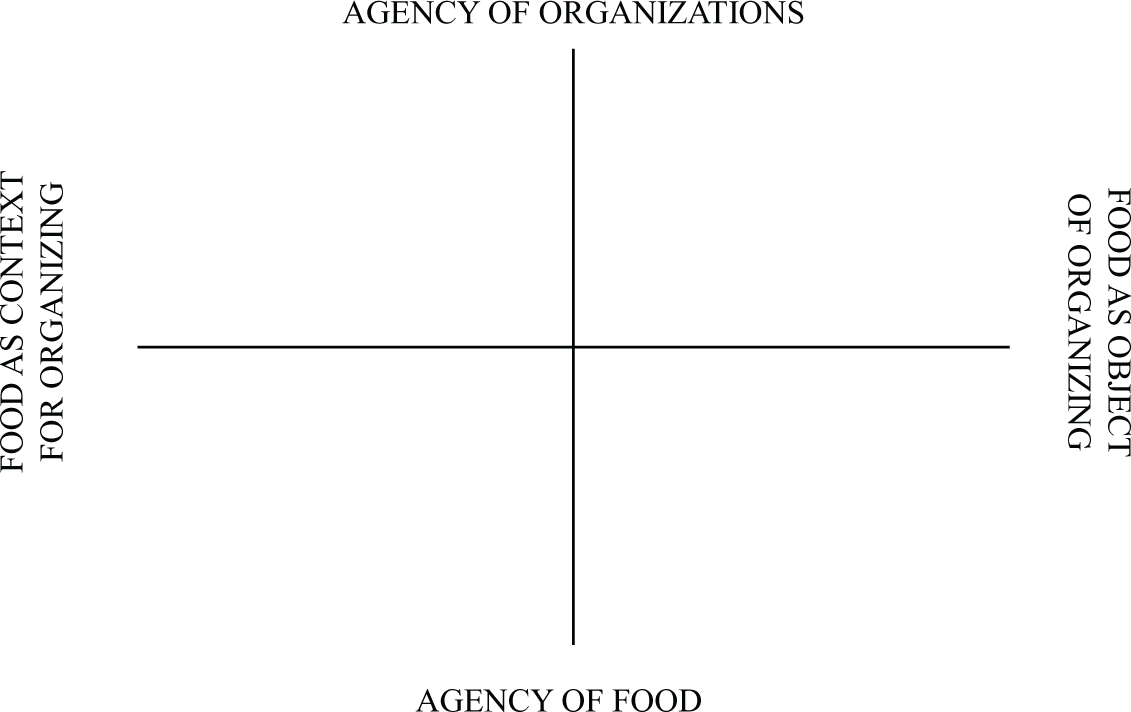
To highlight the diverse possibilities for the study of food organizing, we propose a conceptual framework along two dimensions (Figure 1). One dimension emphasizes what we call the ‘traditional view’ where food is an object of or context for organizing. Here, organizing has an essential role in coordinating the activities necessary for our survival. The second dimension highlights the biomaterial agency of food and its effects on organizational efforts. Here, we refer to the locus of agency in food organizing, distinguishing the biomaterial agency of food from human agency as exercised through organization. Below we introduce these two dimensions and their main distinctions.
Conceptual framework.
The agency of organizations
Food has frequently been studied as an object of organizing, or a product of organizations. The focus is on the interplay of organizations and food which materializes in terms of the politics of food and cultural practices. Ever since the mid-19th century, the cultivation, modification, preparation, transportation and distribution of food has increasingly been industrialized (Pilcher, 2017). Despite cultural differences, global supply chains have given rise to food standards that specify what food is, how it should taste and what it should look like; in short, how it should be organized (Ritzer, 1993). Multinational corporations have adopted processes and technologies to produce food in a Fordist manner, regardless of local and cultural context. Examples include slaughterhouses (Fitzgerald, 2010; Glozer, Caruana, & Hibbert, 2019), hothouse vegetable production and fast-food restaurant chains. Governments, companies and non-governmental organizations struggle to negotiate food security for developing countries (Gammelgaard, Haakonsson, & Just, 2020), while the meat lobby tries to damage the business opportunities of firms producing plant-based meat alternatives (Manager Magazin, 2020).
Yet, food is also a cultural product of organizational efforts that define ideas of taste and aesthetics, and show that ‘what food is’ is defined by prevailing traditions and cultures around food. What is edible and a pleasure to eat, and what goes to waste, is not only materially given but also culturally defined. What is considered food waste in one context might be a delicacy in another. For example, chicken feet are typically thrown away in Europe and Northern America, but constitute a popular dish in China. Most people would never even consider tasting rotten shark, yet in Iceland this dish is a rare delicacy, although it is typically considered to be an acquired taste. The notion of ‘cuisine’ and its association with particular recipes, taste, aesthetics and traditions illustrates the production of food as a cultural object (Gardiner, 2019; Rao, Monin, & Durand, 2003). Thus, studying food as the object of organizing requires us to make sense of both the similarities and differences in tastes and traditions across cultural boundaries. The important role of organizing something ‘as food’ or as a certain type of ‘cuisine’ is infused with social distinction and cultural significance.
Food often serves as a fascinating empirical context in which to investigate and address a range of issues and questions deemed relevant for the field of organization studies. Recent examples include research into categories (Delmestri & Greenwood, 2016), standards (Reinecke, Manning, & von Hagen, 2012), careers (Slavich & Castellucci, 2016), institutional maintenance (Croidieu, Soppe, & Powell, 2018; Gill & Burrow, 2018), corporate social responsibility (Souza-Monteiro & Hooker, 2017), online communities (Moser et al., 2013), creativity (Croidieu, Rüling, & Boutinot, 2016; Koch, Wenzel, Senf, & Maibier, 2018), professional work and identity (Clarke & Knights, 2018, 2019; Hamilton, 2013), knowledge sharing (Moser & Deichmann, 2020) and innovation (Feuls, 2018; Dyck & Silvestre, 2019; Slavich, Svejenova, Opazo, & Patriotta, 2020). Food may be studied as a bonding element in emerging cultural practices, for example, in the recent transformation of the prominent British social institution of the pub into gastropub (Lane, 2018).
However, food as a context for organizing may also be associated with struggles over rights and identities. For example, food production has been examined as embedded in political struggles between mass production and alternative modes of production, such as micro-breweries (Kroezen & Heugens, 2019) and so-called alternative food networks (Ehrnström-Fuentes & Leipämaa-Leskinen, 2019). Combining insights from development studies and post-colonial scholarship, Gammelgaard et al. (2020) analysed the local experience of farmers in Malawi with the New Alliance for Food Security and Nutrition (NA). The NA was launched in 2012 at the initiative of then US president Obama by the G8 and three African countries. They show how the objectives of the NA – sustained, inclusive, agriculture-led growth – were perverted upon their implementation to result in local experiences of land grabbing. DeSoucey (2016) traced the culture war between animal rights activists, artisanal farmers, industry groups, chefs and consumers surrounding the French tradition of eating foie gras (fattened duck or goose liver). In Germany, politicians pondered the question of whether the traditional German dish of pork should still be served in multicultural schools, as Muslim children cannot eat it (Der Spiegel, 2020). Food also allows for explorations into modes of participation in diffuse social movements, for example the vegan movement (Cherry, 2006) or the slow food movement (van Bommel & Spicer, 2011).
As seen in these studies, the passion and energy stirred by the topic of food can intensify the organizational dynamics being investigated, and magnify the cultural and political issues involved in food organizing. Yet, food here mainly serves as an empirical context for studying other practices and processes of organizing, including categorization, standardization, institutionalization, communication, creativity, professional work and identity, and innovation. Food is not of central concern and, hence, other contexts such as energy, electricity, or transportation can easily substitute for food.
The biomaterial agency of food
In this introduction to the special issue, we want to spice up the way of approaching food by recognizing that it is a living matter with biomaterial agency that is productive of organizing: there is a mutually constitutive relationship between the biomateriality of food and the social realm. Although there has been an increased interest in materiality in organization studies (e.g. Boxenbaum et al., 2018), the matter at hand in the idea of a ‘constitutive entanglement of meaning and matter’ (Cooren, 2020, p. 2) has for the most part been of non-living, non-biological, inanimate origins: ‘things’ such as objects, technologies and spaces. Notable exceptions include Callon’s (1986) scallops in the St. Brieuc bay, where scallops are agents in a process of translation. Similarly, Latour’s studies acknowledge the role of viruses (for a recent interview with Bruno Latour on the COVID-19 virus see Watts, 2020). Food, as biological matter, allows extending and further qualifying the interest in materiality to include biomateriality. Food’s biomateriality dynamically shapes organizational efforts, and interacts with the human body through all our senses and its effects in terms of (over-)nourishment or starvation. It thus adds a ‘living’ element to the conversation about materiality in organization studies. In the following, we explain what this living element adds to the conversation about materiality, and how this matters for organizational studies.
Our point of departure is that food fundamentally affects our bodies and metabolisms in ways that other material stuff does not. We need food as a living matter: food nourishes us, it creates sensual embodied experiences in terms of taste, yet it can also poison or intoxicate us, make us sick, or overweight. We might choose to fast or go on hunger strike for health, religious or political reasons, but can only do so for a limited time before suffering deteriorating and sometimes irreversible effects on the human body (and indeed, food deprivation is a form of torture). Without food, we die.
Because food is so important, humans have created meaning, structure and culture around it. Securing food has structured early human societies around social relations of hunters and gatherers, which have later evolved into agricultural societies (Wittfogel, 1956). The growth patterns of plants and the rhythms of planting and harvesting have structured agricultural organizing. In parallel with these rhythms, cultural patterns developed, such as various celebrations around harvest (e.g. ‘Thanksgiving’) and ceremonies around tilling, sowing and planting, to plead with the gods for a merciful growing season. In the intimate realm of families, the ‘housewife and bread winner’ model permeates societies all over the world (Pfau-Effinger, 2004), highlighting the crucial task of providing for the family – which is increasingly the task of both men and women in dual-earner households (von Gleichen & Seeleib-Kaiser, 2018). Biomateriality thus causes and substantiates cultural concepts and structures through community, friendship and conviviality in institutional maintenance.
Biomateriality is also illustrated when considering how seeds carry plants and food into the future. Through them, people preserve not only biodiversity but also culture and history, hopefully for generations to come (Shiva, 2016). Alternative forms of preserving seeds for global food security include formally coordinated, multilateral initiatives, such as the Svalbard Global Seed Vault, which houses and protects seeds’ duplicates from gene banks all over the world. Due to its physical properties, food can also materially anchor relatively abstract ideas, such as in Islamic banking where the physical presence of meat or other food commodities legitimizes financial transactions (Nicolini, Reinecke, &Ismail, 2020). Because a physical transaction needs to take place to make a financial transaction morally permissible under Islamic law, the meat’s perishability becomes a central if unlikely organizing device for the creation of financial products. In extension, food is also a vivid source of metaphors and analogies for making reality comprehensible (Ferguson, 2014). For example, since the days of the Old Testament, milk has offered a telling image of the abstract notion of ‘plenty’, whereas curdling has been used to invoke the transition from chaos to order (McGee, 1984).
As a consequence of the vital importance of food for us, we have ever since tried to tinker with it to make it last longer, taste better, or become nourishing instead of poisonous. As a living matter, food stuff has biomaterial qualities that invite, demand, or resist certain forms of organizing. For example, many food items (e.g. dairy, meat, bread, fruits and vegetables) can easily perish and therefore demand specific treatment (e.g. cooling, freezing, fermenting, curing, drying) to increase their preservability. Other food items are inedible or toxic unless they undergo a specific treatment, such as cooking. Yet others have qualities that only emerge after a specific treatment, such as in the transformation of egg white into foam and of grape juice into wine, champagne, or grappa. Whichever the treatment, it requires organizational efforts.
Building on the above, we contend that all food organizing arises from the profound co-constitution of food materiality and food culture. Indeed, we believe that we can only fully understand many societal phenomena if we take into account the biomateriality of food. The example of formal dining at Cambridge colleges shows how this ritual around food contributes to maintaining the British class system (Dacin, Munir, & Tracey, 2010). Such maintenance would be much harder if people were independent of the living matter of food. In addition, the organization of food, and hence the business of organizations that work with food, is importantly premised on its biomateriality. Studying food organization and organizing thus implies paying attention specifically to the biomateriality of food, as it crucially shapes and informs such organizing. For example, beer brewing invokes very particular practices that shape and resist institutional change (Hatch & Schultz, 2017; Kroezen & Heugens, 2019). Ferran Adrià’s imagination in experimenting with food’s biomateriality (Svejenova et al., 2007) uniquely earned his restaurant ‘El Bulli’ the title of ‘best restaurant’ five times. The recognition of the biomaterial agency of food informs our thinking and confirms our conviction that an organizational perspective on food must take into account its materiality and associated agency.
What this Special Issue Brings to the Table: Towards an Organizational Perspective on Food
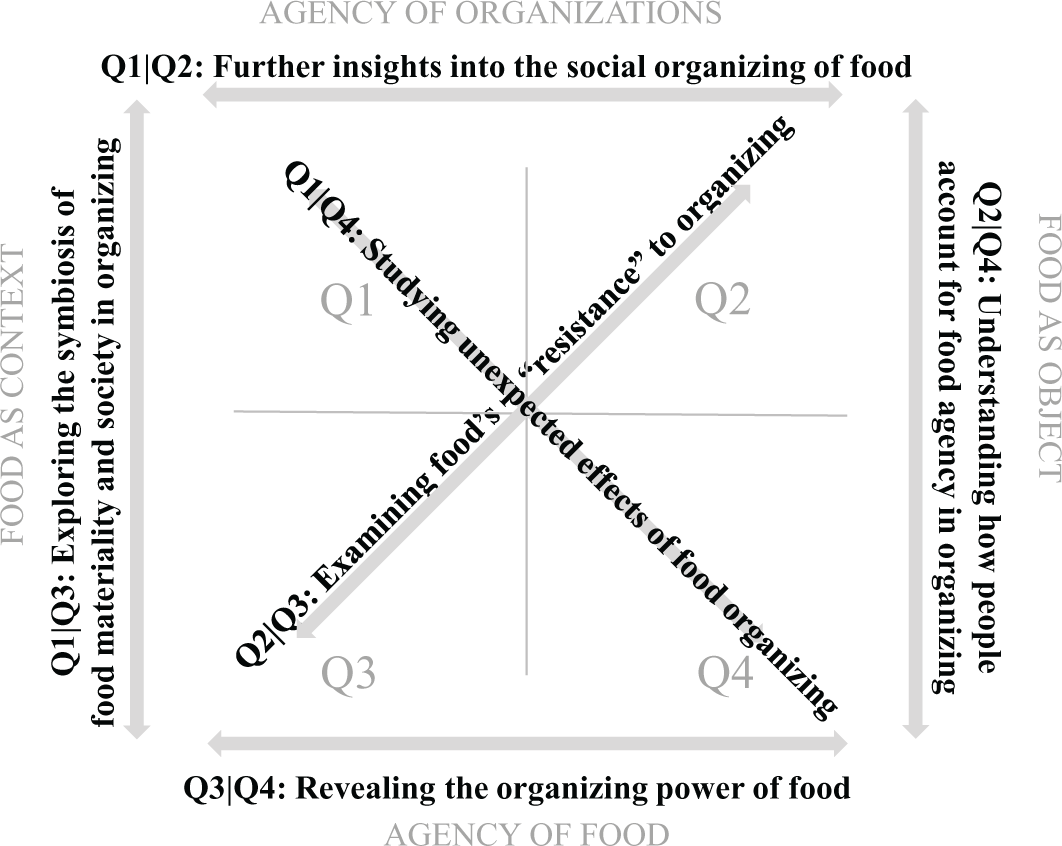
With this special issue, we hope to inspire future research on food organizing. We believe that our conceptualization along the two dimensions in Figure 1 has the potential to inform new and exciting research on the topic. Above, we have described how these two dimensions are part of our lives, and how scholars have approached them. To be sure, the boundaries between organizational agency and the biomaterial agency of food are not as clear-cut as Figure 1 might suggest. Moreover, some of the most interesting mechanisms and processes can be found at the intersections of the two dimensions. Figure 2 seeks to overcome the analytical simplification of Figure 1 by capturing these intersections, as well as their problems, paradoxes and potentialities; it serves as a point of departure for future research on the topic of food organizing.
Interconnections between dimensions.
Q1|Q2: The social organizing of food
Focusing on how food is organized, we propose to investigate the intersection between food as context and as object of organizing: the social organizing of food. Given the centrality of food and organizations in our lives, we believe that the social organizing of food will endure as a key avenue for future research. Above, we provided a glimpse of food-related research and, as indicated, it is beyond the scope of this introduction to review all the work conducted in the food context. Yet, we can savour how food allows us to collect remarkable findings from mundane situations as it is entangled in a network of practices and meanings. This entanglement raises a sheer inexhaustible set of questions about who does what, with and when to food, and how the result becomes organized and accepted.
Three studies in this special issue take up the challenges posed in this line of work by addressing novel questions and areas of studies. In her article ‘Beyond the tipping point: The role of status in organizations’ public narratives to mobilize support for change’ Isabelle Ren studies the no-tipping movement, which started in large US cities in the mid-2000s and is still unfolding. Tipping is an entrenched custom ‘that symbolizes consumer power and reward for performance’ (Ren, this issue, p. 196) yet is deeply consequential for the political economy of restaurants. It inflates the revenues of lower-status servers, while restricting the rewards of higher-status chefs to symbolic and social recognition. Getting rid of tipping, however, hurts customers and servers. Ren identifies four main narratives in how owners legitimize their restaurants’ no-tipping practices, namely as a way to promote ‘compensation fairness, the professionalization of service work, cultural authenticity, [or] equality’ (Ren, this issue, p. 195). Prior studies have shown how status position commends different kinds of legitimation strategies (e.g. Kim, Croidieu, & Lippmann, 2016) and how frames are used in interactions (e.g. Reinecke & Ansari, 2020). Ren extends this literature by revealing how even hardened status hierarchies can become malleable and amenable to change. As the food context reminds us how contested and far-reaching status hierarchies are, we see potential in future research exploring the social antecedents, statutory consequences and feedback loops of the strategic communication of organizations (cf. Joutsenvirta & Vaara, 2015; Ocasio, Laamanen, & Vaara, 2018; Vaara, Tienari, & Laurila, 2006).
Sophie Marie Cappelen and Jesper Strandgaard’s study on ‘Inventing culinary heritage through strategic historical ambiguity’ shifts the spotlight to the role of symbolic work and strategic use of the past to create a culinary heritage and lift the category of elite Turkish cooking. Building on recent work that illuminates how organizations can strategically elevate the categories they belong to by mobilizing symbols (Delmestri & Greenwood, 2016; Pedeliento, Andreini, & Dalli, 2020) and how maintaining the high-level status of these categories requires a massive symbolic expansion (Croidieu et al., 2018), their study explores the role that strategic ambiguity plays in the narratives that gastro-entrepreneurs deploy to fabricate a cultural heritage. By distinguishing the ambiguity of origins, artefacts and ownership in their narratives, the authors reveal how symbols were assembled from different regions, the Ottoman past, as well as the modern Turkish state. Strandgaard and Cappelen show how strategic ambiguity can be exploited to facilitate and support creativity at an abstract level. As food resonates with culture and identities, their study enriches a growing literature on the strategic use of the past (Foroughi, Coraiola, Rintamäki, Mena, & Foster, 2020) and the multimodal symbols that convene when organizations communicate.
In contrast, Gollnhofer and Bhatnagar explore the non-strategic dynamics that underlie category changes in their article ‘Investigating category dynamics: An archival study of the German food market’. Through a historical content analysis of a major consumer journal in the German retail sector since World War 2, they highlight how the meaning of food shifted from scarcity to abundance through, initially, the proliferation of food categories, and subsequently, the valorization and entanglement of components, ingredients and recipes. Where some research has shown the variety of ‘external’ agents involved in category change (e.g. Anand & Watson, 2004; Croidieu et al., 2016), Gollnhofer and Bhatnagar’s study unravels the complex internal dynamics and the role of evaluation criteria that go beyond strategic action. The exploration of the complex dynamics and their possible unintended consequences, such as in relation to food waste, offers a more complete view of category change. The topics central in these three papers – discursive status work, the strategic use of the past and category dynamics – are promising areas for future organizational research.
Q1|Q3: Exploring the symbiosis of food materiality and society in organizing
This intersection allows for a richer understanding of the symbiosis between biomateriality and society in the context of organizing, through the exploration of variations in their ongoing interaction. Attention to this symbiosis reveals a broader view on food: food is no longer a context of organizing, but rather agentic and entangled. The nature of the symbiotic relationship between people and food in the context of organizing has methodological implications and requires a vocabulary that allows for discussing interaction between human and non-human agents on an equal footing (Akrich & Latour, 1992; Carlile et al., 2013). For example, taking seriously the idea of biomateriality would imply studying the symbiotic relationship from a theoretical perspective that grants equivalence to (is not discriminatory between) human and non-human agents.
The symbiosis in the relationship can be of different kinds: mutual, commensal, or parasitic (Gontier, 2016). Interaction in a mutual relationship between people and food is beneficial for both. For example, food can be a source of uplifting, exhilaration and joy. People can ensure that food sources and what is involved in producing and transforming them are respected, through responsible food organizing practices, including the fair-trade treatment of farmers, animal rights or welfare, and nature’s rights. Research concerned with a mutualist relationship may delve into forms of organizing that seek to identify or develop sustainable practices of food organizing. An example of such research is Nathalie Louisgrand and Gazi Islam’s study of collaboration in fine-dining, entitled ‘Tasting the difference: A relational-epistemic approach to aesthetic collaboration in haute cuisine’. Here, French chefs teach Chinese chefs the conventions of French haute cuisine, resulting in novel food combinations. Benefits from exchanges such as these are in the conjoint exploration of cultural and aesthetic conventions in their respective traditions; they resulted in expanding or altering their food-related repertoires. Thus, food itself benefits by expanding its requisite variety with previously unconceivable combinations where one can indeed taste the difference.
The society–people–food relationship can also be commensal, where one entity benefits from, but brings no harm to, the other. Examples include the annual shearing of sheep for their wool, the milking of cows, and the nicking of eggs from underneath hens. The farmer benefits without causing harm to the animals. A commensal relationship is an aspiring mutual relationship, i.e. it carries with it the possibility of finding ways of food organizing that are beneficial to both people and food. However, behind the mere assumption that a relationship will be commensal may be hidden an ignorance, naiveté, or unwillingness to examine whether there may be harmful consequences in the way food is organized; if that is indeed the case, then the relationship is parasitic.
A relationship is parasitic when one entity, the parasite (e.g. people), lives off the other (e.g. food), thus harming it and possibly causing its waste or depletion. This kind of relationship is a source of multiple problems and paradoxes in current food systems. There are numerous parasitic organizations and organizational practices. For example, corporations systematically seek to enhance the yield and efficiency of food production through technological advances, many of which harm bio-diversity or farmers’ and animals’ livelihoods. Nation-states use food and nature resources to establish or increase their power over other states. And despite knowing better, organizations, nation-states and individual people continue to harm food and nature through excessive (e.g. air transport) or wasteful (e.g. single-use plastics; food waste, Moser, 2020) practices in a dramatically accelerating climate change. A parasitic relationship of people in relation to food has far-reaching implications, as harming food often becomes harmful for people’s health and well-being. For example, fast food thrives on people’s desire for instant satisfaction of their cravings, yet is also associated with the much-discussed global obesity pandemic.
Q1|Q4: Studying unexpected effects of food organizing
The next connection points to unexpected effects of food organizing. Places where supply and demand for food is organized, such as (super-/hyper-)markets are one cluster of sites where unexpected effects can be encountered. In particular, local markets are venues where residents purchase their daily needs, as well as tourist attractions to buy local specialities. The Borough Market on the south bank of the Thames in London, the Torvehallerne close to Copenhagen’s Nørreport Station, Barcelona’s centrally located Mercat de la Boqueria, the 1,5 kilometre long Albert Cuyp market in Amsterdam, the Hakaniemen kauppahalli in the Sörnäinen neighbourhood of Helsinki, ‘Les Halles’ and the 134 different markets that can be found in and around Lyon are just a list of our own favourites. Buzzing places such as these are not just efficient vehicles for the trade of commodities, but they are also places to meet, to socialize and to experience.
Markets such as these are judiciously organized (Ahrne, Aspers, & Brunsson, 2015); they require decisions regarding where and when they can be held, who is allowed to sell (and sometimes who is allowed to buy) and under what conditions, the conditions under which goods and foods can be offered, and the monitoring of participants in markets and penalties for those who ignore or transgress the rules of the market. But behind the organization is also emergent organizing. One example is the introduction of the computerized market for strawberries at Fontaines-en-Sologne, which was constructed to approximate economists’ views to a ‘perfect market’, yet over time evolved toward a more solidarity-oriented attitude (Garcia-Parpet, 2007). Another example of emergent organizing in which biomaterial agency played a decisive role was when, in early 2020, many markets were all of a sudden closed down. The COVID-19 pandemic is believed to have had its very origin in a so-called ‘wet-market’ in the city of Wuhan, China, although the story is not unequivocally confirmed through forensic investigation. Yet, it illustrates the emerging organizing of markets with unexpected consequences: the materiality of food matters in organizing in the context of food. Theories of organizing in the context of food are incomplete if they ignore the materiality of food.
The article ‘Forging forms of authority through the sociomateriality of food in partial organizations’ by Stefano Pascucci, Domenico Dentoni, Jen Clements, Kim Poldner and William Gartner offers another illustration of this point. Pascucci et al. study 24 alternative food networks (AFNs) located in Italy, Spain and the Netherlands. AFNs are grassroots initiatives whose members organize around food, based on a shared ideology that seeks to develop alternatives to the prevalent industrialized and commodified food chains. They do so by self-organizing box schemes, operating communal vegetable gardens, and other bottom-up initiatives. This mixed methods study combines interviews and observations with fuzzy-set QCA and shows that, due to its biology, physiology and sociality, food plays an agentic role by generating struggles for the AFNs. The way that AFNs avoided or embraced these struggles premised them on divergent trajectories of forging authority in their initiatives.
Q2|Q3: Examining food’s ‘resistance’ to organizing
The next intersection draws our attention to people’s efforts to organize food while being confronted with the materiality of it. Many studies of organizations and organizing are agnostic about the context in which organizational processes emerge, or in which context organizational outcomes are achieved. Specifically, the material dimension has received limited attention; often, organizational processes are studied as if they were generic and applicable to any context or outcome. Exceptions to this claim can be found in studies of organizational space (e.g. Cnossen, de Vaujany, & Haefliger, 2020), and the role of the body in organizations (e.g. Dale & Latham, 2015; Hassard, Holliday, & Willmott, 2000).
The interplay of material properties of food and organizational efforts is visible when considering global food supply chains. In spite of all the technological prowess and advancements that came with and after the industrial revolution, many food items can still only be produced under specific climate conditions, tied to the rhythm of the seasons, inseparable from their ecosystems. For example, the physical requirements of the coffee plant have shaped the geographies of organization to exploit it. Arabica coffee plants grow only in the very distinct climate conditions of tropical, mid-elevation mountainsides with high humidity and relatively cool temperatures of 18–21 °C. Coffee plants thus ‘resist’ being dislocated from certain geographic regions. In contrast, coffee roasting typically takes place in, or close to, consumption markets. The material properties of coffee re-enforce the geographical asymmetries of value creation and extraction: coffee beans lose their taste easily and quickly after being roasted, which means that distribution must happen quickly. These material particularities create forms of organizing along a global coffee supply chain, which in turn creates new economic relations and commodity markets.
Due to its material properties, food can resist organizational efforts. One example of such resistance is the special issue article ‘Serving magically perfect fruit globally: Local nesting in translating multiple standards’ by Nadine Arnold and Allison Marie Loconto. Here, we are drawn into the world of the pineapple, the ‘king of fruits’. The authors show how a pineapple’s natural process of growing as well as the fruit itself are shaped to fit standardized moulds: a series of (Western) food production standards define the features of the ‘perfect’ pineapple. Friction occurs when these standards are adopted locally. The local adoption of standards is explained here as a process of translation, where networks of human and non-human agents are mobilized to produce the perfect pineapple. The material agency of the pineapple shapes how people adopt and mold standards to their needs and to those of the food stuff. This study into the intertwining of the material and the social raises interesting questions about the boundaries of human agency in the face of biomateriality and the extent by which biomaterial agency affects organizing.
Q2|Q4: Understanding how people account for food agency in organizing
Another intersection can be found between studying the agency of food and organizations, when food is the object of inquiry. A central question in examining this connection is about how people organize food through their understanding of food’s materiality and agency. Below we elaborate on two main responses, which we argue deserve further attention by scholars of organization: dominating and disregarding, and acknowledging and appreciating food’s role in organizing.
First, people and organizations strive to dominate or disregard the materiality of food. In a largely corporate-led race for developing ever more sophisticated technologies for food provision, with lab-conceived and 3D-printed food, and ‘ferming’ (brewing microbes through fermentation) instead of farming (Monbiot, 2020), people are seeking to ‘tame’ the material agency of food. Such dominating or disregarding approaches are defended by global food corporations with arguments of efficiency, innovation and progress to increase yields and produce globally adaptable varieties. This, in turn, affects food’s natural processes, increases local farmers’ dependency on corporations, and diminishes global food diversity. For example, Nelson (2019) reveals a striking decline in numbers of bees in the United States and discusses future devastating effects of this decline on food systems, as the massive use of agrochemicals pollute the environment and, in some instances, has lethal consequences. Some pests develop resistance to the agrochemicals, such that in the longer term beneficial species disappear while the pest species may remain unaffected (den Hond, Groenewegen, & van Straalen, 2003). Resistance comes from NGOs and activist groups such as the Slow Food movement (Slow Food, 2015) and scholars who have criticized human dominance over animals, who serve, like exploited workers, as ‘an ultraflexible underproletariat, exploitable and destructible at will’ (Porcher & Schmitt, 2012, p. 42).
Yet, people also acknowledge and appreciate food agency. Appreciation of food’s agentic materiality implies recognizing the value of different aspects of food for organizing, as becomes apparent when recognizing food as a human right. Appreciating food’s role as a human right has led to conceiving novel ways of organizing food provision. For example, Spanish-American chef José Andrés and his US-based World Central Kitchen provide fresh food at disaster sites. In the face of earthquakes and hurricanes, they rely on local produce and recipes, and mobilize extant food infrastructures, such as restaurants and public kitchens (Andrés, 2018). Under #ChefsForAmerica during the current COVID-19 pandemic, Andrés is connecting people in a dire situation of food insecurity with restaurant workers and drivers whose livelihood is threatened across the US. Andrés is also actively advocating for an alternative form of organizing future food and hunger emergencies, which is led by a new federal-level agency. Despite such calls for government action, food insecurity, which can also lead to food rebellions, is increasingly addressed through grassroots initiatives fuelled by social movements for food sovereignty (Shattuck, Holt-Giménez, & Patel, 2009).
Another example is the differentiation of the quality of wine through the character of grapes, which stems from the workings of the ‘terroir’ (a French expression alluding to a combination of different elements including soil, region and climate). Beyond wine, terroir is also a relevant notion for food, as it shapes the taste of place and hence the taste of the food (Trubek, 2009). Thus, examining how people account for food’s role in organizing provides a fertile soil for investigation of acts of both disregard and appreciation. Such acts could be assessed through temporality and social movement approaches, able to explain present connections with food matter’s past and future, as well as mobilization efforts around food as a human right.
Q3|Q4: Revealing the organizing power of food
Finally, food can be object and context and as such be agentic, which raises compelling questions about the material substance of food. This refers to our embodied, sensuous and physical connectivity to food production and consumption. Above, we have explored the concept of biomateriality in more detail; here, we make the link with organizing and organizations.
The material needs of the human body and the material affordances of foodstuff are closely interlinked, making ‘food’ a central organizing device. For example, food is an essential source of rhythm that organizes the day. The temporal organization of the modern working or non-working day is largely organized around the human need (and desire) to consume three meals a day. The daily ‘lunch break’ is typically a non-negotiable dimension of working life. This organizing capacity of food consumption is illustrated in Roy’s (1959) ethnographic study of machine operators, where the sharing of food and drink established a distinct organizational rhythm. Shop-floor workers created a pattern of regular interruptions for ‘peach time’, ‘banana time’, ‘lunch time’ and so on to interrupt the monotony of the long working day (Roy, 1959, p. 167). Meals are thus a source of taken-for-granted rhythms and temporal regularities, marking distinctions such as sacred and profane, public and private time (Zerubavel, 1981). In working as in family life, social relations emerge, consolidate and are negotiated around the sharing of food.
Materiality also matters because food is subject to processes of growth and ripening but also rotting and decomposition through microbial processes of decay. This necessitates various organizational activities and industries to preserve food, prevent its decay, and prolong its edibility, ranging from food processing to storage, cooling and packaging infrastructures. These interconnections are captured by the paper ‘Material temporality: How materiality ‘does’ time in food organizing’ by Tor Hernes, Jonathan Feddersen and Majken Schultz. The authors describe how the ‘matter’ of food becomes a site of organizing, highlighting in particular the role of temporality in the materiality of food. The authors study four cases from the Carlsberg brewery and the dairy co-operative Arla Foods to show the different dimensions of how materiality embodies temporality. In the case of Carlsberg, beer itself is a living, perishable substance that evolves organically over time through fermentation processes. In one case, the yeast became a driver for innovation when construction workers discovered a crate of old Carlsberg bottles that contained original yeast strains from the company’s founding period in the 1880s. This discovery gave rise to the ‘Rebrew’ project, whereby food scientists worked with the still-living yeast to recreate the original beer and Carlsberg started rebrewing the ‘1883’ beer. Here, the study reveals how an organization’s appreciation of, and exploration into, food’s deep pasts and futures – defined as ‘material temporality’ with its processual and epochal dimensions – enables organizing and consequential innovation. Investigating further the temporality of food both for innovation and preservation would enable further insights into the workings of its organizing effects. In sum, food invites material engagement, ranging from embodied, physical engagement with foodstuff to organizational efforts to utilize, tame or stretch its material properties. This offers unique opportunities to investigate the interplay between material agency and purposive organizing.
Discussion and Conclusions
In this introductory essay, we explored the intersection between organizing and food, with a particular focus on the biomateriality of food. We made a plea for a new focus on how the biomaterial qualities of food shape and affect organizing and organizations. To that end, we provided a framework for analysing food organizing – the organizational efforts that leverage, shape and transform food. Collectively, the papers in this special issue demonstrate that the time is now for organizational scholars to pay greater attention to, and engage further with, questions of food organizing. The special issue covers some, but not all of the interconnections (see Figure 2) that we have explored above. This is because our search for contributions proceeded organically rather than planned, our ‘cherry-picking’ being guided and inspired by the quality and uniqueness of the articles rather than by a predefined framework. Yet, we believe that both the collection of articles in the special issue as well as the remaining gaps offer on a silver platter an informed roadmap to ‘go bananas’ with research explorations into food organizing.
As we reflect back on food as a context and as an object, we can see numerous lines of future research on the social organizing of food. There is an opportunity for scholars of food safety, food security or food global value chains to use their contextual expertise and enrich our portfolio of theories and constructs. For instance, Dyck and Silvestre (2019) studied the failed attempts of small-scale farmers in Nicaragua to diffuse conservation agriculture policies and practices. Studies like this can contribute to an understudied line of organizational research on the misalignments between effectiveness and appropriateness of innovations in food and beyond (e.g. Croidieu & Monin, 2010; Soule, 1999; Nestlé case of water supply in Rogers, 2003). It also offers a deep engagement with the phenomenon, its dire consequences and the practical implications of organizational research. We hope future work will be able to expand on this line of research.
To be sure, the special issue does not cover everything that we would like to have covered. Conspicuously missing is explicit attention to moral issues involved in food organizing, including those related to the industrialized organization of non-human animals (e.g. Fitzgerald, 2010; Glozer et al., 2019). Without doubt, research on these topics is incredibly important and should inform future national and international policies and regulations about employment, health and nutrition. Also, the special issue lacks articles that critically discuss the extraordinary influence of global food corporations on our planet. Genetic changes, deforestation or seed patenting are all examples of the way that these corporations meddle with our very existence, in ways that some have argued affect our planet in irreversible ways. Finally, and connected to the previous point, the link between climate change and food production and consumption is no part of our special issue. While this debate is ongoing and attracts increasing scholarly attention, we hope that future research will delve deeper into the complexities and consequences of food organizing.
To close, we believe that food is not only the foundation of human social organization, but also provides a unique entry point into studying the creativity of human organizing efforts as well as the challenges to human survival. By developing a framework for studying the multiple connections between food and organizing, we sought to propose food organizing as a meaningful pathway for organization studies, and food for thought for organizational scholarship. This special issue challenges the assumption of food as a mere context for organizing, and inspires a deeper and richer exploration of the intersection of the agency of food and organizations. The articles in this special issue provide a taste of the fruitful research directions in which greater attention to food can take us. Bon appetit!
Footnotes
Acknowledgements
We are grateful for the editorial support of Daniel Hjorth and Renate Meyer in developing our manuscript. We want to thank the department of Organization Sciences for sponsoring an editorial meeting. Christine Moser thanks Dirk Deichmann for continued support and many shared meals that have inspired parts of this introduction.
Funding
Silviya Svejenova gratefully acknowledges financial support from the Velux Foundation (Velux Project #00021807 ‘The Temporality of Food Innovation’) for her work on this introduction. The rest of the authors received no financial support for the research, authorship, and/or publication of this article.
