



Abstract
Sociologist Amy C. Steinbugler examines the everyday lives of lesbian, gay, and heterosexual black/white couples. She shows that even as overt racial prejudice declines, racism continues to shape interracial lives through residential segregation, racial orientations, and racial-gender stereotypes.
Stuart (left) and Keynan pose moments after their wedding ceremony in Old Chatham, N.Y.
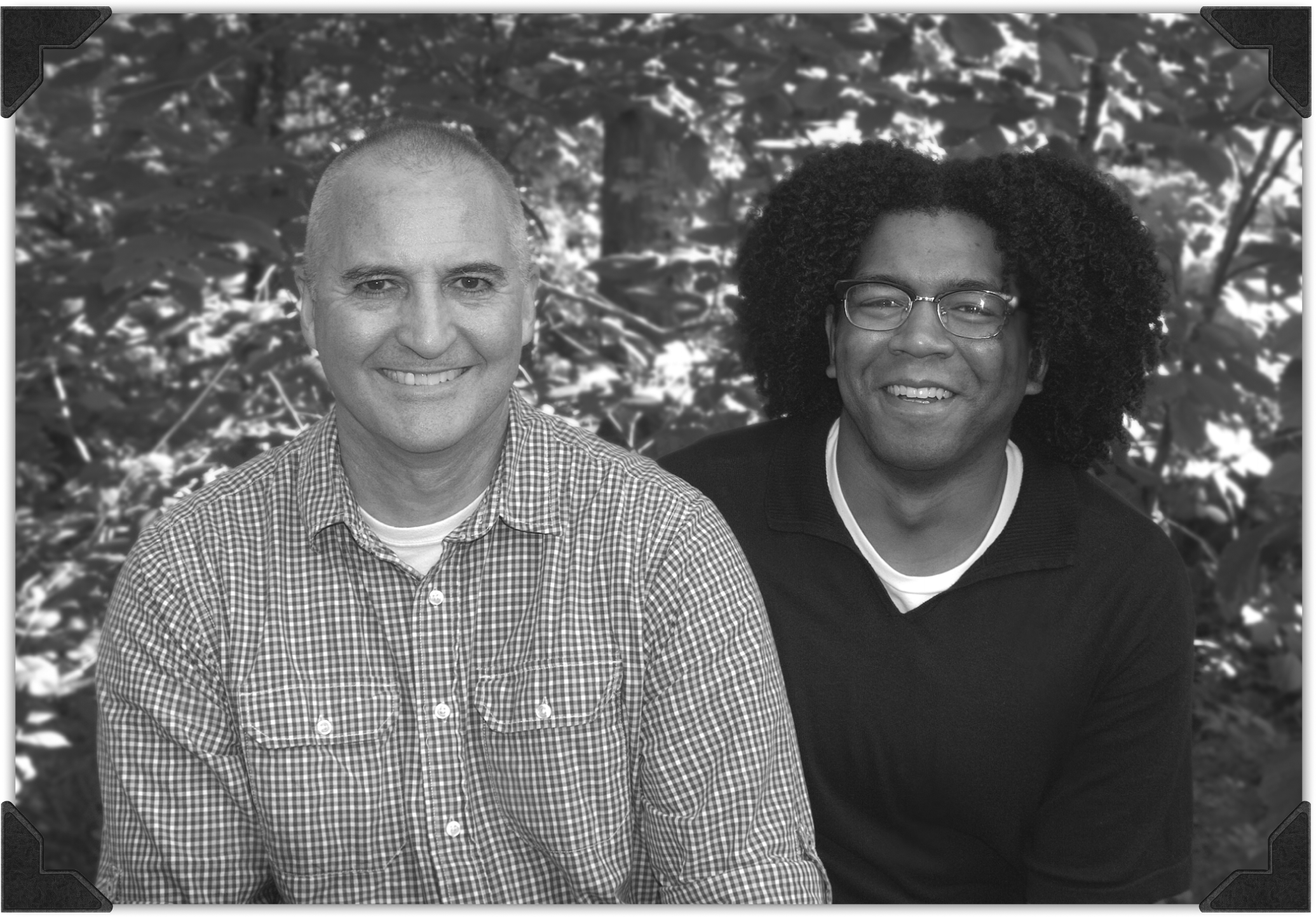
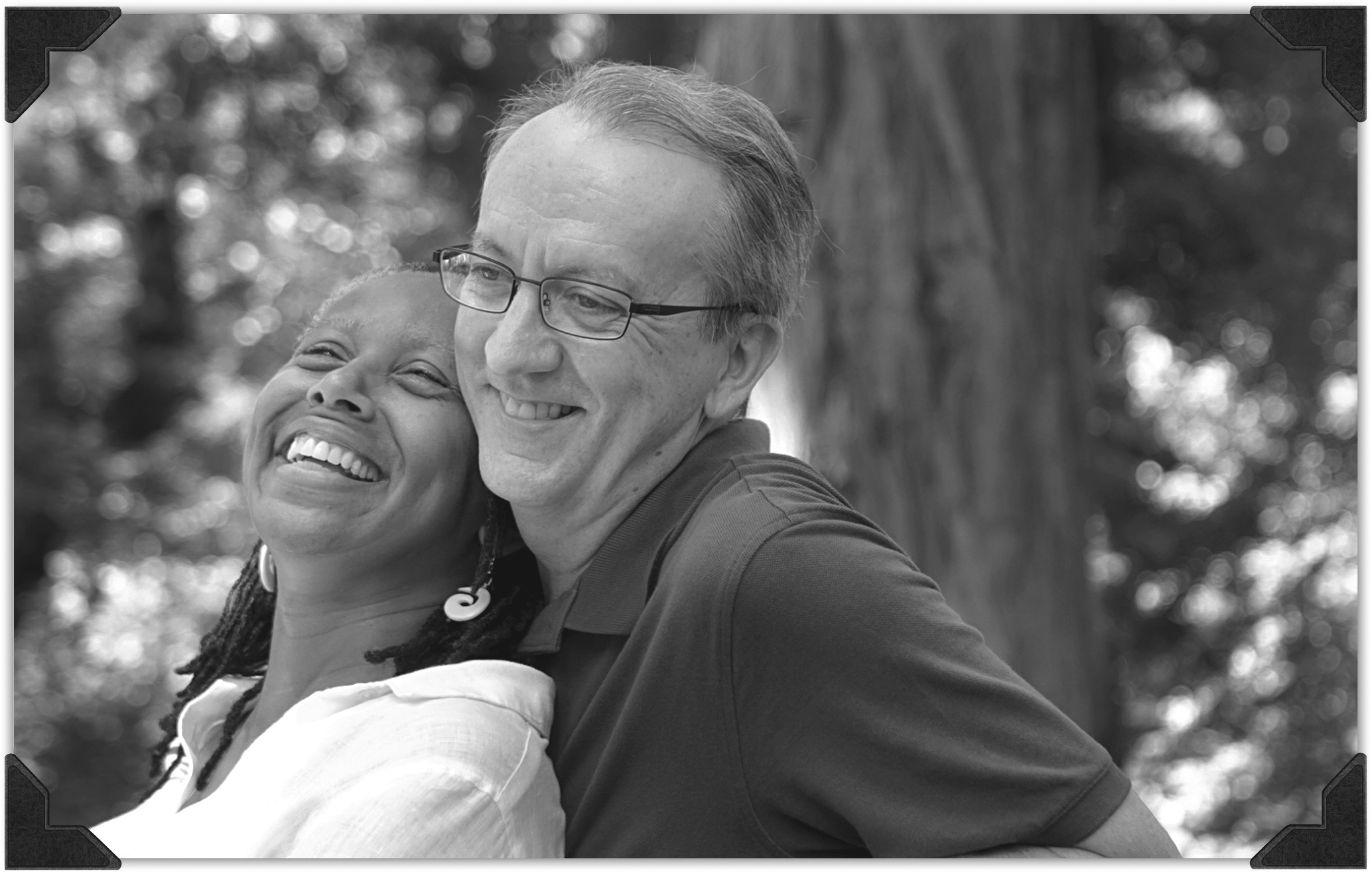
Jacqueline and Jonathan enjoying New York’s Central Park.
Carucha L. Meuse
“I think that people in interracial relationships give up something, you know, give up an ease about living, in some ways,” said Leslie Cobbs, a 30-something white woman, surrounded by novels, textbooks, and old photographs, in the Brooklyn apartment she shares with her black partner Sylvia Chabot.
Leslie acknowledges that African Americans have to “think about race all the time,” but insists that there are unique racial issues that stem from being in an interracial relationship.
Sylvia and Leslie face challenges that are usually less overt than those black/white couples would have confronted 50 years ago. There is little chance that they might lose their jobs, get kicked out of their church, or be denied housing simply because one of them is black and the other is white. While injustices like these still occur, when they do they are noteworthy. Undisguised discrimination against interracial couples is no longer typical. Nor do relationships like theirs inspire the raw disbelief that Sidney Poitier and Katharine Houghton famously elicited when they portrayed a young couple in the 1967 film, Guess Who’s Coming to Dinner.
Still, Sylvia says, “We’re always looking for spaces where we can be together as a couple, [be] validated, feel comfortable.” Compared to straight interracial pairs, same-sex partners like Sylvia and Leslie can count on far fewer legal protections, and also are vulnerable to homophobia from coworkers, family members, and strangers on the street.
Interracial couples in the United States have always attracted public scrutiny. Until the mid-twentieth century, this attention was almost entirely negative. Legal sanctions prevented people of African, Asian and, sometimes, Native American descent from marrying whites. Black/white relationships, especially those between white women and black men, drew the harshest condemnation. Black communities treated such couples as disreputable; white communities often threatened, physically harmed, or ostracized them.
In recent years, interracial couples are more likely to encounter hope than censure, at least in terms of public discourse. Some observers liken current legal prohibitions against same-sex marriage to anti-miscegenation laws before the 1967 Supreme Court ruling in Loving v. The State of Virginia. Social commentators paint contemporary interracial marriage as a victory for equality and freedom. A 2001 Time magazine article celebrated interracial unions as representing an intimate “vanguard” who “work on narrowing the divisions between groups in America, one couple at a time.”
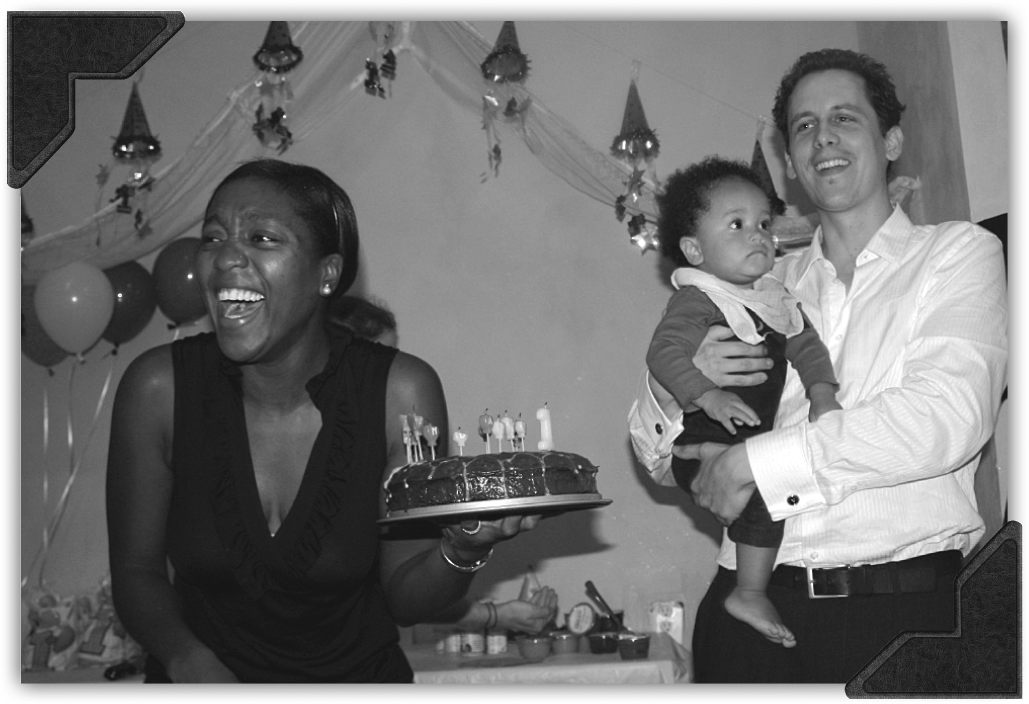
Maya and Vinz celebrating their son Parker’s fi rst birthday.
Aaron Yanes
More recently, a Pew Research Center report released in 2012 suggests a positive shift in public attitudes towards intermarriage. Forty-three percent of Americans now view the trend for more people of different races to marry each other as a change for the better. About two-thirds say it would be fine with them if a family member “married out” of their racial or ethnic group. Even black/white relationships, which have long elicited the fiercest disapproval and the strongest legal sanctions, are becoming more acceptable.
Hostility toward interracial couples, like racism itself, has become more subtle.
Despite the supposed acceptance of dating and marrying across racial lines, only a small percentage of people in the United States—according to the 2010 Census, less than 7 percent of all heterosexual married couples—actually do so. Among gay and lesbian couples, approximately 14 percent are interracial—about the same proportion as among heterosexual unmarried partners.
Low intermarriage rates notwithstanding, many people embrace the popular notion that Americans have truly become “colorblind.” But racism is more than just a matter of prejudice; liberalizing racial attitudes coexist with the stubborn persistence of racism. For the past 12 years, I have studied couples who love across racial difference in Philadelphia, New York, and Washington, D.C. What I’ve found is that while hostility toward interracial pairs, like racism itself, has become more subtle, race continues to powerfully impact everyday life for Sylvia, Leslie, and the other 39 interracial couples I interviewed. Racism, manifested in neighborhood segregation and racial self-understandings, shapes everyday life, creeping up in the most ordinary circumstances, like walking through their neighborhood, or deciding where to get a drink.
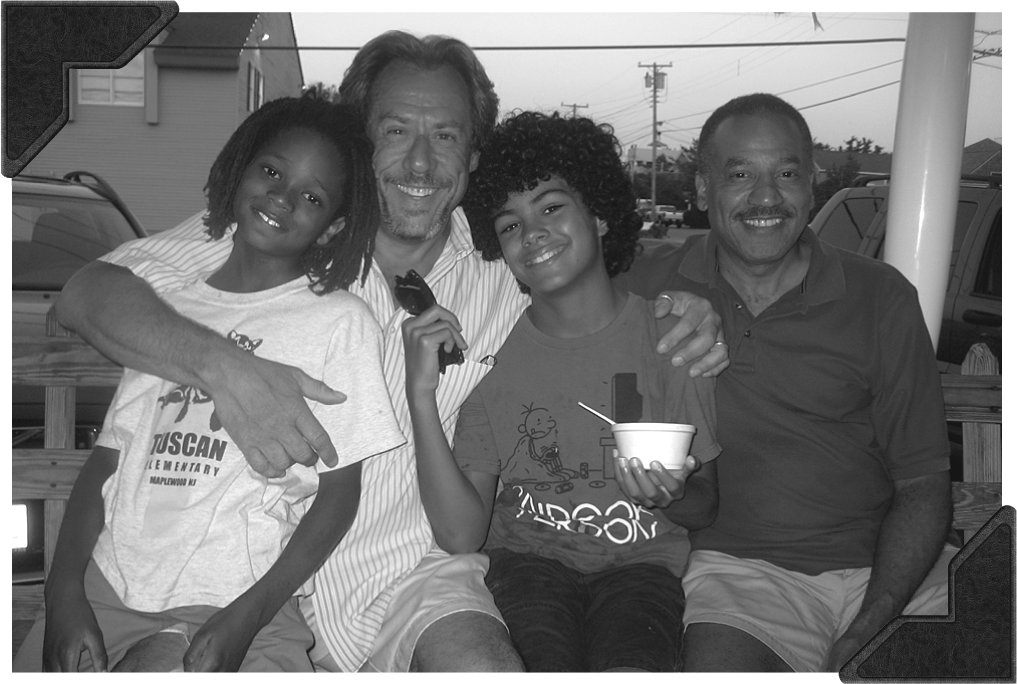
(From left to right) Jordan, Robert, Ben, and John during a summer visit to the Jersey shore.
Norman Rosenberg
Raced Spaces
Mary Chambers, a heterosexual woman of Afro-Caribbean descent, knew that her husband Neil was sometimes uncomfortable in their middle-class, majority-black neighborhood. The neighborhood, which includes many sprawling, three-story, Tudor houses, feels suburban, though it is located in a small city less than 30 miles from Manhattan. Mary thinks that Neil “would prefer to live in a community where he’s more comfortable with the people, in a community where he can look around and see his own race. [One] with more white people.” She finds this discouraging. “I wish that I could change his perspective on it and really make him see that the community we live in is valuable.”
In the years Neil spent in this neighborhood, he became very aware of his own whiteness. It was impossible for him not to think about race in everyday social interactions. It was typical, he says, to go into the grocery store or the post office and be “the only white guy there.” He continues, “It’s not a bad thing, you know. It’s not like I feel like I’m going to get mugged or, um, I’m going to get hurt. But you have to understand, it’s kind of like when you deal with white people, they have their prejudice—they have what they’re used to. And then when you deal with black people, it’s really the same thing, you know?”
The residential racial segregation of blacks and whites has been slowly declining nationwide. But in northeastern cities like New York and Philadelphia, highly segregated neighborhoods remain the norm. (In New York, the racial composition of neighborhoods is so lopsided that 79 percent of blacks would have to move in order to achieve a balanced distribution—in which the percentage of blacks in every neighborhood mirrors their share of the city’s total population.)
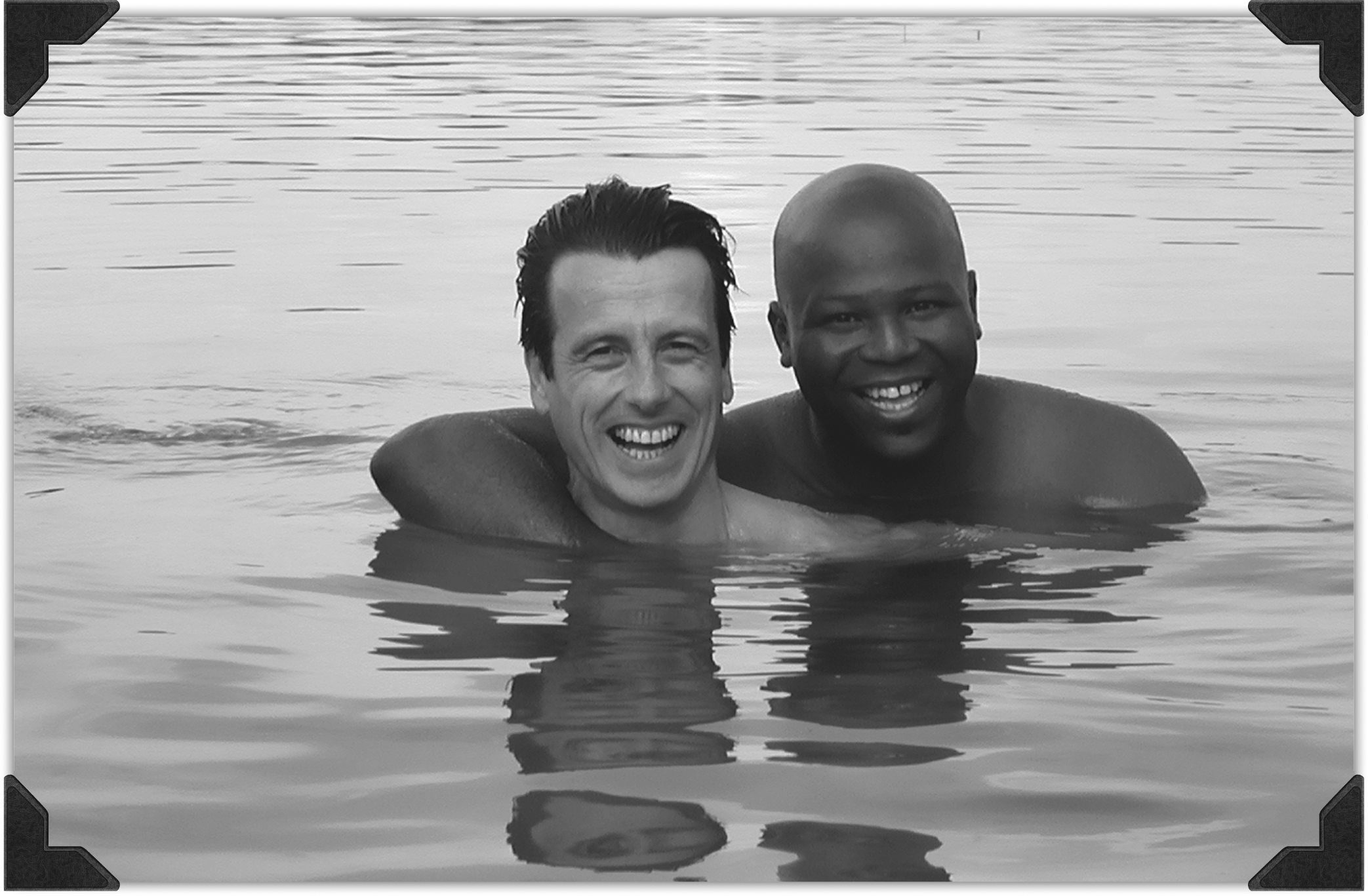
Tilman (left) and Lee vacationing in Germany.
Lars B.
Neighborhoods that are black or white often pose problems for interracial couples because they set the stage for situations in which one partner feels uncomfortable or conspicuous. “No matter where we live,” one white woman lamented, “one of us is not going to be in the right neighborhood.” A black partner agreed, “As diverse as [New York] city is, to me it’s still pretty segregated.” This sense of belonging or not belonging is something interracial partners often brought up as we talked.
Neighborhood divisions are stressful when one partner feels conspicuous and has to look out for racial undercurrents in everyday social interactions. Such divisions create racial fatigue, though they affect black and white partners differently. For Neil Chambers and other whites in my study, being in the racial minority feels awkward because it happens so rarely. Noticing one’s own whiteness is a new experience that can prompt an unsettled feeling. One of the taken-for-granted privileges of being white is the tendency to think of yourself not as a white person—just as a person. I asked one white woman who is married to a black man how often she thinks of herself as white. “I don’t,” she said. “Well, maybe if I were in an all-black environment, and I’m the only white person there. That’s the only time.”
Black interracial partners also noticed when they were among only a handful of blacks in a neighborhood or social gathering. But for these middle-class Americans, that experience was not uncommon. Many worked or had gone to school in majority-white environments. Compared to the whites in my study, black partners tended to be much more accustomed to being in the numerical minority. In contrast to the unease of white partners, who sometimes felt intimidated in black neighborhoods, the discomfort of black partners was linked to a history of violence against their racial group. It was one of many instances in which black and white partners perceived race very differently.
Neighborhood divisions are stressful when one partner feels conspicuous and has to look out for racial undercurrents in everyday social interactions.
Racial Orientations
Tamara is white, and Scott is black. When this 30-something unmarried straight couple decided to move in together, they needed to transport countless boxes of books and clothes from Tamara’s place in Philadelphia to a nearby city. Tamara wanted Scott to drive the SUV she had borrowed from a friend. But like many other black men in the United States, Scott was concerned about racial profiling. He didn’t want to get pulled over driving a borrowed car, especially given that his cell phone wasn’t working properly.
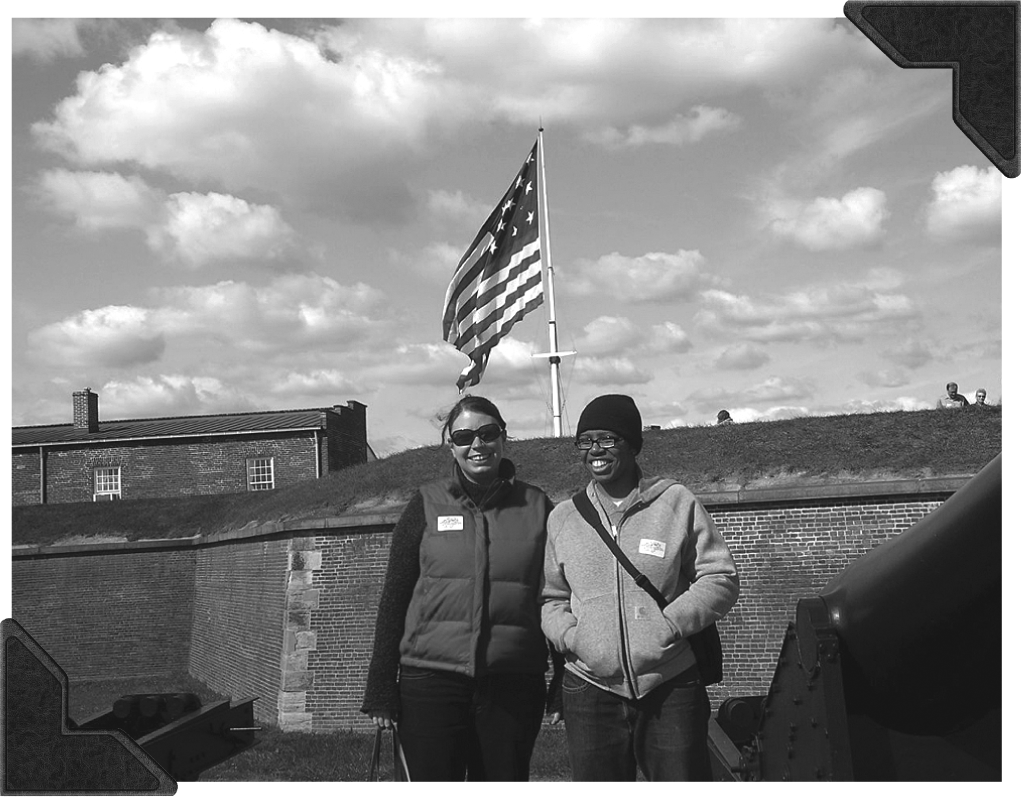
Kate (left) and Courtney on a trip to Fort McHenry in Baltimore.
Annabelle Irey
Scott recalls telling Tamara, “‘I’d really rather you drive…because when—if [I] get pulled over… I can’t dial [the woman who owns the car]. Now it’s just me and some cop and he’s probably going to treat you better than he’s going to treat me.’” For Scott, this was a routine calculation. For Tamara, it didn’t seem like a big deal. This reflects a broader disjuncture in how—and how often—each of them thinks about race. Scott, continuing the story of the move, tells me, “It’s my job to consider that, whereas…I don’t think [me getting pulled over] is automatically something that she considers—and you know what? It doesn’t bother me that it isn’t, because how could it be? Someone [who is] Black can really, really think, like could have their mind go to that.”
The prejudice interracial couples encounter from strangers is only one small part of how race shapes their everyday lives.
For Scott, anticipating everyday acts of prejudice and discrimination is second nature, ever since his grandmother told him about the lynching of Emmett Till. But Tamara, whose whiteness has shielded her from being the target of racial animus, is only now learning to consider how the accumulation of a lifetime of racial experiences informs even small decisions, like who will drive an SUV full of books and clothes 30 minutes away.
Daniel, who is black, and Shawn, who is white, thought their racial orientations were very similar until they became the adoptive parents of two black boys. When Daniel and Shawn began to talk about their sons’ future schooling, they soon discovered that they conceptualize racism differently. “We both share the same basic political views,” Shawn explained. But Daniel, he believed, “subscribes to a kind of conspiracy theory that white America has banded together to exclude black America.” Shawn sees the racism, he says, but “I don’t see it as being organized in the same way. Because I’m white and nobody ever came to me and said, ‘Hey, lets get together and do this thing to the black people.’ So that’s a difference of philosophy.” Daniel sees “[racism] as institutionalized and I see it just as kind of widespread.”
Daniel and Shawn’s perspectives lead to important differences in dealing with racism. While Shawn has no intention of letting his sons get hurt, he is more comfortable taking a wait-and-see approach. Daniel feels more strongly about the need to be pro-active about racial discrimination at school. ”I’m not looking for trouble,” says Daniel. It’s just that “I don’t want to be asleep when that stuff happens.”
For Daniel, there are limits to what a white person can understand about discrimination. Shawn, he says, “doesn’t expect that kind of behavior and it’s hard [for him] to believe that in fact that can happen.” He “just doesn’t believe that a teacher would look at an eight-year-old and actually treat one eight-year-old differently from another simply because of the color of their skin.” While both men are deeply invested in protecting their sons from racism, their conflicting racial orientations to the subject remain unresolved.
Shawn’s strategies for parenting black sons and Tamara’s skepticism about racial profiling reflect the attitudes of many white Americans who question the scope and severity of contemporary racism. Surprisingly, white partners’ intimacy with black people did not substantially challenge their racial perspectives, casting doubt on the notion that interracial partners represent an enlightened, “post-racial” vanguard.
Stereotypes—and Exceptions
Gary, 54 and his wife Soonja, 58, met in Korea. They have been married for 20 years. Gary chose to marry a Korean woman because, he said, a “good” wife should be loyal and subservient, and to him, Soonja’s race signifies these traits. Soonja, too, believes that her choice of husband may reflect upon the kind of person she is. She chafes at being associated with what Koreans regard as stereotypical “international marriages,” temporary sexual relationships between local, uneducated Korean women and American military men.
Gary’s whiteness and American citizenship did not hold any special appeal for Soonja or her family. But over time, part of what has made their marriage work is that Soonja believes there are distinct cultural differences that make American husbands better partners than Korean husbands. “I’m glad that I didn’t marry a Korean, who ignores his wife, drinks a lot, and comes home late.” Gary confides that many of his friends “actually say that they envy me because they understand that Asian women are very good wives and…good mothers.”
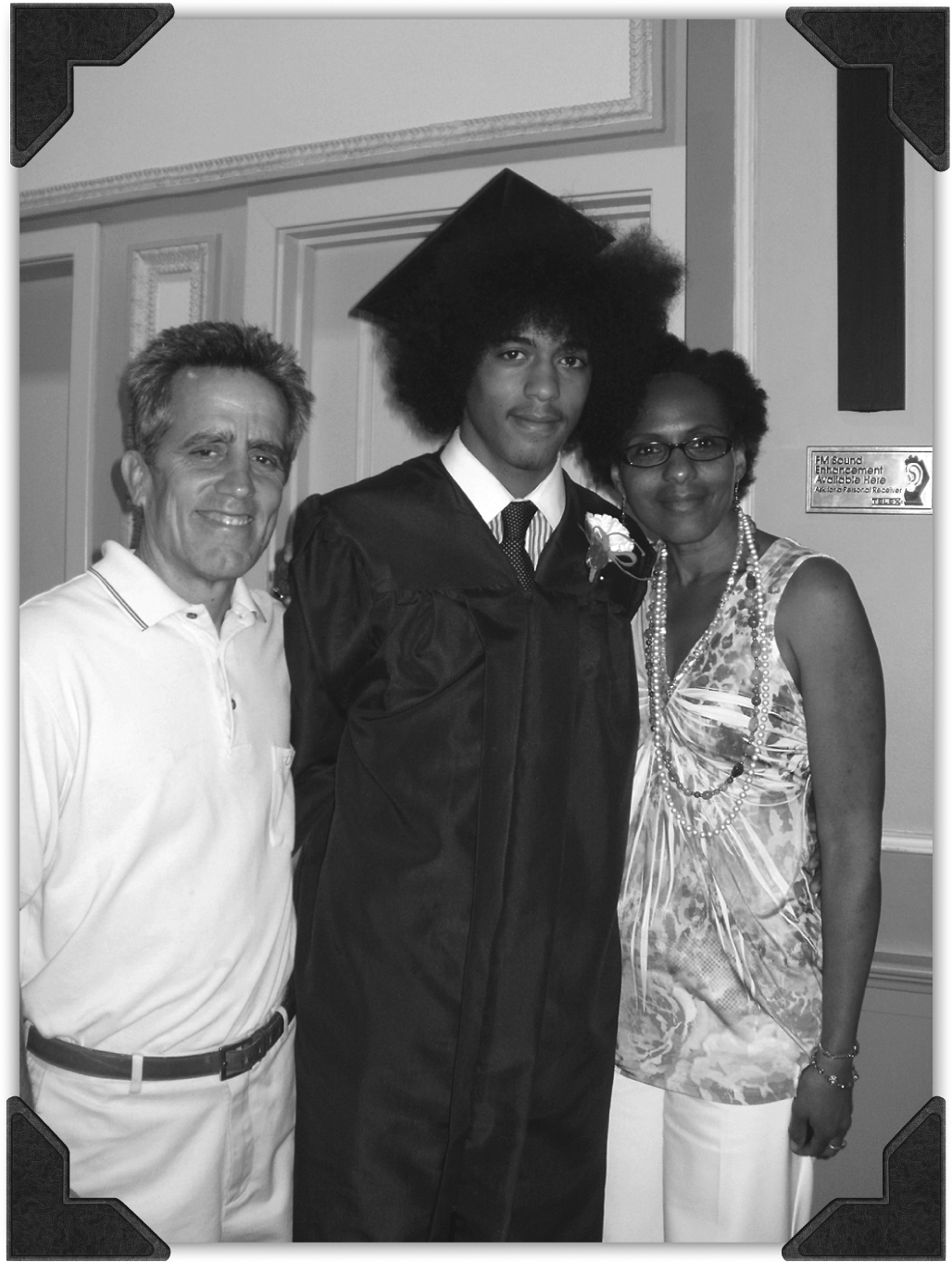
Greg and Lillian at their son Beau’s high school graduation.
Caré Paulmier
Sociologist Kumiko Nemoto has researched marriages between whites and Asians in the United States. White men, according to Nemoto, commonly associate Asian and Asian American women with family and domesticity. Younger Asian women in interracial relationships, she found, are more likely to define themselves as egalitarian, ambitious, and aesthetically (as opposed to domestically) feminine, challenging these stereotypes.
Vivian, 25, who grew up in a Chinese family is attracted to Peter, 27, in part because she sees them as equals. He is intelligent, got good grades in college, and is economically mobile. “We have a mental connection,” she says. Peter’s professional ambitions and work ethic help Vivian think of herself as a modern Asian American woman. Peter, for his part, is proud to appreciate beauty that falls outside of normative white femininity: “[I’m] more attracted to ideas and people who are more exotic…I think Asian features are prettier than white features.” He likes “darker-skinned women” and the “shapes of Asian eyes.”
In the U.S. racial order, particular Asian groups (such as Japanese and Chinese) are positioned much closer to whites than blacks. Asian Americans certainly experience racial discrimination and the false presumptions embedded within the idea of the “model minority.” Even so, some Asian groups are increasingly seen as what sociologist Eduardo Bonilla-Silva calls “honorary Whites.” As the 2010 Census shows, intermarriages between Asian Americans and whites are far more common than those between blacks and whites.
Couples in my study also used racial-gender stereotypes about their partners to describe themselves. Still, some whites were careful to portray their partner as exceptional, rather than a typical example of their racial group. As Neil said of Mary, who is of African American descent: “She’s not someone who would curse or, you know, say anything that’s inappropriate or off color. Not that she’s a saint but—she has a certain background—she’s not offensive to you. She’s very pleasant.”
What this and other examples suggest is that the prejudice interracial couples encounter from strangers is only one small part of how race shapes their everyday lives. Race is a social system that shapes neighborhoods, orientations, and identities, and plays a critical role in intimate relationships. Despite the gains of the Civil Rights movement and the historic election of the first black president, the racial categories we are assigned to at birth have tremendous material consequences for how our lives unfold. Racial inequalities affect the wealth which we have access to, the neighborhoods we live in, the type and amount of the healthcare we are able to get, and the quality of our children’s schools. Even in this supposed post-racial moment, our position in the racial system shapes the way we see the world.