



Abstract
U.S. multiracial families are paradoxically regarded as representatives of a post-racial ideal and as anomalies that challenge assumptions. Here, Black-White couples discuss the pressures they feel to “perform” family when facing racial surveillance and erasure.
iStockPhoto.com // Wirestock

“People are intentionally missing very obvious cues that we are a family,” said Brittany, a 32-year-old Black mom. She cited an ordinary trip to the pet store in which the family experienced erasure and people missed those “very obvious cues.”
Huddled together around a fish tank, Brittany, Dominic, and their two children waited for assistance in picking out a new addition to the family. But what should have been a typical, fun, family outing quickly became an uncomfortable encounter when an employee assumed that Dominic, a White man, wasn’t with Brittany and their 3-year-old multiracial Black-White son, Jay, and his 12-year-old stepdaughter, Rose.
Looking to Brittany, the White staff member said, “I see that he was first in line and then we’ll get to you in a second. Let me just get some more help.” In turn, Rose asked her mom why the person assumed they weren’t together—that they weren’t a family.
For many interracial couples and multiracial families, these experiences are unfortunately common. Because, in the United States, the typical understanding of family is heavily influenced by a “traditional” model rooted in Whiteness and heteronormativity (think White monoracial nuclear family with mom, dad, and two kids), multiracial families often have their biological and familial relationships questioned, especially when the parents and children don’t resemble one another.
Despite claims that we’re now a post-racial society, Black-White multiracial families routinely experience racial surveillance and erasure. I use that term, racial surveillance, to describe direct encounters with authority-type figures, like TSA agents who might question a parent’s biological relation to their multiracial child when traveling. These encounters can be threatening and even lead to legal repercussions if the family isn’t prepared to prove their relations. I use the second term, racial erasure, to refer to everyday interactions that make multiracial families feel as if they’re uncommon or abnormal, such as Dominic and Brittany’s experience at the pet store. In a sense, racial surveillance makes multiracial families feel hypervisible, whereas erasure makes them feel invisible.
Despite claims that we’re now a post-racial society, Black-White multiracial families routinely experience racial surveillance and erasure.
They must navigate this paradox and “perform” family in ways that make their romantic, biological, and/or legal relationships more obvious to those around them. Many of these families are well aware of the painstaking preparations they take to avoid unnecessary questions and encounters with authority figures due to racial surveillance. Others question whether and how they should adjust their behaviors and perform family when they experience erasure, or behavior that delegitimizes their family structure. Utilizing Erving Goffman’s concept of dramaturgy, in this article, I describe some of the actions multiracial families take to prove their legitimate relationships and how they adjust/question their behaviors in public settings, the front stage.
Modern Family?
The population of people who self-identify as two or more races is rising quickly in the United States. Many within this population identify as multiracial. In fact, the U.S. Census Bureau reports that there was a 276% increase in those self-identifying as two or more races between 2010 and 2020, and a third of those self-identifying as multiracial in 2020 were under 18 years old. Research shows that Americans tend to see this steep increase in the multiracial population, coupled with their young age, as an indication that the United States has entered a post-racial era in which race no longer matters.
Although it is true that Americans are typically more open to dating and marrying outside of their race today, it is also key that this is a recent shift. Interracial marriages were only legalized in all states in 1967 with the landmark Loving v. Virginia Supreme Court ruling. And regardless of the ruling, interracial couples have historically been ostracized and met with violence. This is particularly true for interracial relationships between White women and Black men.
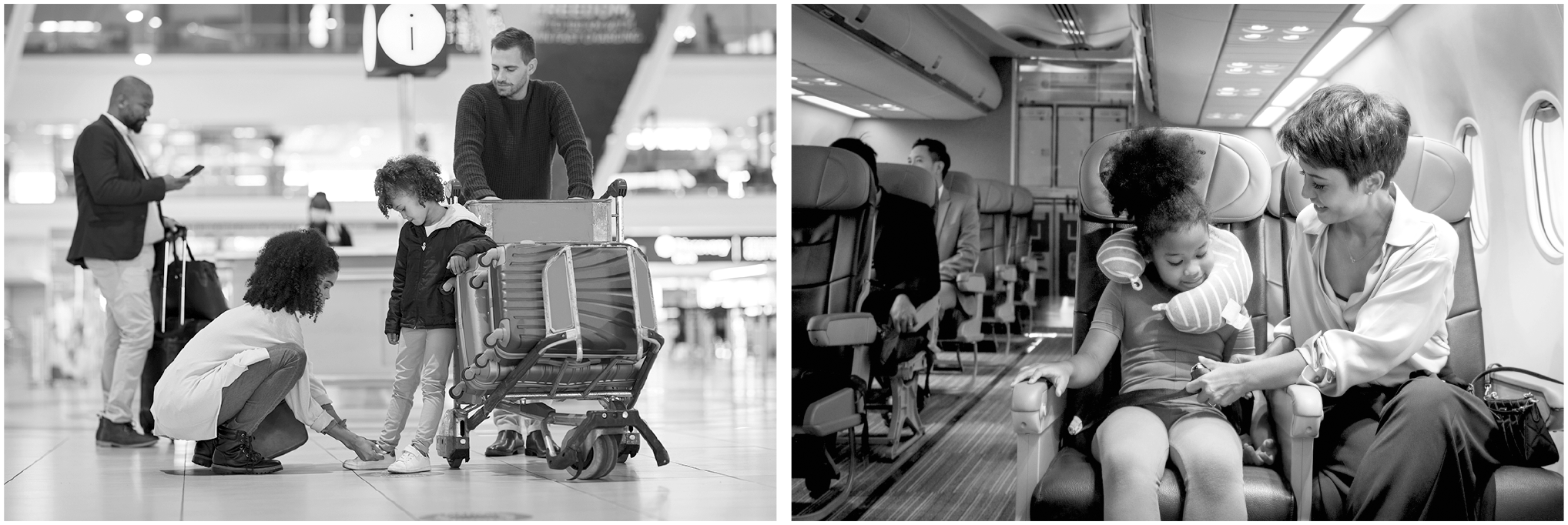
The stress of travel is amplified for mixed-race families, who often contend with racial surveillance.
iStockPhoto.com // Jacob Wackerhausen
Furthermore, it wasn’t until the 2000 Census that people could claim two or more races. Clearly, multiracial people have existed in the United States for more than the last 20+ years. The recency of this change is indicative of the legacy of this country’s violent history of chattel slavery and White men’s sexual violence and assaults of Black enslaved women. Under chattel slavery, the children Black women gave birth to were considered property, and because of the “one drop rule,” these children were considered Black regardless of their biological father’s race. (The “one-drop rule” is an example of scientific racism, which enforced the belief that even “one drop” of “Black blood,” or one Black ancestor, classified someone as Black.)
This long, violent history and more recent taboo nature surrounding consensual interracial relationships has contributed to the racial surveillance and erasure that couples and their children experience today. Despite increasing representations of multiracial families and children in shows, movies, and advertisements, they are still hypervisible in society because multiracial family structures have yet to become normalized.
As such, they have learned to perform family by modifying their public behaviors in response to racial surveillance and erasure. Using Goffman’s dramaturgical theory, I analyze situations in which families alter their front-stage performances. According to Goffman, social interactions are a kind of performance. People are actors who perform various roles in the front stage, where their audience is, as a form of impression management. Front-stage performances are controlled and tailored to leave the audience with a certain perception of an individual. The backstage, where an individual is without an audience to influence, may be likened to their everyday or true self.
In the case of Black-White multiracial families, they may choose to perform or “play up” their familial bonds in the front stage by talking loudly about family things or wearing the same color shirt at the airport to signal that they are a family unit. Whereas in the backstage, the comfort of their own home, you would not find all family members wearing matching vacation shirts. These are very real experiences for multiracial families who routinely alter their performances and presentations of self.
The findings in this essay are part of a larger project with 19 sets of U.S. interracial parents. I conducted in-depth, semi-structured interviews with 8 sets of interracially married Black-White couples. Half of the dyads consisted of Black moms and White dads, and the other half consisted of Black dads and White moms. I requested that both biological parents participate in the interviews to better understand family experiences by race and gender. All participants identified as cisgender men and cisgender women and the sample was predominantly heterosexual, except for two women who identified as bisexual or queer/pansexual. Overall, the families were highly educated and middle-class, with an average annual household income of $140,000. The families represented multiple regions of the United States, with states including North Carolina, Florida, Pennsylvania, Michigan, and Colorado. All participant names used in this essay are pseudonyms.
Experiences of Racial Surveillance
Dominic, a White dad, and Brittany, a Black mom, the parents introduced at the beginning of this essay, were perhaps the most cognizant of my participants when it came to changing their behavior in public settings. For Dominic, this was particularly true when he was out with his Black preteen stepdaughter, Rose. Strangers sometimes assumed an inappropriate relationship between the two, based on their race and age differences.
“So, like when we enter a public space, I’ll raise my voice and talk about things that a parent would talk about… or I’ll reference her mom or something like that…. I just want to avoid the stupidity of those assumptions, enforce kind of verbally and/or visually that concept when I enter a public space in order to interrupt or disrupt or prevent any of that stupid stuff from happening or those assumptions from happening,” Dominic explained.
In fact, these assumptions aren’t uncommon for multiracial families. In a 2018 Sociological Perspectives article, scholars Chandra D. L. Waring and Samit D. Bordoloi found that instead of assuming a parent/child relationship, multiracial children were often mistaken as the romantic partner of their monoracial parent, despite the age gap.
Brittany elaborated on how the family adjusted their behavior in the front stage when traveling by wearing the same mustard yellow-colored shirts. “We’ve had situations before where someone thought our son was lost and they tried to help him. Dom had to be like, ‘No, that’s my son.’ I don’t know if it’s helpful or not, but… we’ll just wear the same color because maybe you’ll see us as a family.”
Like Brittany and Dominic, not being recognized as one family unit is a source of anxiety when traveling for many multiracial families. Some may experience racial surveillance and profiling by TSA agents and airline staff. In many cases, multiracial families are asked to provide additional forms of identification to prove biological and legal relationships, simply because they don’t all resemble one another. This was the case for Shavonne, a 36-year-old Black woman traveling alone with her 3-year-old Black-White daughter, Simone.
Shavonne described calling the airline ahead of time to ask about any required documentation for her daughter, who would be sitting on her lap. She was told there was none but was questioned upon arriving at the airport with her daughter. Shavonne said it wasn’t a great feeling to have to prove that Simone was in fact her daughter. Interestingly, Shavonne described a very different experience when traveling with Blake, her 39-year-old White husband and Simone’s father.
“Blake went up to the counter and I was just standing in the back with our bags, and he went up there with Simone and they never asked him any questions about Simone. Like, ‘Is this child with you? Do you have her birth certificate?’ They didn’t have any of those questions. It was just assumed that here’s a responsible father with his child, and those experiences are very different,” she said.
The difference in their treatment, especially the assumption that he’s a responsible father, demonstrates Blake’s White privilege. Although performing a basic task, he might even be admired for being an active caregiver based on gendered expectations of parental roles. Shavonne’s experience, on the other hand, is an example of gendered racism, in which she was treated as an incompetent mother for not having documentation. Had the staff truly questioned Simone’s biological relation to Shavonne, she might have been treated as a criminal.
Fiona, a 42-year-old White mom, is married to Miles, a 46-year-old Black dad. They are parents to two multiracial Black-White daughters. Fiona didn’t recall explicit experiences when strangers questioned the family but did take preemptive actions herself to avoid this.
“One of my thought processes when I decided to change my [last] name was that when we were traveling with our passports that we could hand them over and say, ‘We are all Carpenters,’ and not have to have that discussion,” she said as an example.
In this case, Fiona is performing family by sharing the same last name as her spouse and children. Historically, the tradition of women adopting their husband’s last name after marriage is rooted in patriarchal norms. This tradition is a form of performative labor that women are disproportionately tasked with to indicate the formation of a new family. As a woman and member of a multiracial family, Fiona likely felt added pressure to change her last name so there was no question of her relationship to her spouse and children.
Experiences of Erasure
Although Black-White multiracial families frequently experience racial surveillance because of their racial differences, which make them hypervisible, they also paradoxically experience erasure, in which their romantic and familial relationships are made to seem unusual. In response, some “play up” their relationships while some are still learning how to perform in response to what are typically very public, at times embarrassing, displays.
Angela, a 34-year-old Black woman, is married to Chris, a 35-year-old White man. The couple share two biological Black-White children, ages 13 and 10, and have an adult White daughter who they describe as “unofficially adopted.” Angela knows that the group draws attention in public.
“When we’re all… together, I don’t know what they have going on in their heads, because they’re just probably like, this is a hodgepodge type of situation…. I know we just have their minds all up in a bunch,” she said. Here, Angela acknowledges that it’s common for her family to be perceived as a “hodgepodge,” not only because they’re multiracial but because of their chosen family member, their adoptive White daughter.
A simple errand can feel fraught when others fail to recognize mixed-race families as families.
iStockPhoto.com // DGL Images

Angela and Chris are an affectionate couple, yet some people still don’t recognize that they’re married. “I will say to this day, we can be holding hands, kissy-face in a restaurant, and they will still ask us if we’re together or if it’s one check or two or whatever. And I’m like, rings, kissy-face, like, I don’t…. We’ve been coming here for 15 years, right? Like, you would think that they would assume we were together…,” Angela commented.
These experiences are clearly frustrating for the couple, as they believe they’re providing obvious cues through their wedding rings and public displays of affection. Because they’re regulars, the questions and actions of restaurant staff could in fact be microaggressions or outright racial hostility. Their experiences could also be compounded by living in the South, where Whites frequently—and recently—inflicted violence upon interracial couples and even murdered Black boys and men.
Members of multiracial families also commonly experience surprise or shock from others, like colleagues, when sharing family photos. They don’t know how to react or perform family based on these reactions. Shavonne, introduced earlier, is part of a group for Black moms with multiracial children and finds comfort in learning how others navigate this shared experience. She clearly notices how people react to pictures of her kids without knowing her husband is White, but is still figuring out how or if she should respond to assumptions of what constitutes a family.
Leigh, a 45-year-old White woman, is married to Ellison, a 49-year-old Black man. They have three teenagers together. She frequently tells people she has two daughters and a son but doesn’t specify that her husband is Black. Because many still conceptualize families as monoracial, people probably assume Leigh is married to a White man.
“When I show pictures of my family to people that don’t know me, they’re always very surprised…. I always wait for it,” explained Leigh. “It’s just, they have no idea…. Am I supposed to act a certain way or dress a certain way, or am I supposed to, you know, announce it to everybody that I have a biracial family? So that’s different because I don’t think that families that are not interracial, they don’t have that. There’s not the whole shock value to showing pictures or anything like that.”
“Am I supposed to act a certain way or dress a certain way, or am I supposed to, you know, announce it to everybody that I have a biracial family?”
Even though Leigh has come to expect this reaction from people unfamiliar with her family, she’s still fazed in a sense and doesn’t know if she should adjust her behaviors to accommodate others. For example, does performing family mean explicitly stating their racial makeup to avoid awkward encounters? Or is performing family going about her everyday life and ignoring actions that serve to “other” multiracial families? As Leigh makes clear, this form of erasure is likely not experienced by monoracial, heterosexual families.
Playing to the Crowd
Due to their (in)visible status and experiences of racial surveillance and erasure, multiracial families change their behaviors and mannerisms in front-stage settings. Some play up their family dynamics for front-stage audiences to ensure that they’re viewed as a family unit, while others question how they should perform in scenarios where their family structures are made to seem abnormal. Either way, the need to change front-stage family dynamics signals two things: interracial couples and multiracial families are still considered anomalous, and for this reason and many others, the United States is not in a post-racial era. Society is still infused with very stereotypical assumptions, influenced by heteronormativity and the color line, of what constitutes a family.
The need to change front-stage family dynamics signals two things: interracial couples and multiracial families are still considered anomalous, and for this reason and many others, the United States is not in a post-racial era.
iStockPhoto.com // Olga Yefimova
Although the findings discussed here are limited to the experiences of Black-White multiracial families, data from the larger project indicates that White-Asian and Black-Asian families are also subjected to the binds of hypervisibility and invisibility. Of course, the experiences of these families are informed by a different historical context and sociopolitical climate than that of Black-White families. The hypervisibility and invisibility of Asian multiracial families may be informed by perceptions of immigration, histories of U.S. military presence in one’s home country, and stereotypical depictions of Asian men and women in popular media. For example, Asian men are typically depicted as nerdy and more feminine, making them less desirable as romantic partners, whereas Asian women are depicted as exotic and submissive, making them more desirable. These stereotypes influence how we imagine couples to be, thus making some couplings and family formations hypervisible or invisible in the real world. This is perhaps best highlighted by the invisibility felt by White and Black women partnered with Asian men, because they are frequently perceived to not be a couple or a family, despite their front-stage performances.
The shared experiences of multiracial families demonstrate Americans’ (particularly White Americans’) limited understandings of family despite the penchant for colorblindness and legislation from the last 50+ years that supports more diverse family structures. This essay offers just a glimpse into how families at the margins, like multiracial families, must alter their behavior to appease (White) audiences.
In fact, the stories of these families tell us a great deal more about the audience they’re performing for than about the actors themselves. In this case, any public setting is a front stage, even if the families aren’t directly interacting with others. Multiracial families and people of color are constantly tasked with impression management to receive a less racially hostile reception from White audiences. Because these families didn’t experience explicit racism per se, such as in the form of racial slurs, it’s easy for those who believe race no longer matters in our society to minimize their experiences. However, all of the interactions they shared with me were racially charged and influenced their front-stage behavior. In an ideal world, perhaps the audience, rather than the performance, would change.