




Abstract
Sociologist Brian J. McCabe explains how homeowners are often more involved in their neighborhoods, but their participation doesn’t always make for stronger communities.
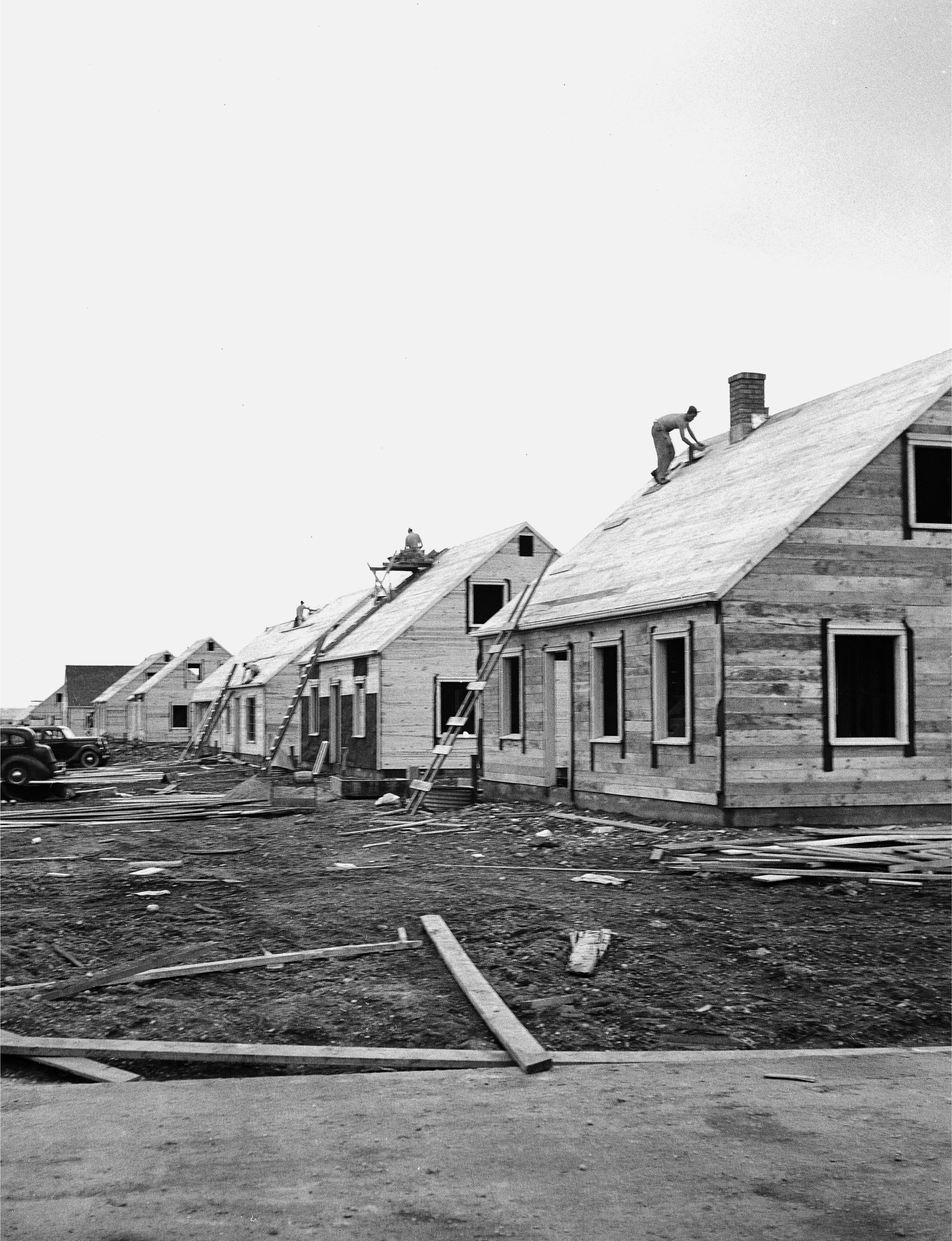
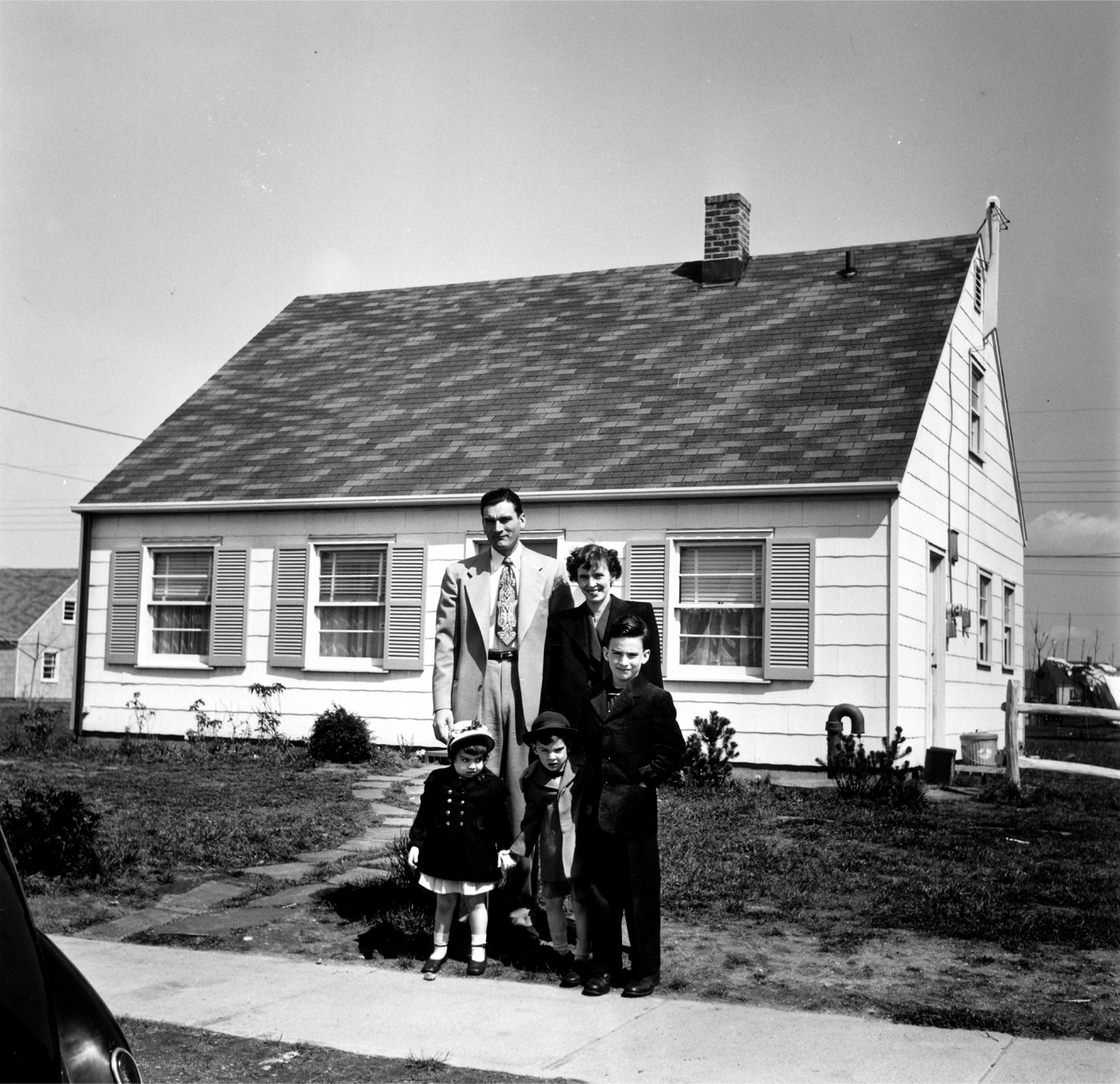
<< While many suburbs, such as Levittown, were founded to provide low-cost housing, today’s suburbanites are often wary of affordable housing projects.
Time & Life Pictures/Getty Images
Residents of Winnetka, an affluent Chicago suburb on the northern shores of Lake Michigan, recently debated a proposal to construct affordable housing in their community. Responding to a state law mandating affordable housing, local officials proposed to create a land trust that would increase the supply of housing available to low- and middle-income families.
The plan provided rental housing for households earning $45,000 annually—somewhere just below the median household income in America, but far below that of Winnetka’s median income of over $200,000. Homeownership units were to be marketed to families earning between $75,000 and $105,000. Teachers, policemen, and shop owners would have the chance to live in the community where they work.
Opposition to the plan was swift and fierce. A loosely organized group of community residents calling themselves the Winnetka Homeowners Association led the charge against the land trust. The group distributed a 25-page publication to village residents that hammered home its opposition and raised the specter of higher crime and lower property values.
“I developed and managed affordable housing,” wrote one resident, and “it brings crime, vandalism and loss of property values to the community.” Another homeowner, drawing upon her experience living in mixed-income housing in Chicago, argued that affordable housing would change the social composition of their town, bringing “the crack head that is the father of one of their six kids, the boyfriend who just got out of jail and needs a place to crash, or his cell mate that got out early and needs a place to stay, and the cousin who’s on house arrest for a sex crime.” One opponent called the affordable housing plan an “un-American, untested and unconstitutional vision of housing utopia.”
Summing up the position of the Winnetka Homeowners Association, Carry Buck, the president of the group, assured a reporter from the Chicago Tribune, “There is plenty of affordable housing in neighboring communities.”
On first glance, the story of the Winnetka Homeowners Association seems like a classic example of “Not in My Backyard” activism. This activism unites diverse groups of actors, including homeowners and renters, who share quality of life concerns. Citizens often join groups and launch protests to stop proposed developments in their neighborhoods, with homeowners frequently leading the charge against neighborhood change.
But the conflict over affordable housing in Winnetka went beyond NIMBY politics. Homeowners took an outsized role in the community, influencing decisions about affordable housing. While we tend to believe that community participation strengthens neighborhoods, creates community bonds, and engenders social trust, that isn’t necessarily true when participation stems from the narrow, self-interested drive to protect property values, as this conflict showed.
Beyond Nimbyism
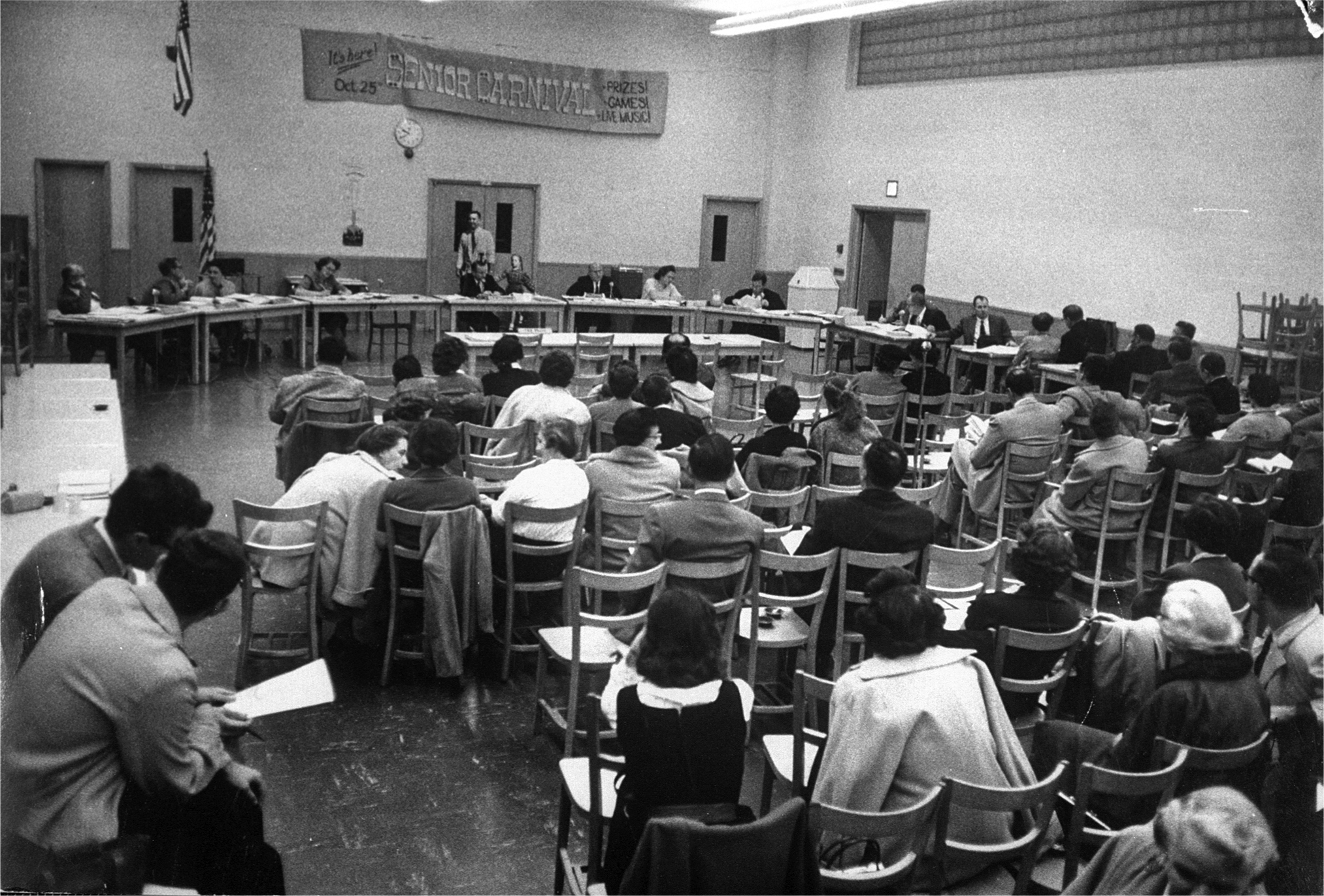
The debate about affordable housing engaged hundreds of Winnetka residents in public deliberations about the future of their community. They wrote letters, attended meetings, and contacted their political officials—activities that social scientists laud as acts of civic engagement.
Although their activism took many forms, much of it focused on the fear that affordable housing would lower their property values. Unlike renters, when they join local civic groups or attend community meetings, as they did in Winnetka, homeowners often do so with the single goal of protecting the value of their homes.
In 2001, Dartmouth economist William Fischel, in a book called The Homevoter Hypothesis, argued that homeowners often dominate local politics. Drawing on observations of local community meetings, he noted that homeowners are increasingly mindful of local government decisions. They recognize that everything from school funding to zoning ordinances to local roadway conditions influences the value of their homes.
Communities across the country have experienced debates like those in Winnetka. In Palos Verdes, California, homeowners who were concerned with neighborhood aesthetics objected to a local developer’s decision to install solar panels. To discourage the installation, the homeowners association required households to pay a fee and submit to a review process.
In Brooklyn, the construction of a bike lane along Prospect Park West led to widespread protests a couple of years ago. Proponents of the lane lauded its contribution to New York City’s cycling culture. Opponents argued that the bike lane was both aesthetically unappealing (one person compared it to the entrance to the Lincoln Tunnel) and unnecessary given the existing bike lanes in nearby Prospect Park.
And last fall, homeowners in the wealthy neighborhoods of Cheviot Hills and Westwood, Los Angeles petitioned the court to halt the construction of a light rail system, fearing that the system would disrupt traffic patterns in their communities and negatively impact property values.
While we tend to believe that community participation strengthens neighborhoods, creates community bonds, and engenders social trust, that isn’t necessarily true when participation stems from the narrow, self-interested drive to protect property values.
The myopic focus on property values stems from a single, important fact: Americans hold the majority of their household wealth in their homes. According to an analysis of the Survey of Consumer Finances by New York University economist Edward Wolff, the owner-occupied home is the largest piece of the wealth portfolio for most Americans. The typical middle class household holds nearly two-thirds of its wealth in its principal residence.
The value of this investment is affected by the conditions of local neighborhoods. Good schools raise property values, and bad schools lower them. When crime rates go down, property values go up. Countless factors that are not directly controlled by homeowners, such as how well neighboring homes are kept up, or whether good transportation options are available, influence home values. In Chicago, Brooklyn, Los Angeles, and other cities, homeowners regularly contact political officials, write letters, and attend community meetings to stave off what they perceive as neighborhood deterioration.
Homeownership data
Source: Social Capital Community Survey
Doing the Numbers
Recently, social scientists have begun to paint a broader picture of the civic habits of homeowners, and the different ways—for better and for worse—that they participate in their communities. In a 2010 article in the journal Sociological Forum, Thomas Rotolo, John Wilson and Mary Elizabeth Hughes show that homeowners participate more actively in volunteer activities in their communities.
Researchers at the Center for Community Capital at the University of North Carolina report that low-income homeowners vote more often in local elections than renters, and have greater social capital to access in their neighborhoods when times get tough. My own research confirms that homeowners are more likely than renters to participate in some types of membership groups, including neighborhood organizations and civic associations.
One of the richest portraits of the civic habits of Americans comes from the Social Capital Community Survey. In 2006, researchers at Harvard University asked more than 12,000 Americans about the types of community activities in which they participated. They queried respondents about whether they interacted with their neighbors or volunteered in their communities, investigating their feelings of trust and cooperation. They asked about participation in political activities, including voting in recent elections and attending political rallies.
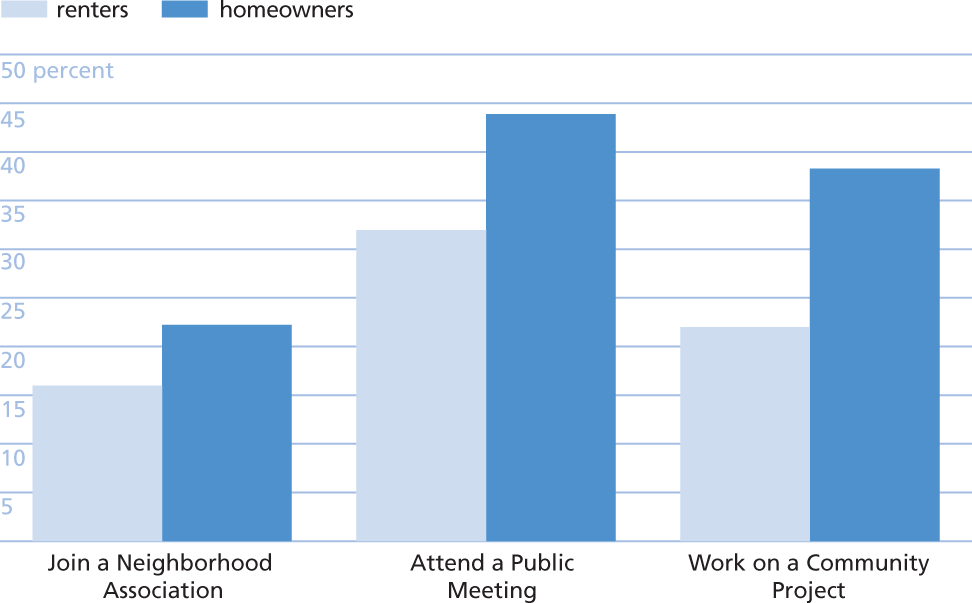
This data allows us to compare the civic habits of homeowners and renters. The chart above shows the percentage of American homeowners and renters who report joining neighborhood associations, participating in public meetings, and working collectively on community projects. In the previous year, 22 percent of homeowners participated in neighborhood associations, compared to about 15 percent of renters. While nearly 44 percent of homeowners reported attending a public meeting to discuss school or town affairs, only 32 percent of renters were active in these meetings. Almost 40 percent of homeowners reported working on a community project in the previous year, but only 22 percent of renters reported similar types of involvement.
Time & Life Pictures/Getty Images
But as it turns out, beyond a small set of activities directly linked to their community, homeowners and renters aren’t all that different from one another. Homeowners aren’t much more neighborly than renters, reporting very similar levels of social interaction with their neighbors. And while they trust their neighbors more, they are no more trusting of other social groups. For most types of membership organizations—including labor unions, political groups and civil rights organizations—renters participate with about the same frequency as homeowners. They also attend religious services and participate in organized sports at about the same rate. So while they are more involved in their communities, homeowners typically limit their involvement to a handful of activities.
The Darker Side of Civic Engagement
Americans believe that civic engagement is a good thing. From block associations to school groups, participation in local groups teaches us to value different opinions and interact with those from diverse backgrounds. Community engagement creates shared interests within neighborhoods. Neighbors learn to trust one another and embrace core democratic values by participating in community groups.
The myopic focus on property values stems from a single, important fact: the typical middle class household holds nearly two-thirds of its wealth in its principal residence.
Social science research is replete with examples of how civic involvement leads to more deliberative, thoughtful communities. Looking at neighborhoods in Chicago, for example, Harvard professor Archon Fung argues that active and engaged participation by local citizens results in demonstrable changes in local neighborhoods. Schools are better and streets are safer when citizens get involved.
Political scientist Robert Putnam, in his influential book on Americans’ declining civic engagement, Bowling Alone, warns about the negative consequences of disengagement from civic life. Tracking falling rates of civic engagement, he wrestles with the implications for our communities.
Political leaders have spent decades promoting homeownership with an eye toward involving citizens in their communities. President Barack Obama, for example, recently extended federal assistance programs to keep struggling homeowners in their homes in an effort to forestall foreclosures and stabilize American neighborhoods. Before him, Bill Clinton introduced the National Homeownership Strategy, designed to boost the homeownership rate for low-income and minority Americans. And as part of his plan for an “ownership” society, George W. Bush offered a down payment assistance program for first-time homebuyers, arguing that homeownership increases investment in communities.
Homeowners may be more engaged in their neighborhoods, but their activism may exacerbate patterns of segregation, increase social exclusion, and create more fractured communities.
But while they are frequently more engaged in their neighborhoods, homeowners often participate in projects that are not necessarily in the best interest of the entire community. Their activism may in fact exacerbate patterns of segregation, increase social exclusion, and create more fractured communities.
Time & Life Pictures/Getty Images
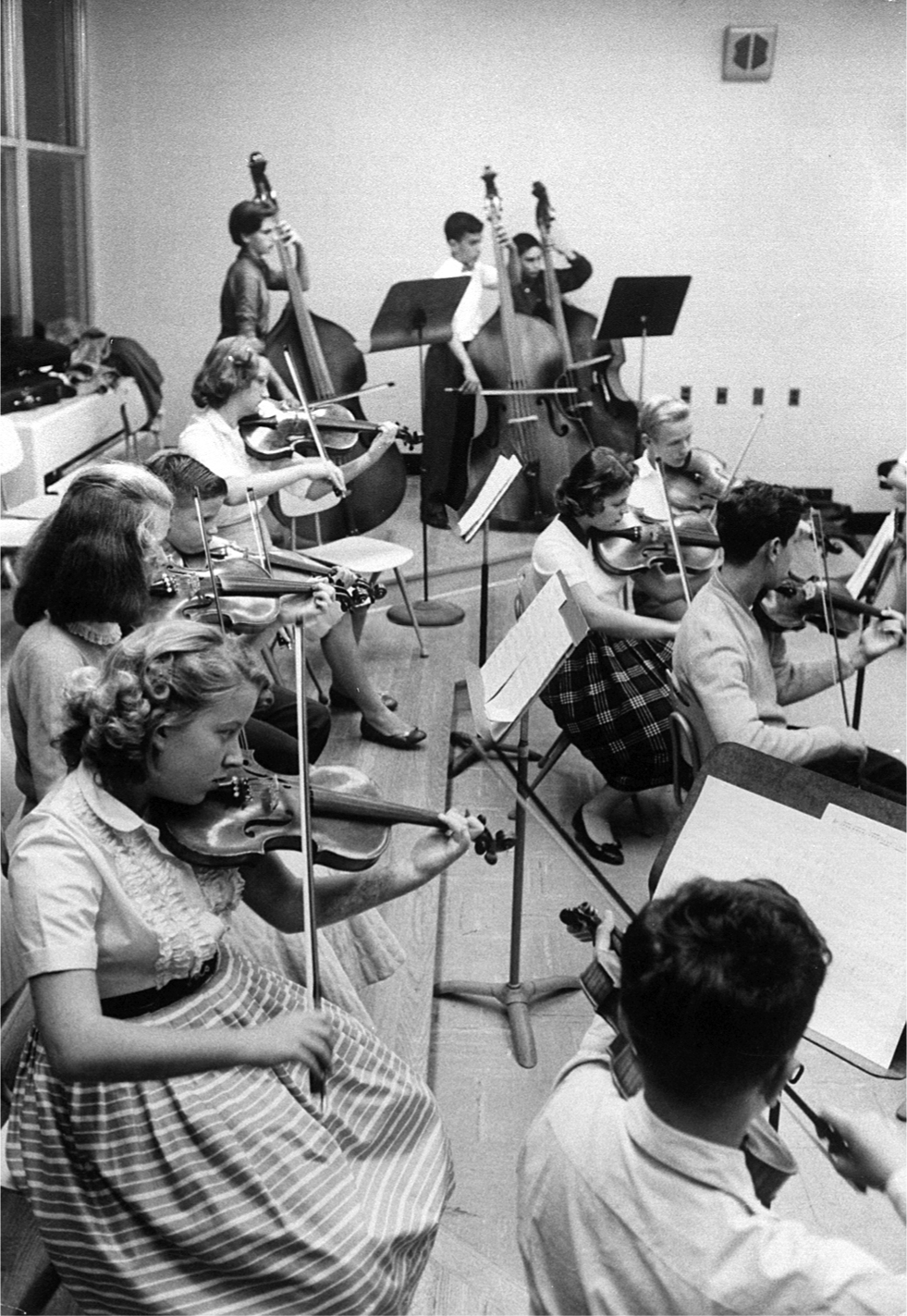
Encouraged by the Winnetka Homeowners Association, citizens in Winnetka promoted a singular vision for the community—a vision that did not include housing for middle-income earners. Homeowners responded to the affordable housing plan by performing textbook acts of civic engagement—attending meetings, contacting officials and discussing politics. Winnetka emerged as a deeply fractured community.
On one side were opponents of the affordable housing plan, including members of the Winnetka Homeowners Association, who succeeded in keeping affordable housing out of their community. On the other side were residents who felt alienated by the controversy and politicking in the Chicago suburb.
As Gail Schechter, the Executive Director of Open Communities, an interfaith housing center based in Winnetka, noted, “Winnetka residents on all sides are burnt out on the affordable housing issue … [T]he real issue, and the one that needs to be discussed in an open, inclusive setting, is ‘What kind of Winnetka do we want to be?’”
Toward More Diverse Voices
Today, on the heels of the foreclosure crisis, as we wrestle with the potential for housing policy to rebuild communities, we need to consider how homeownership shapes the way Americans participate in their communities.
In the face of divisive social issues, like affordable housing, the demands of some homeowners often trump the needs of other community members. This type of participation centralizes political power in the hands of a single, powerful group rather than dispersing it across political actors. It isolates a single voice—a voice focused on local property values—and ignores competing visions of community life. Homeowners’ activism often promotes a narrow notion of self-interest that focuses on the economic value of individual homes rather than on broader social goods, such as social inclusion or diversity.
Time & Life Pictures/Getty Images
There are of course many benefits to owning your own home in the United States. Homeownership encourages households to build wealth and save for their retirement. Families often develop a deeper sense of wellbeing in their homes, and the stability of homeownership can be good for raising children. But as we continue to promote homeownership through a handful of policy tools, including assistance to first-time homebuyers and the generous mortgage interest deduction, we must pay closer attention to its impact on local neighborhoods.
While affluent Winnetka is not representative of the diverse mix of American communities, its experience suggests that homeownership alone does not transform individuals into active, engaged citizens. Instead, homeowners often embrace narrow understandings of the neighborhood good. In protecting their property values, they actively reshape their communities, reinforcing existing divisions and creating new ones. When they take outsized roles, they risk drowning out the diversity of voices that contribute to making vibrant neighborhoods.