Abstract
Visual sociologist Helen M. Stummer revisits her early work on E. 6th Street and highlights her portraits of an interracial family she became close to in this photo essay.
In 1976, a friend let me borrow his New York apartment at 33rd Street and Lexington Avenue for a respite from the burdens of family and work and the obligations of college. I ventured out, heading north to view an exhibit about women at the International Center of Photography (ICP), a new institution that had opened two years earlier. That walk changed my life.
I was in my mid-30s, living in the suburbs, separated from my second husband and raising four children—two of my own and two foster kids. I had only recently earned my general equivalency diploma, having dropped out of high school when I was 15 (to my great regret). Once I got my GED, I enrolled in college classes, eager to pick up where I had left off and find out who I really was.
Painting was my passion, but over the years life got in the way. I enrolled in a class at ICP, though at first I merely wanted to learn to use my camera better when taking pictures of the people and landscapes I wanted to paint. Everyone in my class was asked to photograph our own neighborhood, and week after week, I was the only student who didn’t have anything to show for critique.
“What is your problem?” my instructor Patt Blue asked.
“I live in the suburbs and it’s boring,” I replied.
“Then why don’t you move?” she said.
“I don’t want to move, I just don’t want to photograph it,” I answered.
I was stunned when Patt suggested I travel 88 blocks south to the Children’s Aid Society, the center of the E. 6th Street community, known as gritty, drug-infested, and dangerous. A New York Times piece called the area one of the “meanest streets in America.” The Children’s Aid Society had opened in 1853 to help homeless children. At the time, the center offered day care, English lessons, recreation, and breakfast and lunch. The staff and volunteers helped the residents deal with piles of confusing forms related to welfare, housing, school problems, immigration, and health issues.
On E. 6th Street, I was in a strange and hostile environment, standing in a world I never knew existed.
On E. 6th Street, I was in a strange and hostile environment, standing in a world I never knew existed. I was so filled with fear that everything seemed to be out of focus. I heard the sounds of people laughing, arguing and yelling as swirls of colorful clothes swam before my eyes. The neighborhood was dotted with burned out buildings. Police sirens, honking horns, and fire engines filled the air. Grim looking men dressed in dark clothes hovered in doorways, while children played in the rubble-filled lots. That first day, standing in the Aid Society doorway, I knew deep in my gut that this was the neighborhood I wanted to photograph.
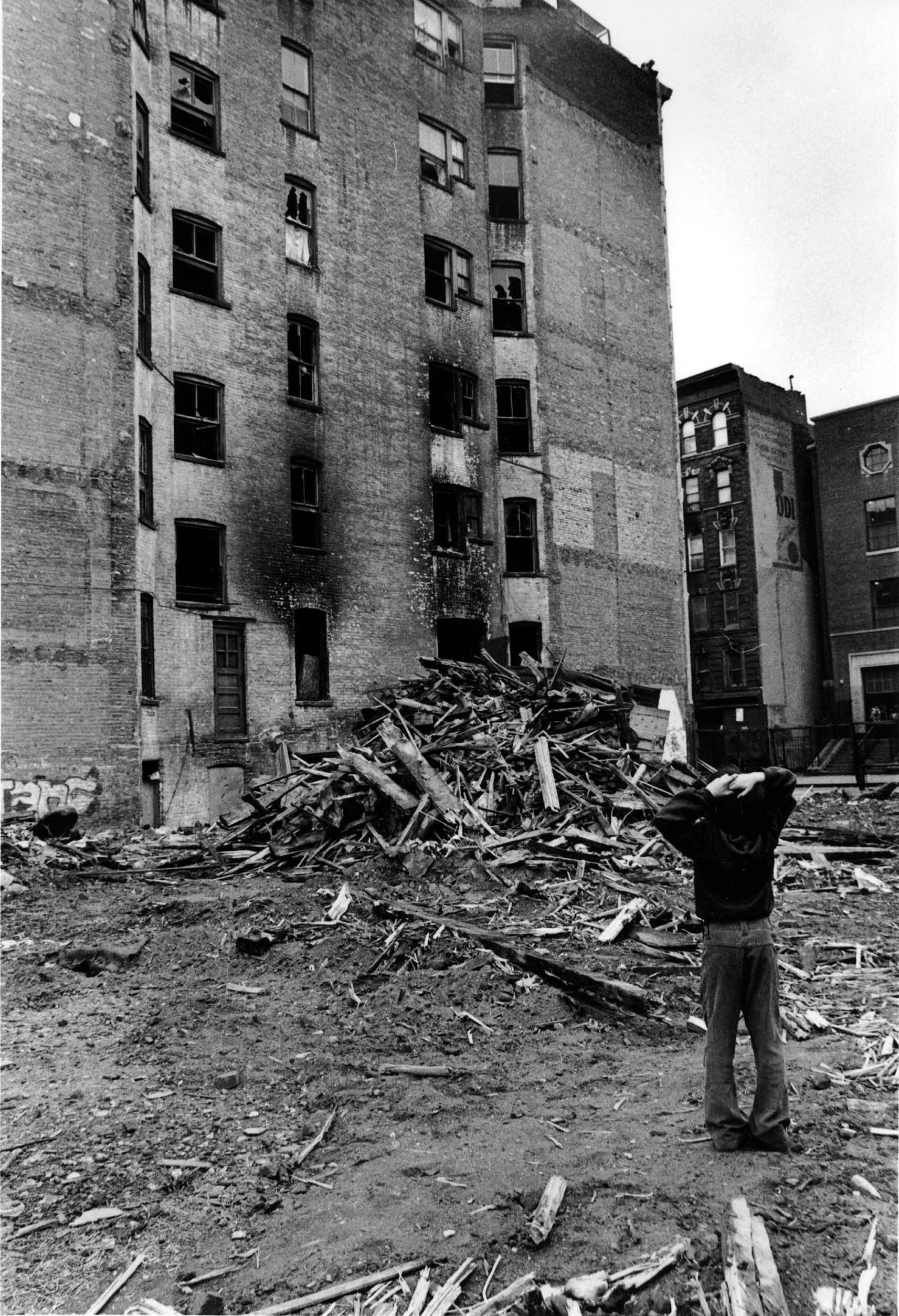
My camera was the tool I hid behind. It was a protective barrier that helped me overcome my shyness, and fear of being rejected by the strangers I constantly approached. On and off during those early years some of my photographs turned out blurry and no one in the class could figure out why. Then one day as I was looking through the viewfinder, ready to take the photo I would later title “Boy Holding His Head,” I happened to notice how violently my hands were shaking. I used a manual camera, so I simply had to increase the shutter speed dial to freeze the motion and correct the problem. In that moment, I confronted my simplest but most constant obstacle—fear.
Eventually the residents no longer blended into their environment, but became individuals. They became visible. And they helped me survive. They told me which side of the street was safe to walk on, how to avoid getting in the line of fire if shots broke out, about the danger of objects thrown from roofs and of walking too close to doorways one could be pulled into.
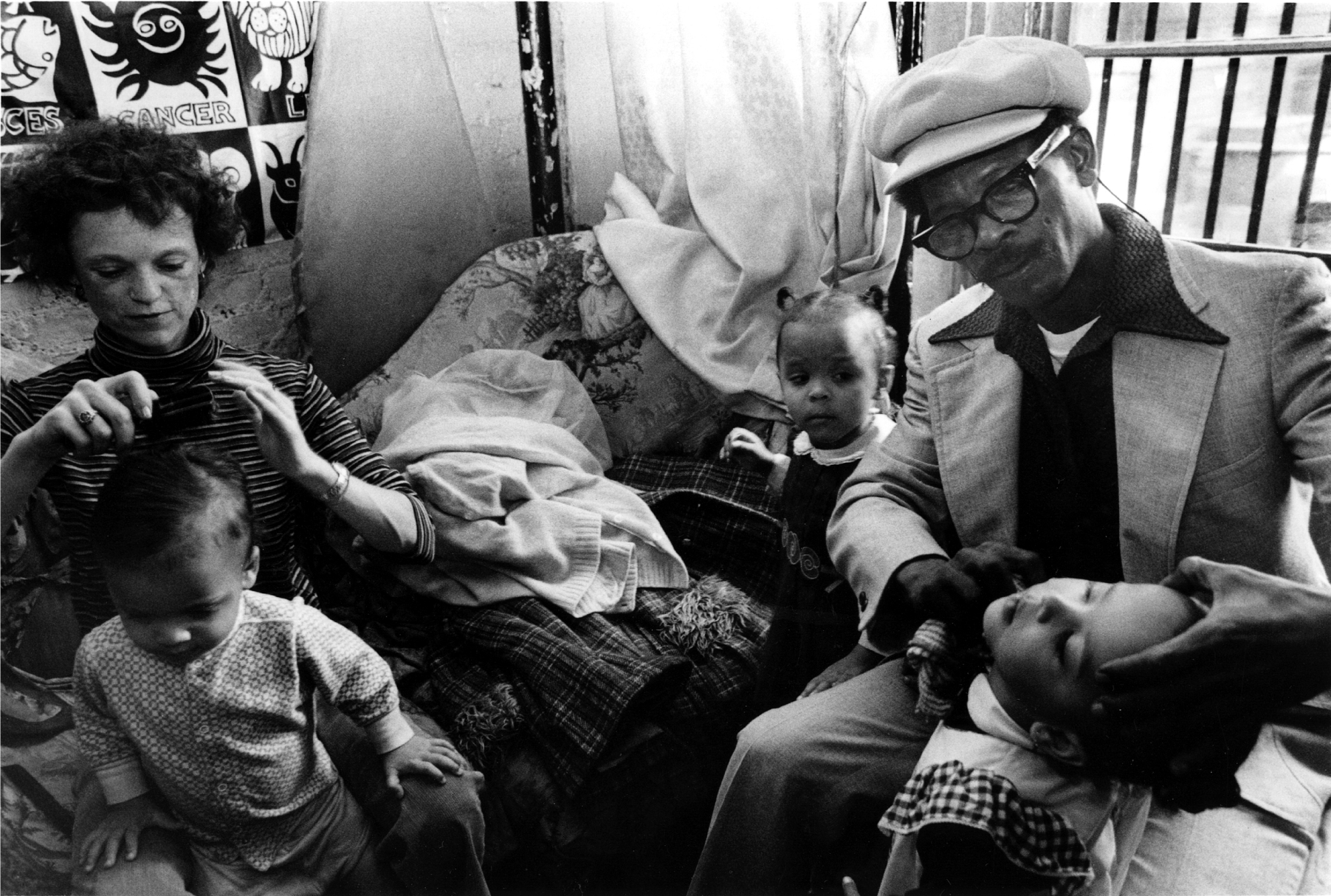
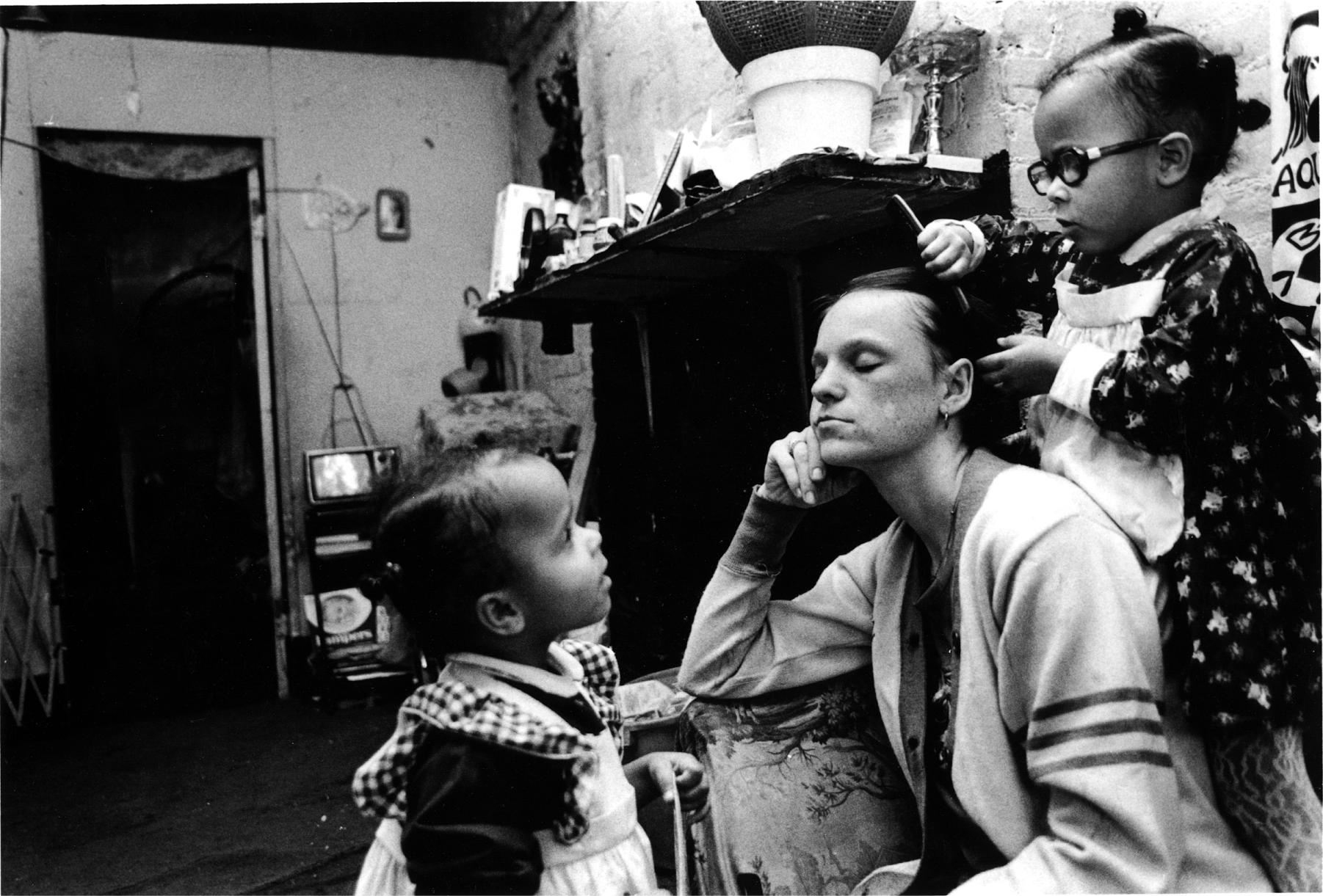
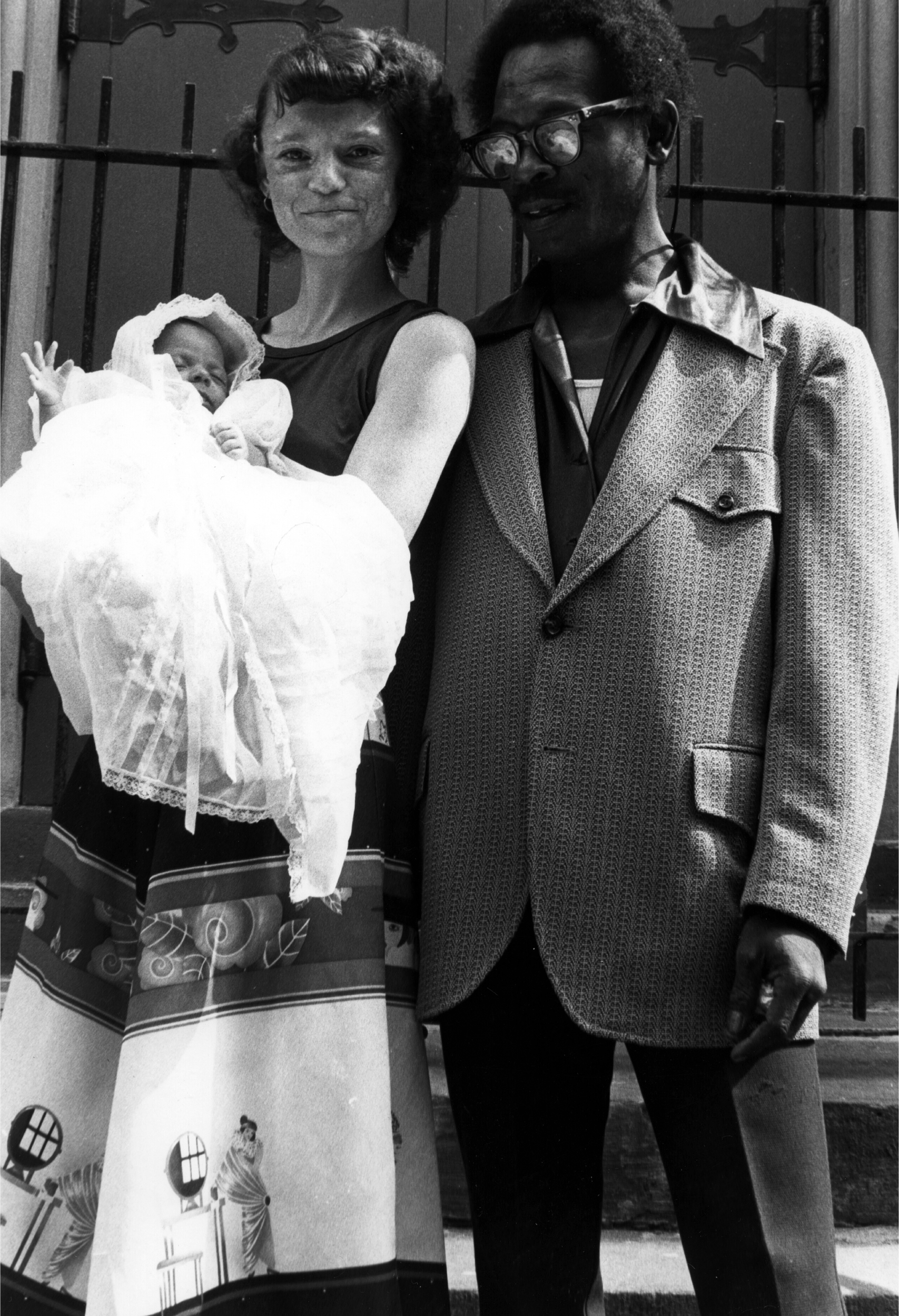
This essay revisits my early work on E. 6th Street and highlights my portraits of an interracial family I became close to—Shirley, Cornel, and their children. This body of work was the beginning of decades of what we at ICP called “concerned photography.” Looking back at these early images, I reflect on my journey as a photographer and a person.
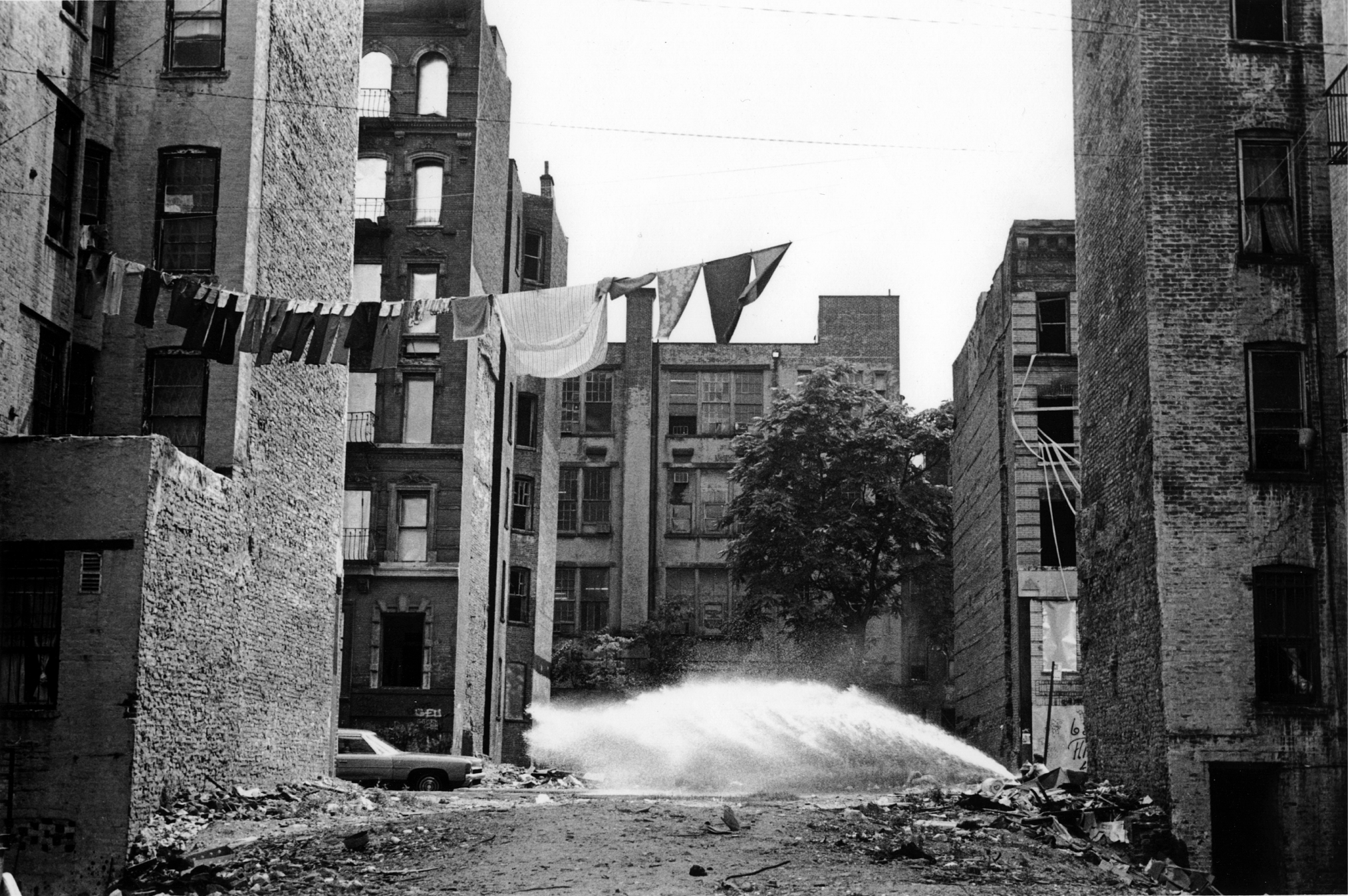
Laundry drying and child spraying hydrant water, 1979
I quickly saw the many differences between the inner city and the suburbs where I grew up. Hardly anything changes in the suburbs compared to the inner city, where changes occur daily. Every time I returned to East 6th Street I learned about someone moving in or moving out, dying or being born. Buildings were constantly being burned up or torn down.
Top: Shirley and Cornel getting three of their children ready to go out, 1978
Bottom: Yvette combing Shirley’s hair as Bernadette watches, 1978
From the beginning of my career people trusted me. I was always surprised. I myself would not let a stranger photograph me or let a stranger into my house. Looking back, I often think it was a miracle that I gained access into the lives of the people on E. 6th Street. “It was outrageous what you did,” Shirley said. “People don’t come here and want to know about us. They are concerned only with leaving. I mean, who would come here to E. 6th Street?”
Shirley and Cornel with baby Michele after christening, 1978
When I asked permission to photograph, the response was always, “What should I do?” I was learning to remember what the person was doing that attracted me in the first place. I would then remind them how they had been standing or holding their hands. I sometimes asked what they were thinking about when I saw them. Often my presence would disrupt the moment, but showing respect by asking permission was important to me. Although I rarely captured what I initially saw, my camera almost always captured something that was often both surprising and riveting. It was the spirit of the moment that kept the image true, even if it was not my original vision.
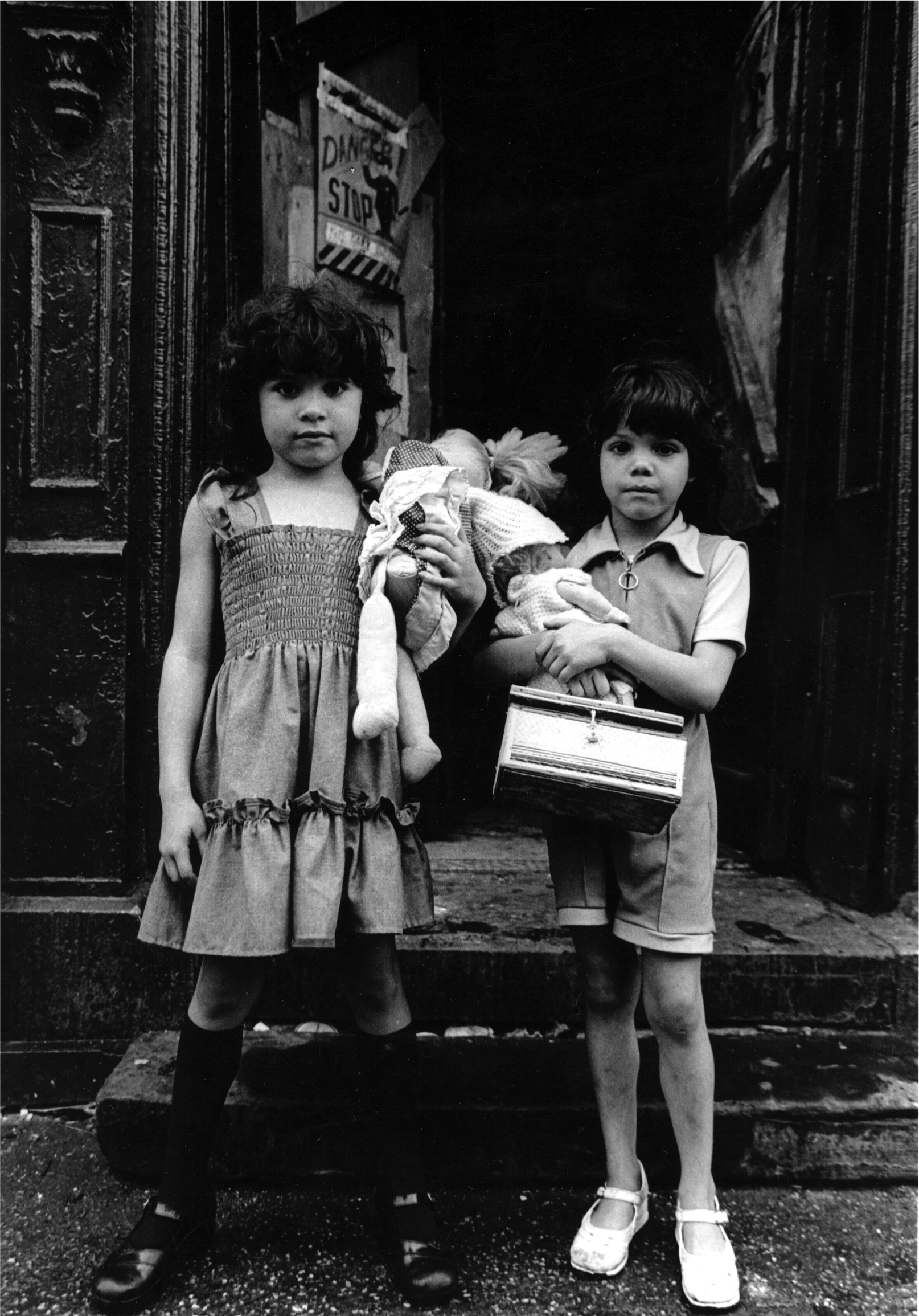
Girls and Dolls 1977
I was intrigued watching children play on the Lower East Side and I wanted to capture their spirit and imagination. I remember the moment I saw two girls walking toward me on Avenue C, each holding a doll. They were dressed primly and sweetly with serious expressions and a big girl posture. Desperate for the shot, I asked permission to photograph and they agreed. After a few shots I knew the composition was all wrong. In a visceral reaction, I asked them to stand in front of the shattered doorway. I never noticed the “Danger” sign until after I printed the image.
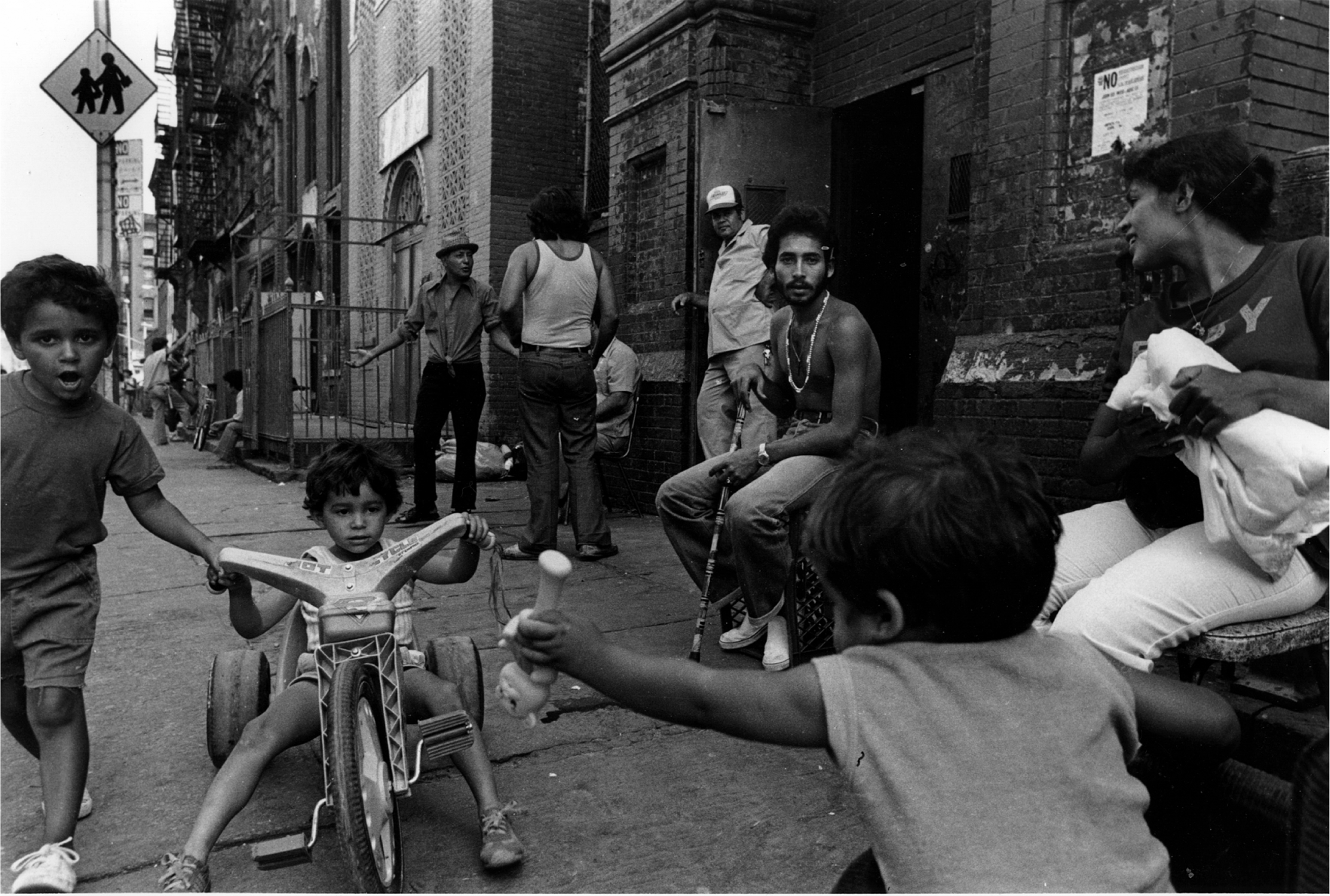
Top: Sloan Center sidewalk, 1980
I always gave people the prints I’d taken. One time I had a huge stack to distribute. People poured from the tenements when they saw me. After I handed out the photos and was leaving, I looked back. People on the third floor were hanging out the windows showing the prints to the ones on the second floor and others on the first floor. People on the sidewalks were waving their photos. The fluttering of black and white prints reminded me of a ticker tape parade. My heart swelled. Then it began to rain and I wanted to yell “Cover the prints!” Instead I smiled and loved the moment.
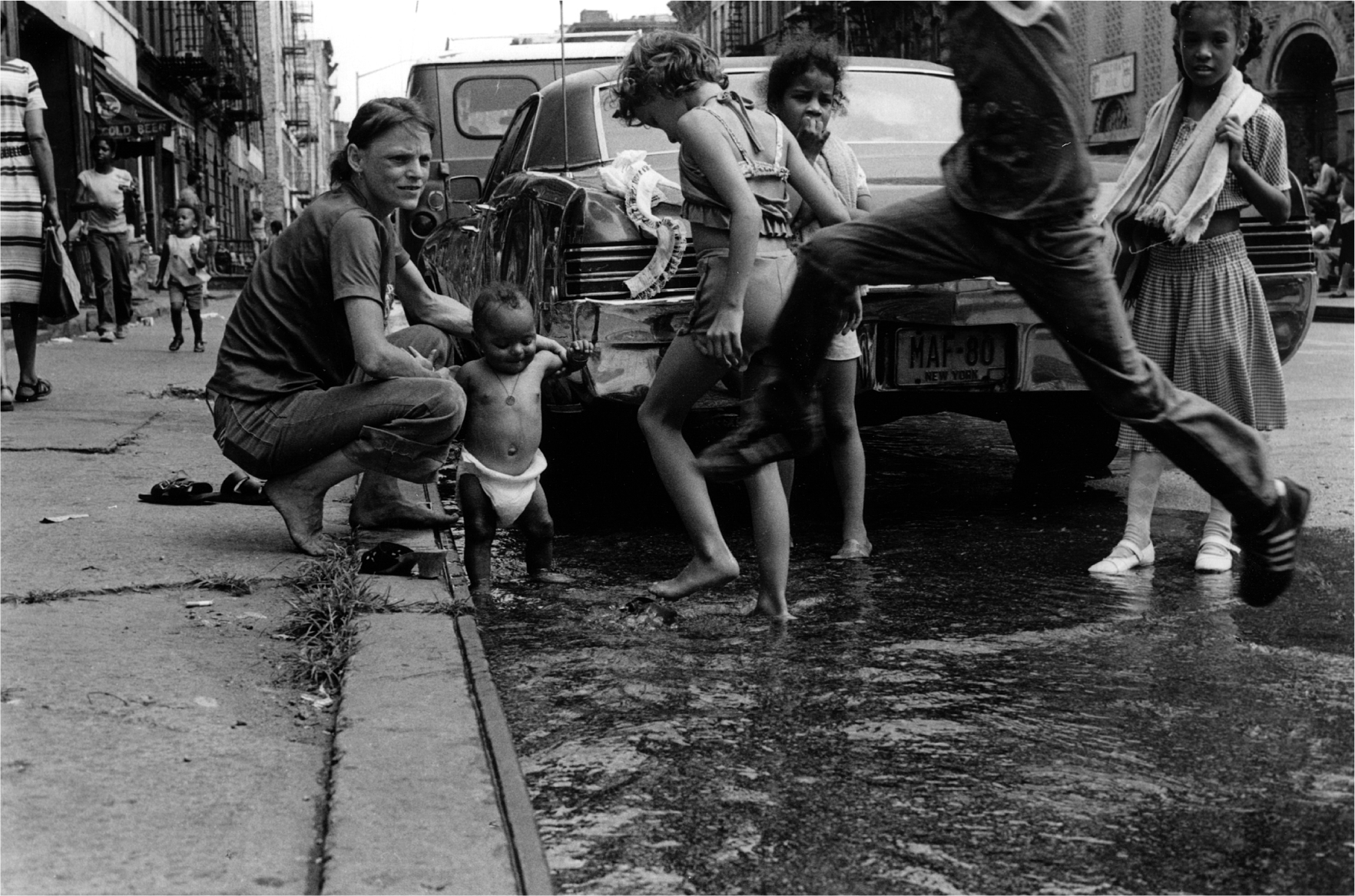
Bottom: Shirley holding baby Michele in the hydrant water, 1979
The neighborhood and the people had a reputation for hostility and violence, but in my photos the people do not appear menacing, but friendly, caring and natural. I was passionate about showing people’s individuality in my photographs, where many tough people revealed their elegance, gentleness and uniqueness.
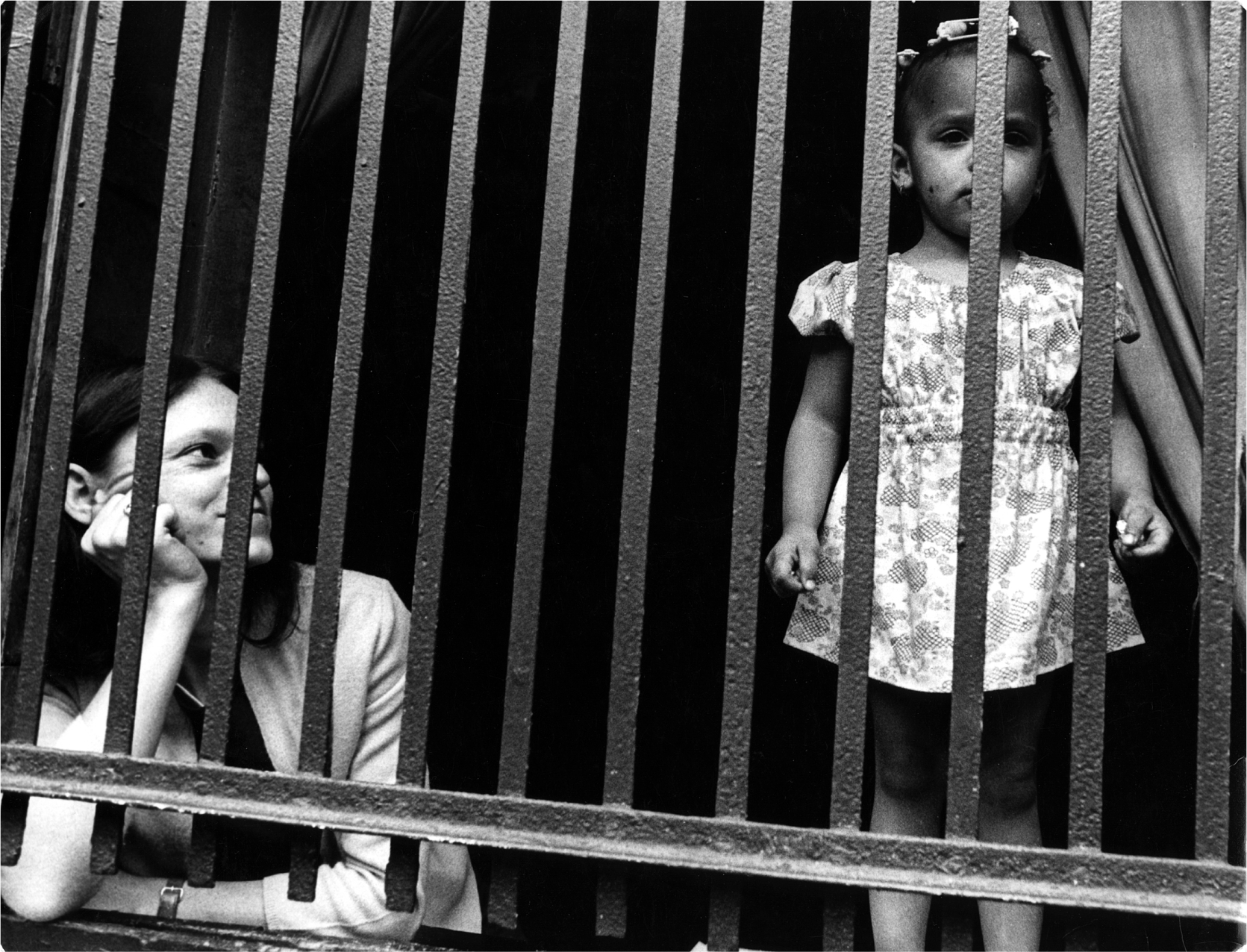
Top: Shirley barred by window with Yvette, 1977
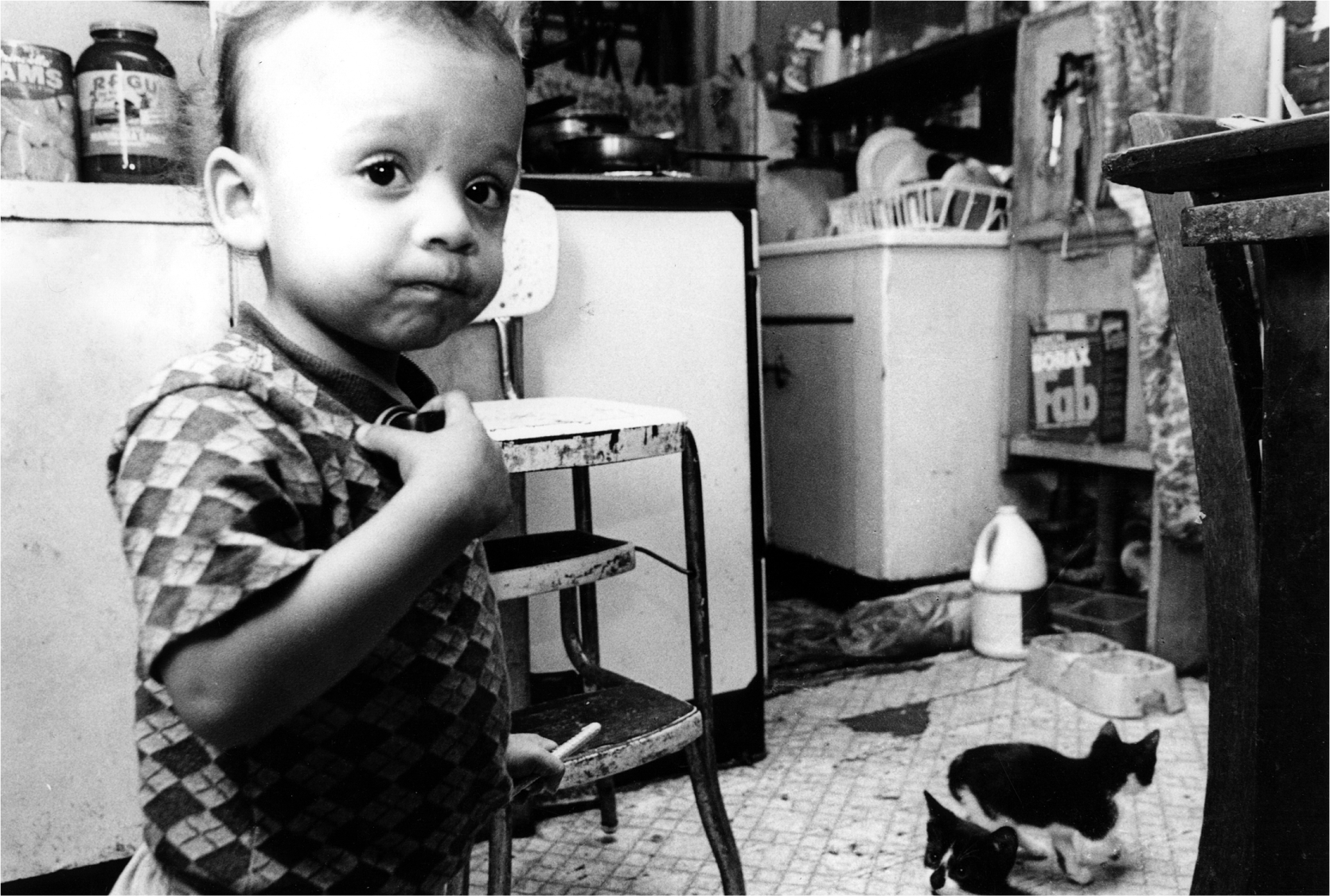
Bottom: Charlie (Shirley and Cornel’s youngest son) in their kitchen, 1978
I had a terrible time deciding what was a good photograph and what wasn’t. It was a struggle to concentrate on the many different things taking place when I was prepared to press the shutter. I had to relate to the person I was photographing, and to keep in the mind that the background was just as important as the foreground. I had to wait for the right moment when the person’s expression, lighting and composition came together in the viewfinder. As my teacher Patt said “you crop in the viewfinder, not in the darkroom.”
Boy holding his head, 1979
I struggled for years to articulate my intentions behind what I was doing photographing E. 6th Street. Eventually I learned I was trying to open a door into myself. I began to see some of my photographs as self-portraits because they were metaphors for my own difficult experiences. Everything I had endured I felt compelled to photograph—harshness, neglect, despair, dignity and invisibility.