



Abstract
The Golden Gate Bridge continues to be the top suicide site in the world. John Bateson argues that a barrier will save lives, end the tragedies, and not detract from the bridge’s beauty or the view–but it remains far off.
Keywords
Carol M. Highsmith/Library of Congress Archives
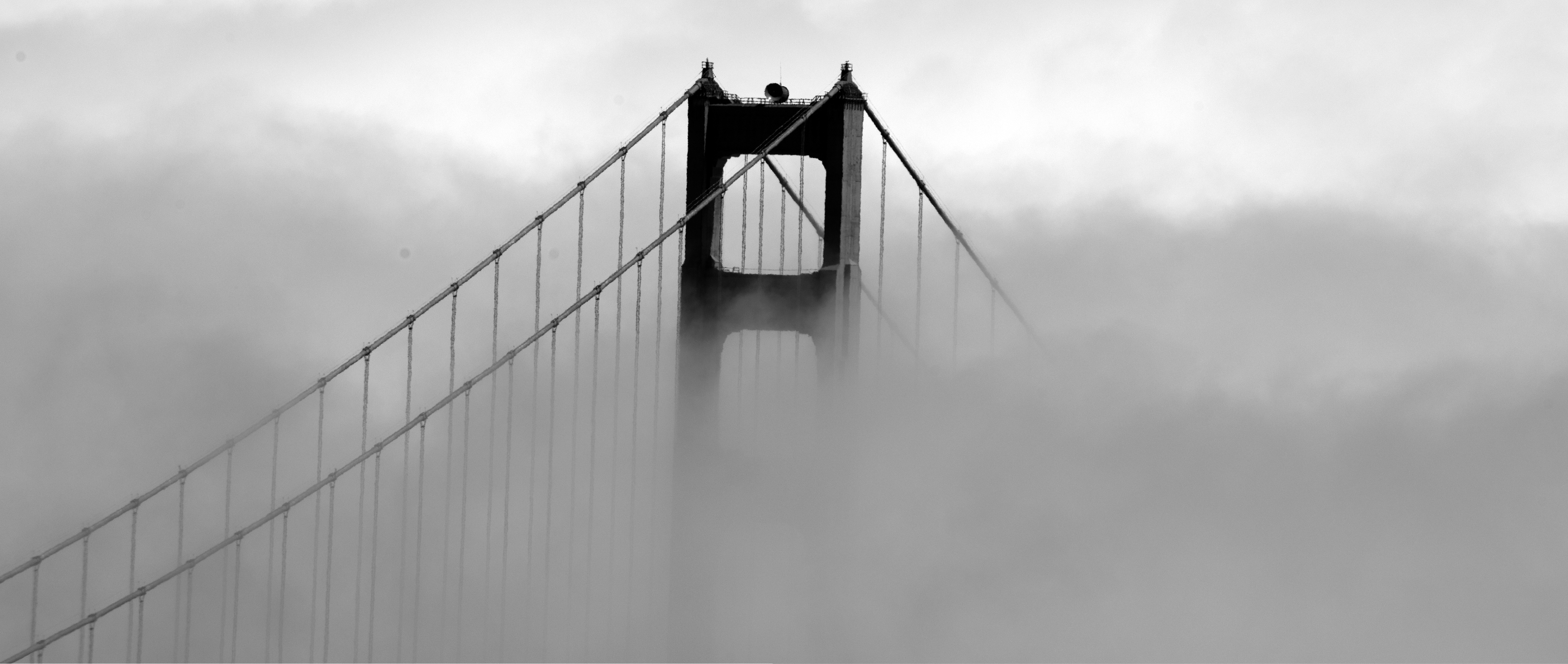
Kay James remembers the day vividly. How could she not? It was the worst day of her life. Monday, March 28, 2011. Her 28-year-old son, Michael Bishop—sweet, smart, talented Michael—jumped to his death from the Golden Gate Bridge.
Most people jump from the east side of the bridge, the side with the pedestrian walkway, facing San Francisco. There is a myth that everyone jumps from this side, but based on the testimony of witnesses and images captured on bridge surveillance equipment, 14 percent jump for the west side, the side reserved for bicyclists, that faces the Pacific Ocean. Michael was in the majority; he jumped facing San Francisco.
According to witnesses, his leap occurred around nine in the morning. A half-hour later his body was recovered by U.S. Coast Guard workers at Station Golden Gate in Marin County, the busiest Coast Guard station in the United States. From there it was turned over to the Marin County coroner’s office for autopsy and notification of next of kin. That’s who Kay James heard the news from, the Marin County coroner. He told her that Michael’s body had been recovered in the water underneath the Golden Gate Bridge. He also told her that a suicide note had been found. Most people don’t leave a note, but Michael did. It was on the passenger seat of his car, which was parked near the bridge. In shock, Kay asked the coroner to read the note to her.
“I wish I could witness your growth through the rest of your life,” Michael told his younger brother, Brendan. “You have a huge heart.” To his girlfriend, Tanya Kaplow, he wrote, “I can’t tell you how much it pains me not to be able to live the rest of my life with you. You are an incredible person and deserve all the happiness the world can offer.” To his parents, Kay James and Tom Bishop, he wrote, “Thank you for giving me such a great life, loving me unconditionally, and always being there for me.”
From outward appearances, Michael was poised to achieve great things. A gifted athlete, accomplished musician, and sensitive soul, he graduated from the University of Puget Sound with a 3.5 grade-point average. He had just been hired by a nonprofit environmental fund in San Francisco. In fact, the morning he jumped was supposed to be his first day at the new job. He was taking two night classes a week in preparation for going to graduate school to become an urban planner and designer. He played violin one night a week in an orchestra, and spent as much time as he could with Tanya, whom he met nine months earlier and planned to marry.
Many bridge jumpers are battling inner demons of some sort, and Michael was no exception. Starting in eleventh grade, he was prescribed medications for depression and, later, for “mild” bipolar disorder. His moods fluctuated and his sleep habits became erratic. Despite excelling academically and having an active social life, he told his mother, “I’m so tired of feeling the way I feel.” After his death, when she requested copies of Michael’s medical records from his psychiatrist, she saw references to suicide. No one—including Michael—had ever broached the subject with her.
Michael Bishop was one of 37 people who jumped to their deaths from the Golden Gate Bridge in 2011. Another 100 people were stopped from jumping by Bridge Patrol and California Highway Patrol officers. In 2012, there were 33 confirmed suicides from the bridge. An additional 86 people were stopped from jumping.
Alluring Danger
Every three days, someone goes to the Golden Gate Bridge and jumps or plans to. At least twice a week, someone ends his or her life or tries to end it from the world’s most famous span.
Since the bridge opened in 1937, there have been more than 1,600 confirmed suicides. An exact number isn’t known because official counts stopped being maintained in the wake of the frenzy that occurred in 1995 when the number approached 1,000. Suicidal people started going to bridge in droves, each vying for the dubious honor of being the milestone suicide. Twenty-two years earlier, when the count neared 500, there was a similar rush. One person who was stopped from jumping had the number 500 pinned to his shirt. In 1995, when the count reached 997, the highway patrol stepped in and discontinued it.
Every three days, someone goes to the Golden Gate Bridge and jumps—or plans to.
Although the number of confirmed suicides from the Golden Gate Bridge is far greater than anywhere else in the world, the total number of suicides from the bridge is even greater than what is recorded. If a body isn’t recovered, the person officially is considered “missing,” even if there is a suicide note and his or her car is found abandoned near the bridge. Inasmuch as ocean currents in and around San Francisco Bay are strong, numerous bodies wash out to sea or sink before anyone can reach them. Other times a body is recovered, but farther down the coast, meaning that the death can’t be attributed with certainty to the bridge.
Many people don’t know or care that the Golden Gate Bridge is the top suicide site in the world, or that it’s the only major international landmark without a suicide barrier. They see only the beauty and grandeur of the bridge, not its dark side.
Suicide sites tend to draw despairing people to them, and the Golden Gate Bridge exerts a stronger pull than anywhere else. They are also drawn by the perception that jumping from the bridge results in a quick, near-certain death, with no messy cleanup. This isn’t necessarily true—5 percent of jumpers survive the impact and subsequently drown—but the perception exists nonetheless. In addition, access is easy. There are parking lots at both ends of the bridge, bus service to it, and pedestrian and bike paths that are open year-round.
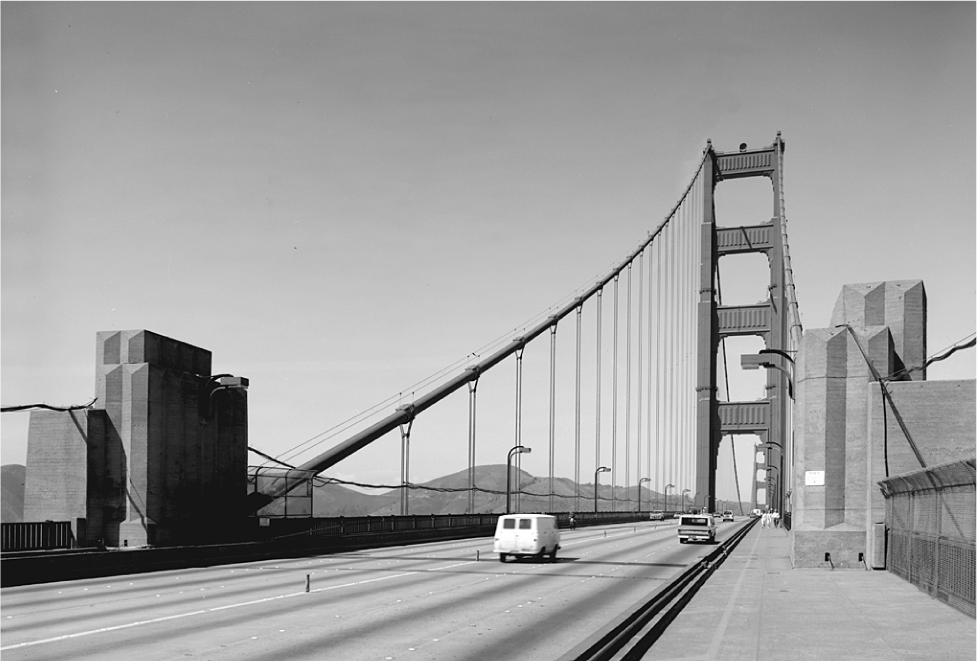
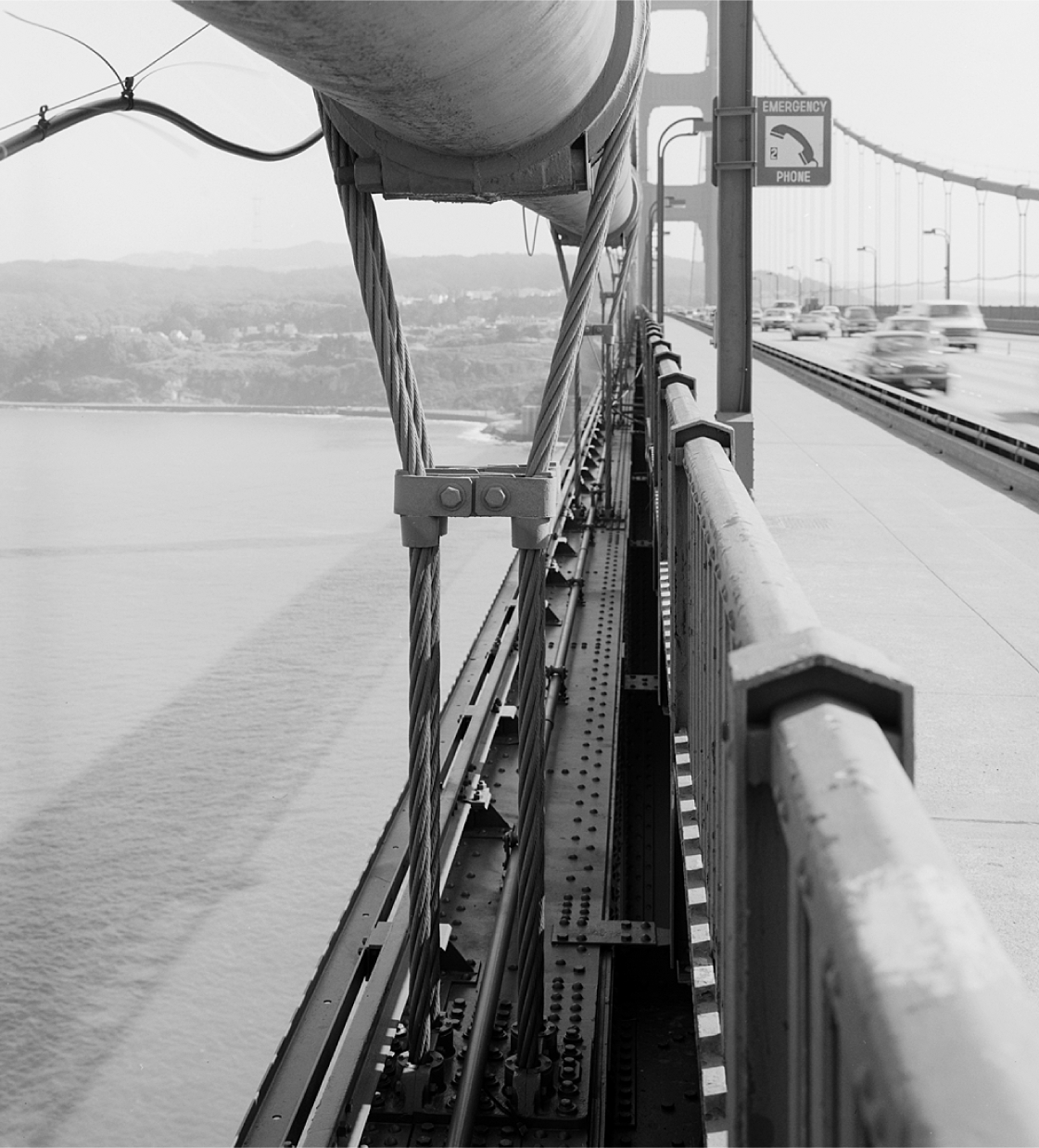
The most important reason people choose the bridge is because the existing railing is only four feet high. Almost anyone can climb over it, from a five-year-old girl—the bridge’s youngest official suicide—to people in their 80s.
Building the Bridge
Original designs for the Golden Gate Bridge called for a higher railing designed to prevent suicides. In a last-minute decision, however, the railing was lowered to enhance the view. Some people have speculated that this was because Joseph Strauss, chief engineer of the bridge, was only five feet tall. In fact, an Oakland architect named Irving Morrow, whom Strauss hired to make the bridge more aesthetically attractive, was probably the person responsible for lowering the railing.
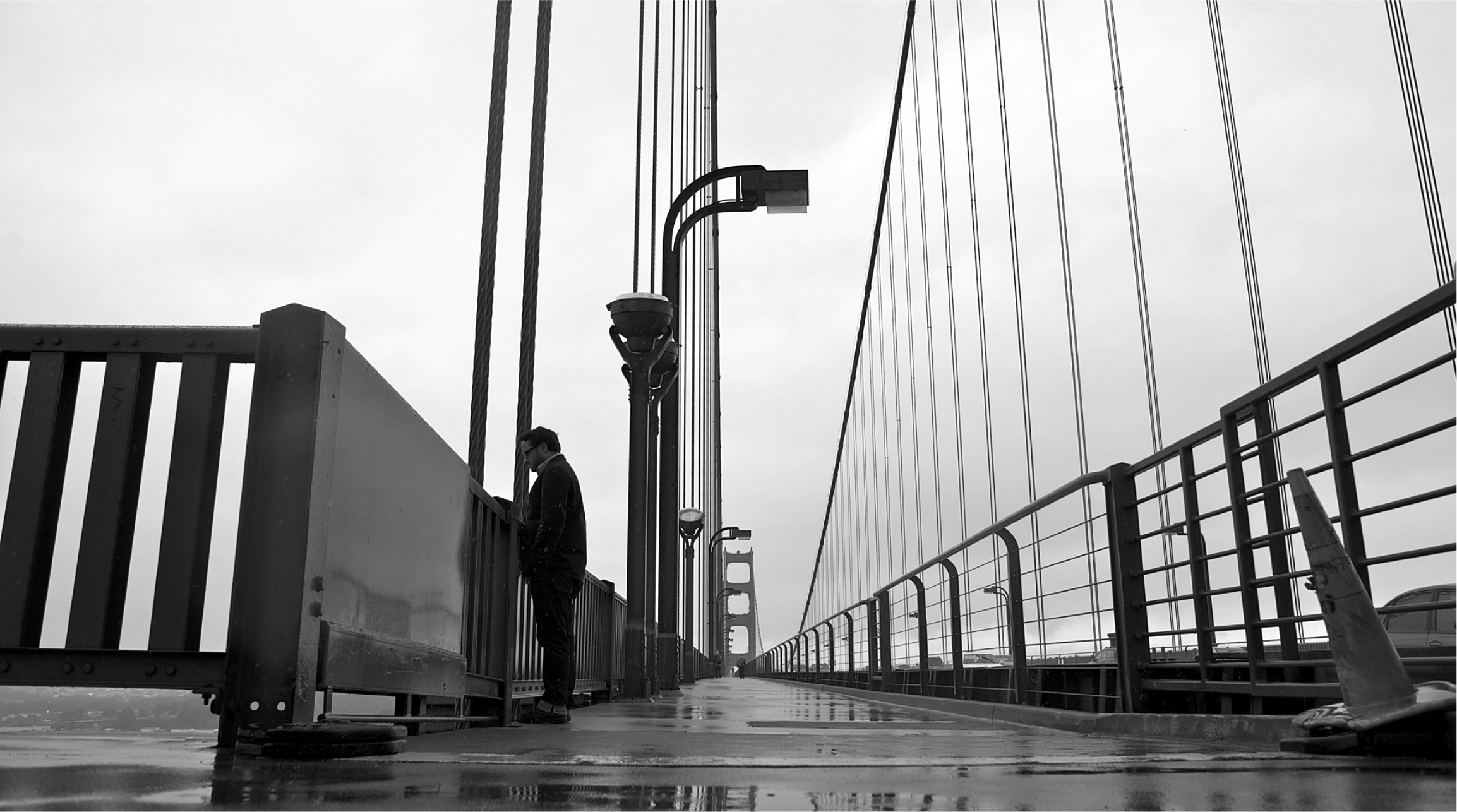
San Francisco’s famed Golden Gate Bridge is the top suicide site in the world.
©2011 Rob Sinclair
Jet Lowe / US National Park Service HABS/HAER
During construction, Strauss strung a net the length of the bridge to protect workers. The net cost $120,000 ($2 million in today’s currency). At various times, 19 men fell into it accidentally and were saved. Four months before construction was completed, a section of scaffolding broke away from the bridge. It tore through the net and 10 workers on it were killed. Strauss immediately spent another $120,000 for a new net. Four months later, when the bridge was completed, the net was removed.
In October 2008, the Golden Gate Bridge District board voted for the first time in history to add a suicide deterrent to bridge: a marine grade, stainless steel net underneath. The net will be rigid, angled, and suspended 20 feet below the roadway so that anyone who falls into it most likely will suffer broken bones and be unable to climb out. A special utility vehicle will be used to retrieve the person. The net was chosen instead of a taller railing because it will be cheaper to maintain and won’t impede views from the bridge.
No other bridge has a net—they all have taller railings. Even so, any kind of deterrent helps. Individuals have decided not to jump from the Golden Gate Bridge because they couldn’t find a parking space, or because they arrived after the pedestrian side was locked at night. One 31-year-old housewife didn’t jump because her skirt was so tight that she couldn’t lift her leg over the short railing, and she was too modest to take it off.
At the same time that Golden Gate Bridge officials approved the net, however, they voted against using any revenues to pay for it. Consequently, while some people are under the impression that the problem ended when the net was approved, in fact the deaths continue unabated.
What Durkheim Missed
by Matt Wray
In his classic text Suicide, published in 1897, sociologist Emile Durkheim showed with great clarity and force that suicide rates are highest when and where social integration—how securely individuals are bound to those around them—is lowest. Scores of subsequent studies have amply demonstrated this. But Durkheim got a few big things wrong. For one, he argued against the need for research into the means of suicide.
“The form of death chosen by the suicide,” he wrote, is “something entirely foreign to the very nature of suicide… The first has nothing to teach us about the second.” This is true if suicide is not impulsive or imitative in its nature. But if it is, then studying the means by which people kill themselves—in different occupations, in different cities, and in different societies, for example—can indeed teach us a great deal. It can teach us about how social and cultural influence works in even the most private matters of life and death, since humans do imitate those around them. And it can certainly teach us how to reduce suicide rates, by helping us to identify and prevent or reduce access to the most lethal or widely available means.
So, as John Bateson’s example of the proposed suicide barrier for the Golden Gate Bridge suggests, Durkheim was very likely wrong when he wrote that studying the means by which people commit suicide was insignificant. A large body of research shows that suicide rates are influenced by the lethality of the available means. To cite just one example: in the United States, states with more guns have higher overall suicide rates, but rates of suicide that do not involve a gun are not, leaving researchers to conclude that the higher rates in gun states are due entirely to gun-related suicides.
Here is what the science of suicide prevention has shown us: When those seeking self-destruction find access to their preferred method thwarted, they do not automatically seek out other means. They often give up. The impulse passes. Moreover, multiple attempters are uncommon—less than 10 percent of those who attempt suicide are likely to complete the task.
The logic is straightforward: if we can limit access to lethal means, attempters are forced to use less lethal means, which increases their chances for survival. Speaking statistically, it is a no-brainer. Even if the rate of attempts increases or merely stays the same, suicide rates will decline when people have less lethal options at their disposal.
What this suggests is that sociologists should fight for the importance of social integration in accounting for suicide, but we should also make peace with theories of suicide causation that Durkheim cast off more than a century ago—and look, for example, at the means people use.
Barriers to Suicide
If two to three people died every month in cable car accidents in San Francisco, or a baseball fan fell over the upper-deck railing at a baseball stadium every 10 days, or an intersection in the city was the site of frequent and fatal vehicle accidents, the problem would be fixed immediately. Public pressure would demand it. Yet people continue to jump from the bridge in record numbers and the Golden Gate Bridge District, which has sole responsibility for everything that happens on the bridge, does little about it. Moreover, the public seems unconcerned.
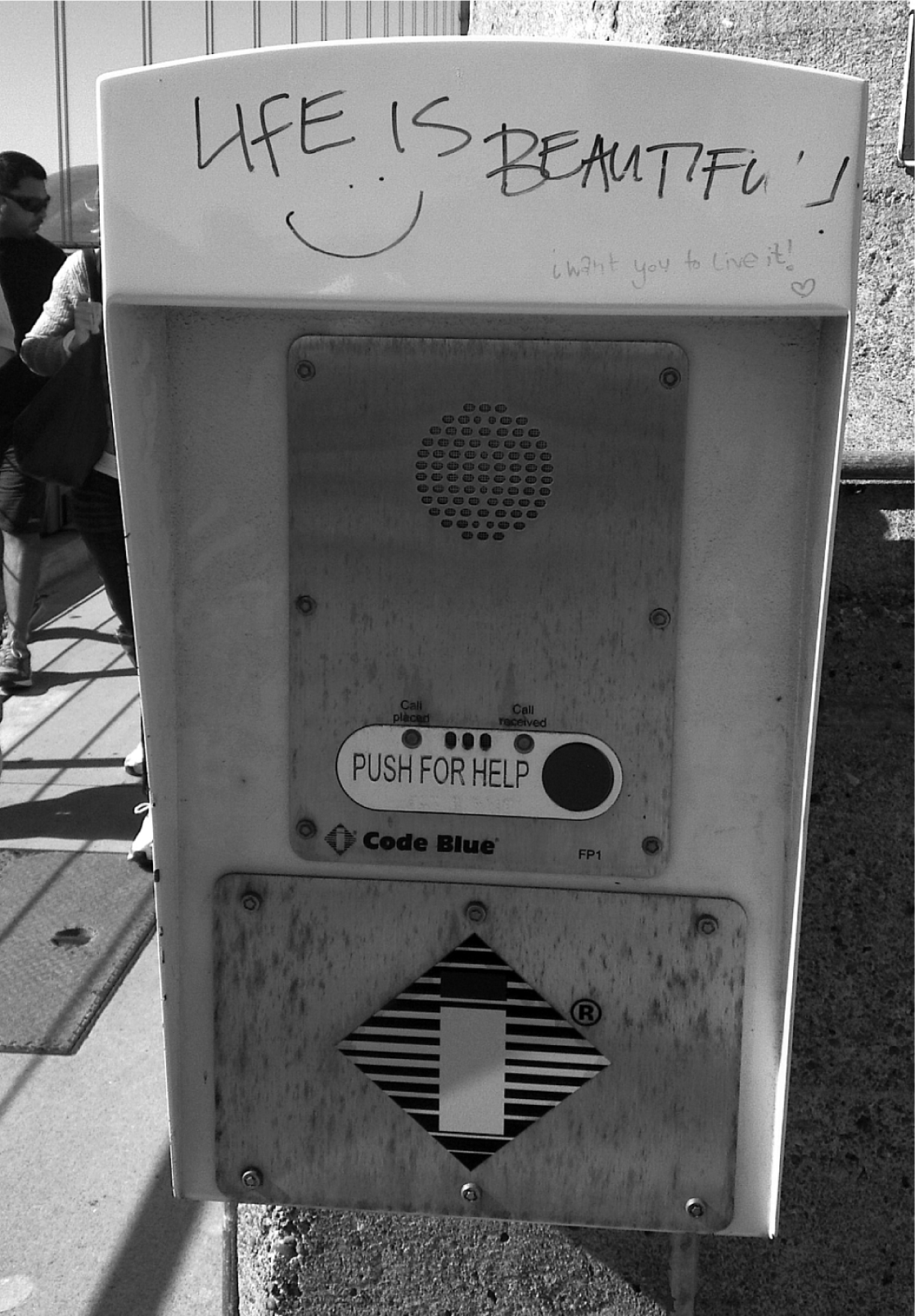
©2010 Raj Shekhar
People who oppose any kind of suicide deterrent on the Golden Gate Bridge tend to cite one of three reasons—cost, aesthetics, or effectiveness. In terms of cost, Bridge District officials say that constructing and installing the net will total $50 million. While that is a lot of money, the district has spent millions of dollars on other public safety improvements that affect far fewer people. For instance, $5 million was spent on a bike barrier even though no bicyclist has ever been killed on the bridge. Another $26.5 million has been authorized for a median separating vehicle traffic even though there have been fewer than 40 traffic fatalities on the bridge. Currently, the district is fundraising for a tourist center and a historical museum—nice additions for visitors, but they won’t make the bridge safer.
Any kind of deterrent helps. Individuals have decided not to jump from the Golden Gate Bridge because they couldn’t find a parking space.
The second argument against a suicide barrier is aesthetics: the bridge is beautiful and a barrier will mar it. Other once-famous suicide sites have had suicide barriers added, though, with little or no visual impact. One bridge in Toronto had a suicide barrier installed that received a national award for design elegance; many people thought aesthetics actually were improved.
Twice in recent years, teams of engineering students in Berkeley have created models of suicide barriers on the bridge for class projects. According to their professor, Robert Bea, the designs not only would maintain the bridge’s distinctive art deco style but would enhance the structural integrity of the bridge by increasing wind resistance.
The southernmost section of the bridge has had a fence for 30 years. It’s chain-link, eight feet high and 350 long. There is nothing pretty about it, but no one complains. It’s not there to prevent suicides; it’s there to prevent people from throwing garbage onto visitors below at Fort Point.
The third and most often-cited argument against a barrier is that it won’t make a difference: suicidal people will kill themselves another way. Yet numerous studies show that many suicidal people fixate on one means of death. If that means isn’t available to them, they don’t choose other means—they choose to live. In one study, researchers tracked what happened to 515 people who were stopped from jumping off the Golden Gate Bridge. Twenty-five years later, 94 percent were still alive or had died by means other than suicide. Only 6 percent went on to kill themselves. According to the Harvard School of Public Health, 90 percent of people who survive a suicide attempt don’t eventually die by suicide. It’s a fallacy to think that they keep attempting.
To date, 32 people are known to have survived a jump from the Golden Gate Bridge. Almost every one has said that he or she wanted to live immediately after going over the side. Ken Baldwin is one of them. A chronically depressed, 28-year-old man who was married with a three-year-old daughter, he jumped in 1985. As soon as he jumped, he knew that he had made a terrible mistake.
“Everything in my life that I thought was unfixable was totally fixable,” he told a reporter later, “except for having just jumped.”
Miraculously, Baldwin survived. For the past 20 years he has been a high school teacher in Angels Camp, California. His proudest moment, he told me, was when he presented her diploma to his daughter when she graduated from the same high school.
Most of the survivors have been young, in their teens and early 20s. Nearly all have said that they didn’t have a Plan B. In the words of one survivor, “It was the Golden Gate Bridge or nothing.”
Saving Lives
Suicide barriers have been added to dozens of bridges that at one time were suicide magnets. In the United States, this includes the Arroyo Seco Bridge in Pasadena, Aurora Bridge in Seattle, Duke Ellington Bridge in Washington, D.C., and Memorial Bridge in Augusta, Maine. In addition, plans are underway to install barriers on bridges in Akron, San Diego, Santa Barbara, Tampa, Taos, Nyack, New York, and elsewhere. Barriers were also added to the Clifton Suspension Bridge in England, Grafton Bridge in New Zealand, Prince Edward Viaduct in Toronto, and Sydney Harbour Bridge in Australia.
In every instance in which a barrier has been installed, suicides from that bridge have ended, there hasn’t been an increase in suicides from neighboring bridges, and there hasn’t been an increase in local suicides by other means. Tourism hasn’t been affected, either—just lives saved.
Here is a final fact that surprises many people: Over the years, three children age three or younger have been thrown over the short railing of the Golden Gate Bridge by suicidal parents who followed them to their deaths. These children weren’t trying to kill themselves; they were murdered. The bridge was the weapon.
Currently, an all-volunteer nonprofit organization called the Bridge Rail Foundation is trying to find money to pay for the net on the bridge. The group is comprised of family members who have lost loved ones, mental health professionals, and Ken Holmes, the longtime coroner of Marin County who retired at the end of 2010. Group leaders believe that the best chance, at least at the moment, is to partner with the Bridge District in applying for federal Transportation Act funding. In 2012, Congress approved the use of this funding for suicide deterrents on publicly operated structures such as bridges. It wasn’t prohibited before, but it also wasn’t specifically authorized. Competition is keen, however, as government entities across the country vie for limited monies to support a variety of transportation needs. Even if funding is approved, it will take a minimum of two years after it’s received before the net is in place, district officials say.
This small ledge is the last stop for scores of suicide victims.
Jet Lowe / US National Park Service HABS/HAER
Meanwhile, a new threat looms. Construction was completed recently on an extension to the Bay Bridge, connecting Oakland to San Francisco. The extension was modeled after the Golden Gate Bridge with the roadway, at its peak, 220 feet above the water (the same as the Golden Gate Bridge), year-round pedestrian access (historically, foot traffic hasn’t been allowed on the Bay Bridge), and a railing that is only four feet, seven inches high.
Recently I talked with a woman whose son jumped from the Golden Gate Bridge around the same time as Michael Bishop. I asked her how her other children were dealing with his death. She said her youngest son has said more than once, “When I’m Jason’s age, I’m going to do what he did.” She is trying hard to prevent it; however, the bridge’s low railing makes jumping easy.
The night before he jumped, Michael Bishop researched suicide sites. His girlfriend Tanya, discovered this afterward, when she accessed the search history on his computer. It didn’t take long for Michael to learn that the most lethal suicide site on earth was practically in his backyard.