




Abstract

The New (Gay Male) Normal
Amanda Lanzone

NBC’s now-defunct sitcom The New Normal featured a happy gay couple living in Los Angeles, and their efforts to build a family through surrogacy. The show, like Will & Grace, Modern Family, and Glee, challenges social norms surrounding romance, marriage, and family, introducing same-sex couples into the mix.
But the “new normal” these shows create looks very white, male, and middle class. In many of these gay-affirmative shows, lesbian characters are still confined to side plots or coming out stories.
Writing in Journal of Homosexuality in 2009, scholar Noelle Collier and her colleagues explain that television is an important source of self-mirroring images that validate the experiences of lesbians in the early stages of identity formation. Citing examples like Willow and Tara (Buffy the Vampire Slayer) and Xena and Gabrielle (Xena: Warrior Princess), they argue that lesbian characters enhance lesbian viewer’s self-esteem and help them to see their own desires and relationships as normal.
But the primetime representations that queer female viewers can draw on remain limited. Fan forums for shows like Rizzoli and Isles and Once Upon a Time call for better representation of lesbian characters, arguing that dynamic female couples shouldn’t be confined to HBO and Showtime. Some shows, such as The Fosters and Pretty Little Liars, are beginning to break the primetime mold by presenting well-rounded characters who happen to be lesbians. Still, we have a long way to go before television shows are reflective of the diversity of the LGBTQ population.
Defensive Doping
When asked about using banned substances to maintain his winning record, champion cyclist Lance Armstrong said it was “part of the job”—like having “air in our tires” and “water in our bottles.” In other words, if everyone’s doing it, it’s not cheating.
But bioethicist Kenneth Kirkwood says that defensive doping—choosing to take illegal substances because other competitors do so—doesn’t level the playing field. In a 2012 article in the Journal of Sport and Social Issues entitled “Defensive Doping: Is There a Moral Justification for ‘If You Can’t Beat ‘Em—Join ‘Em?’” Kirkwood argues that doping is unfair, even if everyone is doing it. Athletes may be taking different drugs, and they may respond differently to using those drugs, so the outcomes of doping do not create a fair situation.
At the same time, we tolerate all kinds of unfairness in sports. Athletes have different skill levels and different body types. They also have access to different equipment and different trainers.
Moreover, guidelines on doping vary widely. Deer antler spray (which contains small amounts of a banned substance) is perfectly legal, for example. Both golfer Vijay Singh and Ravens linebacker Ray Lewis have used this substance in the hope of improving their performance.
In the end, it may be our win-at-all-costs sports culture, rather than particular substances, which is the problem.
Second Life’s Second Life
Experts have voiced concerns about digital addiction and social isolation among online gaming enthusiasts. But virtual platforms, such as Second Life, which offers its users custom designed, computer-simulated 3-D environments, have proven to have useful everyday applications.
By distributing information and providing services to at-risk veterans through audio, video, and text communication, the Department of Defense uses Second Life to help those battling Post-Traumatic Stress Disorder. Veterans who exhibit PTSD symptoms, who are fearful of social stigma, no longer need to suffer in silence: they can interact anonymously with service providers and with one another through avatars, or customizable digital self-representations—virtual alter egos.
©2013 Linden Lab

Weight loss program participants also use Second Life. Health researcher Debra Sullivan and her colleagues monitored a group of individuals who were trying to lose weight. Their 2013 article in the Journal of Nutrition Education and Behavior shows that face-to-face participants lost more weight initially, but Second Life participants were more successful in keeping the weight off. During the weight maintenance phase, researchers found that the Second Life-only group experienced an additional 4 percent loss in weight.
Finally, educators have used Second Life to enable what researchers Palitha Edirisingha, Ming Nie, Mark Pluciennik, and Ruth Young call “border crossing from virtual world to physical world.” In a 2009 issue of the British Journal of Educational Technology, they reported that “In-world socialization had led to real-world network building” among college archaeology students.
As digital technology continues to extend its global reach, these successful applications show that virtual behavior can have beneficial real-life results.
E-Haunting
When a garment factory collapsed outside of Dhaka, Bangladesh last April and more than 1,100 peopled died, a photograph of a woman and a man embracing amid the rubble rapidly circulated through the Internet.
Photographer Taslima Akhter’s heart-wrenching image, shown here, was powerful in itself, creating what sociologist Avery Gordon (in her 2007 book, Ghostly Matters) calls a “haunting” effect, where ghosts from hidden forms of violence make their presence felt.
But the haunting image gained added power via new media, which is an increasingly important component of our “attention economy,” according to sociologist Zeynep Tufekci, writing in American Behavioral Scientist earlier this year.
©2013 Taslima Akhter

In fact, dramatic images of the Dhaka factory fire may be a crucial factor enabling labor reforms now underway. Major apparel companies have been facing pressure from human rights groups and ethical consumers to sign a landmark plan to ensure the safety of workers. Shifts in public opinion have also contributed to the U.S. decision to suspend trade privileges to Bangladesh.
Haunting images, in other words, can at times spur political action.
Tiger Moms vs. Real Moms
Today, it seems like the only way to raise successful, accomplished, well-behaved children is through extreme parenting.
Yale professor Amy Chua gained national attention in 2011 for her book, Battle Hymn of the Tiger Mother, where she argues traditional, strict Chinese mothers make better parents (and therefore, better kids) than wimpy western moms. In 2013, author Suzanne Evans extolled the benefits of the Machiavelli mom, who encourages academic success by pitting her children against each other (Machiavelli for Moms). And shows like Toddlers & Tiaras and Dance Moms remind us that behind some successful children is an overbearing, attention-hungry parent.
In each case, extreme parental involvement is the common thread: parents are expected to be involved in every aspect of their children’s lives, especially if their children have any hope of being exceptional. But how realistic is it to expect this level of involvement from parents?
According to sociologists Melissa Stacer and Robert Perrucci, social factors like family income, parental education, and work commitments all influence how involved parents can be in their children’s lives. In their 2012 article, “Parental Involvement with Children at School, Home, and Community,” the authors find that parents with more income and education, and fewer work obligations, are able to spend more time with their children. And most parents typically use this extra time to read with their children, attend school activities, or take their kids to libraries or museums.
Youjin Oh
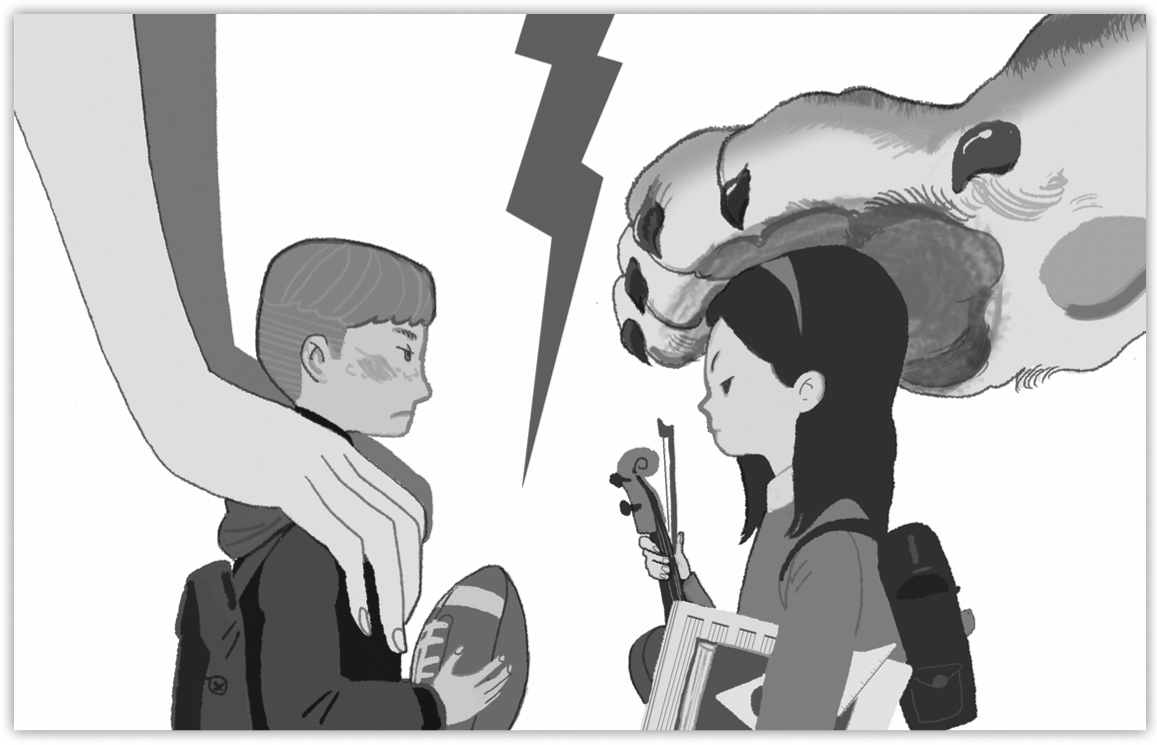
Additionally, sociologists like Annette Lareau have long argued that high levels of involvement can have drawbacks. Children are more likely to feel stressed, often cannot entertain themselves, and have no idea what to do with free time.
Ultimately, neither tiger moms nor dance moms are accurate depictions of everyday parents. Their level of involvement is often not attainable for most parents; nor is it necessarily desirable or beneficial. Even if they make pretty good entertainment.
Table for One, Please
Kimmy Holtz

While meals give us a chance to bond with friends and family, a growing number of studies find that fellow diners may bring more than just a bottle of wine to the table.
Writing in Appetite in 1990, psychologist John de Castro and colleagues found that the more people were present at the table, the more calories diners consumed. Psychologist Patricia Pliner and coauthors, in a 2006 article published in Appetite (“Meal Duration Mediates the Effect of ‘Social Facilitation’ on Eating in Humans”), attribute this change to a “time extension” hypothesis: the more eaters are present, the more we chat, the longer the meal lasts, and the more we eat.
In contrast, solo diners consume fewer calories. One might imagine this is because they spend less time eating, but even those who occupy themselves by reading or working during a solo meal don’t consume more calories.
It turns out that eating with others does more than just lengthen meal times: it leads us to engage in impression management, according to clinical psychologist Sarah-Jeanne Salvy and colleagues in a 2007 article published in Appetite. When we dine with friends and family, we’re more comfortable, so we monitor ourselves less and tend to eat more.
Even if it leads us to eat more, many people still prefer to dine in the company of others. But the next time you ask for a table for one, you can take solace in the fact that it may lead to a slimmer waistline.