



Abstract
When it comes to same-sex marriage, one might expect black Americans to be on board–if it’s a civil rights question, why shouldn’t they be? Marcus Anthony Hunter looks at some of the tangled past behind blacks’ reluctance to accept gay marriage.
Keywords
“Same-sex marriage or marriage equality or gay marriage, whatever phrase you prefer, is just like a lot of other gay issues… black folks might benefit but it seems more about white people’s freedom,” said Malik (a 27-year-old Chicago elementary school teacher) in 2008, just a few weeks after California voters passed the controversial Proposition 8. The ballot initiative had overturned the California State Supreme Court’s earlier ruling that declared marriage discrimination unconstitutional.
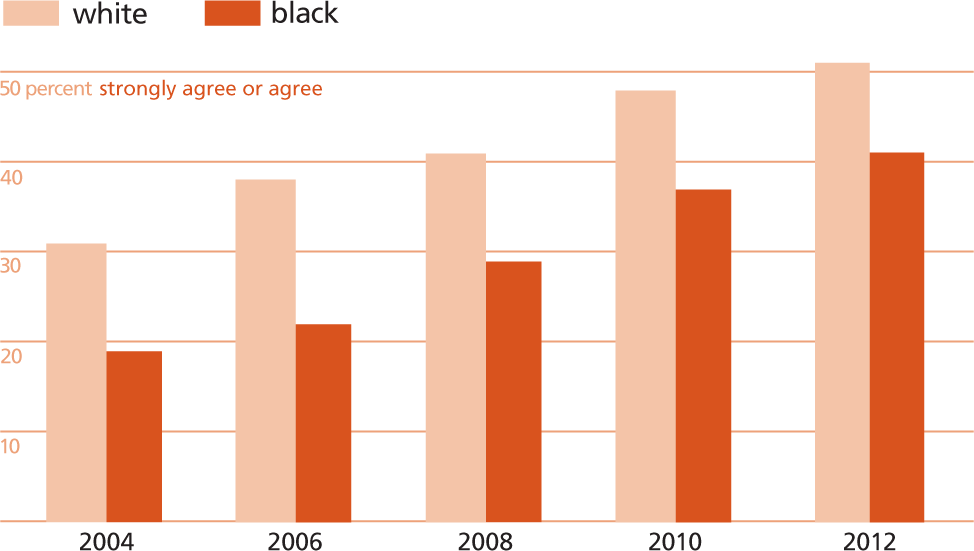
According to the 2008 exit polls, black voters hugely favored Proposition 8, with approximately 70 percent voting in support of the ban on gay marriage. Similarly, General Social Survey data show that black Americans’ attitudes toward same-sex marriage, though becoming more positive, continue to trail behind the attitudes of white Americans (see Figure 1). In my interviews and informal conversations with black gays and lesbians in New York, Philadelphia, and Chicago in the last decade, I have found that most often our exchanges highlight the racial dynamics involved in the marriage debate. What I’ve found is that black responses and activism in favor of and against same-sex marriage are not only about homophobia and religion. Rather, they can also be understood as illustrating how blacks in the U.S., both gay and straight, consider and conceive of the institution of marriage, its limitations, and the power dynamics within marriage. In the course of these conversations, I have found that racial differences in opinions on same-sex marriage are best understood through the lens of race, and the segregation and exclusion many black lesbians and gays experience in their daily lives. Indeed, examining these perspectives provides a more complex analytical framework to explain the racial differences in support for marriage equality.
Cassandra Conlin
Responses to “Homosexual couples should have the right to marry one another”
Source: General Social Survey
Support on the Upswing
Recent surveys indicate an uptick in approval for same-sex marriage in the United States. For example, polls conducted by Gallup (2012) and Pollingreport.com (2012) indicate at least 50 percent of American adults support marriage equality. This support varies along the usual lines of political and religious affiliation, as well as by geography, with the strongest support coming from the Northeast and the lowest in the South. A 2013 Pew Research Center poll finds that the general trend in people who are changing their minds about marriage equality is in favor rather than against. The main reason cited for this shift is getting to know someone who is lesbian or gay.
These trends reflect a “rights” based or equality orientation toward marriage with the assumption that, all else being equal, it is good and desirable. Questions about the costs and benefits of marriage generally, and marriage equality more specifically (particularly from the perspective of black gay and lesbian Americans), are rarely posed in these debates. In her recent book on the relationships and families of black lesbians, sociologist Mignon R. Moore suggests that such families and people are “invisible.” That is, the group is absent from the public imagination of LGBT groups in the U.S., as well as the various political disputes and policies regarding this population. In my research, I have also found that invisibility operated as a lens through which black gay and lesbian Americans understand and determine what political issues matter to them and the amount of energy they will exert toward those particular issues.
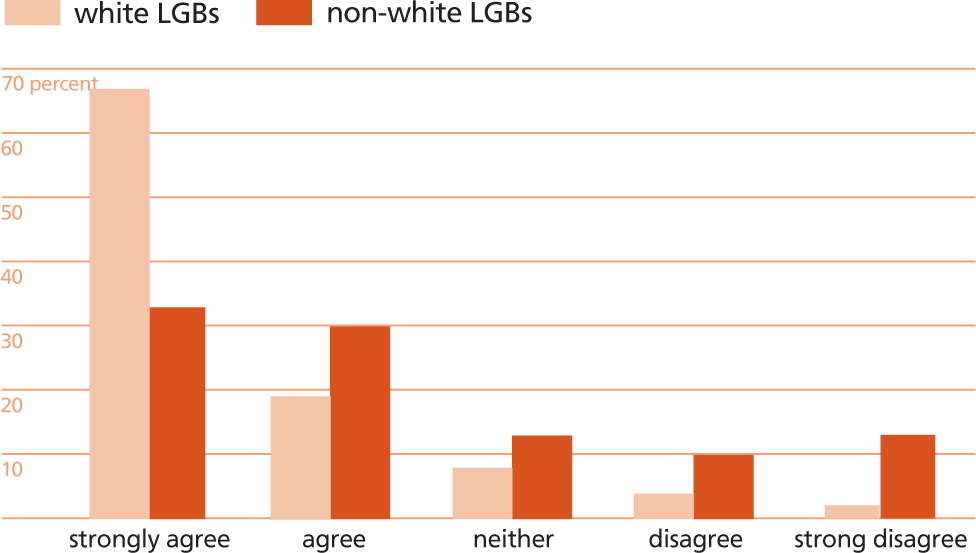
Evaluating the recent trend favoring same sex marriage, I’m interested in what we can learn from the experiences and views of racialized sexual minorities like black gays and lesbians in the U.S. What does marriage equality mean to them? As the figures above illustrate, General Social Survey data show that non-white gay, lesbian, and bisexual Americans are considerably more skeptical about gay marriage than are white gay, lesbian, and bisexual Americans, who fervently support gay marriage (see Figure 2). The reasons non-white LGBT respondents most commonly cite for their hesitancy toward marriage equality include the historical legacy of marriage and its underlying foundation of ownership, the experience of being forgotten or “squeezed” between the Civil and Gay Rights Movements, and the ongoing segregation of LGBT spaces, specifically the nightlife scene.
LGB responses to “Homosexual couples should havethe right to marry one another”
Source: General Social Survey 2008-2012
Race, Marriage, and Ownership
“Who owns marriage?” asked Gary (a 28-year-old black gay Philadelphian). I’d posed a number of questions about his perspective on marriage equality just shortly after the results of Prop 8 were revealed. In one form or another, this important question was asked of me, time and again, by respondents. Kima (a 25-year-old black lesbian and Chicago resident) also underscored this sentiment: “Gay marriage jumps over the simple fact that marriage as an institution is a problem. There are straight black people who have issues with how marriage works [in the United States]. I am worried that we may be forgetting about the history of black people and marriage and slavery.” Kima’s comments crystallized an important sentiment that bubbled up among respondents and has been expressed repeatedly among feminist scholars for many, many years: historically, marriage has been an exclusive, coercive patriarchal institution. Why would we want to join in now?
“Who owns marriage?” In one form or another, this important question was asked of me, time and again.
My respondents also pointed to the importance of terms for romantic partners (e.g., “partner,” “lover,” “my dude,” “boo,” “domestic partner,” “significant other,” “friend”) and their fears that these would be eclipsed by more traditional spousal nomenclature and its accompanying expectations. This concern is not just about terminology, it reflects the very real likelihood that the acceptability of alternative arrangements such as domestic partnerships will decline. One consequence, as reflected in the hesitations expressed by black gays and lesbians, is additional marginalization of those whose intimate arrangements don’t fit traditional marriage parameters or who want to opt out of marriage altogether.
Social Movement “Squeeze”
A second salient narrative respondents used to convey their sentiments on same-sex marriage highlighted the way they feel “squeezed” between black and gay social movements. Consider Cherrelle (a 40-year-old black lesbian and single mother in Chicago): “I feel like black gays and lesbians get forgotten about… squeezed between two movements and always left out!” Cherrelle was referring to the Civil and Gay Rights Movements and how she perceived black sexual minorities had been treated within and as a result of these social movements. Corey (22-year-old black gay New York resident) echoed this point: “White gay people do their own thing and don’t include me, just like black people do their thing and don’t include me… what’s different is that when you’re black you have a similar experience because you’re black, you know, white people are the ones doing shit to you, especially white men. So even though white gay people are gay, they are still white and they are still white men… they aren’t really much like me. This difference especially matters when you then think about why black gays and lesbians may be reluctant supporters of white gay activist for gay marriage.”
Cherrelle and Corey were not alone. William (a 38-year-old black gay Chicagoan) offered a similar perspective: “I mean like black people act like everybody is straight, and gay people act like everybody is white. What am I then… where do I fit? This is how I feel when I think about these social movements like Civil Right and Gay rights.” Such insights bespeak feelings of being simultaneously squeezed between and invisible within both the black and gay communities. These comments also bring out the complications of what sociologist Jodi O’Brien refers to as “cultural belonging”. Outlining the major myths and ideas within the evolving same sex marriage debate, O’Brien argues, “marriage symbolizes the ultimate attainment of cultural belonging.” Taken together, what we see is that the cultural belonging implicit in marriage can be hard for racialized sexual minorities to grasp—they don’t even feel a strong membership within the larger black and gay communities.
Segregated Spaces/Segregated Nightlife
The third salient perspective among my respondents also highlighted issues of cultural belonging. However, the third perspective relied on the lived experiences emergent from seeking social outlets in the racially segregated gay nightlife scene across urban America. “People hear ‘Boystown’ [Chicago], Chelsea [NYC], 13th Street [Philadelphia], and Castro [San Francisco] and think these places are welcoming for ALL gays and lesbians, when in practice they are for whites… How can I think the gay rights movement is about me when in practice socially I am an outcast among gays and lesbians because I am black?” asked Shelia (a 29-year-old black lesbian and Chicago resident). Prince (a 29-year-old black gay Chicago resident) further underscored this issue: “There are just not a lot of places that provide a space where as a gay black person you don’t feel like the minority. This is why for me I think of this space as a place to listen to music, dance, and build the kind of friendships that I need.”
When asked how their social experiences related to their perspectives on same-sex marriage, the answer commonly provided is captured best by Mary (a 33-year-old black lesbian and Philadelphia resident): “It is a reflection of the larger feeling of ambivalence and being invisible among straight blacks and gay and lesbian whites.” Such sentiments are also evident in survey research, particularly that conducted by sociologist Juan Battle and his colleagues. Developing and drawing on innovative surveys of black gays across every state in the U.S. and at gay pride events over the last decade, Battle and his colleagues have demonstrated that race is an important factor mediating the experiences of racial minorities and their interactions with their straight and gay counterparts. Combined with this research, the comments I heard reveal an important feedback loop: non-white gays and lesbians feel reluctance and ambivalence towards the goals of white gay proponents of and activism for same sex-marriage.
Just-us Justice?
Historian Lisa Duggan uses the term “homonormativity” to refer to media trends that increasingly portray white, middle-class gay and lesbian families as “just like everyone else.” O’Brien calls this the “we’re here, we’re queer, let’s go to Ikea” implications of marriage equality. But where do black gays and lesbians fit into this unfolding scenario of supposed domestic bliss and belonging? Contemporary survey results and the experiences of black lesbian and gay Americans like Cherrelle, Malik, Mary, and William offer not only an important critical perspective, but also remind us of the people whose lives, relationships, and families often fall through the cracks of the debates and alliances regarding same-sex marriage (or any marriage, for that matter). Marriage is an institution of both inclusion and exclusion. In the march toward marriage equality, we must be mindful not only of who is being included, but who is being left out. With recent Supreme Court rulings supporting same-sex marriage, perhaps it’s an ideal time to take seriously these “invisible” insights and experiences.